About the Report
Base Year 2024South Korea Digital Brokerage and Trading Apps Market Overview
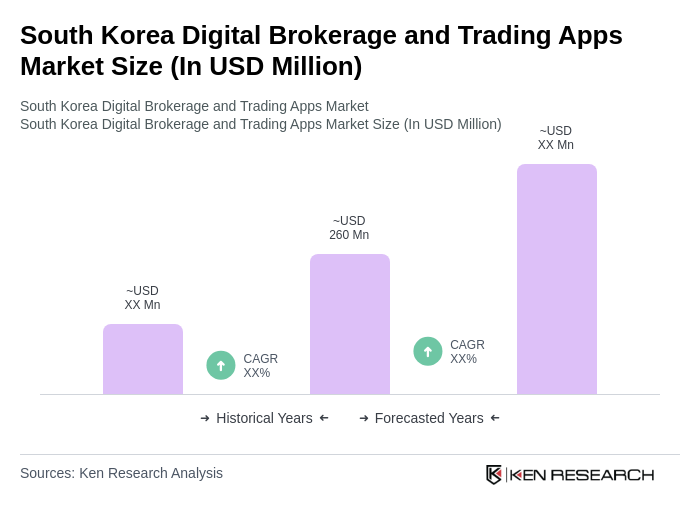
- The South Korea Digital Brokerage and Trading Apps Market is valued at USD 260 million, based on a five-year historical analysis. This growth is primarily driven by the increasing adoption of mobile technology, a surge in retail investor participation, and the rise of fintech innovations that enhance trading experiences. The market has seen a significant influx of users, particularly during periods of market volatility, as individuals seek to capitalize on investment opportunities.
- Seoul is the dominant city in the South Korea Digital Brokerage and Trading Apps Market, attributed to its status as a financial hub with a high concentration of tech-savvy individuals and a robust infrastructure supporting digital finance. Other notable regions include Busan and Incheon, which are also witnessing growth due to increasing internet penetration and a growing interest in investment among the younger population.
- In recent years, the South Korean government has implemented regulations aimed at enhancing investor protection and promoting transparency in the digital trading space. These regulations include stricter compliance requirements for brokerage firms and enhanced disclosure obligations, ensuring that investors receive accurate information about the risks associated with trading activities.
South Korea Digital Brokerage and Trading Apps Market Segmentation
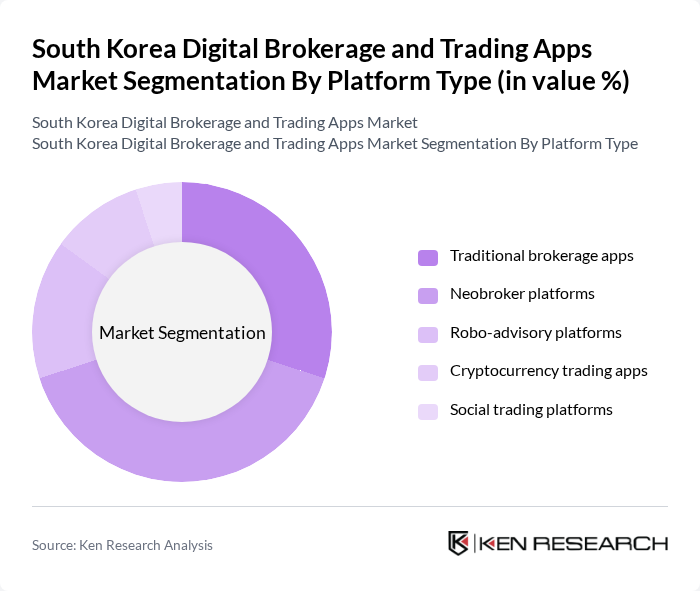
By Platform Type:The platform type segmentation includes various subsegments such as traditional brokerage apps, neobroker platforms, robo-advisory platforms, cryptocurrency trading apps, and social trading platforms. Among these, neobroker platforms are gaining significant traction due to their user-friendly interfaces and low-cost trading options, appealing particularly to younger investors who prefer mobile-first solutions. Traditional brokerage apps continue to hold a substantial market share, but the shift towards digital and automated solutions is evident.
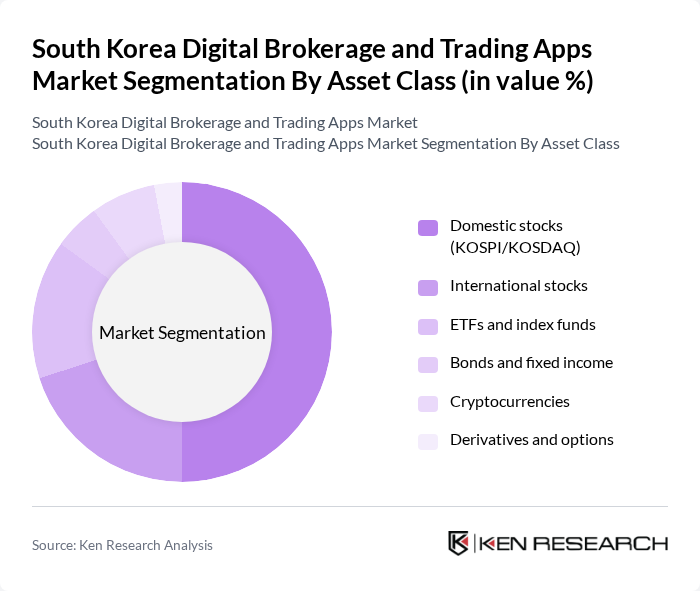
By Asset Class:The asset class segmentation encompasses domestic stocks (KOSPI/KOSDAQ), international stocks, ETFs and index funds, bonds and fixed income, cryptocurrencies, and derivatives and options. Domestic stocks remain the most popular choice among investors, driven by the strong performance of the KOSPI index and the increasing number of retail investors entering the market. Cryptocurrencies are also gaining popularity, particularly among younger demographics seeking alternative investment opportunities.
South Korea Digital Brokerage and Trading Apps Market Competitive Landscape
The South Korea Digital Brokerage and Trading Apps Market is characterized by a dynamic mix of regional and international players. Leading participants such as Kiwoom Securities Co., Ltd., Samsung Securities Co., Ltd., Mirae Asset Securities Co., Ltd., KB Securities Co., Ltd., NH Investment & Securities Co., Ltd., Korea Investment & Securities Co., Ltd., Hanwha Investment & Securities Co., Ltd., Shinhan Investment Corp., Daishin Securities Co., Ltd., Toss Securities, Kakao Pay Securities, Upbit (Dunamu Inc.), Bithumb Korea Co., Ltd., Coinone Co., Ltd., Korbit Co., Ltd. contribute to innovation, geographic expansion, and service delivery in this space.
South Korea Digital Brokerage and Trading Apps Market Industry Analysis
Growth Drivers
- Increasing Smartphone Penetration:As of future, South Korea boasts a smartphone penetration rate of approximately 96%, with over 49 million users. This widespread access to mobile technology facilitates the adoption of digital brokerage and trading apps, allowing users to trade anytime and anywhere. The convenience of mobile trading is further enhanced by the country's advanced 5G network, which supports high-speed transactions and real-time data access, driving user engagement and market growth.
- Rise of Retail Investors:The number of retail investors in South Korea surged to around 15 million in future, reflecting a growing interest in stock trading among the general population. This trend is fueled by increased financial literacy and the availability of user-friendly trading platforms. Retail investors now account for over 72% of total trading volume on the Korea Exchange, indicating a significant shift towards individual participation in the financial markets, which is a key driver for digital brokerage services.
- Enhanced Trading Technologies:The South Korean digital brokerage market is witnessing rapid technological advancements, with over 62% of platforms integrating AI and machine learning for improved trading strategies. These technologies enable personalized investment recommendations and automated trading, enhancing user experience. Additionally, the introduction of advanced analytics tools allows investors to make informed decisions, further driving the adoption of digital trading platforms and increasing overall market activity.
Market Challenges
- High Competition Among Platforms:The South Korean digital brokerage landscape is highly competitive, with over 52 platforms vying for market share. This intense competition leads to aggressive pricing strategies and promotional offers, which can erode profit margins for established players. As new entrants continue to emerge, existing platforms must innovate and differentiate their services to maintain customer loyalty and market position, posing a significant challenge to profitability.
- Regulatory Compliance Costs:Compliance with stringent regulatory requirements in South Korea imposes significant costs on digital brokerage firms. In future, it is estimated that compliance-related expenses could account for up to 16% of total operational costs for these platforms. This includes costs associated with implementing robust anti-money laundering measures and ensuring data protection, which can strain resources, particularly for smaller firms trying to compete in the market.
South Korea Digital Brokerage and Trading Apps Market Future Outlook
The South Korean digital brokerage and trading apps market is poised for continued evolution, driven by technological advancements and changing investor behaviors. The integration of AI and machine learning will enhance trading efficiency, while the growing trend of ESG investing will attract socially conscious investors. Additionally, the rise of mobile-first trading solutions will cater to the increasing demand for convenience. As regulatory frameworks adapt to these changes, the market is expected to become more accessible and innovative, fostering a dynamic trading environment.
Market Opportunities
- Expansion of Financial Literacy Programs:There is a significant opportunity to enhance financial literacy among South Korean citizens, with only 32% of the population currently possessing adequate investment knowledge. By investing in educational initiatives, digital brokerage firms can empower potential investors, leading to increased platform usage and market participation, ultimately driving growth in the sector.
- Development of Niche Trading Platforms:The emergence of niche trading platforms catering to specific investor demographics, such as millennials and environmentally conscious investors, presents a lucrative opportunity. By focusing on tailored services and unique investment options, these platforms can capture underserved market segments, fostering innovation and expanding the overall market landscape.
Scope of the Report
| Segment | Sub-Segments |
|---|---|
| By Platform Type | Traditional brokerage apps Neobroker platforms Robo-advisory platforms Cryptocurrency trading apps Social trading platforms |
| By Asset Class | Domestic stocks (KOSPI/KOSDAQ) International stocks ETFs and index funds Bonds and fixed income Cryptocurrencies Derivatives and options |
| By User Demographics | Millennials (25-40 years) Gen Z (18-24 years) Gen X (41-56 years) Baby Boomers (57+ years) |
| By Investment Experience Level | Beginner investors Intermediate traders Advanced/professional traders |
| By Revenue Model | Commission-based trading Zero-commission models Subscription-based premium services Payment for order flow |
| By Device Platform | Mobile applications (iOS/Android) Web-based platforms Desktop applications |
| By Service Integration | Banking-integrated platforms Standalone trading apps Wealth management integrated |
Key Target Audience
Investors and Venture Capitalist Firms
Government and Regulatory Bodies (e.g., Financial Services Commission, Korea Exchange)
Brokerage Firms and Financial Service Providers
Technology Providers and Software Developers
Payment Processing Companies
Market Analysts and Financial Advisors
Industry Associations (e.g., Korea Securities Dealers Association)
Retail and Institutional Traders
Players Mentioned in the Report:
Kiwoom Securities Co., Ltd.
Samsung Securities Co., Ltd.
Mirae Asset Securities Co., Ltd.
KB Securities Co., Ltd.
NH Investment & Securities Co., Ltd.
Korea Investment & Securities Co., Ltd.
Hanwha Investment & Securities Co., Ltd.
Shinhan Investment Corp.
Daishin Securities Co., Ltd.
Toss Securities
Kakao Pay Securities
Upbit (Dunamu Inc.)
Bithumb Korea Co., Ltd.
Coinone Co., Ltd.
Korbit Co., Ltd.
Table of Contents
Market Assessment Phase
1. Executive Summary and Approach
2. South Korea Digital Brokerage and Trading Apps Market Overview
2.1 Key Insights and Strategic Recommendations
2.2 South Korea Digital Brokerage and Trading Apps Market Overview
2.3 Definition and Scope
2.4 Evolution of Market Ecosystem
2.5 Timeline of Key Regulatory Milestones
2.6 Value Chain & Stakeholder Mapping
2.7 Business Cycle Analysis
2.8 Policy & Incentive Landscape
3. South Korea Digital Brokerage and Trading Apps Market Analysis
3.1 Growth Drivers
3.1.1 Increasing smartphone penetration
3.1.2 Rise of retail investors
3.1.3 Enhanced trading technologies
3.1.4 Regulatory support for digital trading
3.2 Market Challenges
3.2.1 High competition among platforms
3.2.2 Regulatory compliance costs
3.2.3 Market volatility risks
3.2.4 Cybersecurity threats
3.3 Market Opportunities
3.3.1 Expansion of financial literacy programs
3.3.2 Integration of AI and machine learning
3.3.3 Development of niche trading platforms
3.3.4 Partnerships with fintech companies
3.4 Market Trends
3.4.1 Growth of ESG investing
3.4.2 Increasing use of robo-advisors
3.4.3 Shift towards mobile-first trading
3.4.4 Rise of social trading platforms
3.5 Government Regulation
3.5.1 Enhanced investor protection laws
3.5.2 Regulations on trading fees
3.5.3 Compliance requirements for digital platforms
3.5.4 Taxation policies on capital gains
4. SWOT Analysis
5. Stakeholder Analysis
6. Porter's Five Forces Analysis
7. South Korea Digital Brokerage and Trading Apps Market Market Size, 2019-2024
7.1 By Value
7.2 By Volume
7.3 By Average Selling Price
8. South Korea Digital Brokerage and Trading Apps Market Segmentation
8.1 By Platform Type
8.1.1 Traditional brokerage apps
8.1.2 Neobroker platforms
8.1.3 Robo-advisory platforms
8.1.4 Cryptocurrency trading apps
8.1.5 Social trading platforms
8.2 By Asset Class
8.2.1 Domestic stocks (KOSPI/KOSDAQ)
8.2.2 International stocks
8.2.3 ETFs and index funds
8.2.4 Bonds and fixed income
8.2.5 Cryptocurrencies
8.2.6 Derivatives and options
8.3 By User Demographics
8.3.1 Millennials (25-40 years)
8.3.2 Gen Z (18-24 years)
8.3.3 Gen X (41-56 years)
8.3.4 Baby Boomers (57+ years)
8.4 By Investment Experience Level
8.4.1 Beginner investors
8.4.2 Intermediate traders
8.4.3 Advanced/professional traders
8.5 By Revenue Model
8.5.1 Commission-based trading
8.5.2 Zero-commission models
8.5.3 Subscription-based premium services
8.5.4 Payment for order flow
8.6 By Device Platform
8.6.1 Mobile applications (iOS/Android)
8.6.2 Web-based platforms
8.6.3 Desktop applications
8.7 By Service Integration
8.7.1 Banking-integrated platforms
8.7.2 Standalone trading apps
8.7.3 Wealth management integrated
9. South Korea Digital Brokerage and Trading Apps Market Competitive Analysis
9.1 Market Share of Key Players
9.2 Cross Comparison of Key Players
9.2.1 Company Name
9.2.2 Active User Base (Monthly/Daily Active Users)
9.2.3 Assets Under Management (AUM)
9.2.4 Average Revenue Per User (ARPU)
9.2.5 Trading Volume Market Share
9.2.6 User Acquisition Cost (CAC)
9.2.7 Customer Lifetime Value (CLV)
9.2.8 App Store Rating and Downloads
9.2.9 Commission Structure and Fees
9.2.10 Technology Innovation Score
9.3 SWOT Analysis of Top Players
9.4 Pricing Analysis
9.5 Detailed Profile of Major Companies
9.5.1 Kiwoom Securities Co., Ltd.
9.5.2 Samsung Securities Co., Ltd.
9.5.3 Mirae Asset Securities Co., Ltd.
9.5.4 KB Securities Co., Ltd.
9.5.5 NH Investment & Securities Co., Ltd.
9.5.6 Korea Investment & Securities Co., Ltd.
9.5.7 Hanwha Investment & Securities Co., Ltd.
9.5.8 Shinhan Investment Corp.
9.5.9 Daishin Securities Co., Ltd.
9.5.10 Toss Securities
9.5.11 Kakao Pay Securities
9.5.12 Upbit (Dunamu Inc.)
9.5.13 Bithumb Korea Co., Ltd.
9.5.14 Coinone Co., Ltd.
9.5.15 Korbit Co., Ltd.
10. South Korea Digital Brokerage and Trading Apps Market End-User Analysis
10.1 Procurement Behavior of Key Ministries
10.1.1 Investment strategies
10.1.2 Budget allocation processes
10.1.3 Risk management practices
10.2 Corporate Spend on Infrastructure & Energy
10.2.1 Investment in technology upgrades
10.2.2 Spending on cybersecurity measures
10.2.3 Budget for training and development
10.3 Pain Point Analysis by End-User Category
10.3.1 Lack of user-friendly interfaces
10.3.2 High transaction fees
10.3.3 Limited access to investment options
10.4 User Readiness for Adoption
10.4.1 Awareness of digital trading benefits
10.4.2 Comfort with technology
10.4.3 Availability of educational resources
10.5 Post-Deployment ROI and Use Case Expansion
10.5.1 Measurement of trading performance
10.5.2 User feedback mechanisms
10.5.3 Opportunities for feature enhancements
11. South Korea Digital Brokerage and Trading Apps Market Future Size, 2025-2030
11.1 By Value
11.2 By Volume
11.3 By Average Selling Price
Go-To-Market Strategy Phase
1. Whitespace Analysis + Business Model Canvas
1.1 Market gaps identification
1.2 Value proposition development
1.3 Revenue model exploration
1.4 Customer segment targeting
1.5 Key partnerships
1.6 Cost structure analysis
1.7 Competitive advantage assessment
2. Marketing and Positioning Recommendations
2.1 Branding strategies
2.2 Product USPs
2.3 Target audience engagement
2.4 Digital marketing tactics
2.5 Content marketing approach
2.6 Social media strategy
2.7 Influencer partnerships
3. Distribution Plan
3.1 Urban retail vs rural NGO tie-ups
3.2 Online vs offline distribution
3.3 Partnership with financial institutions
3.4 Direct-to-consumer strategies
3.5 Affiliate marketing channels
3.6 Logistics and supply chain considerations
4. Channel & Pricing Gaps
4.1 Underserved routes
4.2 Pricing bands
4.3 Competitor pricing analysis
4.4 Customer willingness to pay
4.5 Value-based pricing strategies
4.6 Discount and promotion strategies
5. Unmet Demand & Latent Needs
5.1 Category gaps
5.2 Consumer segments
5.3 Emerging trends analysis
5.4 Feedback from potential users
5.5 Market research insights
5.6 Future demand forecasting
6. Customer Relationship
6.1 Loyalty programs
6.2 After-sales service
6.3 Customer feedback loops
6.4 Community engagement initiatives
6.5 Personalization strategies
6.6 Customer support channels
7. Value Proposition
7.1 Sustainability
7.2 Integrated supply chains
7.3 Unique selling points
7.4 Customer-centric approach
7.5 Competitive differentiation
7.6 Long-term value creation
8. Key Activities
8.1 Regulatory compliance
8.2 Branding
8.3 Distribution setup
8.4 Technology development
8.5 Market research
8.6 Training and development
9. Entry Strategy Evaluation
9.1 Domestic Market Entry Strategy
9.1.1 Product mix
9.1.2 Pricing band
9.1.3 Packaging
9.2 Export Entry Strategy
9.2.1 Target countries
9.2.2 Compliance roadmap
10. Entry Mode Assessment
10.1 JV
10.2 Greenfield
10.3 M&A
10.4 Distributor Model
11. Capital and Timeline Estimation
11.1 Capital requirements
11.2 Timelines
12. Control vs Risk Trade-Off
12.
Research Methodology
Phase 1: Approach1
Desk Research
- Analysis of market reports from financial regulatory bodies in South Korea
- Review of industry publications and white papers on digital brokerage trends
- Examination of user reviews and ratings on popular trading apps in South Korea
Primary Research
- Interviews with product managers from leading digital brokerage firms
- Surveys targeting active traders and retail investors using mobile trading apps
- Focus groups with fintech experts and analysts specializing in the South Korean market
Validation & Triangulation
- Cross-validation of findings with data from financial institutions and app usage statistics
- Triangulation of insights from user feedback, expert opinions, and market trends
- Sanity checks through peer reviews and expert panel discussions
Phase 2: Market Size Estimation1
Top-down Assessment
- Estimation of total market size based on national financial service spending
- Segmentation by user demographics and trading volumes across different asset classes
- Incorporation of government initiatives promoting digital finance and investment
Bottom-up Modeling
- Data collection on user acquisition rates and transaction volumes from key apps
- Operational cost analysis based on service fees and commission structures
- Volume x revenue model to estimate total market revenue from trading activities
Forecasting & Scenario Analysis
- Multi-variable regression analysis incorporating economic indicators and user growth rates
- Scenario planning based on regulatory changes and technological advancements
- Baseline, optimistic, and pessimistic forecasts through 2030
Phase 3: CATI Sample Composition1
| Scope Item/Segment | Sample Size | Target Respondent Profiles |
|---|---|---|
| Retail Investor Usage Patterns | 100 | Individual Traders, Retail Investors |
| Institutional Investor Insights | 60 | Portfolio Managers, Investment Analysts |
| App User Experience Feedback | 50 | Active Users, New Users |
| Regulatory Impact Assessment | 40 | Compliance Officers, Legal Advisors |
| Fintech Expert Opinions | 40 | Industry Analysts, Fintech Consultants |
Frequently Asked Questions
What is the current value of the South Korea Digital Brokerage and Trading Apps Market?
The South Korea Digital Brokerage and Trading Apps Market is valued at approximately USD 260 million, reflecting significant growth driven by mobile technology adoption, increased retail investor participation, and fintech innovations enhancing trading experiences.
Which city is the leading hub for digital brokerage and trading apps in South Korea?
What are the main types of platforms in the South Korea Digital Brokerage Market?
What asset classes are popular among investors in South Korea?
Other Regional/Country Reports
Indonesia Digital Brokerage and Trading Apps Market
Malaysia Digital Brokerage and Trading Apps Market
KSA Digital Brokerage and Trading Apps Market
APAC Digital Brokerage and Trading Apps Market
SEA Digital Brokerage and Trading Apps Market
Other Adjacent Reports
Indonesia RegTech Market
UAE insurtech market size, share, growth drivers, trends, opportunities & forecast 2025–2030Brazil Payment Processing Market
Indonesia Peer-to-Peer Lending Market Size, Share & Forecast, By Product Type, Customer Segment & Institution Type, 2026–2032Global Crowdfunding Market Size, Share & Forecast, By Funding Model, End User & Platform Type, 2026-2031KSA Blockchain Market outlook to 2030Indonesia AI in Finance Market
Indonesia Cybersecurity in Finance Market
Oman Mobile Banking Market
Why Buy From Us?

What makes us stand out is that our consultants follow Robust, Refine and Result (RRR) methodology. Robust for clear definitions, approaches and sanity checking, Refine for differentiating respondents' facts and opinions, and Result for presenting data with story.

We have set a benchmark in the industry by offering our clients with syndicated and customized market research reports featuring coverage of entire market as well as meticulous research and analyst insights.

While we don't replace traditional research, we flip the method upside down. Our dual approach of Top Bottom & Bottom Top ensures quality deliverable by not just verifying company fundamentals but also looking at the sector and macroeconomic factors.

With one step in the future, our research team constantly tries to show you the bigger picture. We help with some of the tough questions you may encounter along the way: How is the industry positioned? Best marketing channel? KPI's of competitors? By aligning every element, we help maximize success.

Our report gives you instant access to the answers and sources that other companies might choose to hide. We elaborate each steps of research methodology we have used and showcase you the sample size to earn your trust.

If you need any support, we are here! We pride ourselves on universe strength, data quality, and quick, friendly, and professional service.