About the Report
Base Year 2024Switzerland Renewable Energy Market Overview
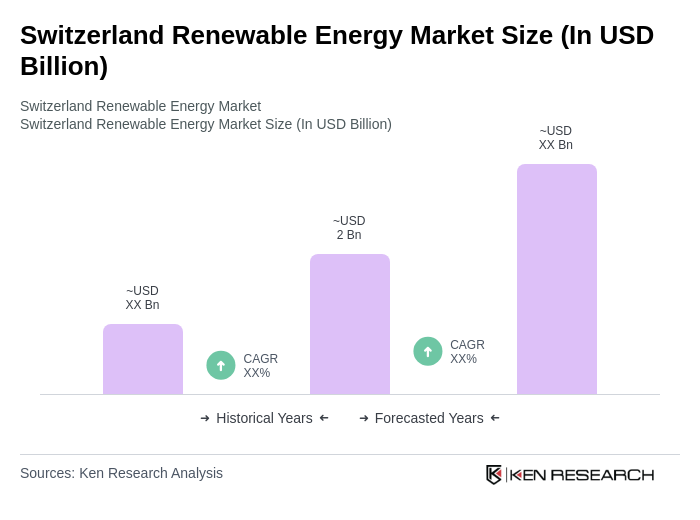
- The Switzerland Renewable Energy Market is valued at USD 2 billion, based on a five-year historical analysis. This growth is primarily driven by the country's commitment to sustainability, government incentives, and increasing investments in renewable technologies. The shift towards cleaner energy sources is further supported by public awareness and demand for energy independence.
- Key players in this market include Zurich, Geneva, and Bern, which are focal hubs due to robust infrastructure, cantonal/municipal support, and strategic initiatives aimed at promoting renewable energy; these cities host major utilities and research institutions that foster innovation and deployment in the renewable sector. For example, Services Industriels de Genève (SIG) and Energie Wasser Bern operate significant local clean energy programs and district energy networks supporting renewables and efficiency.
- In 2023, the Swiss Federal Act on a Secure Electricity Supply with Renewable Energies (Revision of the Energy Act and Electricity Supply Act, commonly referred to as the new Energy Act package) set a stronger trajectory to expand domestic renewables and security of supply, including enhanced incentives, faster permitting for key projects, and strengthened targets toward a largely renewable electricity system by mid-century. Policy frameworks emphasize boosting hydropower and rapidly scaling solar PV, complemented by grid upgrades and storage, thereby encouraging investments in sustainable energy solutions.
Switzerland Renewable Energy Market Segmentation
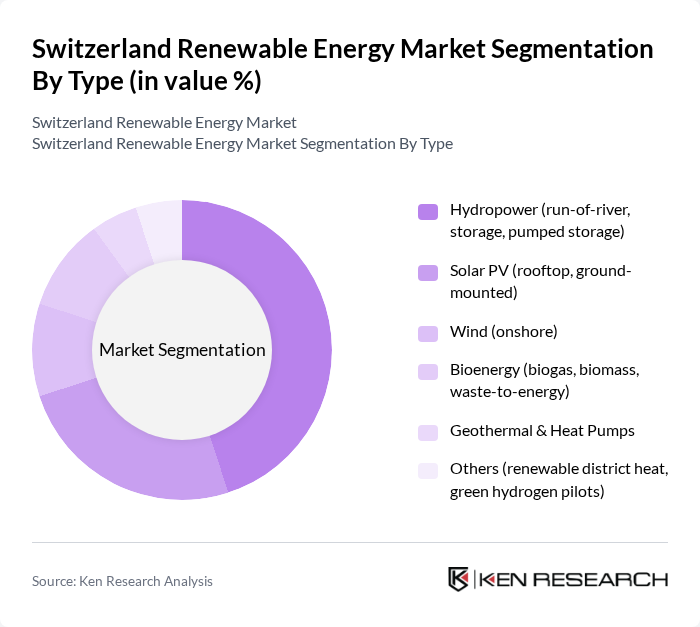
By Type:The market is segmented into various types of renewable energy sources, including hydropower, solar PV, wind, bioenergy, geothermal, and others. Each type plays a crucial role in the overall energy landscape, with hydropower being the most dominant due to Switzerland's mountainous geography and extensive run-of-river and storage capacity. Solar PV is also gaining traction, particularly on rooftops and alpine installations, as technology advances, costs decline, and policy support accelerates deployment.
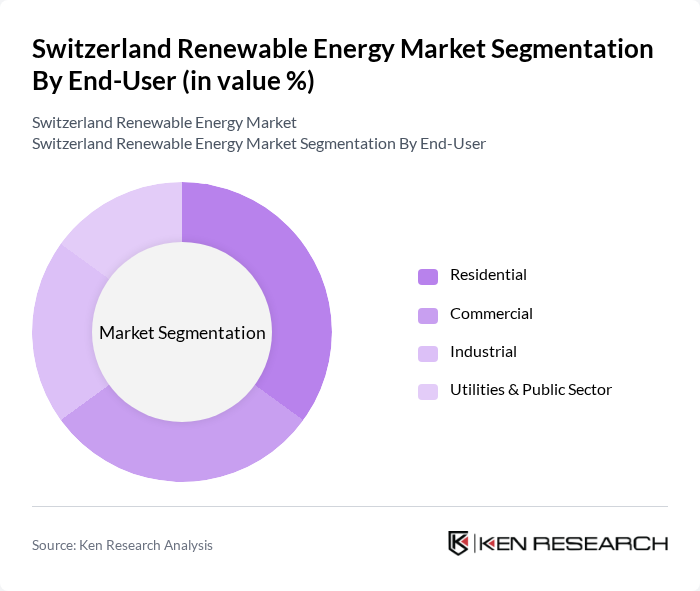
By End-User:The end-user segmentation includes residential, commercial, industrial, and utilities/public sector consumers. The residential sector is increasingly adopting renewable energy solutions, driven by government incentives and a growing awareness of sustainability. The commercial sector follows closely, with businesses seeking to reduce their carbon footprint and energy costs.
Switzerland Renewable Energy Market Competitive Landscape
The Switzerland Renewable Energy Market is characterized by a dynamic mix of regional and international players. Leading participants such as Axpo Holding AG, Alpiq Holding AG, BKW AG, Repower AG, CKW AG (Centralschweizerische Kraftwerke AG), Energie Wasser Bern (ewb), IWB Industrielle Werke Basel, Groupe E SA, Romande Energie Holding SA, SIG – Services Industriels de Genève, Swissgrid AG, Nant de Drance SA, JUWI AG (Switzerland) / JUWI Energie Rinnovabili Swiss, Helion Energy AG (A BKW Company), Swissolar (Swiss Solar Industry Association) contribute to innovation, geographic expansion, and service delivery in this space.
Switzerland Renewable Energy Market Industry Analysis
Growth Drivers
- Increasing Demand for Sustainable Energy:The demand for sustainable energy in Switzerland is projected to reach 32 terawatt-hours (TWh) by the future, driven by a growing population and industrial activities. The Swiss government aims to reduce greenhouse gas emissions by 50% by 2030 compared to 1990 levels, which has led to increased investments in renewable energy sources. This shift is supported by the rising public preference for clean energy, with 76% of Swiss citizens favoring renewable energy initiatives, according to recent surveys.
- Government Incentives and Subsidies:The Swiss government has allocated approximately CHF 1.6 billion (around USD 1.7 billion) for renewable energy subsidies in the future. These incentives are designed to encourage the adoption of solar, wind, and hydroelectric power. The Feed-in Tariff (FiT) system guarantees fixed payments for renewable energy producers, ensuring financial viability. This supportive regulatory framework has resulted in a 22% increase in new renewable energy projects in the last year alone, fostering a robust market environment.
- Technological Advancements in Renewable Energy:Technological innovations in renewable energy have significantly reduced costs and improved efficiency. For instance, the cost of solar photovoltaic (PV) systems has decreased by 82% since 2010, making solar energy more accessible. In the future, Switzerland is expected to install an additional 1.3 gigawatts (GW) of solar capacity, driven by advancements in energy storage and smart grid technologies. These developments are crucial for integrating renewable sources into the national grid effectively.
Market Challenges
- High Initial Investment Costs:The initial capital required for renewable energy projects in Switzerland remains a significant barrier, with average costs for solar installations reaching CHF 1,250 (approximately USD 1,350) per kilowatt. This high upfront investment can deter potential investors and slow down project implementation. Despite government incentives, many small and medium enterprises struggle to secure financing, limiting their participation in the renewable energy sector.
- Regulatory Compliance Complexity:Navigating the regulatory landscape in Switzerland can be challenging for renewable energy developers. The country has over 210 regulations governing energy production, which can lead to delays in project approvals. In the future, it is estimated that compliance costs could account for up to 16% of total project expenses. This complexity can discourage new entrants and hinder the overall growth of the renewable energy market.
Switzerland Renewable Energy Market Future Outlook
The future of the renewable energy market in Switzerland appears promising, with a strong emphasis on sustainability and innovation. In the future, the integration of smart grid technologies is expected to enhance energy efficiency and reliability. Additionally, the expansion of community solar projects will empower local stakeholders, fostering greater public engagement. As the government continues to support renewable initiatives, the market is likely to witness increased collaboration between public and private sectors, driving further advancements in clean energy solutions.
Market Opportunities
- Expansion of Solar Energy Projects:With the Swiss government targeting a 52% increase in solar capacity in the future, there is a significant opportunity for developers to invest in new solar farms. The anticipated installation of 1.6 GW of solar capacity will create jobs and stimulate local economies, making it a lucrative sector for investment.
- Development of Energy Storage Solutions:The growing demand for energy storage solutions presents a unique opportunity for innovation. In the future, the energy storage market in Switzerland is expected to grow to CHF 550 million (approximately USD 600 million), driven by the need to balance supply and demand. This growth will encourage investments in battery technologies and other storage systems, enhancing grid stability.
Scope of the Report
| Segment | Sub-Segments |
|---|---|
| By Type | Hydropower (run-of-river, storage, pumped storage) Solar PV (rooftop, ground-mounted) Wind (onshore) Bioenergy (biogas, biomass, waste-to-energy) Geothermal & Heat Pumps Others (renewable district heat, green hydrogen pilots) |
| By End-User | Residential Commercial Industrial Utilities & Public Sector |
| By Application | Grid-Connected (feed-in/remuneration, market premium) Self-Consumption / Behind-the-Meter Off-Grid / Remote & Alpine Sites Utility-Scale Projects |
| By Investment Source | Domestic (utilities, cooperatives) Foreign Direct Investment (FDI) Public–Private Partnerships (PPP) Government Programs & Incentives |
| By Policy Support | Investment Contributions/Subsidies Tax Incentives & Depreciation Feed-in Remuneration / Market Premium Guarantees of Origin (GoO) / Green Certificates |
| By Distribution Mode | Direct EPC & Utility Procurement Installer/Integrator Networks Online Sales & Marketplaces Distributors & Wholesalers |
| By Price Range | Low Medium High |
Key Target Audience
Investors and Venture Capitalist Firms
Government and Regulatory Bodies (e.g., Swiss Federal Office of Energy, Federal Office for the Environment)
Energy Producers and Utilities
Renewable Energy Project Developers
Grid Operators and Transmission Companies
Environmental NGOs and Advocacy Groups
Energy Storage Solution Providers
Local Municipalities and Regional Authorities
Players Mentioned in the Report:
Axpo Holding AG
Alpiq Holding AG
BKW AG
Repower AG
CKW AG (Centralschweizerische Kraftwerke AG)
Energie Wasser Bern (ewb)
IWB Industrielle Werke Basel
Groupe E SA
Romande Energie Holding SA
SIG Services Industriels de Geneve
Swissgrid AG
Nant de Drance SA
JUWI AG (Switzerland) / JUWI Energie Rinnovabili Swiss
Helion Energy AG (A BKW Company)
Swissolar (Swiss Solar Industry Association)
Table of Contents
Market Assessment Phase
1. Executive Summary and Approach
2. Switzerland Renewable Energy Market Overview
2.1 Key Insights and Strategic Recommendations
2.2 Switzerland Renewable Energy Market Overview
2.3 Definition and Scope
2.4 Evolution of Market Ecosystem
2.5 Timeline of Key Regulatory Milestones
2.6 Value Chain & Stakeholder Mapping
2.7 Business Cycle Analysis
2.8 Policy & Incentive Landscape
3. Switzerland Renewable Energy Market Analysis
3.1 Growth Drivers
3.1.1 Increasing Demand for Sustainable Energy
3.1.2 Government Incentives and Subsidies
3.1.3 Technological Advancements in Renewable Energy
3.1.4 Public Awareness and Environmental Concerns
3.2 Market Challenges
3.2.1 High Initial Investment Costs
3.2.2 Regulatory Compliance Complexity
3.2.3 Competition from Traditional Energy Sources
3.2.4 Infrastructure Limitations
3.3 Market Opportunities
3.3.1 Expansion of Solar Energy Projects
3.3.2 Development of Energy Storage Solutions
3.3.3 Growth in Electric Vehicle Charging Infrastructure
3.3.4 International Collaboration on Renewable Projects
3.4 Market Trends
3.4.1 Shift Towards Decentralized Energy Systems
3.4.2 Increasing Investment in Smart Grids
3.4.3 Rise of Community Solar Initiatives
3.4.4 Focus on Energy Efficiency Measures
3.5 Government Regulation
3.5.1 Renewable Energy Act Compliance
3.5.2 Feed-in Tariff Regulations
3.5.3 Emission Reduction Targets
3.5.4 Grid Access Regulations
4. SWOT Analysis
5. Stakeholder Analysis
6. Porter's Five Forces Analysis
7. Switzerland Renewable Energy Market Market Size, 2019-2024
7.1 By Value
7.2 By Volume
7.3 By Average Selling Price
8. Switzerland Renewable Energy Market Segmentation
8.1 By Type
8.1.1 Hydropower (run-of-river, storage, pumped storage)
8.1.2 Solar PV (rooftop, ground-mounted)
8.1.3 Wind (onshore)
8.1.4 Bioenergy (biogas, biomass, waste-to-energy)
8.1.5 Geothermal & Heat Pumps
8.1.6 Others (renewable district heat, green hydrogen pilots)
8.2 By End-User
8.2.1 Residential
8.2.2 Commercial
8.2.3 Industrial
8.2.4 Utilities & Public Sector
8.3 By Application
8.3.1 Grid-Connected (feed-in/remuneration, market premium)
8.3.2 Self-Consumption / Behind-the-Meter
8.3.3 Off-Grid / Remote & Alpine Sites
8.3.4 Utility-Scale Projects
8.4 By Investment Source
8.4.1 Domestic (utilities, cooperatives)
8.4.2 Foreign Direct Investment (FDI)
8.4.3 Public–Private Partnerships (PPP)
8.4.4 Government Programs & Incentives
8.5 By Policy Support
8.5.1 Investment Contributions/Subsidies
8.5.2 Tax Incentives & Depreciation
8.5.3 Feed-in Remuneration / Market Premium
8.5.4 Guarantees of Origin (GoO) / Green Certificates
8.6 By Distribution Mode
8.6.1 Direct EPC & Utility Procurement
8.6.2 Installer/Integrator Networks
8.6.3 Online Sales & Marketplaces
8.6.4 Distributors & Wholesalers
8.7 By Price Range
8.7.1 Low
8.7.2 Medium
8.7.3 High
9. Switzerland Renewable Energy Market Competitive Analysis
9.1 Market Share of Key Players
9.2 Cross Comparison of Key Players
9.2.1 Company Name
9.2.2 Group Size (Utility, IPP, EPC/Installer, OEM)
9.2.3 Installed Renewable Capacity in Switzerland (MW)
9.2.4 Annual Capacity Additions in Switzerland (MW, latest year)
9.2.5 Revenue from Switzerland (CHF, latest fiscal year)
9.2.6 EBITDA Margin (%)
9.2.7 Pipeline/Backlog (MW) and Awarded Projects
9.2.8 LCOE Range by Technology (CHF/MWh)
9.2.9 Average PPA/Feed-in Remuneration (CHF/MWh)
9.2.10 Capacity Factor by Technology (%)
9.2.11 Grid Curtailment/Availability (%)
9.2.12 Capex per kW (CHF/kW) and Opex per kW-year
9.2.13 Time-to-Commissioning (months) and Permitting Lead Time
9.2.14 Share of Certified Green Power Sales (GoO) (%)
9.2.15 Scope 1–3 Emissions Intensity (gCO2e/kWh) and Net-Zero Target Year
9.3 SWOT Analysis of Top Players
9.4 Pricing Analysis
9.5 Detailed Profile of Major Companies
9.5.1 Axpo Holding AG
9.5.2 Alpiq Holding AG
9.5.3 BKW AG
9.5.4 Repower AG
9.5.5 CKW AG (Centralschweizerische Kraftwerke AG)
9.5.6 Energie Wasser Bern (ewb)
9.5.7 IWB Industrielle Werke Basel
9.5.8 Groupe E SA
9.5.9 Romande Energie Holding SA
9.5.10 SIG – Services Industriels de Genève
9.5.11 Swissgrid AG
9.5.12 Nant de Drance SA
9.5.13 JUWI AG (Switzerland) / JUWI Energie Rinnovabili Swiss
9.5.14 Helion Energy AG (A BKW Company)
9.5.15 Swissolar (Swiss Solar Industry Association)
10. Switzerland Renewable Energy Market End-User Analysis
10.1 Procurement Behavior of Key Ministries
10.1.1 Energy Procurement Strategies
10.1.2 Budget Allocation for Renewable Projects
10.1.3 Collaboration with Private Sector
10.2 Corporate Spend on Infrastructure & Energy
10.2.1 Investment Trends in Renewable Energy
10.2.2 Budgeting for Sustainability Initiatives
10.2.3 Long-term Energy Contracts
10.3 Pain Point Analysis by End-User Category
10.3.1 Cost of Transition to Renewables
10.3.2 Reliability of Energy Supply
10.3.3 Regulatory Compliance Challenges
10.4 User Readiness for Adoption
10.4.1 Awareness of Renewable Options
10.4.2 Financial Readiness for Investment
10.4.3 Technical Capability for Implementation
10.5 Post-Deployment ROI and Use Case Expansion
10.5.1 Measurement of Energy Savings
10.5.2 Expansion into New Applications
10.5.3 Long-term Maintenance Costs
11. Switzerland Renewable Energy Market Future Size, 2025-2030
11.1 By Value
11.2 By Volume
11.3 By Average Selling Price
Go-To-Market Strategy Phase
1. Whitespace Analysis + Business Model Canvas
1.1 Identification of Market Gaps
1.2 Business Model Development
1.3 Value Proposition Canvas
1.4 Competitive Landscape Analysis
1.5 Customer Segmentation
1.6 Revenue Streams
1.7 Cost Structure
2. Marketing and Positioning Recommendations
2.1 Branding Strategies
2.2 Product USPs
2.3 Target Audience Identification
2.4 Communication Strategy
2.5 Digital Marketing Tactics
2.6 Partnership Opportunities
3. Distribution Plan
3.1 Urban Retail Strategies
3.2 Rural NGO Tie-ups
3.3 Online Distribution Channels
3.4 Direct Sales Approaches
3.5 Logistics and Supply Chain Management
4. Channel & Pricing Gaps
4.1 Underserved Routes
4.2 Pricing Bands Analysis
4.3 Competitor Pricing Strategies
4.4 Customer Willingness to Pay
4.5 Discounting Strategies
5. Unmet Demand & Latent Needs
5.1 Category Gaps
5.2 Consumer Segments Analysis
5.3 Emerging Trends and Needs
5.4 Feedback from Current Users
5.5 Future Demand Projections
6. Customer Relationship
6.1 Loyalty Programs
6.2 After-sales Service
6.3 Customer Feedback Mechanisms
6.4 Community Engagement Initiatives
6.5 Customer Education Programs
7. Value Proposition
7.1 Sustainability Initiatives
7.2 Integrated Supply Chains
7.3 Cost Savings for Customers
7.4 Innovation in Product Offerings
7.5 Long-term Partnerships
8. Key Activities
8.1 Regulatory Compliance
8.2 Branding Initiatives
8.3 Distribution Setup
8.4 Training and Development
8.5 Market Research Activities
9. Entry Strategy Evaluation
9.1 Domestic Market Entry Strategy
9.1.1 Product Mix Considerations
9.1.2 Pricing Band Analysis
9.1.3 Packaging Strategies
9.2 Export Entry Strategy
9.2.1 Target Countries Identification
9.2.2 Compliance Roadmap Development
10. Entry Mode Assessment
10.1 Joint Ventures
10.2 Greenfield Investments
10.3 Mergers & Acquisitions
10.4 Distributor Model Evaluation
11. Capital and Timeline Estimation
11.1 Capital Requirements
11.2 Timelines for Implementation
12. Control vs Risk Trade-Off
12.1 Ownership vs Partnerships
13. Profitability Outlook
13.1 Breakeven Analysis
13.2 Long-term Sustainability Strategies
14. Potential Partner List
14.1 Distributors
14.2 Joint Ventures
14.3 Acquisition Targets
15. Execution Roadmap
15.1 Phased Plan for Market Entry
15.1.1 Market Setup
15.1.2 Market Entry
15.1.3 Growth Acceleration
15.1.4 Scale & Stabilize
15.2 Key Activities and Milestones
15.2.1 Milestone Planning
15.2.2 Activity Tracking
Research Methodology
Phase 1: Approach1
Desk Research
- Analysis of government reports on renewable energy policies and initiatives in Switzerland
- Review of industry publications and market analysis reports from Swiss energy associations
- Examination of academic journals and white papers focusing on renewable energy technologies and trends
Primary Research
- Interviews with key stakeholders in the Swiss renewable energy sector, including project developers and energy consultants
- Surveys targeting energy policy experts and regulatory bodies to understand the impact of legislation
- Field interviews with operators of renewable energy facilities to gather insights on operational challenges and innovations
Validation & Triangulation
- Cross-validation of findings through comparison with international renewable energy market trends
- Triangulation of data from government sources, industry reports, and expert interviews
- Sanity checks conducted through expert panel reviews to ensure data accuracy and relevance
Phase 2: Market Size Estimation1
Top-down Assessment
- Estimation of total renewable energy capacity based on national energy consumption statistics
- Segmentation of the market by energy source (solar, wind, hydro, etc.) and application (residential, commercial, industrial)
- Incorporation of government targets for renewable energy adoption and carbon reduction commitments
Bottom-up Modeling
- Collection of data on installed capacity and generation from leading renewable energy companies in Switzerland
- Operational cost analysis based on technology type and scale of projects
- Volume x cost calculations for energy production and sales across different segments
Forecasting & Scenario Analysis
- Multi-factor regression analysis incorporating economic growth, energy prices, and technological advancements
- Scenario modeling based on potential changes in government policy and market dynamics
- Development of baseline, optimistic, and pessimistic forecasts through 2030
Phase 3: CATI Sample Composition1
| Scope Item/Segment | Sample Size | Target Respondent Profiles |
|---|---|---|
| Solar Energy Installations | 150 | Project Managers, Solar Technicians |
| Wind Energy Projects | 100 | Operations Managers, Environmental Consultants |
| Hydropower Facilities | 80 | Facility Managers, Regulatory Affairs Specialists |
| Biomass Energy Producers | 70 | Production Managers, Sustainability Officers |
| Energy Storage Solutions | 90 | Product Development Managers, Energy Analysts |
Frequently Asked Questions
What is the current value of the Switzerland Renewable Energy Market?
The Switzerland Renewable Energy Market is valued at approximately USD 2 billion, reflecting a significant growth driven by government incentives, public demand for sustainability, and increased investments in renewable technologies.
What are the main types of renewable energy sources in Switzerland?
How does the Swiss government support renewable energy initiatives?
What role does hydropower play in Switzerland's renewable energy landscape?
Other Regional/Country Reports
Why Buy From Us?

What makes us stand out is that our consultants follow Robust, Refine and Result (RRR) methodology. Robust for clear definitions, approaches and sanity checking, Refine for differentiating respondents' facts and opinions, and Result for presenting data with story.

We have set a benchmark in the industry by offering our clients with syndicated and customized market research reports featuring coverage of entire market as well as meticulous research and analyst insights.

While we don't replace traditional research, we flip the method upside down. Our dual approach of Top Bottom & Bottom Top ensures quality deliverable by not just verifying company fundamentals but also looking at the sector and macroeconomic factors.

With one step in the future, our research team constantly tries to show you the bigger picture. We help with some of the tough questions you may encounter along the way: How is the industry positioned? Best marketing channel? KPI's of competitors? By aligning every element, we help maximize success.

Our report gives you instant access to the answers and sources that other companies might choose to hide. We elaborate each steps of research methodology we have used and showcase you the sample size to earn your trust.

If you need any support, we are here! We pride ourselves on universe strength, data quality, and quick, friendly, and professional service.