About the Report
Base Year 2024Listen to the audio summary
Thailand E Health Market Overview
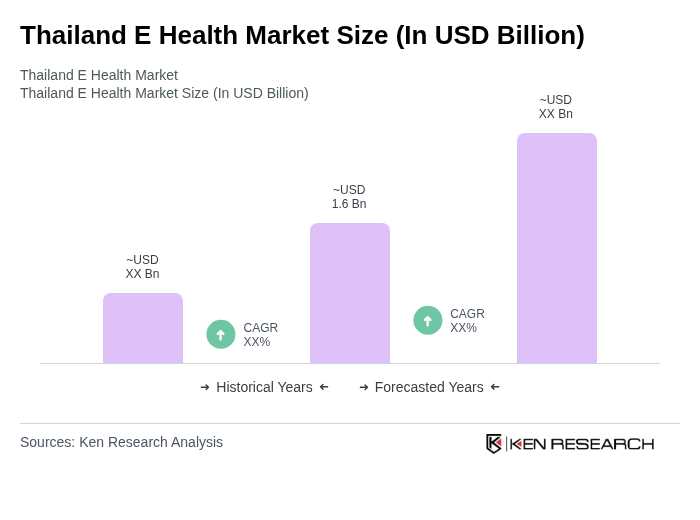
- The Thailand E Health Market is valued at USD 1.6 billion, based on a five-year historical analysis. This growth is primarily driven by the increasing adoption of digital health solutions, rising healthcare costs, the growing burden of chronic diseases, and a rapidly aging population, all of which are encouraging a stronger focus on preventive and value-based care. The demand for telemedicine and remote patient monitoring has surged, particularly following the COVID-19 pandemic, which accelerated the shift towards virtual consultations, home-based care, and digital healthcare services across hospitals and insurers.
- Bangkok, Chiang Mai, and Phuket are the dominant cities in the Thailand E Health Market. Bangkok, as the capital, hosts a significant number of tertiary hospitals, specialist centers, and major private hospital groups, as well as telecom operators driving 5G and digital platforms, making it a key hub for digital health innovation and telehealth rollouts. Chiang Mai and Phuket attract both local and international patients as leading medical and wellness tourism destinations, which enhances the demand for e-health services, particularly in telemedicine, remote follow-up for international patients, and wellness applications integrated with health tourism offerings.
- The Thai government has been advancing national e-health and digital health policies through instruments such as the National eHealth Strategy 2017–2026 issued by the Ministry of Public Health, which aims to integrate digital health technologies, standardized health information systems, and electronic health records into the national healthcare system. In parallel, professional use of telemedicine is governed by the Medical Council Notification on Telemedicine Practice under the supervision of the Medical Council of Thailand and the Ministry of Public Health, which sets requirements for local medical licensing, professional responsibility, and appropriate standards for providing medical services via telehealth platforms. These measures are supported by investments in telehealth infrastructure and the promotion of interoperable electronic health records to enable efficient and accessible services for the population.
Thailand E Health Market Segmentation
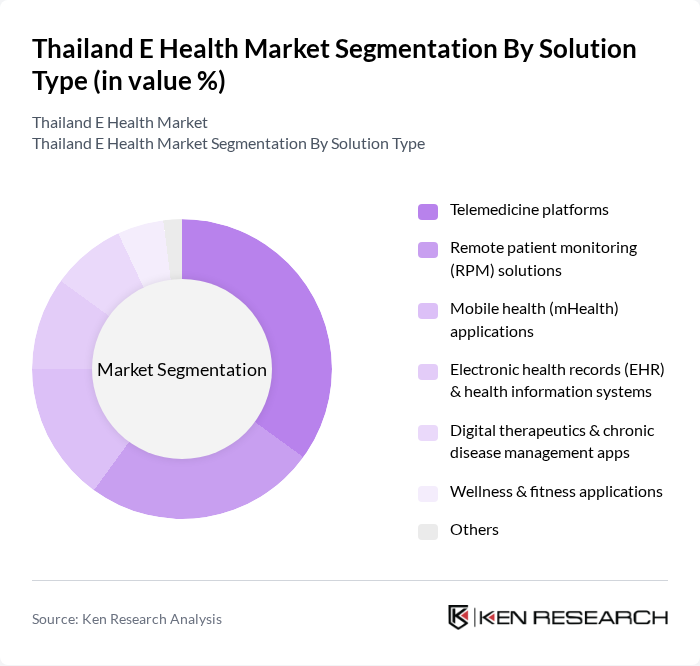
By Solution Type:The solution type segmentation includes various subsegments such as telemedicine platforms, remote patient monitoring (RPM) solutions, mobile health (mHealth) applications, electronic health records (EHR) & health information systems, digital therapeutics & chronic disease management apps, wellness & fitness applications, and others. Among these, telemedicine platforms are leading the market due to their convenience and accessibility, especially during and after the pandemic, as real-time virtual consultations and follow-up care have become mainstream across major hospital groups. The growing acceptance of virtual consultations, supported by high smartphone penetration, 5G deployment, and increasing patient familiarity with app-based services, has significantly influenced consumer behavior and provider workflows, leading to increased adoption rates.
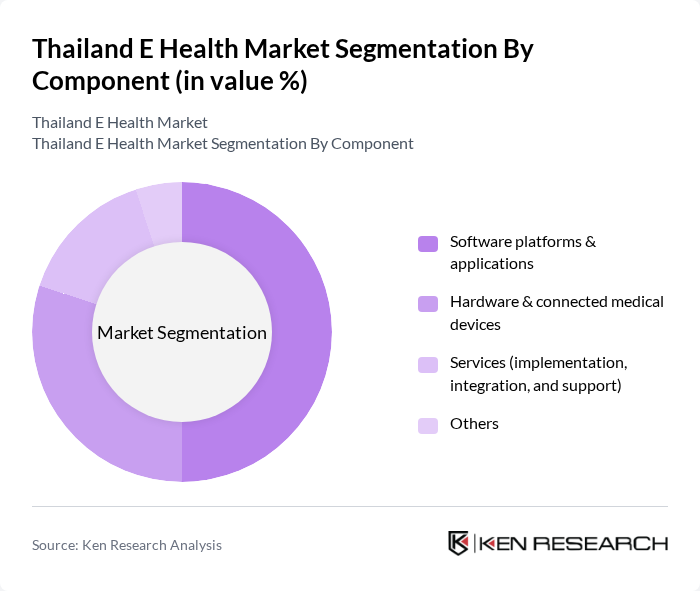
By Component:The component segmentation encompasses software platforms & applications, hardware & connected medical devices, services (implementation, integration, and support), and others. Software platforms & applications dominate this segment, driven by the increasing demand for user-friendly interfaces, virtual consultation tools, and interoperable health information systems that can be integrated with existing hospital information systems and national e-health infrastructure. The rise in mobile health applications, AI-enabled triage tools, and cloud-based telehealth platforms has also contributed to the growth of this segment, as consumers and providers seek more personalized, data-driven health management solutions and remote monitoring capabilities.
Thailand E Health Market Competitive Landscape
The Thailand E Health Market is characterized by a dynamic mix of regional and international players. Leading participants such as Bangkok Dusit Medical Services (BDMS), Bumrungrad International Hospital, Thonburi Healthcare Group, Samitivej Hospital Group, Phyathai – Paolo Hospital Group, Vejthani Hospital, Chulalongkorn University & King Chulalongkorn Memorial Hospital, Doctor Anywhere (Thailand), Health at Home, mClinica, Med247, HealthMetrics, True Corporation (True HEALTH), AIS (AIS Telehealth / partnerships), AIA Thailand & Krungthai-AXA (digital health initiatives) contribute to innovation, geographic expansion, and service delivery in this space.
Thailand E Health Market Industry Analysis
Growth Drivers
- Increasing Smartphone Penetration:Thailand's smartphone penetration reached 90 million users, representing approximately 130% of the population. This widespread access to smartphones facilitates the adoption of e-health applications, enabling users to manage their health more effectively. The World Bank reported that mobile internet subscriptions in Thailand increased by 15% in future, further supporting the growth of digital health solutions. This trend is expected to continue, driving the demand for mobile health services and applications.
- Government Initiatives for Digital Health:The Thai government allocated THB 1.5 billion (approximately USD 45 million) to enhance digital health infrastructure. Initiatives include the establishment of the Digital Health Center, aimed at improving telemedicine services and health data management. The Ministry of Public Health's commitment to integrating digital health into the national healthcare system is evident, with plans to increase telehealth consultations by 30%, thereby enhancing accessibility and efficiency in healthcare delivery.
- Rising Demand for Telemedicine Services:The telemedicine market in Thailand is projected to grow significantly, with an estimated 2 million telehealth consultations conducted. This surge is driven by the increasing need for accessible healthcare, especially post-COVID-19. The Thai population's growing preference for remote consultations, supported by a 20% increase in telehealth app downloads, indicates a shift towards digital health solutions. This trend is expected to continue, further propelling the e-health market forward.
Market Challenges
- Data Privacy Concerns:Data privacy remains a significant challenge in Thailand's e-health market, with 70% of consumers expressing concerns about the security of their health information. The lack of robust data protection regulations has led to hesitance among users to adopt digital health solutions. The Thai government is currently working on enhancing data protection laws, but until these measures are fully implemented, consumer trust in e-health services may remain low, hindering market growth.
- Limited Internet Access in Rural Areas:Approximately 30% of Thailand's rural population lacks reliable internet access, which poses a barrier to the adoption of e-health services. The National Broadcasting and Telecommunications Commission reported that internet penetration in rural areas is only 50%, compared to 90% in urban regions. This digital divide limits the reach of telemedicine and other digital health initiatives, making it challenging to provide equitable healthcare access across the country.
Thailand E Health Market Future Outlook
The Thailand e-health market is poised for significant growth, driven by technological advancements and increasing consumer demand for accessible healthcare solutions. As the government continues to invest in digital health infrastructure, the integration of AI and data analytics will enhance service delivery. Additionally, the rise of wearable health technology and a focus on preventive healthcare will shape the future landscape. In future, the market is expected to witness a substantial increase in telehealth services, improving overall health outcomes for the population.
Market Opportunities
- Expansion of Telehealth Services:The growing acceptance of telehealth presents a significant opportunity for providers to expand their services. With an estimated 3 million telehealth consultations projected in future, companies can capitalize on this trend by offering specialized services tailored to consumer needs, thereby enhancing patient engagement and satisfaction.
- Integration of AI in Healthcare:The integration of AI technologies in healthcare can streamline operations and improve patient outcomes. With the Thai government investing THB 500 million (approximately USD 15 million) in AI research for healthcare in future, companies that leverage AI for diagnostics and personalized treatment plans can gain a competitive edge in the evolving e-health landscape.
Scope of the Report
| Segment | Sub-Segments |
|---|---|
| By Solution Type | Telemedicine platforms Remote patient monitoring (RPM) solutions Mobile health (mHealth) applications Electronic health records (EHR) & health information systems Digital therapeutics & chronic disease management apps Wellness & fitness applications Others |
| By Component | Software platforms & applications Hardware & connected medical devices Services (implementation, integration, and support) Others |
| By End-User | Hospitals and hospital networks Clinics and ambulatory care centers Home healthcare & individual consumers Corporates & employers Insurance companies & payers Government health agencies Others |
| By Application | Consultation and teleconsultation services Health monitoring & disease management Preventive care & health education Emergency & triage support Medication adherence & management Others |
| By Technology | Cloud-based e-health solutions AI and machine learning-enabled solutions IoT and connected medical devices Blockchain and advanced security technologies Others |
| By Pricing / Payment Model | Subscription-based Freemium and in-app purchases Pay-per-use / transaction-based Insurance reimbursement-backed Others |
| By User Demographics | Age group (children, adults, seniors) Gender Income level Health status (chronic vs non-chronic) Others |
Key Target Audience
Investors and Venture Capitalist Firms
Government and Regulatory Bodies (e.g., Ministry of Public Health, National Health Security Office)
Healthcare Providers and Hospitals
Health Insurance Companies
Telecommunication Companies
Medical Device Manufacturers
Pharmaceutical Companies
Health Technology Startups
Players Mentioned in the Report:
Bangkok Dusit Medical Services (BDMS)
Bumrungrad International Hospital
Thonburi Healthcare Group
Samitivej Hospital Group
Phyathai Paolo Hospital Group
Vejthani Hospital
Chulalongkorn University & King Chulalongkorn Memorial Hospital
Doctor Anywhere (Thailand)
Health at Home
mClinica
Med247
HealthMetrics
True Corporation (True HEALTH)
AIS (AIS Telehealth / partnerships)
AIA Thailand & Krungthai-AXA (digital health initiatives)
Table of Contents
Market Assessment Phase
1. Executive Summary and Approach
2. Thailand E Health Market Overview
2.1 Key Insights and Strategic Recommendations
2.2 Thailand E Health Market Overview
2.3 Definition and Scope
2.4 Evolution of Market Ecosystem
2.5 Timeline of Key Regulatory Milestones
2.6 Value Chain & Stakeholder Mapping
2.7 Business Cycle Analysis
2.8 Policy & Incentive Landscape
3. Thailand E Health Market Analysis
3.1 Growth Drivers
3.1.1 Increasing smartphone penetration
3.1.2 Government initiatives for digital health
3.1.3 Rising demand for telemedicine services
3.1.4 Growing health awareness among consumers
3.2 Market Challenges
3.2.1 Data privacy concerns
3.2.2 Limited internet access in rural areas
3.2.3 Resistance to change from traditional practices
3.2.4 Regulatory hurdles
3.3 Market Opportunities
3.3.1 Expansion of telehealth services
3.3.2 Integration of AI in healthcare
3.3.3 Partnerships with tech companies
3.3.4 Development of personalized health solutions
3.4 Market Trends
3.4.1 Rise of wearable health technology
3.4.2 Increased focus on mental health solutions
3.4.3 Growth of health data analytics
3.4.4 Shift towards preventive healthcare
3.5 Government Regulation
3.5.1 Telemedicine regulations
3.5.2 Data protection laws
3.5.3 Licensing requirements for e-health providers
3.5.4 Standards for digital health applications
4. SWOT Analysis
5. Stakeholder Analysis
6. Porter's Five Forces Analysis
7. Thailand E Health Market Market Size, 2019-2024
7.1 By Value
7.2 By Volume
7.3 By Average Selling Price
8. Thailand E Health Market Segmentation
8.1 By Solution Type
8.1.1 Telemedicine platforms
8.1.2 Remote patient monitoring (RPM) solutions
8.1.3 Mobile health (mHealth) applications
8.1.4 Electronic health records (EHR) & health information systems
8.1.5 Digital therapeutics & chronic disease management apps
8.1.6 Wellness & fitness applications
8.1.7 Others
8.2 By Component
8.2.1 Software platforms & applications
8.2.2 Hardware & connected medical devices
8.2.3 Services (implementation, integration, and support)
8.2.4 Others
8.3 By End-User
8.3.1 Hospitals and hospital networks
8.3.2 Clinics and ambulatory care centers
8.3.3 Home healthcare & individual consumers
8.3.4 Corporates & employers
8.3.5 Insurance companies & payers
8.3.6 Government health agencies
8.3.7 Others
8.4 By Application
8.4.1 Consultation and teleconsultation services
8.4.2 Health monitoring & disease management
8.4.3 Preventive care & health education
8.4.4 Emergency & triage support
8.4.5 Medication adherence & management
8.4.6 Others
8.5 By Technology
8.5.1 Cloud-based e-health solutions
8.5.2 AI and machine learning-enabled solutions
8.5.3 IoT and connected medical devices
8.5.4 Blockchain and advanced security technologies
8.5.5 Others
8.6 By Pricing / Payment Model
8.6.1 Subscription-based
8.6.2 Freemium and in-app purchases
8.6.3 Pay-per-use / transaction-based
8.6.4 Insurance reimbursement-backed
8.6.5 Others
8.7 By User Demographics
8.7.1 Age group (children, adults, seniors)
8.7.2 Gender
8.7.3 Income level
8.7.4 Health status (chronic vs non-chronic)
8.7.5 Others
9. Thailand E Health Market Competitive Analysis
9.1 Market Share of Key Players
9.2 Cross Comparison of Key Players
9.2.1 Company Name
9.2.2 Group Size (Large, Medium, or Small as per industry convention)
9.2.3 Annual revenue from e-health (USD)
9.2.4 3-year revenue CAGR in e-health (%)
9.2.5 Active user base / registered users
9.2.6 Monthly active users (MAUs)
9.2.7 Average Revenue Per User (ARPU)
9.2.8 Customer Acquisition Cost (CAC)
9.2.9 Customer Lifetime Value (LTV)
9.2.10 Customer Retention / Churn rate
9.2.11 Number of paid enterprise / institutional clients
9.2.12 Number of consultations / transactions per month
9.2.13 Market share (%) in Thailand e-health
9.2.14 Geographic coverage (number of provinces / regions served)
9.2.15 Regulatory & compliance status (licenses, certifications)
9.2.16 User satisfaction / Net Promoter Score (NPS)
9.3 SWOT Analysis of Top Players
9.4 Pricing Analysis
9.5 Detailed Profile of Major Companies
9.5.1 Bangkok Dusit Medical Services (BDMS)
9.5.2 Bumrungrad International Hospital
9.5.3 Thonburi Healthcare Group
9.5.4 Samitivej Hospital Group
9.5.5 Phyathai – Paolo Hospital Group
9.5.6 Vejthani Hospital
9.5.7 Chulalongkorn University & King Chulalongkorn Memorial Hospital
9.5.8 Doctor Anywhere (Thailand)
9.5.9 Health at Home
9.5.10 mClinica
9.5.11 Med247
9.5.12 HealthMetrics
9.5.13 True Corporation (True HEALTH)
9.5.14 AIS (AIS Telehealth / partnerships)
9.5.15 AIA Thailand & Krungthai-AXA (digital health initiatives)
10. Thailand E Health Market End-User Analysis
10.1 Procurement Behavior of Key Ministries
10.1.1 Ministry of Public Health
10.1.2 Ministry of Digital Economy and Society
10.1.3 Ministry of Finance
10.1.4 Others
10.2 Corporate Spend on Infrastructure & Energy
10.2.1 Healthcare infrastructure investments
10.2.2 Technology upgrades
10.2.3 Training and development
10.2.4 Others
10.3 Pain Point Analysis by End-User Category
10.3.1 Hospitals
10.3.2 Clinics
10.3.3 Home healthcare providers
10.3.4 Patients
10.4 User Readiness for Adoption
10.4.1 Awareness of e-health solutions
10.4.2 Training needs
10.4.3 Infrastructure readiness
10.4.4 Others
10.5 Post-Deployment ROI and Use Case Expansion
10.5.1 Cost savings
10.5.2 Improved patient outcomes
10.5.3 Scalability of solutions
10.5.4 Others
11. Thailand E Health Market Future Size, 2025-2030
11.1 By Value
11.2 By Volume
11.3 By Average Selling Price
Go-To-Market Strategy Phase
1. Whitespace Analysis + Business Model Canvas
1.1 Market gaps identification
1.2 Value proposition development
1.3 Revenue model exploration
1.4 Customer segmentation
1.5 Competitive landscape analysis
1.6 Key partnerships
1.7 Risk assessment
2. Marketing and Positioning Recommendations
2.1 Branding strategies
2.2 Product USPs
2.3 Target audience identification
2.4 Communication strategy
2.5 Digital marketing tactics
2.6 Offline marketing strategies
2.7 Performance metrics
3. Distribution Plan
3.1 Urban retail strategies
3.2 Rural NGO tie-ups
3.3 Online distribution channels
3.4 Partnerships with healthcare providers
3.5 Logistics and supply chain management
3.6 Distribution performance metrics
4. Channel & Pricing Gaps
4.1 Underserved routes
4.2 Pricing bands analysis
4.3 Competitor pricing strategies
4.4 Customer willingness to pay
4.5 Price elasticity of demand
4.6 Recommendations for pricing adjustments
5. Unmet Demand & Latent Needs
5.1 Category gaps
5.2 Consumer segments analysis
5.3 Emerging trends identification
5.4 Recommendations for product development
5.5 Market entry strategies
6. Customer Relationship
6.1 Loyalty programs
6.2 After-sales service
6.3 Customer feedback mechanisms
6.4 Community engagement strategies
6.5 Customer relationship management tools
7. Value Proposition
7.1 Sustainability initiatives
7.2 Integrated supply chains
7.3 Unique selling points
7.4 Customer benefits
7.5 Competitive advantages
8. Key Activities
8.1 Regulatory compliance
8.2 Branding efforts
8.3 Distribution setup
8.4 Training and development
8.5 Performance monitoring
9. Entry Strategy Evaluation
9.1 Domestic Market Entry Strategy
9.1.1 Product mix
9.1.2 Pricing band
9.1.3 Packaging
9.2 Export Entry Strategy
9.2.1 Target countries
9.2.2 Compliance roadmap
10. Entry Mode Assessment
10.1 Joint Ventures
10.2 Greenfield investments
10.3 Mergers & Acquisitions
10.4 Distributor Model
11. Capital and Timeline Estimation
11.1 Capital requirements
11.2 Timelines
12. Control vs Risk Trade-Off
12.1 Ownership vs Partnerships
13. Profitability Outlook
13.1 Breakeven analysis
13.2 Long-term sustainability
14. Potential Partner List
14.1 Distributors
14.2 Joint Ventures
14.3 Acquisition targets
15. Execution Roadmap
15.1 Phased Plan for Market Entry
15.1.1 Market Setup
15.1.2 Market Entry
15.1.3 Growth Acceleration
15.1.4 Scale & Stabilize
15.2 Key Activities and Milestones
15.2.1 Activity timelines
15.2.2 Milestone tracking
Research Methodology
Phase 1: Approach1
Desk Research
- Analysis of government reports on healthcare infrastructure and digital health initiatives
- Review of industry publications and market reports on e-health trends in Thailand
- Examination of academic journals focusing on telemedicine and health technology adoption
Primary Research
- Interviews with healthcare professionals and administrators in hospitals and clinics
- Surveys targeting patients to understand their experiences with e-health services
- Focus groups with technology providers and developers in the e-health sector
Validation & Triangulation
- Cross-validation of findings through multiple data sources, including government and private sector reports
- Triangulation of qualitative insights from interviews with quantitative data from surveys
- Sanity checks conducted through expert panel reviews comprising industry veterans
Phase 2: Market Size Estimation1
Top-down Assessment
- Estimation of the e-health market size based on national healthcare expenditure data
- Segmentation of the market by service type, including telemedicine, mobile health apps, and electronic health records
- Incorporation of growth rates from related sectors such as telecommunications and IT services
Bottom-up Modeling
- Collection of data from leading e-health service providers on user adoption rates and service usage
- Estimation of revenue generated from various e-health services based on pricing models
- Volume x cost analysis for different e-health solutions to derive market potential
Forecasting & Scenario Analysis
- Multi-factor regression analysis incorporating demographic trends and technology penetration rates
- Scenario modeling based on potential regulatory changes and public health initiatives
- Development of baseline, optimistic, and pessimistic forecasts through 2030
Phase 3: CATI Sample Composition1
| Scope Item/Segment | Sample Size | Target Respondent Profiles |
|---|---|---|
| Telemedicine Service Users | 140 | Patients, Caregivers |
| Healthcare Providers | 120 | Doctors, Nurses, Administrators |
| Health Technology Developers | 90 | Product Managers, Software Engineers |
| Insurance Companies | 80 | Underwriters, Claims Managers |
| Regulatory Bodies | 60 | Policy Makers, Health Regulators |
Frequently Asked Questions
What is the current value of the Thailand E Health Market?
The Thailand E Health Market is valued at approximately USD 1.6 billion, reflecting significant growth driven by the adoption of digital health solutions, rising healthcare costs, and an aging population, particularly accelerated by the COVID-19 pandemic.
What are the main drivers of growth in the Thailand E Health Market?
Which cities are the primary hubs for e-health services in Thailand?
What types of solutions are included in the Thailand E Health Market?
Other Regional/Country Reports
Other Adjacent Reports
Egypt Mobile Health Market
India Digital Therapeutics Market Size, Share & Forecast, By Product Type, Disease Area & Care Setting, 2026–2031Global Wearable Technology Market Size, Share & Forecast, By Product Type, Application & Distribution Channel, 2026-2031Kuwait Health Analytics Market
Middle East Chronic Disease Management Market Size, Share, Growth Drivers, Trends, Opportunities & Forecast 2025–2030Philippines Medical Tourism Market Size, Share & Forecast, By Service Type, Care Setting & Customer Type, 2026–2032Why Buy From Us?

What makes us stand out is that our consultants follow Robust, Refine and Result (RRR) methodology. Robust for clear definitions, approaches and sanity checking, Refine for differentiating respondents' facts and opinions, and Result for presenting data with story.

We have set a benchmark in the industry by offering our clients with syndicated and customized market research reports featuring coverage of entire market as well as meticulous research and analyst insights.

While we don't replace traditional research, we flip the method upside down. Our dual approach of Top Bottom & Bottom Top ensures quality deliverable by not just verifying company fundamentals but also looking at the sector and macroeconomic factors.

With one step in the future, our research team constantly tries to show you the bigger picture. We help with some of the tough questions you may encounter along the way: How is the industry positioned? Best marketing channel? KPI's of competitors? By aligning every element, we help maximize success.

Our report gives you instant access to the answers and sources that other companies might choose to hide. We elaborate each steps of research methodology we have used and showcase you the sample size to earn your trust.

If you need any support, we are here! We pride ourselves on universe strength, data quality, and quick, friendly, and professional service.