Thailand Non GMO Food Market Size Share Growth Drivers Trends Opportunities & Forecast 2025–2030

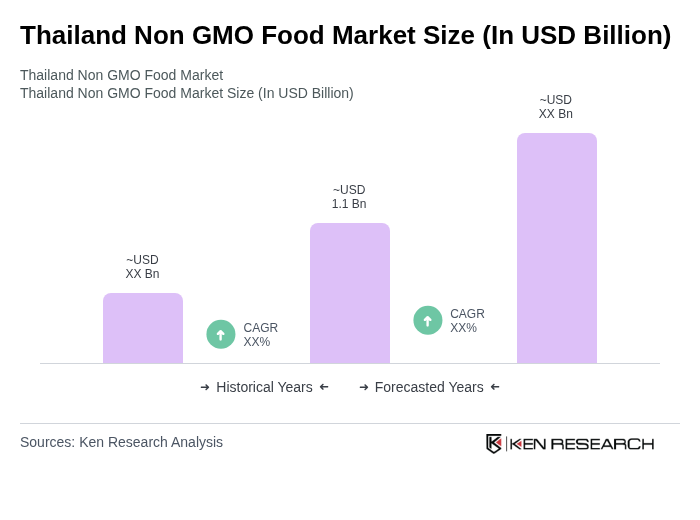
Thailand Non GMO Food Market, valued at USD 1.1 Bn, grows due to rising health consciousness, organic trends, and retail expansion in key cities like Bangkok and Chiang Mai.

Region:Asia

Author(s):Shubham

Product Code:KRAD2587

Pages:88

Published On:January 2026
About the Report

Base Year 2024

Thailand Non GMO Food Market Overview

  • The Thailand Non GMO Food Market is valued at USD 1.1 billion, based on a five-year historical analysis, aligning with the rapid growth of non-GMO food demand observed across Asia-Pacific and globally. This growth is primarily driven by increasing consumer awareness regarding health and wellness, alongside a rising demand for organic and natural food products, which mirrors broader non-GMO and clean-label trends in the region. The shift towards non-GMO foods is also influenced by government initiatives promoting sustainable agriculture and food safety standards, including policies that restrict commercial cultivation of genetically modified crops while tightening oversight of GM feed imports to support domestic non-GMO crop production.
  • Key demand hubs in this market include Bangkok, Chiang Mai, and Phuket, which together account for a significant share of non-GMO and organic food consumption due to their robust distribution networks, concentration of modern retail outlets, tourism-driven hospitality sectors, and high-income, health-conscious consumer bases. These cities are also home to a vibrant food culture that increasingly embraces organic, natural, and chemical-free options, with supermarkets, specialty organic stores, and café chains expanding their non-GMO offerings to capture premium urban demand.
  • Non-GMO food production and marketing in Thailand operate under a broader framework of food safety, labeling, and biotechnology oversight, including instruments such as the Biosafety Guidelines in Genetic Engineering and Biotechnology, issued by the National Center for Genetic Engineering and Biotechnology (BIOTEC) and related agencies, which set out requirements for the contained use, field trials, and risk management of genetically modified organisms. In parallel, the Food and Drug Administration under the Ministry of Public Health enforces mandatory labeling for approved GM ingredients in certain food categories, creating a regulatory environment that supports clear differentiation of non-GMO products and encourages adoption of verified non-GMO and organic standards in the domestic food supply.
Thailand Non GMO Food Market Size

Thailand Non GMO Food Market Segmentation

By Product Type:The product type segmentation includes various categories such as cereals and grains, fruits and vegetables, meat and poultry, dairy and dairy alternatives, bakery and confectionery, snacks and packaged foods, beverages, edible oils and fats, and others. This structure is consistent with global non-GMO food market classifications where staple food, fresh produce, and processed packaged categories are all significant contributors. Among these, cereals and grains are leading the market due to their essential role in daily diets, the importance of non-GMO maize and rice in both human food and feed, and the increasing preference for healthier breakfast and staple options with transparent sourcing. The demand for organic fruits and vegetables is also rising, driven by health-conscious consumers seeking fresh and chemical-free produce and supported by the expansion of organic and non-GMO retail chains and cooperative networks in urban centers.
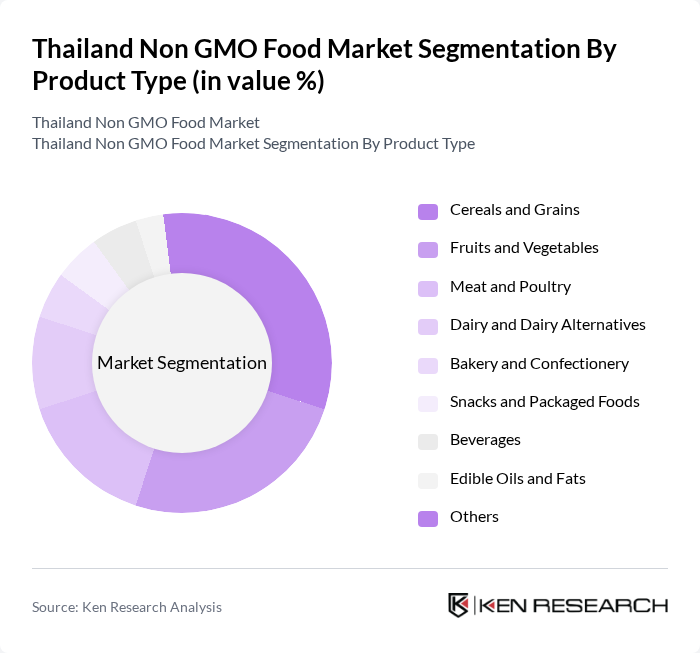
Thailand Non GMO Food Market segmentation by Product Type.

By Application:The application segmentation encompasses retail packaged foods, foodservice and HORECA, food and beverage manufacturing, animal feed, and others. This segmentation aligns with the way non-GMO products are commercialized globally, where retail packaged foods and foodservice channels are the primary consumer-facing outlets, while manufacturers and feed users drive upstream demand. Retail packaged foods dominate this segment, driven by the convenience of ready-to-eat and ready-to-cook options, the expansion of supermarket and convenience store chains in Thailand, and the growing trend of health-conscious consumers preferring non-GMO and clean-label products for at-home consumption. The foodservice sector is also witnessing significant growth as restaurants, hotels, cafés, and wellness-focused outlets increasingly offer non-GMO and organic menu options to cater to health-oriented and tourist clientele, supported by a robust hospitality industry and rising interest in sustainable, locally sourced ingredients.
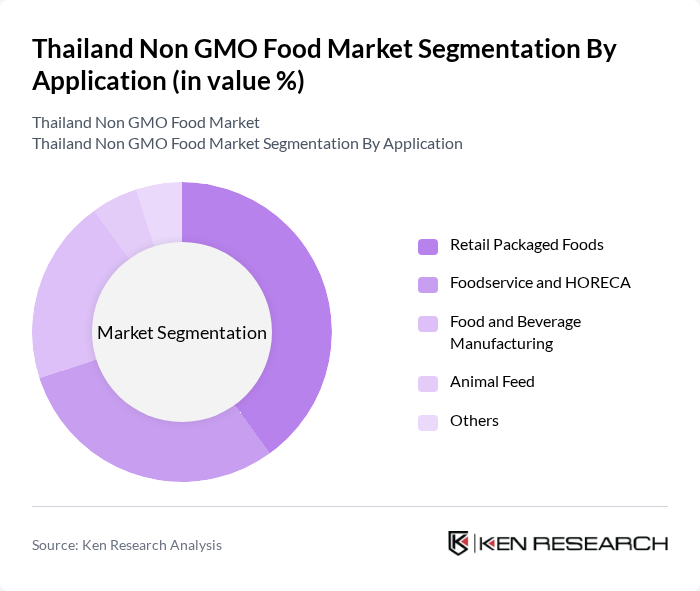
Thailand Non GMO Food Market segmentation by Application.

Thailand Non GMO Food Market Competitive Landscape

The Thailand Non GMO Food Market is characterized by a dynamic mix of regional and international players. Leading participants such as Tai Tai Co., Ltd., Green Net Cooperative, Thai Organic Trade Association, Organic Agriculture Certification Thailand (ACT), The Royal Project Foundation, Lemon Farm, Organic Village, Raitong Organics Farm, Doi Kham Food Products Co., Ltd., Saha Pathana Inter-Holding PLC (Food Division), Betagro Public Company Limited (Non-GMO Lines), Charoen Pokphand Foods PCL (Selected Non-GMO Ranges), Thai Beverage Public Company Limited (Health & Non-GMO Beverages), Tipco Foods Public Company Limited, and other emerging non-GMO and organic brands contribute to innovation, geographic expansion, and service delivery in this space.

Tai Tai Co., Ltd.

2005

Bangkok, Thailand

Green Net Cooperative

1993

Bangkok, Thailand

Thai Organic Trade Association

2010

Bangkok, Thailand

Organic Agriculture Certification Thailand (ACT)

1995

Bangkok, Thailand

The Royal Project Foundation

1969

Chiang Mai, Thailand

Company

Establishment Year

Headquarters

Group Size (Large, Medium, or Small as per industry convention)

Thailand Non-GMO Food Revenue (THB Million)

Thailand Non-GMO Revenue CAGR, Last 3 Years (%)

Non-GMO Portfolio Share in Total Revenue (%)

Market Share in Thailand Non-GMO Food Market (%)

Geographic Coverage (Number of Provinces / Outlets)

Thailand Non GMO Food Market Industry Analysis

Growth Drivers

  • Increasing Consumer Awareness of Health Benefits:The Thai population is becoming increasingly aware of the health benefits associated with non-GMO foods. According to a recent survey by the Ministry of Public Health, 70% of consumers prioritize health when making food choices. This shift is supported by a growing body of research linking non-GMO diets to reduced health risks, driving demand for these products. The health food sector in Thailand is projected to reach THB 220 billion in future, reflecting this trend.
  • Rising Demand for Organic and Natural Products:The demand for organic and natural food products in Thailand has surged, with the organic food market valued at THB 35 billion in future. This growth is fueled by a 30% annual increase in organic product consumption, as consumers seek healthier, environmentally friendly options. The Thai government’s initiatives to promote organic farming further bolster this trend, encouraging farmers to transition to non-GMO practices, thus expanding the market for non-GMO foods.
  • Expansion of Retail Channels for Non-GMO Products:The retail landscape for non-GMO foods in Thailand is evolving, with a notable increase in dedicated health food stores and online platforms. In future, the number of health food stores grew by 20%, while e-commerce sales of food products reached THB 60 billion. This expansion provides consumers with greater access to non-GMO options, facilitating market growth and increasing consumer choice in the food sector.

Market Challenges

  • High Production Costs:The production of non-GMO foods often incurs higher costs due to stringent farming practices and certification processes. For instance, organic farming can cost up to 35% more than conventional methods. This financial burden can deter farmers from adopting non-GMO practices, limiting supply and increasing prices for consumers. As a result, the market faces challenges in maintaining competitive pricing against GMO products, which are typically cheaper to produce.
  • Limited Consumer Knowledge about Non-GMO:Despite growing interest, many Thai consumers still lack comprehensive knowledge about non-GMO foods. A recent study indicated that only 45% of consumers could accurately identify non-GMO products. This gap in understanding can hinder market growth, as consumers may be hesitant to choose non-GMO options without clear information on their benefits. Educational initiatives are essential to bridge this knowledge gap and promote informed purchasing decisions.

Thailand Non GMO Food Market Future Outlook

The future of the Thailand non-GMO food market appears promising, driven by increasing consumer health consciousness and government support for sustainable agriculture. As e-commerce continues to expand, more consumers will have access to non-GMO products, enhancing market penetration. Additionally, collaborations with health and wellness brands are likely to foster innovation and product development, further solidifying the market's position. Overall, the non-GMO food sector is poised for significant growth, reflecting broader trends in health and sustainability.

Market Opportunities

  • Growth in E-commerce for Food Products:The e-commerce sector in Thailand is projected to grow by 25% in future, providing a significant opportunity for non-GMO food brands. With more consumers shopping online, businesses can reach a wider audience, enhancing visibility and sales. This trend allows for innovative marketing strategies and direct consumer engagement, which can drive demand for non-GMO products.
  • Development of Non-GMO Certification Programs:Establishing robust non-GMO certification programs can enhance consumer trust and product credibility. As of now, only 20% of non-GMO products in Thailand are certified. Expanding certification initiatives can help standardize quality, making it easier for consumers to identify trustworthy products, thus potentially increasing market share for certified non-GMO foods.

Scope of the Report

SegmentSub-Segments
By Product Type

Cereals and Grains

Fruits and Vegetables

Meat and Poultry

Dairy and Dairy Alternatives

Bakery and Confectionery

Snacks and Packaged Foods

Beverages

Edible Oils and Fats

Others

By Application

Retail Packaged Foods

Foodservice and HORECA

Food and Beverage Manufacturing

Animal Feed

Others

By Distribution Channel

Supermarkets and Hypermarkets

Convenience Stores and Grocery Stores

Specialty Organic and Health Stores

Online Retail and E-commerce

Direct-to-Consumer and Farm Gate

Food Service Distributors

Others

By Certification and Claim

Non-GMO Certified

Organic Certified (Non-GMO by Standard)

Clean Label / Natural Claim

Other Health and Sustainability Claims

By Price Positioning

Premium

Mid-Range

Value / Mass Market

By Packaging Format

Rigid Packaging (Bottles, Jars, Cans)

Flexible Packaging (Pouches, Sachets, Bags)

Bulk and Institutional Packs

Eco-Friendly and Sustainable Packaging

Others

By Region

Central Thailand (including Bangkok)

Northern Thailand

Southern Thailand

Northeastern Thailand

Eastern and Western Thailand

Key Target Audience

Investors and Venture Capitalist Firms

Government and Regulatory Bodies (e.g., Food and Drug Administration of Thailand, Ministry of Agriculture and Cooperatives)

Manufacturers and Producers of Non-GMO Food Products

Distributors and Retailers of Organic and Non-GMO Foods

Food Safety and Quality Assurance Organizations

Industry Associations (e.g., Thai Organic Trade Association)

Exporters and Importers of Non-GMO Food Products

Financial Institutions and Banks Supporting Agricultural Ventures

Players Mentioned in the Report:

Tai Tai Co., Ltd.

Green Net Cooperative

Thai Organic Trade Association

Organic Agriculture Certification Thailand (ACT)

The Royal Project Foundation

Lemon Farm

Organic Village

Raitong Organics Farm

Doi Kham Food Products Co., Ltd.

Saha Pathana Inter-Holding PLC (Food Division)

Betagro Public Company Limited (Non-GMO Lines)

Charoen Pokphand Foods PCL (Selected Non-GMO Ranges)

Thai Beverage Public Company Limited (Health & Non-GMO Beverages)

Tipco Foods Public Company Limited

Other Emerging Non-GMO and Organic Brands

Table of Contents

Market Assessment Phase

1. Executive Summary and Approach


2. Thailand Non GMO Food Market Overview

2.1 Key Insights and Strategic Recommendations

2.2 Thailand Non GMO Food Market Overview

2.3 Definition and Scope

2.4 Evolution of Market Ecosystem

2.5 Timeline of Key Regulatory Milestones

2.6 Value Chain & Stakeholder Mapping

2.7 Business Cycle Analysis

2.8 Policy & Incentive Landscape


3. Thailand Non GMO Food Market Analysis

3.1 Growth Drivers

3.1.1 Increasing Consumer Awareness of Health Benefits
3.1.2 Rising Demand for Organic and Natural Products
3.1.3 Government Support for Non-GMO Initiatives
3.1.4 Expansion of Retail Channels for Non-GMO Products

3.2 Market Challenges

3.2.1 High Production Costs
3.2.2 Limited Consumer Knowledge about Non-GMO
3.2.3 Competition from GMO Products
3.2.4 Regulatory Hurdles and Compliance Issues

3.3 Market Opportunities

3.3.1 Growth in E-commerce for Food Products
3.3.2 Increasing Export Potential to Neighboring Countries
3.3.3 Development of Non-GMO Certification Programs
3.3.4 Collaboration with Health and Wellness Brands

3.4 Market Trends

3.4.1 Shift Towards Plant-Based Diets
3.4.2 Rise of Local Sourcing and Farm-to-Table Initiatives
3.4.3 Growth of Non-GMO Labeling in Retail
3.4.4 Increased Focus on Sustainable Farming Practices

3.5 Government Regulation

3.5.1 Non-GMO Labeling Requirements
3.5.2 Import Regulations for Non-GMO Products
3.5.3 Subsidies for Non-GMO Farmers
3.5.4 Food Safety Standards for Non-GMO Foods

4. SWOT Analysis


5. Stakeholder Analysis


6. Porter's Five Forces Analysis


7. Thailand Non GMO Food Market Market Size, 2019-2024

7.1 By Value

7.2 By Volume

7.3 By Average Selling Price


8. Thailand Non GMO Food Market Segmentation

8.1 By Product Type

8.1.1 Cereals and Grains
8.1.2 Fruits and Vegetables
8.1.3 Meat and Poultry
8.1.4 Dairy and Dairy Alternatives
8.1.5 Bakery and Confectionery
8.1.6 Snacks and Packaged Foods
8.1.7 Beverages
8.1.8 Edible Oils and Fats
8.1.9 Others

8.2 By Application

8.2.1 Retail Packaged Foods
8.2.2 Foodservice and HORECA
8.2.3 Food and Beverage Manufacturing
8.2.4 Animal Feed
8.2.5 Others

8.3 By Distribution Channel

8.3.1 Supermarkets and Hypermarkets
8.3.2 Convenience Stores and Grocery Stores
8.3.3 Specialty Organic and Health Stores
8.3.4 Online Retail and E-commerce
8.3.5 Direct-to-Consumer and Farm Gate
8.3.6 Food Service Distributors
8.3.7 Others

8.4 By Certification and Claim

8.4.1 Non-GMO Certified
8.4.2 Organic Certified (Non-GMO by Standard)
8.4.3 Clean Label / Natural Claim
8.4.4 Other Health and Sustainability Claims

8.5 By Price Positioning

8.5.1 Premium
8.5.2 Mid-Range
8.5.3 Value / Mass Market

8.6 By Packaging Format

8.6.1 Rigid Packaging (Bottles, Jars, Cans)
8.6.2 Flexible Packaging (Pouches, Sachets, Bags)
8.6.3 Bulk and Institutional Packs
8.6.4 Eco-Friendly and Sustainable Packaging
8.6.5 Others

8.7 By Region

8.7.1 Central Thailand (including Bangkok)
8.7.2 Northern Thailand
8.7.3 Southern Thailand
8.7.4 Northeastern Thailand
8.7.5 Eastern and Western Thailand

9. Thailand Non GMO Food Market Competitive Analysis

9.1 Market Share of Key Players

9.2 Cross Comparison of Key Players

9.2.1 Company Name
9.2.2 Group Size (Large, Medium, or Small as per industry convention)
9.2.3 Thailand Non-GMO Food Revenue (THB Million)
9.2.4 Thailand Non-GMO Revenue CAGR, Last 3 Years (%)
9.2.5 Non-GMO Portfolio Share in Total Revenue (%)
9.2.6 Market Share in Thailand Non-GMO Food Market (%)
9.2.7 Geographic Coverage (Number of Provinces / Outlets)
9.2.8 Distribution Channel Breadth (Number of Channels Served)
9.2.9 Average Realized Price vs Market Average (%)
9.2.10 EBITDA Margin from Non-GMO Portfolio (%)
9.2.11 Capex Intensity for Non-GMO Expansion (Capex/Revenue, %)
9.2.12 Innovation Intensity (New SKUs Launched in Last 24 Months)
9.2.13 Brand Awareness and Preference Score
9.2.14 Digital and E-commerce Penetration (% of Sales Online)
9.2.15 Customer Satisfaction / NPS Score

9.3 SWOT Analysis of Top Players

9.4 Pricing Analysis

9.5 Detailed Profile of Major Companies

9.5.1 Tai Tai Co., Ltd.
9.5.2 Green Net Cooperative
9.5.3 Thai Organic Trade Association
9.5.4 Organic Agriculture Certification Thailand (ACT)
9.5.5 The Royal Project Foundation
9.5.6 Lemon Farm
9.5.7 Organic Village
9.5.8 Raitong Organics Farm
9.5.9 Doi Kham Food Products Co., Ltd.
9.5.10 Saha Pathana Inter-Holding PLC (Food Division)
9.5.11 Betagro Public Company Limited (Non-GMO Lines)
9.5.12 Charoen Pokphand Foods PCL (Selected Non-GMO Ranges)
9.5.13 Thai Beverage Public Company Limited (Health & Non-GMO Beverages)
9.5.14 Tipco Foods Public Company Limited
9.5.15 Other Emerging Non-GMO and Organic Brands

10. Thailand Non GMO Food Market End-User Analysis

10.1 Procurement Behavior of Key Ministries

10.1.1 Ministry of Public Health
10.1.2 Ministry of Agriculture and Cooperatives
10.1.3 Ministry of Commerce
10.1.4 Others

10.2 Corporate Spend on Infrastructure & Energy

10.2.1 Food Processing Companies
10.2.2 Retail Chains
10.2.3 Exporters
10.2.4 Others

10.3 Pain Point Analysis by End-User Category

10.3.1 Price Sensitivity
10.3.2 Quality Assurance
10.3.3 Supply Chain Reliability
10.3.4 Others

10.4 User Readiness for Adoption

10.4.1 Awareness Levels
10.4.2 Accessibility of Non-GMO Products
10.4.3 Willingness to Pay
10.4.4 Others

10.5 Post-Deployment ROI and Use Case Expansion

10.5.1 Increased Sales
10.5.2 Brand Loyalty
10.5.3 Market Share Growth
10.5.4 Others

11. Thailand Non GMO Food Market Future Size, 2025-2030

11.1 By Value

11.2 By Volume

11.3 By Average Selling Price


Go-To-Market Strategy Phase

1. Whitespace Analysis + Business Model Canvas

1.1 Market Gaps Identification

1.2 Business Model Development


2. Marketing and Positioning Recommendations

2.1 Branding Strategies

2.2 Product USPs


3. Distribution Plan

3.1 Urban Retail Strategies

3.2 Rural NGO Tie-ups


4. Channel & Pricing Gaps

4.1 Underserved Routes

4.2 Pricing Bands


5. Unmet Demand & Latent Needs

5.1 Category Gaps

5.2 Consumer Segments


6. Customer Relationship

6.1 Loyalty Programs

6.2 After-sales Service


7. Value Proposition

7.1 Sustainability Initiatives

7.2 Integrated Supply Chains


8. Key Activities

8.1 Regulatory Compliance

8.2 Branding

8.3 Distribution Setup


9. Entry Strategy Evaluation

9.1 Domestic Market Entry Strategy

9.1.1 Product Mix
9.1.2 Pricing Band
9.1.3 Packaging

9.2 Export Entry Strategy

9.2.1 Target Countries
9.2.2 Compliance Roadmap

10. Entry Mode Assessment

10.1 Joint Ventures

10.2 Greenfield Investments

10.3 Mergers & Acquisitions

10.4 Distributor Model


11. Capital and Timeline Estimation

11.1 Capital Requirements

11.2 Timelines


12. Control vs Risk Trade-Off

12.1 Ownership vs Partnerships


13. Profitability Outlook

13.1 Breakeven Analysis

13.2 Long-term Sustainability


14. Potential Partner List

14.1 Distributors

14.2 Joint Ventures

14.3 Acquisition Targets


15. Execution Roadmap

15.1 Phased Plan for Market Entry

15.1.1 Market Setup
15.1.2 Market Entry
15.1.3 Growth Acceleration
15.1.4 Scale & Stabilize

15.2 Key Activities and Milestones

15.2.1 Milestone Planning
15.2.2 Activity Tracking

Research Methodology

ApproachModellingSample

Phase 1: Approach1

Desk Research

  • Analysis of government publications on agricultural policies and non-GMO regulations
  • Review of market reports from agricultural associations and food safety organizations
  • Examination of consumer behavior studies related to non-GMO food preferences in Thailand

Primary Research

  • Interviews with key stakeholders in the non-GMO food supply chain, including farmers and distributors
  • Surveys targeting consumers to gauge awareness and purchasing habits regarding non-GMO products
  • Focus group discussions with health and nutrition experts to understand market trends and consumer motivations

Validation & Triangulation

  • Cross-validation of findings through multiple data sources, including trade publications and consumer surveys
  • Triangulation of insights from interviews with industry experts and market data analysis
  • Sanity checks through expert panel reviews to ensure data accuracy and relevance

Phase 2: Market Size Estimation1

Top-down Assessment

  • Estimation of the total market size based on national food consumption statistics and non-GMO product penetration rates
  • Segmentation of the market by product categories such as grains, dairy, and processed foods
  • Incorporation of growth rates from related sectors, such as organic food markets, to project non-GMO trends

Bottom-up Modeling

  • Collection of sales data from leading non-GMO food brands and retailers in Thailand
  • Estimation of average pricing and volume sold across different non-GMO product categories
  • Analysis of distribution channels and their impact on market reach and sales volume

Forecasting & Scenario Analysis

  • Development of forecasting models based on historical sales data and projected consumer trends
  • Scenario analysis considering factors such as regulatory changes and shifts in consumer preferences towards health and sustainability
  • Creation of baseline, optimistic, and pessimistic market growth projections through 2030

Phase 3: CATI Sample Composition1

Scope Item/SegmentSample SizeTarget Respondent Profiles
Consumer Awareness of Non-GMO Products150Health-conscious Consumers, Grocery Shoppers
Retailer Insights on Non-GMO Product Sales120Store Managers, Category Buyers
Farmer Perspectives on Non-GMO Crop Production90Organic Farmers, Agricultural Cooperatives
Distributor Feedback on Non-GMO Supply Chain70Logistics Managers, Supply Chain Coordinators
Expert Opinions on Non-GMO Market Trends60Nutritionists, Food Scientists, Policy Makers

Frequently Asked Questions

What is the current value of the Thailand Non-GMO Food Market?

The Thailand Non-GMO Food Market is valued at approximately USD 1.1 billion, reflecting significant growth driven by increasing consumer awareness of health benefits and a rising demand for organic and natural food products.

What factors are driving the growth of the Non-GMO food market in Thailand?

Which cities in Thailand are the main hubs for Non-GMO food consumption?

What are the main product types in the Thailand Non-GMO food market?

Other Adjacent Reports

China Organic Food Market Outlook to 2020 - Rising Food Safety Concerns and Urban Population to Prosper Market Growth

Malaysia Health Food Market

Singapore Natural Products Market

Singapore Sustainable Agriculture Market

Bahrain Food Certification Market

Bahrain E-commerce Grocery Market

Qatar Animal Feed Market Outlook To 2030

Vietnam Packaged Snacks Market

Mexico Functional Beverages Market

Oman Dairy Alternatives Market Report Size, Share, Growth Drivers, Trends, Opportunities & Forecast 2025–2030

Why Buy From Us?

Refine Robust Result (RRR) Framework

What makes us stand out is that our consultants follow Robust, Refine and Result (RRR) methodology. Robust for clear definitions, approaches and sanity checking, Refine for differentiating respondents' facts and opinions, and Result for presenting data with story.

Our Reach Is Unmatched

We have set a benchmark in the industry by offering our clients with syndicated and customized market research reports featuring coverage of entire market as well as meticulous research and analyst insights.

Shifting the Research Paradigm

While we don't replace traditional research, we flip the method upside down. Our dual approach of Top Bottom & Bottom Top ensures quality deliverable by not just verifying company fundamentals but also looking at the sector and macroeconomic factors.

More Insights-Better Decisions

With one step in the future, our research team constantly tries to show you the bigger picture. We help with some of the tough questions you may encounter along the way: How is the industry positioned? Best marketing channel? KPI's of competitors? By aligning every element, we help maximize success.

Transparency and Trust

Our report gives you instant access to the answers and sources that other companies might choose to hide. We elaborate each steps of research methodology we have used and showcase you the sample size to earn your trust.

Round the Clock Support

If you need any support, we are here! We pride ourselves on universe strength, data quality, and quick, friendly, and professional service.

Why Clients Choose Us?

400000+
Reports in repository
150+
Consulting projects a year
100+
Analysts
8000+
Client Queries in 2022








