About the Report
Base Year 2024Thailand Off Road Vehicle Market Overview
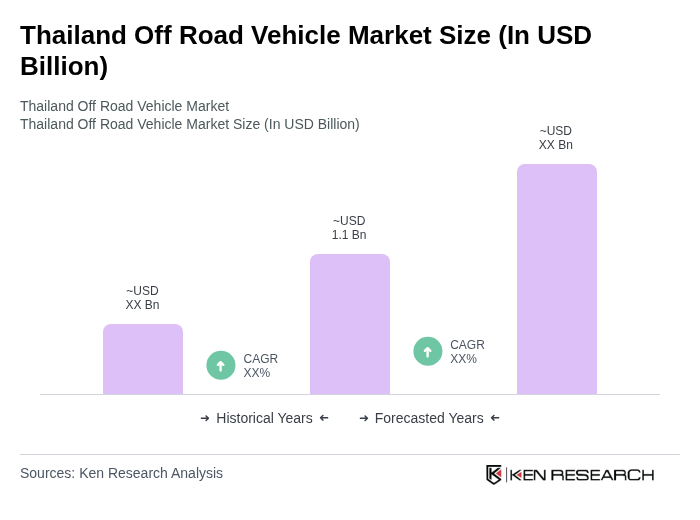
- The Thailand Off Road Vehicle Market is valued at USD 1.1 billion, based on a five-year historical analysis, taking into account dedicated 4WD UTV and broader off-road segments reported for Thailand and Asia-Pacific. This growth is primarily driven by increasing consumer interest in outdoor recreational activities, coupled with a rise in tourism and adventure sports, supported by Thailand’s strong tourism receipts and growing demand for adventure and nature-based experiences. The expanding infrastructure and road networks in rural areas, along with construction and agricultural mechanization, have also contributed to the demand for off-road vehicles, as they are essential for accessing remote locations and supporting utility tasks in challenging terrains.
- Key cities such as Bangkok, Chiang Mai, and Pattaya dominate the market due to their vibrant tourism sectors and outdoor recreational opportunities, including organized off-road tours, trail riding, and nature excursions that increasingly use ATVs, UTVs, and off-road motorcycles as part of the experience. The increasing number of adventure tourism operators and tour companies in these regions has led to a higher demand for off-road vehicles, as they are essential for activities like off-road tours and safaris, eco?tourism rides, and rural sightseeing, further driving market growth.
- In 2023, the Thai government strengthened the policy framework to promote environmentally friendly vehicles, including off-road platforms, under measures such as the Promotion Measures for the Use of Electric Vehicles (EV3) and related incentive packages administered by the Office of the Board of Investment (BOI) and the National Electric Vehicle Policy Committee. These measures provide tax incentives and investment support for manufacturers of electric and hybrid vehicles, including light utility and specialty vehicles, aiming to reduce transport-related emissions and support more sustainable tourism and logistics applications, thereby encouraging the gradual introduction of electric off-road models into the Thai market.
Thailand Off Road Vehicle Market Segmentation
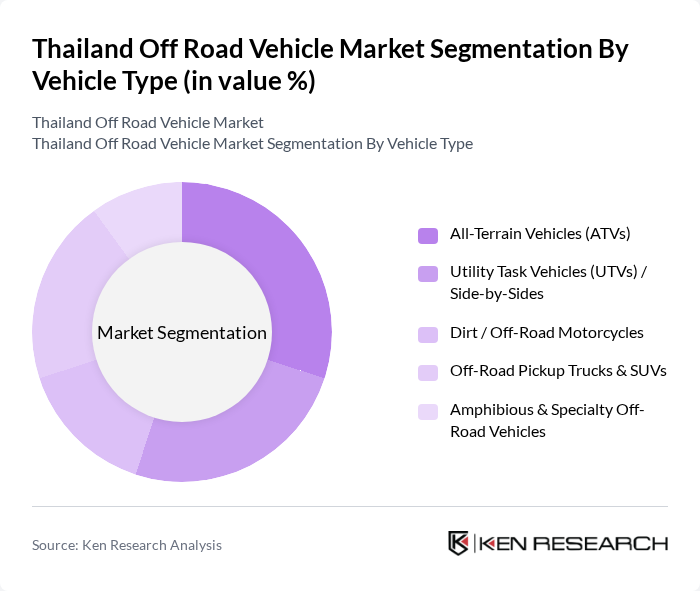
By Vehicle Type:The vehicle type segmentation includes All-Terrain Vehicles (ATVs), Utility Task Vehicles (UTVs) / Side-by-Sides, Dirt / Off-Road Motorcycles, Off-Road Pickup Trucks & SUVs, and Amphibious & Specialty Off-Road Vehicles. This structure aligns with global off-road classifications, where ATVs and UTVs are treated as distinct recreational and utility segments, alongside off-road motorcycles and light trucks. The ATV segment is particularly popular among recreational users for trail riding, beach and jungle tours, and motorsports activities. UTVs are favored for their utility in agricultural, forestry, and industrial applications, as well as construction and site support, due to their higher payload, multi-passenger capacity, and suitability for rugged worksites. Off-road pickup trucks and SUVs are gaining traction due to their versatility for both everyday use and off-road excursions, supported by Thailand’s strong production and domestic use of pickup-based 4x4 models.
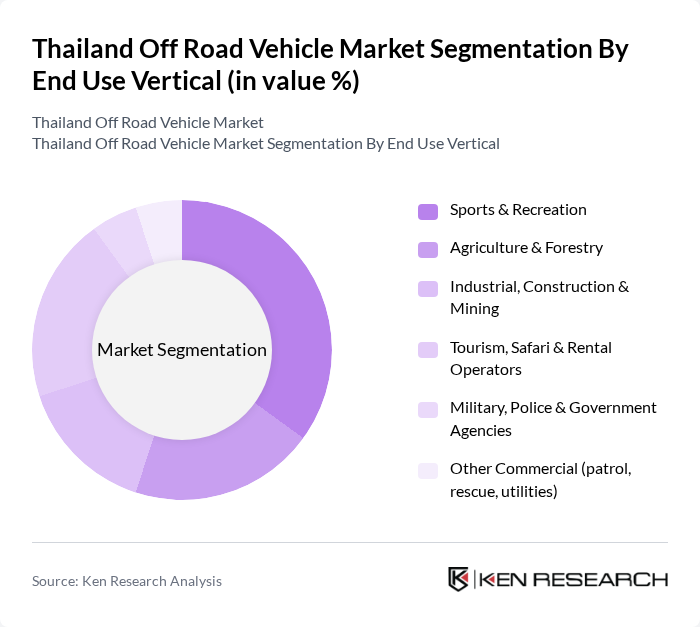
By End Use Vertical:The end-use vertical segmentation includes Sports & Recreation, Agriculture & Forestry, Industrial, Construction & Mining, Tourism, Safari & Rental Operators, Military, Police & Government Agencies, and Other Commercial (patrol, rescue, utilities). This segmentation is consistent with global off-road vehicle usage patterns, where sports and recreation, agriculture, construction, and tourism are the leading demand centers. The sports and recreation segment is witnessing significant growth due to the increasing popularity of off-road racing, trail and dune riding, and organized adventure tourism packages promoted across Asia-Pacific. The agricultural sector also contributes to the demand for utility vehicles, particularly in rural areas, where UTVs and small off-road platforms are used for farm transport, plantation operations, and estate management, complementing larger agricultural machinery.
Thailand Off Road Vehicle Market Competitive Landscape
The Thailand Off Road Vehicle Market is characterized by a dynamic mix of regional and international players. Leading participants such as Toyota Motor Thailand Co., Ltd., Honda Automobile (Thailand) Co., Ltd., Yamaha Motor Co., Ltd., Polaris Inc., Kawasaki Motors Enterprise (Thailand) Co., Ltd., BRP Inc. (Can-Am), Suzuki Motor (Thailand) Co., Ltd., Arctic Cat Inc., KTM AG, Mahindra & Mahindra Ltd., CFMOTO, John Deere (Thailand), TGB (Taiwan Golden Bee), Local and Regional Rental & Tour Operators (selected), Other Notable Emerging Players contribute to innovation, geographic expansion, and service delivery in this space, reflecting the broader global off-road vehicle competitive landscape in which brands like Polaris, BRP, Yamaha, Honda, and Arctic Cat hold significant shares.
Thailand Off Road Vehicle Market Industry Analysis
Growth Drivers
- Increasing Popularity of Off-Road Recreational Activities:The off-road recreational sector in Thailand has seen a significant rise, with over 1.5 million participants engaging in activities such as off-road biking and ATV riding in future. This growth is supported by a 20% increase in off-road event registrations, indicating a robust interest in outdoor adventures. The Thai government reported that outdoor recreational spending reached approximately THB 30 billion in future, further fueling demand for off-road vehicles.
- Expansion of Tourism and Adventure Sports:Thailand's tourism sector is projected to attract over 40 million visitors in future, with adventure tourism growing at a rate of 15% annually. This influx is driving demand for off-road vehicles, as tourists seek unique experiences. The Ministry of Tourism and Sports noted that adventure sports contribute around THB 12 billion to the economy, highlighting the potential for off-road vehicle rentals and tours, which are becoming increasingly popular among international visitors.
- Government Initiatives Promoting Off-Road Vehicle Usage:The Thai government has implemented several initiatives to promote off-road vehicle usage, including the establishment of designated off-road parks and trails. In future, the government allocated THB 500 million for infrastructure development in these areas. Additionally, tax incentives for off-road vehicle manufacturers have increased production by 10%, making vehicles more accessible to consumers and encouraging participation in off-road activities.
Market Challenges
- Regulatory Hurdles and Compliance Issues:The off-road vehicle market faces significant regulatory challenges, including stringent emission standards and safety regulations. In future, compliance costs for manufacturers rose by 15%, impacting profitability. Additionally, the lack of clear guidelines for off-road vehicle usage in national parks has led to confusion among consumers and businesses, hindering market growth. The government is currently reviewing these regulations to streamline compliance processes.
- High Initial Investment Costs:The high upfront costs associated with purchasing off-road vehicles remain a barrier for many potential buyers. The average price of a new off-road vehicle in Thailand is around THB 1.2 million, which is prohibitive for a significant portion of the population. Furthermore, financing options are limited, with only 30% of consumers able to secure loans for such purchases, thereby restricting market expansion and consumer participation.
Thailand Off Road Vehicle Market Future Outlook
The future of the Thailand off-road vehicle market appears promising, driven by increasing consumer interest in adventure tourism and recreational activities. As disposable incomes rise, more individuals are likely to invest in off-road vehicles. Additionally, the government's commitment to enhancing infrastructure and promoting eco-friendly practices will likely create a more favorable environment for market growth. Innovations in electric off-road vehicles and the expansion of rental services are expected to further stimulate demand, making off-road experiences more accessible to a broader audience.
Market Opportunities
- Growth in Electric Off-Road Vehicles:The shift towards electric vehicles is gaining momentum, with the Thai government aiming for 30% of all vehicles to be electric by future. This presents a significant opportunity for manufacturers to develop electric off-road vehicles, catering to environmentally conscious consumers. The market for electric off-road vehicles is projected to grow, with an estimated 10,000 units expected to be sold in future alone.
- Development of Off-Road Vehicle Accessories and Modifications:The demand for customization is on the rise, with consumers increasingly seeking unique modifications for their off-road vehicles. The accessories market is projected to reach THB 5 billion by future, driven by trends in personalization. Companies that offer innovative accessories and modification services can capitalize on this growing segment, enhancing customer satisfaction and loyalty.
Scope of the Report
| Segment | Sub-Segments |
|---|---|
| By Vehicle Type | All-Terrain Vehicles (ATVs) Utility Task Vehicles (UTVs) / Side-by-Sides Dirt / Off-Road Motorcycles Off-Road Pickup Trucks & SUVs Amphibious & Specialty Off-Road Vehicles |
| By End Use Vertical | Sports & Recreation Agriculture & Forestry Industrial, Construction & Mining Tourism, Safari & Rental Operators Military, Police & Government Agencies Other Commercial (patrol, rescue, utilities) |
| By Engine Displacement | Below 400 cc –800 cc Above 800 cc |
| By Propulsion / Fuel Type | Gasoline (ICE) Diesel (ICE) Battery Electric Hybrid / Plug-in Hybrid |
| By Application | Trail Riding & Adventure Tourism Agriculture & Plantation Operations Construction & Industrial Site Operations Utility, Patrol & Rescue Sports, Racing & Events |
| By Distribution Channel | Authorized Dealerships Independent Dealers Online Sales (OEM & Marketplaces) Fleet & Institutional Sales |
| By Price Band | Entry / Budget Mid-Range Premium & Performance |
Key Target Audience
Investors and Venture Capitalist Firms
Government and Regulatory Bodies (e.g., Department of Land Transport, Ministry of Transport)
Manufacturers and Producers
Distributors and Retailers
Automotive Parts Suppliers
Off-Road Vehicle Clubs and Associations
Event Organizers for Off-Road Competitions
Insurance Companies Specializing in Off-Road Vehicles
Players Mentioned in the Report:
Toyota Motor Thailand Co., Ltd.
Honda Automobile (Thailand) Co., Ltd.
Yamaha Motor Co., Ltd.
Polaris Inc.
Kawasaki Motors Enterprise (Thailand) Co., Ltd.
BRP Inc. (Can-Am)
Suzuki Motor (Thailand) Co., Ltd.
Arctic Cat Inc.
KTM AG
Mahindra & Mahindra Ltd.
CFMOTO
John Deere (Thailand)
TGB (Taiwan Golden Bee)
Local and Regional Rental & Tour Operators (selected)
Other Notable Emerging Players
Table of Contents
Market Assessment Phase
1. Executive Summary and Approach
2. Thailand Off Road Vehicle Market Overview
2.1 Key Insights and Strategic Recommendations
2.2 Thailand Off Road Vehicle Market Overview
2.3 Definition and Scope
2.4 Evolution of Market Ecosystem
2.5 Timeline of Key Regulatory Milestones
2.6 Value Chain & Stakeholder Mapping
2.7 Business Cycle Analysis
2.8 Policy & Incentive Landscape
3. Thailand Off Road Vehicle Market Analysis
3.1 Growth Drivers
3.1.1 Increasing popularity of off-road recreational activities
3.1.2 Expansion of tourism and adventure sports
3.1.3 Government initiatives promoting off-road vehicle usage
3.1.4 Rising disposable income among consumers
3.2 Market Challenges
3.2.1 Regulatory hurdles and compliance issues
3.2.2 High initial investment costs
3.2.3 Limited infrastructure for off-road activities
3.2.4 Environmental concerns and sustainability issues
3.3 Market Opportunities
3.3.1 Growth in electric off-road vehicles
3.3.2 Development of off-road vehicle accessories and modifications
3.3.3 Expansion into rural markets
3.3.4 Collaborations with tourism companies
3.4 Market Trends
3.4.1 Increasing demand for customization and personalization
3.4.2 Rise of online sales channels
3.4.3 Focus on sustainability and eco-friendly vehicles
3.4.4 Technological advancements in vehicle performance
3.5 Government Regulation
3.5.1 Emission standards for off-road vehicles
3.5.2 Safety regulations for vehicle manufacturing
3.5.3 Licensing requirements for off-road vehicle operators
3.5.4 Land use regulations for off-road activities
4. SWOT Analysis
5. Stakeholder Analysis
6. Porter's Five Forces Analysis
7. Thailand Off Road Vehicle Market Market Size, 2019-2024
7.1 By Value
7.2 By Volume
7.3 By Average Selling Price
8. Thailand Off Road Vehicle Market Segmentation
8.1 By Vehicle Type
8.1.1 All-Terrain Vehicles (ATVs)
8.1.2 Utility Task Vehicles (UTVs) / Side-by-Sides
8.1.3 Dirt / Off-Road Motorcycles
8.1.4 Off-Road Pickup Trucks & SUVs
8.1.5 Amphibious & Specialty Off-Road Vehicles
8.2 By End Use Vertical
8.2.1 Sports & Recreation
8.2.2 Agriculture & Forestry
8.2.3 Industrial, Construction & Mining
8.2.4 Tourism, Safari & Rental Operators
8.2.5 Military, Police & Government Agencies
8.2.6 Other Commercial (patrol, rescue, utilities)
8.3 By Engine Displacement
8.3.1 Below 400 cc
8.3.2 400–800 cc
8.3.3 Above 800 cc
8.4 By Propulsion / Fuel Type
8.4.1 Gasoline (ICE)
8.4.2 Diesel (ICE)
8.4.3 Battery Electric
8.4.4 Hybrid / Plug-in Hybrid
8.5 By Application
8.5.1 Trail Riding & Adventure Tourism
8.5.2 Agriculture & Plantation Operations
8.5.3 Construction & Industrial Site Operations
8.5.4 Utility, Patrol & Rescue
8.5.5 Sports, Racing & Events
8.6 By Distribution Channel
8.6.1 Authorized Dealerships
8.6.2 Independent Dealers
8.6.3 Online Sales (OEM & Marketplaces)
8.6.4 Fleet & Institutional Sales
8.7 By Price Band
8.7.1 Entry / Budget
8.7.2 Mid-Range
8.7.3 Premium & Performance
9. Thailand Off Road Vehicle Market Competitive Analysis
9.1 Market Share of Key Players
9.2 Cross Comparison of Key Players
9.2.1 Company Name
9.2.2 Group Size (global / regional / local)
9.2.3 Thailand Off-Road Vehicle Revenue (USD, latest year)
9.2.4 3-Year Revenue CAGR in Thailand Off-Road Segment
9.2.5 Off-Road Vehicle Unit Sales in Thailand (latest year)
9.2.6 Market Share in Thailand Off-Road Vehicle Market (%)
9.2.7 EBITDA Margin from Off-Road Vehicle Business (%)
9.2.8 Average Realized Selling Price per Vehicle (USD)
9.2.9 R&D Spend on Off-Road Portfolio (% of segment revenue)
9.2.10 Dealer Network Coverage in Thailand (no. of outlets)
9.2.11 Installed Production / Assembly Capacity in Thailand (units per year)
9.2.12 Export Share of Thailand-Produced Off-Road Vehicles (%)
9.3 SWOT Analysis of Top Players
9.4 Pricing Analysis
9.5 Detailed Profile of Major Companies
9.5.1 Toyota Motor Thailand Co., Ltd.
9.5.2 Honda Automobile (Thailand) Co., Ltd.
9.5.3 Yamaha Motor Co., Ltd.
9.5.4 Polaris Inc.
9.5.5 Kawasaki Motors Enterprise (Thailand) Co., Ltd.
9.5.6 BRP Inc. (Can-Am)
9.5.7 Suzuki Motor (Thailand) Co., Ltd.
9.5.8 Arctic Cat Inc.
9.5.9 KTM AG
9.5.10 Mahindra & Mahindra Ltd.
9.5.11 CFMOTO
9.5.12 John Deere (Thailand)
9.5.13 TGB (Taiwan Golden Bee)
9.5.14 Local and Regional Rental & Tour Operators (selected)
9.5.15 Other Notable Emerging Players
10. Thailand Off Road Vehicle Market End-User Analysis
10.1 Procurement Behavior of Key Ministries
10.1.1 Government procurement policies
10.1.2 Budget allocation for off-road vehicles
10.1.3 Decision-making processes
10.1.4 Supplier evaluation criteria
10.2 Corporate Spend on Infrastructure & Energy
10.2.1 Investment trends in off-road infrastructure
10.2.2 Corporate partnerships with vehicle manufacturers
10.2.3 Budgeting for maintenance and operations
10.2.4 Future spending forecasts
10.3 Pain Point Analysis by End-User Category
10.3.1 Challenges faced by recreational users
10.3.2 Issues for commercial users
10.3.3 Government agency concerns
10.3.4 Others
10.4 User Readiness for Adoption
10.4.1 Awareness of off-road vehicle benefits
10.4.2 Readiness to invest in off-road vehicles
10.4.3 Training and support needs
10.4.4 Others
10.5 Post-Deployment ROI and Use Case Expansion
10.5.1 Measurement of ROI post-purchase
10.5.2 Expansion into new use cases
10.5.3 Customer feedback and improvement
10.5.4 Others
11. Thailand Off Road Vehicle Market Future Size, 2025-2030
11.1 By Value
11.2 By Volume
11.3 By Average Selling Price
Go-To-Market Strategy Phase
1. Whitespace Analysis + Business Model Canvas
1.1 Market gaps and opportunities
1.2 Business model components
2. Marketing and Positioning Recommendations
2.1 Branding strategies
2.2 Product USPs
3. Distribution Plan
3.1 Urban retail vs rural NGO tie-ups
4. Channel & Pricing Gaps
4.1 Underserved routes
4.2 Pricing bands
5. Unmet Demand & Latent Needs
5.1 Category gaps
5.2 Consumer segments
6. Customer Relationship
6.1 Loyalty programs
6.2 After-sales service
7. Value Proposition
7.1 Sustainability
7.2 Integrated supply chains
8. Key Activities
8.1 Regulatory compliance
8.2 Branding
8.3 Distribution setup
9. Entry Strategy Evaluation
9.1 Domestic Market Entry Strategy
9.1.1 Product mix
9.1.2 Pricing band
9.1.3 Packaging
9.2 Export Entry Strategy
9.2.1 Target countries
9.2.2 Compliance roadmap
10. Entry Mode Assessment
10.1 JV
10.2 Greenfield
10.3 M&A
10.4 Distributor Model
11. Capital and Timeline Estimation
11.1 Capital requirements
11.2 Timelines
12. Control vs Risk Trade-Off
12.1 Ownership vs Partnerships
13. Profitability Outlook
13.1 Breakeven analysis
13.2 Long-term sustainability
14. Potential Partner List
14.1 Distributors
14.2 JVs
14.3 Acquisition targets
15. Execution Roadmap
15.1 Phased Plan for Market Entry
15.1.1 Market Setup
15.1.2 Market Entry
15.1.3 Growth Acceleration
15.1.4 Scale & Stabilize
15.2 Key Activities and Milestones
15.2.1 Milestone tracking
15.2.2 Activity scheduling
Research Methodology
Phase 1: Approach1
Desk Research
- Analysis of industry reports from automotive associations in Thailand
- Review of government publications on off-road vehicle regulations and policies
- Examination of market trends through online databases and trade journals
Primary Research
- Interviews with manufacturers and distributors of off-road vehicles
- Surveys targeting end-users, including recreational and professional off-road vehicle operators
- Focus groups with enthusiasts and community leaders in off-road vehicle clubs
Validation & Triangulation
- Cross-validation of findings with data from industry experts and market analysts
- Triangulation of insights from primary interviews and secondary data sources
- Sanity checks through expert panel discussions and feedback sessions
Phase 2: Market Size Estimation1
Top-down Assessment
- Estimation of market size based on national vehicle registration statistics
- Segmentation of the market by vehicle type, including ATVs, UTVs, and motorcycles
- Incorporation of growth rates from related sectors such as tourism and outdoor activities
Bottom-up Modeling
- Collection of sales data from leading off-road vehicle manufacturers in Thailand
- Estimation of average selling prices and unit sales across different vehicle categories
- Analysis of aftermarket sales, including parts and accessories for off-road vehicles
Forecasting & Scenario Analysis
- Multi-variable forecasting based on economic indicators and consumer trends
- Scenario analysis considering potential regulatory changes and environmental impacts
- Development of baseline, optimistic, and pessimistic market growth scenarios through 2030
Phase 3: CATI Sample Composition1
| Scope Item/Segment | Sample Size | Target Respondent Profiles |
|---|---|---|
| Recreational Off-Road Vehicle Users | 120 | Enthusiasts, Club Members, Event Participants |
| Commercial Off-Road Vehicle Operators | 90 | Fleet Managers, Business Owners, Operators |
| Dealers and Distributors | 80 | Sales Managers, Product Specialists, Retail Owners |
| Aftermarket Parts Suppliers | 70 | Supply Chain Managers, Product Development Leads |
| Regulatory and Policy Makers | 40 | Government Officials, Industry Regulators, Policy Analysts |
Frequently Asked Questions
What is the current value of the Thailand Off Road Vehicle Market?
The Thailand Off Road Vehicle Market is valued at approximately USD 1.1 billion, reflecting a robust growth driven by increasing consumer interest in outdoor recreational activities and adventure tourism, alongside expanding infrastructure in rural areas.
What types of off-road vehicles are popular in Thailand?
How does tourism impact the off-road vehicle market in Thailand?
What government initiatives support the off-road vehicle market in Thailand?
Other Regional/Country Reports
Other Adjacent Reports
Belgium Motorcycle Market
Qatar Automotive Accessories Market
Kuwait Recreational Vehicle Market Size, Share, Growth Drivers, Trends, Opportunities & Forecast 2025–2030Japan Outdoor Recreation Equipment Market
China Vehicle Rental Market Size, Share & Forecast, 2026–2032Vietnam Utility Vehicle Market
Why Buy From Us?

What makes us stand out is that our consultants follow Robust, Refine and Result (RRR) methodology. Robust for clear definitions, approaches and sanity checking, Refine for differentiating respondents' facts and opinions, and Result for presenting data with story.

We have set a benchmark in the industry by offering our clients with syndicated and customized market research reports featuring coverage of entire market as well as meticulous research and analyst insights.

While we don't replace traditional research, we flip the method upside down. Our dual approach of Top Bottom & Bottom Top ensures quality deliverable by not just verifying company fundamentals but also looking at the sector and macroeconomic factors.

With one step in the future, our research team constantly tries to show you the bigger picture. We help with some of the tough questions you may encounter along the way: How is the industry positioned? Best marketing channel? KPI's of competitors? By aligning every element, we help maximize success.

Our report gives you instant access to the answers and sources that other companies might choose to hide. We elaborate each steps of research methodology we have used and showcase you the sample size to earn your trust.

If you need any support, we are here! We pride ourselves on universe strength, data quality, and quick, friendly, and professional service.