About the Report
Base Year 2024Thailand Oil And Gas Market Overview
- The Thailand Oil and Gas Market is valued at USD 25 billion, based on a five-year historical analysis. This market value reflects the combined impact of increased energy demand, government-driven energy security initiatives, and sustained investments in exploration and production activities. The sector has experienced a steady influx of both domestic and foreign investments, particularly in upstream and downstream segments, supporting its ongoing expansion .
- Key operational hubs in this market include Bangkok, Rayong, and Songkhla, each benefiting from strategic locations and robust infrastructure. Bangkok functions as the economic and corporate center, Rayong is recognized for its concentration of refining and petrochemical industries, and Songkhla plays a pivotal role in offshore exploration and production due to its proximity to major oil and gas fields .
- Recent regulatory developments have emphasized sustainable energy practices and operational efficiency. The Thai government has updated its energy policy framework to require oil and gas companies to adopt environmentally friendly technologies and align with international standards, fostering innovation and compliance across the sector .

Thailand Oil And Gas Market Segmentation
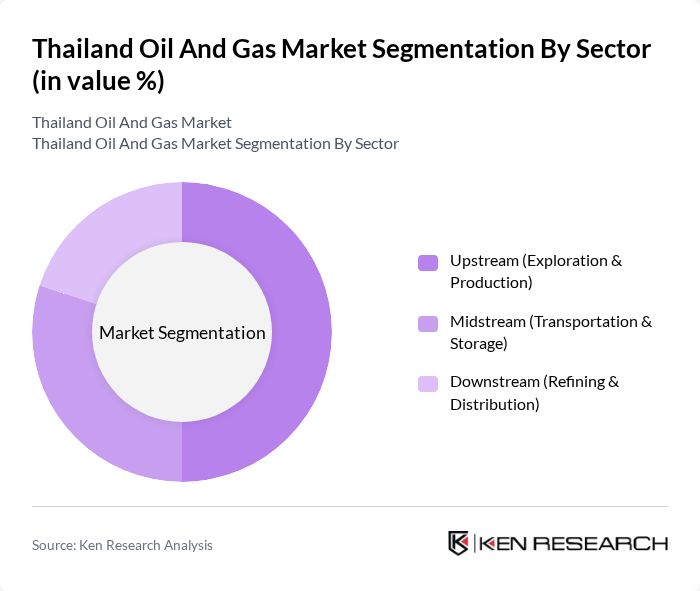
By Sector:The Thailand Oil and Gas Market is segmented into three main sectors: Upstream (Exploration & Production), Midstream (Transportation & Storage), and Downstream (Refining & Distribution). The upstream sector remains the most prominent, supported by ongoing exploration activities in the Gulf of Thailand and the strategic imperative of energy security. The midstream segment is focused on enhancing transportation and storage infrastructure to accommodate increased LNG imports and domestic distribution needs. The downstream sector is characterized by refinery upgrades and expanded distribution networks, serving both domestic and export markets .
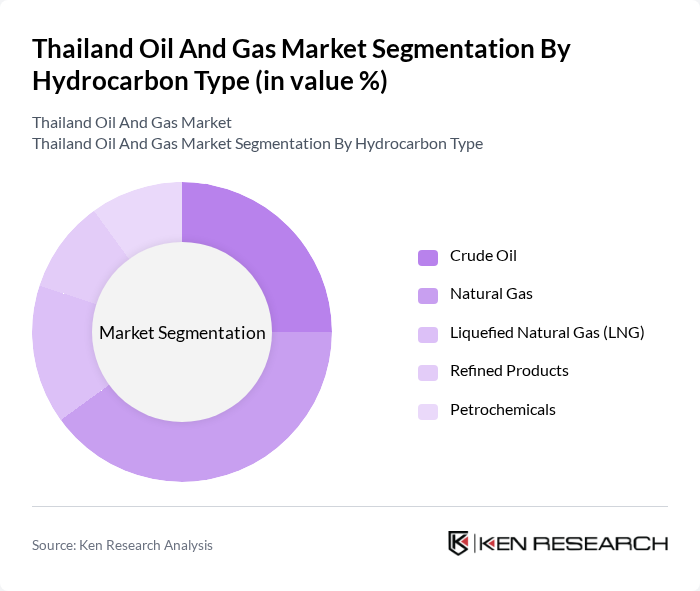
By Hydrocarbon Type:The market is further segmented by hydrocarbon type, including Crude Oil, Natural Gas, Liquefied Natural Gas (LNG), Refined Products, and Petrochemicals. Natural Gas is the leading segment, driven by the government's emphasis on cleaner energy and the rising demand for gas in power generation and transportation. Crude oil remains vital for refining and petrochemical feedstock, while LNG is increasingly important for energy diversification and security. Refined products and petrochemicals continue to support industrial and export activities .
Thailand Oil And Gas Market Competitive Landscape
The Thailand Oil And Gas Market is characterized by a dynamic mix of regional and international players. Leading participants such as PTT Public Company Limited, Chevron Thailand Exploration and Production, Ltd., PTTEP (PTT Exploration and Production Public Company Limited), Thai Oil Public Company Limited, Bangchak Corporation Public Company Limited, IRPC Public Company Limited, Shell Company of Thailand Limited, ExxonMobil Limited (Thailand), TotalEnergies EP Thailand, Hess Corporation (Thailand), CNOOC Thailand Limited, Mitsui Oil Exploration Co., Ltd. (MOECO), Eni Thailand B.V., ConocoPhillips Thailand, and MedcoEnergi Thailand contribute to innovation, geographic expansion, and service delivery in this space.
Thailand Oil And Gas Market Industry Analysis
Growth Drivers
- Increasing Energy Demand:Thailand's energy consumption is projected to reach 300 million tons of oil equivalent (Mtoe) in future, driven by industrial growth and urbanization. The country's GDP growth rate is expected to be around 4.0% in future, further fueling energy needs. The rising population, estimated at approximately 71 million, contributes to a significant increase in electricity demand, which is anticipated to grow by 3.5% annually, necessitating a robust oil and gas supply to meet these requirements.
- Government Investment in Infrastructure:The Thai government plans to invest approximately $50 billion in energy infrastructure in future, focusing on enhancing oil and gas facilities. This investment includes the development of pipelines and refineries, which are crucial for improving supply chain efficiency. Additionally, the government aims to increase the capacity of natural gas power plants, which currently generate about approximately 60% of the country's electricity, thereby ensuring a stable energy supply for future growth.
- Technological Advancements in Exploration:Thailand's oil and gas sector is witnessing significant technological advancements, particularly in exploration and production. The adoption of advanced seismic imaging and drilling technologies has improved recovery rates, with enhanced oil recovery (EOR) techniques projected to increase output by 15% in future. This technological shift is supported by a growing number of partnerships with international firms, which are expected to invest around $2 billion in innovative exploration methods over the next few years.
Market Challenges
- Environmental Regulations:The oil and gas industry in Thailand faces stringent environmental regulations, which are becoming increasingly complex. The government has implemented laws that require companies to adhere to strict emissions standards, with penalties reaching up to $1 million for non-compliance. These regulations can hinder operational flexibility and increase costs, as companies must invest in cleaner technologies and processes to meet environmental standards while maintaining profitability.
- Volatility in Global Oil Prices:The Thai oil and gas market is significantly affected by fluctuations in global oil prices, which can vary widely due to geopolitical tensions and market dynamics. Oil prices fluctuated between $70 and $90 per barrel in recent periods, impacting local production costs and profitability. This volatility creates uncertainty for investors and can lead to reduced capital expenditure in exploration and production, ultimately affecting the market's growth trajectory.
Thailand Oil And Gas Market Future Outlook
The Thailand oil and gas market is poised for transformation as it adapts to evolving energy demands and regulatory landscapes. With a focus on cleaner energy sources and technological innovations, the sector is expected to enhance operational efficiencies and reduce environmental impacts. Strategic partnerships with international firms will likely drive investment in advanced exploration techniques. Additionally, the government's commitment to infrastructure development will support the growth of natural gas usage, positioning Thailand as a key player in the regional energy landscape in future.
Market Opportunities
- Expansion of Natural Gas Usage:The Thai government aims to increase the share of natural gas in the energy mix to approximately 60% in future, driven by its cleaner-burning properties. This shift presents opportunities for investment in LNG infrastructure, with projected investments of $10 billion to develop new terminals and pipelines, enhancing energy security and reducing reliance on coal.
- Development of Offshore Resources:Thailand's offshore oil and gas reserves are estimated at approximately 0.4 billion barrels of oil equivalent. The government is encouraging exploration in these areas, with plans to auction new exploration licenses in future. This initiative is expected to attract significant foreign investment, estimated at $3 billion, fostering growth in the sector and increasing domestic production capabilities.
Scope of the Report
| Segment | Sub-Segments |
|---|---|
| By Sector | Upstream (Exploration & Production) Midstream (Transportation & Storage) Downstream (Refining & Distribution) |
| By Hydrocarbon Type | Crude Oil Natural Gas Liquefied Natural Gas (LNG) Refined Products Petrochemicals |
| By End-User Industry | Power Generation Transportation Industrial Residential & Commercial |
| By Region | Gulf of Thailand (Offshore) Central Thailand (Onshore) Northeastern Thailand (Onshore) |
| By Investment Source | Domestic Investment Foreign Direct Investment (FDI) Public-Private Partnerships (PPP) Government Schemes |
| By Distribution Mode | Pipeline Tanker Rail Truck |
| By Pricing Strategy | Cost-Plus Pricing Market-Oriented Pricing Value-Based Pricing |
| By Policy Support | Subsidies Tax Exemptions Regulatory Support Others |
Key Target Audience
Investors and Venture Capitalist Firms
Government and Regulatory Bodies (e.g., Ministry of Energy, Energy Policy and Planning Office)
Oil and Gas Exploration and Production Companies
Refining and Petrochemical Companies
Pipeline and Infrastructure Operators
Environmental and Safety Regulatory Agencies (e.g., Pollution Control Department)
Energy Trading Companies
Local and Regional Oil and Gas Associations
Players Mentioned in the Report:
PTT Public Company Limited
Chevron Thailand Exploration and Production, Ltd.
PTTEP (PTT Exploration and Production Public Company Limited)
Thai Oil Public Company Limited
Bangchak Corporation Public Company Limited
IRPC Public Company Limited
Shell Company of Thailand Limited
ExxonMobil Limited (Thailand)
TotalEnergies EP Thailand
Hess Corporation (Thailand)
CNOOC Thailand Limited
Mitsui Oil Exploration Co., Ltd. (MOECO)
Eni Thailand B.V.
ConocoPhillips Thailand
MedcoEnergi Thailand
Table of Contents
Market Assessment Phase
1. Executive Summary and Approach
2. Thailand Oil And Gas Market Overview
2.1 Key Insights and Strategic Recommendations
2.2 Thailand Oil And Gas Market Overview
2.3 Definition and Scope
2.4 Evolution of Market Ecosystem
2.5 Timeline of Key Regulatory Milestones
2.6 Value Chain & Stakeholder Mapping
2.7 Business Cycle Analysis
2.8 Policy & Incentive Landscape
3. Thailand Oil And Gas Market Analysis
3.1 Growth Drivers
3.1.1 Increasing Energy Demand
3.1.2 Government Investment in Infrastructure
3.1.3 Technological Advancements in Exploration
3.1.4 Foreign Direct Investment (FDI) Opportunities
3.2 Market Challenges
3.2.1 Environmental Regulations
3.2.2 Volatility in Global Oil Prices
3.2.3 Infrastructure Limitations
3.2.4 Competition from Renewable Energy Sources
3.3 Market Opportunities
3.3.1 Expansion of Natural Gas Usage
3.3.2 Development of Offshore Resources
3.3.3 Enhanced Oil Recovery Techniques
3.3.4 Strategic Partnerships with International Firms
3.4 Market Trends
3.4.1 Shift Towards Cleaner Energy Sources
3.4.2 Digital Transformation in Operations
3.4.3 Increased Focus on Sustainability
3.4.4 Rising Investment in LNG Infrastructure
3.5 Government Regulation
3.5.1 Energy Policy Framework
3.5.2 Environmental Protection Laws
3.5.3 Tax Incentives for Oil and Gas Exploration
3.5.4 Licensing and Permitting Requirements
4. SWOT Analysis
5. Stakeholder Analysis
6. Porter's Five Forces Analysis
7. Thailand Oil And Gas Market Market Size, 2019-2024
7.1 By Value
7.2 By Volume
7.3 By Average Selling Price
8. Thailand Oil And Gas Market Segmentation
8.1 By Sector
8.1.1 Upstream (Exploration & Production)
8.1.2 Midstream (Transportation & Storage)
8.1.3 Downstream (Refining & Distribution)
8.2 By Hydrocarbon Type
8.2.1 Crude Oil
8.2.2 Natural Gas
8.2.3 Liquefied Natural Gas (LNG)
8.2.4 Refined Products
8.2.5 Petrochemicals
8.3 By End-User Industry
8.3.1 Power Generation
8.3.2 Transportation
8.3.3 Industrial
8.3.4 Residential & Commercial
8.4 By Region
8.4.1 Gulf of Thailand (Offshore)
8.4.2 Central Thailand (Onshore)
8.4.3 Northeastern Thailand (Onshore)
8.5 By Investment Source
8.5.1 Domestic Investment
8.5.2 Foreign Direct Investment (FDI)
8.5.3 Public-Private Partnerships (PPP)
8.5.4 Government Schemes
8.6 By Distribution Mode
8.6.1 Pipeline
8.6.2 Tanker
8.6.3 Rail
8.6.4 Truck
8.7 By Pricing Strategy
8.7.1 Cost-Plus Pricing
8.7.2 Market-Oriented Pricing
8.7.3 Value-Based Pricing
8.8 By Policy Support
8.8.1 Subsidies
8.8.2 Tax Exemptions
8.8.3 Regulatory Support
8.8.4 Others
9. Thailand Oil And Gas Market Competitive Analysis
9.1 Market Share of Key Players
9.2 KPIs for Cross Comparison of Key Players
9.2.1 Company Name
9.2.2 Group Size (Large, Medium, or Small as per industry convention)
9.2.3 Annual Revenue (USD)
9.2.4 Revenue Growth Rate (%)
9.2.5 Market Share (%)
9.2.6 Production Volume (Barrels of Oil Equivalent per Day)
9.2.7 Reserve Replacement Ratio
9.2.8 Refining Capacity (Barrels per Day)
9.2.9 LNG Import/Export Volume (Million Tonnes per Year)
9.2.10 Operational Efficiency Ratio (e.g., OPEX/BOE)
9.2.11 Return on Investment (ROI)
9.2.12 Capital Expenditure (CAPEX)
9.2.13 Environmental Compliance Score
9.2.14 Digitalization Index
9.2.15 Customer Retention Rate (%)
9.3 SWOT Analysis of Top Players
9.4 Pricing Analysis
9.5 Detailed Profile of Major Companies
9.5.1 PTT Public Company Limited
9.5.2 Chevron Thailand Exploration and Production, Ltd.
9.5.3 PTTEP (PTT Exploration and Production Public Company Limited)
9.5.4 Thai Oil Public Company Limited
9.5.5 Bangchak Corporation Public Company Limited
9.5.6 IRPC Public Company Limited
9.5.7 Shell Company of Thailand Limited
9.5.8 ExxonMobil Limited (Thailand)
9.5.9 TotalEnergies EP Thailand
9.5.10 Hess Corporation (Thailand)
9.5.11 CNOOC Thailand Limited
9.5.12 Mitsui Oil Exploration Co., Ltd. (MOECO)
9.5.13 Eni Thailand B.V.
9.5.14 ConocoPhillips Thailand
9.5.15 MedcoEnergi Thailand
10. Thailand Oil And Gas Market End-User Analysis
10.1 Procurement Behavior of Key Ministries
10.1.1 Ministry of Energy
10.1.2 Ministry of Industry
10.1.3 Ministry of Natural Resources and Environment
10.2 Corporate Spend on Infrastructure & Energy
10.2.1 Investment Trends
10.2.2 Budget Allocations
10.2.3 Project Prioritization
10.3 Pain Point Analysis by End-User Category
10.3.1 Cost Management
10.3.2 Supply Chain Disruptions
10.3.3 Regulatory Compliance
10.4 User Readiness for Adoption
10.4.1 Technology Adoption Rates
10.4.2 Training and Development Needs
10.5 Post-Deployment ROI and Use Case Expansion
10.5.1 Performance Metrics
10.5.2 Future Investment Plans
11. Thailand Oil And Gas Market Future Size, 2025-2030
11.1 By Value
11.2 By Volume
11.3 By Average Selling Price
Go-To-Market Strategy Phase
1. Whitespace Analysis + Business Model Canvas
1.1 Market Gaps Identification
1.2 Business Model Development
2. Marketing and Positioning Recommendations
2.1 Branding Strategies
2.2 Product USPs
3. Distribution Plan
3.1 Urban Retail vs Rural NGO Tie-ups
4. Channel & Pricing Gaps
4.1 Underserved Routes
4.2 Pricing Bands
5. Unmet Demand & Latent Needs
5.1 Category Gaps
5.2 Consumer Segments
6. Customer Relationship
6.1 Loyalty Programs
6.2 After-sales Service
7. Value Proposition
7.1 Sustainability
7.2 Integrated Supply Chains
8. Key Activities
8.1 Regulatory Compliance
8.2 Branding
8.3 Distribution Setup
9. Entry Strategy Evaluation
9.1 Domestic Market Entry Strategy
9.1.1 Product Mix
9.1.2 Pricing Band
9.1.3 Packaging
9.2 Export Entry Strategy
9.2.1 Target Countries
9.2.2 Compliance Roadmap
10. Entry Mode Assessment
10.1 Joint Ventures
10.2 Greenfield Investments
10.3 Mergers & Acquisitions
10.4 Distributor Model
11. Capital and Timeline Estimation
11.1 Capital Requirements
11.2 Timelines
12. Control vs Risk Trade-Off
12.1 Ownership vs Partnerships
13. Profitability Outlook
13.1 Breakeven Analysis
13.2 Long-term Sustainability
14. Potential Partner List
14.1 Distributors
14.2 Joint Ventures
14.3 Acquisition Targets
15. Execution Roadmap
15.1 Phased Plan for Market Entry
15.1.1 Market Setup
15.1.2 Market Entry
15.1.3 Growth Acceleration
15.1.4 Scale & Stabilize
15.2 Key Activities and Milestones
15.2.1 Milestone Planning
15.2.2 Activity Tracking
Research Methodology
Phase 1: Approach1
Desk Research
- Analysis of government publications and reports from the Ministry of Energy in Thailand
- Review of industry reports from organizations such as the Energy Policy and Planning Office (EPPO)
- Examination of market trends and forecasts from reputable financial institutions and consultancy firms
Primary Research
- Interviews with executives from major oil and gas companies operating in Thailand
- Surveys conducted with industry experts and analysts specializing in the Southeast Asian energy sector
- Field interviews with regulatory bodies and environmental agencies involved in oil and gas oversight
Validation & Triangulation
- Cross-validation of data through multiple sources including trade publications and market analysis reports
- Triangulation of findings from primary interviews with secondary data insights
- Sanity checks performed through expert panel discussions to ensure data accuracy
Phase 2: Market Size Estimation1
Top-down Assessment
- Estimation of total market size based on national energy consumption statistics and oil import/export data
- Segmentation of the market by product type, including crude oil, natural gas, and refined products
- Incorporation of government energy policies and initiatives impacting market dynamics
Bottom-up Modeling
- Collection of production data from key oil and gas producers in Thailand
- Operational cost analysis based on financial reports from leading firms in the sector
- Volume and pricing analysis to establish a comprehensive market model
Forecasting & Scenario Analysis
- Utilization of econometric models to project future market trends based on historical data
- Scenario planning based on potential regulatory changes and global oil price fluctuations
- Development of baseline, optimistic, and pessimistic forecasts through 2030
Phase 3: CATI Sample Composition1
| Scope Item/Segment | Sample Size | Target Respondent Profiles |
|---|---|---|
| Upstream Oil Production | 60 | Exploration Managers, Production Engineers |
| Natural Gas Distribution | 50 | Distribution Managers, Regulatory Affairs Specialists |
| Refining Operations | 40 | Refinery Managers, Process Engineers |
| Environmental Compliance | 40 | Environmental Managers, Compliance Officers |
| Market Regulation Insights | 50 | Policy Analysts, Government Officials |
Frequently Asked Questions
What is the current value of the Thailand Oil and Gas Market?
The Thailand Oil and Gas Market is valued at approximately USD 25 billion, reflecting a combination of increased energy demand, government initiatives for energy security, and ongoing investments in exploration and production activities.
What are the key operational hubs in the Thailand Oil and Gas Market?
How is the Thailand Oil and Gas Market segmented?
What hydrocarbon types are prominent in the Thailand Oil and Gas Market?
Why Buy From Us?

What makes us stand out is that our consultants follow Robust, Refine and Result (RRR) methodology. Robust for clear definitions, approaches and sanity checking, Refine for differentiating respondents' facts and opinions, and Result for presenting data with story.

We have set a benchmark in the industry by offering our clients with syndicated and customized market research reports featuring coverage of entire market as well as meticulous research and analyst insights.

While we don't replace traditional research, we flip the method upside down. Our dual approach of Top Bottom & Bottom Top ensures quality deliverable by not just verifying company fundamentals but also looking at the sector and macroeconomic factors.

With one step in the future, our research team constantly tries to show you the bigger picture. We help with some of the tough questions you may encounter along the way: How is the industry positioned? Best marketing channel? KPI's of competitors? By aligning every element, we help maximize success.

Our report gives you instant access to the answers and sources that other companies might choose to hide. We elaborate each steps of research methodology we have used and showcase you the sample size to earn your trust.

If you need any support, we are here! We pride ourselves on universe strength, data quality, and quick, friendly, and professional service.