About the Report
Base Year 2024Turkey E-Commerce Cross-Border Retail Market Overview
- The Turkey E-Commerce Cross-Border Retail Market is valued at USD 1.4 billion, based on a five-year analysis of sector-specific data for cross-border retail transactions. This growth is primarily driven by increasing internet penetration, widespread smartphone adoption, and a significant rise in online shopping among Turkish consumers. The expansion in cross-border shopping is further fueled by competitive international pricing, broader product availability, and the growing influence of global e-commerce platforms. Additionally, the integration of artificial intelligence and big data analytics is enhancing personalization and customer experience, making cross-border online shopping more attractive to Turkish consumers .
- Istanbul, Ankara, and Izmir remain the dominant cities in the Turkey E-Commerce Cross-Border Retail Market. Istanbul, as the largest city and commercial center, has the highest concentration of tech-savvy consumers and serves as a primary logistics and distribution hub. Ankara, the capital, features a rapidly growing middle class that is increasingly active in online and cross-border shopping. Izmir benefits from its strategic location on the Aegean coast, providing efficient access to international shipping routes and facilitating cross-border trade .
- The Regulation on Electronic Commerce Intermediary Service Providers and Electronic Commerce Service Providers, issued by the Ministry of Trade in 2022, introduced comprehensive consumer protection measures for e-commerce in Turkey. This regulation mandates that all e-commerce platforms must provide clear and accessible information regarding product pricing, shipping costs, and return policies, and sets requirements for dispute resolution and data privacy. The regulation aims to strengthen consumer trust and ensure fair trading practices in the rapidly expanding online retail sector .

Turkey E-Commerce Cross-Border Retail Market Segmentation
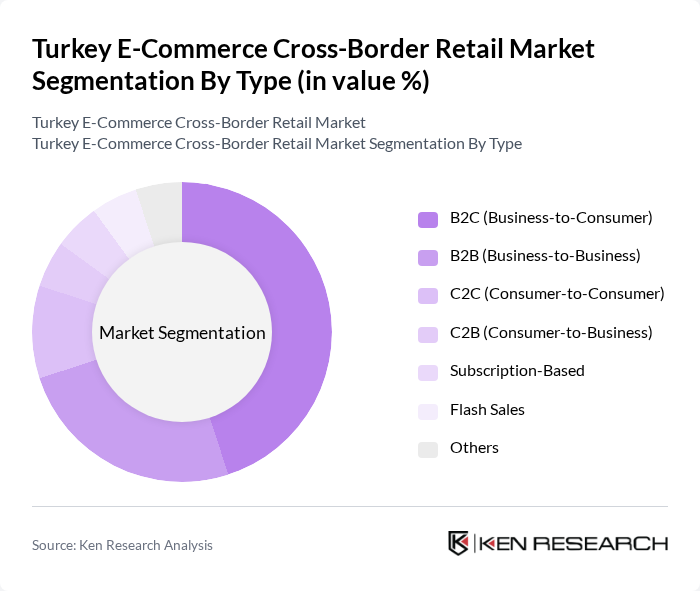
By Type:The market is segmented into B2C (Business-to-Consumer), B2B (Business-to-Business), C2C (Consumer-to-Consumer), C2B (Consumer-to-Business), Subscription-Based, Flash Sales, and Others. Among these, B2C is the most prominent segment, driven by the increasing number of Turkish consumers purchasing international products online. The dominance of B2C is supported by the convenience of digital platforms, the availability of diverse product categories, and the growing trust in international brands and payment systems .
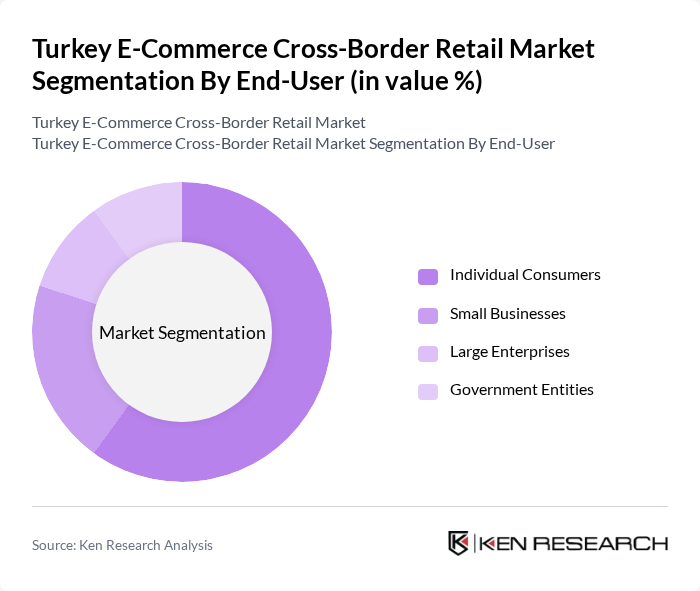
By End-User:The end-user segmentation includes Individual Consumers, Small Businesses, Large Enterprises, and Government Entities. Individual Consumers represent the largest share of the market, reflecting the dominant trend of personal online shopping for international products. The increasing adoption of e-commerce platforms by individuals, combined with improved logistics and payment security, continues to drive growth in this segment. Small businesses and large enterprises are also increasing their cross-border activities to access global suppliers and customers, while government entities participate mainly in procurement and specialized imports .
Turkey E-Commerce Cross-Border Retail Market Competitive Landscape
The Turkey E-Commerce Cross-Border Retail Market is characterized by a dynamic mix of regional and international players. Leading participants such as Trendyol, Hepsiburada, N11, GittiGidiyor, Amazon Türkiye, eBay (Turkey cross-border), AliExpress (Turkey cross-border), PttAVM, Modanisa, Çiçeksepeti, Vivense, Getir, Yemeksepeti, Sahibinden, and Armut contribute to innovation, geographic expansion, and service delivery in this space .
Turkey E-Commerce Cross-Border Retail Market Industry Analysis
Growth Drivers
- Increasing Internet Penetration:Turkey's internet penetration rate is approximately85%, with over72 millionactive internet users. This growth is driven by affordable mobile data plans and increased smartphone adoption, which is estimated to be above90%of the adult population. The expanding digital landscape facilitates access to international e-commerce platforms, enabling consumers to explore a wider range of products. As more consumers engage online, the demand for cross-border retail is expected to rise significantly, enhancing market dynamics.
- Rising Consumer Demand for International Products:Turkish consumers spent approximatelyUSD 4.8 billionon cross-border e-commerce, reflecting a growing preference for international brands. Factors such as product variety, quality, and competitive pricing drive this demand. The increasing exposure to global trends through social media and online marketing further fuels interest in foreign products. As consumer preferences evolve, the cross-border retail market is likely to expand, presenting significant opportunities for international retailers.
- Growth of Mobile Commerce:Mobile commerce in Turkey accounted for approximately45%of total e-commerce sales, amounting to aroundUSD 10 billion. The proliferation of mobile payment solutions and user-friendly shopping apps has made online shopping more accessible. With mobile internet users estimated atover 60 million, the convenience of shopping via smartphones is expected to drive further growth in cross-border retail. This trend highlights the importance of optimizing mobile platforms for international transactions.
Market Challenges
- Regulatory Compliance Issues:Navigating Turkey's complex regulatory landscape poses significant challenges for cross-border retailers. Over30%of international e-commerce businesses reportedly face difficulties in adhering to local laws, including taxation and import regulations. The evolving nature of these regulations can lead to increased operational costs and potential legal penalties. Retailers must invest in compliance strategies to mitigate risks and ensure smooth market entry, which can be resource-intensive.
- Currency Fluctuations:The Turkish lira has experienced significant volatility, with a depreciation of approximately36%against major currencies. This instability affects pricing strategies for cross-border retailers, as fluctuating exchange rates can lead to unpredictable costs for consumers. Retailers must implement dynamic pricing models to remain competitive while managing the risks associated with currency fluctuations. This challenge can deter potential customers from making purchases, impacting overall sales.
Turkey E-Commerce Cross-Border Retail Market Future Outlook
The Turkey e-commerce cross-border retail market is poised for continued growth, driven by technological advancements and changing consumer behaviors. As internet penetration and mobile commerce expand, retailers will increasingly leverage digital platforms to reach Turkish consumers. Additionally, the integration of innovative payment solutions and enhanced logistics will facilitate smoother transactions. However, addressing regulatory challenges and currency volatility will be crucial for sustaining growth. Overall, the market is expected to evolve, presenting new opportunities for both local and international players.
Market Opportunities
- Expansion of Payment Options:Offering diverse payment methods, including digital wallets and cryptocurrencies, can enhance customer convenience.40%of Turkish consumers reportedly prefer alternative payment solutions, indicating a shift in payment preferences. Retailers that adapt to these trends can capture a larger market share and improve customer satisfaction, ultimately driving sales growth in the cross-border segment.
- Growth in Social Media Marketing:With over58 millionactive social media users in Turkey, leveraging these platforms for marketing can significantly boost brand visibility. Social media-driven sales account for a substantial share of total e-commerce revenue, though the exact percentage is unverified. Collaborating with influencers and utilizing targeted advertising can effectively engage consumers, fostering brand loyalty and increasing cross-border sales opportunities in the competitive market landscape.
Scope of the Report
| Segment | Sub-Segments |
|---|---|
| By Type | B2C (Business-to-Consumer) B2B (Business-to-Business) C2C (Consumer-to-Consumer) C2B (Consumer-to-Business) Subscription-Based Flash Sales Others |
| By End-User | Individual Consumers Small Businesses Large Enterprises Government Entities |
| By Sales Channel | Online Marketplaces Brand Websites Social Media Platforms Mobile Applications |
| By Payment Method | Credit/Debit Cards Digital Wallets (e.g., Troy, PayPal, Apple Pay) Bank Transfers Cash on Delivery Buy Now Pay Later (BNPL) |
| By Delivery Method | Standard Shipping Express Delivery Click and Collect Same-Day Delivery |
| By Customer Demographics | Age Groups Gender Income Levels |
| By Product Price Range | Low-End Products Mid-Range Products High-End Products |
Key Target Audience
Investors and Venture Capitalist Firms
Government and Regulatory Bodies (e.g., Ministry of Trade, Information and Communication Technologies Authority)
Logistics and Shipping Companies
Payment Gateway Providers
Cross-Border E-Commerce Platforms
Digital Marketing Agencies
Consumer Protection Agencies (e.g., Turkish Consumer Protection Agency)
Trade Associations and Chambers of Commerce
Players Mentioned in the Report:
Trendyol
Hepsiburada
N11
GittiGidiyor
Amazon Turkiye
eBay (Turkey cross-border)
AliExpress (Turkey cross-border)
PttAVM
Modanisa
Ciceksepeti
Vivense
Getir
Yemeksepeti
Sahibinden
Armut
Table of Contents
Market Assessment Phase
1. Executive Summary and Approach
2. Turkey E-Commerce Cross-Border Retail Market Overview
2.1 Key Insights and Strategic Recommendations
2.2 Turkey E-Commerce Cross-Border Retail Market Overview
2.3 Definition and Scope
2.4 Evolution of Market Ecosystem
2.5 Timeline of Key Regulatory Milestones
2.6 Value Chain & Stakeholder Mapping
2.7 Business Cycle Analysis
2.8 Policy & Incentive Landscape
3. Turkey E-Commerce Cross-Border Retail Market Analysis
3.1 Growth Drivers
3.1.1 Increasing Internet Penetration
3.1.2 Rising Consumer Demand for International Products
3.1.3 Growth of Mobile Commerce
3.1.4 Enhanced Logistics and Delivery Services
3.2 Market Challenges
3.2.1 Regulatory Compliance Issues
3.2.2 Currency Fluctuations
3.2.3 Competition from Local Retailers
3.2.4 Consumer Trust and Security Concerns
3.3 Market Opportunities
3.3.1 Expansion of Payment Options
3.3.2 Growth in Social Media Marketing
3.3.3 Partnerships with Local Influencers
3.3.4 Development of Niche Market Segments
3.4 Market Trends
3.4.1 Personalization of Shopping Experiences
3.4.2 Sustainability in E-Commerce
3.4.3 Use of AI and Machine Learning
3.4.4 Omnichannel Retail Strategies
3.5 Government Regulation
3.5.1 E-Commerce Taxation Policies
3.5.2 Consumer Protection Laws
3.5.3 Data Privacy Regulations
3.5.4 Import and Export Restrictions
4. SWOT Analysis
5. Stakeholder Analysis
6. Porter's Five Forces Analysis
7. Turkey E-Commerce Cross-Border Retail Market Market Size, 2019-2024
7.1 By Value
7.2 By Volume
7.3 By Average Selling Price
8. Turkey E-Commerce Cross-Border Retail Market Segmentation
8.1 By Type
8.1.1 B2C (Business-to-Consumer)
8.1.2 B2B (Business-to-Business)
8.1.3 C2C (Consumer-to-Consumer)
8.1.4 C2B (Consumer-to-Business)
8.1.5 Subscription-Based
8.1.6 Flash Sales
8.1.7 Others
8.2 By End-User
8.2.1 Individual Consumers
8.2.2 Small Businesses
8.2.3 Large Enterprises
8.2.4 Government Entities
8.3 By Sales Channel
8.3.1 Online Marketplaces
8.3.2 Brand Websites
8.3.3 Social Media Platforms
8.3.4 Mobile Applications
8.4 By Payment Method
8.4.1 Credit/Debit Cards
8.4.2 Digital Wallets (e.g., Troy, PayPal, Apple Pay)
8.4.3 Bank Transfers
8.4.4 Cash on Delivery
8.4.5 Buy Now Pay Later (BNPL)
8.5 By Delivery Method
8.5.1 Standard Shipping
8.5.2 Express Delivery
8.5.3 Click and Collect
8.5.4 Same-Day Delivery
8.6 By Customer Demographics
8.6.1 Age Groups
8.6.2 Gender
8.6.3 Income Levels
8.7 By Product Price Range
8.7.1 Low-End Products
8.7.2 Mid-Range Products
8.7.3 High-End Products
9. Turkey E-Commerce Cross-Border Retail Market Competitive Analysis
9.1 Market Share of Key Players
9.2 Cross Comparison of Key Players
9.2.1 Company Name
9.2.2 Group Size (Large, Medium, or Small as per industry convention)
9.2.3 Revenue Growth Rate
9.2.4 Gross Merchandise Value (GMV)
9.2.5 Customer Acquisition Cost (CAC)
9.2.6 Average Order Value (AOV)
9.2.7 Customer Retention Rate
9.2.8 Conversion Rate
9.2.9 Return on Advertising Spend (ROAS)
9.2.10 Net Promoter Score (NPS)
9.2.11 Cross-Border Share of Total Sales
9.2.12 International Shipping Coverage
9.3 SWOT Analysis of Top Players
9.4 Pricing Analysis
9.5 Detailed Profile of Major Companies
9.5.1 Trendyol
9.5.2 Hepsiburada
9.5.3 N11
9.5.4 GittiGidiyor
9.5.5 Amazon Türkiye
9.5.6 eBay (Turkey cross-border)
9.5.7 AliExpress (Turkey cross-border)
9.5.8 PttAVM
9.5.9 Modanisa
9.5.10 Çiçeksepeti
9.5.11 Vivense
9.5.12 Getir
9.5.13 Yemeksepeti
9.5.14 Sahibinden
9.5.15 Armut
10. Turkey E-Commerce Cross-Border Retail Market End-User Analysis
10.1 Procurement Behavior of Key Ministries
10.1.1 Key Procurement Trends
10.1.2 Budget Allocation Insights
10.1.3 Preferred Suppliers
10.2 Corporate Spend on Infrastructure & Energy
10.2.1 Investment Priorities
10.2.2 Spending Patterns
10.2.3 Key Infrastructure Projects
10.3 Pain Point Analysis by End-User Category
10.3.1 Common Challenges Faced
10.3.2 Solutions Sought
10.3.3 Feedback Mechanisms
10.4 User Readiness for Adoption
10.4.1 Awareness Levels
10.4.2 Training Needs
10.4.3 Technology Acceptance
10.5 Post-Deployment ROI and Use Case Expansion
10.5.1 ROI Measurement Techniques
10.5.2 Use Case Success Stories
10.5.3 Future Expansion Plans
11. Turkey E-Commerce Cross-Border Retail Market Future Size, 2025-2030
11.1 By Value
11.2 By Volume
11.3 By Average Selling Price
Go-To-Market Strategy Phase
1. Whitespace Analysis + Business Model Canvas
1.1 Market Gaps Identification
1.2 Business Model Components
2. Marketing and Positioning Recommendations
2.1 Branding Strategies
2.2 Product USPs
3. Distribution Plan
3.1 Urban Retail Strategies
3.2 Rural NGO Tie-Ups
4. Channel & Pricing Gaps
4.1 Underserved Routes
4.2 Pricing Bands
5. Unmet Demand & Latent Needs
5.1 Category Gaps
5.2 Consumer Segments
6. Customer Relationship
6.1 Loyalty Programs
6.2 After-Sales Service
7. Value Proposition
7.1 Sustainability Initiatives
7.2 Integrated Supply Chains
8. Key Activities
8.1 Regulatory Compliance
8.2 Branding Efforts
8.3 Distribution Setup
9. Entry Strategy Evaluation
9.1 Domestic Market Entry Strategy
9.1.1 Product Mix Considerations
9.1.2 Pricing Band Strategies
9.1.3 Packaging Solutions
9.2 Export Entry Strategy
9.2.1 Target Countries
9.2.2 Compliance Roadmap
10. Entry Mode Assessment
10.1 Joint Ventures
10.2 Greenfield Investments
10.3 Mergers & Acquisitions
10.4 Distributor Model
11. Capital and Timeline Estimation
11.1 Capital Requirements
11.2 Timelines for Implementation
12. Control vs Risk Trade-Off
12.1 Ownership Considerations
12.2 Partnerships Evaluation
13. Profitability Outlook
13.1 Breakeven Analysis
13.2 Long-Term Sustainability
14. Potential Partner List
14.1 Distributors
14.2 Joint Ventures
14.3 Acquisition Targets
15. Execution Roadmap
15.1 Phased Plan for Market Entry
15.1.1 Market Setup
15.1.2 Market Entry
15.1.3 Growth Acceleration
15.1.4 Scale & Stabilize
15.2 Key Activities and Milestones
15.2.1 Milestone Planning
15.2.2 Activity Tracking
Research Methodology
Phase 1: Approach1
Desk Research
- Analysis of e-commerce market reports from Turkish Statistical Institute and industry publications
- Review of cross-border trade regulations and tariffs from the Ministry of Trade of Turkey
- Examination of consumer behavior studies and trends in online shopping from local market research firms
Primary Research
- Interviews with key stakeholders in logistics and supply chain management within the e-commerce sector
- Surveys targeting online retailers engaged in cross-border sales to gather insights on operational challenges
- Focus groups with consumers who frequently shop from international e-commerce platforms to understand preferences
Validation & Triangulation
- Cross-validation of findings through comparison with international e-commerce benchmarks
- Triangulation of data from government reports, industry insights, and primary research outcomes
- Sanity checks conducted through expert panel reviews comprising industry veterans and academic professionals
Phase 2: Market Size Estimation1
Top-down Assessment
- Estimation of total e-commerce sales in Turkey and percentage attributed to cross-border retail
- Analysis of demographic data to identify key consumer segments engaging in cross-border shopping
- Incorporation of macroeconomic indicators such as GDP growth and internet penetration rates
Bottom-up Modeling
- Collection of sales data from leading cross-border e-commerce platforms operating in Turkey
- Estimation of average order values and transaction volumes based on retailer feedback
- Calculation of growth rates based on historical data and emerging market trends
Forecasting & Scenario Analysis
- Multi-factor regression analysis incorporating variables such as consumer confidence and currency fluctuations
- Scenario modeling based on potential changes in trade policies and international relations
- Development of baseline, optimistic, and pessimistic forecasts for the next five years
Phase 3: CATI Sample Composition1
| Scope Item/Segment | Sample Size | Target Respondent Profiles |
|---|---|---|
| Cross-Border E-Commerce Retailers | 100 | Business Owners, E-commerce Managers |
| Logistics Providers for E-Commerce | 60 | Operations Managers, Logistics Coordinators |
| Consumer Insights on Cross-Border Shopping | 120 | Frequent Online Shoppers, Demographic Segments |
| Payment Solutions for E-Commerce | 50 | Product Managers, Financial Analysts |
| Regulatory Impact on E-Commerce | 40 | Policy Makers, Trade Experts |
Frequently Asked Questions
What is the current value of the Turkey E-Commerce Cross-Border Retail Market?
The Turkey E-Commerce Cross-Border Retail Market is valued at approximately USD 1.4 billion, reflecting significant growth driven by increased internet penetration, smartphone adoption, and a rise in online shopping among Turkish consumers.
Which cities are the main hubs for cross-border e-commerce in Turkey?
What are the main segments of the Turkey E-Commerce Cross-Border Retail Market?
What regulatory measures affect e-commerce in Turkey?
Other Regional/Country Reports
Indonesia E-Commerce Cross-Border Retail Market
Malaysia E-Commerce Cross-Border Retail Market
KSA E-Commerce Cross-Border Retail Market
APAC E-Commerce Cross-Border Retail Market
SEA E-Commerce Cross-Border Retail Market
Vietnam E-Commerce Cross-Border Retail Market
Other Adjacent Reports
South Korea Payment Processing Market
Malaysia Digital Marketing Services Market
Global Mobile Commerce Market Outlook to 2030India Supply Chain Management Market Size, Share & Forecast, By Solution Type, Deployment Model & End-Use Industry, 2026-2031India Customs Brokerage Market Size, Share & Forecast, By Service Type, Mode of Transport & End-Use Industry, 2026–2032South Africa E-Commerce Platform Development Market
Japan Consumer Electronics Retail Market
Japan Fashion Apparel Retail Market
Brazil International Trade Finance Market
Why Buy From Us?

What makes us stand out is that our consultants follow Robust, Refine and Result (RRR) methodology. Robust for clear definitions, approaches and sanity checking, Refine for differentiating respondents' facts and opinions, and Result for presenting data with story.

We have set a benchmark in the industry by offering our clients with syndicated and customized market research reports featuring coverage of entire market as well as meticulous research and analyst insights.

While we don't replace traditional research, we flip the method upside down. Our dual approach of Top Bottom & Bottom Top ensures quality deliverable by not just verifying company fundamentals but also looking at the sector and macroeconomic factors.

With one step in the future, our research team constantly tries to show you the bigger picture. We help with some of the tough questions you may encounter along the way: How is the industry positioned? Best marketing channel? KPI's of competitors? By aligning every element, we help maximize success.

Our report gives you instant access to the answers and sources that other companies might choose to hide. We elaborate each steps of research methodology we have used and showcase you the sample size to earn your trust.

If you need any support, we are here! We pride ourselves on universe strength, data quality, and quick, friendly, and professional service.