About the Report
Base Year 2024Listen to the audio summary
Canada Customs Brokerage Market Overview
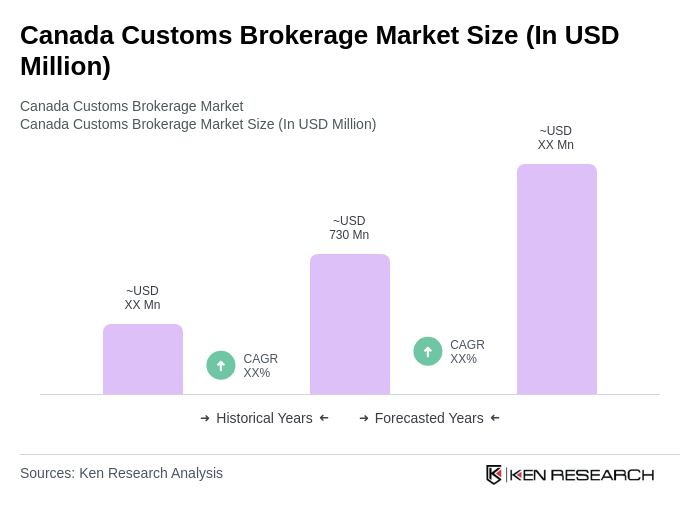
- The Canada Customs Brokerage Market is valued at USD 730 million, based on a five-year historical analysis. This growth is primarily driven by the increasing volume of international trade, the complexity of customs regulations, and the need for efficient logistics solutions. The rise in e-commerce and cross-border transactions has further fueled demand for customs brokerage services, as businesses seek to navigate the intricacies of customs compliance and tariffs .
- Key players in this market include major cities such as Toronto, Vancouver, and Montreal, which serve as critical trade hubs due to their strategic locations and well-developed infrastructure. These cities benefit from proximity to major ports and airports, facilitating efficient import and export activities. Additionally, the presence of a diverse range of industries in these regions contributes to the high demand for customs brokerage services .
- Recent regulatory changes, including amendments to the Customs Act, have introduced stricter compliance requirements for importers and exporters. These regulations mandate enhanced documentation and reporting standards, aimed at improving trade security and compliance. As a result, businesses are increasingly relying on customs brokers to ensure adherence to these regulations, thereby driving growth in the customs brokerage market .
Canada Customs Brokerage Market Segmentation
By Service Type:
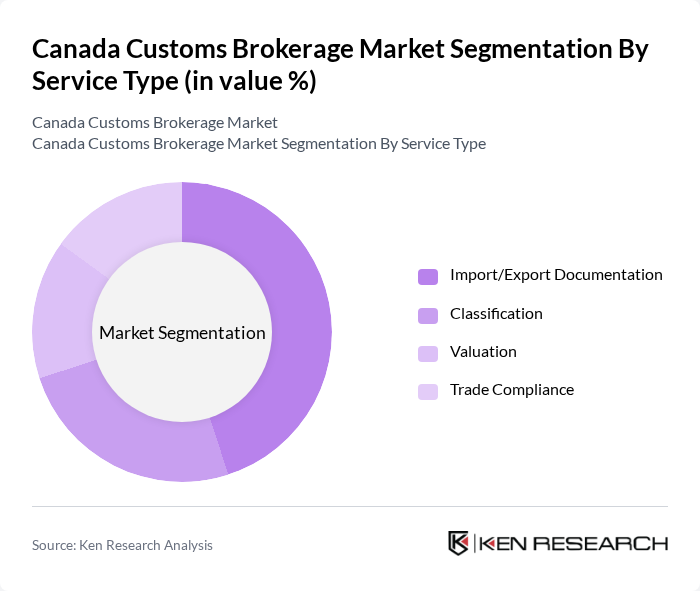
The service type segmentation includes Import/Export Documentation, Classification, Valuation, and Trade Compliance. Among these, Import/Export Documentation is the leading sub-segment, driven by the increasing complexity of international trade regulations and the need for accurate documentation to avoid delays and penalties. Businesses are prioritizing compliance and efficiency, leading to a higher demand for comprehensive documentation services. The growing e-commerce sector also contributes to this trend, as online retailers require robust customs documentation to facilitate smooth cross-border transactions .
By Mode of Transport:
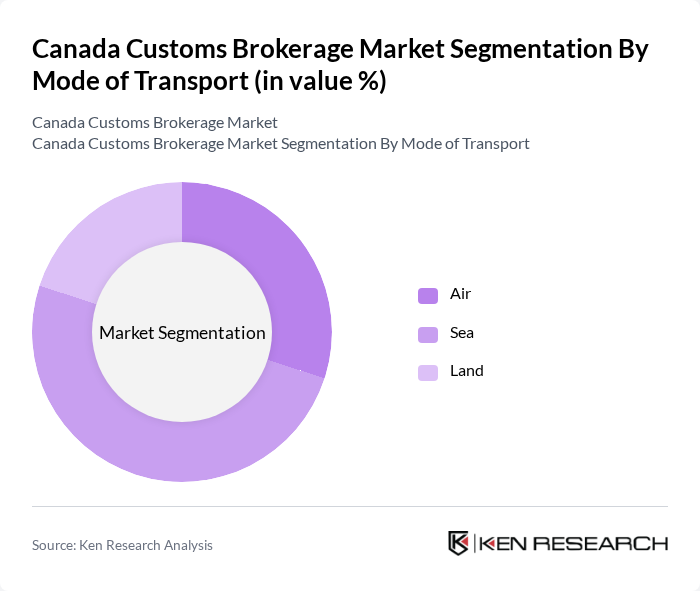
This segmentation includes Air, Sea, and Land transport modes. The Sea transport mode dominates the market, primarily due to its cost-effectiveness for bulk shipments and the increasing volume of goods transported internationally. The growth of global trade and the expansion of shipping routes have made sea transport a preferred choice for many businesses. Additionally, the rise of e-commerce has led to an increase in containerized shipping, further solidifying the dominance of this mode in the customs brokerage market .
Canada Customs Brokerage Market Competitive Landscape
The Canada Customs Brokerage Market is characterized by a dynamic mix of regional and international players. Leading participants such as Livingston International, Kuehne + Nagel, DB Schenker, Expeditors International, UPS Supply Chain Solutions, FedEx Trade Networks, DHL Global Forwarding, C.H. Robinson, A.N. Deringer, Farrow, Russell A. Farrow Limited, Cole International, Pacific Customs Brokers, Thompson Ahern International, GEODIS contribute to innovation, geographic expansion, and service delivery in this space .
Canada Customs Brokerage Market Industry Analysis
Growth Drivers
- Increasing Cross-Border Trade:The value of Canada’s cross-border trade reached approximately CAD 1.2 trillion in future, driven by strong demand for Canadian goods in the U.S. and Mexico. This growth is supported by the United States-Mexico-Canada Agreement (USMCA), which has streamlined trade processes. As trade volumes increase, customs brokerage services are essential for navigating complex regulations, ensuring compliance, and facilitating timely deliveries, thus driving market growth in the customs brokerage sector.
- E-commerce Growth:E-commerce sales in Canada surged to CAD 45 billion in future, reflecting a 20% increase from the previous year. This rapid growth in online shopping has led to a significant rise in cross-border shipments, necessitating efficient customs brokerage services. As consumers increasingly demand faster delivery times, customs brokers play a crucial role in expediting the clearance process, thereby capitalizing on the booming e-commerce market and enhancing their service offerings.
- Regulatory Changes Favoring Trade Facilitation:Recent amendments to the Customs Act have simplified various customs procedures, reducing clearance times by an average of 30%. These regulatory changes are designed to enhance trade facilitation and improve Canada’s competitiveness in global markets. As businesses adapt to these new regulations, the demand for customs brokerage services is expected to rise, as companies seek expertise in compliance and efficient logistics management to navigate the evolving landscape.
Market Challenges
- Complex Regulatory Environment:The Canadian customs landscape is characterized by intricate regulations that can vary significantly across provinces and territories. In future, over 1,000 regulatory changes were documented, creating challenges for customs brokers in maintaining compliance. This complexity can lead to delays and increased operational costs, as businesses must invest in training and resources to navigate the regulatory maze effectively, impacting overall market efficiency.
- Competition from Non-Traditional Players:The rise of technology-driven logistics companies has intensified competition in the customs brokerage market. In future, approximately 25% of customs clearance processes were handled by non-traditional players, such as tech startups offering automated solutions. This shift poses a challenge for established customs brokers, who must innovate and enhance their service offerings to retain clients and remain competitive in an increasingly digital landscape.
Canada Customs Brokerage Market Future Outlook
The Canada customs brokerage market is poised for significant transformation as technological advancements and regulatory reforms continue to shape the industry. The integration of automation and artificial intelligence in customs processes is expected to enhance efficiency and accuracy, reducing clearance times. Additionally, the growing emphasis on sustainability in logistics will drive demand for eco-friendly practices. As businesses increasingly seek compliance and efficiency, customs brokers will need to adapt to these trends to remain competitive and meet evolving client needs.
Market Opportunities
- Expansion of Free Trade Agreements:The ongoing negotiations for new free trade agreements present significant opportunities for customs brokers. With the potential to reduce tariffs and streamline trade processes, these agreements can enhance cross-border trade volumes. Customs brokers can leverage this environment by offering specialized services to help businesses navigate the complexities of new trade regulations and maximize their benefits.
- Adoption of Digital Solutions:The increasing adoption of digital solutions in logistics presents a lucrative opportunity for customs brokers. As businesses seek to enhance operational efficiency, the demand for digital platforms that facilitate real-time tracking and compliance will grow. Customs brokers can capitalize on this trend by integrating advanced technologies into their service offerings, providing clients with enhanced visibility and control over their shipments.
Scope of the Report
| Segment | Sub-Segments |
|---|---|
| By Service Type | Import/Export Documentation Classification Valuation Trade Compliance |
| By Mode of Transport | Air Sea Land |
| By End User | Personal Enterprise |
| By Industry Vertical | Retail Manufacturing E-commerce Automotive Pharmaceuticals Others |
| By Geographic Coverage | National Coverage Regional Coverage Local Coverage |
| By Client Type | Large Enterprises Medium Enterprises Small Enterprises |
| By Pricing Model | Fixed Pricing Variable Pricing Subscription-Based Pricing Others |
Key Target Audience
Investors and Venture Capitalist Firms
Government and Regulatory Bodies (e.g., Canada Border Services Agency, Transport Canada)
Importers and Exporters
Logistics and Supply Chain Companies
Customs Brokerage Firms
Freight Forwarders
Trade Compliance Specialists
Shipping and Transportation Companies
Players Mentioned in the Report:
Livingston International
Kuehne + Nagel
DB Schenker
Expeditors International
UPS Supply Chain Solutions
FedEx Trade Networks
DHL Global Forwarding
C.H. Robinson
A.N. Deringer
Farrow
Russell A. Farrow Limited
Cole International
Pacific Customs Brokers
Thompson Ahern International
GEODIS
Table of Contents
Market Assessment Phase
1. Executive Summary and Approach
2. Canada Customs Brokerage Market Overview
2.1 Key Insights and Strategic Recommendations
2.2 Canada Customs Brokerage Market Overview
2.3 Definition and Scope
2.4 Evolution of Market Ecosystem
2.5 Timeline of Key Regulatory Milestones
2.6 Value Chain & Stakeholder Mapping
2.7 Business Cycle Analysis
2.8 Policy & Incentive Landscape
3. Canada Customs Brokerage Market Analysis
3.1 Growth Drivers
3.1.1 Increasing Cross-Border Trade
3.1.2 E-commerce Growth
3.1.3 Regulatory Changes Favoring Trade Facilitation
3.1.4 Technological Advancements in Logistics
3.2 Market Challenges
3.2.1 Complex Regulatory Environment
3.2.2 Competition from Non-Traditional Players
3.2.3 Fluctuating Trade Policies
3.2.4 High Operational Costs
3.3 Market Opportunities
3.3.1 Expansion of Free Trade Agreements
3.3.2 Adoption of Digital Solutions
3.3.3 Growth in Small and Medium Enterprises
3.3.4 Increased Demand for Compliance Services
3.4 Market Trends
3.4.1 Rise of Automation in Customs Processes
3.4.2 Focus on Sustainability in Logistics
3.4.3 Integration of AI and Machine Learning
3.4.4 Shift Towards Real-Time Data Analytics
3.5 Government Regulation
3.5.1 Customs Act Amendments
3.5.2 Trade Facilitation Agreement Compliance
3.5.3 Import and Export Control Regulations
3.5.4 Anti-Dumping and Countervailing Measures
4. SWOT Analysis
5. Stakeholder Analysis
6. Porter's Five Forces Analysis
7. Canada Customs Brokerage Market Market Size, 2019-2024
7.1 By Value
7.2 By Volume
7.3 By Average Selling Price
8. Canada Customs Brokerage Market Segmentation
8.1 By Service Type
8.1.1 Import/Export Documentation
8.1.2 Classification
8.1.3 Valuation
8.1.4 Trade Compliance
8.2 By Mode of Transport
8.2.1 Air
8.2.2 Sea
8.2.3 Land
8.3 By End User
8.3.1 Personal
8.3.2 Enterprise
8.4 By Industry Vertical
8.4.1 Retail
8.4.2 Manufacturing
8.4.3 E-commerce
8.4.4 Automotive
8.4.5 Pharmaceuticals
8.4.6 Others
8.5 By Geographic Coverage
8.5.1 National Coverage
8.5.2 Regional Coverage
8.5.3 Local Coverage
8.6 By Client Type
8.6.1 Large Enterprises
8.6.2 Medium Enterprises
8.6.3 Small Enterprises
8.7 By Pricing Model
8.7.1 Fixed Pricing
8.7.2 Variable Pricing
8.7.3 Subscription-Based Pricing
8.7.4 Others
9. Canada Customs Brokerage Market Competitive Analysis
9.1 Market Share of Key Players
9.2 KPIs for Cross Comparison of Key Players
9.2.1 Company Name
9.2.2 Group Size (Large, Medium, or Small as per industry convention)
9.2.3 Annual Brokerage Revenue (CAD)
9.2.4 Number of Customs Entries Processed
9.2.5 Average Clearance Time (Hours)
9.2.6 Compliance Rate (%)
9.2.7 Customer Retention Rate (%)
9.2.8 Market Share (%)
9.2.9 Technology Adoption Level
9.2.10 Customer Satisfaction Score (NPS or Equivalent)
9.3 SWOT Analysis of Top Players
9.4 Pricing Analysis
9.5 Detailed Profile of Major Companies
9.5.1 Livingston International
9.5.2 Kuehne + Nagel
9.5.3 DB Schenker
9.5.4 Expeditors International
9.5.5 UPS Supply Chain Solutions
9.5.6 FedEx Trade Networks
9.5.7 DHL Global Forwarding
9.5.8 C.H. Robinson
9.5.9 A.N. Deringer
9.5.10 Farrow
9.5.11 Russell A. Farrow Limited
9.5.12 Cole International
9.5.13 Pacific Customs Brokers
9.5.14 Thompson Ahern International
9.5.15 GEODIS
10. Canada Customs Brokerage Market End-User Analysis
10.1 Procurement Behavior of Key Ministries
10.1.1 Ministry of Transport
10.1.2 Ministry of International Trade
10.1.3 Ministry of Finance
10.2 Corporate Spend on Infrastructure & Energy
10.2.1 Investment in Logistics Infrastructure
10.2.2 Spending on Compliance Technologies
10.2.3 Budget Allocation for Customs Services
10.3 Pain Point Analysis by End-User Category
10.3.1 Delays in Customs Clearance
10.3.2 High Compliance Costs
10.3.3 Lack of Transparency in Processes
10.4 User Readiness for Adoption
10.4.1 Awareness of Digital Solutions
10.4.2 Training and Skill Development Needs
10.4.3 Infrastructure Readiness
10.5 Post-Deployment ROI and Use Case Expansion
10.5.1 Measurement of Efficiency Gains
10.5.2 Expansion of Service Offerings
10.5.3 Long-term Cost Savings
11. Canada Customs Brokerage Market Future Size, 2025-2030
11.1 By Value
11.2 By Volume
11.3 By Average Selling Price
Go-To-Market Strategy Phase
1. Whitespace Analysis + Business Model Canvas
1.1 Market Gaps Identification
1.2 Value Proposition Development
1.3 Revenue Streams Analysis
1.4 Cost Structure Evaluation
1.5 Key Partnerships Exploration
1.6 Customer Segmentation
1.7 Channels of Distribution
2. Marketing and Positioning Recommendations
2.1 Branding Strategies
2.2 Product USPs
3. Distribution Plan
3.1 Urban Retail vs Rural NGO Tie-ups
4. Channel & Pricing Gaps
4.1 Underserved Routes
4.2 Pricing Bands
5. Unmet Demand & Latent Needs
5.1 Category Gaps
5.2 Consumer Segments
6. Customer Relationship
6.1 Loyalty Programs
6.2 After-Sales Service
7. Value Proposition
7.1 Sustainability
7.2 Integrated Supply Chains
8. Key Activities
8.1 Regulatory Compliance
8.2 Branding
8.3 Distribution Setup
9. Entry Strategy Evaluation
9.1 Domestic Market Entry Strategy
9.1.1 Product Mix
9.1.2 Pricing Band
9.1.3 Packaging
9.2 Export Entry Strategy
9.2.1 Target Countries
9.2.2 Compliance Roadmap
10. Entry Mode Assessment
10.1 JV
10.2 Greenfield
10.3 M&A
10.4 Distributor Model
11. Capital and Timeline Estimation
11.1 Capital Requirements
11.2 Timelines
12. Control vs Risk Trade-Off
12.1 Ownership vs Partnerships
13. Profitability Outlook
13.1 Breakeven Analysis
13.2 Long-term Sustainability
14. Potential Partner List
14.1 Distributors
14.2 JVs
14.3 Acquisition Targets
15. Execution Roadmap
15.1 Phased Plan for Market Entry
15.1.1 Market Setup
15.1.2 Market Entry
15.1.3 Growth Acceleration
15.1.4 Scale & Stabilize
15.2 Key Activities and Milestones
15.2.1 Activity Planning
15.2.2 Milestone Tracking
Research Methodology
Phase 1: Approach1
Desk Research
- Analysis of trade statistics from the Canada Border Services Agency (CBSA)
- Review of industry reports from the Canadian International Freight Forwarders Association (CIFFA)
- Examination of regulatory frameworks and compliance guidelines from the Canada Customs and Revenue Agency (CCRA)
Primary Research
- Interviews with customs brokers and logistics service providers across Canada
- Surveys targeting import/export managers in various industries
- Field interviews with compliance officers in multinational corporations
Validation & Triangulation
- Cross-validation of findings with data from industry associations and government publications
- Triangulation of insights from primary interviews with secondary data trends
- Sanity checks through expert panel discussions with industry veterans
Phase 2: Market Size Estimation1
Top-down Assessment
- Estimation of market size based on national import/export volumes and customs duties
- Segmentation by industry verticals such as retail, manufacturing, and agriculture
- Incorporation of trends in e-commerce and cross-border trade growth
Bottom-up Modeling
- Analysis of revenue data from leading customs brokerage firms
- Operational cost assessments based on service pricing models
- Volume estimates derived from transaction data and service frequency
Forecasting & Scenario Analysis
- Multi-variable regression analysis incorporating trade agreements and tariffs
- Scenario modeling based on potential changes in customs regulations
- Baseline, optimistic, and pessimistic forecasts through 2030
Phase 3: CATI Sample Composition1
| Scope Item/Segment | Sample Size | Target Respondent Profiles |
|---|---|---|
| Customs Brokerage Services | 60 | Customs Brokers, Compliance Managers |
| Import/Export Operations | 50 | Logistics Coordinators, Supply Chain Managers |
| Regulatory Compliance | 40 | Legal Advisors, Regulatory Affairs Specialists |
| Trade Policy Impact | 40 | Policy Analysts, Trade Economists |
| E-commerce Logistics | 45 | eCommerce Managers, Operations Directors |
Frequently Asked Questions
What is the current value of the Canada Customs Brokerage Market?
The Canada Customs Brokerage Market is valued at approximately USD 730 million, reflecting growth driven by increasing international trade, complex customs regulations, and the rising demand for efficient logistics solutions, particularly in e-commerce and cross-border transactions.
What factors are driving growth in the Canada Customs Brokerage Market?
Which cities are major hubs for customs brokerage services in Canada?
What are the main service types offered in the Canada Customs Brokerage Market?
Why Buy From Us?

What makes us stand out is that our consultants follow Robust, Refine and Result (RRR) methodology. Robust for clear definitions, approaches and sanity checking, Refine for differentiating respondents' facts and opinions, and Result for presenting data with story.

We have set a benchmark in the industry by offering our clients with syndicated and customized market research reports featuring coverage of entire market as well as meticulous research and analyst insights.

While we don't replace traditional research, we flip the method upside down. Our dual approach of Top Bottom & Bottom Top ensures quality deliverable by not just verifying company fundamentals but also looking at the sector and macroeconomic factors.

With one step in the future, our research team constantly tries to show you the bigger picture. We help with some of the tough questions you may encounter along the way: How is the industry positioned? Best marketing channel? KPI's of competitors? By aligning every element, we help maximize success.

Our report gives you instant access to the answers and sources that other companies might choose to hide. We elaborate each steps of research methodology we have used and showcase you the sample size to earn your trust.

If you need any support, we are here! We pride ourselves on universe strength, data quality, and quick, friendly, and professional service.