UAE Decorative Rugs Market Report Size Share Growth Drivers Trends Opportunities & Forecast 2025–2030

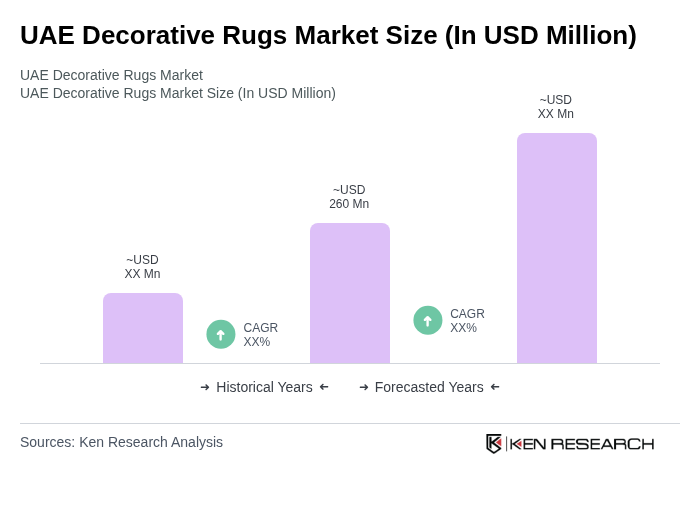
UAE decorative rugs market grows with interior decor and luxury hospitality demand, valued at USD 260M.

Region:Middle East

Author(s):Geetanshi

Product Code:KRAA0308

Pages:93

Published On:December 2025
About the Report

Base Year 2024

UAE Decorative Rugs Market Overview

  • The UAE Decorative Rugs Market is valued at USD 260 million, based on recent analysis. Growth is driven by increasing focus on interior decoration in residential and commercial spaces, rising disposable incomes, and tourism-led demand within luxury hospitality projects. The availability of diverse designs, materials, and customization options further fuels consumer interest. These factors collectively underpin robust demand for decorative rugs across the UAE’s design-conscious market.
  • Key players in this market include RAK Ceramics, Carpet Land, and IKEA, which influence market dynamics through diversified product offerings in flooring and home textiles. The UAE leads MEA market activity due to its affluent consumer base and strong logistics infrastructure, with regional trade hubs and cosmopolitan urban centers such as Dubai known for re-export capabilities and cultural design preferences that elevate rug consumption.
  • In 2024, the UAE government announced a regulatory framework requiring all decorative rugs to be registered with local authorities before sale. This initiative aims to ensure consumer safety, product quality, accurate labeling, and traceability, reinforcing compliance in the home décor sector and enhancing consumer trust in the market.
UAE Decorative Rugs Market Size

UAE Decorative Rugs Market Segmentation

By Type:The decorative rugs market is segmented into various types, including hand-knotted rugs, machine-made rugs, flatweave rugs, shag rugs, outdoor rugs, vintage rugs, and others. Among these, hand-knotted rugs are particularly popular due to their craftsmanship and unique designs, appealing to consumers looking for luxury and authenticity in their home décor. Machine-made rugs, on the other hand, cater to a broader audience with their affordability and variety, making them a significant segment in the market.
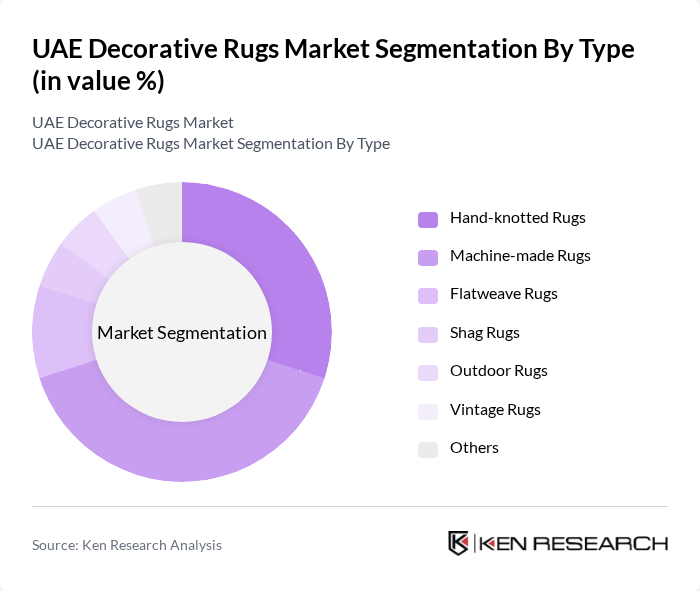
UAE Decorative Rugs Market segmentation by Type.

By End-User:The market is also segmented by end-user, which includes residential, commercial, hospitality, government & utilities, and others. The residential segment dominates the market as homeowners increasingly invest in decorative rugs to enhance their living spaces. The commercial and hospitality sectors are also significant contributors, driven by the demand for aesthetically pleasing environments in offices, hotels, and restaurants.
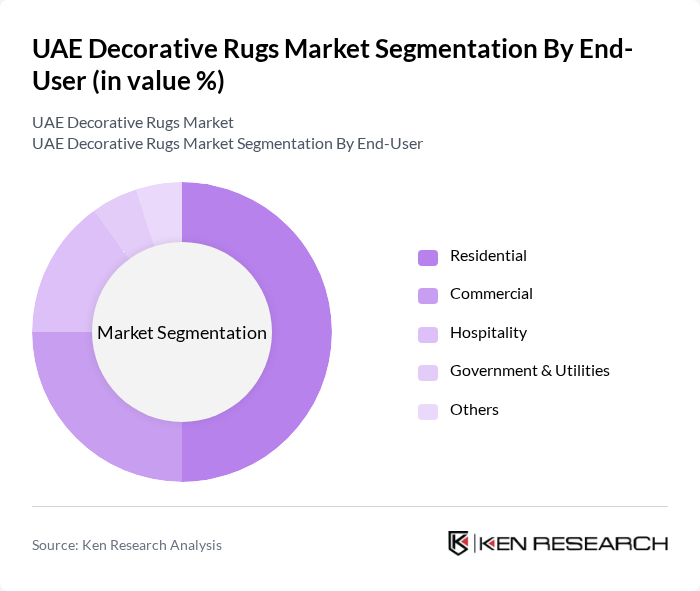
UAE Decorative Rugs Market segmentation by End-User.

UAE Decorative Rugs Market Competitive Landscape

The UAE Decorative Rugs Market is characterized by a dynamic mix of regional and international players. Leading participants such as Al Khamis Rugs, Abu Dhabi Rugs, Dubai Rugs, Oriental Weavers, The Rug Company, RUGS & MORE, Al Ain Rugs, Carpetland, Al Futtaim Group, IKEA UAE, Home Centre, Pottery Barn, The Home Depot, West Elm, and Crate and Barrel contribute to innovation, geographic expansion, and service delivery in this space.

Al Khamis Rugs

1975

Dubai, UAE

Abu Dhabi Rugs

1980

Abu Dhabi, UAE

Dubai Rugs

1990

Dubai, UAE

Oriental Weavers

1980

Cairo, Egypt

The Rug Company

1997

London, UK

Company

Establishment Year

Headquarters

Group Size (Large, Medium, or Small as per industry convention)

Revenue Growth Rate

Market Penetration Rate

Customer Retention Rate

Average Order Value

Pricing Strategy

UAE Decorative Rugs Market Industry Analysis

Growth Drivers

  • High GDP and Per Capita Income:The UAE's nominal GDP is projected at USD 537.08 billion in future, with a GDP per capita of USD 49,378. This robust economic environment enhances consumer purchasing power, enabling increased spending on luxury items such as decorative rugs. As disposable income rises, consumers are more inclined to invest in high-quality home decor, driving demand in the decorative rugs market. Source: World Bank ((https://data.worldbank.org/country/united-arab-emirates?utm_source=openai)).
  • Rapid Economic Diversification & Non-Oil Sector Expansion:In future, the non-oil sector is expected to contribute 75.5 percent to the UAE's GDP, amounting to approximately AED 1,342 billion (USD 365 billion). This diversification fosters growth in sectors like tourism and real estate, which increases demand for home furnishings, including decorative rugs. The expansion of these sectors is crucial for sustaining market growth. Source: Arab News ((https://www.arabnews.com/node/2604561/business-economy?utm_source=openai)).
  • Surge in Millionaire Population – Growing Affluent Customer Base:The UAE added around 13,000 new dollar-millionaires in future, bringing total private wealth to USD 785 billion. This increase in high-net-worth individuals is likely to drive demand for premium home decor products, including decorative rugs, as affluent consumers seek unique and luxurious furnishings to enhance their living spaces. Source: Times of India ((https://timesofindia.indiatimes.com/world/middle-east/every-30th-adult-now-a-millionare-uae-adds-13000-dollar-millionaires-in-2024/articleshow/121935497.cms?utm_source=openai)).

Market Challenges

  • Potential Supply Chain Constraints:The construction sector in the UAE faces challenges, with elevated non-performing loans impacting financial stability. This situation may hinder new projects, subsequently limiting the demand for decorative rugs from real estate developers. Supply chain disruptions could also affect the availability of raw materials, further complicating market dynamics. Source: IMF Article IV consultation ((https://www.imf.org/en/news/articles/2024/12/05/pr-24450-united-arab-emirates-imf-executive-board-concludes-2024-article-iv-consultation?utm_source=openai)).
  • Modest Overall GDP Growth Amid External Pressures:The UAE's real GDP growth is projected at around 4 percent in future, reflecting a cautious economic environment influenced by global headwinds. This modest growth may lead to restrained consumer spending, particularly on discretionary items like decorative rugs. Economic uncertainty could result in delayed purchases, impacting overall market performance. Source: IMF (Reuters summary) ((https://www.reuters.com/world/middle-east/imf-says-uae-overall-real-gdp-projected-grow-4-2024-2024-05-20/?utm_source=openai)).

UAE Decorative Rugs Market Future Outlook

The UAE decorative rugs market is poised for growth, driven by ongoing economic diversification and a rising affluent demographic. The expansion of the non-hydrocarbon sector, particularly in tourism and real estate, will sustain demand for luxury home decor. Additionally, the increasing number of high-net-worth individuals presents opportunities for premium product offerings. As consumer preferences evolve, the market is likely to see a shift towards unique, high-quality decorative rugs that reflect personal style and heritage.

Market Opportunities

  • Premium Segment Catering to High-Net-Worth Individuals:With the addition of 13,000 new millionaires and total private wealth reaching USD 785 billion, there is a significant opportunity to develop high-end decorative rug lines. Targeting affluent consumers seeking luxury furnishings can enhance market penetration and profitability. This segment is likely to drive innovation and quality in product offerings. Source: Times of India ((https://timesofindia.indiatimes.com/world/middle-east/every-30th-adult-now-a-millionare-uae-adds-13000-dollar-millionaires-in-2024/articleshow/121935497.cms?utm_source=openai)).
  • Integration with Real Estate & Hospitality Projects:The ongoing large-scale property developments in the UAE present opportunities for partnerships with real estate developers and hospitality projects. Collaborating on bulk supply agreements or design initiatives can enhance market presence and create tailored solutions for upscale properties, driving demand for decorative rugs. Source: Abu Dhabi economic data ((https://en.wikipedia.org/wiki/Emirate_of_Abu_Dhabi?utm_source=openai)).

Scope of the Report

SegmentSub-Segments
By Type

Hand-knotted Rugs

Machine-made Rugs

Flatweave Rugs

Shag Rugs

Outdoor Rugs

Vintage Rugs

Others

By End-User

Residential

Commercial

Hospitality

Government & Utilities

Others

By Material

Wool

Silk

Synthetic Fibers

Cotton

Jute

Others

By Design Style

Traditional

Contemporary

Transitional

Bohemian

Others

By Distribution Channel

Online Retail

Offline Retail

Direct Sales

Wholesale

Others

By Price Range

Budget

Mid-range

Premium

Luxury

Others

By Region

Abu Dhabi

Dubai

Sharjah

Ajman

Ras Al Khaimah

Fujairah

Others

Key Target Audience

Investors and Venture Capitalist Firms

Government and Regulatory Bodies (e.g., Ministry of Economy, Department of Economic Development)

Manufacturers and Producers

Distributors and Retailers

Interior Designers and Decorators

Real Estate Developers

Hospitality Industry Stakeholders

Home Furnishing and Decor Retail Chains

Players Mentioned in the Report:

Al Khamis Rugs

Abu Dhabi Rugs

Dubai Rugs

Oriental Weavers

The Rug Company

RUGS & MORE

Al Ain Rugs

Carpetland

Al Futtaim Group

IKEA UAE

Home Centre

Pottery Barn

The Home Depot

West Elm

Crate and Barrel

Table of Contents

Market Assessment Phase

1. Executive Summary and Approach


2. UAE Decorative Rugs Market Overview

2.1 Key Insights and Strategic Recommendations

2.2 UAE Decorative Rugs Market Overview

2.3 Definition and Scope

2.4 Evolution of Market Ecosystem

2.5 Timeline of Key Regulatory Milestones

2.6 Value Chain & Stakeholder Mapping

2.7 Business Cycle Analysis

2.8 Policy & Incentive Landscape


3. UAE Decorative Rugs Market Analysis

3.1 Growth Drivers

3.1.1 Increasing demand for luxury home decor
3.1.2 Rising disposable income among consumers
3.1.3 Growth in the real estate and hospitality sectors
3.1.4 Cultural significance of rugs in UAE households

3.2 Market Challenges

3.2.1 Intense competition from international brands
3.2.2 Fluctuating raw material prices
3.2.3 Counterfeit products affecting brand reputation
3.2.4 Limited awareness of sustainable options

3.3 Market Opportunities

3.3.1 Expansion of e-commerce platforms
3.3.2 Growing interest in eco-friendly products
3.3.3 Customization trends among consumers
3.3.4 Collaborations with interior designers

3.4 Market Trends

3.4.1 Shift towards online shopping
3.4.2 Increasing popularity of handmade rugs
3.4.3 Integration of technology in design
3.4.4 Focus on heritage and traditional designs

3.5 Government Regulation

3.5.1 Import regulations on textile products
3.5.2 Standards for sustainable materials
3.5.3 Consumer protection laws
3.5.4 Trade agreements affecting imports

4. SWOT Analysis


5. Stakeholder Analysis


6. Porter's Five Forces Analysis


7. UAE Decorative Rugs Market Market Size, 2019-2024

7.1 By Value

7.2 By Volume

7.3 By Average Selling Price


8. UAE Decorative Rugs Market Segmentation

8.1 By Type

8.1.1 Hand-knotted Rugs
8.1.2 Machine-made Rugs
8.1.3 Flatweave Rugs
8.1.4 Shag Rugs
8.1.5 Outdoor Rugs
8.1.6 Vintage Rugs
8.1.7 Others

8.2 By End-User

8.2.1 Residential
8.2.2 Commercial
8.2.3 Hospitality
8.2.4 Government & Utilities
8.2.5 Others

8.3 By Material

8.3.1 Wool
8.3.2 Silk
8.3.3 Synthetic Fibers
8.3.4 Cotton
8.3.5 Jute
8.3.6 Others

8.4 By Design Style

8.4.1 Traditional
8.4.2 Contemporary
8.4.3 Transitional
8.4.4 Bohemian
8.4.5 Others

8.5 By Distribution Channel

8.5.1 Online Retail
8.5.2 Offline Retail
8.5.3 Direct Sales
8.5.4 Wholesale
8.5.5 Others

8.6 By Price Range

8.6.1 Budget
8.6.2 Mid-range
8.6.3 Premium
8.6.4 Luxury
8.6.5 Others

8.7 By Region

8.7.1 Abu Dhabi
8.7.2 Dubai
8.7.3 Sharjah
8.7.4 Ajman
8.7.5 Ras Al Khaimah
8.7.6 Fujairah
8.7.7 Others

9. UAE Decorative Rugs Market Competitive Analysis

9.1 Market Share of Key Players

9.2 Cross Comparison of Key Players

9.2.1 Company Name
9.2.2 Group Size (Large, Medium, or Small as per industry convention)
9.2.3 Revenue Growth Rate
9.2.4 Market Penetration Rate
9.2.5 Customer Retention Rate
9.2.6 Average Order Value
9.2.7 Pricing Strategy
9.2.8 Brand Recognition Score
9.2.9 Product Return Rate
9.2.10 Customer Satisfaction Index

9.3 SWOT Analysis of Top Players

9.4 Pricing Analysis

9.5 Detailed Profile of Major Companies

9.5.1 Al Khamis Rugs
9.5.2 Abu Dhabi Rugs
9.5.3 Dubai Rugs
9.5.4 Oriental Weavers
9.5.5 The Rug Company
9.5.6 RUGS & MORE
9.5.7 Al Ain Rugs
9.5.8 Carpetland
9.5.9 Al Futtaim Group
9.5.10 IKEA UAE
9.5.11 Home Centre
9.5.12 Pottery Barn
9.5.13 The Home Depot
9.5.14 West Elm
9.5.15 Crate and Barrel

10. UAE Decorative Rugs Market End-User Analysis

10.1 Procurement Behavior of Key Ministries

10.1.1 Government contracts for public spaces
10.1.2 Budget allocation for cultural projects
10.1.3 Preference for local suppliers
10.1.4 Sustainability considerations in procurement

10.2 Corporate Spend on Infrastructure & Energy

10.2.1 Investment in hospitality sector renovations
10.2.2 Corporate gifting of decorative rugs
10.2.3 Partnerships with interior design firms
10.2.4 Budgeting for office aesthetics

10.3 Pain Point Analysis by End-User Category

10.3.1 Quality concerns among residential buyers
10.3.2 Sourcing challenges for commercial buyers
10.3.3 Maintenance issues in hospitality
10.3.4 Budget constraints in government projects

10.4 User Readiness for Adoption

10.4.1 Awareness of sustainable options
10.4.2 Interest in customization
10.4.3 Online shopping habits
10.4.4 Brand loyalty factors

10.5 Post-Deployment ROI and Use Case Expansion

10.5.1 Evaluation of rug durability
10.5.2 Impact on overall aesthetics
10.5.3 Customer feedback mechanisms
10.5.4 Opportunities for upselling

11. UAE Decorative Rugs Market Future Size, 2025-2030

11.1 By Value

11.2 By Volume

11.3 By Average Selling Price


Go-To-Market Strategy Phase

1. Whitespace Analysis + Business Model Canvas

1.1 Market Gaps Identification

1.2 Business Model Development


2. Marketing and Positioning Recommendations

2.1 Branding Strategies

2.2 Product USPs


3. Distribution Plan

3.1 Urban Retail vs Rural NGO Tie-ups


4. Channel & Pricing Gaps

4.1 Underserved Routes

4.2 Pricing Bands


5. Unmet Demand & Latent Needs

5.1 Category Gaps

5.2 Consumer Segments


6. Customer Relationship

6.1 Loyalty Programs

6.2 After-sales Service


7. Value Proposition

7.1 Sustainability

7.2 Integrated Supply Chains


8. Key Activities

8.1 Regulatory Compliance

8.2 Branding

8.3 Distribution Setup


9. Entry Strategy Evaluation

9.1 Domestic Market Entry Strategy

9.1.1 Product Mix
9.1.2 Pricing Band
9.1.3 Packaging

9.2 Export Entry Strategy

9.2.1 Target Countries
9.2.2 Compliance Roadmap

10. Entry Mode Assessment

10.1 JV

10.2 Greenfield

10.3 M&A

10.4 Distributor Model


11. Capital and Timeline Estimation

11.1 Capital Requirements

11.2 Timelines


12. Control vs Risk Trade-Off

12.1 Ownership vs Partnerships


13. Profitability Outlook

13.1 Breakeven Analysis

13.2 Long-term Sustainability


14. Potential Partner List

14.1 Distributors

14.2 JVs

14.3 Acquisition Targets


15. Execution Roadmap

15.1 Phased Plan for Market Entry

15.1.1 Market Setup
15.1.2 Market Entry
15.1.3 Growth Acceleration
15.1.4 Scale & Stabilize

15.2 Key Activities and Milestones

15.2.1 Activity Planning
15.2.2 Milestone Tracking

Research Methodology

ApproachModellingSample

Phase 1: Approach1

Desk Research

  • Market reports from industry associations and trade publications focused on decorative rugs
  • Government publications and trade statistics from the UAE Ministry of Economy
  • Analysis of online platforms and e-commerce data related to decorative rugs sales

Primary Research

  • Interviews with key stakeholders in the decorative rugs supply chain, including manufacturers and retailers
  • Surveys targeting interior designers and home decor specialists to understand market trends
  • Field visits to major retail outlets and exhibitions showcasing decorative rugs

Validation & Triangulation

  • Cross-validation of findings through multiple data sources, including sales data and consumer feedback
  • Triangulation of insights from primary interviews with secondary data trends
  • Sanity checks conducted through expert panel reviews comprising industry veterans

Phase 2: Market Size Estimation1

Top-down Assessment

  • Estimation of the overall home decor market size in the UAE and its share attributed to decorative rugs
  • Analysis of demographic trends and consumer spending patterns on home furnishings
  • Incorporation of growth rates from related sectors such as real estate and hospitality

Bottom-up Modeling

  • Collection of sales data from leading decorative rug retailers and manufacturers
  • Estimation of average selling prices and volume sold across different rug categories
  • Analysis of import/export data to gauge market demand and supply dynamics

Forecasting & Scenario Analysis

  • Multi-factor regression analysis considering economic indicators and consumer preferences
  • Scenario modeling based on potential shifts in consumer behavior and market disruptions
  • Development of baseline, optimistic, and pessimistic forecasts through 2030

Phase 3: CATI Sample Composition1

Scope Item/SegmentSample SizeTarget Respondent Profiles
Retail Decorative Rugs Sales150Store Managers, Sales Executives
Interior Design Projects100Interior Designers, Project Managers
Online E-commerce Platforms80E-commerce Managers, Digital Marketing Specialists
Manufacturing Insights70Production Managers, Quality Control Officers
Consumer Preferences Survey120Homeowners, Renters, Interior Decor Enthusiasts

Frequently Asked Questions

What is the current value of the UAE Decorative Rugs Market?

The UAE Decorative Rugs Market is valued at approximately USD 260 million. This valuation reflects the growing demand for decorative rugs driven by increased focus on interior decoration, rising disposable incomes, and tourism-related projects in the luxury hospitality sector.

What factors are driving growth in the UAE Decorative Rugs Market?

Who are the key players in the UAE Decorative Rugs Market?

What types of decorative rugs are popular in the UAE?

Other Regional/Country Reports

Indonesia Decorative Rugs Market

Malaysia Decorative Rugs Market

KSA Decorative Rugs Market

APAC Decorative Rugs Market

SEA Decorative Rugs Market

Vietnam Decorative Rugs Market

Why Buy From Us?

Refine Robust Result (RRR) Framework

What makes us stand out is that our consultants follow Robust, Refine and Result (RRR) methodology. Robust for clear definitions, approaches and sanity checking, Refine for differentiating respondents' facts and opinions, and Result for presenting data with story.

Our Reach Is Unmatched

We have set a benchmark in the industry by offering our clients with syndicated and customized market research reports featuring coverage of entire market as well as meticulous research and analyst insights.

Shifting the Research Paradigm

While we don't replace traditional research, we flip the method upside down. Our dual approach of Top Bottom & Bottom Top ensures quality deliverable by not just verifying company fundamentals but also looking at the sector and macroeconomic factors.

More Insights-Better Decisions

With one step in the future, our research team constantly tries to show you the bigger picture. We help with some of the tough questions you may encounter along the way: How is the industry positioned? Best marketing channel? KPI's of competitors? By aligning every element, we help maximize success.

Transparency and Trust

Our report gives you instant access to the answers and sources that other companies might choose to hide. We elaborate each steps of research methodology we have used and showcase you the sample size to earn your trust.

Round the Clock Support

If you need any support, we are here! We pride ourselves on universe strength, data quality, and quick, friendly, and professional service.

Why Clients Choose Us?

400000+
Reports in repository
150+
Consulting projects a year
100+
Analysts
8000+
Client Queries in 2022








