About the Report
Base Year 2024UAE Epoxy Composites Market Overview
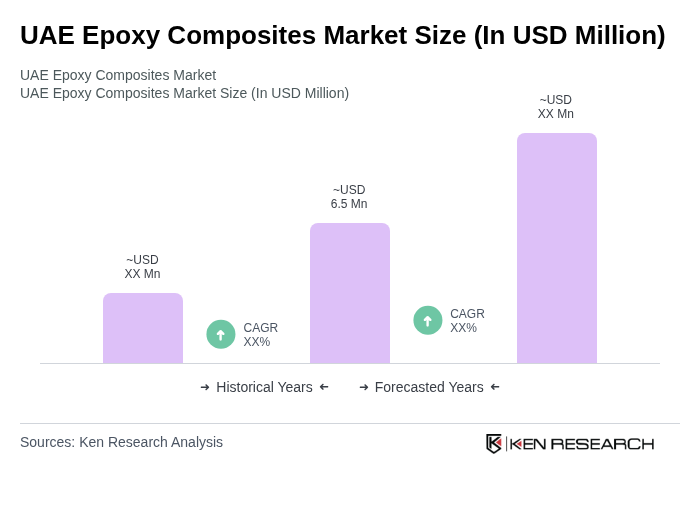
- The UAE Epoxy Composites Market is valued at USD 6.5 million, based on a five-year historical analysis of the country’s flexible epoxy resin and epoxy composites usage within the broader Middle East and Africa market. This growth is primarily driven by the increasing demand for lightweight and high-strength materials in key end-user industries, including automotive, aerospace, construction, marine, and wind energy, where epoxy composites are favored for their high strength-to-weight ratio and structural performance. The rising trend towards sustainable and eco-friendly materials also supports market expansion, as epoxy composites offer excellent durability, corrosion resistance, and longer service life, contributing to reduced maintenance and lifecycle environmental impact in infrastructure and transport applications.
- Dubai and Abu Dhabi are the dominant cities in the UAE Epoxy Composites Market due to their robust industrial and logistics infrastructure, large-scale real estate and infrastructure development pipelines, and strong presence of aerospace, marine, and automotive-related activities. Significant investments in high-rise buildings, bridges, transport corridors, and airport expansions in these emirates drive the use of epoxy-based construction composites for strengthening, repair, and corrosion protection, while free zones and industrial clusters attract global composite and resin suppliers and technology partners.
- In 2023, the UAE government continued to advance regulations and technical provisions encouraging the use of high?performance and durable materials, including fiber-reinforced polymer and epoxy-based systems, in building and infrastructure works. For example, the UAE Fire and Life Safety Code of Practice, issued by the UAE Ministry of Interior and Civil Defense authorities, sets binding requirements on material performance, fire resistance, and testing for construction products and coatings, which apply to many epoxy composite applications in structural strengthening, protective flooring, and cladding systems. In parallel, emirate-level building regulations and green building frameworks, such as Dubai’s Al Sa’fat Green Building System and Abu Dhabi’s Estidama Pearl Rating System, incentivize the use of durable, corrosion?resistant, and resource?efficient materials, supporting the adoption of epoxy composites to enhance structural longevity and reduce environmental impact over the asset lifecycle.
UAE Epoxy Composites Market Segmentation
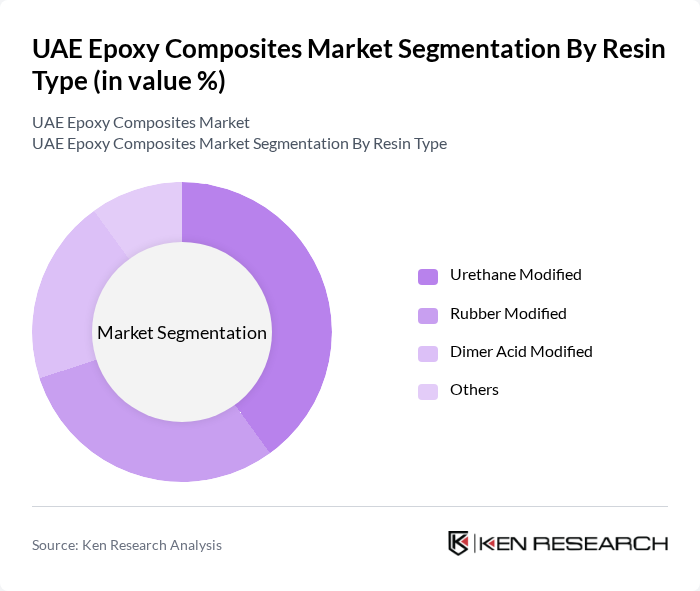
By Resin Type:The resin type segmentation includes Urethane Modified, Rubber Modified, Dimer Acid Modified, and Others. Urethane Modified resins account for the largest share of flexible epoxy resin demand in the UAE and are gaining traction due to their superior flexibility, impact resistance, and crack-bridging capability, making them well suited for dynamic load-bearing applications in automotive components, industrial flooring, and structural repair systems. Rubber Modified resins are also popular for their enhanced toughness, peel strength, and adhesion to varied substrates, particularly in construction adhesives, anchor systems, and vibration?resistant bonding applications. The demand for Dimer Acid Modified resins is growing as they offer excellent chemical resistance, flexibility, and hydrolytic stability, supporting use in protective coatings, marine and chemical?exposure environments, while the 'Others' category includes specialized epoxy formulations tailored for electrical insulation, electronics encapsulation, and niche industrial needs.
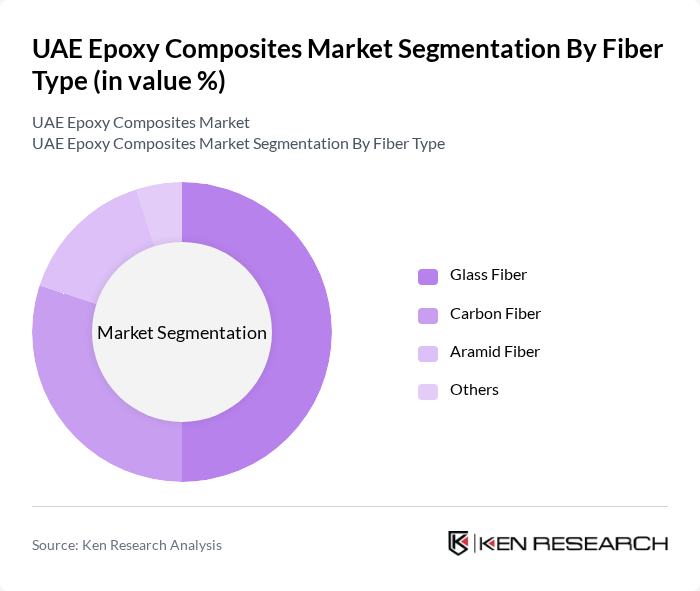
By Fiber Type:The fiber type segmentation encompasses Glass Fiber, Carbon Fiber, Aramid Fiber, and Others. Glass Fiber is the leading subsegment due to its favorable cost?to?performance ratio, good mechanical properties, and versatility, making it widely used in construction composites, marine structures, utility poles, rebar, and automotive body parts across the Middle East and Africa region. Carbon Fiber is gaining popularity for its lightweight and high-strength characteristics, especially in aerospace, high?performance automotive, sports equipment, and wind turbine blades, where weight reduction and stiffness are critical. Aramid Fiber, known for its heat resistance, impact resistance, and durability, is primarily used in specialized applications such as protective equipment, high?temperature components, and ballistic or impact?resistant structures, while the 'Others' category includes basalt, natural, and hybrid fibers tailored for specific performance or sustainability requirements.
UAE Epoxy Composites Market Competitive Landscape
The UAE Epoxy Composites Market is characterized by a dynamic mix of regional and international players. Leading participants such as Huntsman Corporation, Hexion Inc., Dow Inc., Olin Corp, BASF SE, Sika AG, 3M Company, Kukdo Chemical, Nan Ya Plastics Corp., DIC Corp, Solvay S.A., Mitsubishi Chemical Corporation, Hexcel Corporation, Covestro AG, Gurit Holding AG contribute to innovation, geographic expansion, and service delivery in this space.
UAE Epoxy Composites Market Industry Analysis
Growth Drivers
- Increasing Demand for Lightweight Materials:The UAE's construction and automotive sectors are increasingly adopting lightweight materials, with the lightweight materials market projected to reach $200 billion in future. This shift is driven by the need for improved fuel efficiency and reduced emissions, as lightweight composites can reduce vehicle weight by up to 10–30%. The UAE's commitment to sustainable development further fuels this demand, aligning with global trends towards energy-efficient solutions.
- Expansion of Construction and Automotive Sectors:The UAE's construction sector is expected to grow by 5.5% in future, driven by major infrastructure projects like Expo 2020 and the UAE Vision 2021 initiative. Concurrently, the automotive sector is projected to reach $20 billion in future, with a focus on electric vehicles. This growth creates a significant demand for epoxy composites, which are essential for lightweight, durable, and high-performance applications in both industries.
- Technological Advancements in Composite Materials:The UAE is witnessing rapid advancements in composite technologies, with R&D investments expected to exceed $1 billion in future. Innovations such as 3D printing and nanotechnology are enhancing the performance and applications of epoxy composites. These advancements enable manufacturers to produce stronger, lighter, and more versatile materials, catering to the evolving needs of industries such as aerospace, automotive, and construction.
Market Challenges
- High Production Costs:The production costs of epoxy composites remain a significant challenge, with average costs estimated at $15 per kilogram. This is primarily due to the expensive raw materials and complex manufacturing processes involved. As the UAE aims to diversify its economy, high production costs can hinder the competitiveness of local manufacturers in the global market, limiting their ability to scale operations effectively.
- Limited Availability of Raw Materials:The UAE faces challenges in sourcing raw materials for epoxy composites, with over 70% of key inputs imported. This reliance on imports can lead to supply chain vulnerabilities, especially in times of geopolitical tensions or global disruptions. The limited availability of high-quality raw materials can also impact production timelines and costs, posing a challenge for manufacturers aiming to meet growing demand.
UAE Epoxy Composites Market Future Outlook
The UAE epoxy composites market is poised for significant growth, driven by increasing investments in infrastructure and a shift towards sustainable materials. As the government prioritizes green building initiatives, the demand for eco-friendly composites is expected to rise. Additionally, advancements in smart technologies will likely enhance product performance, creating new applications. The market is also anticipated to benefit from the expansion of renewable energy projects, further solidifying the role of epoxy composites in the UAE's economic diversification efforts.
Market Opportunities
- Growth in Renewable Energy Applications:The UAE's commitment to renewable energy, with a target of generating 50% of its energy from clean sources in future, presents a significant opportunity for epoxy composites. These materials are increasingly used in wind turbine blades and solar panel structures, enhancing efficiency and durability, thus supporting the country's sustainability goals.
- Increasing Investments in Infrastructure Projects:With the UAE government allocating $100 billion for infrastructure development in future, there is a substantial opportunity for epoxy composites. These materials are essential for constructing durable and lightweight structures, making them ideal for use in bridges, roads, and buildings, thereby driving demand in the construction sector.
Scope of the Report
| Segment | Sub-Segments |
|---|---|
| By Resin Type | Urethane Modified Rubber Modified Dimer Acid Modified Others |
| By Fiber Type | Glass Fiber Carbon Fiber Aramid Fiber Others |
| By End-Use Industry | Aerospace & Defense Automotive & Transportation Construction Wind Energy Electrical & Electronics Others |
| By Manufacturing Process | Hand Lay-Up Spray-Up Filament Winding Resin Transfer Molding Others |
| By Distribution Channel | Direct Sales Distributors Online Sales Retail Others |
| By Geography | Abu Dhabi Dubai Sharjah Ajman Ras Al Khaimah Others |
| By Product Form | Liquid Epoxy Solid Epoxy Powder Coatings Others |
Key Target Audience
Investors and Venture Capitalist Firms
Government and Regulatory Bodies (e.g., Ministry of Economy, Ministry of Climate Change and Environment)
Manufacturers and Producers
Distributors and Retailers
Construction and Infrastructure Companies
Aerospace and Automotive Industries
Oil and Gas Sector Stakeholders
Trade Associations and Industry Groups
Players Mentioned in the Report:
Huntsman Corporation
Hexion Inc.
Dow Inc.
Olin Corp
BASF SE
Sika AG
3M Company
Kukdo Chemical
Nan Ya Plastics Corp.
DIC Corp
Solvay S.A.
Mitsubishi Chemical Corporation
Hexcel Corporation
Covestro AG
Gurit Holding AG
Table of Contents
Market Assessment Phase
1. Executive Summary and Approach
2. UAE Epoxy Composites Market Overview
2.1 Key Insights and Strategic Recommendations
2.2 UAE Epoxy Composites Market Overview
2.3 Definition and Scope
2.4 Evolution of Market Ecosystem
2.5 Timeline of Key Regulatory Milestones
2.6 Value Chain & Stakeholder Mapping
2.7 Business Cycle Analysis
2.8 Policy & Incentive Landscape
3. UAE Epoxy Composites Market Analysis
3.1 Growth Drivers
3.1.1 Increasing demand for lightweight materials
3.1.2 Expansion of construction and automotive sectors
3.1.3 Technological advancements in composite materials
3.1.4 Rising awareness of environmental sustainability
3.2 Market Challenges
3.2.1 High production costs
3.2.2 Limited availability of raw materials
3.2.3 Regulatory compliance issues
3.2.4 Competition from alternative materials
3.3 Market Opportunities
3.3.1 Growth in renewable energy applications
3.3.2 Increasing investments in infrastructure projects
3.3.3 Development of bio-based epoxy composites
3.3.4 Expansion into emerging markets
3.4 Market Trends
3.4.1 Shift towards sustainable and eco-friendly products
3.4.2 Integration of smart technologies in composites
3.4.3 Customization and personalization of products
3.4.4 Growth of e-commerce in the composites sector
3.5 Government Regulation
3.5.1 Standards for composite materials
3.5.2 Environmental regulations on production
3.5.3 Safety regulations in construction
3.5.4 Incentives for sustainable practices
4. SWOT Analysis
5. Stakeholder Analysis
6. Porter's Five Forces Analysis
7. UAE Epoxy Composites Market Market Size, 2019-2024
7.1 By Value
7.2 By Volume
7.3 By Average Selling Price
8. UAE Epoxy Composites Market Segmentation
8.1 By Resin Type
8.1.1 Urethane Modified
8.1.2 Rubber Modified
8.1.3 Dimer Acid Modified
8.1.4 Others
8.2 By Fiber Type
8.2.1 Glass Fiber
8.2.2 Carbon Fiber
8.2.3 Aramid Fiber
8.2.4 Others
8.3 By End-Use Industry
8.3.1 Aerospace & Defense
8.3.2 Automotive & Transportation
8.3.3 Construction
8.3.4 Wind Energy
8.3.5 Electrical & Electronics
8.3.6 Others
8.4 By Manufacturing Process
8.4.1 Hand Lay-Up
8.4.2 Spray-Up
8.4.3 Filament Winding
8.4.4 Resin Transfer Molding
8.4.5 Others
8.5 By Distribution Channel
8.5.1 Direct Sales
8.5.2 Distributors
8.5.3 Online Sales
8.5.4 Retail
8.5.5 Others
8.6 By Geography
8.6.1 Abu Dhabi
8.6.2 Dubai
8.6.3 Sharjah
8.6.4 Ajman
8.6.5 Ras Al Khaimah
8.6.6 Others
8.7 By Product Form
8.7.1 Liquid Epoxy
8.7.2 Solid Epoxy
8.7.3 Powder Coatings
8.7.4 Others
9. UAE Epoxy Composites Market Competitive Analysis
9.1 Market Share of Key Players
9.2 KPIs for Cross Comparison of Key Players
9.2.1 Company Name
9.2.2 Group Size (Large, Medium, or Small as per industry convention)
9.2.3 Revenue Growth Rate
9.2.4 Market Share in UAE
9.2.5 Production Capacity Utilization
9.2.6 R&D Investment as % of Revenue
9.2.7 Export Volume to Middle East
9.2.8 Supply Chain Localization Index
9.2.9 Sustainability Certifications
9.2.10 Strategic Partnerships in UAE
9.3 SWOT Analysis of Top Players
9.4 Pricing Analysis
9.5 List of Major Companies
9.5.1 Huntsman Corporation
9.5.2 Hexion Inc.
9.5.3 Dow Inc.
9.5.4 Olin Corp
9.5.5 BASF SE
9.5.6 Sika AG
9.5.7 3M Company
9.5.8 Kukdo Chemical
9.5.9 Nan Ya Plastics Corp.
9.5.10 DIC Corp
9.5.11 Solvay S.A.
9.5.12 Mitsubishi Chemical Corporation
9.5.13 Hexcel Corporation
9.5.14 Covestro AG
9.5.15 Gurit Holding AG
10. UAE Epoxy Composites Market End-User Analysis
10.1 Procurement Behavior of Key Ministries
10.1.1 Government contracts and tenders
10.1.2 Budget allocation for infrastructure projects
10.1.3 Sustainability initiatives
10.1.4 Supplier evaluation criteria
10.2 Corporate Spend on Infrastructure & Energy
10.2.1 Investment trends in construction
10.2.2 Energy efficiency projects
10.2.3 Public-private partnerships
10.2.4 Corporate social responsibility spending
10.3 Pain Point Analysis by End-User Category
10.3.1 Cost management challenges
10.3.2 Quality assurance issues
10.3.3 Supply chain disruptions
10.3.4 Regulatory compliance hurdles
10.4 User Readiness for Adoption
10.4.1 Awareness of epoxy composites
10.4.2 Training and skill development needs
10.4.3 Infrastructure readiness
10.4.4 Financial readiness for investment
10.5 Post-Deployment ROI and Use Case Expansion
10.5.1 Performance metrics tracking
10.5.2 Case studies of successful implementations
10.5.3 Feedback mechanisms for improvement
10.5.4 Future expansion opportunities
11. UAE Epoxy Composites Market Future Size, 2025-2030
11.1 By Value
11.2 By Volume
11.3 By Average Selling Price
Go-To-Market Strategy Phase
1. Whitespace Analysis + Business Model Canvas
1.1 Market gaps identification
1.2 Value proposition development
1.3 Revenue model exploration
1.4 Customer segmentation analysis
1.5 Competitive landscape overview
1.6 Key partnerships identification
1.7 Risk assessment
2. Marketing and Positioning Recommendations
2.1 Branding strategies
2.2 Product USPs
2.3 Target audience definition
2.4 Communication strategy
2.5 Digital marketing approach
2.6 Trade show participation
2.7 Customer engagement tactics
3. Distribution Plan
3.1 Urban retail strategies
3.2 Rural NGO tie-ups
3.3 E-commerce integration
3.4 Logistics and supply chain management
3.5 Distribution channel optimization
3.6 Partnership with local distributors
3.7 Inventory management strategies
4. Channel & Pricing Gaps
4.1 Underserved routes
4.2 Pricing bands analysis
4.3 Competitor pricing strategies
4.4 Customer willingness to pay
4.5 Value-based pricing models
4.6 Discount and promotion strategies
4.7 Price elasticity assessment
5. Unmet Demand & Latent Needs
5.1 Category gaps identification
5.2 Consumer segments analysis
5.3 Emerging trends exploration
5.4 Product development opportunities
5.5 Market entry barriers
5.6 Customer feedback analysis
5.7 Future demand forecasting
6. Customer Relationship
6.1 Loyalty programs
6.2 After-sales service
6.3 Customer feedback mechanisms
6.4 Relationship management strategies
6.5 Community engagement initiatives
6.6 Customer education programs
6.7 Retention strategies
7. Value Proposition
7.1 Sustainability initiatives
7.2 Integrated supply chains
7.3 Unique selling points
7.4 Customer-centric approach
7.5 Competitive advantages
7.6 Value-added services
7.7 Brand positioning
8. Key Activities
8.1 Regulatory compliance
8.2 Branding efforts
8.3 Distribution setup
8.4 Marketing campaigns
8.5 Training and development
8.6 Performance monitoring
8.7 Stakeholder engagement
9. Entry Strategy Evaluation
9.1 Domestic Market Entry Strategy
9.1.1 Product mix
9.1.2 Pricing band
9.1.3 Packaging considerations
9.1.4 Marketing approach
9.1.5 Distribution strategy
9.1.6 Regulatory considerations
9.1.7 Risk management
9.2 Export Entry Strategy
9.2.1 Target countries
9.2.2 Compliance roadmap
9.2.3 Market research
9.2.4 Distribution channels
9.2.5 Pricing strategy
9.2.6 Partnership opportunities
9.2.7 Risk assessment
10. Entry Mode Assessment
10.1 Joint Ventures
10.2 Greenfield Investments
10.3 Mergers & Acquisitions
10.4 Distributor Model
10.5 Strategic Alliances
10.6 Licensing Agreements
10.7 Franchising Opportunities
11. Capital and Timeline Estimation
11.1 Capital requirements
11.2 Timelines for market entry
11.3 Funding sources
11.4 Financial projections
11.5 Budget allocation
11.6 Risk management strategies
11.7 Milestone tracking
12. Control vs Risk Trade-Off
12.1 Ownership considerations
12.2 Partnership dynamics
12.3 Risk assessment
12.4 Control mechanisms
12.5 Exit strategies
12.6 Long-term sustainability
12.7 Stakeholder management
13. Profitability Outlook
13.1 Breakeven analysis
13.2 Long-term sustainability
13.3 Profit margin analysis
13.4 Revenue growth projections
13.5 Cost management strategies
13.6 Investment returns
13.7 Financial health assessment
14. Potential Partner List
14.1 Distributors
14.2 Joint Ventures
14.3 Acquisition targets
14.4 Strategic alliances
14.5 Local partnerships
14.6 International collaborations
14.7 Industry associations
15. Execution Roadmap
15.1 Phased Plan for Market Entry
15.1.1 Market Setup
15.1.2 Market Entry
15.1.3 Growth Acceleration
15.1.4 Scale & Stabilize
15.2 Key Activities and Milestones
15.2.1 Activity tracking
15.2.2 Milestone achievements
15.2.3 Performance evaluation
Research Methodology
Phase 1: Approach1
Desk Research
- Industry reports from the UAE Ministry of Economy and relevant trade associations
- Market analysis publications from leading chemical industry journals
- Statistical data from the UAE Federal Competitiveness and Statistics Authority
Primary Research
- Interviews with R&D heads at major epoxy resin manufacturers
- Surveys with procurement managers in construction and automotive sectors
- Field interviews with application engineers in composite material firms
Validation & Triangulation
- Cross-validation of findings through multiple industry expert interviews
- Triangulation of data from trade publications, market reports, and expert insights
- Sanity checks through feedback from a panel of industry specialists
Phase 2: Market Size Estimation1
Top-down Assessment
- Analysis of national epoxy resin consumption trends and growth rates
- Segmentation by end-use industries such as construction, automotive, and aerospace
- Incorporation of government initiatives promoting composite materials
Bottom-up Modeling
- Volume estimates based on production capacities of leading epoxy manufacturers
- Cost analysis derived from pricing models of epoxy composite products
- Estimation of market share based on sales data from key players
Forecasting & Scenario Analysis
- Multi-variable regression analysis incorporating economic indicators and industry growth
- Scenario planning based on potential regulatory changes and market dynamics
- Development of baseline, optimistic, and pessimistic forecasts through 2030
Phase 3: CATI Sample Composition1
| Scope Item/Segment | Sample Size | Target Respondent Profiles |
|---|---|---|
| Construction Industry Applications | 100 | Project Managers, Material Engineers |
| Automotive Sector Utilization | 80 | Product Development Engineers, Quality Assurance Managers |
| Aerospace Composite Materials | 60 | Design Engineers, Compliance Officers |
| Marine Industry Epoxy Usage | 50 | Marine Engineers, Procurement Specialists |
| Consumer Goods Manufacturing | 70 | Operations Managers, Supply Chain Analysts |
Frequently Asked Questions
What is the current value of the UAE Epoxy Composites Market?
The UAE Epoxy Composites Market is valued at approximately USD 6.5 million, reflecting a historical analysis of flexible epoxy resin and epoxy composites usage within the broader Middle East and Africa market.
What are the key drivers of growth in the UAE Epoxy Composites Market?
Which cities dominate the UAE Epoxy Composites Market?
What types of resin are used in the UAE Epoxy Composites Market?
Other Regional/Country Reports
Indonesia Epoxy Composites Market Size, Share, Growth Drivers, Trends, Opportunities & Forecast 2025–2030
Malaysia Epoxy Composites Market Size, Share, Growth Drivers, Trends, Opportunities & Forecast 2025–2030
KSA Epoxy Composites Market Size, Share, Growth Drivers, Trends, Opportunities & Forecast 2025–2030
APAC Epoxy Composites Market Size, Share, Growth Drivers, Trends, Opportunities & Forecast 2025–2030
SEA Epoxy Composites Market Size, Share, Growth Drivers, Trends, Opportunities & Forecast 2025–2030
Vietnam Epoxy Composites Market Size, Share, Growth Drivers, Trends, Opportunities & Forecast 2025–2030
Other Adjacent Reports
Japan Wind Energy Composites Market
Asia Pacific Carbon Fiber Market Outlook to 2030: Size, Share, Growth and TrendsGermany Glass Fiber Market
Middle East Aramid Fiber Market Report Size Share Growth Drivers Trends Opportunities & Forecast 2025–2030India Epoxy Resin Market (2023-2029)Gcc Lightweight Materials Market Size, Share, Growth Drivers, Trends, Opportunities & Forecast 2025–2030Why Buy From Us?

What makes us stand out is that our consultants follow Robust, Refine and Result (RRR) methodology. Robust for clear definitions, approaches and sanity checking, Refine for differentiating respondents' facts and opinions, and Result for presenting data with story.

We have set a benchmark in the industry by offering our clients with syndicated and customized market research reports featuring coverage of entire market as well as meticulous research and analyst insights.

While we don't replace traditional research, we flip the method upside down. Our dual approach of Top Bottom & Bottom Top ensures quality deliverable by not just verifying company fundamentals but also looking at the sector and macroeconomic factors.

With one step in the future, our research team constantly tries to show you the bigger picture. We help with some of the tough questions you may encounter along the way: How is the industry positioned? Best marketing channel? KPI's of competitors? By aligning every element, we help maximize success.

Our report gives you instant access to the answers and sources that other companies might choose to hide. We elaborate each steps of research methodology we have used and showcase you the sample size to earn your trust.

If you need any support, we are here! We pride ourselves on universe strength, data quality, and quick, friendly, and professional service.