About the Report
Base Year 2024Uk Home Furniture Market Overview
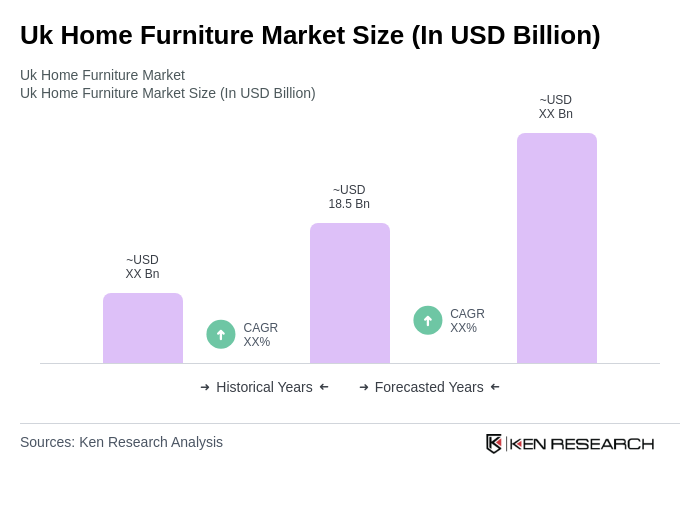
- The UK Home Furniture Market is valued at approximately USD 18.5 billion, based on a five-year historical analysis, reflecting the latest reported market sizing benchmarks from industry trackers. The market is driven by rising consumer spending on home improvement, the ongoing shift to online channels, and preferences for personalization, multifunctional designs, and sustainable materials.
- Key cities dominating the UK Home Furniture Market include London, Manchester, and Birmingham. London leads due to its large population and higher disposable income levels, with Manchester and Birmingham benefitting from strong urban demographics and retail density, including robust e-commerce penetration in these metropolitan areas.
- In 2023, the UK advanced regulations aimed at enhancing sustainability in products placed on the market. The government has consulted on an Extended Producer Responsibility approach for bulky waste, including furniture, and is expanding policies such as eco-design, durability, repairability, and waste prevention under the Resources and Waste Strategy; EPR is being used across product categories, with ongoing work to address furniture lifecycles and end-of-life impacts.
Uk Home Furniture Market Segmentation
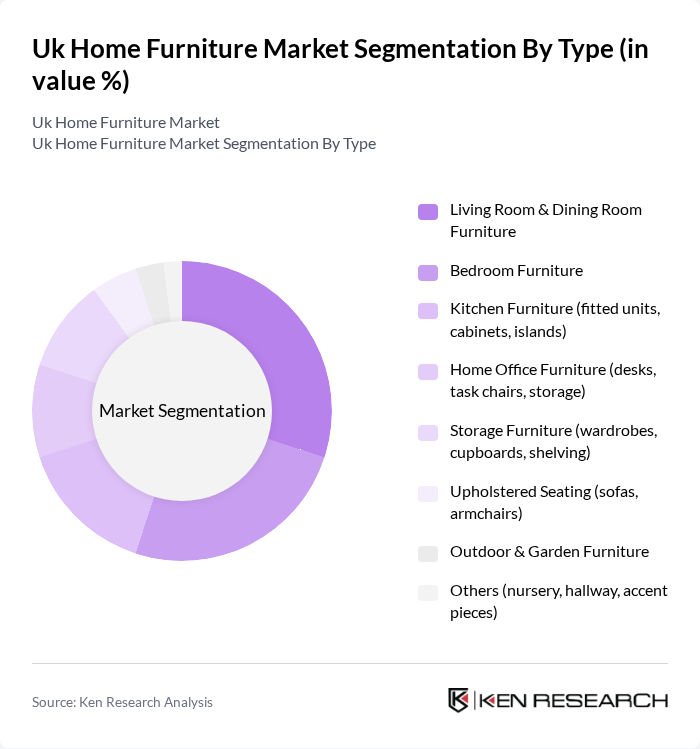
By Type:The market is segmented into various types of furniture, including Living Room & Dining Room Furniture, Bedroom Furniture, Kitchen Furniture, Home Office Furniture, Storage Furniture, Upholstered Seating, Outdoor & Garden Furniture, and Others. Among these, Living Room & Dining Room Furniture is the leading segment, driven by consumer preferences for stylish and functional designs that enhance the home environment. The trend towards open-plan living spaces has also increased the demand for versatile dining and living room solutions.
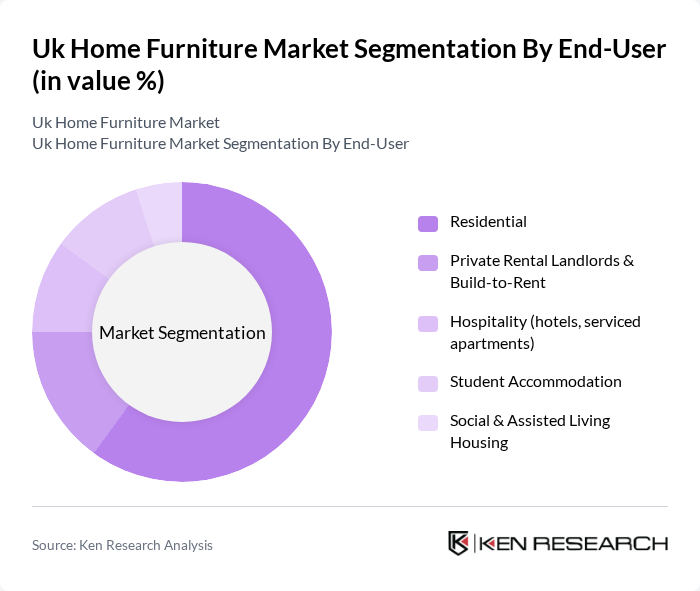
By End-User:The end-user segmentation includes Residential, Private Rental Landlords & Build-to-Rent, Hospitality, Student Accommodation, and Social & Assisted Living Housing. The Residential segment dominates the market, driven by the increasing trend of home ownership and the desire for personalized living spaces. Consumers are investing in furniture that reflects their style and meets their functional needs, contributing to the growth of this segment.
Uk Home Furniture Market Competitive Landscape
The UK Home Furniture Market is characterized by a dynamic mix of regional and international players. Leading participants such as IKEA, DFS Furniture plc, John Lewis & Partners, Argos (Sainsbury’s), Habitat (Sainsbury’s), Wayfair, Furniture Village, ScS Group plc, Oak Furnitureland, Dunelm Group plc, B&Q (Kingfisher plc), Homebase, Next Home (Next plc), Loaf, Heal’s contribute to innovation, geographic expansion, and service delivery in this space.
Uk Home Furniture Market Industry Analysis
Growth Drivers
- Increasing Consumer Spending on Home Decor:In future, UK households are projected to spend approximately £54 billion on home decor, reflecting a 8% increase from the previous year. This rise is driven by a growing emphasis on personalizing living spaces, with consumers increasingly investing in aesthetics and comfort. The average household expenditure on furniture and decor has risen to £1,900 annually, indicating a robust demand for home furnishings as consumers prioritize their living environments.
- Rise in Online Furniture Sales:The UK online furniture sales market is expected to reach £18 billion in future, marking a 20% increase from the previous year. This growth is fueled by the convenience of e-commerce platforms and the increasing penetration of internet access, with over 95% of households now online. Additionally, the shift towards digital shopping has led to a 35% rise in online furniture purchases, as consumers seek a wider variety of options and competitive pricing.
- Growing Demand for Sustainable Furniture:The sustainable furniture segment is projected to grow to £6 billion in future, driven by a 20% increase in consumer preference for eco-friendly products. Approximately 65% of UK consumers now consider sustainability when purchasing furniture, reflecting a significant shift in buying behavior. This trend is supported by government initiatives promoting sustainable practices, as well as increased awareness of environmental issues among consumers, leading to a demand for responsibly sourced materials.
Market Challenges
- Supply Chain Disruptions:The UK furniture industry continues to face significant supply chain disruptions, with delays affecting over 45% of shipments in future. Factors such as global shipping constraints and labor shortages have led to increased lead times, impacting inventory levels and customer satisfaction. The cost of logistics has risen by 30%, further straining profit margins for retailers who struggle to maintain adequate stock levels amid fluctuating demand.
- Intense Competition:The UK home furniture market is characterized by intense competition, with over 1,600 retailers vying for market share in future. This saturation has led to aggressive pricing strategies, with many companies reducing prices by an average of 12% to attract consumers. Additionally, the rise of direct-to-consumer brands has intensified competition, forcing traditional retailers to innovate and differentiate their offerings to maintain relevance in a crowded marketplace.
Uk Home Furniture Market Future Outlook
The UK home furniture market is poised for dynamic growth, driven by evolving consumer preferences and technological advancements. As more consumers prioritize home aesthetics and functionality, the demand for innovative designs and smart furniture solutions is expected to rise. Additionally, the increasing focus on sustainability will likely shape product offerings, encouraging manufacturers to adopt eco-friendly practices. The integration of technology in furniture design will further enhance user experience, positioning the market for significant transformation in the coming years.
Market Opportunities
- Expansion of E-commerce Platforms:The continued growth of e-commerce presents a significant opportunity for furniture retailers, with online sales projected to account for 45% of total furniture sales in future. This shift allows businesses to reach a broader audience and reduce overhead costs associated with physical stores, enabling them to offer competitive pricing and diverse product ranges.
- Customization and Personalization Trends:The demand for customized furniture solutions is on the rise, with consumers increasingly seeking unique products tailored to their preferences. This trend is expected to create a £3 billion market opportunity in future, as brands that offer personalization options can differentiate themselves and enhance customer loyalty, driving sales growth in a competitive landscape.
Scope of the Report
| Segment | Sub-Segments |
|---|---|
| By Type | Living Room & Dining Room Furniture Bedroom Furniture Kitchen Furniture (fitted units, cabinets, islands) Home Office Furniture (desks, task chairs, storage) Storage Furniture (wardrobes, cupboards, shelving) Upholstered Seating (sofas, armchairs) Outdoor & Garden Furniture Others (nursery, hallway, accent pieces) |
| By End-User | Residential Private Rental Landlords & Build-to-Rent Hospitality (hotels, serviced apartments) Student Accommodation Social & Assisted Living Housing |
| By Sales Channel | Specialty Furniture Retailers Home Centers & DIY Sheds Online Retail (D2C, marketplaces) Flagship & Brand Stores Others (department stores, catalog/TV) |
| By Price Range | Budget Mid-Range Premium Luxury/Designer |
| By Material | Solid Wood & Engineered Wood Metal Upholstery & Mattresses (fabric/leather/foam) Glass & Stone/Composite Tops Plastic & Rattan/Wicker (incl. synthetic) |
| By Design Style | Modern/Contemporary Traditional/Classical Scandinavian/Minimalist Rustic/Industrial |
| By Functionality | Multi-functional & Modular Space-saving (folding, nesting, sofa beds) Customizable/Made-to-Order Standard |
Key Target Audience
Investors and Venture Capitalist Firms
Government and Regulatory Bodies (e.g., Department for Business and Trade, Environment Agency)
Manufacturers and Producers
Distributors and Retailers
Interior Designers and Architects
Home Improvement and Renovation Companies
Industry Associations (e.g., British Furniture Manufacturers, Furniture Industry Research Association)
Financial Institutions and Banks
Players Mentioned in the Report:
IKEA
DFS Furniture plc
John Lewis & Partners
Argos (Sainsburys)
Habitat (Sainsburys)
Wayfair
Furniture Village
ScS Group plc
Oak Furnitureland
Dunelm Group plc
B&Q (Kingfisher plc)
Homebase
Next Home (Next plc)
Loaf
Heals
Table of Contents
Market Assessment Phase
1. Executive Summary and Approach
2. Uk Home Furniture Market Overview
2.1 Key Insights and Strategic Recommendations
2.2 Uk Home Furniture Market Overview
2.3 Definition and Scope
2.4 Evolution of Market Ecosystem
2.5 Timeline of Key Regulatory Milestones
2.6 Value Chain & Stakeholder Mapping
2.7 Business Cycle Analysis
2.8 Policy & Incentive Landscape
3. Uk Home Furniture Market Analysis
3.1 Growth Drivers
3.1.1 Increasing Consumer Spending on Home Decor
3.1.2 Rise in Online Furniture Sales
3.1.3 Growing Demand for Sustainable Furniture
3.1.4 Urbanization and Housing Market Growth
3.2 Market Challenges
3.2.1 Supply Chain Disruptions
3.2.2 Intense Competition
3.2.3 Fluctuating Raw Material Prices
3.2.4 Changing Consumer Preferences
3.3 Market Opportunities
3.3.1 Expansion of E-commerce Platforms
3.3.2 Customization and Personalization Trends
3.3.3 Growth in Smart Furniture Solutions
3.3.4 Increasing Focus on Home Office Furniture
3.4 Market Trends
3.4.1 Minimalist and Functional Design Preferences
3.4.2 Rise of Multi-functional Furniture
3.4.3 Emphasis on Eco-friendly Materials
3.4.4 Integration of Technology in Furniture
3.5 Government Regulation
3.5.1 Furniture Safety Regulations
3.5.3 Consumer Protection Laws
3.5.4 Trade Tariffs and Import Regulations
4. SWOT Analysis
5. Stakeholder Analysis
6. Porter's Five Forces Analysis
7. Uk Home Furniture Market Market Size, 2019-2024
7.1 By Value
7.2 By Volume
7.3 By Average Selling Price
8. Uk Home Furniture Market Segmentation
8.1 By Type
8.1.1 Living Room & Dining Room Furniture
8.1.2 Bedroom Furniture
8.1.3 Kitchen Furniture (fitted units, cabinets, islands)
8.1.4 Home Office Furniture (desks, task chairs, storage)
8.1.5 Storage Furniture (wardrobes, cupboards, shelving)
8.1.6 Upholstered Seating (sofas, armchairs)
8.1.7 Outdoor & Garden Furniture
8.1.8 Others (nursery, hallway, accent pieces)
8.2 By End-User
8.2.1 Residential
8.2.2 Private Rental Landlords & Build-to-Rent
8.2.3 Hospitality (hotels, serviced apartments)
8.2.4 Student Accommodation
8.2.5 Social & Assisted Living Housing
8.3 By Sales Channel
8.3.1 Specialty Furniture Retailers
8.3.2 Home Centers & DIY Sheds
8.3.3 Online Retail (D2C, marketplaces)
8.3.4 Flagship & Brand Stores
8.3.5 Others (department stores, catalog/TV)
8.4 By Price Range
8.4.1 Budget
8.4.2 Mid-Range
8.4.3 Premium
8.4.4 Luxury/Designer
8.5 By Material
8.5.1 Solid Wood & Engineered Wood
8.5.2 Metal
8.5.3 Upholstery & Mattresses (fabric/leather/foam)
8.5.4 Glass & Stone/Composite Tops
8.5.5 Plastic & Rattan/Wicker (incl. synthetic)
8.6 By Design Style
8.6.1 Modern/Contemporary
8.6.2 Traditional/Classical
8.6.3 Scandinavian/Minimalist
8.6.4 Rustic/Industrial
8.7 By Functionality
8.7.1 Multi-functional & Modular
8.7.2 Space-saving (folding, nesting, sofa beds)
8.7.3 Customizable/Made-to-Order
8.7.4 Standard
9. Uk Home Furniture Market Competitive Analysis
9.1 Market Share of Key Players
9.2 Cross Comparison of Key Players
9.2.1 Company Name
9.2.2 Group Size (Large, Medium, or Small as per industry convention)
9.2.3 UK Furniture Revenue (latest FY)
9.2.4 Revenue Growth Rate (YoY)
9.2.5 Gross Margin (%)
9.2.6 Like-for-Like (LFL) Sales Growth (%)
9.2.7 Online Sales Mix (% of revenue)
9.2.8 Market Share in UK Home Furniture (%)
9.2.9 Average Order Value (£)
9.2.10 Order Fulfilment Lead Time (days)
9.2.11 Product Return Rate (%)
9.2.12 Inventory Turnover (x)
9.2.13 Store Count in the UK (no.)
9.2.14 Customer Satisfaction/NPS
9.2.15 Sustainability KPIs (e.g., % FSC-certified wood, recycled materials)
9.3 SWOT Analysis of Top Players
9.4 Pricing Analysis
9.5 Detailed Profile of Major Companies
9.5.1 IKEA
9.5.2 DFS Furniture plc
9.5.3 John Lewis & Partners
9.5.4 Argos (Sainsbury’s)
9.5.5 Habitat (Sainsbury’s)
9.5.6 Wayfair
9.5.7 Furniture Village
9.5.8 ScS Group plc
9.5.9 Oak Furnitureland
9.5.10 Dunelm Group plc
9.5.11 B&Q (Kingfisher plc)
9.5.12 Homebase
9.5.13 Next Home (Next plc)
9.5.14 Loaf
9.5.15 Heal’s
10. Uk Home Furniture Market End-User Analysis
10.1 Procurement Behavior of Key Ministries
10.1.1 Budget Allocation Trends
10.1.2 Preferred Suppliers
10.1.3 Procurement Processes
10.1.4 Sustainability Considerations
10.2 Corporate Spend on Infrastructure & Energy
10.2.1 Investment in Office Furniture
10.2.2 Trends in Corporate Renovations
10.2.3 Budgeting for Employee Well-being
10.3 Pain Point Analysis by End-User Category
10.3.1 Quality Concerns
10.3.2 Delivery Timeliness
10.3.3 Customization Needs
10.4 User Readiness for Adoption
10.4.1 Awareness of New Products
10.4.2 Willingness to Invest
10.4.3 Feedback Mechanisms
10.5 Post-Deployment ROI and Use Case Expansion
10.5.1 Measurement of Satisfaction
10.5.2 Opportunities for Upselling
10.5.3 Long-term Usage Trends
11. Uk Home Furniture Market Future Size, 2025-2030
11.1 By Value
11.2 By Volume
11.3 By Average Selling Price
Go-To-Market Strategy Phase
1. Whitespace Analysis + Business Model Canvas
1.1 Market Gaps Identification
1.2 Value Proposition Development
1.3 Revenue Streams Analysis
1.4 Customer Segmentation
1.5 Key Partnerships
1.6 Cost Structure
1.7 Channels of Distribution
2. Marketing and Positioning Recommendations
2.1 Branding Strategies
2.2 Product USPs
3. Distribution Plan
3.1 Urban Retail vs Rural NGO Tie-ups
4. Channel & Pricing Gaps
4.1 Underserved Routes
4.2 Pricing Bands
5. Unmet Demand & Latent Needs
5.1 Category Gaps
5.2 Consumer Segments
6. Customer Relationship
6.1 Loyalty Programs
6.2 After-sales Service
7. Value Proposition
7.1 Sustainability
7.2 Integrated Supply Chains
8. Key Activities
8.1 Regulatory Compliance
8.2 Branding
8.3 Distribution Setup
9. Entry Strategy Evaluation
9.1 Domestic Market Entry Strategy
9.1.1 Product Mix
9.1.2 Pricing Band
9.1.3 Packaging
9.2 Export Entry Strategy
9.2.1 Target Countries
9.2.2 Compliance Roadmap
10. Entry Mode Assessment
10.1 JV
10.2 Greenfield
10.3 M&A
10.4 Distributor Model
11. Capital and Timeline Estimation
11.1 Capital Requirements
11.2 Timelines
12. Control vs Risk Trade-Off
12.1 Ownership vs Partnerships
13. Profitability Outlook
13.1 Breakeven Analysis
13.2 Long-term Sustainability
14. Potential Partner List
14.1 Distributors
14.2 JVs
14.3 Acquisition Targets
15. Execution Roadmap
15.1 Phased Plan for Market Entry
15.1.1 Market Setup
15.1.2 Market Entry
15.1.3 Growth Acceleration
15.1.4 Scale & Stabilize
15.2 Key Activities and Milestones
15.2.1 Activity Planning
15.2.2 Milestone Tracking
Research Methodology
Phase 1: Approach1
Desk Research
- Analysis of market reports from industry associations such as the British Furniture Manufacturers (BFM)
- Review of government publications and statistics on household spending and furniture imports
- Examination of consumer behavior studies and trends in home furnishing preferences
Primary Research
- Interviews with key stakeholders including furniture retailers and manufacturers
- Surveys targeting consumers to understand purchasing habits and preferences
- Focus groups with interior designers to gather insights on market trends and consumer demands
Validation & Triangulation
- Cross-validation of findings through multiple data sources including sales data and consumer surveys
- Triangulation of insights from industry experts and market analysts
- Sanity checks through expert panel reviews to ensure data accuracy and relevance
Phase 2: Market Size Estimation1
Top-down Assessment
- Estimation of total market size based on national household expenditure on furniture
- Segmentation of the market by product categories such as sofas, beds, and dining sets
- Incorporation of growth rates from historical data and economic indicators
Bottom-up Modeling
- Collection of sales data from leading furniture retailers to establish volume benchmarks
- Analysis of average selling prices across different furniture categories
- Calculation of market size based on unit sales and revenue generation
Forecasting & Scenario Analysis
- Development of forecasts using historical growth trends and economic forecasts
- Scenario analysis based on potential impacts of economic fluctuations and consumer trends
- Creation of baseline, optimistic, and pessimistic market projections through 2030
Phase 3: CATI Sample Composition1
| Scope Item/Segment | Sample Size | Target Respondent Profiles |
|---|---|---|
| Retail Furniture Sales | 120 | Store Managers, Sales Representatives |
| Consumer Furniture Purchases | 150 | Homeowners, Renters |
| Online Furniture Shopping Trends | 100 | E-commerce Managers, Digital Marketing Specialists |
| Interior Design Preferences | 80 | Interior Designers, Home Decorators |
| Furniture Manufacturing Insights | 70 | Production Managers, Supply Chain Coordinators |
Frequently Asked Questions
What is the current value of the UK Home Furniture Market?
The UK Home Furniture Market is valued at approximately USD 18.5 billion, reflecting a robust demand driven by consumer spending on home improvement and preferences for personalized, multifunctional designs.
Which cities are the largest markets for home furniture in the UK?
What are the main drivers of growth in the UK Home Furniture Market?
How has online shopping impacted the UK Home Furniture Market?
Other Regional/Country Reports
Why Buy From Us?

What makes us stand out is that our consultants follow Robust, Refine and Result (RRR) methodology. Robust for clear definitions, approaches and sanity checking, Refine for differentiating respondents' facts and opinions, and Result for presenting data with story.

We have set a benchmark in the industry by offering our clients with syndicated and customized market research reports featuring coverage of entire market as well as meticulous research and analyst insights.

While we don't replace traditional research, we flip the method upside down. Our dual approach of Top Bottom & Bottom Top ensures quality deliverable by not just verifying company fundamentals but also looking at the sector and macroeconomic factors.

With one step in the future, our research team constantly tries to show you the bigger picture. We help with some of the tough questions you may encounter along the way: How is the industry positioned? Best marketing channel? KPI's of competitors? By aligning every element, we help maximize success.

Our report gives you instant access to the answers and sources that other companies might choose to hide. We elaborate each steps of research methodology we have used and showcase you the sample size to earn your trust.

If you need any support, we are here! We pride ourselves on universe strength, data quality, and quick, friendly, and professional service.