United Arab Emirates Lactation Massager Market Report Size Share Growth Drivers Trends Opportunities & Forecast 2025–2030

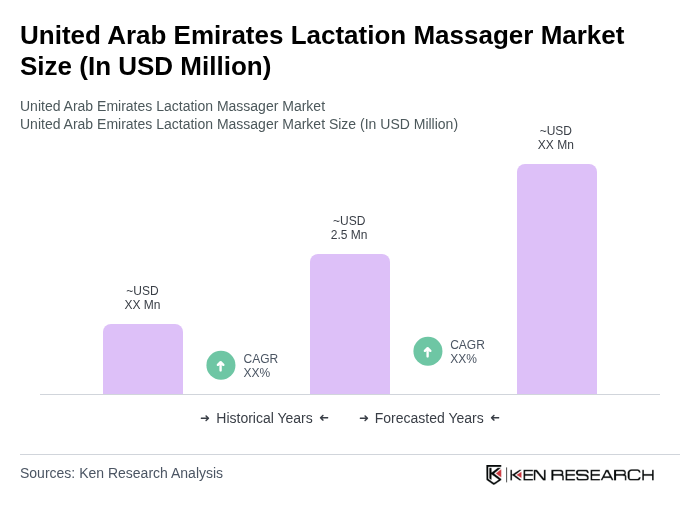
UAE Lactation Massager Market, valued at USD 2.5M, is growing with rising awareness of breastfeeding benefits and demand for innovative products like heated and smart massagers for milk flow support.

Region:Middle East

Author(s):Dev

Product Code:KRAC4968

Pages:93

Published On:January 2026
About the Report

Base Year 2024

United Arab Emirates Lactation Massager Market Overview

  • The United Arab Emirates Lactation Massager Market is valued at USD 2.5 million, based on a five-year historical analysis and its share within the broader global lactation massager market, which is valued at around USD 61–62 million. This growth is primarily driven by increasing awareness of breastfeeding benefits, supported by national breastfeeding promotion initiatives, and a rise in the number of working mothers seeking effective lactation support solutions. The market has seen growing demand for innovative, tech-enhanced products that address clogged ducts, engorgement, and comfort, in line with global trends in lactation massagers.
  • Key cities such as Dubai and Abu Dhabi dominate the market due to their high population density, affluent consumer base, and advanced healthcare infrastructure. These urban centers are characterized by a growing number of maternity clinics and hospitals that actively promote breastfeeding through Baby-Friendly Hospital Initiative accreditation and lactation consulting services, further driving the demand for lactation support products, including massagers. Additionally, the presence of leading international breastfeeding brands and well-developed e-commerce and pharmacy retail chains in these cities enhances product availability and consumer choice.
  • Breastfeeding and maternal health in the UAE are supported by national policy frameworks such as the National Strategy for Maternal and Child Health and the implementation of the International Code of Marketing of Breast-milk Substitutes through Ministerial resolutions issued by the Ministry of Health and Prevention. These instruments encourage hospitals and primary healthcare facilities to offer breastfeeding counseling, establish lactation clinics, and train staff in breastfeeding support, which in practice increases exposure to and uptake of lactation aids, including massagers, as part of comprehensive lactation support services.
United Arab Emirates Lactation Massager Market Size

United Arab Emirates Lactation Massager Market Segmentation

By Type:The market is segmented into various types of lactation massagers, including heated, non-heated, vibrating, multi-functional/smart, and others. Heated lactation massagers are gaining popularity due to their ability to provide soothing warmth and vibration, which helps in relieving discomfort and supporting milk flow, in line with global preference for heated devices as the fastest-growing segment. Non-heated options are preferred for their simplicity, lower price point, and ease of use. Vibrating massagers are favored for their effectiveness in stimulating milk flow and helping to manage clogged ducts, a primary application segment globally. Multi-functional or smart devices offer additional features such as multiple vibration modes, adjustable intensity, ergonomic designs, and in some cases app connectivity to track sessions, which appeals to tech-savvy consumers in urban UAE markets. The "Others" category includes niche products that cater to specific needs, such as manual breast massage tools, silicone comb-style devices, and combination kits bundled with breast pumps and nursing accessories.
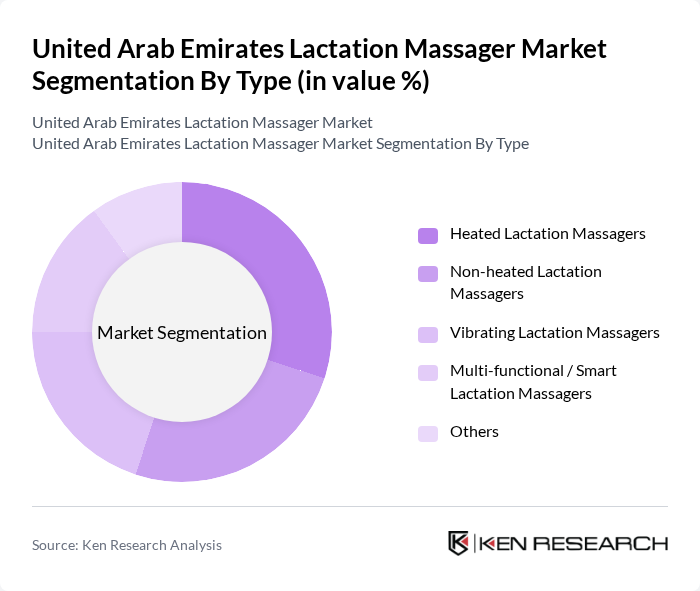
United Arab Emirates Lactation Massager Market segmentation by Type.

By Application:The lactation massager market is segmented based on applications, including relief for engorged breasts, clogged milk ducts, mastitis-related discomfort, support for milk expression and let-down, and others. Relief for engorged breasts is a significant application, as many new mothers experience breast fullness and pain during the early postpartum period, and global clinical guidance acknowledges massage and warm compression as supportive measures. The demand for solutions addressing clogged milk ducts and mastitis-related discomfort is also notable, as these conditions can hinder breastfeeding continuation and are among the main use cases cited for lactation massagers worldwide. Support for milk expression and let-down is crucial for working mothers and for those who rely on breast pumps, making this segment vital for market growth, particularly in the UAE where female labor force participation has been rising and many mothers use pumping and storage to sustain breastfeeding. The "Others" category covers broader comfort and wellness uses, such as general breast care, prevention-focused massage, and use alongside lactation consultancy protocols.
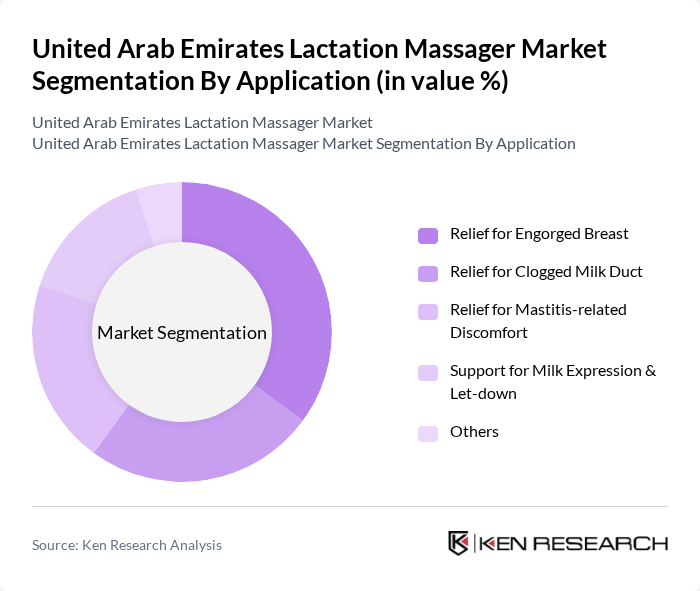
United Arab Emirates Lactation Massager Market segmentation by Application.

United Arab Emirates Lactation Massager Market Competitive Landscape

The United Arab Emirates Lactation Massager Market is characterized by a dynamic mix of regional and international players. Leading participants such as Medela AG, Lansinoh Laboratories, Inc., Philips Avent, Spectra Baby, Haakaa, Elvie, BabyBuddha, Frida Mom, Momcozy, Motif Medical, Bellema, Youha, NatureBond, Malish, Other Emerging UAE & Regional Brands contribute to innovation, geographic expansion, and service delivery in this space.

Medela AG

1961

Switzerland

Lansinoh Laboratories, Inc.

1984

USA

Philips Avent

1984

Netherlands

Haakaa

2014

New Zealand

Elvie

2013

UK

Company

Establishment Year

Headquarters

UAE Lactation Massager Revenue

3-year CAGR in UAE Revenue

UAE Market Share (%)

Average Selling Price Band in UAE

Share of Online vs Offline Sales (%)

Number of SKUs / Product Variants in UAE

United Arab Emirates Lactation Massager Market Industry Analysis

Growth Drivers

  • Increasing Awareness of Breastfeeding Benefits:The United Arab Emirates has seen a significant rise in awareness regarding the benefits of breastfeeding, with 95% of mothers recognizing its importance for infant health. This awareness is supported by the World Health Organization's recommendation of exclusive breastfeeding for the first six months. As a result, the demand for lactation support products, including massagers, is expected to increase, with an estimated 20% growth in sales anticipated in future, driven by educational campaigns and healthcare provider recommendations.
  • Rising Number of Working Mothers:The UAE's labor force participation rate for women has reached approximately 55%, with a notable increase in working mothers. According to the UAE Ministry of Economy, the number of working mothers has grown by 25% over the past five years. This demographic shift has led to a greater need for lactation support solutions, as working mothers seek efficient ways to manage breastfeeding while balancing their careers, thus driving the demand for lactation massagers.
  • Technological Advancements in Lactation Massage Devices:The lactation massager market is benefiting from rapid technological advancements, with new devices incorporating features such as smart technology and customizable settings. In future, it is projected that 35% of lactation massagers will include app connectivity for personalized usage tracking. This innovation not only enhances user experience but also attracts tech-savvy consumers, contributing to a projected increase in market penetration and sales by 30% in the coming year.

Market Challenges

  • High Cost of Advanced Lactation Massagers:The average price of advanced lactation massagers in the UAE ranges from AED 900 to AED 1,600, which can be prohibitive for many consumers. This high cost limits accessibility, particularly among lower-income families. According to the UAE Federal Competitiveness and Statistics Authority, approximately 35% of households earn less than AED 12,000 monthly, making it challenging for them to invest in premium lactation products, thus hindering market growth.
  • Limited Consumer Awareness About Product Benefits:Despite the growing market, consumer awareness regarding the specific benefits of lactation massagers remains low. A survey conducted by the UAE Ministry of Health revealed that only 45% of mothers are aware of the advantages of using lactation massagers. This lack of awareness poses a significant challenge for manufacturers and retailers, as it limits the potential customer base and slows down market adoption rates, impacting overall sales growth.

United Arab Emirates Lactation Massager Market Future Outlook

The future of the lactation massager market in the UAE appears promising, driven by increasing consumer interest in maternal health and wellness. As more mothers seek effective solutions for breastfeeding challenges, the market is expected to expand significantly. Additionally, the integration of smart technology and personalized features will likely enhance product appeal, attracting a broader audience. With ongoing government support for maternal health initiatives, the market is poised for sustained growth, fostering innovation and accessibility in lactation support products.

Market Opportunities

  • Expansion of E-commerce Platforms for Sales:The rise of e-commerce in the UAE presents a significant opportunity for lactation massager manufacturers. With online retail sales projected to reach AED 25 billion in future, companies can leverage digital platforms to reach a wider audience, enhancing product visibility and accessibility. This shift towards online shopping is expected to drive sales growth, particularly among tech-savvy consumers seeking convenience.
  • Collaborations with Healthcare Providers:Forming partnerships with healthcare providers can create valuable opportunities for lactation massager brands. By collaborating with hospitals and clinics, companies can promote their products directly to new mothers, increasing awareness and credibility. Such initiatives can lead to a projected 20% increase in product adoption rates, as healthcare professionals often influence purchasing decisions among new parents seeking reliable lactation support solutions.

Scope of the Report

SegmentSub-Segments
By Type

Heated Lactation Massagers

Non-heated Lactation Massagers

Vibrating Lactation Massagers

Multi-functional / Smart Lactation Massagers

Others

By Application

Relief for Engorged Breast

Relief for Clogged Milk Duct

Relief for Mastitis-related Discomfort

Support for Milk Expression & Let-down

Others

By End-User

Individual Consumers (Home Use)

Hospitals

Maternity Clinics & Lactation Centers

Pharmacies & Retail Chains

Others

By Distribution Channel

E-commerce Platforms

Pharmacy & Baby Stores

Hospital & Clinic Procurement

Specialty & Mother-baby Boutiques

Others

By Price Range

Economy

Mid-range

Premium

Ultra-premium / Smart-connected

By Material

Medical-grade Silicone

ABS Plastic & Composites

Silicone–Plastic Hybrid

Others

By User Demographics

First-time Mothers

Experienced Mothers

Working Mothers

Stay-at-home Mothers

Others

Key Target Audience

Investors and Venture Capitalist Firms

Government and Regulatory Bodies (e.g., Ministry of Health and Prevention, Emirates Authority for Standardization and Metrology)

Manufacturers and Producers

Distributors and Retailers

Healthcare Providers and Hospitals

Wellness and Spa Centers

Industry Associations (e.g., UAE Health and Wellness Association)

Financial Institutions

Players Mentioned in the Report:

Medela AG

Lansinoh Laboratories, Inc.

Philips Avent

Spectra Baby

Haakaa

Elvie

BabyBuddha

Frida Mom

Momcozy

Motif Medical

Bellema

Youha

NatureBond

Malish

Other Emerging UAE & Regional Brands

Table of Contents

Market Assessment Phase

1. Executive Summary and Approach


2. United Arab Emirates Lactation Massager Market Overview

2.1 Key Insights and Strategic Recommendations

2.2 United Arab Emirates Lactation Massager Market Overview

2.3 Definition and Scope

2.4 Evolution of Market Ecosystem

2.5 Timeline of Key Regulatory Milestones

2.6 Value Chain & Stakeholder Mapping

2.7 Business Cycle Analysis

2.8 Policy & Incentive Landscape


3. United Arab Emirates Lactation Massager Market Analysis

3.1 Growth Drivers

3.1.1 Increasing awareness of breastfeeding benefits
3.1.2 Rising number of working mothers
3.1.3 Technological advancements in lactation massage devices
3.1.4 Government initiatives promoting maternal health

3.2 Market Challenges

3.2.1 High cost of advanced lactation massagers
3.2.2 Limited consumer awareness about product benefits
3.2.3 Regulatory hurdles in product approvals
3.2.4 Competition from traditional lactation support methods

3.3 Market Opportunities

3.3.1 Expansion of e-commerce platforms for sales
3.3.2 Collaborations with healthcare providers
3.3.3 Development of innovative product features
3.3.4 Increasing demand for personalized maternal care solutions

3.4 Market Trends

3.4.1 Growing popularity of wellness and self-care products
3.4.2 Shift towards eco-friendly and sustainable products
3.4.3 Rise in online reviews and social media influence
3.4.4 Integration of smart technology in lactation massagers

3.5 Government Regulation

3.5.1 Standards for product safety and efficacy
3.5.2 Import regulations for lactation massagers
3.5.3 Guidelines for marketing and advertising
3.5.4 Support programs for maternal health initiatives

4. SWOT Analysis


5. Stakeholder Analysis


6. Porter's Five Forces Analysis


7. United Arab Emirates Lactation Massager Market Market Size, 2019-2024

7.1 By Value

7.2 By Volume

7.3 By Average Selling Price


8. United Arab Emirates Lactation Massager Market Segmentation

8.1 By Type

8.1.1 Heated Lactation Massagers
8.1.2 Non-heated Lactation Massagers
8.1.3 Vibrating Lactation Massagers
8.1.4 Multi-functional / Smart Lactation Massagers
8.1.5 Others

8.2 By Application

8.2.1 Relief for Engorged Breast
8.2.2 Relief for Clogged Milk Duct
8.2.3 Relief for Mastitis-related Discomfort
8.2.4 Support for Milk Expression & Let-down
8.2.5 Others

8.3 By End-User

8.3.1 Individual Consumers (Home Use)
8.3.2 Hospitals
8.3.3 Maternity Clinics & Lactation Centers
8.3.4 Pharmacies & Retail Chains
8.3.5 Others

8.4 By Distribution Channel

8.4.1 E-commerce Platforms
8.4.2 Pharmacy & Baby Stores
8.4.3 Hospital & Clinic Procurement
8.4.4 Specialty & Mother-baby Boutiques
8.4.5 Others

8.5 By Price Range

8.5.1 Economy
8.5.2 Mid-range
8.5.3 Premium
8.5.4 Ultra-premium / Smart-connected

8.6 By Material

8.6.1 Medical-grade Silicone
8.6.2 ABS Plastic & Composites
8.6.3 Silicone–Plastic Hybrid
8.6.4 Others

8.7 By User Demographics

8.7.1 First-time Mothers
8.7.2 Experienced Mothers
8.7.3 Working Mothers
8.7.4 Stay-at-home Mothers
8.7.5 Others

9. United Arab Emirates Lactation Massager Market Competitive Analysis

9.1 Market Share of Key Players

9.2 Cross Comparison of Key Players

9.2.1 Company Name
9.2.2 UAE Lactation Massager Revenue
9.2.3 3-year CAGR in UAE Revenue
9.2.4 UAE Market Share (%)
9.2.5 Average Selling Price Band in UAE
9.2.6 Share of Online vs Offline Sales (%)
9.2.7 Number of SKUs / Product Variants in UAE
9.2.8 New Product Launches in Last 3 Years (Count)
9.2.9 UAE Gross Margin (%)
9.2.10 Average Customer Rating (Online Platforms)
9.2.11 Repeat Purchase / Subscription Share (%)

9.3 SWOT Analysis of Top Players

9.4 Pricing Analysis

9.5 Detailed Profile of Major Companies

9.5.1 Medela AG
9.5.2 Lansinoh Laboratories, Inc.
9.5.3 Philips Avent
9.5.4 Spectra Baby
9.5.5 Haakaa
9.5.6 Elvie
9.5.7 BabyBuddha
9.5.8 Frida Mom
9.5.9 Momcozy
9.5.10 Motif Medical
9.5.11 Bellema
9.5.12 Youha
9.5.13 NatureBond
9.5.14 Malish
9.5.15 Other Emerging UAE & Regional Brands

10. United Arab Emirates Lactation Massager Market End-User Analysis

10.1 Procurement Behavior of Key Ministries

10.1.1 Budget Allocation for Maternal Health
10.1.2 Procurement Processes and Regulations
10.1.3 Preferred Suppliers and Brands
10.1.4 Evaluation Criteria for Products

10.2 Corporate Spend on Infrastructure & Energy

10.2.1 Investment in Maternal Health Programs
10.2.2 Funding for Lactation Support Initiatives
10.2.3 Partnerships with Healthcare Providers
10.2.4 Budgeting for Equipment and Supplies

10.3 Pain Point Analysis by End-User Category

10.3.1 Challenges Faced by Hospitals
10.3.2 Issues Encountered by Clinics
10.3.3 Concerns of Home Users
10.3.4 Needs of Maternity Centers

10.4 User Readiness for Adoption

10.4.1 Awareness Levels Among Users
10.4.2 Willingness to Invest in Lactation Massagers
10.4.3 Training and Support Needs
10.4.4 Feedback Mechanisms for Improvement

10.5 Post-Deployment ROI and Use Case Expansion

10.5.1 Measurement of Effectiveness
10.5.2 User Satisfaction and Feedback
10.5.3 Opportunities for Product Upgrades
10.5.4 Expansion into New User Segments

11. United Arab Emirates Lactation Massager Market Future Size, 2025-2030

11.1 By Value

11.2 By Volume

11.3 By Average Selling Price


Go-To-Market Strategy Phase

1. Whitespace Analysis + Business Model Canvas

1.1 Market Gaps and Opportunities

1.2 Business Model Framework


2. Marketing and Positioning Recommendations

2.1 Branding Strategies

2.2 Product USPs


3. Distribution Plan

3.1 Urban Retail vs Rural NGO Tie-ups


4. Channel & Pricing Gaps

4.1 Underserved Routes

4.2 Pricing Bands


5. Unmet Demand & Latent Needs

5.1 Category Gaps

5.2 Consumer Segments


6. Customer Relationship

6.1 Loyalty Programs

6.2 After-sales Service


7. Value Proposition

7.1 Sustainability

7.2 Integrated Supply Chains


8. Key Activities

8.1 Regulatory Compliance

8.2 Branding

8.3 Distribution Setup


9. Entry Strategy Evaluation

9.1 Domestic Market Entry Strategy

9.1.1 Product Mix
9.1.2 Pricing Band
9.1.3 Packaging

9.2 Export Entry Strategy

9.2.1 Target Countries
9.2.2 Compliance Roadmap

10. Entry Mode Assessment

10.1 JV

10.2 Greenfield

10.3 M&A

10.4 Distributor Model


11. Capital and Timeline Estimation

11.1 Capital Requirements

11.2 Timelines


12. Control vs Risk Trade-Off

12.1 Ownership vs Partnerships


13. Profitability Outlook

13.1 Breakeven Analysis

13.2 Long-term Sustainability


14. Potential Partner List

14.1 Distributors

14.2 JVs

14.3 Acquisition Targets


15. Execution Roadmap

15.1 Phased Plan for Market Entry

15.1.1 Market Setup
15.1.2 Market Entry
15.1.3 Growth Acceleration
15.1.4 Scale & Stabilize

15.2 Key Activities and Milestones

15.2.1 Milestone Planning
15.2.2 Activity Tracking

Research Methodology

ApproachModellingSample

Phase 1: Approach1

Desk Research

  • Analysis of market reports from health and wellness organizations focusing on lactation products
  • Review of government publications and health guidelines related to breastfeeding and maternal care in the UAE
  • Examination of online consumer reviews and feedback on lactation massagers from e-commerce platforms

Primary Research

  • Interviews with lactation consultants and healthcare professionals specializing in maternal health
  • Surveys conducted with new mothers to gather insights on their experiences and preferences regarding lactation massagers
  • Focus group discussions with parenting support groups to understand community perceptions and needs

Validation & Triangulation

  • Cross-validation of findings through comparison with international lactation product trends
  • Triangulation of data from healthcare professionals, consumer surveys, and market reports
  • Sanity checks through expert panel reviews involving pediatricians and maternal health advocates

Phase 2: Market Size Estimation1

Top-down Assessment

  • Estimation of the lactation massager market size based on overall maternal health product spending in the UAE
  • Segmentation of the market by product type, distribution channel, and consumer demographics
  • Incorporation of trends in breastfeeding rates and maternal health initiatives by the UAE government

Bottom-up Modeling

  • Collection of sales data from leading retailers and e-commerce platforms selling lactation massagers
  • Estimation of average selling prices and volume sold across different product categories
  • Analysis of consumer purchasing behavior and frequency of lactation massager usage

Forecasting & Scenario Analysis

  • Multi-factor regression analysis incorporating demographic shifts, healthcare policies, and consumer awareness
  • Scenario modeling based on potential changes in breastfeeding trends and maternal health campaigns
  • Development of baseline, optimistic, and pessimistic market projections through 2030

Phase 3: CATI Sample Composition1

Scope Item/SegmentSample SizeTarget Respondent Profiles
Healthcare Professionals80Lactation Consultants, Pediatricians
New Mothers120First-time Mothers, Expectant Mothers
Retailers of Maternal Products60Store Managers, Product Buyers
Parenting Support Groups40Group Leaders, Community Organizers
Health Policy Makers40Government Officials, Health Advocates

Frequently Asked Questions

What is the current value of the United Arab Emirates Lactation Massager Market?

The United Arab Emirates Lactation Massager Market is valued at approximately USD 2.5 million, reflecting its share within the global lactation massager market, which is estimated to be around USD 6162 million.

What factors are driving the growth of the lactation massager market in the UAE?

Which cities in the UAE are leading in the lactation massager market?

What types of lactation massagers are available in the UAE market?

Other Adjacent Reports

Belgium Breast Pump Market

KSA Nursing Accessories Market

Vietnam Maternal Health Supplements Market

KSA Postpartum Recovery Market

Mexico Infant Nutrition Market

Philippines Womens Wellness Devices Market

Indonesia Baby Care Products Market

Germany Maternity Wear Market

Thailand Breast Milk Storage Market

Mexico Lactation Support Services Market

Why Buy From Us?

Refine Robust Result (RRR) Framework

What makes us stand out is that our consultants follow Robust, Refine and Result (RRR) methodology. Robust for clear definitions, approaches and sanity checking, Refine for differentiating respondents' facts and opinions, and Result for presenting data with story.

Our Reach Is Unmatched

We have set a benchmark in the industry by offering our clients with syndicated and customized market research reports featuring coverage of entire market as well as meticulous research and analyst insights.

Shifting the Research Paradigm

While we don't replace traditional research, we flip the method upside down. Our dual approach of Top Bottom & Bottom Top ensures quality deliverable by not just verifying company fundamentals but also looking at the sector and macroeconomic factors.

More Insights-Better Decisions

With one step in the future, our research team constantly tries to show you the bigger picture. We help with some of the tough questions you may encounter along the way: How is the industry positioned? Best marketing channel? KPI's of competitors? By aligning every element, we help maximize success.

Transparency and Trust

Our report gives you instant access to the answers and sources that other companies might choose to hide. We elaborate each steps of research methodology we have used and showcase you the sample size to earn your trust.

Round the Clock Support

If you need any support, we are here! We pride ourselves on universe strength, data quality, and quick, friendly, and professional service.

Why Clients Choose Us?

400000+
Reports in repository
150+
Consulting projects a year
100+
Analysts
8000+
Client Queries in 2022








