Region:Middle East
Author(s):Geetanshi
Product Code:KRAA3979
Pages:85
Published On:January 2026
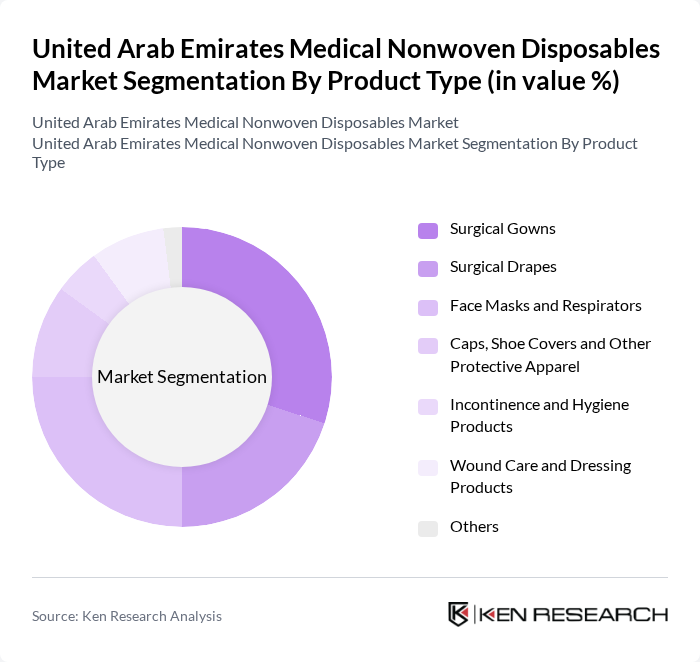
By Product Type:The product type segmentation includes various categories such as Surgical Gowns, Surgical Drapes, Face Masks and Respirators, Caps, Shoe Covers and Other Protective Apparel, Incontinence and Hygiene Products, Wound Care and Dressing Products, and Others. In line with global and regional patterns where surgical nonwoven products and respiratory supplies form a major part of medical nonwoven demand, Surgical Gowns and Face Masks have seen the highest usage due to their critical role in infection prevention and control in operating rooms, intensive care units, and outpatient procedural settings.
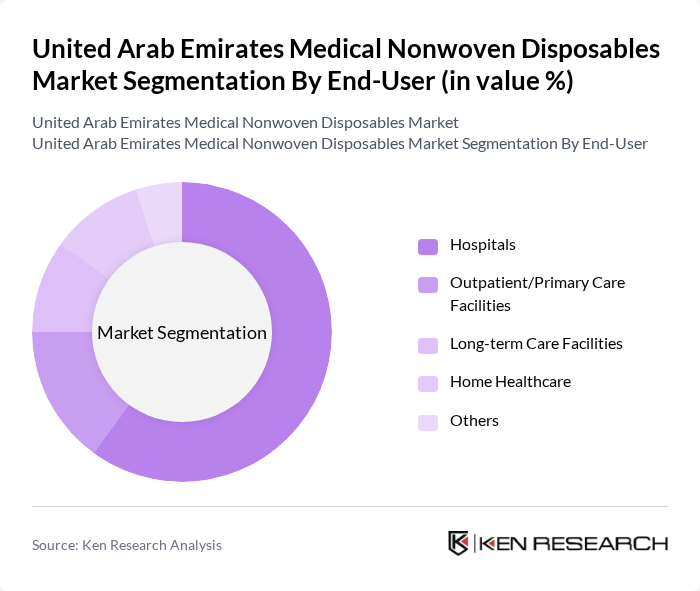
By End-User:The end-user segmentation encompasses Hospitals, Outpatient/Primary Care Facilities, Long-term Care Facilities, Home Healthcare, and Others. Hospitals are the leading end-users of medical nonwoven disposables, consistent with broader UAE medical disposables trends where hospitals constitute the largest end-use segment, driven by high procedure volumes, stringent infection-control protocols, and reliance on single-use gowns, drapes, masks, and sterile packs.
The United Arab Emirates Medical Nonwoven Disposables Market is characterized by a dynamic mix of regional and international players. Leading participants such as Medline Industries, LP, Kimberly-Clark Corporation, Mölnlycke Health Care AB, Cardinal Health, Inc., Owens & Minor, Inc. (Halyard), 3M Company, Smith & Nephew plc, Ahlstrom-Munksjö Oyj, Berry Global Group, Inc., PAUL HARTMANN AG, Medtronic plc, Stryker Corporation, Convatec Group Plc, B. Braun Melsungen AG, Fresenius SE & Co. KGaA contribute to innovation, geographic expansion, and service delivery in this space, with a focus on high-barrier surgical nonwovens, advanced wound dressings, and procedure packs tailored to Middle Eastern hospital requirements.
The future of the UAE medical nonwoven disposables market appears promising, driven by ongoing advancements in technology and a heightened focus on sustainability. As healthcare providers increasingly prioritize eco-friendly materials, manufacturers are likely to invest in innovative product development. Additionally, the expansion of healthcare facilities in emerging markets presents significant growth opportunities, allowing companies to tap into new customer bases and enhance their market presence in the region.
| Segment | Sub-Segments |
|---|---|
| By Product Type | Surgical Gowns Surgical Drapes Face Masks and Respirators Caps, Shoe Covers and Other Protective Apparel Incontinence and Hygiene Products Wound Care and Dressing Products Others |
| By End-User | Hospitals Outpatient/Primary Care Facilities Long-term Care Facilities Home Healthcare Others |
| By Distribution Channel | Direct Institutional Sales Tender-based Procurement Distributors and Dealers Online and E-procurement Platforms Retail/Pharmacy and Others |
| By Material Type | Polypropylene (PP) Polyester (PET) Rayon/Viscose Biodegradable and Sustainable Nonwovens Others |
| By Application | Surgical and Procedural Patient Care and Bedding Infection Prevention and Barrier Protection Hygiene and Incontinence Management Others |
| By Region | Abu Dhabi Dubai Sharjah Ajman Ras Al Khaimah Fujairah & Umm Al Quwain |
| Scope Item/Segment | Sample Size | Target Respondent Profiles |
|---|---|---|
| Hospital Procurement Departments | 120 | Procurement Managers, Supply Chain Coordinators |
| Manufacturers of Nonwoven Disposables | 90 | Production Managers, Quality Assurance Heads |
| Healthcare Professionals in Clinical Settings | 85 | Nurses, Surgeons, Medical Technologists |
| Distributors of Medical Supplies | 70 | Sales Managers, Logistics Coordinators |
| Regulatory Bodies and Health Authorities | 55 | Policy Makers, Compliance Officers |
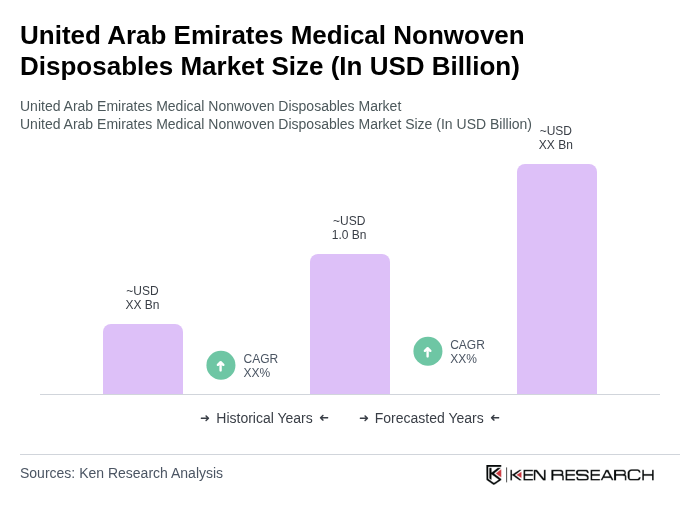
The United Arab Emirates Medical Nonwoven Disposables Market is valued at approximately USD 1.0 billion as of 2023, contributing to the broader UAE medical disposables market, which generated around USD 5.7 billion in the same year.

What makes us stand out is that our consultants follow Robust, Refine and Result (RRR) methodology. Robust for clear definitions, approaches and sanity checking, Refine for differentiating respondents' facts and opinions, and Result for presenting data with story.

We have set a benchmark in the industry by offering our clients with syndicated and customized market research reports featuring coverage of entire market as well as meticulous research and analyst insights.

While we don't replace traditional research, we flip the method upside down. Our dual approach of Top Bottom & Bottom Top ensures quality deliverable by not just verifying company fundamentals but also looking at the sector and macroeconomic factors.

With one step in the future, our research team constantly tries to show you the bigger picture. We help with some of the tough questions you may encounter along the way: How is the industry positioned? Best marketing channel? KPI's of competitors? By aligning every element, we help maximize success.

Our report gives you instant access to the answers and sources that other companies might choose to hide. We elaborate each steps of research methodology we have used and showcase you the sample size to earn your trust.

If you need any support, we are here! We pride ourselves on universe strength, data quality, and quick, friendly, and professional service.













