Region:Middle East
Author(s):Rebecca
Product Code:KRAB2024
Pages:85
Published On:January 2026
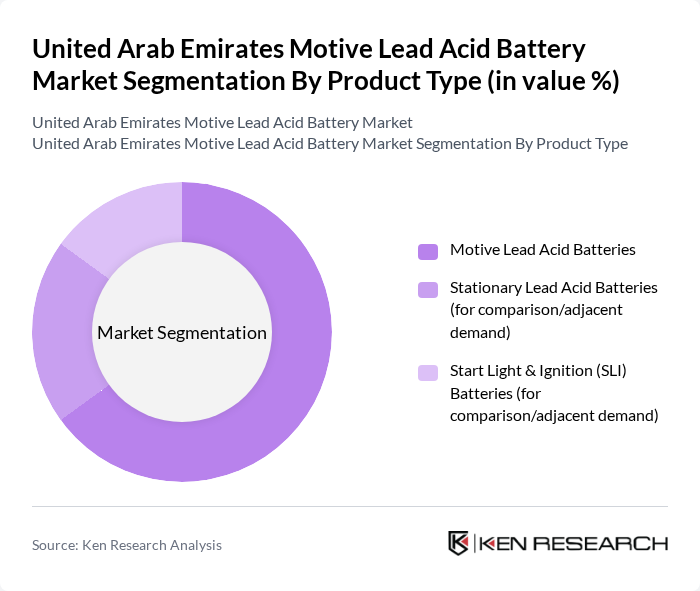
By Product Type:The product type segmentation includes various categories of batteries that cater to different applications. The primary subsegments are Motive Lead Acid Batteries, Stationary Lead Acid Batteries, and Start Light & Ignition (SLI) Batteries. Among these, Motive Lead Acid Batteries are an important demand block in the UAE as part of the wider lead acid battery landscape, which is dominated by automotive and transport-related applications. Motive batteries are widely used in electric forklifts, pallet trucks, airport ground support equipment, cleaning machines, and golf carts, particularly in logistics, retail, airports, and industrial facilities. The growing logistics and warehousing sectors, supported by e?commerce expansion and free?zone development, bolster the demand for these batteries, making them a preferred choice where robustness, cost-effectiveness, and established servicing networks are critical.
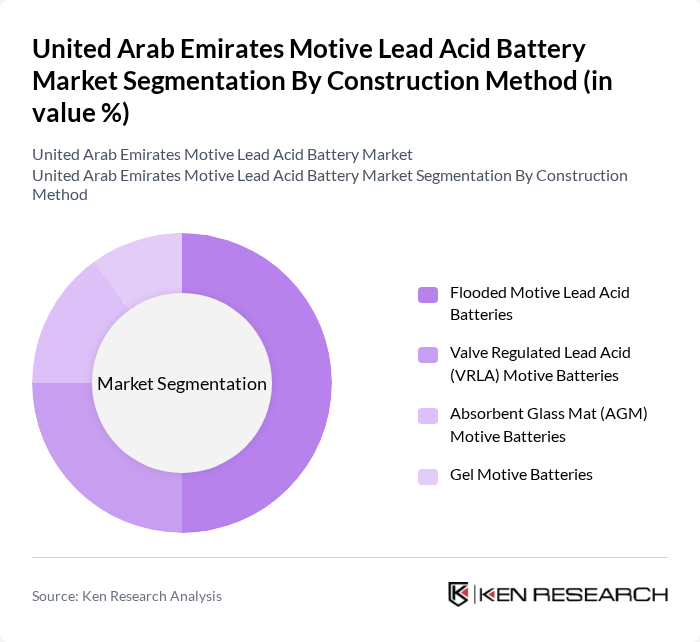
By Construction Method:The construction method segmentation includes Flooded Motive Lead Acid Batteries, Valve Regulated Lead Acid (VRLA) Motive Batteries, Absorbent Glass Mat (AGM) Motive Batteries, and Gel Motive Batteries. Flooded Motive Lead Acid Batteries remain widely used globally and in the region due to their relatively low cost, proven performance, and suitability for heavy-duty industrial and material-handling applications where regular maintenance can be managed. However, VRLA and AGM batteries are gaining traction in motive and industrial uses because of their maintenance-free operation, lower risk of acid spillage, and better suitability for indoor environments and equipment operating in hygiene-sensitive or space-constrained facilities. Gel motive batteries address niche applications requiring deeper cycling capability and enhanced resistance to vibration and temperature variation, appealing to users seeking longer service life and improved safety characteristics in demanding operating conditions.
The United Arab Emirates Motive Lead Acid Battery Market is characterized by a dynamic mix of regional and international players. Leading participants such as Exide Industries Ltd., Amara Raja Energy & Mobility Ltd., GS Yuasa Corporation, East Penn Manufacturing Co., Trojan Battery Company, LLC, EnerSys, C&D Technologies, Inc., Banner GmbH (Banner Batteries), HBL Power Systems Ltd., Leoch International Technology Ltd., NorthStar Battery Company, A123 Systems LLC, Saft Groupe S.A., Panasonic Corporation, Clarios (formerly Johnson Controls Power Solutions) contribute to innovation, geographic expansion, and service delivery in this space.
The future of the UAE motive lead acid battery market appears promising, driven by the increasing integration of renewable energy sources and the growing electric vehicle sector. As the government continues to invest in sustainable energy solutions, the demand for efficient energy storage systems will rise. Additionally, advancements in battery management technologies will enhance performance and safety, positioning lead batteries as a viable option in various applications, despite competition from alternative technologies.
| Segment | Sub-Segments |
|---|---|
| By Product Type | Motive Lead Acid Batteries Stationary Lead Acid Batteries (for comparison/adjacent demand) Start Light & Ignition (SLI) Batteries (for comparison/adjacent demand) |
| By Construction Method | Flooded Motive Lead Acid Batteries Valve Regulated Lead Acid (VRLA) Motive Batteries Absorbent Glass Mat (AGM) Motive Batteries Gel Motive Batteries |
| By Application | Material Handling Equipment (Forklifts, Reach Trucks, Pallet Jacks) Warehousing & Logistics Vehicles Golf Carts & Utility Vehicles Airport Ground Support & Industrial Vehicles Other Motive & Traction Applications |
| By End-Use Industry | Warehousing & E-commerce Logistics Manufacturing & Industrial Construction & Real Estate Transportation, Ports & Airports Retail, Hospitality & Commercial Facilities Others |
| By Sales Channel | Original Equipment Market (OEM) Aftermarket / Replacement |
| By Region (Within UAE) | Dubai Abu Dhabi Sharjah Rest of UAE |
| By Battery Capacity / Voltage Class | Up to 24V V–48V Above 48V |
| Scope Item/Segment | Sample Size | Target Respondent Profiles |
|---|---|---|
| Automotive Lead-Acid Battery Usage | 120 | Fleet Managers, Automotive Engineers |
| Industrial Battery Applications | 90 | Operations Managers, Facility Engineers |
| Telecommunications Backup Systems | 70 | Network Operations Managers, IT Directors |
| Renewable Energy Storage Solutions | 60 | Project Managers, Renewable Energy Consultants |
| Battery Recycling and Disposal Practices | 50 | Environmental Compliance Officers, Waste Management Specialists |
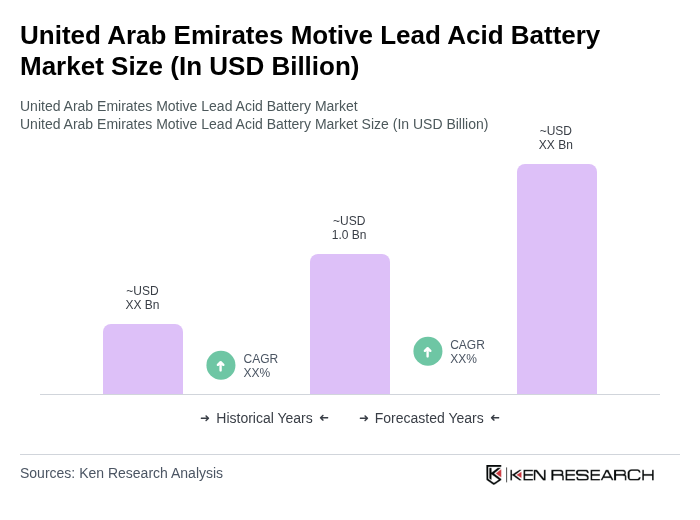
The United Arab Emirates Motive Lead Acid Battery Market is valued at approximately USD 1.0 billion as of 2023, contributing to the broader UAE lead acid battery market, which generated around USD 1.9 billion in the same year.

What makes us stand out is that our consultants follow Robust, Refine and Result (RRR) methodology. Robust for clear definitions, approaches and sanity checking, Refine for differentiating respondents' facts and opinions, and Result for presenting data with story.

We have set a benchmark in the industry by offering our clients with syndicated and customized market research reports featuring coverage of entire market as well as meticulous research and analyst insights.

While we don't replace traditional research, we flip the method upside down. Our dual approach of Top Bottom & Bottom Top ensures quality deliverable by not just verifying company fundamentals but also looking at the sector and macroeconomic factors.

With one step in the future, our research team constantly tries to show you the bigger picture. We help with some of the tough questions you may encounter along the way: How is the industry positioned? Best marketing channel? KPI's of competitors? By aligning every element, we help maximize success.

Our report gives you instant access to the answers and sources that other companies might choose to hide. We elaborate each steps of research methodology we have used and showcase you the sample size to earn your trust.

If you need any support, we are here! We pride ourselves on universe strength, data quality, and quick, friendly, and professional service.













