About the Report
Base Year 2024United States Data Center Construction Market Overview
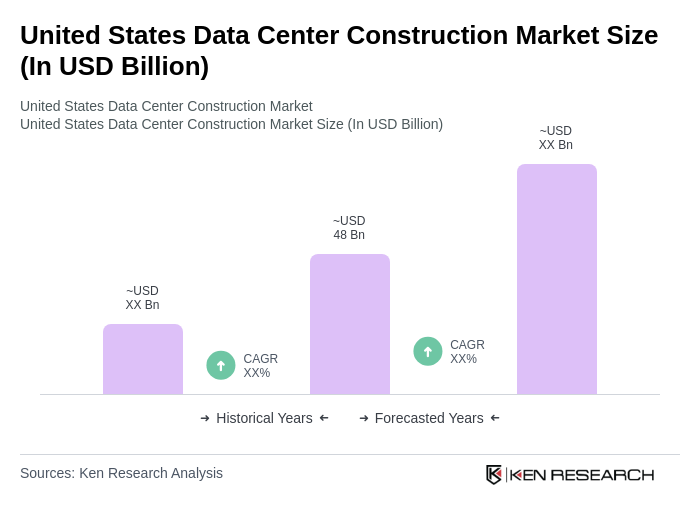
- The United States Data Center Construction Market is valued at USD 48 billion, based on a five-year historical analysis. This growth is primarily driven by the surging demand for artificial intelligence workloads, rapid expansion of cloud services, and the proliferation of big data analytics. The expansion of digital infrastructure and the increasing adoption of IoT devices have further accelerated investments in data center construction, establishing it as a cornerstone of the national technology landscape .
- Key players in this market include major metropolitan areas such as Northern Virginia, Dallas, and Silicon Valley. These regions dominate due to their strategic locations, robust fiber connectivity, and increasing access to renewable energy sources. The presence of hyperscale cloud providers, large technology companies, and a highly skilled workforce further reinforce their leadership in the data center construction sector, attracting ongoing investments and large-scale development .
- In recent years, U.S. government and state-level initiatives have focused on enhancing energy efficiency in data centers, including incentives for renewable energy adoption and advanced cooling technologies. While there is no federal "Energy Efficiency Improvement Act" specifically mandating energy performance standards for new data centers, regulatory momentum and voluntary standards are increasingly shaping sustainable practices and reducing the carbon footprint of the industry .
United States Data Center Construction Market Segmentation
By Type:The data center construction market can be segmented into Hyperscale Data Centers, Colocation Data Centers, Edge Data Centers, Modular Data Centers, and Enterprise Data Centers. Each type addresses distinct operational needs: Hyperscale Data Centers support massive cloud and AI workloads; Colocation Data Centers provide shared infrastructure for multiple tenants; Edge Data Centers enable low-latency processing closer to end-users; Modular Data Centers offer rapid deployment and scalability; and Enterprise Data Centers serve the dedicated needs of large organizations .
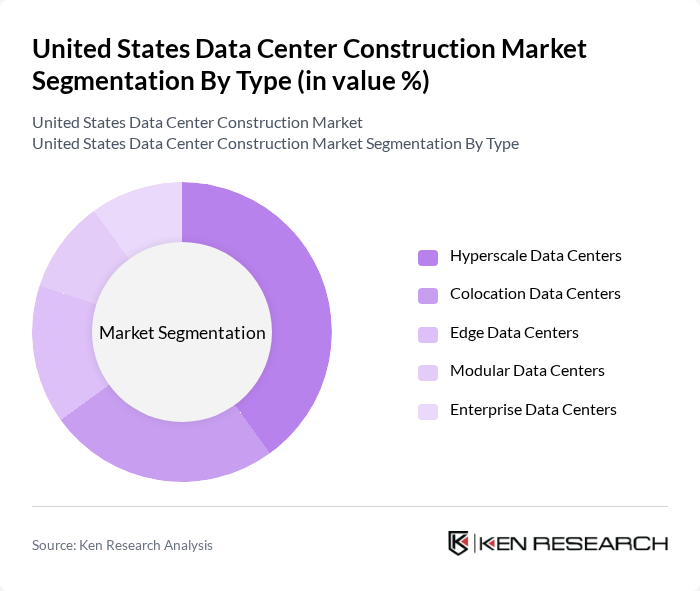
The Hyperscale Data Centers segment is currently dominating the market, driven by the exponential growth in cloud computing, artificial intelligence, and large-scale data processing. These facilities are engineered for scalability and high efficiency, making them the preferred choice for major technology companies and cloud service providers. The ongoing digital transformation and the need for robust, cost-effective data management solutions continue to accelerate the expansion of hyperscale data centers .
By End-User:The end-user segmentation includes IT and Telecommunications, Financial Services (BFSI), Healthcare, Government and Defense, and Energy & Utilities. Each sector has unique operational and regulatory requirements that drive the demand for specialized data center construction: IT and Telecommunications require high-availability and scalable infrastructure; BFSI demands stringent security and compliance; Healthcare prioritizes data privacy and uptime; Government and Defense focus on security and resilience; and Energy & Utilities seek reliable, distributed processing capabilities .
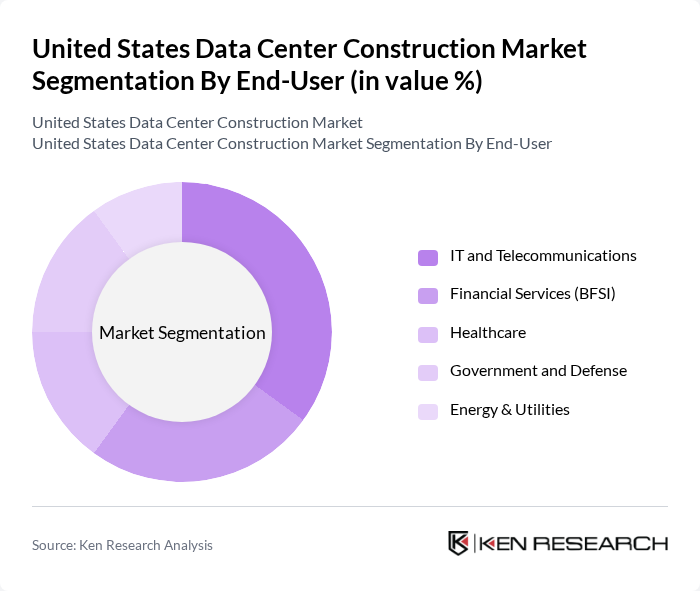
The IT and Telecommunications sector leads the end-user market, propelled by the rapid expansion of cloud services, AI-driven applications, and the growing reliance on data-intensive solutions. Organizations in this sector require resilient, high-capacity data center infrastructure to support mission-critical operations, manage vast data volumes, and ensure uninterrupted service delivery. The digital transformation across all industries further amplifies demand, solidifying IT and Telecommunications as the primary end-user segment .
United States Data Center Construction Market Competitive Landscape
The United States Data Center Construction Market is characterized by a dynamic mix of regional and international players. Leading participants such as Digital Realty, Equinix, CyrusOne, NTT Global Data Centers Americas, CoreSite Realty Corporation, Iron Mountain Data Centers, QTS Realty Trust, Switch, Inc., STACK Infrastructure, Vantage Data Centers, Flexential, TierPoint, DataBank, 365 Data Centers, T5 Data Centers, DPR Construction, Turner Construction Company, Holder Construction, HITT Contracting, Clayco, Corgan (Design/Architecture), Jacobs (Engineering/Project Management), Schneider Electric (Power Infrastructure), Vertiv (Critical Infrastructure), ABB (Power Infrastructure) contribute to innovation, geographic expansion, and service delivery in this space.
United States Data Center Construction Market Industry Analysis
Growth Drivers
- Increasing Demand for Cloud Services:The United States is witnessing a surge in cloud service adoption, with the market expected to reach $600 billion in future. This growth is driven by businesses transitioning to cloud-based solutions for enhanced flexibility and scalability. According to the International Data Corporation (IDC), cloud infrastructure spending is projected to grow by 20% annually, necessitating the construction of new data centers to support this demand, thereby driving significant investment in the sector.
- Expansion of Digital Infrastructure:The U.S. government has allocated approximately $65 billion for broadband expansion as part of the Infrastructure Investment and Jobs Act. This investment aims to enhance digital connectivity, particularly in underserved areas. As digital infrastructure expands, the need for data centers to support increased internet traffic and connectivity will rise, leading to a robust construction market that addresses these infrastructural demands.
- Rising Data Consumption:Data consumption in the U.S. is projected to reach 175 zettabytes in future, driven by the proliferation of IoT devices and streaming services. This exponential growth in data generation necessitates the construction of additional data centers to store and process this information efficiently. The demand for high-capacity storage solutions will further fuel investments in data center construction, creating a dynamic market landscape.
Market Challenges
- High Construction Costs:The average cost of constructing a data center in the U.S. has risen to approximately $10 million per megawatt, influenced by rising material costs and labor expenses. According to the U.S. Bureau of Labor Statistics, construction costs have increased by 5% annually, posing a significant challenge for developers aiming to build new facilities. This financial burden can deter investment and slow down market growth.
- Regulatory Compliance Complexities:Navigating the regulatory landscape for data center construction can be daunting, with numerous federal, state, and local regulations to comply with. For instance, the Environmental Protection Agency (EPA) mandates strict compliance with environmental standards, which can delay projects and increase costs. The complexity of these regulations can hinder timely construction and deter potential investors from entering the market.
United States Data Center Construction Market Future Outlook
The future of the U.S. data center construction market appears promising, driven by technological advancements and increasing digital demands. As businesses continue to embrace cloud computing and edge solutions, the need for innovative data center designs will grow. Additionally, sustainability initiatives will shape construction practices, with a focus on energy-efficient designs and renewable energy integration. This evolving landscape will create opportunities for companies that adapt to these trends and invest in cutting-edge technologies.
Market Opportunities
- Growth in Edge Computing:The rise of edge computing is creating new opportunities for data center construction, as businesses seek to process data closer to the source. This trend is expected to drive the establishment of smaller, localized data centers, enhancing response times and reducing latency. The market for edge data centers is projected to grow significantly, offering lucrative prospects for construction firms.
- Adoption of Green Building Practices:With increasing awareness of environmental sustainability, there is a growing demand for green data centers. The U.S. Green Building Council reports that energy-efficient designs can reduce operational costs by up to 30%. This shift towards sustainable construction practices presents a significant opportunity for developers to differentiate themselves and attract environmentally conscious clients.
Scope of the Report
| Segment | Sub-Segments |
|---|---|
| By Type | Hyperscale Data Centers Colocation Data Centers Edge Data Centers Modular Data Centers Enterprise Data Centers |
| By End-User | IT and Telecommunications Financial Services (BFSI) Healthcare Government and Defense Energy & Utilities |
| By Application | Cloud Computing Big Data Analytics Disaster Recovery & Business Continuity Content Delivery & Streaming Internet of Things (IoT) |
| By Investment Source | Private Investments Public Funding Joint Ventures Real Estate Investment Trusts (REITs) Others |
| By Location | Urban Areas Suburban Areas Rural Areas Secondary Markets (e.g., Hillsboro, Phoenix, Atlanta) |
| By Size | Small Data Centers (<5 MW) Medium Data Centers (5–20 MW) Large Data Centers (>20 MW) Mega Data Centers (>50 MW) |
| By Policy Support | Tax Incentives Subsidies Regulatory Support Energy Efficiency Mandates |
Key Target Audience
Investors and Venture Capitalist Firms
Government and Regulatory Bodies (e.g., Federal Energy Regulatory Commission, Environmental Protection Agency)
Data Center Operators
Construction and Engineering Firms
Telecommunications Providers
Utility Companies
Real Estate Developers
Technology Providers
Players Mentioned in the Report:
Digital Realty
Equinix
CyrusOne
NTT Global Data Centers Americas
CoreSite Realty Corporation
Iron Mountain Data Centers
QTS Realty Trust
Switch, Inc.
STACK Infrastructure
Vantage Data Centers
Flexential
TierPoint
DataBank
365 Data Centers
T5 Data Centers
DPR Construction
Turner Construction Company
Holder Construction
HITT Contracting
Clayco
Corgan (Design/Architecture)
Jacobs (Engineering/Project Management)
Schneider Electric (Power Infrastructure)
Vertiv (Critical Infrastructure)
ABB (Power Infrastructure)
Table of Contents
Market Assessment Phase
1. Executive Summary and Approach
2. United States Data Center Construction Market Overview
2.1 Key Insights and Strategic Recommendations
2.2 United States Data Center Construction Market Overview
2.3 Definition and Scope
2.4 Evolution of Market Ecosystem
2.5 Timeline of Key Regulatory Milestones
2.6 Value Chain & Stakeholder Mapping
2.7 Business Cycle Analysis
2.8 Policy & Incentive Landscape
3. United States Data Center Construction Market Analysis
3.1 Growth Drivers
3.1.1 Increasing demand for cloud services
3.1.2 Expansion of digital infrastructure
3.1.3 Rising data consumption
3.1.4 Government initiatives for technology advancement
3.2 Market Challenges
3.2.1 High construction costs
3.2.2 Regulatory compliance complexities
3.2.3 Skilled labor shortages
3.2.4 Environmental sustainability concerns
3.3 Market Opportunities
3.3.1 Growth in edge computing
3.3.2 Adoption of green building practices
3.3.3 Investment in renewable energy sources
3.3.4 Technological advancements in cooling solutions
3.4 Market Trends
3.4.1 Shift towards modular data centers
3.4.2 Increased focus on energy efficiency
3.4.3 Rise of colocation services
3.4.4 Integration of AI and automation in operations
3.5 Government Regulation
3.5.1 Energy efficiency standards
3.5.2 Building codes and safety regulations
3.5.3 Environmental impact assessments
3.5.4 Tax incentives for green construction
4. SWOT Analysis
5. Stakeholder Analysis
6. Porter's Five Forces Analysis
7. United States Data Center Construction Market Market Size, 2019-2024
7.1 By Value
7.2 By Volume
7.3 By Average Selling Price
8. United States Data Center Construction Market Segmentation
8.1 By Type
8.1.1 Hyperscale Data Centers
8.1.2 Colocation Data Centers
8.1.3 Edge Data Centers
8.1.4 Modular Data Centers
8.1.5 Enterprise Data Centers
8.2 By End-User
8.2.1 IT and Telecommunications
8.2.2 Financial Services (BFSI)
8.2.3 Healthcare
8.2.4 Government and Defense
8.2.5 Energy & Utilities
8.3 By Application
8.3.1 Cloud Computing
8.3.2 Big Data Analytics
8.3.3 Disaster Recovery & Business Continuity
8.3.4 Content Delivery & Streaming
8.3.5 Internet of Things (IoT)
8.4 By Investment Source
8.4.1 Private Investments
8.4.2 Public Funding
8.4.3 Joint Ventures
8.4.4 Real Estate Investment Trusts (REITs)
8.4.5 Others
8.5 By Location
8.5.1 Urban Areas
8.5.2 Suburban Areas
8.5.3 Rural Areas
8.5.4 Secondary Markets (e.g., Hillsboro, Phoenix, Atlanta)
8.6 By Size
8.6.1 Small Data Centers (<5 MW)
8.6.2 Medium Data Centers (5–20 MW)
8.6.3 Large Data Centers (>20 MW)
8.6.4 Mega Data Centers (>50 MW)
8.7 By Policy Support
8.7.1 Tax Incentives
8.7.2 Subsidies
8.7.3 Regulatory Support
8.7.4 Energy Efficiency Mandates
9. United States Data Center Construction Market Competitive Analysis
9.1 Market Share of Key Players
9.2 Cross Comparison of Key Players
9.2.1 Company Name
9.2.2 Group Size (Large, Medium, or Small as per industry convention)
9.2.3 Annual Revenue from Data Center Construction
9.2.4 Number of Data Center Projects Completed (US, last 5 years)
9.2.5 Total IT Load Delivered (MW)
9.2.6 Average Project Completion Time (months)
9.2.7 Market Penetration Rate (by region or segment)
9.2.8 Customer Retention Rate
9.2.9 Sustainability Index (LEED/Tier certifications, renewable energy %)
9.2.10 Innovation Rate (patents, new construction methods, modularity)
9.2.11 Safety Record (OSHA incidents per 100,000 hours)
9.3 SWOT Analysis of Top Players
9.4 Pricing Analysis
9.5 Detailed Profile of Major Companies
9.5.1 Digital Realty
9.5.2 Equinix
9.5.3 CyrusOne
9.5.4 NTT Global Data Centers Americas
9.5.5 CoreSite Realty Corporation
9.5.6 Iron Mountain Data Centers
9.5.7 QTS Realty Trust
9.5.8 Switch, Inc.
9.5.9 STACK Infrastructure
9.5.10 Vantage Data Centers
9.5.11 Flexential
9.5.12 TierPoint
9.5.13 DataBank
9.5.14 365 Data Centers
9.5.15 T5 Data Centers
9.5.16 DPR Construction
9.5.17 Turner Construction Company
9.5.18 Holder Construction
9.5.19 HITT Contracting
9.5.20 Clayco
9.5.21 Corgan (Design/Architecture)
9.5.22 Jacobs (Engineering/Project Management)
9.5.23 Schneider Electric (Power Infrastructure)
9.5.24 Vertiv (Critical Infrastructure)
9.5.25 ABB (Power Infrastructure)
10. United States Data Center Construction Market End-User Analysis
10.1 Procurement Behavior of Key Ministries
10.1.1 Federal Government Agencies
10.1.2 State Government Departments
10.1.3 Local Government Entities
10.2 Corporate Spend on Infrastructure & Energy
10.2.1 IT Sector Investments
10.2.2 Financial Sector Allocations
10.2.3 Healthcare Sector Expenditures
10.3 Pain Point Analysis by End-User Category
10.3.1 IT and Telecommunications Challenges
10.3.2 Financial Services Issues
10.3.3 Healthcare Sector Concerns
10.4 User Readiness for Adoption
10.4.1 Technology Adoption Rates
10.4.2 Infrastructure Readiness
10.4.3 Budget Allocations
10.5 Post-Deployment ROI and Use Case Expansion
10.5.1 Performance Metrics
10.5.2 Cost Savings Analysis
10.5.3 Future Expansion Plans
11. United States Data Center Construction Market Future Size, 2025-2030
11.1 By Value
11.2 By Volume
11.3 By Average Selling Price
Go-To-Market Strategy Phase
1. Whitespace Analysis + Business Model Canvas
1.1 Market Gaps Identification
1.2 Business Model Development
2. Marketing and Positioning Recommendations
2.1 Branding Strategies
2.2 Product USPs
3. Distribution Plan
3.1 Urban Retail Strategies
3.2 Rural NGO Tie-ups
4. Channel & Pricing Gaps
4.1 Underserved Routes
4.2 Pricing Bands
5. Unmet Demand & Latent Needs
5.1 Category Gaps
5.2 Consumer Segments
6. Customer Relationship
6.1 Loyalty Programs
6.2 After-sales Service
7. Value Proposition
7.1 Sustainability Initiatives
7.2 Integrated Supply Chains
8. Key Activities
8.1 Regulatory Compliance
8.2 Branding Efforts
8.3 Distribution Setup
9. Entry Strategy Evaluation
9.1 Domestic Market Entry Strategy
9.1.1 Product Mix Considerations
9.1.2 Pricing Band Strategy
9.1.3 Packaging Options
9.2 Export Entry Strategy
9.2.1 Target Countries
9.2.2 Compliance Roadmap
10. Entry Mode Assessment
10.1 Joint Ventures
10.2 Greenfield Investments
10.3 Mergers & Acquisitions
10.4 Distributor Model
11. Capital and Timeline Estimation
11.1 Capital Requirements
11.2 Timelines for Implementation
12. Control vs Risk Trade-Off
12.1 Ownership Considerations
12.2 Partnerships Evaluation
13. Profitability Outlook
13.1 Breakeven Analysis
13.2 Long-term Sustainability
14. Potential Partner List
14.1 Distributors
14.2 Joint Ventures
14.3 Acquisition Targets
15. Execution Roadmap
15.1 Phased Plan for Market Entry
15.1.1 Market Setup
15.1.2 Market Entry
15.1.3 Growth Acceleration
15.1.4 Scale & Stabilize
15.2 Key Activities and Milestones
15.2.1 Activity Planning
15.2.2 Milestone Tracking
Research Methodology
Phase 1: Approach1
Desk Research
- Analysis of industry reports from data center associations and market research firms
- Review of government publications and regulatory frameworks impacting data center construction
- Examination of construction trends and investment patterns from financial reports of major players
Primary Research
- Interviews with project managers and engineers involved in recent data center projects
- Surveys with real estate developers focusing on data center facilities
- Field interviews with local government officials regarding zoning and permitting processes
Validation & Triangulation
- Cross-validation of findings through multiple data sources, including industry publications and expert opinions
- Triangulation of construction cost data with market demand indicators
- Sanity checks through expert panel reviews comprising industry veterans and analysts
Phase 2: Market Size Estimation1
Top-down Assessment
- Estimation of total market size based on national IT infrastructure spending trends
- Segmentation of market by data center type (hyperscale, colocation, enterprise) and geographic region
- Incorporation of growth forecasts from cloud service providers and digital transformation initiatives
Bottom-up Modeling
- Analysis of construction costs per square foot for various data center designs
- Volume estimates based on the number of data centers under construction and planned
- Cost breakdowns by region, including labor, materials, and technology investments
Forecasting & Scenario Analysis
- Multi-factor regression analysis incorporating factors such as energy costs, technology advancements, and regulatory changes
- Scenario modeling based on varying levels of demand for cloud services and data storage
- Baseline, optimistic, and pessimistic projections through 2030, considering market volatility
Phase 3: CATI Sample Composition1
| Scope Item/Segment | Sample Size | Target Respondent Profiles |
|---|---|---|
| Hyperscale Data Centers | 100 | Data Center Managers, Infrastructure Architects |
| Colocation Facilities | 80 | Operations Directors, Facility Managers |
| Enterprise Data Center Projects | 70 | IT Managers, Project Coordinators |
| Green Data Center Initiatives | 50 | Sustainability Officers, Energy Managers |
| Data Center Construction Trends | 60 | Construction Managers, Real Estate Developers |
Frequently Asked Questions
What is the current value of the United States Data Center Construction Market?
The United States Data Center Construction Market is valued at approximately USD 48 billion, reflecting significant growth driven by the increasing demand for cloud services, artificial intelligence workloads, and big data analytics.
What factors are driving growth in the U.S. Data Center Construction Market?
Which regions are leading in data center construction in the U.S.?
What types of data centers are included in the U.S. market?
Other Regional/Country Reports
Indonesia Data Center Construction Market
Malaysia Data Center Construction Market
Why Buy From Us?

What makes us stand out is that our consultants follow Robust, Refine and Result (RRR) methodology. Robust for clear definitions, approaches and sanity checking, Refine for differentiating respondents' facts and opinions, and Result for presenting data with story.

We have set a benchmark in the industry by offering our clients with syndicated and customized market research reports featuring coverage of entire market as well as meticulous research and analyst insights.

While we don't replace traditional research, we flip the method upside down. Our dual approach of Top Bottom & Bottom Top ensures quality deliverable by not just verifying company fundamentals but also looking at the sector and macroeconomic factors.

With one step in the future, our research team constantly tries to show you the bigger picture. We help with some of the tough questions you may encounter along the way: How is the industry positioned? Best marketing channel? KPI's of competitors? By aligning every element, we help maximize success.

Our report gives you instant access to the answers and sources that other companies might choose to hide. We elaborate each steps of research methodology we have used and showcase you the sample size to earn your trust.

If you need any support, we are here! We pride ourselves on universe strength, data quality, and quick, friendly, and professional service.