About the Report
Base Year 2024United States Defense Market Overview
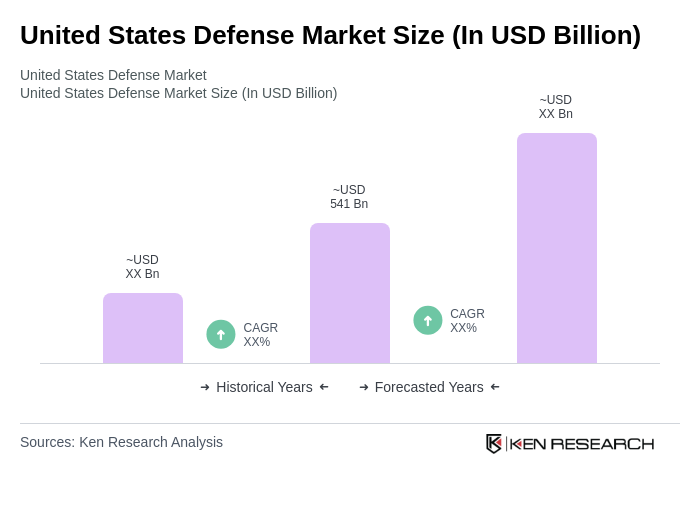
- The United States Defense Market is valued at USD 541 billion, based on a five-year historical analysis. This growth is primarily driven by escalating geopolitical tensions, rapid advancements in artificial intelligence and cyber warfare capabilities, and sustained increases in the U.S. defense budget. The demand for advanced weaponry, cybersecurity solutions, and modernization of military assets continues to significantly contribute to the market's expansion, with a particular emphasis on digitalization and autonomous systems .
- Key players in this market include major defense contractors such as Lockheed Martin, Boeing, and Northrop Grumman. These companies dominate the market due to their extensive experience, technological expertise, and strong relationships with government agencies. Their ability to innovate and deliver cutting-edge defense solutions—including AI-enabled systems, advanced missile defense, and integrated C4ISR platforms—has solidified their positions as leaders in the U.S. defense sector .
- In 2023, the U.S. government implemented the National Defense Authorization Act (NDAA), which authorized a defense budget of approximately USD 858 billion. This regulation aims to enhance military readiness, support research and development, and ensure the procurement of advanced defense systems. The NDAA reflects the government's commitment to maintaining a strong defense posture in response to evolving global threats, with a growing focus on cyber resilience and next-generation technologies .
United States Defense Market Segmentation
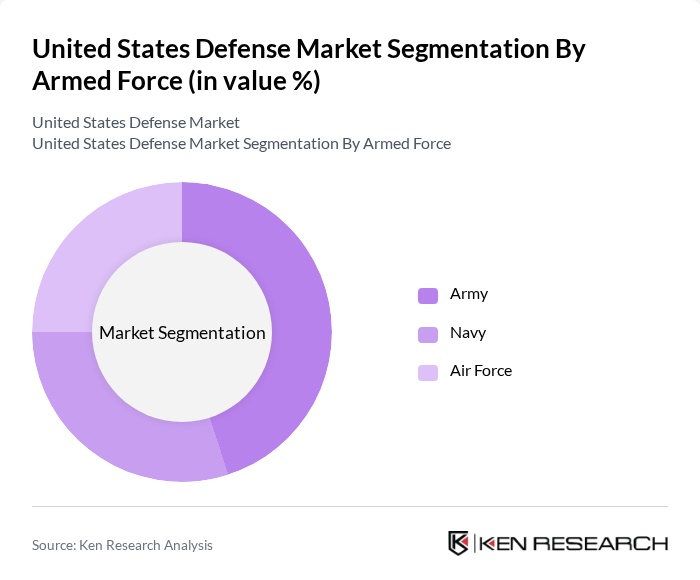
By Armed Force:The U.S. defense market is segmented into three primary armed forces: Army, Navy, and Air Force. Each branch has distinct operational requirements and budget allocations, shaping their procurement strategies. The Army emphasizes modernization of ground-based systems and integrated air defense, the Navy focuses on expanding naval capabilities and fleet readiness, and the Air Force prioritizes aerial superiority and advanced surveillance. The Army remains the dominant segment, driven by ongoing modernization programs and increased funding for ground operations .
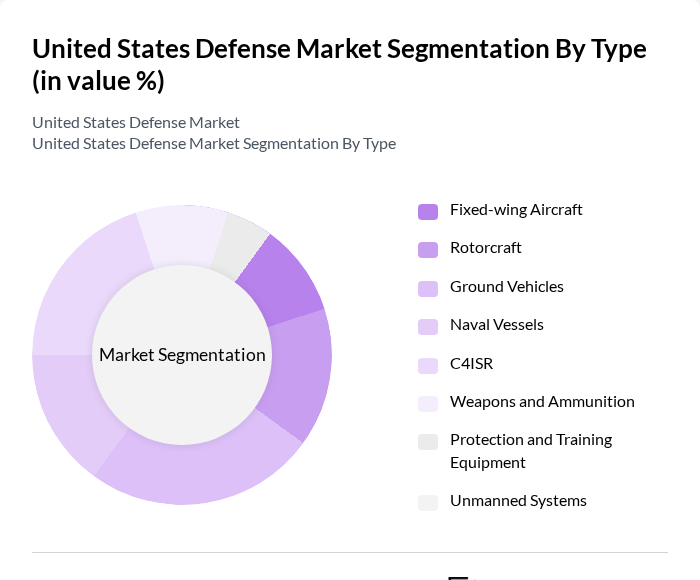
By Type:The market is also segmented by type, including Fixed-wing Aircraft, Rotorcraft, Ground Vehicles, Naval Vessels, C4ISR (Command, Control, Communications, Computers, Intelligence, Surveillance, and Reconnaissance), Weapons and Ammunition, Protection and Training Equipment, and Unmanned Systems. The C4ISR segment is currently leading the market due to the increasing need for advanced communication, integrated intelligence, and real-time situational awareness in modern warfare. There is also strong growth in unmanned systems and AI-enabled platforms as the U.S. military prioritizes automation and network-centric operations .
United States Defense Market Competitive Landscape
The United States Defense Market is characterized by a dynamic mix of regional and international players. Leading participants such as Lockheed Martin, RTX (Raytheon Technologies), Northrop Grumman, Boeing Defense, Space & Security, General Dynamics, BAE Systems Inc. (US Subsidiary), L3Harris Technologies, Huntington Ingalls Industries, Leidos, SAIC (Science Applications International Corporation), Textron Systems, Oshkosh Defense, Elbit Systems of America, Kratos Defense & Security Solutions, AeroVironment contribute to innovation, geographic expansion, and service delivery in this space.
United States Defense Market Industry Analysis
Growth Drivers
- Increased Defense Spending:The U.S. defense budget for fiscal year 2024 is projected to reach approximately $816.7 billion, reflecting a significant increase from $877 billion in 2023. This rise is driven by the need to enhance military capabilities amid rising global tensions. The Department of Defense (DoD) allocates around $276 billion annually for procurement and research, which supports the growth of defense contractors and technology firms, fostering innovation and modernization in defense systems.
- Technological Advancements:The U.S. defense sector is increasingly investing in advanced technologies, with an estimated $145 billion earmarked for research and development in future. This investment focuses on artificial intelligence, autonomous systems, and advanced weaponry. The integration of these technologies is crucial for maintaining a competitive edge, as the U.S. aims to counter threats from nations like China and Russia, which are also ramping up their military capabilities through technological innovations.
- Geopolitical Tensions:Heightened geopolitical tensions, particularly in Eastern Europe and the Indo-Pacific region, have led to increased military readiness and strategic partnerships. The U.S. has committed over $44 billion in military aid to Ukraine since 2022, underscoring its focus on countering aggression. Additionally, the U.S. is strengthening alliances with NATO and other partners, which drives demand for advanced defense systems and capabilities, further propelling market growth in the defense sector.
Market Challenges
- Budget Constraints:Despite increased defense spending, budget constraints remain a significant challenge. The Congressional Budget Office (CBO) projects that the U.S. will face a budget deficit exceeding $1.5 trillion in future, which may lead to cuts in defense spending in future years. This uncertainty can hinder long-term planning and investment in critical defense projects, impacting the overall stability of the defense market and its growth potential.
- Regulatory Compliance:The defense industry is subject to stringent regulations, including ITAR and DFARS, which can complicate operations for contractors. Compliance costs are estimated to exceed $10 billion annually for the industry. These regulations can slow down project timelines and increase operational costs, making it challenging for smaller firms to compete effectively. Navigating this complex regulatory landscape is essential for maintaining competitiveness in the defense market.
United States Defense Market Future Outlook
The future of the U.S. defense market appears robust, driven by ongoing technological advancements and a focus on modernization. As the geopolitical landscape evolves, the demand for innovative defense solutions will likely increase. The integration of artificial intelligence and cybersecurity measures will be pivotal in shaping defense strategies. Additionally, the emphasis on sustainability in defense operations will drive investments in green technologies, ensuring that the U.S. military remains prepared for future challenges while addressing environmental concerns.
Market Opportunities
- Defense Modernization Programs:The U.S. government is investing heavily in defense modernization, with over $90 billion allocated for upgrading existing systems in future. This presents significant opportunities for contractors specializing in advanced technologies, including cyber defense and unmanned systems, to secure lucrative contracts and enhance their market presence.
- Public-Private Partnerships:The U.S. defense sector is increasingly fostering public-private partnerships, with initiatives like the Defense Innovation Unit (DIU) facilitating collaboration. In future, the government aims to allocate substantial funding to support these partnerships, enabling private firms to contribute innovative solutions to defense challenges, thus expanding their market opportunities and driving growth.
Scope of the Report
| Segment | Sub-Segments |
|---|---|
| By Armed Force | Army Navy Air Force |
| By Type | Fixed-wing Aircraft Rotorcraft Ground Vehicles Naval Vessels C4ISR (Command, Control, Communications, Computers, Intelligence, Surveillance, and Reconnaissance) Weapons and Ammunition Protection and Training Equipment Unmanned Systems |
| By Region | New England Mideast Great Lakes Plains Southeast Southwest Rocky Mountain Far West |
Key Target Audience
Investors and Venture Capitalist Firms
Government and Regulatory Bodies (e.g., Department of Defense, Department of Homeland Security)
Military and Defense Contractors
Defense Technology Developers
Logistics and Supply Chain Management Firms
National Security Agencies (e.g., National Security Agency, Central Intelligence Agency)
Defense Policy Makers and Analysts
Foreign Military Sales and International Defense Partners
Players Mentioned in the Report:
Lockheed Martin
RTX (Raytheon Technologies)
Northrop Grumman
Boeing Defense, Space & Security
General Dynamics
BAE Systems Inc. (US Subsidiary)
L3Harris Technologies
Huntington Ingalls Industries
Leidos
SAIC (Science Applications International Corporation)
Textron Systems
Oshkosh Defense
Elbit Systems of America
Kratos Defense & Security Solutions
AeroVironment
Table of Contents
Market Assessment Phase
1. Executive Summary and Approach
2. United States Defense Market Overview
2.1 Key Insights and Strategic Recommendations
2.2 United States Defense Market Overview
2.3 Definition and Scope
2.4 Evolution of Market Ecosystem
2.5 Timeline of Key Regulatory Milestones
2.6 Value Chain & Stakeholder Mapping
2.7 Business Cycle Analysis
2.8 Policy & Incentive Landscape
3. United States Defense Market Analysis
3.1 Growth Drivers
3.1.1 Increased Defense Spending
3.1.2 Technological Advancements
3.1.3 Geopolitical Tensions
3.1.4 Cybersecurity Threats
3.2 Market Challenges
3.2.1 Budget Constraints
3.2.2 Regulatory Compliance
3.2.3 Supply Chain Disruptions
3.2.4 Competition from Emerging Markets
3.3 Market Opportunities
3.3.1 Defense Modernization Programs
3.3.2 Public-Private Partnerships
3.3.3 Advanced Research and Development
3.3.4 International Defense Contracts
3.4 Market Trends
3.4.1 Increased Focus on AI and Automation
3.4.2 Shift Towards Asymmetric Warfare
3.4.3 Growth in Defense Cybersecurity Solutions
3.4.4 Emphasis on Sustainability in Defense Operations
3.5 Government Regulation
3.5.1 ITAR Compliance
3.5.2 DFARS Regulations
3.5.3 Export Control Regulations
3.5.4 Federal Acquisition Regulations (FAR)
4. SWOT Analysis
5. Stakeholder Analysis
6. Porter's Five Forces Analysis
7. United States Defense Market Market Size, 2019-2024
7.1 By Value
7.2 By Volume
7.3 By Average Selling Price
8. United States Defense Market Segmentation
8.1 By Armed Force
8.1.1 Army
8.1.2 Navy
8.1.3 Air Force
8.2 By Type
8.2.1 Fixed-wing Aircraft
8.2.2 Rotorcraft
8.2.3 Ground Vehicles
8.2.4 Naval Vessels
8.2.5 C4ISR (Command, Control, Communications, Computers, Intelligence, Surveillance, and Reconnaissance)
8.2.6 Weapons and Ammunition
8.2.7 Protection and Training Equipment
8.2.8 Unmanned Systems
8.3 By Region
8.3.1 New England
8.3.2 Mideast
8.3.3 Great Lakes
8.3.4 Plains
8.3.5 Southeast
8.3.6 Southwest
8.3.7 Rocky Mountain
8.3.8 Far West
9. United States Defense Market Competitive Analysis
9.1 Market Share of Key Players
9.2 KPIs for Cross Comparison of Key Players
9.2.1 Total Defense Revenue (USD)
9.2.2 Revenue Growth Rate (%)
9.2.3 Market Share (%)
9.2.4 Number of Active Defense Contracts
9.2.5 R&D Expenditure (% of Revenue)
9.2.6 Backlog Value (USD)
9.2.7 Major Program Deliveries (Units/Year)
9.2.8 International vs. Domestic Revenue Split (%)
9.2.9 Contract Win Rate (%)
9.2.10 EBITDA Margin (%)
9.2.11 Employee Headcount (Defense Segment)
9.2.12 Capital Expenditure (USD)
9.3 SWOT Analysis of Top Players
9.4 Pricing Analysis
9.5 Detailed Profile of Major Companies
9.5.1 Lockheed Martin
9.5.2 RTX (Raytheon Technologies)
9.5.3 Northrop Grumman
9.5.4 Boeing Defense, Space & Security
9.5.5 General Dynamics
9.5.6 BAE Systems Inc. (US Subsidiary)
9.5.7 L3Harris Technologies
9.5.8 Huntington Ingalls Industries
9.5.9 Leidos
9.5.10 SAIC (Science Applications International Corporation)
9.5.11 Textron Systems
9.5.12 Oshkosh Defense
9.5.13 Elbit Systems of America
9.5.14 Kratos Defense & Security Solutions
9.5.15 AeroVironment
10. United States Defense Market End-User Analysis
10.1 Procurement Behavior of Key Ministries
10.1.1 Department of Defense Procurement Trends
10.1.2 Homeland Security Spending Patterns
10.1.3 Law Enforcement Procurement Strategies
10.1.4 Private Sector Engagement
10.2 Corporate Spend on Infrastructure & Energy
10.2.1 Defense Infrastructure Investments
10.2.2 Energy Efficiency Initiatives
10.2.3 Technology Upgrades
10.2.4 Others
10.3 Pain Point Analysis by End-User Category
10.3.1 Budget Constraints
10.3.2 Compliance Challenges
10.3.3 Technology Integration Issues
10.3.4 Others
10.4 User Readiness for Adoption
10.4.1 Training and Support Needs
10.4.2 Technology Acceptance Levels
10.4.3 Infrastructure Readiness
10.4.4 Others
10.5 Post-Deployment ROI and Use Case Expansion
10.5.1 Performance Metrics
10.5.2 Long-term Cost Savings
10.5.3 Scalability of Solutions
10.5.4 Others
11. United States Defense Market Future Size, 2025-2030
11.1 By Value
11.2 By Volume
11.3 By Average Selling Price
Go-To-Market Strategy Phase
1. Whitespace Analysis + Business Model Canvas
1.1 Market Gaps Identification
1.2 Business Model Framework
2. Marketing and Positioning Recommendations
2.1 Branding Strategies
2.2 Product USPs
3. Distribution Plan
3.1 Urban Retail Strategies
3.2 Rural NGO Tie-ups
4. Channel & Pricing Gaps
4.1 Underserved Routes
4.2 Pricing Bands
5. Unmet Demand & Latent Needs
5.1 Category Gaps
5.2 Consumer Segments
6. Customer Relationship
6.1 Loyalty Programs
6.2 After-sales Service
7. Value Proposition
7.1 Sustainability Initiatives
7.2 Integrated Supply Chains
8. Key Activities
8.1 Regulatory Compliance
8.2 Branding Efforts
8.3 Distribution Setup
9. Entry Strategy Evaluation
9.1 Domestic Market Entry Strategy
9.1.1 Product Mix
9.1.2 Pricing Band
9.1.3 Packaging
9.2 Export Entry Strategy
9.2.1 Target Countries
9.2.2 Compliance Roadmap
10. Entry Mode Assessment
10.1 Joint Ventures
10.2 Greenfield Investments
10.3 Mergers & Acquisitions
10.4 Distributor Model
11. Capital and Timeline Estimation
11.1 Capital Requirements
11.2 Timelines
12. Control vs Risk Trade-Off
12.1 Ownership vs Partnerships
13. Profitability Outlook
13.1 Breakeven Analysis
13.2 Long-term Sustainability
14. Potential Partner List
14.1 Distributors
14.2 Joint Ventures
14.3 Acquisition Targets
15. Execution Roadmap
15.1 Phased Plan for Market Entry
15.1.1 Market Setup
15.1.2 Market Entry
15.1.3 Growth Acceleration
15.1.4 Scale & Stabilize
15.2 Key Activities and Milestones
15.2.1 Milestone Planning
15.2.2 Activity Tracking
Research Methodology
Phase 1: Approach1
Desk Research
- Analysis of defense spending reports from the Department of Defense (DoD) and Congressional Budget Office (CBO)
- Review of industry publications and white papers from defense think tanks and research organizations
- Examination of procurement data and contract awards from the Federal Procurement Data System (FPDS)
Primary Research
- Interviews with defense contractors and suppliers to gather insights on market trends and challenges
- Surveys with military procurement officers to understand purchasing behaviors and preferences
- Field interviews with defense analysts and policy experts to assess the impact of geopolitical factors
Validation & Triangulation
- Cross-validation of findings through multiple data sources, including government reports and industry surveys
- Triangulation of qualitative insights from interviews with quantitative data from market reports
- Sanity checks through expert panel reviews comprising former military officials and defense economists
Phase 2: Market Size Estimation1
Top-down Assessment
- Estimation of total defense budget allocation across various sectors (e.g., land, air, naval)
- Analysis of historical spending trends to project future budgetary allocations
- Incorporation of emerging defense technologies and their projected market impact
Bottom-up Modeling
- Collection of firm-level revenue data from leading defense contractors and suppliers
- Operational cost analysis based on contract types and project scopes
- Volume x cost basis for different defense segments, including procurement and maintenance
Forecasting & Scenario Analysis
- Multi-factor regression analysis incorporating factors such as geopolitical tensions and technological advancements
- Scenario modeling based on potential changes in defense policy and budgetary constraints
- Baseline, optimistic, and pessimistic projections through 2030, considering global defense dynamics
Phase 3: CATI Sample Composition1
| Scope Item/Segment | Sample Size | Target Respondent Profiles |
|---|---|---|
| Defense Procurement Strategies | 100 | Procurement Officers, Contract Managers |
| Military Technology Adoption | 80 | R&D Directors, Technology Officers |
| Logistics and Supply Chain Management | 70 | Logistics Coordinators, Supply Chain Analysts |
| Defense Policy Impact Assessment | 60 | Policy Advisors, Defense Analysts |
| Emerging Defense Markets | 90 | Market Analysts, Business Development Managers |
Frequently Asked Questions
What is the current value of the United States Defense Market?
The United States Defense Market is valued at approximately USD 541 billion, reflecting significant growth driven by geopolitical tensions, advancements in technology, and increased defense spending. This market is expected to continue expanding as modernization and cybersecurity needs rise.
Who are the key players in the U.S. Defense Market?
What factors are driving growth in the U.S. Defense Market?
What is the projected defense budget for the U.S. in 2024?
Other Regional/Country Reports
Why Buy From Us?

What makes us stand out is that our consultants follow Robust, Refine and Result (RRR) methodology. Robust for clear definitions, approaches and sanity checking, Refine for differentiating respondents' facts and opinions, and Result for presenting data with story.

We have set a benchmark in the industry by offering our clients with syndicated and customized market research reports featuring coverage of entire market as well as meticulous research and analyst insights.

While we don't replace traditional research, we flip the method upside down. Our dual approach of Top Bottom & Bottom Top ensures quality deliverable by not just verifying company fundamentals but also looking at the sector and macroeconomic factors.

With one step in the future, our research team constantly tries to show you the bigger picture. We help with some of the tough questions you may encounter along the way: How is the industry positioned? Best marketing channel? KPI's of competitors? By aligning every element, we help maximize success.

Our report gives you instant access to the answers and sources that other companies might choose to hide. We elaborate each steps of research methodology we have used and showcase you the sample size to earn your trust.

If you need any support, we are here! We pride ourselves on universe strength, data quality, and quick, friendly, and professional service.