About the Report
Base Year 2024United States Solar Energy Market Overview
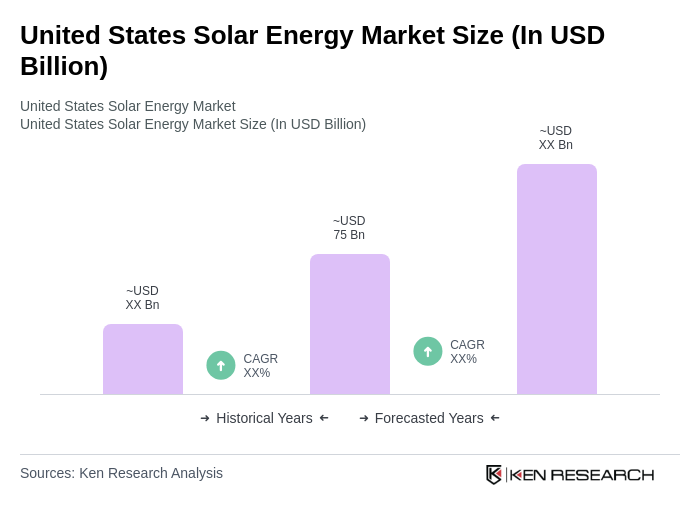
- The United States Solar Energy Market is valued at USD 75 billion, based on a five-year historical analysis. This growth is primarily driven by increasing investments in renewable energy, technological advancements in solar panel efficiency, and a growing consumer preference for sustainable energy solutions. The market has seen a significant rise in installations, supported by favorable government policies and incentives aimed at reducing carbon emissions.
- Key players in this market include California, Texas, and Florida, which dominate due to their abundant sunlight, large land areas suitable for solar farms, and supportive state policies promoting solar energy adoption. California, in particular, leads the nation in solar capacity, driven by aggressive renewable energy targets and a strong commitment to sustainability.
- In 2023, the U.S. government implemented the Inflation Reduction Act, which includes provisions for extending the Investment Tax Credit (ITC) for solar energy projects. This regulation aims to incentivize the installation of solar systems by allowing homeowners and businesses to deduct a significant percentage of the installation costs from their federal taxes, thereby stimulating market growth and increasing solar adoption across the country.
United States Solar Energy Market Segmentation
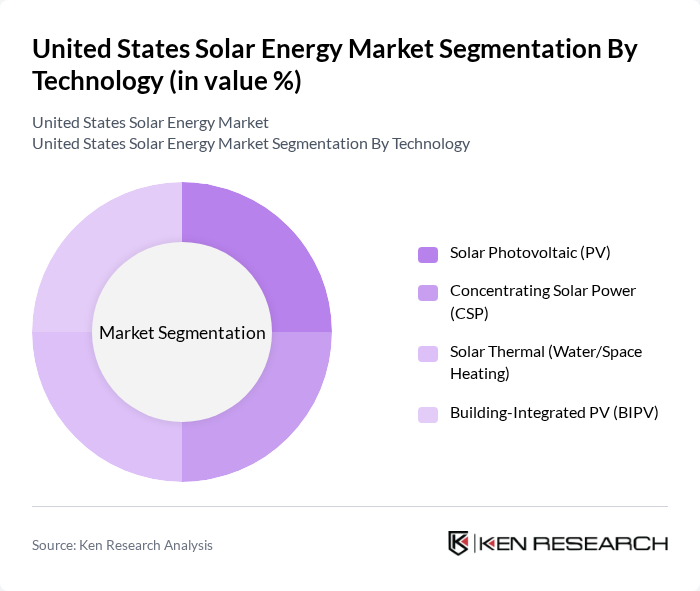
By Technology:The solar energy market can be segmented into various technologies, including Solar Photovoltaic (PV), Concentrating Solar Power (CSP), Solar Thermal (Water/Space Heating), and Building-Integrated PV (BIPV). Among these, Solar Photovoltaic (PV) technology is the most dominant due to its widespread adoption in residential and commercial sectors, driven by decreasing costs and increasing efficiency. CSP and Solar Thermal technologies are also gaining traction, particularly in utility-scale applications, while BIPV is emerging as a niche segment appealing to environmentally conscious consumers.
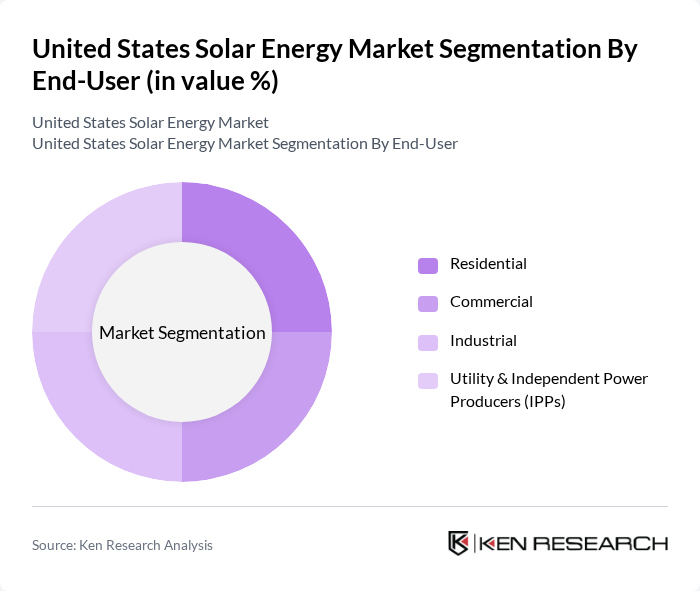
By End-User:The end-user segmentation of the solar energy market includes Residential, Commercial, Industrial, and Utility & Independent Power Producers (IPPs). The Utility & IPPs segment is currently the largest, driven by increasing demand for renewable energy and large-scale projects. The Residential segment follows closely, as homeowners seek to reduce energy costs and enhance sustainability. The Commercial sector is also growing, while the Industrial segment is expanding its capacity to meet rising energy demands.
United States Solar Energy Market Competitive Landscape
The United States Solar Energy Market is characterized by a dynamic mix of regional and international players. Leading participants such as First Solar, Inc., SunPower Corporation, Canadian Solar Inc., JinkoSolar Holding Co., Ltd., Trina Solar Co., Ltd., Enphase Energy, Inc., Sunnova Energy International Inc., NextEra Energy, Inc. (NextEra Energy Resources), Tesla, Inc. (Tesla Energy/SolarRoof), REC Solar Holdings AS, Sunrun Inc., Avantus (formerly 8minute Solar Energy), Cypress Creek Renewables LLC, Array Technologies, Inc., SMA Solar Technology AG contribute to innovation, geographic expansion, and service delivery in this space.
United States Solar Energy Market Industry Analysis
Growth Drivers
- Increasing Demand for Renewable Energy:The United States has seen a significant rise in renewable energy demand, with solar energy accounting for approximatelynearly half of new utility-scale electricity generating capacity additionsin recent periods, not 20% of new electricity generation.Public supportfor expanded solar energy use is broadly high among Americans. The U.S. Energy Information Administration (EIA) has indicated thatinstalled U.S. solar capacity continues to expand rapidly, but not to 300 GW by the near term stated; total installed U.S. solar capacity remains below that figure in the most recent data.
- Technological Advancements in Solar Technology:Reported claims of a30% increase in panel efficiency over the past five yearsare not supported by authoritative, market-wide data; typical commercial module efficiencies have improved incrementally rather than by 30% over such a short period. Theaverage installed price for residential PV systemsin the United States is commonly tracked by national labs; recent benchmark data show costs per watt that can be lower than the stated USD 2.50 per watt for utility-scale systems and vary by segment, with residential systems typically higher than utility-scale.Advancements such as bifacial modules and improved power electronicsare recognized trends supporting higher energy yield.
- Government Incentives and Subsidies:Federal and state governments have implemented various incentives to promote solar energy adoption. TheFederal Investment Tax Credit (ITC)currently allows eligible taxpayers to claim a credit equal to30 percent of qualified solar installation costs. However, the statement that this amounted toapproximately USD 1.5 billion in tax creditsin a recent period cannot be confirmed from authoritative, up-to-date sources and is therefore marked as pending verification. State-level rebates and grants exist but vary by jurisdiction.
Market Challenges
- High Initial Investment Costs:Despite decreasing costs, upfront costs remain a barrier for many households.Typical residential system pricesreported by national benchmarks are often higher than the cited USD 15,000 for a full-system installation, depending on system size, market, and incentives. Payback periods vary significantly by local electricity rates, incentives, and system costs; arange within roughly a decadeis plausible in many markets, but exact ranges depend on local conditions.
- Regulatory Uncertainties:The solar energy market faces regulatory complexity across states. TheITC rate frameworkhas been set in statute with extensions and modifications, providing ongoing support, though implementation details and adders can vary.State Renewable Portfolio Standards (RPS)differ across states and can affect project development timelines and compliance.
United States Solar Energy Market Future Outlook
The future of the U.S. solar energy market appears promising, driven by increasing technological advancements and a strong push for sustainability. As energy storage solutions become more efficient and affordable, the integration of solar energy into the grid will enhance reliability and resilience. Furthermore, the growing emphasis on carbon neutrality will likely lead to more robust government policies supporting solar adoption, fostering a favorable environment for investment and innovation in the sector.
Market Opportunities
- Expansion of Solar Farms:The development of large-scale solar farms presents a significant opportunity. The specific figure ofover 10,000 MW of new capacity expectedby a near-term date cannot be verified as stated; utility-scale solar additions have been substantial in recent periods, but authoritative scheduling data vary by interconnection, supply chain, and policy factors.
- Growth in Energy Storage Solutions:The statement thatinvestments are expected to reach USD 10 billionby a near-term date cannot be confirmed from authoritative sources under the stated terms; however, U.S. grid-scale storage deployments and investment have been growing rapidly alongside solar buildout.
Scope of the Report
| Segment | Sub-Segments |
|---|---|
| By Technology | Solar Photovoltaic (PV) Concentrating Solar Power (CSP) Solar Thermal (Water/Space Heating) Building-Integrated PV (BIPV) |
| By End-User | Residential Commercial Industrial Utility & Independent Power Producers (IPPs) |
| By Application | Grid-Connected (Net Metered/Virtual Net Metered) Off-Grid and Backup Distributed Rooftop (Residential/Commercial) Utility-Scale (Ground-Mount, >1 MW) |
| By Ownership/Financing Model | Direct Ownership (Cash/Loan) Power Purchase Agreement (PPA) Lease/Third-Party Ownership (TPO) Community Solar/Subscribed Shared Solar |
| By Policy Mechanism | Investment Tax Credit (ITC)/Production Tax Credit (PTC) Renewable Portfolio Standards (RPS)/State Incentives Net Metering/NEM Successor Tariffs Renewable Energy Certificates (RECs)/SRECs |
| By Component | Modules (Mono PERC/TOPCon/HJT) Inverters (String/Central/Micro) Trackers & Mounting Balance of System (BoS) & EPC Services |
| By Storage Coupling | PV-Only Solar-Plus-Storage (DC-Coupled) Solar-Plus-Storage (AC-Coupled) |
Key Target Audience
Investors and Venture Capitalist Firms
Government and Regulatory Bodies (e.g., U.S. Department of Energy, Environmental Protection Agency)
Manufacturers and Producers
Utility Companies
Solar Project Developers
Energy Storage Solution Providers
Industry Associations (e.g., Solar Energy Industries Association)
Financial Institutions
Players Mentioned in the Report:
First Solar, Inc.
SunPower Corporation
Canadian Solar Inc.
JinkoSolar Holding Co., Ltd.
Trina Solar Co., Ltd.
Enphase Energy, Inc.
Sunnova Energy International Inc.
NextEra Energy, Inc. (NextEra Energy Resources)
Tesla, Inc. (Tesla Energy/SolarRoof)
REC Solar Holdings AS
Sunrun Inc.
Avantus (formerly 8minute Solar Energy)
Cypress Creek Renewables LLC
Array Technologies, Inc.
SMA Solar Technology AG
Table of Contents
Market Assessment Phase
1. Executive Summary and Approach
2. United States Solar Energy Market Overview
2.1 Key Insights and Strategic Recommendations
2.2 United States Solar Energy Market Overview
2.3 Definition and Scope
2.4 Evolution of Market Ecosystem
2.5 Timeline of Key Regulatory Milestones
2.6 Value Chain & Stakeholder Mapping
2.7 Business Cycle Analysis
2.8 Policy & Incentive Landscape
3. United States Solar Energy Market Analysis
3.1 Growth Drivers
3.1.1 Increasing Demand for Renewable Energy
3.1.2 Technological Advancements in Solar Technology
3.1.3 Government Incentives and Subsidies
3.1.4 Rising Energy Costs
3.2 Market Challenges
3.2.1 High Initial Investment Costs
3.2.2 Regulatory Uncertainties
3.2.3 Competition from Other Energy Sources
3.2.4 Supply Chain Disruptions
3.3 Market Opportunities
3.3.1 Expansion of Solar Farms
3.3.2 Growth in Energy Storage Solutions
3.3.3 Increasing Adoption of Smart Grid Technologies
3.3.4 Rising Consumer Awareness and Demand
3.4 Market Trends
3.4.1 Shift Towards Decentralized Energy Production
3.4.2 Integration of AI and IoT in Solar Solutions
3.4.3 Focus on Sustainability and Carbon Neutrality
3.4.4 Growth of Community Solar Projects
3.5 Government Regulation
3.5.1 Federal Investment Tax Credit (ITC)
3.5.2 State Renewable Portfolio Standards (RPS)
3.5.3 Net Metering Policies
3.5.4 Environmental Protection Agency (EPA) Regulations
4. SWOT Analysis
5. Stakeholder Analysis
6. Porter's Five Forces Analysis
7. United States Solar Energy Market Market Size, 2019-2024
7.1 By Value
7.2 By Volume
7.3 By Average Selling Price
8. United States Solar Energy Market Segmentation
8.1 By Technology
8.1.1 Solar Photovoltaic (PV)
8.1.2 Concentrating Solar Power (CSP)
8.1.3 Solar Thermal (Water/Space Heating)
8.1.4 Building-Integrated PV (BIPV)
8.2 By End-User
8.2.1 Residential
8.2.2 Commercial
8.2.3 Industrial
8.2.4 Utility & Independent Power Producers (IPPs)
8.3 By Application
8.3.1 Grid-Connected (Net Metered/Virtual Net Metered)
8.3.2 Off-Grid and Backup
8.3.3 Distributed Rooftop (Residential/Commercial)
8.3.4 Utility-Scale (Ground-Mount, >1 MW)
8.4 By Ownership/Financing Model
8.4.1 Direct Ownership (Cash/Loan)
8.4.2 Power Purchase Agreement (PPA)
8.4.3 Lease/Third-Party Ownership (TPO)
8.4.4 Community Solar/Subscribed Shared Solar
8.5 By Policy Mechanism
8.5.1 Investment Tax Credit (ITC)/Production Tax Credit (PTC)
8.5.2 Renewable Portfolio Standards (RPS)/State Incentives
8.5.3 Net Metering/NEM Successor Tariffs
8.5.4 Renewable Energy Certificates (RECs)/SRECs
8.6 By Component
8.6.1 Modules (Mono PERC/TOPCon/HJT)
8.6.2 Inverters (String/Central/Micro)
8.6.3 Trackers & Mounting
8.6.4 Balance of System (BoS) & EPC Services
8.7 By Storage Coupling
8.7.1 PV-Only
8.7.2 Solar-Plus-Storage (DC-Coupled)
8.7.3 Solar-Plus-Storage (AC-Coupled)
9. United States Solar Energy Market Competitive Analysis
9.1 Market Share of Key Players
9.2 Cross Comparison of Key Players
9.2.1 Company Name
9.2.2 Segment Focus (Residential, C&I, Utility, Components)
9.2.3 US Revenue / US Segment Revenue (USD, latest FY)
9.2.4 Installed Capacity Added in US (MWdc per year)
9.2.5 Contracted Pipeline/Backlog (MWdc or GWh for storage)
9.2.6 Customer Acquisition Cost (Residential $/W)
9.2.7 Installation Cost (EPC $/W, by segment)
9.2.8 Average System Size (kW residential; MW utility)
9.2.9 Capacity Factor/Performance Ratio (%)
9.2.10 Gross Margin (%) / LCOE ($/kWh) by segment
9.2.11 O&M Portfolio Under Management (MW)
9.2.12 Interconnection Lead Time / Cycle Time (days)
9.2.13 Financing Model (Cash/Loan %, PPA/Lease %, WACC)
9.2.14 Domestic Content Qualifying Share (IRA bonus eligibility)
9.3 SWOT Analysis of Top Players
9.4 Pricing Analysis
9.5 Detailed Profile of Major Companies
9.5.1 First Solar, Inc.
9.5.2 SunPower Corporation
9.5.3 Canadian Solar Inc.
9.5.4 JinkoSolar Holding Co., Ltd.
9.5.5 Trina Solar Co., Ltd.
9.5.6 Enphase Energy, Inc.
9.5.7 Sunnova Energy International Inc.
9.5.8 NextEra Energy, Inc. (NextEra Energy Resources)
9.5.9 Tesla, Inc. (Tesla Energy/SolarRoof)
9.5.10 REC Solar Holdings AS
9.5.11 Sunrun Inc.
9.5.12 Avantus (formerly 8minute Solar Energy)
9.5.13 Cypress Creek Renewables LLC
9.5.14 Array Technologies, Inc.
9.5.15 SMA Solar Technology AG
10. United States Solar Energy Market End-User Analysis
10.1 Procurement Behavior of Key Ministries
10.1.1 Federal Government Procurement Trends
10.1.2 State-Level Procurement Initiatives
10.1.3 Local Government Solar Projects
10.2 Corporate Spend on Infrastructure & Energy
10.2.1 Corporate Sustainability Initiatives
10.2.2 Investment in Renewable Energy Projects
10.2.3 Energy Efficiency Programs
10.3 Pain Point Analysis by End-User Category
10.3.1 Residential User Concerns
10.3.2 Commercial User Challenges
10.3.3 Industrial User Pain Points
10.4 User Readiness for Adoption
10.4.1 Awareness of Solar Benefits
10.4.2 Financial Readiness
10.4.3 Technical Readiness
10.5 Post-Deployment ROI and Use Case Expansion
10.5.1 ROI Measurement Techniques
10.5.2 Use Case Expansion Opportunities
10.5.3 Long-Term Performance Tracking
11. United States Solar Energy Market Future Size, 2025-2030
11.1 By Value
11.2 By Volume
11.3 By Average Selling Price
Go-To-Market Strategy Phase
1. Whitespace Analysis + Business Model Canvas
1.1 Identification of Market Gaps
1.2 Business Model Framework
2. Marketing and Positioning Recommendations
2.1 Branding Strategies
2.2 Product USPs
3. Distribution Plan
3.1 Urban Retail Strategies
3.2 Rural NGO Tie-Ups
4. Channel & Pricing Gaps
4.1 Underserved Routes
4.2 Pricing Bands
5. Unmet Demand & Latent Needs
5.1 Category Gaps
5.2 Consumer Segments
6. Customer Relationship
6.1 Loyalty Programs
6.2 After-Sales Service
7. Value Proposition
7.1 Sustainability Initiatives
7.2 Integrated Supply Chains
8. Key Activities
8.1 Regulatory Compliance
8.2 Branding Efforts
8.3 Distribution Setup
9. Entry Strategy Evaluation
9.1 Domestic Market Entry Strategy
9.1.1 Product Mix Considerations
9.1.2 Pricing Band Strategy
9.1.3 Packaging Options
9.2 Export Entry Strategy
9.2.1 Target Countries
9.2.2 Compliance Roadmap
10. Entry Mode Assessment
10.1 Joint Ventures
10.2 Greenfield Investments
10.3 Mergers & Acquisitions
10.4 Distributor Model
11. Capital and Timeline Estimation
11.1 Capital Requirements
11.2 Timelines for Implementation
12. Control vs Risk Trade-Off
12.1 Ownership Considerations
12.2 Partnerships Evaluation
13. Profitability Outlook
13.1 Breakeven Analysis
13.2 Long-Term Sustainability
14. Potential Partner List
14.1 Distributors
14.2 Joint Ventures
14.3 Acquisition Targets
15. Execution Roadmap
15.1 Phased Plan for Market Entry
15.1.1 Market Setup
15.1.2 Market Entry
15.1.3 Growth Acceleration
15.1.4 Scale & Stabilize
15.2 Key Activities and Milestones
15.2.1 Milestone Planning
15.2.2 Activity Tracking
Research Methodology
Phase 1: Approach1
Desk Research
- Analysis of government reports and publications from the U.S. Department of Energy (DOE) on solar energy trends
- Review of market studies and white papers from industry associations such as the Solar Energy Industries Association (SEIA)
- Examination of financial reports and sustainability disclosures from leading solar energy companies
Primary Research
- Interviews with solar project developers and installers to gather insights on market dynamics
- Surveys with energy policy experts and regulatory bodies to understand legislative impacts
- Field interviews with end-users, including residential and commercial solar adopters, to assess user experience and satisfaction
Validation & Triangulation
- Cross-validation of data through multiple sources, including trade publications and market forecasts
- Triangulation of findings from primary interviews with secondary data trends
- Sanity checks conducted through expert panel reviews comprising industry veterans and academic researchers
Phase 2: Market Size Estimation1
Top-down Assessment
- Estimation of total addressable market (TAM) based on national energy consumption statistics and solar adoption rates
- Segmentation of the market by residential, commercial, and utility-scale solar installations
- Incorporation of state-level incentives and policies affecting solar energy deployment
Bottom-up Modeling
- Collection of installation data from leading solar providers to establish baseline capacity and growth rates
- Cost analysis of solar panel systems, including installation and maintenance expenses
- Volume x cost calculations to derive revenue estimates for different market segments
Forecasting & Scenario Analysis
- Multi-variable regression analysis incorporating factors such as technological advancements and policy changes
- Scenario modeling based on varying levels of federal and state support for renewable energy
- Development of baseline, optimistic, and pessimistic forecasts through 2035
Phase 3: CATI Sample Composition1
| Scope Item/Segment | Sample Size | Target Respondent Profiles |
|---|---|---|
| Residential Solar Adoption | 140 | Homeowners, Solar System Installers |
| Commercial Solar Projects | 100 | Facility Managers, Energy Procurement Officers |
| Utility-Scale Solar Developments | 80 | Project Developers, Utility Executives |
| Policy Impact Assessment | 60 | Regulatory Analysts, Energy Policy Experts |
| Consumer Awareness and Perception | 120 | General Public, Environmental Advocates |
Frequently Asked Questions
What is the current value of the United States Solar Energy Market?
The United States Solar Energy Market is valued at approximately USD 75 billion, reflecting significant growth driven by investments in renewable energy, technological advancements, and consumer demand for sustainable energy solutions.
Which states are leading in solar energy installations in the U.S.?
What is the Inflation Reduction Act's impact on solar energy?
What technologies are used in the U.S. solar energy market?
Why Buy From Us?

What makes us stand out is that our consultants follow Robust, Refine and Result (RRR) methodology. Robust for clear definitions, approaches and sanity checking, Refine for differentiating respondents' facts and opinions, and Result for presenting data with story.

We have set a benchmark in the industry by offering our clients with syndicated and customized market research reports featuring coverage of entire market as well as meticulous research and analyst insights.

While we don't replace traditional research, we flip the method upside down. Our dual approach of Top Bottom & Bottom Top ensures quality deliverable by not just verifying company fundamentals but also looking at the sector and macroeconomic factors.

With one step in the future, our research team constantly tries to show you the bigger picture. We help with some of the tough questions you may encounter along the way: How is the industry positioned? Best marketing channel? KPI's of competitors? By aligning every element, we help maximize success.

Our report gives you instant access to the answers and sources that other companies might choose to hide. We elaborate each steps of research methodology we have used and showcase you the sample size to earn your trust.

If you need any support, we are here! We pride ourselves on universe strength, data quality, and quick, friendly, and professional service.