About the Report
Base Year 2024US Digital Signage Market Overview
- The US Digital Signage Market is valued at USD 9 billion, based on a five-year historical analysis. This growth is primarily driven by the increasing adoption of digital advertising, advancements in display technologies including IoT, AI, and cloud integration, surge in digital out-of-home (DOOH) ad-spend, retail digital transformation, and the rising demand for interactive and engaging customer experiences across various sectors.
- Key players in this market include major metropolitan areas such as New York, Los Angeles, and Chicago, which dominate due to their high population density, significant advertising budgets, and a strong presence of retail and entertainment industries that leverage digital signage for enhanced customer engagement.
- The Energy Policy Act of 2005, issued by the US Congress, establishes energy conservation standards for commercial and industrial electric motors used in digital signage displays, requiring compliance with efficiency levels such as nominal full load efficiency thresholds for motors above certain horsepower ratings to reduce energy consumption and carbon emissions, encouraging businesses to adopt sustainable practices while enhancing the visual appeal of their advertising efforts.

US Digital Signage Market Segmentation
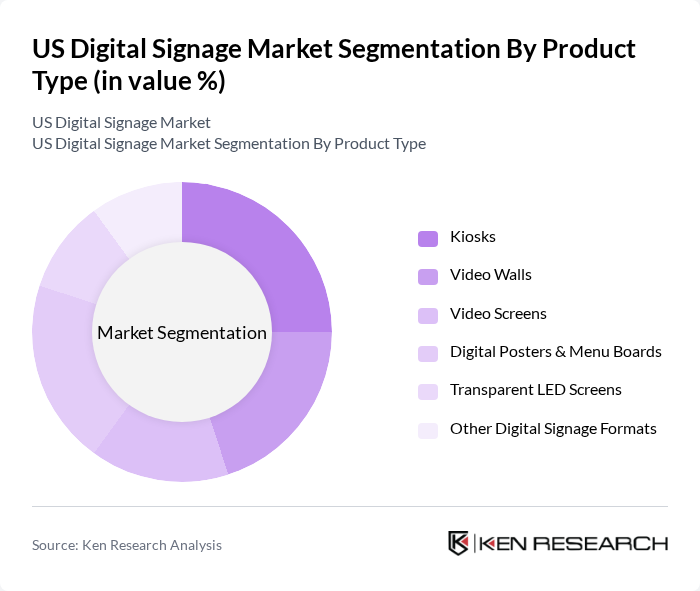
By Product Type:The product type segmentation includes various formats of digital signage that cater to different consumer needs and preferences. Kiosks, video walls, and video screens are among the most popular formats, driven by their ability to deliver dynamic content and engage audiences effectively. Digital posters and menu boards are also gaining traction, particularly in retail and food service sectors, as they offer flexibility and ease of content updates. Transparent LED screens and other digital signage formats are emerging trends, appealing to businesses looking for innovative ways to attract customers.
By Component:The component segmentation encompasses hardware, software, and services that are essential for the effective deployment and management of digital signage solutions. Hardware, including displays, media players, and mounts, constitutes a significant portion of the market, driven by the demand for high-quality visual experiences. Software solutions, particularly content management systems (CMS) and analytics tools, are increasingly important for businesses to optimize their digital signage strategies. Services such as installation, managed services, and content creation are also critical, as they ensure that digital signage systems operate efficiently and deliver impactful messaging.

US Digital Signage Market Competitive Landscape
The US Digital Signage Market is characterized by a dynamic mix of regional and international players. Leading participants such as Samsung Electronics Co., Ltd. (Samsung Display Solutions), LG Electronics Inc. (LG Business Solutions USA), Sharp NEC Display Solutions of America, Inc., Sony Corporation (Sony Professional Displays & Solutions), Panasonic Corporation of North America, Cisco Systems, Inc., Intel Corporation, Microsoft Corporation, Daktronics, Inc., BrightSign LLC, Scala, Inc. (STRATACACHE Company), STRATACACHE, Inc., Four Winds Interactive LLC (now Poppulo), Visix, Inc., Mvix, Inc., Userful Corporation, Signagelive (Remote Media Limited) contribute to innovation, geographic expansion, and service delivery in this space.
US Digital Signage Market Industry Analysis
Growth Drivers
- Increasing Demand for Interactive Displays:The US digital signage market is witnessing a surge in demand for interactive displays, driven by a projected increase in consumer engagement. In future, the interactive display segment is expected to reach $5.2 billion, reflecting a 15% increase from the previous period. This growth is fueled by advancements in touch technology and the need for businesses to enhance customer experiences, particularly in retail and hospitality sectors, where interactive displays can significantly boost sales and customer satisfaction.
- Advancements in Display Technology:Technological innovations are propelling the US digital signage market forward. The introduction of OLED and 4K resolution displays is expected to increase market penetration, with the total number of digital displays projected to exceed 1.5 million units in future. These advancements not only improve visual quality but also reduce energy consumption, aligning with the growing demand for energy-efficient solutions in commercial environments, thus attracting more businesses to adopt digital signage.
- Rising Adoption of Digital Advertising:The shift from traditional advertising to digital platforms is a significant growth driver for the US digital signage market. In future, digital advertising spending is anticipated to reach $200 billion, with a substantial portion allocated to digital signage. This transition is supported by the effectiveness of digital ads in targeting specific demographics and measuring engagement, making them a preferred choice for marketers aiming to maximize their return on investment.
Market Challenges
- High Initial Investment Costs:One of the primary challenges facing the US digital signage market is the high initial investment required for setup. Businesses may need to allocate upwards of $10,000 for a comprehensive digital signage system, including hardware, software, and installation. This upfront cost can deter small and medium-sized enterprises from adopting digital signage, limiting market growth potential in certain sectors, particularly among budget-conscious businesses.
- Technical Complexity and Maintenance Issues:The technical complexity associated with digital signage systems poses a significant challenge. Many businesses lack the in-house expertise to manage and maintain these systems effectively. In future, it is estimated that 30% of digital signage installations will face operational issues due to inadequate technical support, leading to increased downtime and additional costs for businesses, which can hinder overall market adoption.
US Digital Signage Market Future Outlook
The future of the US digital signage market appears promising, driven by ongoing technological advancements and increasing consumer expectations for interactive experiences. As businesses continue to prioritize customer engagement, the integration of AI and machine learning into digital signage solutions is expected to enhance content personalization and effectiveness. Additionally, the growing trend of cloud-based solutions will facilitate easier management and scalability, allowing businesses to adapt quickly to changing market demands and consumer preferences.
Market Opportunities
- Expansion in Smart Cities Initiatives:The rise of smart city initiatives presents a significant opportunity for the digital signage market. With cities investing over $100 billion in smart infrastructure by future, digital signage can play a crucial role in enhancing urban communication and information dissemination, creating a demand for innovative signage solutions that integrate with smart technologies.
- Integration with IoT Solutions:The integration of digital signage with IoT solutions is poised to create new market opportunities. By future, the IoT market is expected to reach $1.1 trillion, and digital signage can leverage this growth by providing real-time data and analytics, enhancing user engagement and operational efficiency for businesses across various sectors, including retail and transportation.
Scope of the Report
| Segment | Sub-Segments |
|---|---|
| By Product Type | Kiosks Video Walls Video Screens Digital Posters & Menu Boards Transparent LED Screens Other Digital Signage Formats |
| By Component | Hardware (Displays, Media Players, Mounts) Software (CMS & Analytics) Services (Installation, Managed Services, Content) |
| By Display Technology | LCD/LED OLED Projection e-Paper and Reflective Displays |
| By Location | Indoor Outdoor |
| By Application | Retail Hospitality & Restaurants (QSR/Fast Casual) Transportation (Airports, Rail, Transit) Corporate & Banking Healthcare Education Stadiums, Arenas & Entertainment Venues Government & Public Spaces Other Applications |
| By Deployment Mode | On-Premise Cloud-Based (SaaS) Hybrid |
| By Region | Northeast Midwest South West |
Key Target Audience
Investors and Venture Capitalist Firms
Government and Regulatory Bodies (e.g., Federal Communications Commission, National Highway Traffic Safety Administration)
Manufacturers and Producers
Distributors and Retailers
Advertising Agencies
Event Organizers and Planners
Real Estate Developers
Transportation Authorities
Players Mentioned in the Report:
Samsung Electronics Co., Ltd. (Samsung Display Solutions)
LG Electronics Inc. (LG Business Solutions USA)
Sharp NEC Display Solutions of America, Inc.
Sony Corporation (Sony Professional Displays & Solutions)
Panasonic Corporation of North America
Cisco Systems, Inc.
Intel Corporation
Microsoft Corporation
Daktronics, Inc.
BrightSign LLC
Scala, Inc. (STRATACACHE Company)
STRATACACHE, Inc.
Four Winds Interactive LLC (now Poppulo)
Visix, Inc.
Mvix, Inc.
Userful Corporation
Signagelive (Remote Media Limited)
Table of Contents
Market Assessment Phase
1. Executive Summary and Approach
2. US Digital Signage Market Overview
2.1 Key Insights and Strategic Recommendations
2.2 US Digital Signage Market Overview
2.3 Definition and Scope
2.4 Evolution of Market Ecosystem
2.5 Timeline of Key Regulatory Milestones
2.6 Value Chain & Stakeholder Mapping
2.7 Business Cycle Analysis
2.8 Policy & Incentive Landscape
3. US Digital Signage Market Analysis
3.1 Growth Drivers
3.1.1 Increasing Demand for Interactive Displays
3.1.2 Advancements in Display Technology
3.1.3 Rising Adoption of Digital Advertising
3.1.4 Growth in Retail and Hospitality Sectors
3.2 Market Challenges
3.2.1 High Initial Investment Costs
3.2.2 Technical Complexity and Maintenance Issues
3.2.3 Regulatory Compliance Challenges
3.2.4 Rapid Technological Changes
3.3 Market Opportunities
3.3.1 Expansion in Smart Cities Initiatives
3.3.2 Integration with IoT Solutions
3.3.3 Growth in E-commerce and Online Retail
3.3.4 Increased Focus on Sustainability
3.4 Market Trends
3.4.1 Shift Towards Cloud-Based Solutions
3.4.2 Personalization of Content Delivery
3.4.3 Use of AI and Machine Learning
3.4.4 Enhanced User Engagement Strategies
3.5 Government Regulation
3.5.1 Compliance with ADA Standards
3.5.2 Local Zoning Laws for Digital Signage
3.5.3 Environmental Regulations on Energy Use
3.5.4 Advertising Regulations in Public Spaces
4. SWOT Analysis
5. Stakeholder Analysis
6. Porter's Five Forces Analysis
7. US Digital Signage Market Market Size, 2019-2024
7.1 By Value
7.2 By Volume
7.3 By Average Selling Price
8. US Digital Signage Market Segmentation
8.1 By Product Type
8.1.1 Kiosks
8.1.2 Video Walls
8.1.3 Video Screens
8.1.4 Digital Posters & Menu Boards
8.1.5 Transparent LED Screens
8.1.6 Other Digital Signage Formats
8.2 By Component
8.2.1 Hardware (Displays, Media Players, Mounts)
8.2.2 Software (CMS & Analytics)
8.2.3 Services (Installation, Managed Services, Content)
8.3 By Display Technology
8.3.1 LCD/LED
8.3.2 OLED
8.3.3 Projection
8.3.4 e-Paper and Reflective Displays
8.4 By Location
8.4.1 Indoor
8.4.2 Outdoor
8.5 By Application
8.5.1 Retail
8.5.2 Hospitality & Restaurants (QSR/Fast Casual)
8.5.3 Transportation (Airports, Rail, Transit)
8.5.4 Corporate & Banking
8.5.5 Healthcare
8.5.6 Education
8.5.7 Stadiums, Arenas & Entertainment Venues
8.5.8 Government & Public Spaces
8.5.9 Other Applications
8.6 By Deployment Mode
8.6.1 On-Premise
8.6.2 Cloud-Based (SaaS)
8.6.3 Hybrid
8.7 By Region
8.7.1 Northeast
8.7.2 Midwest
8.7.3 South
8.7.4 West
9. US Digital Signage Market Competitive Analysis
9.1 Market Share of Key Players
9.2 Cross Comparison of Key Players
9.2.1 Company Name
9.2.2 Core Offering (Hardware, Software, Services, or Integrated)
9.2.3 Estimated US Digital Signage Revenue
9.2.4 Revenue Growth Rate (US Digital Signage)
9.2.5 Installed Base / Number of Active Screens Managed
9.2.6 Average Contract Value (ACV) / Average Deal Size
9.2.7 Recurring Revenue Share (SaaS & Managed Services)
9.2.8 Customer Mix (Enterprise vs SMB)
9.2.9 Major End-User Verticals Served
9.2.10 Geographic Footprint within the US (Regional Coverage)
9.2.11 Channel & Partner Ecosystem Strength
9.2.12 Product Differentiation (Feature Depth & Innovation Index)
9.2.13 Service Level Performance (Uptime, SLA Adherence)
9.2.14 Customer Retention / Net Revenue Retention Rate
9.2.15 Brand Awareness & Perception Score (US Market)
9.3 SWOT Analysis of Top Players
9.4 Pricing Analysis
9.5 Detailed Profile of Major Companies
9.5.1 Samsung Electronics Co., Ltd. (Samsung Display Solutions)
9.5.2 LG Electronics Inc. (LG Business Solutions USA)
9.5.3 Sharp NEC Display Solutions of America, Inc.
9.5.4 Sony Corporation (Sony Professional Displays & Solutions)
9.5.5 Panasonic Corporation of North America
9.5.6 Cisco Systems, Inc.
9.5.7 Intel Corporation
9.5.8 Microsoft Corporation
9.5.9 Daktronics, Inc.
9.5.10 BrightSign LLC
9.5.11 Scala, Inc. (STRATACACHE Company)
9.5.12 STRATACACHE, Inc.
9.5.13 Four Winds Interactive LLC (now Poppulo)
9.5.14 Visix, Inc.
9.5.15 Mvix, Inc.
9.5.16 Userful Corporation
9.5.17 Signagelive (Remote Media Limited)
10. US Digital Signage Market End-User Analysis
10.1 Procurement Behavior of Key Ministries
10.1.1 Budget Allocation Trends
10.1.2 Decision-Making Processes
10.1.3 Preferred Vendors
10.1.4 Contracting Practices
10.2 Corporate Spend on Infrastructure & Energy
10.2.1 Investment Trends
10.2.2 Budget Prioritization
10.2.3 Spending Patterns
10.2.4 Cost-Saving Initiatives
10.3 Pain Point Analysis by End-User Category
10.3.1 Common Challenges Faced
10.3.2 Technology Adoption Barriers
10.3.3 Support and Maintenance Issues
10.3.4 Content Management Difficulties
10.4 User Readiness for Adoption
10.4.1 Training and Support Needs
10.4.2 Technology Familiarity
10.4.3 Infrastructure Readiness
10.4.4 Change Management Strategies
10.5 Post-Deployment ROI and Use Case Expansion
10.5.1 Measurement of Success
10.5.2 Case Studies of Successful Implementations
10.5.3 Future Expansion Plans
10.5.4 User Feedback and Iteration
11. US Digital Signage Market Future Size, 2025-2030
11.1 By Value
11.2 By Volume
11.3 By Average Selling Price
Go-To-Market Strategy Phase
1. Whitespace Analysis + Business Model Canvas
1.1 Market Gaps Identification
1.2 Value Proposition Development
1.3 Revenue Streams Analysis
1.4 Cost Structure Evaluation
1.5 Key Partnerships Exploration
1.6 Customer Segmentation
1.7 Channels of Distribution
2. Marketing and Positioning Recommendations
2.1 Branding Strategies
2.2 Product USPs
2.3 Target Audience Identification
2.4 Communication Strategies
2.5 Digital Marketing Approaches
3. Distribution Plan
3.1 Urban Retail Strategies
3.2 Rural NGO Tie-Ups
3.3 Online Distribution Channels
3.4 Direct Sales Approaches
4. Channel & Pricing Gaps
4.1 Underserved Routes
4.2 Pricing Bands Analysis
4.3 Competitor Pricing Strategies
5. Unmet Demand & Latent Needs
5.1 Category Gaps Identification
5.2 Consumer Segments Analysis
5.3 Emerging Trends Exploration
6. Customer Relationship
6.1 Loyalty Programs Development
6.2 After-Sales Service Strategies
6.3 Customer Feedback Mechanisms
7. Value Proposition
7.1 Sustainability Initiatives
7.2 Integrated Supply Chains
7.3 Unique Selling Points
8. Key Activities
8.1 Regulatory Compliance
8.2 Branding Initiatives
8.3 Distribution Setup
9. Entry Strategy Evaluation
9.1 Domestic Market Entry Strategy
9.1.1 Product Mix Considerations
9.1.2 Pricing Band Strategies
9.1.3 Packaging Approaches
9.2 Export Entry Strategy
9.2.1 Target Countries Identification
9.2.2 Compliance Roadmap Development
10. Entry Mode Assessment
10.1 Joint Ventures
10.2 Greenfield Investments
10.3 Mergers & Acquisitions
10.4 Distributor Model Evaluation
11. Capital and Timeline Estimation
11.1 Capital Requirements Analysis
11.2 Timelines for Implementation
12. Control vs Risk Trade-Off
12.1 Ownership Considerations
12.2 Partnerships Evaluation
13. Profitability Outlook
13.1 Breakeven Analysis
13.2 Long-Term Sustainability Strategies
14. Potential Partner List
14.1 Distributors Identification
14.2 Joint Ventures Exploration
14.3 Acquisition Targets
15. Execution Roadmap
15.1 Phased Plan for Market Entry
15.1.1 Market Setup
15.1.2 Market Entry
15.1.3 Growth Acceleration
15.1.4 Scale & Stabilize
15.2 Key Activities and Milestones
15.2.1 Milestone Planning
15.2.2 Activity Tracking
Research Methodology
Phase 1: Approach1
Desk Research
- Analysis of industry reports from market research firms focusing on digital signage trends
- Review of government publications and statistics related to digital advertising expenditures
- Examination of case studies and white papers from leading digital signage technology providers
Primary Research
- Interviews with marketing executives at major retail chains utilizing digital signage
- Surveys with AV integrators and digital signage solution providers
- Field interviews with end-users in sectors such as hospitality and transportation
Validation & Triangulation
- Cross-validation of findings through multiple industry sources and expert opinions
- Triangulation of data from primary interviews and secondary research findings
- Sanity checks conducted through expert panel discussions and feedback sessions
Phase 2: Market Size Estimation1
Top-down Assessment
- Estimation of market size based on overall advertising spend in the U.S. and digital signage's share
- Segmentation of market size by application areas such as retail, transportation, and corporate
- Incorporation of growth rates from digital advertising trends and technological advancements
Bottom-up Modeling
- Collection of data on unit sales and pricing from leading digital signage manufacturers
- Estimation of installation and maintenance costs based on service provider pricing models
- Volume x cost analysis for various digital signage solutions across different sectors
Forecasting & Scenario Analysis
- Multi-factor regression analysis incorporating economic indicators and digital adoption rates
- Scenario modeling based on potential regulatory changes and technological disruptions
- Development of baseline, optimistic, and pessimistic forecasts through 2030
Phase 3: CATI Sample Composition1
| Scope Item/Segment | Sample Size | Target Respondent Profiles |
|---|---|---|
| Retail Digital Signage Usage | 120 | Marketing Managers, Store Operations Directors |
| Transportation Sector Signage | 100 | Facility Managers, Transportation Coordinators |
| Corporate Communication Displays | 80 | IT Managers, Corporate Communications Heads |
| Hospitality Industry Applications | 70 | Guest Experience Managers, Marketing Executives |
| Healthcare Facility Signage | 60 | Facility Managers, Patient Experience Coordinators |
Frequently Asked Questions
What is the current value of the US Digital Signage Market?
The US Digital Signage Market is valued at approximately USD 9 billion, reflecting significant growth driven by digital advertising adoption, advancements in display technologies, and the demand for interactive customer experiences across various sectors.
What are the key drivers of growth in the US Digital Signage Market?
What challenges does the US Digital Signage Market face?
Which regions in the US dominate the Digital Signage Market?
Other Regional/Country Reports
Other Adjacent Reports
Belgium Display Technology Market
APAC interactive display market size, share, growth drivers, trends, opportunities & forecast 2025–2030South Africa Retail Technology Market
Kuwait Content Management Software Market Size, Share, Growth Drivers, Trends, Opportunities & Forecast 2025–2030Qatar LED Display Market
Indonesia Video Wall Market Report Size Share Growth Drivers Trends Opportunities & Forecast 2025–2030Brazil Out-of-Home Advertising Market
Saudi Arabia Smart City Infrastructure MarketIndonesia IoT Solutions Market
Why Buy From Us?

What makes us stand out is that our consultants follow Robust, Refine and Result (RRR) methodology. Robust for clear definitions, approaches and sanity checking, Refine for differentiating respondents' facts and opinions, and Result for presenting data with story.

We have set a benchmark in the industry by offering our clients with syndicated and customized market research reports featuring coverage of entire market as well as meticulous research and analyst insights.

While we don't replace traditional research, we flip the method upside down. Our dual approach of Top Bottom & Bottom Top ensures quality deliverable by not just verifying company fundamentals but also looking at the sector and macroeconomic factors.

With one step in the future, our research team constantly tries to show you the bigger picture. We help with some of the tough questions you may encounter along the way: How is the industry positioned? Best marketing channel? KPI's of competitors? By aligning every element, we help maximize success.

Our report gives you instant access to the answers and sources that other companies might choose to hide. We elaborate each steps of research methodology we have used and showcase you the sample size to earn your trust.

If you need any support, we are here! We pride ourselves on universe strength, data quality, and quick, friendly, and professional service.