US Life Non Life Insurance Market

US Life Non Life Insurance Market, valued at USD 2.0 trillion, grows due to increasing consumer awareness, tech advancements in underwriting, and demand for personalized products amid rising healthcare costs.

Region:North America

Author(s):Shubham

Product Code:KRAA1853

Pages:81

Published On:August 2025
About the Report

Base Year 2024

US Life Non Life Insurance Market Overview

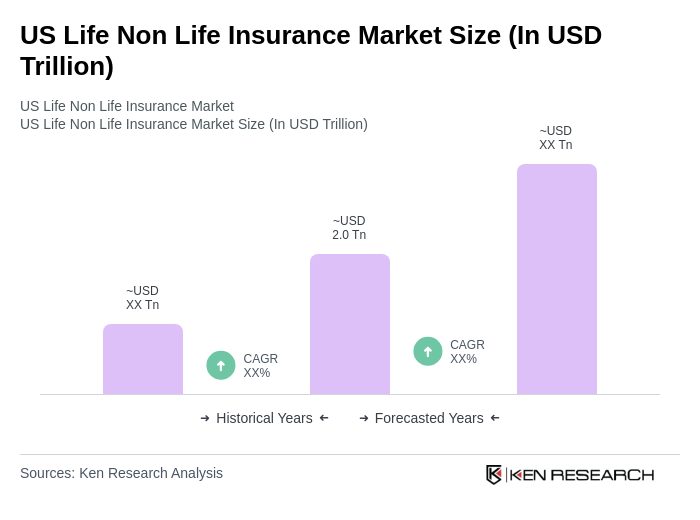
  • The US Life Non Life Insurance Market is valued at USD 2.0 trillion, based on a five-year historical analysis. This reflects the combined scale of life and non-life (including health) premiums in the United States, supported by industry trackers indicating the overall market size near the two-trillion mark.
  • Growth is primarily driven by rising healthcare costs and the need for financial security, heightened post-pandemic awareness of protection and savings products, and persistently higher interest rates that have bolstered annuity and savings-type life products. Insurer innovation in embedded distribution and digital experiences is also expanding access and uptake across lines.
  • Key market activity is concentrated in major insurance hubs and financial centers such as New York and Chicago, which host many carriers, brokers, and capital markets participants; however, national distribution and multi-state operations mean competition is broad-based beyond any single city.
  • The Affordable Care Act (ACA) was enacted earlier in the 2010s and continues to underpin health coverage expansion through exchanges and Medicaid, supporting enrollment growth in public and private plans; it was not newly implemented in 2023.
US Life Non Life Insurance Market Size

US Life Non Life Insurance Market Segmentation

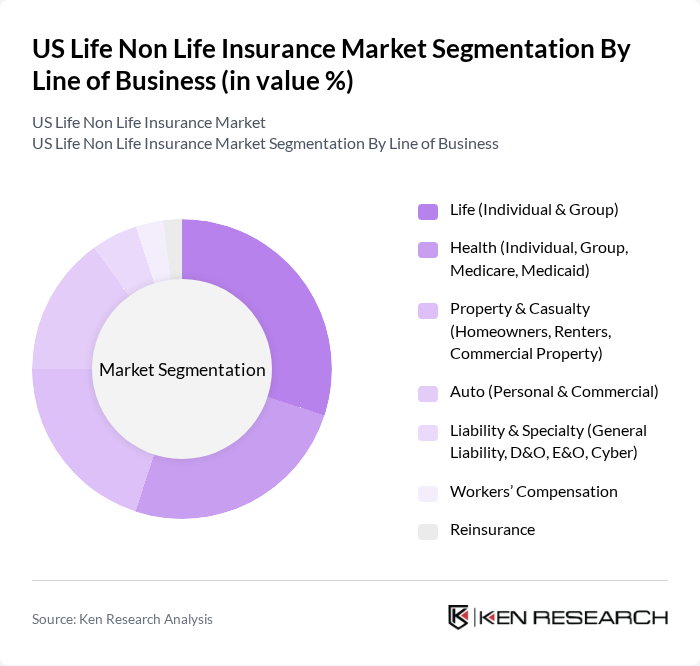
By Line of Business:

US Life Non Life Insurance Market segmentation by Line of Business.

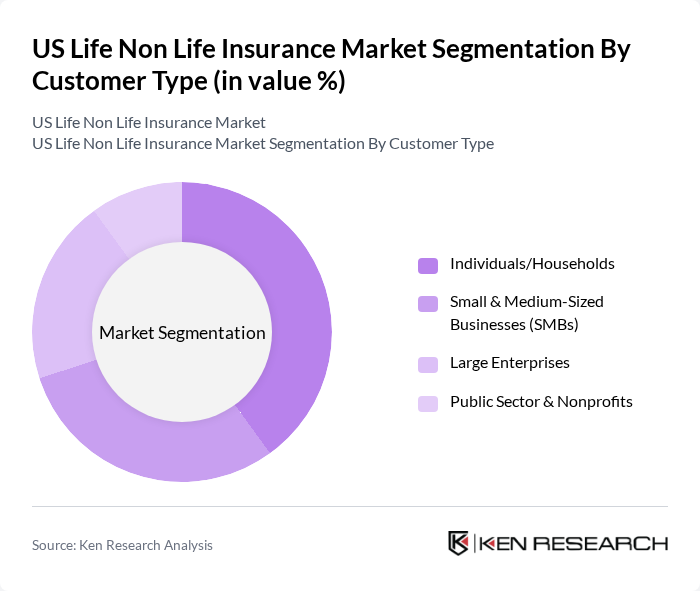
By Customer Type:

US Life Non Life Insurance Market segmentation by Customer Type.

US Life Non Life Insurance Market Competitive Landscape

The US Life Non Life Insurance Market is characterized by a dynamic mix of regional and international players. Leading participants such as State Farm Mutual Automobile Insurance Company, Berkshire Hathaway Inc. (GEICO, General Re), The Allstate Corporation, Prudential Financial, Inc., MetLife, Inc., American International Group, Inc. (AIG), Chubb Limited, The Travelers Companies, Inc., Liberty Mutual Insurance, Nationwide Mutual Insurance Company, New York Life Insurance Company, Massachusetts Mutual Life Insurance Company (MassMutual), The Hartford Financial Services Group, Inc., American Family Insurance, USAA (United Services Automobile Association), UnitedHealth Group Incorporated, Cigna Group, Elevance Health, Inc. (Anthem), Progressive Corporation, Humana Inc. contribute to innovation, geographic expansion, and service delivery in this space.

State Farm Mutual Automobile Insurance Company

1922

Bloomington, Illinois

Berkshire Hathaway Inc. (GEICO, General Re)

1839

Omaha, Nebraska

The Allstate Corporation

1931

Northfield Township, Illinois

Prudential Financial, Inc.

1875

Newark, New Jersey

MetLife, Inc.

1868

New York City, New York

Company

Establishment Year

Headquarters

Gross Written Premiums (GWP) and Net Premiums Written (NPW)

Policyholder Surplus / RBC Ratio

Claims Payout Ratio and Loss Ratio

Combined Ratio (P&C) and Benefit Ratio (Life/Health)

New Business Annualized Premium (NBAP) and Life Sales Mix

Lapse/Surrender Rate (Life) and Retention/Persistency

US Life Non Life Insurance Market Industry Analysis

Growth Drivers

  • Increasing Consumer Awareness of Insurance Products:The US life and non-life insurance market is experiencing a surge in consumer awareness, with 75% of Americans now recognizing the importance of insurance coverage. This heightened awareness is driven by educational campaigns and the increasing visibility of insurance products through digital platforms. As of the future, the average household expenditure on insurance is projected to reach $3,500, reflecting a growing commitment to securing financial protection against unforeseen events.
  • Technological Advancements in Underwriting and Claims Processing:The integration of technology in the insurance sector is revolutionizing underwriting and claims processing. In the future, it is estimated that 65% of insurers will utilize AI-driven tools to enhance risk assessment and streamline claims, reducing processing times by up to 35%. This efficiency not only improves customer satisfaction but also lowers operational costs, allowing insurers to offer more competitive premiums and attract a broader customer base.
  • Rising Healthcare Costs Driving Demand for Life Insurance:With healthcare costs in the US projected to exceed $5 trillion in the future, there is a corresponding increase in demand for life insurance products. Families are increasingly seeking financial security to cover potential medical expenses and ensure their loved ones are protected. This trend is evident as life insurance policy sales have risen by 20% over the past year, indicating a proactive approach to financial planning amidst rising healthcare uncertainties.

Market Challenges

  • Intense Competition Among Insurers:The US insurance market is characterized by fierce competition, with over 6,200 insurance companies vying for market share. This saturation leads to aggressive pricing strategies, which can erode profit margins. In the future, the average combined ratio for insurers is expected to hover around 97%, indicating that many companies are operating at or near breakeven, making it challenging to sustain profitability while maintaining competitive pricing.
  • Regulatory Compliance Complexities:Insurers face significant challenges in navigating the complex regulatory landscape, which includes over 55 state-specific regulations. Compliance costs are projected to reach $1.8 billion in the future, straining resources for many companies. Additionally, the evolving nature of regulations, particularly concerning data privacy and consumer protection, requires continuous adaptation, diverting focus from core business operations and innovation.

US Life Non Life Insurance Market Future Outlook

The future of the US life and non-life insurance market appears promising, driven by technological innovations and evolving consumer preferences. As insurers increasingly adopt digital platforms, customer engagement is expected to improve significantly. Furthermore, the demand for personalized insurance products will likely rise, reflecting a shift towards tailored solutions that meet individual needs. This evolution will create opportunities for insurers to enhance their offerings and strengthen customer loyalty in a competitive landscape.

Market Opportunities

  • Expansion of Digital Insurance Platforms:The growth of digital insurance platforms presents a significant opportunity, with online insurance sales projected to reach $60 billion in the future. This shift allows insurers to reach a broader audience, particularly younger consumers who prefer online transactions. Enhanced user experiences and streamlined processes will likely drive higher conversion rates and customer satisfaction.
  • Increasing Demand for Personalized Insurance Products:As consumers seek tailored solutions, the demand for personalized insurance products is expected to grow. In the future, approximately 45% of consumers are anticipated to prefer customized policies that cater to their specific needs. Insurers that leverage data analytics to offer personalized options will likely gain a competitive edge, fostering customer loyalty and increasing market share.

Scope of the Report

SegmentSub-Segments
By Line of Business

Life (Individual & Group)

Health (Individual, Group, Medicare, Medicaid)

Property & Casualty (Homeowners, Renters, Commercial Property)

Auto (Personal & Commercial)

Liability & Specialty (General Liability, D&O, E&O, Cyber)

Workers’ Compensation

Reinsurance

By Customer Type

Individuals/Households

Small & Medium-Sized Businesses (SMBs)

Large Enterprises

Public Sector & Nonprofits

By Distribution Channel

Captive/Exclusive Agents

Independent Agents & Brokers

Direct-to-Consumer (Online & Direct Response)

Bancassurance & Affinity Partners

By Life Policy Type

Term Life

Whole Life

Universal & Indexed Universal Life

Variable Life & Variable Universal Life

By P&C Policy Type

Homeowners & Renters

Personal Auto

Commercial Auto

Commercial Property

General Liability & Umbrella

Specialty (Cyber, D&O, E&O, Inland Marine)

By Premium Size

Sub-$1,000

$1,000–$5,000

Above $5,000

By Customer Demographics (Life & Health)

Age Cohort

Income Tier

Household Composition

By Coverage Amount (Life)

<$250,000

$250,000–$1 Million

>$1 Million

Key Target Audience

Investors and Venture Capitalist Firms

Government and Regulatory Bodies (e.g., National Association of Insurance Commissioners, Federal Insurance Office)

Insurance Brokers and Agents

Reinsurers

Insurance Technology (InsurTech) Companies

Claims Management Service Providers

Underwriting Firms

Actuarial Consulting Firms

Players Mentioned in the Report:

State Farm Mutual Automobile Insurance Company

Berkshire Hathaway Inc. (GEICO, General Re)

The Allstate Corporation

Prudential Financial, Inc.

MetLife, Inc.

American International Group, Inc. (AIG)

Chubb Limited

The Travelers Companies, Inc.

Liberty Mutual Insurance

Nationwide Mutual Insurance Company

New York Life Insurance Company

Massachusetts Mutual Life Insurance Company (MassMutual)

The Hartford Financial Services Group, Inc.

American Family Insurance

USAA (United Services Automobile Association)

UnitedHealth Group Incorporated

Cigna Group

Elevance Health, Inc. (Anthem)

Progressive Corporation

Humana Inc.

Table of Contents

Market Assessment Phase

1. Executive Summary and Approach


2. US Life Non Life Insurance Market Overview

2.1 Key Insights and Strategic Recommendations

2.2 US Life Non Life Insurance Market Overview

2.3 Definition and Scope

2.4 Evolution of Market Ecosystem

2.5 Timeline of Key Regulatory Milestones

2.6 Value Chain & Stakeholder Mapping

2.7 Business Cycle Analysis

2.8 Policy & Incentive Landscape


3. US Life Non Life Insurance Market Analysis

3.1 Growth Drivers

3.1.1 Increasing consumer awareness of insurance products
3.1.2 Technological advancements in underwriting and claims processing
3.1.3 Rising healthcare costs driving demand for life insurance
3.1.4 Regulatory support for insurance penetration

3.2 Market Challenges

3.2.1 Intense competition among insurers
3.2.2 Regulatory compliance complexities
3.2.3 Economic downturns affecting premium collections
3.2.4 Consumer skepticism towards insurance products

3.3 Market Opportunities

3.3.1 Expansion of digital insurance platforms
3.3.2 Increasing demand for personalized insurance products
3.3.3 Growth in the gig economy creating new insurance needs
3.3.4 Strategic partnerships with fintech companies

3.4 Market Trends

3.4.1 Shift towards usage-based insurance models
3.4.2 Integration of AI and machine learning in risk assessment
3.4.3 Growing focus on sustainability in insurance offerings
3.4.4 Rise of telematics in auto insurance

3.5 Government Regulation

3.5.1 Solvency II regulations impacting capital requirements
3.5.2 Consumer protection laws enhancing transparency
3.5.3 Tax incentives for life insurance policies
3.5.4 Data privacy regulations affecting customer data usage

4. SWOT Analysis


5. Stakeholder Analysis


6. Porter's Five Forces Analysis


7. US Life Non Life Insurance Market Market Size, 2019-2024

7.1 By Value

7.2 By Volume

7.3 By Average Selling Price


8. US Life Non Life Insurance Market Segmentation

8.1 By Line of Business

8.1.1 Life (Individual & Group)
8.1.2 Health (Individual, Group, Medicare, Medicaid)
8.1.3 Property & Casualty (Homeowners, Renters, Commercial Property)
8.1.4 Auto (Personal & Commercial)
8.1.5 Liability & Specialty (General Liability, D&O, E&O, Cyber)
8.1.6 Workers’ Compensation
8.1.7 Reinsurance

8.2 By Customer Type

8.2.1 Individuals/Households
8.2.2 Small & Medium-Sized Businesses (SMBs)
8.2.3 Large Enterprises
8.2.4 Public Sector & Nonprofits

8.3 By Distribution Channel

8.3.1 Captive/Exclusive Agents
8.3.2 Independent Agents & Brokers
8.3.3 Direct-to-Consumer (Online & Direct Response)
8.3.4 Bancassurance & Affinity Partners

8.4 By Life Policy Type

8.4.1 Term Life
8.4.2 Whole Life
8.4.3 Universal & Indexed Universal Life
8.4.4 Variable Life & Variable Universal Life

8.5 By P&C Policy Type

8.5.1 Homeowners & Renters
8.5.2 Personal Auto
8.5.3 Commercial Auto
8.5.4 Commercial Property
8.5.5 General Liability & Umbrella
8.5.6 Specialty (Cyber, D&O, E&O, Inland Marine)

8.6 By Premium Size

8.6.1 Sub-$1,000
8.6.2 $1,000–$5,000
8.6.3 Above $5,000

8.7 By Customer Demographics (Life & Health)

8.7.1 Age Cohort
8.7.2 Income Tier
8.7.3 Household Composition

8.8 By Coverage Amount (Life)

8.8.1 <$250,000
8.8.2 $250,000–$1 Million
8.8.3 >$1 Million

9. US Life Non Life Insurance Market Competitive Analysis

9.1 Market Share of Key Players

9.2 KPIs for Cross Comparison of Key Players

9.2.1 Company Name
9.2.2 Gross Written Premiums (GWP) and Net Premiums Written (NPW)
9.2.3 Policyholder Surplus / RBC Ratio
9.2.4 Claims Payout Ratio and Loss Ratio
9.2.5 Combined Ratio (P&C) and Benefit Ratio (Life/Health)
9.2.6 New Business Annualized Premium (NBAP) and Life Sales Mix
9.2.7 Lapse/Surrender Rate (Life) and Retention/Persistency
9.2.8 Premium Growth Rate (YoY and 3-year CAGR)
9.2.9 Expense Ratio and Operating Margin
9.2.10 Investment Yield and Net Investment Income
9.2.11 Distribution Mix Efficiency (Agent/Broker/Direct/Digital)
9.2.12 Customer Satisfaction (e.g., J.D. Power) and Complaint Index (NAIC)
9.2.13 Capital Adequacy and AM Best/credit ratings

9.3 SWOT Analysis of Top Players

9.4 Pricing Analysis

9.5 Detailed Profile of Major Companies

9.5.1 State Farm Mutual Automobile Insurance Company
9.5.2 Berkshire Hathaway Inc. (GEICO, General Re)
9.5.3 The Allstate Corporation
9.5.4 Prudential Financial, Inc.
9.5.5 MetLife, Inc.
9.5.6 American International Group, Inc. (AIG)
9.5.7 Chubb Limited
9.5.8 The Travelers Companies, Inc.
9.5.9 Liberty Mutual Insurance
9.5.10 Nationwide Mutual Insurance Company
9.5.11 New York Life Insurance Company
9.5.12 Massachusetts Mutual Life Insurance Company (MassMutual)
9.5.13 The Hartford Financial Services Group, Inc.
9.5.14 American Family Insurance
9.5.15 USAA (United Services Automobile Association)
9.5.16 UnitedHealth Group Incorporated
9.5.17 Cigna Group
9.5.18 Elevance Health, Inc. (Anthem)
9.5.19 Progressive Corporation
9.5.20 Humana Inc.

10. US Life Non Life Insurance Market End-User Analysis

10.1 Procurement Behavior of Key Ministries

10.1.1 Insurance policy procurement trends
10.1.2 Budget allocation for insurance products
10.1.3 Decision-making processes in insurance purchases

10.2 Corporate Spend on Infrastructure & Energy

10.2.1 Insurance coverage for infrastructure projects
10.2.2 Investment in risk management solutions
10.2.3 Trends in corporate insurance spending

10.3 Pain Point Analysis by End-User Category

10.3.1 Coverage gaps in existing policies
10.3.2 Complexity in policy terms and conditions
10.3.3 Delays in claims processing

10.4 User Readiness for Adoption

10.4.1 Awareness of insurance products
10.4.2 Willingness to switch providers
10.4.3 Digital adoption trends among users

10.5 Post-Deployment ROI and Use Case Expansion

10.5.1 Measuring ROI on insurance investments
10.5.2 Expansion of coverage post-deployment
10.5.3 Long-term benefits of insurance policies

11. US Life Non Life Insurance Market Future Size, 2025-2030

11.1 By Value

11.2 By Volume

11.3 By Average Selling Price


Go-To-Market Strategy Phase

1. Whitespace Analysis + Business Model Canvas

1.1 Identification of market gaps

1.2 Business model innovation strategies


2. Marketing and Positioning Recommendations

2.1 Branding strategies for market penetration

2.2 Product USPs for competitive advantage


3. Distribution Plan

3.1 Urban retail vs rural NGO tie-ups


4. Channel & Pricing Gaps

4.1 Underserved routes in distribution

4.2 Pricing bands for different segments


5. Unmet Demand & Latent Needs

5.1 Category gaps in insurance offerings

5.2 Consumer segments with unmet needs


6. Customer Relationship

6.1 Loyalty programs for customer retention

6.2 After-sales service enhancements


7. Value Proposition

7.1 Sustainability in insurance offerings

7.2 Integrated supply chains for efficiency


8. Key Activities

8.1 Regulatory compliance strategies

8.2 Branding initiatives for market visibility

8.3 Distribution setup for effective reach


9. Entry Strategy Evaluation

9.1 Domestic Market Entry Strategy

9.1.1 Product mix considerations
9.1.2 Pricing band strategies
9.1.3 Packaging options for different segments

9.2 Export Entry Strategy

9.2.1 Target countries for expansion
9.2.2 Compliance roadmap for international markets

10. Entry Mode Assessment

10.1 JV, Greenfield, M&A, Distributor Model


11. Capital and Timeline Estimation

11.1 Capital requirements for market entry

11.2 Timelines for execution


12. Control vs Risk Trade-Off

12.1 Ownership vs Partnerships considerations


13. Profitability Outlook

13.1 Breakeven analysis for new entrants

13.2 Long-term sustainability strategies


14. Potential Partner List

14.1 Distributors, JVs, Acquisition targets


15. Execution Roadmap

15.1 Phased Plan for Market Entry

15.1.1 Market Setup activities
15.1.2 Market Entry strategies
15.1.3 Growth Acceleration initiatives
15.1.4 Scale & Stabilize actions

15.2 Key Activities and Milestones

15.2.1 Milestones for market entry
15.2.2 Key activities for growth

Research Methodology

ApproachModellingSample

Phase 1: Approach1

Desk Research

  • Analysis of industry reports from the National Association of Insurance Commissioners (NAIC)
  • Review of financial statements and annual reports from major US life and non-life insurance companies
  • Examination of regulatory frameworks and guidelines from the Insurance Information Institute (III) and state insurance departments

Primary Research

  • Interviews with senior executives from leading life and non-life insurance firms
  • Surveys targeting insurance brokers and agents to gather insights on market trends
  • Focus groups with policyholders to understand consumer preferences and satisfaction levels

Validation & Triangulation

  • Cross-validation of findings through comparison with historical market data and trends
  • Triangulation of insights from primary interviews with secondary data sources
  • Sanity checks conducted through expert panel reviews comprising industry veterans

Phase 2: Market Size Estimation1

Top-down Assessment

  • Estimation of total market size based on national insurance premium data
  • Segmentation of the market by product lines, including life, health, property, and casualty insurance
  • Incorporation of macroeconomic indicators such as GDP growth and demographic trends

Bottom-up Modeling

  • Collection of data on policy issuance and claims from a representative sample of insurance companies
  • Estimation of average premiums and claims ratios across different insurance segments
  • Calculation of market size based on the aggregation of firm-level data

Forecasting & Scenario Analysis

  • Utilization of econometric models to project future market growth based on historical trends
  • Scenario analysis considering factors such as regulatory changes and technological advancements
  • Development of multiple forecasts (baseline, optimistic, and pessimistic) through 2030

Phase 3: CATI Sample Composition1

Scope Item/SegmentSample SizeTarget Respondent Profiles
Life Insurance Policyholders140Individuals aged 30-60, Financial Advisors
Health Insurance Consumers120Families, HR Managers from Corporates
Property Insurance Clients100Homeowners, Real Estate Agents
Casualty Insurance Stakeholders80Business Owners, Risk Managers
Insurance Brokers and Agents90Licensed Insurance Agents, Brokerage Firm Executives

Frequently Asked Questions

What is the current value of the US Life Non Life Insurance Market?

The US Life Non Life Insurance Market is valued at approximately USD 2.0 trillion, reflecting the combined scale of life and non-life premiums, including health insurance, based on a five-year historical analysis.

What factors are driving growth in the US Life Non Life Insurance Market?

How has the Affordable Care Act impacted the insurance market?

What are the main challenges facing the US Life Non Life Insurance Market?

Why Buy From Us?

Refine Robust Result (RRR) Framework

What makes us stand out is that our consultants follow Robust, Refine and Result (RRR) methodology. Robust for clear definitions, approaches and sanity checking, Refine for differentiating respondents' facts and opinions, and Result for presenting data with story.

Our Reach Is Unmatched

We have set a benchmark in the industry by offering our clients with syndicated and customized market research reports featuring coverage of entire market as well as meticulous research and analyst insights.

Shifting the Research Paradigm

While we don't replace traditional research, we flip the method upside down. Our dual approach of Top Bottom & Bottom Top ensures quality deliverable by not just verifying company fundamentals but also looking at the sector and macroeconomic factors.

More Insights-Better Decisions

With one step in the future, our research team constantly tries to show you the bigger picture. We help with some of the tough questions you may encounter along the way: How is the industry positioned? Best marketing channel? KPI's of competitors? By aligning every element, we help maximize success.

Transparency and Trust

Our report gives you instant access to the answers and sources that other companies might choose to hide. We elaborate each steps of research methodology we have used and showcase you the sample size to earn your trust.

Round the Clock Support

If you need any support, we are here! We pride ourselves on universe strength, data quality, and quick, friendly, and professional service.

Why Clients Choose Us?

400000+
Reports in repository
150+
Consulting projects a year
100+
Analysts
8000+
Client Queries in 2022