About the Report
Base Year 2024Listen to the audio summary
US Pharmacy Benefit Management Market Overview
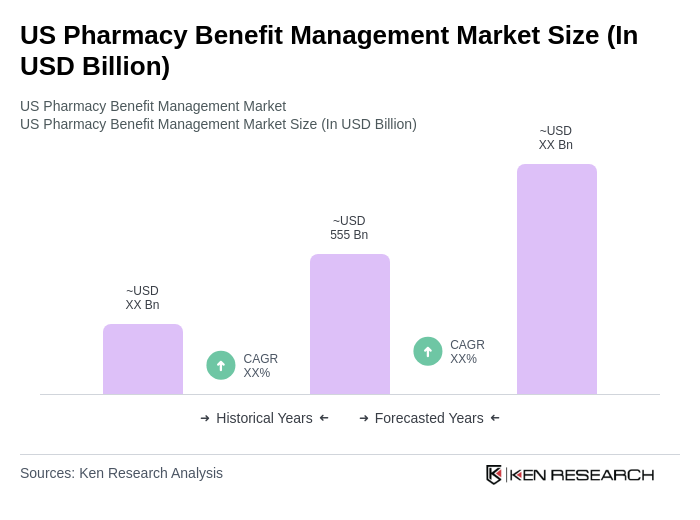
- The US Pharmacy Benefit Management market is valued at USD 555 billion, based on a five-year historical analysis. This growth is primarily driven by the increasing prevalence of chronic diseases, rising healthcare costs, and the growing demand for prescription medications. Additional drivers include drug price inflation, vertical integration among insurers and PBMs, and the adoption of advanced technologies such as artificial intelligence to optimize medication management and cost containment. The shift towards value-based care and the need for cost-effective medication management solutions further support market expansion .
- Key players in this market are concentrated in major metropolitan areas such as New York, Los Angeles, and Chicago. These cities dominate due to their large populations, advanced healthcare infrastructure, and the presence of numerous healthcare providers and insurance companies. The concentration of healthcare resources and innovation hubs in these regions further enhances their market leadership .
- In 2023, the US government implemented the Inflation Reduction Act, which includes provisions aimed at reducing prescription drug costs for Medicare beneficiaries. This regulation, officially titled the “Inflation Reduction Act of 2022” issued by the United States Congress, allows Medicare to negotiate prices for certain high-cost drugs, thereby impacting the overall pharmacy benefit management landscape by promoting affordability and accessibility of medications. The Act establishes negotiation authority for selected drugs, sets annual out-of-pocket caps, and introduces inflationary rebates for drug price increases above inflation .
US Pharmacy Benefit Management Market Segmentation
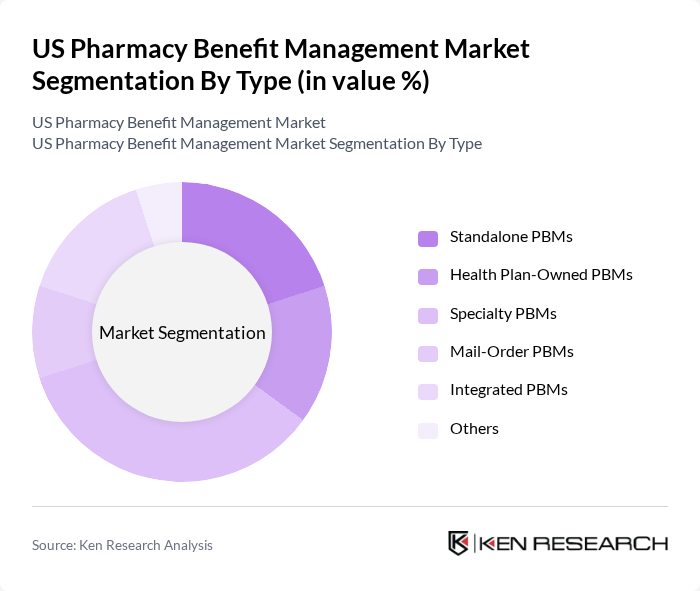
By Type:The market is segmented into various types of pharmacy benefit managers, including Standalone PBMs, Health Plan-Owned PBMs, Specialty PBMs, Mail-Order PBMs, Integrated PBMs, and Others. Among these, Specialty PBMs are gaining traction due to the increasing demand for specialty medications, which are often high-cost and require specialized management. The rise in chronic diseases, complex treatment regimens, and the growing pipeline of specialty pharmaceuticals have led to a greater focus on specialty pharmacy services, making this subsegment a leader in the market .
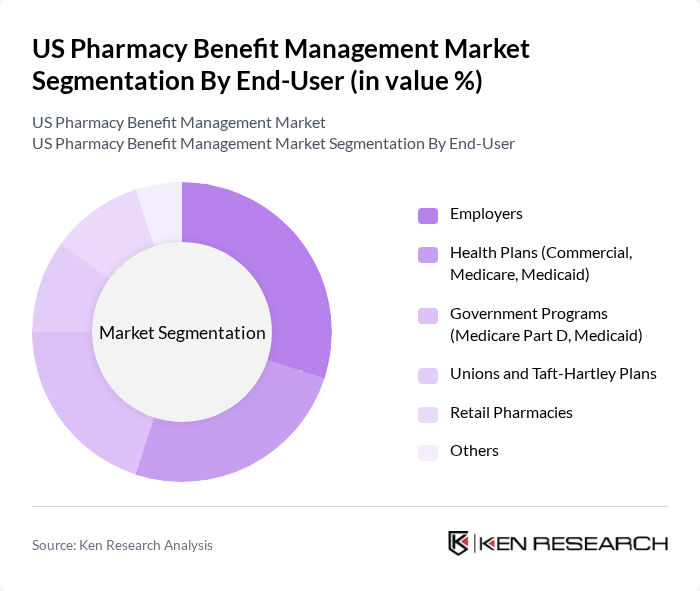
By End-User:The end-user segmentation includes Employers, Health Plans (Commercial, Medicare, Medicaid), Government Programs (Medicare Part D, Medicaid), Unions and Taft-Hartley Plans, Retail Pharmacies, and Others. Employers are a significant segment as they often provide pharmacy benefits as part of their health insurance offerings. The increasing focus on employee health and wellness programs, combined with the need for cost control and improved medication adherence, has led to a rise in employer-sponsored pharmacy benefit plans, making this subsegment a key player in the market .
US Pharmacy Benefit Management Market Competitive Landscape
The US Pharmacy Benefit Management Market is characterized by a dynamic mix of regional and international players. Leading participants such as CVS Health Corporation (Caremark), Express Scripts (Cigna Corporation), OptumRx, Inc. (UnitedHealth Group), Prime Therapeutics LLC, MedImpact Healthcare Systems, Inc., Humana Pharmacy Solutions (Humana Inc.), Envolve Pharmacy Solutions (Centene Corporation), PerformRx, LLC, Magellan Rx Management (Magellan Health, Inc.), Elixir Rx Solutions (formerly EnvisionRxOptions), WellDyneRx, LLC, Anthem, Inc. (IngenioRx, now CarelonRx), Aetna Pharmacy Management (CVS Health), Navitus Health Solutions, LLC, RxAdvance (now AscellaHealth) contribute to innovation, geographic expansion, and service delivery in this space.
US Pharmacy Benefit Management Market Industry Analysis
Growth Drivers
- Increasing Prescription Drug Costs:The US witnessed a staggering increase in prescription drug costs, with total spending reaching approximatelyUSD 406 billionin future. This surge is driven by high prices for brand-name medications, which accounted for nearly80%of total drug expenditures. As patients face higher out-of-pocket costs, the demand for Pharmacy Benefit Managers (PBMs) to negotiate better prices and manage these expenses effectively is intensifying, thereby propelling market growth.
- Rising Demand for Specialty Drugs:Specialty drugs, which represented aboutUSD 301 billionin spending in future, are becoming a significant component of the pharmaceutical landscape. These medications often treat complex conditions and require special handling, leading to increased demand for PBM services that can manage these high-cost therapies. The growing prevalence of chronic diseases, such as cancer and autoimmune disorders, is expected to further drive this demand, enhancing the role of PBMs in the healthcare system.
- Technological Advancements in PBM Services:The integration of advanced technologies, such as artificial intelligence and data analytics, is transforming PBM operations. In future, investments in technology by PBMs are reported to be substantial, focusing on improving drug utilization reviews and enhancing patient engagement. These innovations not only streamline operations but also enable more personalized care, which is increasingly sought after by patients and healthcare providers alike, thus driving market growth.
Market Challenges
- Regulatory Compliance Issues:The PBM industry faces significant regulatory scrutiny, with over30 statesimplementing new laws aimed at increasing transparency and accountability. Compliance with these regulations can be costly and complex, with estimates suggesting that PBMs may incur up toUSD 5 billionannually in compliance-related expenses. This challenge can hinder operational efficiency and profitability, impacting the overall market landscape.
- Competition from Direct-to-Consumer Models:The rise of direct-to-consumer (DTC) models is reshaping the pharmacy landscape, with companies like Amazon Pharmacy and GoodRx gaining traction. In future, DTC pharmacy sales are reported to be approximatelyUSD 15 billion, posing a significant threat to traditional PBM models. This competition pressures PBMs to innovate and adapt their services to retain clients and ensure their relevance in an evolving market.
US Pharmacy Benefit Management Market Future Outlook
The future of the US Pharmacy Benefit Management market is poised for transformation, driven by the increasing integration of technology and a shift towards patient-centric care models. As healthcare providers and PBMs collaborate more closely, the focus will be on delivering personalized medicine and improving patient outcomes. Additionally, the expansion of telehealth services is expected to enhance access to medications, further influencing the dynamics of the PBM landscape in the coming years.
Market Opportunities
- Growth in Telehealth Services:The telehealth market is projected to reachUSD 250 billionby future, creating opportunities for PBMs to integrate their services with telehealth platforms. This integration can streamline medication management and improve patient adherence, ultimately enhancing the value proposition of PBMs in the healthcare ecosystem.
- Partnerships with Healthcare Providers:Collaborations between PBMs and healthcare providers are on the rise, with over60%of PBMs actively seeking partnerships. These alliances can lead to improved care coordination and better management of drug formularies, positioning PBMs as essential players in the evolving healthcare landscape and driving future growth.
Scope of the Report
| Segment | Sub-Segments |
|---|---|
| By Type | Standalone PBMs Health Plan-Owned PBMs Specialty PBMs Mail-Order PBMs Integrated PBMs Others |
| By End-User | Employers Health Plans (Commercial, Medicare, Medicaid) Government Programs (Medicare Part D, Medicaid) Unions and Taft-Hartley Plans Retail Pharmacies Others |
| By Service Type | Claims Processing Formulary Management Drug Utilization Review Clinical Management Programs Specialty Pharmacy Management Pharmacy Network Management Rebate Negotiation & Administration Others |
| By Distribution Channel | Direct Contracts Online Platforms Third-Party Distributors Others |
| By Customer Type | Individual Consumers Small Businesses Large Enterprises Government Entities Others |
| By Geographic Coverage | National Coverage Regional Coverage Local Coverage Others |
| By Pricing Model | Cost-Plus Pricing Flat Fee Pricing Performance-Based Pricing Spread Pricing Others |
Key Target Audience
Investors and Venture Capitalist Firms
Government and Regulatory Bodies (e.g., Centers for Medicare & Medicaid Services, Food and Drug Administration)
Pharmacy Benefit Managers
Health Insurance Companies
Pharmaceutical Manufacturers
Healthcare Providers and Systems
Employers and Self-Insured Organizations
Technology Providers and Software Developers
Players Mentioned in the Report:
CVS Health Corporation (Caremark)
Express Scripts (Cigna Corporation)
OptumRx, Inc. (UnitedHealth Group)
Prime Therapeutics LLC
MedImpact Healthcare Systems, Inc.
Humana Pharmacy Solutions (Humana Inc.)
Envolve Pharmacy Solutions (Centene Corporation)
PerformRx, LLC
Magellan Rx Management (Magellan Health, Inc.)
Elixir Rx Solutions (formerly EnvisionRxOptions)
WellDyneRx, LLC
Anthem, Inc. (IngenioRx, now CarelonRx)
Aetna Pharmacy Management (CVS Health)
Navitus Health Solutions, LLC
RxAdvance (now AscellaHealth)
Table of Contents
Market Assessment Phase
1. Executive Summary and Approach
2. US Pharmacy Benefit Management Market Overview
2.1 Key Insights and Strategic Recommendations
2.2 US Pharmacy Benefit Management Market Overview
2.3 Definition and Scope
2.4 Evolution of Market Ecosystem
2.5 Timeline of Key Regulatory Milestones
2.6 Value Chain & Stakeholder Mapping
2.7 Business Cycle Analysis
2.8 Policy & Incentive Landscape
3. US Pharmacy Benefit Management Market Analysis
3.1 Growth Drivers
3.1.1 Increasing Prescription Drug Costs
3.1.2 Rising Demand for Specialty Drugs
3.1.3 Expansion of Value-Based Care Models
3.1.4 Technological Advancements in PBM Services
3.2 Market Challenges
3.2.1 Regulatory Compliance Issues
3.2.2 Competition from Direct-to-Consumer Models
3.2.3 Pricing Transparency Demands
3.2.4 Managing Drug Formularies Effectively
3.3 Market Opportunities
3.3.1 Growth in Telehealth Services
3.3.2 Partnerships with Healthcare Providers
3.3.3 Development of Personalized Medicine
3.3.4 Expansion into Emerging Markets
3.4 Market Trends
3.4.1 Shift Towards Integrated Care Models
3.4.2 Increased Focus on Patient-Centric Services
3.4.3 Adoption of Artificial Intelligence in PBM
3.4.4 Growth of Home Delivery Pharmacy Services
3.5 Government Regulation
3.5.1 Drug Pricing Transparency Laws
3.5.2 Medicaid Drug Rebate Program Changes
3.5.3 Pharmacy Benefit Manager Oversight Regulations
3.5.4 Medicare Part D Policy Adjustments
4. SWOT Analysis
5. Stakeholder Analysis
6. Porter's Five Forces Analysis
7. US Pharmacy Benefit Management Market Market Size, 2019-2024
7.1 By Value
7.2 By Volume
7.3 By Average Selling Price
8. US Pharmacy Benefit Management Market Segmentation
8.1 By Type
8.1.1 Standalone PBMs
8.1.2 Health Plan-Owned PBMs
8.1.3 Specialty PBMs
8.1.4 Mail-Order PBMs
8.1.5 Integrated PBMs
8.1.6 Others
8.2 By End-User
8.2.1 Employers
8.2.2 Health Plans (Commercial, Medicare, Medicaid)
8.2.3 Government Programs (Medicare Part D, Medicaid)
8.2.4 Unions and Taft-Hartley Plans
8.2.5 Retail Pharmacies
8.2.6 Others
8.3 By Service Type
8.3.1 Claims Processing
8.3.2 Formulary Management
8.3.3 Drug Utilization Review
8.3.4 Clinical Management Programs
8.3.5 Specialty Pharmacy Management
8.3.6 Pharmacy Network Management
8.3.7 Rebate Negotiation & Administration
8.3.8 Others
8.4 By Distribution Channel
8.4.1 Direct Contracts
8.4.2 Online Platforms
8.4.3 Third-Party Distributors
8.4.4 Others
8.5 By Customer Type
8.5.1 Individual Consumers
8.5.2 Small Businesses
8.5.3 Large Enterprises
8.5.4 Government Entities
8.5.5 Others
8.6 By Geographic Coverage
8.6.1 National Coverage
8.6.2 Regional Coverage
8.6.3 Local Coverage
8.6.4 Others
8.7 By Pricing Model
8.7.1 Cost-Plus Pricing
8.7.2 Flat Fee Pricing
8.7.3 Performance-Based Pricing
8.7.4 Spread Pricing
8.7.5 Others
9. US Pharmacy Benefit Management Market Competitive Analysis
9.1 Market Share of Key Players
9.2 KPIs for Cross Comparison of Key Players
9.2.1 Company Name
9.2.2 Group Size (Large, Medium, or Small as per industry convention)
9.2.3 Total Prescription Volume (Annual Scripts Processed)
9.2.4 Market Share (%)
9.2.5 Revenue ($, latest fiscal year)
9.2.6 Profit Margin (%)
9.2.7 Client Retention Rate (%)
9.2.8 Formulary Compliance Rate (%)
9.2.9 Average Cost Savings Delivered to Clients (%)
9.2.10 Customer Satisfaction Score (Net Promoter Score or equivalent)
9.2.11 Network Size (Number of Contracted Pharmacies)
9.2.12 Specialty Pharmacy Penetration (%)
9.2.13 Rebate Negotiation Effectiveness ($ per script or % of spend)
9.2.14 Digital Engagement Metrics (e.g., % of claims processed electronically)
9.2.15 Revenue Growth Rate (%)
9.3 SWOT Analysis of Top Players
9.4 Pricing Analysis
9.5 List of Major Companies
9.5.1 CVS Health Corporation (Caremark)
9.5.2 Express Scripts (Cigna Corporation)
9.5.3 OptumRx, Inc. (UnitedHealth Group)
9.5.4 Prime Therapeutics LLC
9.5.5 MedImpact Healthcare Systems, Inc.
9.5.6 Humana Pharmacy Solutions (Humana Inc.)
9.5.7 Envolve Pharmacy Solutions (Centene Corporation)
9.5.8 PerformRx, LLC
9.5.9 Magellan Rx Management (Magellan Health, Inc.)
9.5.10 Elixir Rx Solutions (formerly EnvisionRxOptions)
9.5.11 WellDyneRx, LLC
9.5.12 Anthem, Inc. (IngenioRx, now CarelonRx)
9.5.13 Aetna Pharmacy Management (CVS Health)
9.5.14 Navitus Health Solutions, LLC
9.5.15 RxAdvance (now AscellaHealth)
10. US Pharmacy Benefit Management Market End-User Analysis
10.1 Procurement Behavior of Key Ministries
10.1.1 Budget Allocation for Pharmacy Benefits
10.1.2 Decision-Making Processes
10.1.3 Evaluation Criteria for PBM Services
10.2 Corporate Spend on Infrastructure & Energy
10.2.1 Investment in Pharmacy Benefit Management
10.2.2 Trends in Corporate Healthcare Spending
10.2.3 Cost Management Strategies
10.3 Pain Point Analysis by End-User Category
10.3.1 High Drug Costs
10.3.2 Complexity of Drug Formularies
10.3.3 Lack of Transparency in Pricing
10.4 User Readiness for Adoption
10.4.1 Awareness of PBM Services
10.4.2 Willingness to Switch Providers
10.4.3 Training and Support Needs
10.5 Post-Deployment ROI and Use Case Expansion
10.5.1 Measurement of Cost Savings
10.5.2 User Feedback and Satisfaction
10.5.3 Opportunities for Service Expansion
11. US Pharmacy Benefit Management Market Future Size, 2025-2030
11.1 By Value
11.2 By Volume
11.3 By Average Selling Price
Go-To-Market Strategy Phase
1. Whitespace Analysis + Business Model Canvas
1.1 Identification of Market Gaps
1.2 Business Model Framework
2. Marketing and Positioning Recommendations
2.1 Branding Strategies
2.2 Product USPs
3. Distribution Plan
3.1 Urban Retail vs Rural NGO Tie-Ups
4. Channel & Pricing Gaps
4.1 Underserved Routes
4.2 Pricing Bands
5. Unmet Demand & Latent Needs
5.1 Category Gaps
5.2 Consumer Segments
6. Customer Relationship
6.1 Loyalty Programs
6.2 After-Sales Service
7. Value Proposition
7.1 Sustainability
7.2 Integrated Supply Chains
8. Key Activities
8.1 Regulatory Compliance
8.2 Branding
8.3 Distribution Setup
9. Entry Strategy Evaluation
9.1 Domestic Market Entry Strategy
9.1.1 Product Mix
9.1.2 Pricing Band
9.1.3 Packaging
9.2 Export Entry Strategy
9.2.1 Target Countries
9.2.2 Compliance Roadmap
10. Entry Mode Assessment
10.1 JV
10.2 Greenfield
10.3 M&A
10.4 Distributor Model
11. Capital and Timeline Estimation
11.1 Capital Requirements
11.2 Timelines
12. Control vs Risk Trade-Off
12.1 Ownership vs Partnerships
13. Profitability Outlook
13.1 Breakeven Analysis
13.2 Long-Term Sustainability
14. Potential Partner List
14.1 Distributors
14.2 JVs
14.3 Acquisition Targets
15. Execution Roadmap
15.1 Phased Plan for Market Entry
15.1.1 Market Setup
15.1.2 Market Entry
15.1.3 Growth Acceleration
15.1.4 Scale & Stabilize
15.2 Key Activities and Milestones
15.2.1 Milestone Planning
15.2.2 Activity Tracking
Research Methodology
Phase 1: Approach1
Desk Research
- Analysis of industry reports from the National Association of Chain Drug Stores (NACDS)
- Review of government publications and healthcare policy documents from the Centers for Medicare & Medicaid Services (CMS)
- Examination of market trends and forecasts from pharmaceutical market research databases
Primary Research
- Interviews with pharmacy benefit managers (PBMs) to understand operational challenges
- Surveys with healthcare providers to gauge the impact of PBM practices on patient care
- Focus groups with patients to collect insights on their experiences with PBM services
Validation & Triangulation
- Cross-validation of findings through multiple expert interviews across different sectors
- Triangulation of data from PBM financial reports and healthcare expenditure statistics
- Sanity checks through peer reviews and expert panel discussions
Phase 2: Market Size Estimation1
Top-down Assessment
- Estimation of total pharmacy spending in the U.S. as a baseline for PBM market size
- Segmentation of the market by therapeutic categories and payer types
- Incorporation of trends in drug pricing and reimbursement policies
Bottom-up Modeling
- Collection of data on prescription volumes managed by leading PBMs
- Analysis of revenue streams from administrative fees and rebates
- Estimation of market share based on client contracts and service offerings
Forecasting & Scenario Analysis
- Multi-variable regression analysis incorporating drug utilization trends and demographic shifts
- Scenario modeling based on potential regulatory changes and market disruptions
- Development of baseline, optimistic, and pessimistic forecasts through 2030
Phase 3: CATI Sample Composition1
| Scope Item/Segment | Sample Size | Target Respondent Profiles |
|---|---|---|
| Retail Pharmacy Benefit Management | 120 | Pharmacy Managers, Benefit Coordinators |
| Health Plan PBM Relationships | 100 | Health Plan Executives, Pharmacy Directors |
| Specialty Drug Management | 80 | Clinical Pharmacists, Specialty Drug Managers |
| Patient Experience with PBMs | 120 | Patients, Care Coordinators |
| Regulatory Impact on PBM Operations | 90 | Compliance Officers, Regulatory Affairs Specialists |
Frequently Asked Questions
What is the current value of the US Pharmacy Benefit Management market?
The US Pharmacy Benefit Management market is valued at approximately USD 555 billion, driven by factors such as the increasing prevalence of chronic diseases, rising healthcare costs, and the growing demand for prescription medications.
What factors are driving the growth of the Pharmacy Benefit Management market?
How does the Inflation Reduction Act impact Pharmacy Benefit Management?
What types of Pharmacy Benefit Managers are there?
Other Regional/Country Reports
Indonesia Pharmacy Benefit Management Market
Malaysia Pharmacy Benefit Management Market
KSA Pharmacy Benefit Management Market
APAC Pharmacy Benefit Management Market
SEA Pharmacy Benefit Management Market
Vietnam Pharmacy Benefit Management Market
Other Adjacent Reports
Philippines Specialty Pharmacy Market
Saudi Arabia Health Insurance Market Size, Share & Forecast, By Product Type, Customer Segment & Distribution Channel, 2026-2032Saudi Arabia Pharmaceutical Distribution Market Size, Share, Growth Drivers, Trends, Opportunities & Forecast 2025–2030KSA healthcare it market size, share, growth drivers, trends, opportunities & forecast 2025–2030Global Africa Telehealth Market Report Size Share Growth Drivers Trends Opportunities & Forecast 2025–2030Middle East Chronic Disease Management Market Size, Share, Growth Drivers, Trends, Opportunities & Forecast 2025–2030Thailand Drug Pricing and Reimbursement Market
Germany Mail-Order Pharmacy Market
United States Healthcare Analytics Market Outlook to 2030: Size, Share, Growth and TrendsOman Value-Based Care Market
Why Buy From Us?

What makes us stand out is that our consultants follow Robust, Refine and Result (RRR) methodology. Robust for clear definitions, approaches and sanity checking, Refine for differentiating respondents' facts and opinions, and Result for presenting data with story.

We have set a benchmark in the industry by offering our clients with syndicated and customized market research reports featuring coverage of entire market as well as meticulous research and analyst insights.

While we don't replace traditional research, we flip the method upside down. Our dual approach of Top Bottom & Bottom Top ensures quality deliverable by not just verifying company fundamentals but also looking at the sector and macroeconomic factors.

With one step in the future, our research team constantly tries to show you the bigger picture. We help with some of the tough questions you may encounter along the way: How is the industry positioned? Best marketing channel? KPI's of competitors? By aligning every element, we help maximize success.

Our report gives you instant access to the answers and sources that other companies might choose to hide. We elaborate each steps of research methodology we have used and showcase you the sample size to earn your trust.

If you need any support, we are here! We pride ourselves on universe strength, data quality, and quick, friendly, and professional service.