About the Report
Base Year 2024USA Robotics in Manufacturing and Warehousing Market Overview
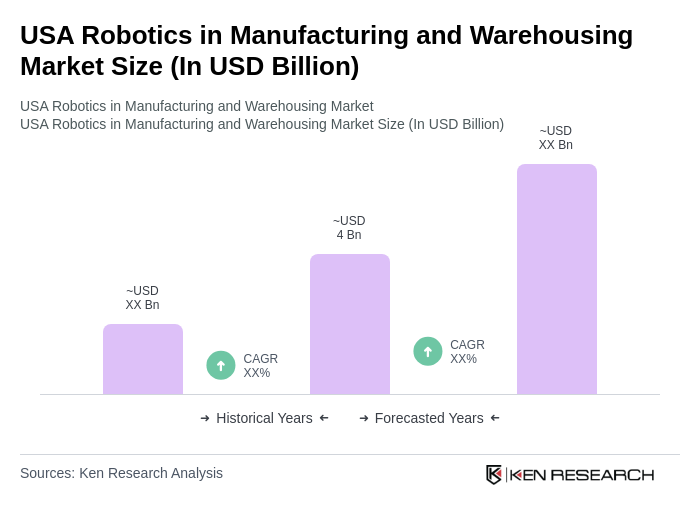
- The USA Robotics in Manufacturing and Warehousing Market is valued at USD 4 billion, based on a five-year historical analysis. This market size reflects the significant share of the USA within the North American industrial robotics sector, which accounts for over 8% of the global industrial robotics market valued at USD 33.9 billion globally. Growth is primarily driven by advancements in automation technology, rising labor costs, and the increased demand for operational efficiency and cost reduction in manufacturing processes. The integration of robotics in warehousing is further accelerated by the surge in e-commerce, which requires faster and more accurate order fulfillment and logistics automation .
- Key players in this market are concentrated in major cities such as San Francisco, Detroit, and Chicago, which dominate due to their robust industrial bases and vibrant technology innovation ecosystems. These cities host leading robotics companies, research institutions, and collaborative hubs, fostering ongoing development and commercialization of robotics technologies and enhancing their competitive edge .
- In 2023, the USA government advanced the "Manufacturing USA" initiative, officially titled the “Revitalizing American Manufacturing and Innovation Act of 2014,” administered by the National Institute of Standards and Technology (NIST). This program includes funding of USD 300 million to support research and development in advanced manufacturing technologies, including robotics, and mandates operational standards for public-private innovation institutes. The initiative promotes innovation, workforce training, and compliance with best practices to ensure the U.S. maintains global competitiveness .
USA Robotics in Manufacturing and Warehousing Market Segmentation
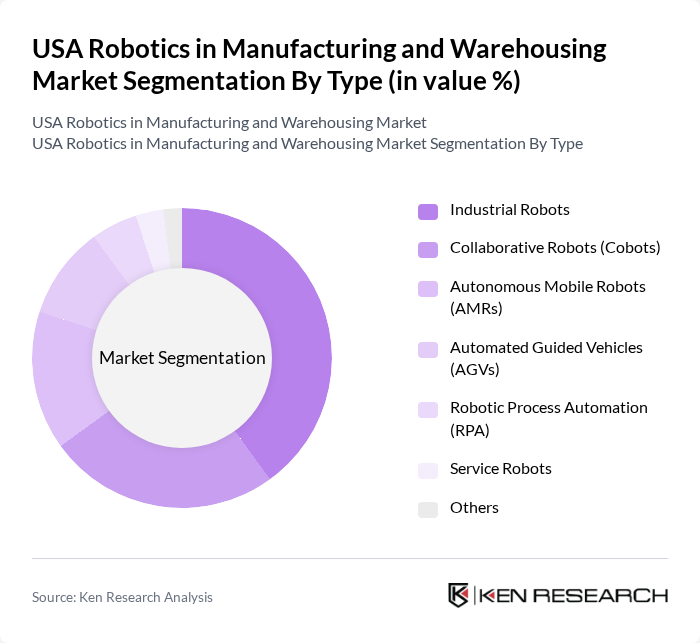
By Type:The robotics market in manufacturing and warehousing is segmented into Industrial Robots, Collaborative Robots (Cobots), Autonomous Mobile Robots (AMRs), Automated Guided Vehicles (AGVs), Robotic Process Automation (RPA), Service Robots, and Others. Industrial Robots lead the market due to their extensive use in assembly lines, material handling, and heavy lifting, which drive productivity and reduce labor costs. Collaborative Robots are rapidly gaining traction, especially among small and medium enterprises, as they work safely alongside human operators and enable automation without major infrastructure changes. Autonomous Mobile Robots and AGVs are increasingly deployed in warehousing for automated picking, sorting, and transport, reflecting the trend toward flexible, scalable logistics automation .
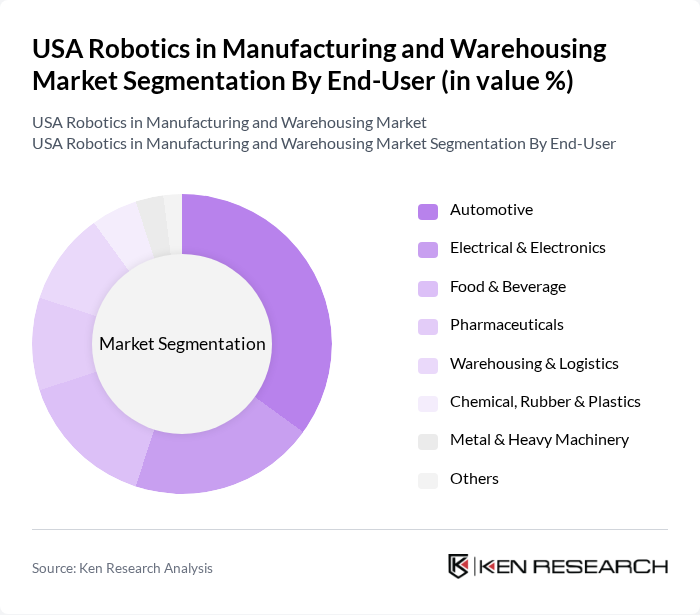
By End-User:The end-user segmentation of the robotics market includes Automotive, Electrical & Electronics, Food & Beverage, Pharmaceuticals, Warehousing & Logistics, Chemical, Rubber & Plastics, Metal & Heavy Machinery, and Others. The Automotive sector remains the largest end-user, driven by the need for precision, speed, and efficiency in manufacturing. The Electrical & Electronics industry also represents a significant share, reflecting the high adoption of industrial robots for assembly and material handling. The Food & Beverage industry is rapidly automating packaging and processing to meet hygiene standards and increase throughput. Warehousing & Logistics is experiencing robust growth due to the adoption of AMRs and AGVs for order fulfillment and inventory management .
USA Robotics in Manufacturing and Warehousing Market Competitive Landscape
The USA Robotics in Manufacturing and Warehousing Market is characterized by a dynamic mix of regional and international players. Leading participants such as ABB Ltd., KUKA AG, FANUC Corporation, Yaskawa Electric Corporation, Universal Robots A/S, Siemens AG, Rockwell Automation, Inc., Omron Corporation, Mitsubishi Electric Corporation, Teradyne, Inc., Cognex Corporation, Zebra Technologies Corporation, Blue Yonder, Fetch Robotics, Inc. (now part of Zebra Technologies), Locus Robotics, Boston Dynamics, Inc., Amazon Robotics LLC, Vecna Robotics, Geekplus Technology Co., Ltd., GreyOrange Inc. contribute to innovation, geographic expansion, and service delivery in this space.
USA Robotics in Manufacturing and Warehousing Market Industry Analysis
Growth Drivers
- Increased Automation Demand:The USA manufacturing sector is projected to invest approximately $270 billion in automation technologies in future, driven by the need for efficiency and productivity. This surge is largely attributed to the increasing complexity of supply chains and the necessity for rapid production cycles. As companies strive to meet consumer demands, the integration of robotics becomes essential, with over 70% of manufacturers indicating plans to enhance automation in their operations, according to the National Association of Manufacturers.
- Labor Shortages in Manufacturing:The USA is facing a significant labor shortage, with an estimated 3.5 million manufacturing jobs expected to remain unfilled in future. This gap is prompting manufacturers to turn to robotics to maintain production levels. The Bureau of Labor Statistics reports that the manufacturing workforce has shrunk by approximately 1.5 million since 2000, leading to a greater reliance on robotic solutions to fill the void and ensure operational continuity in the face of workforce challenges.
- Technological Advancements in Robotics:The robotics industry is experiencing rapid technological advancements, with investments in R&D reaching $20 billion in future. Innovations such as AI-driven robotics and enhanced machine learning capabilities are enabling more sophisticated automation solutions. According to the International Federation of Robotics, the number of operational industrial robots in the USA is expected to exceed 350,000 units in future, reflecting the growing adoption of advanced robotics technologies across various sectors.
Market Challenges
- High Initial Investment Costs:The upfront costs associated with implementing robotics in manufacturing can be substantial, often exceeding $120,000 per unit for advanced systems. This financial barrier can deter small and medium enterprises from adopting robotic solutions. A report from the Robotics Industries Association indicates that while operational savings can be significant, the initial capital required remains a critical challenge for many businesses looking to automate their processes.
- Integration with Existing Systems:Many manufacturers face difficulties in integrating new robotic systems with their existing infrastructure. Approximately 45% of companies report challenges in achieving seamless integration, which can lead to operational disruptions. The complexity of legacy systems often necessitates additional investments in software and training, further complicating the automation process. This challenge can hinder the overall efficiency gains that robotics are intended to provide.
USA Robotics in Manufacturing and Warehousing Market Future Outlook
The future of the USA robotics market in manufacturing and warehousing is poised for transformative growth, driven by technological innovations and evolving consumer demands. As companies increasingly prioritize efficiency and sustainability, the integration of robotics with IoT and AI will become more prevalent. Additionally, the rise of collaborative robots will facilitate human-robot interaction, enhancing productivity. With ongoing investments in automation technologies, the market is expected to adapt rapidly to changing industry needs, positioning itself for significant advancements in the coming years.
Market Opportunities
- Expansion in E-commerce Logistics:The e-commerce sector is projected to grow by $1.5 trillion in future, creating substantial demand for automated warehousing solutions. Robotics can streamline order fulfillment processes, reducing delivery times and operational costs. Companies that invest in robotic systems for logistics are likely to gain a competitive edge in this rapidly evolving market, capitalizing on the increasing consumer preference for fast and efficient service.
- Adoption of AI and Machine Learning:The integration of AI and machine learning into robotics is expected to enhance operational capabilities significantly. By future, the market for AI in robotics is anticipated to reach $8 billion, enabling smarter decision-making and predictive maintenance. This technological synergy will not only improve efficiency but also reduce downtime, providing manufacturers with a robust opportunity to optimize their operations and drive profitability.
Scope of the Report
| Segment | Sub-Segments |
|---|---|
| By Type | Industrial Robots Collaborative Robots (Cobots) Autonomous Mobile Robots (AMRs) Automated Guided Vehicles (AGVs) Robotic Process Automation (RPA) Service Robots Others |
| By End-User | Automotive Electrical & Electronics Food & Beverage Pharmaceuticals Warehousing & Logistics Chemical, Rubber & Plastics Metal & Heavy Machinery Others |
| By Application | Material Handling (incl. Packaging & Palletizing) Assembly Line Automation Quality Control & Inspection Welding & Soldering Painting & Coating Maintenance & Repair Others |
| By Distribution Channel | Direct Sales Distributors Online Sales Retail Others |
| By Region | Northeast Midwest South West Others |
| By Price Range | Low-End Robots Mid-Range Robots High-End Robots |
| By Service Type | Maintenance Services Consulting Services Training Services System Integration Services Others |
Key Target Audience
Investors and Venture Capitalist Firms
Government and Regulatory Bodies (e.g., Occupational Safety and Health Administration, National Institute of Standards and Technology)
Manufacturers and Producers
Logistics and Supply Chain Companies
Automation Technology Providers
Industry Associations (e.g., Robotics Industries Association)
Financial Institutions
Trade Organizations
Players Mentioned in the Report:
ABB Ltd.
KUKA AG
FANUC Corporation
Yaskawa Electric Corporation
Universal Robots A/S
Siemens AG
Rockwell Automation, Inc.
Omron Corporation
Mitsubishi Electric Corporation
Teradyne, Inc.
Cognex Corporation
Zebra Technologies Corporation
Blue Yonder
Fetch Robotics, Inc. (now part of Zebra Technologies)
Locus Robotics
Boston Dynamics, Inc.
Amazon Robotics LLC
Vecna Robotics
Geekplus Technology Co., Ltd.
GreyOrange Inc.
Table of Contents
Market Assessment Phase
1. Executive Summary and Approach
2. USA Robotics in Manufacturing and Warehousing Market Overview
2.1 Key Insights and Strategic Recommendations
2.2 USA Robotics in Manufacturing and Warehousing Market Overview
2.3 Definition and Scope
2.4 Evolution of Market Ecosystem
2.5 Timeline of Key Regulatory Milestones
2.6 Value Chain & Stakeholder Mapping
2.7 Business Cycle Analysis
2.8 Policy & Incentive Landscape
3. USA Robotics in Manufacturing and Warehousing Market Analysis
3.1 Growth Drivers
3.1.1 Increased Automation Demand
3.1.2 Labor Shortages in Manufacturing
3.1.3 Technological Advancements in Robotics
3.1.4 Cost Reduction in Operations
3.2 Market Challenges
3.2.1 High Initial Investment Costs
3.2.2 Integration with Existing Systems
3.2.3 Regulatory Compliance Issues
3.2.4 Rapid Technological Changes
3.3 Market Opportunities
3.3.1 Expansion in E-commerce Logistics
3.3.2 Adoption of AI and Machine Learning
3.3.3 Growth in Small and Medium Enterprises
3.3.4 Development of Collaborative Robots
3.4 Market Trends
3.4.1 Increased Focus on Sustainability
3.4.2 Rise of Autonomous Mobile Robots
3.4.3 Customization of Robotics Solutions
3.4.4 Integration of IoT in Robotics
3.5 Government Regulation
3.5.1 Safety Standards for Robotics
3.5.2 Labor Regulations Impacting Automation
3.5.3 Environmental Compliance Requirements
3.5.4 Incentives for Automation Adoption
4. SWOT Analysis
5. Stakeholder Analysis
6. Porter's Five Forces Analysis
7. USA Robotics in Manufacturing and Warehousing Market Market Size, 2019-2024
7.1 By Value
7.2 By Volume
7.3 By Average Selling Price
8. USA Robotics in Manufacturing and Warehousing Market Segmentation
8.1 By Type
8.1.1 Industrial Robots
8.1.2 Collaborative Robots (Cobots)
8.1.3 Autonomous Mobile Robots (AMRs)
8.1.4 Automated Guided Vehicles (AGVs)
8.1.5 Robotic Process Automation (RPA)
8.1.6 Service Robots
8.1.7 Others
8.2 By End-User
8.2.1 Automotive
8.2.2 Electrical & Electronics
8.2.3 Food & Beverage
8.2.4 Pharmaceuticals
8.2.5 Warehousing & Logistics
8.2.6 Chemical, Rubber & Plastics
8.2.7 Metal & Heavy Machinery
8.2.8 Others
8.3 By Application
8.3.1 Material Handling (incl. Packaging & Palletizing)
8.3.2 Assembly Line Automation
8.3.3 Quality Control & Inspection
8.3.4 Welding & Soldering
8.3.5 Painting & Coating
8.3.6 Maintenance & Repair
8.3.7 Others
8.4 By Distribution Channel
8.4.1 Direct Sales
8.4.2 Distributors
8.4.3 Online Sales
8.4.4 Retail
8.4.5 Others
8.5 By Region
8.5.1 Northeast
8.5.2 Midwest
8.5.3 South
8.5.4 West
8.5.5 Others
8.6 By Price Range
8.6.1 Low-End Robots
8.6.2 Mid-Range Robots
8.6.3 High-End Robots
8.7 By Service Type
8.7.1 Maintenance Services
8.7.2 Consulting Services
8.7.3 Training Services
8.7.4 System Integration Services
8.7.5 Others
9. USA Robotics in Manufacturing and Warehousing Market Competitive Analysis
9.1 Market Share of Key Players
9.2 Cross Comparison of Key Players
9.2.1 Company Name
9.2.2 Company Size (Large, Medium, Small)
9.2.3 Annual Revenue (USD)
9.2.4 Revenue Growth Rate (%)
9.2.5 Market Share (%)
9.2.6 Installed Base (Units in USA)
9.2.7 Market Penetration Rate (%)
9.2.8 Customer Retention Rate (%)
9.2.9 Average Deal Size (USD)
9.2.10 Pricing Strategy (Premium, Value, Custom)
9.2.11 Product Innovation Rate (Patents/Year or % Revenue from New Products)
9.2.12 R&D Spend (% of Revenue)
9.2.13 Operational Efficiency (Robots Installed per Employee)
9.2.14 Customer Satisfaction Score (NPS or Equivalent)
9.2.15 After-Sales Service Coverage (%)
9.3 SWOT Analysis of Top Players
9.4 Pricing Analysis
9.5 Detailed Profile of Major Companies
9.5.1 ABB Ltd.
9.5.2 KUKA AG
9.5.3 FANUC Corporation
9.5.4 Yaskawa Electric Corporation
9.5.5 Universal Robots A/S
9.5.6 Siemens AG
9.5.7 Rockwell Automation, Inc.
9.5.8 Omron Corporation
9.5.9 Mitsubishi Electric Corporation
9.5.10 Teradyne, Inc.
9.5.11 Cognex Corporation
9.5.12 Zebra Technologies Corporation
9.5.13 Blue Yonder
9.5.14 Fetch Robotics, Inc. (now part of Zebra Technologies)
9.5.15 Locus Robotics
9.5.16 Boston Dynamics, Inc.
9.5.17 Amazon Robotics LLC
9.5.18 Vecna Robotics
9.5.19 Geekplus Technology Co., Ltd.
9.5.20 GreyOrange Inc.
10. USA Robotics in Manufacturing and Warehousing Market End-User Analysis
10.1 Procurement Behavior of Key Ministries
10.1.1 Budget Allocation Trends
10.1.2 Decision-Making Processes
10.1.3 Vendor Selection Criteria
10.2 Corporate Spend on Infrastructure & Energy
10.2.1 Investment in Automation Technologies
10.2.2 Budgeting for Robotics Integration
10.2.3 Long-term Financial Commitments
10.3 Pain Point Analysis by End-User Category
10.3.1 Labor Cost Management
10.3.2 Efficiency in Operations
10.3.3 Quality Control Challenges
10.4 User Readiness for Adoption
10.4.1 Training and Skill Development Needs
10.4.2 Technology Acceptance Levels
10.4.3 Infrastructure Readiness
10.5 Post-Deployment ROI and Use Case Expansion
10.5.1 Measurement of ROI
10.5.2 Expansion of Use Cases
10.5.3 Long-term Benefits Realization
11. USA Robotics in Manufacturing and Warehousing Market Future Size, 2025-2030
11.1 By Value
11.2 By Volume
11.3 By Average Selling Price
Go-To-Market Strategy Phase
1. Whitespace Analysis + Business Model Canvas
1.1 Market Gaps Identification
1.2 Business Model Framework
2. Marketing and Positioning Recommendations
2.1 Branding Strategies
2.2 Product USPs
3. Distribution Plan
3.1 Urban Retail Strategies
3.2 Rural NGO Tie-ups
4. Channel & Pricing Gaps
4.1 Underserved Routes
4.2 Pricing Bands Analysis
5. Unmet Demand & Latent Needs
5.1 Category Gaps
5.2 Consumer Segments
6. Customer Relationship
6.1 Loyalty Programs
6.2 After-sales Service
7. Value Proposition
7.1 Sustainability Initiatives
7.2 Integrated Supply Chains
8. Key Activities
8.1 Regulatory Compliance
8.2 Branding Efforts
8.3 Distribution Setup
9. Entry Strategy Evaluation
9.1 Domestic Market Entry Strategy
9.1.1 Product Mix Considerations
9.1.2 Pricing Band Strategy
9.1.3 Packaging Solutions
9.2 Export Entry Strategy
9.2.1 Target Countries
9.2.2 Compliance Roadmap
10. Entry Mode Assessment
10.1 Joint Ventures
10.2 Greenfield Investments
10.3 Mergers & Acquisitions
10.4 Distributor Model
11. Capital and Timeline Estimation
11.1 Capital Requirements
11.2 Timelines for Implementation
12. Control vs Risk Trade-Off
12.1 Ownership Considerations
12.2 Partnerships Evaluation
13. Profitability Outlook
13.1 Breakeven Analysis
13.2 Long-term Sustainability
14. Potential Partner List
14.1 Distributors
14.2 Joint Ventures
14.3 Acquisition Targets
15. Execution Roadmap
15.1 Phased Plan for Market Entry
15.1.1 Market Setup
15.1.2 Market Entry
15.1.3 Growth Acceleration
15.1.4 Scale & Stabilize
15.2 Key Activities and Milestones
15.2.1 Milestone Planning
15.2.2 Activity Tracking
Research Methodology
Phase 1: Approach1
Desk Research
- Industry reports from the Robotics Industries Association and relevant trade publications
- Government publications on manufacturing and warehousing statistics from the U.S. Census Bureau
- Academic journals and white papers focusing on robotics applications in manufacturing and logistics
Primary Research
- Interviews with operations managers at leading manufacturing firms utilizing robotics
- Surveys with warehouse managers to assess current automation levels and needs
- Focus groups with industry experts to discuss trends and future outlooks in robotics
Validation & Triangulation
- Cross-validation of data from multiple industry sources to ensure accuracy
- Triangulation of findings from desk research and primary interviews
- Sanity checks through expert panel reviews to confirm market assumptions
Phase 2: Market Size Estimation1
Top-down Assessment
- Analysis of total manufacturing output and warehousing capacity in the U.S. to estimate robotics penetration
- Segmentation of the market by industry verticals such as automotive, electronics, and consumer goods
- Incorporation of government initiatives promoting automation and robotics in manufacturing
Bottom-up Modeling
- Collection of sales data from leading robotics manufacturers and suppliers
- Estimation of unit sales based on production volumes and automation rates in key sectors
- Cost analysis of robotics systems including installation, maintenance, and operational expenses
Forecasting & Scenario Analysis
- Multi-variable forecasting models incorporating economic indicators and technological advancements
- Scenario analysis based on varying levels of adoption and regulatory impacts on robotics deployment
- Development of baseline, optimistic, and pessimistic forecasts through 2030
Phase 3: CATI Sample Composition1
| Scope Item/Segment | Sample Size | Target Respondent Profiles |
|---|---|---|
| Automotive Manufacturing Robotics | 50 | Production Managers, Automation Engineers |
| Warehouse Automation Solutions | 60 | Warehouse Operations Managers, Logistics Coordinators |
| Electronics Assembly Robotics | 50 | Manufacturing Engineers, Quality Control Managers |
| Food and Beverage Processing Robotics | 40 | Plant Managers, Supply Chain Analysts |
| Consumer Goods Packaging Automation | 60 | Packaging Engineers, Operations Directors |
Frequently Asked Questions
What is the current value of the USA Robotics in Manufacturing and Warehousing Market?
The USA Robotics in Manufacturing and Warehousing Market is valued at approximately USD 4 billion, reflecting its significant share within the North American industrial robotics sector, which constitutes over 8% of the global market valued at USD 33.9 billion.
What are the main drivers of growth in the USA Robotics market?
Which cities are leading in robotics innovation in the USA?
What is the "Manufacturing USA" initiative?
Other Regional/Country Reports
Indonesia Robotics in Manufacturing and Warehousing Market
Malaysia Robotics in Manufacturing and Warehousing Market
KSA Robotics in Manufacturing and Warehousing Market
APAC Robotics in Manufacturing and Warehousing Market
SEA Robotics in Manufacturing and Warehousing Market
Vietnam Robotics in Manufacturing and Warehousing Market
Other Adjacent Reports
Egypt Warehouse Management Systems Market
United Arab Emirates Supply Chain Analytics Market Report Size Share Growth Drivers Trends Opportunities & Forecast 2025–2030Saudi Arabia artificial intelligence in manufacturing market Size, Share, Growth Drivers, Trends, Opportunities & Forecast 2025–2030South Korea IoT in Manufacturing Market
GCC Road Express (Parcel & LTL) E-commerce Logistics Market Size, Share, Growth Drivers, Trends, Opportunities, Competitive Landscape & Forecast 2025–2030Malaysia Advanced Manufacturing Technologies Market
Japan Machine Vision Systems Market
Why Buy From Us?

What makes us stand out is that our consultants follow Robust, Refine and Result (RRR) methodology. Robust for clear definitions, approaches and sanity checking, Refine for differentiating respondents' facts and opinions, and Result for presenting data with story.

We have set a benchmark in the industry by offering our clients with syndicated and customized market research reports featuring coverage of entire market as well as meticulous research and analyst insights.

While we don't replace traditional research, we flip the method upside down. Our dual approach of Top Bottom & Bottom Top ensures quality deliverable by not just verifying company fundamentals but also looking at the sector and macroeconomic factors.

With one step in the future, our research team constantly tries to show you the bigger picture. We help with some of the tough questions you may encounter along the way: How is the industry positioned? Best marketing channel? KPI's of competitors? By aligning every element, we help maximize success.

Our report gives you instant access to the answers and sources that other companies might choose to hide. We elaborate each steps of research methodology we have used and showcase you the sample size to earn your trust.

If you need any support, we are here! We pride ourselves on universe strength, data quality, and quick, friendly, and professional service.