About the Report
Base Year 2024Vietnam Electric Forklift Market Overview
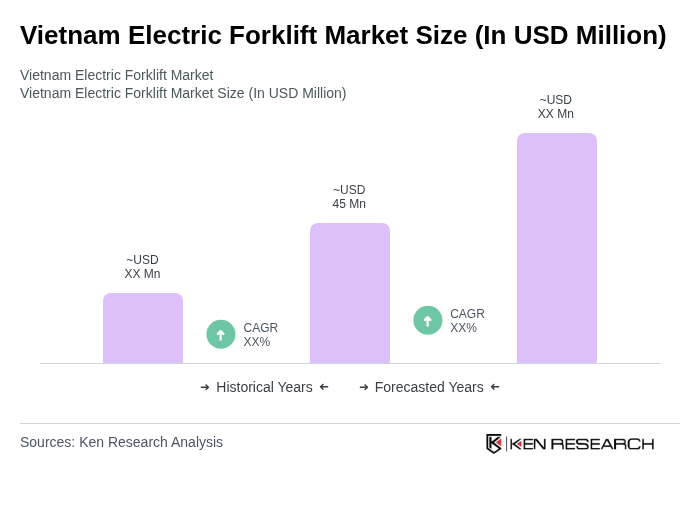
- The Vietnam Electric Forklift Market is valued at USD 180 million, based on a five-year historical analysis. This growth is primarily driven by the increasing demand for efficient material handling solutions in various industries, coupled with the government's push for sustainable and eco-friendly technologies. The rise in e-commerce and logistics activities has further accelerated the adoption of electric forklifts, as businesses seek to enhance operational efficiency and reduce carbon footprints.
- Key cities such as Ho Chi Minh City and Hanoi dominate the market due to their status as economic hubs with a high concentration of manufacturing and logistics companies. The strategic location of these cities facilitates trade and distribution, making them attractive for investments in electric forklift technologies. Additionally, the growing urbanization and infrastructure development in these regions contribute to the increasing demand for electric forklifts.
- The Decree No. 10/2022/ND-CP issued by the Government of Vietnam in 2022 regulates the management and use of electric vehicles, including provisions applicable to electric forklifts used in industrial settings, requiring compliance with technical standards for batteries, charging infrastructure, and safety features to qualify for incentives such as reduced import duties and value-added tax preferences for green technologies. This initiative is part of a broader strategy to reduce greenhouse gas emissions and transition towards a more sustainable economy, encouraging companies to adopt electric forklifts in their operations.
Vietnam Electric Forklift Market Segmentation
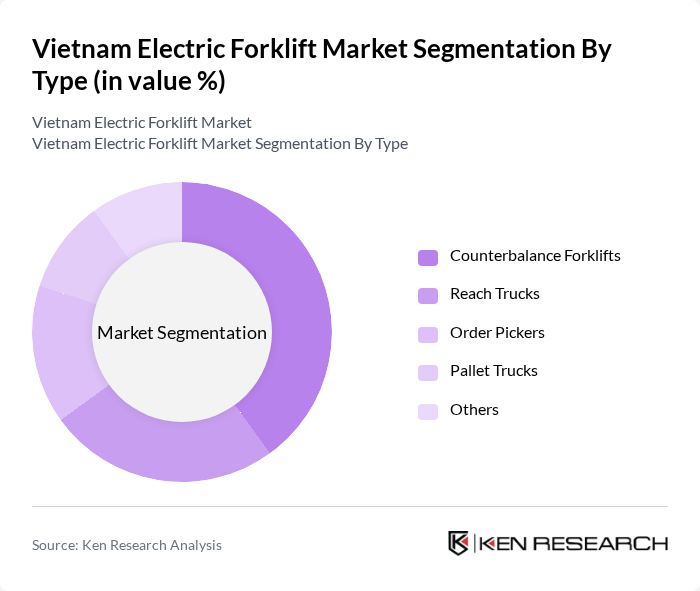
By Type:The market is segmented into various types of electric forklifts, including Counterbalance Forklifts, Reach Trucks, Order Pickers, Pallet Trucks, and Others. Each type serves specific operational needs, with Counterbalance Forklifts being the most widely used due to their versatility in handling various loads. Reach Trucks are gaining traction in warehousing applications, while Order Pickers are preferred for picking operations in retail and distribution centers.
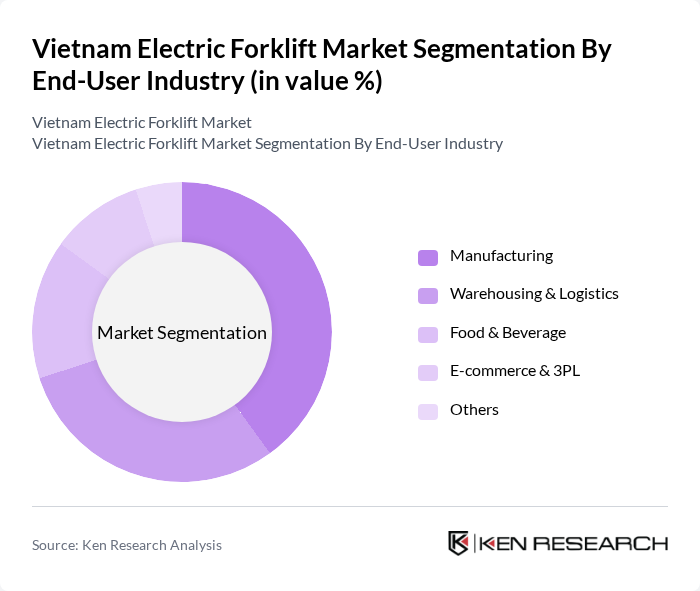
By End-User Industry:The electric forklift market is segmented by end-user industries, including Manufacturing, Warehousing & Logistics, Food & Beverage, E-commerce & 3PL, and Others. The Manufacturing sector is the largest consumer of electric forklifts, driven by the need for efficient material handling in production processes. The rapid growth of e-commerce has also led to increased demand in the Warehousing & Logistics sector, where electric forklifts are essential for optimizing storage and distribution operations.
Vietnam Electric Forklift Market Competitive Landscape
The Vietnam Electric Forklift Market is characterized by a dynamic mix of regional and international players. Leading participants such as Toyota Material Handling, Jungheinrich AG, Hyster-Yale Materials Handling, Crown Equipment Corporation, Mitsubishi Logisnext, KION Group AG, Doosan Industrial Vehicle, Clark Material Handling Company, Yale Materials Handling Corporation, Hangcha Group, EP Equipment, Komatsu Ltd., Nissan Forklift Corporation, Manitou Group, Aisle-Master contribute to innovation, geographic expansion, and service delivery in this space.
Vietnam Electric Forklift Market Industry Analysis
Growth Drivers
- Increasing Demand for Eco-Friendly Logistics Solutions:The Vietnamese logistics sector is projected to grow significantly, with the market size reaching approximately $45 billion in future. This growth is driven by a rising awareness of environmental sustainability, leading companies to adopt electric forklifts. The government’s commitment to reducing carbon emissions by 20% in future further supports this trend, as businesses seek to align with national goals and consumer preferences for greener operations.
- Government Incentives for Electric Vehicle Adoption:The Vietnamese government has introduced various incentives to promote electric vehicle adoption, including electric forklifts. In future, the government allocated around $200 million for subsidies aimed at reducing the purchase costs of electric vehicles. This financial support is crucial for businesses looking to transition from traditional to electric forklifts, making them more accessible and appealing to logistics operators across the country.
- Growth in E-Commerce and Warehousing Sectors:Vietnam's e-commerce market is expected to reach $30 billion in future, driven by a 30% annual growth rate. This surge in online shopping is increasing demand for efficient warehousing solutions, where electric forklifts play a vital role. As companies expand their warehousing capabilities to meet consumer demands, the need for electric forklifts, known for their efficiency and lower operational costs, is becoming increasingly critical in the logistics chain.
Market Challenges
- High Initial Investment Costs:The upfront costs associated with electric forklifts can be a significant barrier for many businesses. In future, the average price of an electric forklift in Vietnam is estimated to be around $35,000, compared to $25,000 for traditional models. This price difference can deter small and medium-sized enterprises from making the switch, limiting the overall market growth and adoption of electric forklifts in the logistics sector.
- Limited Charging Infrastructure:The lack of adequate charging infrastructure poses a challenge for the widespread adoption of electric forklifts in Vietnam. As of future, there are only about 600 charging stations across the country, primarily concentrated in urban areas. This limited availability can lead to operational inefficiencies and downtime for businesses relying on electric forklifts, hindering their ability to fully transition to electric solutions in logistics operations.
Vietnam Electric Forklift Market Future Outlook
The future of the electric forklift market in Vietnam appears promising, driven by increasing investments in logistics infrastructure and a growing emphasis on sustainability. As companies continue to prioritize eco-friendly practices, the demand for electric forklifts is expected to rise. Additionally, advancements in battery technology and charging solutions will likely enhance operational efficiency, making electric forklifts more attractive. The integration of automation and IoT technologies will further streamline operations, positioning electric forklifts as essential tools in modern logistics and warehousing.
Market Opportunities
- Expansion of Logistics and Supply Chain Networks:The ongoing expansion of logistics networks in Vietnam presents a significant opportunity for electric forklift adoption. With the logistics sector projected to grow by 16% annually, businesses are increasingly investing in modern equipment, including electric forklifts, to enhance efficiency and reduce operational costs in their supply chains.
- Development of Smart Warehouse Solutions:The rise of smart warehouses, which utilize advanced technologies for inventory management and operations, creates a favorable environment for electric forklifts. In future, the smart warehouse market in Vietnam is expected to reach $1.2 billion, encouraging the integration of electric forklifts equipped with IoT capabilities to optimize material handling and improve overall warehouse efficiency.
Scope of the Report
| Segment | Sub-Segments |
|---|---|
| By Type | Counterbalance Forklifts Reach Trucks Order Pickers Pallet Trucks Others |
| By End-User Industry | Manufacturing Warehousing & Logistics Food & Beverage E-commerce & 3PL Others |
| By Application | Indoor Operations Outdoor Operations Warehouse Distribution Centers Others |
| By Battery Type | Lithium-ion Lead-acid Others |
| By Load Capacity | Below 5 tons 10 tons Above 10 tons Others |
| By Tire Type | Cushion Tires Pneumatic Tires Solid Tires Others |
| By Region | Northern Vietnam Central Vietnam Southern Vietnam Others |
Key Target Audience
Investors and Venture Capitalist Firms
Government and Regulatory Bodies (e.g., Ministry of Industry and Trade, Ministry of Transport)
Manufacturers and Producers
Distributors and Retailers
Logistics and Supply Chain Companies
Warehouse Operators
Industry Associations (e.g., Vietnam Logistics Association)
Financial Institutions
Players Mentioned in the Report:
Toyota Material Handling
Jungheinrich AG
Hyster-Yale Materials Handling
Crown Equipment Corporation
Mitsubishi Logisnext
KION Group AG
Doosan Industrial Vehicle
Clark Material Handling Company
Yale Materials Handling Corporation
Hangcha Group
EP Equipment
Komatsu Ltd.
Nissan Forklift Corporation
Manitou Group
Aisle-Master
Table of Contents
Market Assessment Phase
1. Executive Summary and Approach
2. Vietnam Electric Forklift Market Overview
2.1 Key Insights and Strategic Recommendations
2.2 Vietnam Electric Forklift Market Overview
2.3 Definition and Scope
2.4 Evolution of Market Ecosystem
2.5 Timeline of Key Regulatory Milestones
2.6 Value Chain & Stakeholder Mapping
2.7 Business Cycle Analysis
2.8 Policy & Incentive Landscape
3. Vietnam Electric Forklift Market Analysis
3.1 Growth Drivers
3.1.1 Increasing demand for eco-friendly logistics solutions
3.1.2 Government incentives for electric vehicle adoption
3.1.3 Growth in e-commerce and warehousing sectors
3.1.4 Technological advancements in battery efficiency
3.2 Market Challenges
3.2.1 High initial investment costs
3.2.2 Limited charging infrastructure
3.2.3 Competition from traditional forklifts
3.2.4 Regulatory compliance complexities
3.3 Market Opportunities
3.3.1 Expansion of logistics and supply chain networks
3.3.2 Increasing urbanization and industrialization
3.3.3 Potential for export to neighboring countries
3.3.4 Development of smart warehouse solutions
3.4 Market Trends
3.4.1 Shift towards automation in material handling
3.4.2 Rising focus on sustainability and carbon footprint reduction
3.4.3 Integration of IoT in forklift operations
3.4.4 Growth of rental and leasing models
3.5 Government Regulation
3.5.1 Emission standards for electric vehicles
3.5.2 Subsidies for electric forklift purchases
3.5.3 Safety regulations for warehouse operations
3.5.4 Tax incentives for green technology investments
4. SWOT Analysis
5. Stakeholder Analysis
6. Porter's Five Forces Analysis
7. Vietnam Electric Forklift Market Market Size, 2019-2024
7.1 By Value
7.2 By Volume
7.3 By Average Selling Price
8. Vietnam Electric Forklift Market Segmentation
8.1 By Type
8.1.1 Counterbalance Forklifts
8.1.2 Reach Trucks
8.1.3 Order Pickers
8.1.4 Pallet Trucks
8.1.5 Others
8.2 By End-User Industry
8.2.1 Manufacturing
8.2.2 Warehousing & Logistics
8.2.3 Food & Beverage
8.2.4 E-commerce & 3PL
8.2.5 Others
8.3 By Application
8.3.1 Indoor Operations
8.3.2 Outdoor Operations
8.3.3 Warehouse
8.3.4 Distribution Centers
8.3.5 Others
8.4 By Battery Type
8.4.1 Lithium-ion
8.4.2 Lead-acid
8.4.3 Others
8.5 By Load Capacity
8.5.1 Below 5 tons
8.5.2 5-10 tons
8.5.3 Above 10 tons
8.5.4 Others
8.6 By Tire Type
8.6.1 Cushion Tires
8.6.2 Pneumatic Tires
8.6.3 Solid Tires
8.6.4 Others
8.7 By Region
8.7.1 Northern Vietnam
8.7.2 Central Vietnam
8.7.3 Southern Vietnam
8.7.4 Others
9. Vietnam Electric Forklift Market Competitive Analysis
9.1 Market Share of Key Players
9.2 Cross Comparison of Key Players
9.2.1 Company Name
9.2.2 Market Share (%)
9.2.3 Revenue Growth Rate (CAGR %)
9.2.4 EBITDA Margin (%)
9.2.5 Installed Base (Units)
9.2.6 R&D Investment (% of Revenue)
9.2.7 Production Capacity (Units/Year)
9.2.8 Service Network Coverage (# Locations)
9.2.9 Patent Portfolio Size
9.2.10 Customer Acquisition Cost (USD/Unit)
9.3 SWOT Analysis of Top Players
9.4 Pricing Analysis
9.5 Detailed Profile of Major Companies
9.5.1 Toyota Material Handling
9.5.2 Jungheinrich AG
9.5.3 Hyster-Yale Materials Handling
9.5.4 Crown Equipment Corporation
9.5.5 Mitsubishi Logisnext
9.5.6 KION Group AG
9.5.7 Doosan Industrial Vehicle
9.5.8 Clark Material Handling Company
9.5.9 Yale Materials Handling Corporation
9.5.10 Hangcha Group
9.5.11 EP Equipment
9.5.12 Komatsu Ltd.
9.5.13 Nissan Forklift Corporation
9.5.14 Manitou Group
9.5.15 Aisle-Master
10. Vietnam Electric Forklift Market End-User Analysis
10.1 Procurement Behavior of Key Ministries
10.1.1 Government procurement policies
10.1.2 Budget allocation for electric vehicles
10.1.3 Evaluation criteria for suppliers
10.1.4 Sustainability goals in procurement
10.2 Corporate Spend on Infrastructure & Energy
10.2.1 Investment trends in electric forklifts
10.2.2 Budgeting for energy-efficient solutions
10.2.3 Long-term infrastructure planning
10.2.4 Cost-benefit analysis of electric vs. traditional forklifts
10.3 Pain Point Analysis by End-User Category
10.3.1 Operational inefficiencies
10.3.2 Maintenance costs
10.3.3 Training and skill gaps
10.3.4 Safety concerns
10.4 User Readiness for Adoption
10.4.1 Awareness of electric forklift benefits
10.4.2 Training programs availability
10.4.3 Infrastructure readiness
10.4.4 Financial readiness for investment
10.5 Post-Deployment ROI and Use Case Expansion
10.5.1 Performance metrics tracking
10.5.2 Case studies of successful deployments
10.5.3 Expansion into new applications
10.5.4 Long-term cost savings analysis
11. Vietnam Electric Forklift Market Future Size, 2025-2030
11.1 By Value
11.2 By Volume
11.3 By Average Selling Price
Go-To-Market Strategy Phase
1. Whitespace Analysis + Business Model Canvas
1.1 Market gaps identification
1.2 Value proposition development
1.3 Revenue model exploration
1.4 Customer segmentation analysis
1.5 Competitive landscape overview
1.6 Key partnerships identification
1.7 Operational framework design
2. Marketing and Positioning Recommendations
2.1 Branding strategies
2.2 Product USPs
2.3 Target audience definition
2.4 Communication channels selection
2.5 Marketing budget allocation
3. Distribution Plan
3.1 Urban retail vs rural NGO tie-ups
3.2 Logistics and supply chain management
3.3 Distribution channel optimization
3.4 Partnership with local distributors
3.5 E-commerce integration
4. Channel & Pricing Gaps
4.1 Underserved routes
4.2 Pricing bands
4.3 Competitor pricing analysis
4.4 Value-based pricing strategies
4.5 Discount and promotion strategies
5. Unmet Demand & Latent Needs
5.1 Category gaps
5.2 Consumer segments
5.3 Emerging trends analysis
5.4 Customer feedback incorporation
5.5 Future demand forecasting
6. Customer Relationship
6.1 Loyalty programs
6.2 After-sales service
6.3 Customer engagement strategies
6.4 Feedback and improvement loops
6.5 Community building initiatives
7. Value Proposition
7.1 Sustainability
7.2 Integrated supply chains
7.3 Cost efficiency
7.4 Enhanced productivity
7.5 Customer-centric solutions
8. Key Activities
8.1 Regulatory compliance
8.2 Branding
8.3 Distribution setup
8.4 Training and development
8.5 Performance monitoring
9. Entry Strategy Evaluation
9.1 Domestic Market Entry Strategy
9.1.1 Product mix
9.1.2 Pricing band
9.1.3 Packaging
9.2 Export Entry Strategy
9.2.1 Target countries
9.2.2 Compliance roadmap
10. Entry Mode Assessment
10.1 JV
10.2 Greenfield
10.3 M&A
10.4 Distributor Model
11. Capital and Timeline Estimation
11.1 Capital requirements
11.2 Timelines
12. Control vs Risk Trade-Off
12.1 Ownership vs Partnerships
13. Profitability Outlook
13.1 Breakeven analysis
13.2 Long-term sustainability
14. Potential Partner List
14.1 Distributors
14.2 JVs
14.3 Acquisition targets
15. Execution Roadmap
15.1 Phased Plan for Market Entry
15.1.1 Market Setup
15.1.2 Market Entry
15.1.3 Growth Acceleration
15.1.4 Scale & Stabilize
15.2 Key Activities and Milestones
15.2.1 Milestone tracking
15.2.2 Activity scheduling
15.2.3 Resource allocation
Research Methodology
Phase 1: Approach1
Desk Research
- Analysis of industry reports from Vietnamese logistics and manufacturing associations
- Review of government publications on electric vehicle regulations and incentives
- Examination of market trends through trade journals and publications specific to the forklift industry
Primary Research
- Interviews with key stakeholders in the electric forklift supply chain, including manufacturers and distributors
- Surveys conducted with warehouse managers and logistics coordinators using electric forklifts
- Field visits to operational sites utilizing electric forklifts to gather firsthand insights
Validation & Triangulation
- Cross-validation of data from multiple sources, including industry reports and expert interviews
- Triangulation of market size estimates through sales data and regulatory frameworks
- Sanity checks performed through expert panel reviews and feedback sessions
Phase 2: Market Size Estimation1
Top-down Assessment
- Estimation of market size based on national electric vehicle adoption rates and forklift usage statistics
- Segmentation of the market by industry verticals such as manufacturing, warehousing, and retail
- Incorporation of government initiatives promoting electric vehicle usage in logistics
Bottom-up Modeling
- Collection of sales data from leading electric forklift manufacturers operating in Vietnam
- Estimation of operational costs associated with electric forklifts versus traditional models
- Volume and pricing analysis based on customer demand and market penetration rates
Forecasting & Scenario Analysis
- Multi-variable forecasting models incorporating economic growth, urbanization, and environmental policies
- Scenario analysis based on potential shifts in regulatory frameworks and technological advancements
- Development of baseline, optimistic, and pessimistic market projections through 2030
Phase 3: CATI Sample Composition1
| Scope Item/Segment | Sample Size | Target Respondent Profiles |
|---|---|---|
| Manufacturing Sector Electric Forklift Usage | 120 | Operations Managers, Plant Supervisors |
| Warehouse Management Systems | 100 | Warehouse Managers, Logistics Coordinators |
| Retail Sector Forklift Operations | 90 | Supply Chain Directors, Inventory Managers |
| Electric Forklift Maintenance Services | 80 | Maintenance Managers, Service Technicians |
| Government and Regulatory Bodies | 50 | Policy Makers, Environmental Officers |
Frequently Asked Questions
What is the current value of the Vietnam Electric Forklift Market?
The Vietnam Electric Forklift Market is valued at approximately USD 180 million, reflecting a significant growth trend driven by the demand for efficient material handling solutions and government initiatives promoting eco-friendly technologies.
What factors are driving the growth of electric forklifts in Vietnam?
Which cities are the primary markets for electric forklifts in Vietnam?
What government regulations affect the electric forklift market in Vietnam?
Other Regional/Country Reports
Other Adjacent Reports
UAE Electric Vehicle Charging Market
Asia Pacific Logistics Automation Market Size, Share & Forecast, By Solution Type, Application & End-Use Industry, 2025-2032India Supply Chain Management Market Size, Share & Forecast, By Solution Type, Deployment Model & End-Use Industry, 2026-2031Kuwait Industrial Robotics Market Size, Share & Forecast, By Robot Type, Application & End-Use Industry, 2025-2032Malaysia Conveyor Systems Market Size, Share & Forecast, By Product Type, End-Use Industry & Technology, 2025-2032USA Sustainable Logistics Market Size, Share & Forecast, By Service Type, Transport Mode & End-Use Industry, 2025-2032Why Buy From Us?

What makes us stand out is that our consultants follow Robust, Refine and Result (RRR) methodology. Robust for clear definitions, approaches and sanity checking, Refine for differentiating respondents' facts and opinions, and Result for presenting data with story.

We have set a benchmark in the industry by offering our clients with syndicated and customized market research reports featuring coverage of entire market as well as meticulous research and analyst insights.

While we don't replace traditional research, we flip the method upside down. Our dual approach of Top Bottom & Bottom Top ensures quality deliverable by not just verifying company fundamentals but also looking at the sector and macroeconomic factors.

With one step in the future, our research team constantly tries to show you the bigger picture. We help with some of the tough questions you may encounter along the way: How is the industry positioned? Best marketing channel? KPI's of competitors? By aligning every element, we help maximize success.

Our report gives you instant access to the answers and sources that other companies might choose to hide. We elaborate each steps of research methodology we have used and showcase you the sample size to earn your trust.

If you need any support, we are here! We pride ourselves on universe strength, data quality, and quick, friendly, and professional service.