About the Report
Base Year 2024Vietnam Oil Gas Automation and Instrumentation Market Overview
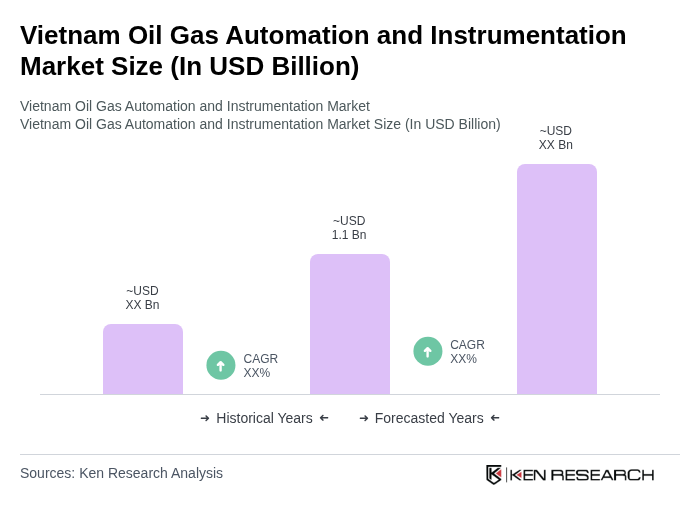
- The Vietnam Oil Gas Automation and Instrumentation Market is valued at USD 1.1 billion, based on a five-year historical analysis and benchmarked against the overall Vietnam oil and gas market size and the global oil and gas terminal automation market.This growth is primarily driven by the increasing demand for automation solutions in the oil and gas sector, coupled with the government's push for modernization and efficiency in energy production.The market is also supported by rising investments in upstream and midstream infrastructure, LNG terminals, digital oilfield technologies, and technology upgrades such as AI-driven optimization and predictive maintenance across the industry.
- Key demand centers and deployment hubs for oil and gas automation and instrumentation solutions include Ho Chi Minh City, Hanoi, Da Nang, and key energy corridors such as Ba Ria–Vung Tau and the Mekong Delta, which benefit from strategic locations, robust industrial bases, and significant investments in oil and gas and LNG infrastructure.These cities and regions host headquarters and operational bases of major national and international oil and gas companies, EPC contractors, and service providers, facilitating easier access to pipelines, terminals, ports, and skilled labor, thus driving market growth for automation and digital control systems.
- In 2023, the Vietnamese government strengthened the regulatory framework for oil and gas operations through instruments such as the Law on Petroleum 2022, issued by the National Assembly, and its implementing Decree 45/2023/ND-CP, which set detailed safety, environmental protection, and operational requirements for exploration, production, transportation, and storage activities.These rules, read together with the Environmental Protection Law 2020, require operators to implement risk-based safety management, continuous monitoring, leak detection, emergency shutdown procedures, and periodic safety and environmental audits, effectively mandating greater use of advanced automation, SCADA, and instrumentation systems aligned with international standards to enhance operational efficiency and reduce environmental risks.
Vietnam Oil Gas Automation and Instrumentation Market Segmentation
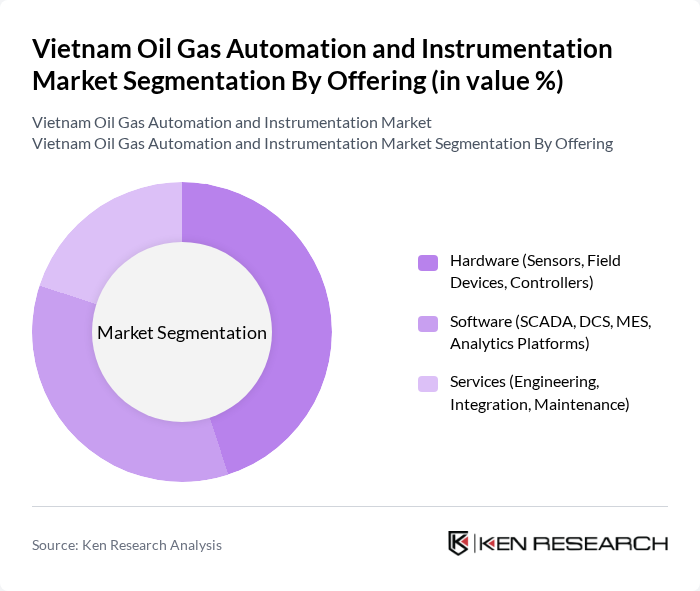
By Offering:This segmentation includes Hardware (Sensors, Field Devices, Controllers), Software (SCADA, DCS, MES, Analytics Platforms), and Services (Engineering, Integration, Maintenance). The hardware segment is currently leading the market due to the increasing need for real-time data collection, process measurement, and control in upstream, midstream, and downstream oil and gas operations, including refineries, LNG terminals, and pipeline networks.The demand for advanced sensors, flowmeters, transmitters, and controllers is driven by the industry's focus on enhancing operational efficiency, ensuring process safety, and complying with stricter environmental norms.The software segment is also growing, particularly with the rise of SCADA, DCS, historian, and analytics tools used for digital twins, predictive maintenance, and yield optimization, while services such as integration, lifecycle maintenance, and remote monitoring support brownfield upgrades and digital transformation programs.
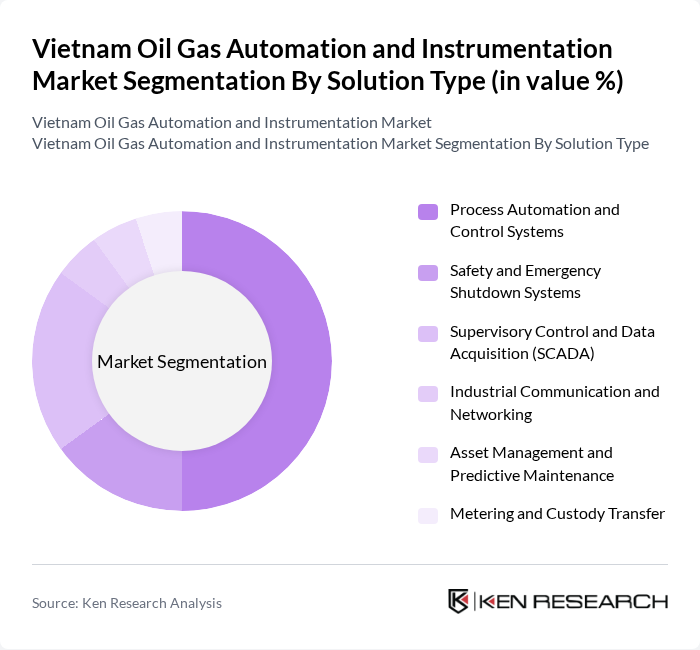
By Solution Type:This segmentation encompasses Process Automation and Control Systems, Safety and Emergency Shutdown Systems, Supervisory Control and Data Acquisition (SCADA), Industrial Communication and Networking, Asset Management and Predictive Maintenance, and Metering and Custody Transfer. The Process Automation and Control Systems segment is the most dominant, driven by the need for efficient and reliable operations in upstream production platforms, gas processing plants, refineries, and petrochemical complexes, where DCS, PLCs, and advanced process control are widely deployed.Companies are increasingly investing in automation solutions to enhance productivity, optimize energy use, and reduce operational costs, while safety and emergency shutdown systems, SCADA for pipelines and terminals, and metering and custody transfer solutions gain traction amid growing LNG regasification and pipeline expansion in Vietnam.
Vietnam Oil Gas Automation and Instrumentation Market Competitive Landscape
The Vietnam Oil Gas Automation and Instrumentation Market is characterized by a dynamic mix of regional and international players. Leading participants such as Siemens AG, Honeywell International Inc., Emerson Electric Co., Schneider Electric SE, Yokogawa Electric Corporation, ABB Ltd., Rockwell Automation, Inc., Endress+Hauser Group Services AG, KROHNE Messtechnik GmbH, National Instruments Corporation, Azbil Corporation, Mitsubishi Electric Corporation, General Electric Company (GE Vernova, GE Digital), Hexagon AB (Intergraph Process, Power & Marine), AMETEK, Inc. contribute to innovation, geographic expansion, and service delivery in this space.
Vietnam Oil Gas Automation and Instrumentation Market Industry Analysis
Growth Drivers
- Increasing Demand for Energy Efficiency:The Vietnamese government aims to reduce energy consumption by 5-7% by 2030, driving the need for automation and instrumentation solutions. In future, energy efficiency investments reached approximately $1.2 billion, reflecting a growing trend towards optimizing energy use in the oil and gas sector. This shift is crucial as Vietnam's energy demand is projected to increase by 8% annually, necessitating advanced technologies to enhance operational efficiency and reduce waste.
- Government Initiatives for Modernization:The Vietnamese government has allocated $3 billion for the modernization of its oil and gas infrastructure by 2030. This initiative includes upgrading existing facilities and implementing advanced automation technologies. The focus on modernization is part of Vietnam's broader strategy to enhance energy security and reduce dependency on imported fuels, which accounted for 30% of total energy consumption in future, highlighting the urgency for domestic advancements.
- Rising Investments in Oil and Gas Infrastructure:In future, Vietnam attracted $2.5 billion in foreign direct investment (FDI) for oil and gas projects, indicating a robust interest in infrastructure development. This influx of capital is expected to facilitate the adoption of advanced automation technologies, which are essential for improving operational efficiency and safety. The government’s commitment to enhancing infrastructure is crucial, as the oil and gas sector contributes approximately 10% to Vietnam's GDP, underscoring its economic significance.
Market Challenges
- High Initial Investment Costs:The implementation of advanced automation systems in Vietnam's oil and gas sector requires significant upfront capital, often exceeding $1 million per project. This financial barrier can deter smaller companies from investing in necessary technologies. Additionally, the return on investment (ROI) for automation projects can take several years to materialize, creating further hesitation among stakeholders in a market characterized by tight margins and fluctuating prices.
- Lack of Skilled Workforce:The oil and gas sector in Vietnam faces a critical shortage of skilled professionals, with an estimated 40% of positions remaining unfilled due to a lack of qualified candidates. This skills gap hampers the effective implementation and maintenance of advanced automation technologies. The government has recognized this issue, with plans to invest $500 million in vocational training programs by 2030, aiming to enhance the workforce's capabilities in automation and instrumentation.
Vietnam Oil Gas Automation and Instrumentation Market Future Outlook
The future of Vietnam's oil and gas automation and instrumentation market appears promising, driven by ongoing technological advancements and a strong governmental push for modernization. As the sector increasingly embraces digitalization, the integration of IoT and smart technologies will likely enhance operational efficiency and sustainability. Furthermore, the anticipated growth in renewable energy projects will create new avenues for automation solutions, positioning Vietnam as a regional leader in energy innovation and efficiency.
Market Opportunities
- Expansion of Renewable Energy Integration:With Vietnam's renewable energy capacity expected to reach 20% of total energy generation by 2030, there is a significant opportunity for automation technologies to optimize energy management systems. This integration will enhance grid stability and efficiency, creating a demand for advanced instrumentation solutions that can seamlessly manage diverse energy sources.
- Adoption of IoT in Oil and Gas:The adoption of IoT technologies in Vietnam's oil and gas sector is projected to grow, with investments expected to exceed $500 million by 2030. This trend will facilitate real-time monitoring and predictive maintenance, significantly improving operational efficiency and reducing downtime. The increasing reliance on data-driven decision-making will further drive the demand for sophisticated automation solutions.
Scope of the Report
| Segment | Sub-Segments |
|---|---|
| By Offering | Hardware (Sensors, Field Devices, Controllers) Software (SCADA, DCS, MES, Analytics Platforms) Services (Engineering, Integration, Maintenance) |
| By Solution Type | Process Automation and Control Systems Safety and Emergency Shutdown Systems Supervisory Control and Data Acquisition (SCADA) Industrial Communication and Networking Asset Management and Predictive Maintenance Metering and Custody Transfer |
| By Oil & Gas Value Chain | Upstream (Exploration & Production) Midstream (Pipelines, Terminals, Storage) Downstream (Refining, Petrochemicals) LNG & Gas Processing |
| By Application | Drilling and Wellhead Automation Production Monitoring and Optimization Pipeline Monitoring and Leak Detection Tank Farm and Terminal Automation Refinery Process Control Offshore Platform Automation |
| By Technology | Distributed Control Systems (DCS) Programmable Logic Controllers (PLC) & RTU SCADA Systems Industrial IoT and Edge Computing Advanced Process Control (APC) & Analytics |
| By End-User Type | National Oil Companies (NOCs) International Oil Companies (IOCs) Independent E&P and Service Companies EPC Contractors and System Integrators |
| By Region | Northern Vietnam Central Vietnam Southern Vietnam |
Key Target Audience
Investors and Venture Capitalist Firms
Government and Regulatory Bodies (e.g., Ministry of Industry and Trade, Vietnam Oil and Gas Group)
Manufacturers and Producers
Distributors and Retailers
Technology Providers
Industry Associations (e.g., Vietnam Petroleum Association)
Financial Institutions
Oil and Gas Exploration and Production Companies
Players Mentioned in the Report:
Siemens AG
Honeywell International Inc.
Emerson Electric Co.
Schneider Electric SE
Yokogawa Electric Corporation
ABB Ltd.
Rockwell Automation, Inc.
Endress+Hauser Group Services AG
KROHNE Messtechnik GmbH
National Instruments Corporation
Azbil Corporation
Mitsubishi Electric Corporation
General Electric Company (GE Vernova, GE Digital)
Hexagon AB (Intergraph Process, Power & Marine)
AMETEK, Inc.
Table of Contents
Market Assessment Phase
1. Executive Summary and Approach
2. Vietnam Oil Gas Automation and Instrumentation Market Overview
2.1 Key Insights and Strategic Recommendations
2.2 Vietnam Oil Gas Automation and Instrumentation Market Overview
2.3 Definition and Scope
2.4 Evolution of Market Ecosystem
2.5 Timeline of Key Regulatory Milestones
2.6 Value Chain & Stakeholder Mapping
2.7 Business Cycle Analysis
2.8 Policy & Incentive Landscape
3. Vietnam Oil Gas Automation and Instrumentation Market Analysis
3.1 Growth Drivers
3.1.1 Increasing demand for energy efficiency
3.1.2 Government initiatives for modernization
3.1.3 Rising investments in oil and gas infrastructure
3.1.4 Technological advancements in automation
3.2 Market Challenges
3.2.1 High initial investment costs
3.2.2 Lack of skilled workforce
3.2.3 Regulatory hurdles
3.2.4 Market volatility and price fluctuations
3.3 Market Opportunities
3.3.1 Expansion of renewable energy integration
3.3.2 Adoption of IoT in oil and gas
3.3.3 Development of smart grid technologies
3.3.4 Strategic partnerships and collaborations
3.4 Market Trends
3.4.1 Shift towards digitalization
3.4.2 Increased focus on sustainability
3.4.3 Growth of predictive maintenance solutions
3.4.4 Rising demand for real-time data analytics
3.5 Government Regulation
3.5.1 Environmental protection regulations
3.5.2 Safety and operational standards
3.5.3 Incentives for renewable energy projects
3.5.4 Compliance with international standards
4. SWOT Analysis
5. Stakeholder Analysis
6. Porter's Five Forces Analysis
7. Vietnam Oil Gas Automation and Instrumentation Market Market Size, 2019-2024
7.1 By Value
7.2 By Volume
7.3 By Average Selling Price
8. Vietnam Oil Gas Automation and Instrumentation Market Segmentation
8.1 By Offering
8.1.1 Hardware (Sensors, Field Devices, Controllers)
8.1.2 Software (SCADA, DCS, MES, Analytics Platforms)
8.1.3 Services (Engineering, Integration, Maintenance)
8.2 By Solution Type
8.2.1 Process Automation and Control Systems
8.2.2 Safety and Emergency Shutdown Systems
8.2.3 Supervisory Control and Data Acquisition (SCADA)
8.2.4 Industrial Communication and Networking
8.2.5 Asset Management and Predictive Maintenance
8.2.6 Metering and Custody Transfer
8.3 By Oil & Gas Value Chain
8.3.1 Upstream (Exploration & Production)
8.3.2 Midstream (Pipelines, Terminals, Storage)
8.3.3 Downstream (Refining, Petrochemicals)
8.3.4 LNG & Gas Processing
8.4 By Application
8.4.1 Drilling and Wellhead Automation
8.4.2 Production Monitoring and Optimization
8.4.3 Pipeline Monitoring and Leak Detection
8.4.4 Tank Farm and Terminal Automation
8.4.5 Refinery Process Control
8.4.6 Offshore Platform Automation
8.5 By Technology
8.5.1 Distributed Control Systems (DCS)
8.5.2 Programmable Logic Controllers (PLC) & RTU
8.5.3 SCADA Systems
8.5.4 Industrial IoT and Edge Computing
8.5.5 Advanced Process Control (APC) & Analytics
8.6 By End-User Type
8.6.1 National Oil Companies (NOCs)
8.6.2 International Oil Companies (IOCs)
8.6.3 Independent E&P and Service Companies
8.6.4 EPC Contractors and System Integrators
8.7 By Region
8.7.1 Northern Vietnam
8.7.2 Central Vietnam
8.7.3 Southern Vietnam
9. Vietnam Oil Gas Automation and Instrumentation Market Competitive Analysis
9.1 Market Share of Key Players
9.2 Cross Comparison of Key Players
9.2.1 Company Name
9.2.2 Vietnam Oil & Gas Automation Revenue (USD Million)
9.2.3 3-Year Revenue CAGR in Vietnam (%)
9.2.4 Installed Base in Vietnam (Number of Sites/Projects)
9.2.5 Order Backlog in Vietnam (USD Million)
9.2.6 EBITDA Margin from Oil & Gas Segment (%)
9.2.7 R&D Spend as % of Global Revenue
9.2.8 Capex in Vietnam over Last 3 Years (USD Million)
9.2.9 Market Share in Vietnam Oil & Gas Automation (%)
9.2.10 Win Rate in Competitive Bids in Vietnam (%)
9.2.11 Average Contract Size in Vietnam (USD Million)
9.2.12 Customer Satisfaction / NPS Score in Vietnam
9.3 SWOT Analysis of Top Players
9.4 Pricing Analysis
9.5 Detailed Profile of Major Companies
9.5.1 Siemens AG
9.5.2 Honeywell International Inc.
9.5.3 Emerson Electric Co.
9.5.4 Schneider Electric SE
9.5.5 Yokogawa Electric Corporation
9.5.6 ABB Ltd.
9.5.7 Rockwell Automation, Inc.
9.5.8 Endress+Hauser Group Services AG
9.5.9 KROHNE Messtechnik GmbH
9.5.10 National Instruments Corporation
9.5.11 Azbil Corporation
9.5.12 Mitsubishi Electric Corporation
9.5.13 General Electric Company (GE Vernova, GE Digital)
9.5.14 Hexagon AB (Intergraph Process, Power & Marine)
9.5.15 AMETEK, Inc.
10. Vietnam Oil Gas Automation and Instrumentation Market End-User Analysis
10.1 Procurement Behavior of Key Ministries
10.1.1 Key procurement processes
10.1.2 Budget allocation trends
10.1.3 Decision-making criteria
10.1.4 Supplier evaluation methods
10.2 Corporate Spend on Infrastructure & Energy
10.2.1 Investment priorities
10.2.2 Spending patterns
10.2.3 Budget forecasting
10.3 Pain Point Analysis by End-User Category
10.3.1 Operational inefficiencies
10.3.2 Compliance challenges
10.3.3 Technology integration issues
10.4 User Readiness for Adoption
10.4.1 Training and support needs
10.4.2 Technology acceptance levels
10.5 Post-Deployment ROI and Use Case Expansion
10.5.1 ROI measurement techniques
10.5.2 Use case identification
11. Vietnam Oil Gas Automation and Instrumentation Market Future Size, 2025-2030
11.1 By Value
11.2 By Volume
11.3 By Average Selling Price
Go-To-Market Strategy Phase
1. Whitespace Analysis + Business Model Canvas
1.1 Market gaps identification
1.2 Business model development
2. Marketing and Positioning Recommendations
2.1 Branding strategies
2.2 Product USPs
3. Distribution Plan
3.1 Urban retail vs rural NGO tie-ups
4. Channel & Pricing Gaps
4.1 Underserved routes
4.2 Pricing bands
5. Unmet Demand & Latent Needs
5.1 Category gaps
5.2 Consumer segments
6. Customer Relationship
6.1 Loyalty programs
6.2 After-sales service
7. Value Proposition
7.1 Sustainability
7.2 Integrated supply chains
8. Key Activities
8.1 Regulatory compliance
8.2 Branding
8.3 Distribution setup
9. Entry Strategy Evaluation
9.1 Domestic Market Entry Strategy
9.1.1 Product mix
9.1.2 Pricing band
9.1.3 Packaging
9.2 Export Entry Strategy
9.2.1 Target countries
9.2.2 Compliance roadmap
10. Entry Mode Assessment
10.1 Joint Ventures
10.2 Greenfield Investments
10.3 Mergers & Acquisitions
10.4 Distributor Model
11. Capital and Timeline Estimation
11.1 Capital requirements
11.2 Timelines
12. Control vs Risk Trade-Off
12.1 Ownership vs Partnerships
13. Profitability Outlook
13.1 Breakeven analysis
13.2 Long-term sustainability
14. Potential Partner List
14.1 Distributors
14.2 Joint Ventures
14.3 Acquisition targets
15. Execution Roadmap
15.1 Phased Plan for Market Entry
15.1.1 Market Setup
15.1.2 Market Entry
15.1.3 Growth Acceleration
15.1.4 Scale & Stabilize
15.2 Key Activities and Milestones
15.2.1 Milestone tracking
15.2.2 Activity scheduling
Research Methodology
Phase 1: Approach1
Desk Research
- Analysis of industry reports from government bodies and trade associations in Vietnam
- Review of market studies and white papers published by industry experts and consultancy firms
- Examination of regulatory frameworks and policies affecting the oil and gas sector in Vietnam
Primary Research
- Interviews with key stakeholders including engineers and project managers in oil and gas companies
- Surveys targeting automation and instrumentation suppliers and service providers
- Field visits to operational sites to gather insights on current automation practices and technologies
Validation & Triangulation
- Cross-validation of findings through multiple data sources including trade publications and expert opinions
- Triangulation of quantitative data with qualitative insights from industry experts
- Sanity checks through peer reviews and feedback from industry panels
Phase 2: Market Size Estimation1
Top-down Assessment
- Estimation of market size based on national oil and gas production statistics and forecasts
- Segmentation of the market by application areas such as upstream, midstream, and downstream operations
- Incorporation of government initiatives aimed at enhancing automation in the oil and gas sector
Bottom-up Modeling
- Collection of data on sales volumes and revenues from leading automation and instrumentation firms
- Estimation of market share based on firm-level performance and product offerings
- Analysis of pricing strategies and cost structures to derive market potential
Forecasting & Scenario Analysis
- Development of forecasting models using historical data and market trends
- Scenario analysis based on potential regulatory changes and technological advancements
- Creation of baseline, optimistic, and pessimistic forecasts through 2030
Phase 3: CATI Sample Composition1
| Scope Item/Segment | Sample Size | Target Respondent Profiles |
|---|---|---|
| Oil Production Automation | 60 | Automation Engineers, Operations Managers |
| Gas Processing Instrumentation | 55 | Instrumentation Specialists, Plant Managers |
| Pipeline Monitoring Systems | 50 | Safety Officers, Maintenance Supervisors |
| Refinery Automation Solutions | 65 | Process Engineers, Project Leads |
| Control Systems Integration | 50 | IT Managers, System Integrators |
Frequently Asked Questions
What is the current value of the Vietnam Oil Gas Automation and Instrumentation Market?
The Vietnam Oil Gas Automation and Instrumentation Market is valued at approximately USD 1.1 billion, reflecting significant growth driven by increasing demand for automation solutions and government initiatives aimed at modernizing energy production and infrastructure.
What are the key drivers of growth in the Vietnam Oil Gas Automation and Instrumentation Market?
Which regions in Vietnam are major hubs for oil and gas automation and instrumentation?
What are the main segments of the Vietnam Oil Gas Automation and Instrumentation Market?
Other Regional/Country Reports
Other Adjacent Reports
Vietnam Process Control Systems Market
South Africa SCADA Systems Market
Saudi Arabia distributed control systems market size, share, growth drivers, trends, opportunities & forecast 2025–2030Qatar predictive maintenance market size, share, growth drivers, trends, opportunities & forecast 2025–2030Indonesia LNG Infrastructure Market
KSA digital oilfield market Size, Share, Growth Drivers, Trends, Opportunities & Forecast 2025–2030Malaysia Energy Efficiency Solutions Market
Japan IoT in Energy Market
Why Buy From Us?

What makes us stand out is that our consultants follow Robust, Refine and Result (RRR) methodology. Robust for clear definitions, approaches and sanity checking, Refine for differentiating respondents' facts and opinions, and Result for presenting data with story.

We have set a benchmark in the industry by offering our clients with syndicated and customized market research reports featuring coverage of entire market as well as meticulous research and analyst insights.

While we don't replace traditional research, we flip the method upside down. Our dual approach of Top Bottom & Bottom Top ensures quality deliverable by not just verifying company fundamentals but also looking at the sector and macroeconomic factors.

With one step in the future, our research team constantly tries to show you the bigger picture. We help with some of the tough questions you may encounter along the way: How is the industry positioned? Best marketing channel? KPI's of competitors? By aligning every element, we help maximize success.

Our report gives you instant access to the answers and sources that other companies might choose to hide. We elaborate each steps of research methodology we have used and showcase you the sample size to earn your trust.

If you need any support, we are here! We pride ourselves on universe strength, data quality, and quick, friendly, and professional service.