About the Report
Base Year 2024APAC Metaverse Market Overview
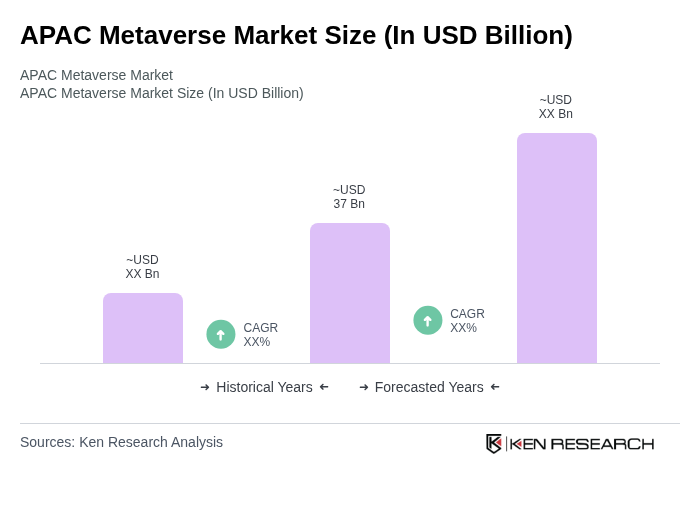
- The APAC Metaverse Market is valued at USD 37 billion, based on a five-year historical analysis. Growth is driven by rapid advancements in immersive technologies such as AR, VR and high-speed connectivity across diverse industries, along with rising digitalization especially in gaming, retail, education and virtual collaboration ecosystems. These factors collectively underpin the evolving demand for metaverse experiences across the region.
- Key players in this market include technology-savvy countries like China, South Korea, Japan and India, where strong infrastructure, gaming cultures and major tech firms such as Tencent, Sony, Samsung, Reliance Jio and Jio Platforms are shaping the regional dynamics, supported by localized platforms and content ecosystems. Companies like Animoca Brands in Hong Kong are notable players investing in blockchain gaming and virtual platforms such as The Sandbox, further reinforcing market momentum.
- In 2024, South Korea's government announced a commitment of approximately USD 1 billion under its Digital New Deal to bolster metaverse infrastructure spanning education, healthcare, tourism and business, alongside the launch of a Metaverse Alliance to drive ecosystem collaboration.
APAC Metaverse Market Segmentation
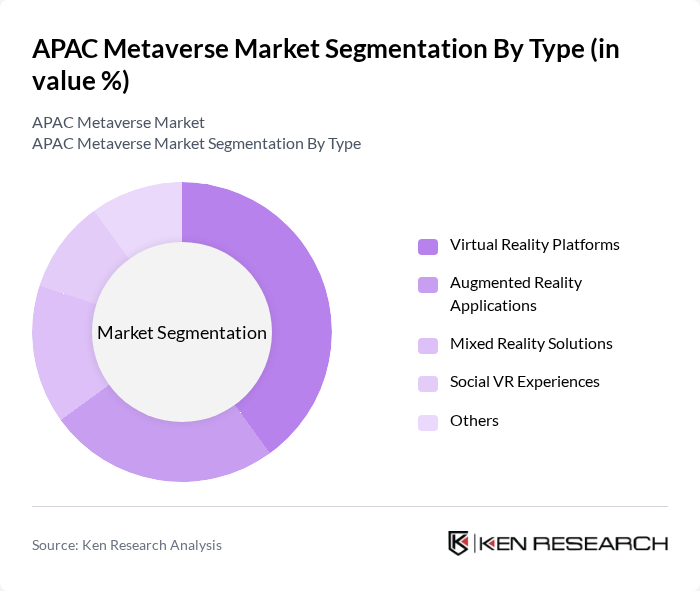
By Type:The APAC Metaverse Market is segmented into various types, including Virtual Reality Platforms, Augmented Reality Applications, Mixed Reality Solutions, Social VR Experiences, and Others. Among these, Virtual Reality Platforms are leading the market due to their immersive experiences that cater to gaming and entertainment sectors. The increasing adoption of VR headsets and advancements in technology are driving consumer interest and engagement in this segment.
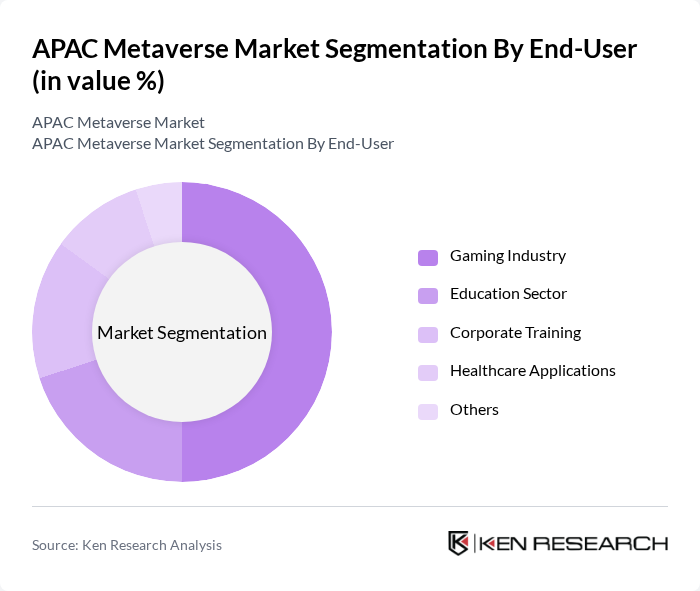
By End-User:The market is also segmented by end-user applications, including the Gaming Industry, Education Sector, Corporate Training, Healthcare Applications, and Others. The Gaming Industry dominates this segment, driven by the increasing popularity of online gaming and the demand for immersive experiences. The rise of esports and virtual reality gaming platforms has significantly contributed to the growth of this segment, attracting a large user base.
APAC Metaverse Market Competitive Landscape
The APAC Metaverse Market is characterized by a dynamic mix of regional and international players. Leading participants such as Meta Platforms, Inc., Roblox Corporation, Epic Games, Inc., Tencent Holdings Limited, Niantic, Inc., Unity Technologies, Inc., Microsoft Corporation, NVIDIA Corporation, Decentraland, Sandbox, HTC Corporation, Sony Interactive Entertainment, Square Enix Holdings Co., Ltd., Bandai Namco Holdings Inc., Valve Corporation contribute to innovation, geographic expansion, and service delivery in this space.
APAC Metaverse Market Industry Analysis
Growth Drivers
- Increasing Internet Penetration:The APAC region has seen a significant rise in internet users, reaching approximately 3 billion in the future, according to the International Telecommunication Union. This growth is driven by improved infrastructure and affordability of mobile devices. With internet penetration rates exceeding 80% in countries like China and India, the accessibility of online platforms fosters engagement in the metaverse, enhancing user interaction and content consumption across various sectors, including gaming and social media.
- Rise of Virtual Reality and Augmented Reality Technologies:The adoption of VR and AR technologies is accelerating in APAC, with the market expected to reach $40 billion in the future, as reported by Statista. This growth is fueled by advancements in hardware and software, making immersive experiences more accessible. Countries like Japan and South Korea are leading in AR/VR development, driving innovation in entertainment, education, and training sectors, thus expanding the metaverse's reach and user base.
- Growing Investment in Gaming and Entertainment:The gaming industry in APAC is projected to generate over $120 billion in revenue in the future, according to Newzoo. This surge in investment is attracting major players to develop metaverse-related content, including immersive gaming experiences. The increasing popularity of esports and mobile gaming is also contributing to this growth, as more users engage with virtual environments, creating a robust ecosystem for metaverse applications in entertainment and social interaction.
Market Challenges
- Data Privacy Concerns:As the metaverse expands, data privacy issues are becoming increasingly prominent. In the future, it is estimated that over 70% of users in APAC will express concerns about data security, according to a survey by Cybersecurity Ventures. This apprehension can hinder user adoption and engagement, as individuals fear potential misuse of personal information. Companies must navigate these challenges to build trust and ensure compliance with evolving data protection regulations.
- High Development Costs:The financial burden of developing metaverse platforms is significant, with initial investments often exceeding $15 million for comprehensive projects. This high cost can deter smaller companies from entering the market, limiting innovation and competition. As reported by Deloitte, the average cost of creating a VR experience can range from $60,000 to $600,000, depending on complexity, which poses a barrier to entry for many potential developers in the APAC region.
APAC Metaverse Market Future Outlook
The APAC metaverse market is poised for transformative growth, driven by technological advancements and increasing user engagement. As hybrid work environments become more prevalent, businesses are likely to leverage metaverse platforms for collaboration and training. Additionally, the integration of AI and machine learning will enhance user experiences, making virtual interactions more personalized and efficient. The focus on user-generated content will also foster community-driven ecosystems, further solidifying the metaverse's role in daily life and commerce across the region.
Market Opportunities
- Integration of Blockchain Technology:The incorporation of blockchain can enhance security and transparency in virtual transactions, attracting more users to the metaverse. With the blockchain market in APAC projected to reach $10 billion in the future, this integration can facilitate the creation of decentralized applications, fostering trust and encouraging user participation in virtual economies.
- Expansion into Education and Training:The metaverse presents significant opportunities in education, with the global e-learning market expected to surpass $500 billion in the future. APAC institutions are increasingly adopting virtual environments for immersive learning experiences, enhancing engagement and accessibility. This trend can lead to innovative educational models, bridging gaps in traditional learning methodologies and expanding reach to diverse demographics.
Scope of the Report
| Segment | Sub-Segments |
|---|---|
| By Type | Virtual Reality Platforms Augmented Reality Applications Mixed Reality Solutions Social VR Experiences Others |
| By End-User | Gaming Industry Education Sector Corporate Training Healthcare Applications Others |
| By Region | East Asia Southeast Asia South Asia Oceania |
| By Technology | D Modeling and Animation Cloud Computing Blockchain Integration AI and Machine Learning Others |
| By Application | Entertainment and Gaming Social Networking E-commerce Virtual Events Others |
| By Investment Source | Venture Capital Private Equity Government Grants Crowdfunding Others |
| By Policy Support | Tax Incentives Research and Development Grants Regulatory Frameworks Public-Private Partnerships Others |
Key Target Audience
Investors and Venture Capitalist Firms
Government and Regulatory Bodies (e.g., Ministry of Digital Economy and Society, National Telecommunications Commission)
Content Creators and Developers
Telecommunications Companies
Gaming Companies
Advertising and Marketing Agencies
Real Estate Developers
Technology Providers
Players Mentioned in the Report:
Meta Platforms, Inc.
Roblox Corporation
Epic Games, Inc.
Tencent Holdings Limited
Niantic, Inc.
Unity Technologies, Inc.
Microsoft Corporation
NVIDIA Corporation
Decentraland
Sandbox
HTC Corporation
Sony Interactive Entertainment
Square Enix Holdings Co., Ltd.
Bandai Namco Holdings Inc.
Valve Corporation
Table of Contents
Market Assessment Phase
1. Executive Summary and Approach
2. APAC Metaverse Market Overview
2.1 Key Insights and Strategic Recommendations
2.2 APAC Metaverse Market Overview
2.3 Definition and Scope
2.4 Evolution of Market Ecosystem
2.5 Timeline of Key Regulatory Milestones
2.6 Value Chain & Stakeholder Mapping
2.7 Business Cycle Analysis
2.8 Policy & Incentive Landscape
3. APAC Metaverse Market Analysis
3.1 Growth Drivers
3.1.1 Increasing Internet Penetration
3.1.2 Rise of Virtual Reality and Augmented Reality Technologies
3.1.3 Growing Investment in Gaming and Entertainment
3.1.4 Expansion of Social Media Platforms
3.2 Market Challenges
3.2.1 Data Privacy Concerns
3.2.2 High Development Costs
3.2.3 Regulatory Uncertainty
3.2.4 Limited User Adoption
3.3 Market Opportunities
3.3.1 Integration of Blockchain Technology
3.3.2 Development of Virtual Economies
3.3.3 Expansion into Education and Training
3.3.4 Collaborations with Traditional Industries
3.4 Market Trends
3.4.1 Emergence of Hybrid Work Environments
3.4.2 Growth of NFTs in Digital Art and Collectibles
3.4.3 Increased Focus on User-Generated Content
3.4.4 Advancements in AI and Machine Learning
3.5 Government Regulation
3.5.1 Data Protection Laws
3.5.2 Content Moderation Policies
3.5.3 Taxation on Virtual Transactions
3.5.4 Intellectual Property Rights Regulations
4. SWOT Analysis
5. Stakeholder Analysis
6. Porter's Five Forces Analysis
7. APAC Metaverse Market Market Size, 2019-2024
7.1 By Value
7.2 By Volume
7.3 By Average Selling Price
8. APAC Metaverse Market Segmentation
8.1 By Type
8.1.1 Virtual Reality Platforms
8.1.2 Augmented Reality Applications
8.1.3 Mixed Reality Solutions
8.1.4 Social VR Experiences
8.1.5 Others
8.2 By End-User
8.2.1 Gaming Industry
8.2.2 Education Sector
8.2.3 Corporate Training
8.2.4 Healthcare Applications
8.2.5 Others
8.3 By Region
8.3.1 East Asia
8.3.2 Southeast Asia
8.3.3 South Asia
8.3.4 Oceania
8.4 By Technology
8.4.1 3D Modeling and Animation
8.4.2 Cloud Computing
8.4.3 Blockchain Integration
8.4.4 AI and Machine Learning
8.4.5 Others
8.5 By Application
8.5.1 Entertainment and Gaming
8.5.2 Social Networking
8.5.3 E-commerce
8.5.4 Virtual Events
8.5.5 Others
8.6 By Investment Source
8.6.1 Venture Capital
8.6.2 Private Equity
8.6.3 Government Grants
8.6.4 Crowdfunding
8.6.5 Others
8.7 By Policy Support
8.7.1 Tax Incentives
8.7.2 Research and Development Grants
8.7.3 Regulatory Frameworks
8.7.4 Public-Private Partnerships
8.7.5 Others
9. APAC Metaverse Market Competitive Analysis
9.1 Market Share of Key Players
9.2 Cross Comparison of Key Players
9.2.1 Company Name
9.2.2 Group Size (Large, Medium, or Small as per industry convention)
9.2.3 User Engagement Rate
9.2.4 Revenue Growth Rate
9.2.5 Market Penetration Rate
9.2.6 Customer Retention Rate
9.2.7 Pricing Strategy
9.2.8 Average Revenue Per User (ARPU)
9.2.9 Return on Investment (ROI)
9.2.10 Customer Acquisition Cost (CAC)
9.3 SWOT Analysis of Top Players
9.4 Pricing Analysis
9.5 Detailed Profile of Major Companies
9.5.1 Meta Platforms, Inc.
9.5.2 Roblox Corporation
9.5.3 Epic Games, Inc.
9.5.4 Tencent Holdings Limited
9.5.5 Niantic, Inc.
9.5.6 Unity Technologies, Inc.
9.5.7 Microsoft Corporation
9.5.8 NVIDIA Corporation
9.5.9 Decentraland
9.5.10 Sandbox
9.5.11 HTC Corporation
9.5.12 Sony Interactive Entertainment
9.5.13 Square Enix Holdings Co., Ltd.
9.5.14 Bandai Namco Holdings Inc.
9.5.15 Valve Corporation
10. APAC Metaverse Market End-User Analysis
10.1 Procurement Behavior of Key Ministries
10.1.1 Government Initiatives in Digital Transformation
10.1.2 Budget Allocations for Technology Adoption
10.1.3 Collaboration with Private Sector
10.1.4 Focus on Education and Training Programs
10.2 Corporate Spend on Infrastructure & Energy
10.2.1 Investment in Virtual Collaboration Tools
10.2.2 Budget for Digital Marketing and Advertising
10.2.3 Expenditure on Cybersecurity Measures
10.2.4 Funding for Research and Development
10.3 Pain Point Analysis by End-User Category
10.3.1 User Experience Challenges
10.3.2 Integration with Existing Systems
10.3.3 Cost of Implementation
10.3.4 Training and Support Needs
10.4 User Readiness for Adoption
10.4.1 Awareness of Metaverse Capabilities
10.4.2 Technical Proficiency of Users
10.4.3 Availability of Infrastructure
10.4.4 Willingness to Invest in New Technologies
10.5 Post-Deployment ROI and Use Case Expansion
10.5.1 Measurement of Success Metrics
10.5.2 Identification of Additional Use Cases
10.5.3 Feedback Mechanisms for Continuous Improvement
10.5.4 Long-term Value Realization
11. APAC Metaverse Market Future Size, 2025-2030
11.1 By Value
11.2 By Volume
11.3 By Average Selling Price
Go-To-Market Strategy Phase
1. Whitespace Analysis + Business Model Canvas
1.1 Market Gaps Identification
1.2 Business Model Framework
2. Marketing and Positioning Recommendations
2.1 Branding Strategies
2.2 Product USPs
3. Distribution Plan
3.1 Urban Retail Strategies
3.2 Rural NGO Tie-ups
4. Channel & Pricing Gaps
4.1 Underserved Routes
4.2 Pricing Bands
5. Unmet Demand & Latent Needs
5.1 Category Gaps
5.2 Consumer Segments
6. Customer Relationship
6.1 Loyalty Programs
6.2 After-sales Service
7. Value Proposition
7.1 Sustainability
7.2 Integrated Supply Chains
8. Key Activities
8.1 Regulatory Compliance
8.2 Branding
8.3 Distribution Setup
9. Entry Strategy Evaluation
9.1 Domestic Market Entry Strategy
9.1.1 Product Mix
9.1.2 Pricing Band
9.1.3 Packaging
9.2 Export Entry Strategy
9.2.1 Target Countries
9.2.2 Compliance Roadmap
10. Entry Mode Assessment
10.1 Joint Ventures
10.2 Greenfield Investments
10.3 Mergers & Acquisitions
10.4 Distributor Model
11. Capital and Timeline Estimation
11.1 Capital Requirements
11.2 Timelines
12. Control vs Risk Trade-Off
12.1 Ownership vs Partnerships
13. Profitability Outlook
13.1 Breakeven Analysis
13.2 Long-term Sustainability
14. Potential Partner List
14.1 Distributors
14.2 Joint Ventures
14.3 Acquisition Targets
15. Execution Roadmap
15.1 Phased Plan for Market Entry
15.1.1 Market Setup
15.1.2 Market Entry
15.1.3 Growth Acceleration
15.1.4 Scale & Stabilize
15.2 Key Activities and Milestones
15.2.1 Milestone Planning
15.2.2 Activity Tracking
Research Methodology
Phase 1: Approach1
Desk Research
- Market reports from industry associations and research firms focusing on the APAC Metaverse landscape
- Analysis of white papers and publications from technology think tanks and academic institutions
- Review of government policy documents and regulatory frameworks impacting the Metaverse in APAC countries
Primary Research
- Interviews with executives from leading technology firms involved in Metaverse development
- Surveys targeting end-users, including gamers and virtual reality enthusiasts, to gauge market sentiment
- Focus groups with content creators and developers to understand challenges and opportunities in the Metaverse
Validation & Triangulation
- Cross-validation of findings through multiple data sources, including market trends and user feedback
- Triangulation of insights from industry experts, user surveys, and secondary data analysis
- Sanity checks conducted through expert panel reviews to ensure data reliability and relevance
Phase 2: Market Size Estimation1
Top-down Assessment
- Estimation of the overall digital economy growth in APAC as a baseline for Metaverse market potential
- Segmentation of the market by key user demographics, including age, income, and technology adoption rates
- Incorporation of trends in virtual goods and services consumption within the Metaverse ecosystem
Bottom-up Modeling
- Data collection from leading Metaverse platforms to establish user engagement metrics and revenue streams
- Analysis of transaction volumes and average spending per user on virtual goods and experiences
- Estimation of growth rates based on user acquisition trends and platform expansion plans
Forecasting & Scenario Analysis
- Multi-factor regression analysis incorporating variables such as internet penetration, VR headset adoption, and gaming trends
- Scenario modeling based on potential regulatory impacts and technological advancements in the Metaverse
- Development of baseline, optimistic, and pessimistic forecasts through 2030 to capture market volatility
Phase 3: CATI Sample Composition1
| Scope Item/Segment | Sample Size | Target Respondent Profiles |
|---|---|---|
| Gaming Industry Stakeholders | 150 | Game Developers, Publishers, and Marketing Executives |
| Virtual Reality Hardware Manufacturers | 100 | Product Managers, R&D Engineers, and Sales Directors |
| Content Creators in the Metaverse | 80 | Artists, Designers, and Influencers |
| End-Users of Metaverse Platforms | 200 | Gamers, VR Enthusiasts, and Casual Users |
| Investors in Metaverse Startups | 50 | Venture Capitalists, Angel Investors, and Financial Analysts |
Frequently Asked Questions
What is the current value of the APAC Metaverse Market?
The APAC Metaverse Market is valued at approximately USD 37 billion, driven by advancements in immersive technologies like AR and VR, as well as increasing digitalization in sectors such as gaming, retail, and education.
Which countries are leading the APAC Metaverse Market?
What are the main segments of the APAC Metaverse Market?
What are the growth drivers of the APAC Metaverse Market?
Other Regional/Country Reports
Other Adjacent Reports
Egypt Digital Collaboration Market
Belgium Social Media Market
UAE Esports MarketIndonesia Mobile Gaming Market
Malaysia AI and Machine Learning Market
Why Buy From Us?

What makes us stand out is that our consultants follow Robust, Refine and Result (RRR) methodology. Robust for clear definitions, approaches and sanity checking, Refine for differentiating respondents' facts and opinions, and Result for presenting data with story.

We have set a benchmark in the industry by offering our clients with syndicated and customized market research reports featuring coverage of entire market as well as meticulous research and analyst insights.

While we don't replace traditional research, we flip the method upside down. Our dual approach of Top Bottom & Bottom Top ensures quality deliverable by not just verifying company fundamentals but also looking at the sector and macroeconomic factors.

With one step in the future, our research team constantly tries to show you the bigger picture. We help with some of the tough questions you may encounter along the way: How is the industry positioned? Best marketing channel? KPI's of competitors? By aligning every element, we help maximize success.

Our report gives you instant access to the answers and sources that other companies might choose to hide. We elaborate each steps of research methodology we have used and showcase you the sample size to earn your trust.

If you need any support, we are here! We pride ourselves on universe strength, data quality, and quick, friendly, and professional service.