About the Report
Base Year 2024APAC Single Serve Packaging Market Overview
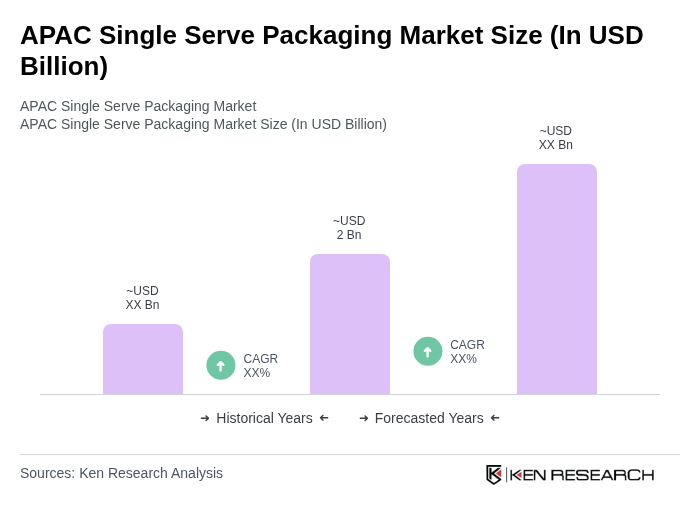
- The APAC Single Serve Packaging Market is valued at USD 2 billion, based on a five-year historical analysis. This growth is primarily driven by the increasing demand for convenience and on-the-go consumption, particularly in urban areas, along with rapid urbanization, changing dietary habits, rising health awareness, and the expansion of e-commerce and retail sectors. The rise in disposable income and changing consumer lifestyles have further fueled the market, as consumers seek packaging solutions that offer portability and ease of use.
- Key players in this market include China, Japan, and India, which dominate due to their large populations and rapid urbanization. China leads with its extensive manufacturing capabilities and consumer base, while Japan is known for its innovation in packaging technology. India’s growing middle class and increasing demand for packaged food and beverages also contribute significantly to the market's expansion.
- The Plastics Waste Management Rules, 2022 issued by the Ministry of Environment, Forest and Climate Change require extended producer responsibility for plastic packaging, mandating registration of producers, importers and brand owners handling over 100 kg per month, collection targets starting at 25% in 2024 rising to 100% by 2028, and standards for recyclable or compostable single-use plastics including bans on identified non-recyclable items.
APAC Single Serve Packaging Market Segmentation
By Packaging Format:The packaging format segment includes various types such as pouches & sachets, cups, tubs & trays, bottles & cartons, blister & strip packs, stick packs & tubes, and others. Each format serves different consumer needs and preferences, influencing their market share.
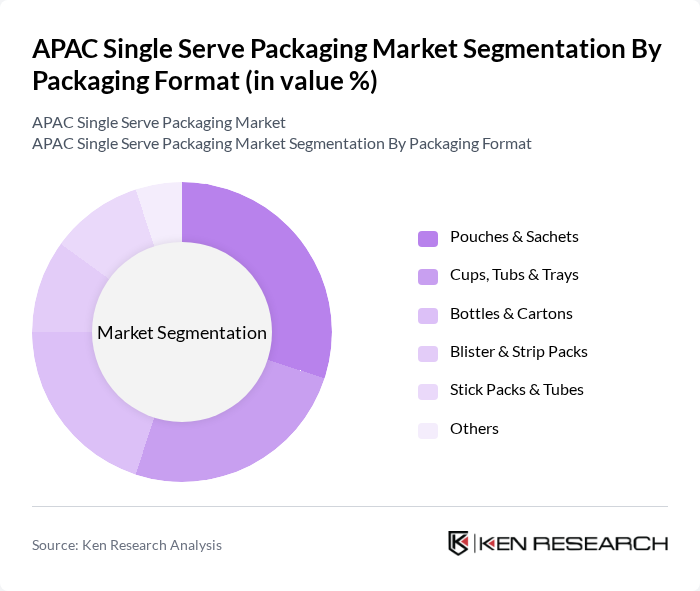
The pouches & sachets segment is currently dominating the market due to their lightweight, convenience, and cost-effectiveness. They are widely used in the food and beverage industry for snacks, sauces, and single-serve portions, catering to the growing trend of on-the-go consumption. The versatility of pouches in terms of design and functionality also appeals to manufacturers, making them a preferred choice for packaging.
By End-Use Industry:This segment encompasses various industries including food (snacks, dairy, confectionery, ready meals), beverages (juices, RTD drinks, dairy beverages), personal care & cosmetics, household & home care, pharmaceuticals & healthcare, and others. Each industry has unique packaging requirements that influence the choice of single-serve formats.
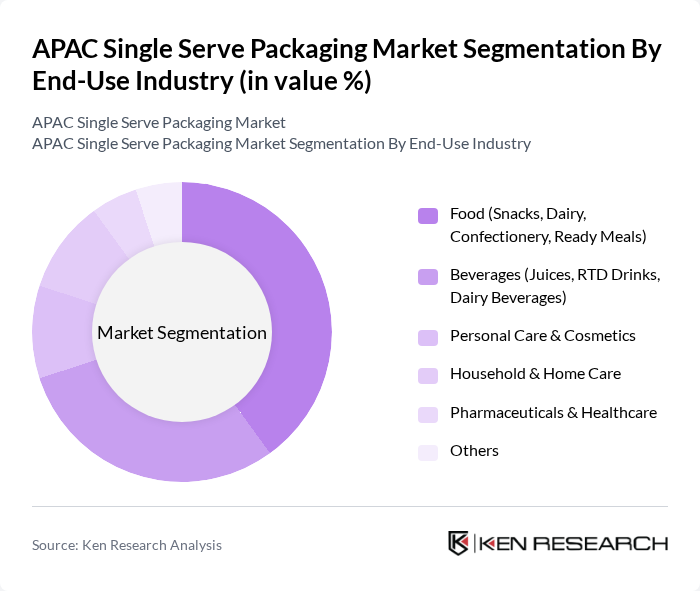
The food segment, particularly snacks and ready meals, is leading the market due to the increasing demand for convenient meal options among busy consumers. The rise in snacking culture and the preference for portion-controlled packaging are driving growth in this segment. Additionally, the expansion of e-commerce platforms has further boosted the demand for single-serve food packaging.
APAC Single Serve Packaging Market Competitive Landscape
The APAC Single Serve Packaging Market is characterized by a dynamic mix of regional and international players. Leading participants such as Amcor plc, Huhtamaki Oyj, Tetra Pak International S.A., Mondi Group, Berry Global, Inc., Toyo Seikan Group Holdings, Ltd., Nippon Paper Industries Co., Ltd., Sealed Air Corporation, Uflex Ltd., Constantia Flexibles, Sonoco Products Company, WestRock Company, Winpak Ltd., ProAmpac LLC, Graphic Packaging Holding Company contribute to innovation, geographic expansion, and service delivery in this space.
APAC Single Serve Packaging Market Industry Analysis
Growth Drivers
- Increasing Consumer Demand for Convenience:The APAC region has witnessed a significant shift towards convenience-oriented products, with the single-serve packaging segment experiencing a surge. In future, the convenience food market in APAC was valued at approximately $220 billion, driven by busy lifestyles and urbanization. This trend is expected to continue, as 60% of consumers prioritize convenience in their purchasing decisions, leading to increased demand for single-serve packaging solutions that cater to on-the-go consumption.
- Rise in E-commerce and Online Food Delivery Services:The e-commerce sector in APAC is projected to reach $2.5 trillion in future, with online food delivery services contributing significantly to this growth. In future, the online food delivery market was valued at $60 billion, reflecting a 20% increase from the previous year. This surge in online shopping and food delivery is driving the demand for single-serve packaging, as consumers seek convenient, ready-to-eat options that can be easily transported and consumed.
- Growing Focus on Sustainable Packaging Solutions:Sustainability is becoming a key driver in the packaging industry, with 75% of consumers in APAC expressing a preference for eco-friendly packaging options. The market for sustainable packaging in the region is expected to grow to $35 billion in future. Companies are increasingly investing in biodegradable and recyclable materials, responding to consumer demand for environmentally responsible products, which is further propelling the single-serve packaging market.
Market Challenges
- High Competition Among Packaging Manufacturers:The APAC single-serve packaging market is characterized by intense competition, with over 600 manufacturers vying for market share. This saturation leads to price wars and reduced profit margins, making it challenging for companies to maintain profitability. In future, the average profit margin for packaging manufacturers in the region was reported at just 4%, highlighting the need for differentiation and innovation to stay competitive.
- Regulatory Compliance and Environmental Concerns:The packaging industry in APAC faces stringent regulations regarding plastic usage and waste management. In future, over 35% of packaging manufacturers reported difficulties in meeting compliance standards, which can lead to fines and operational disruptions. Additionally, growing environmental concerns among consumers are pressuring companies to adopt sustainable practices, further complicating compliance efforts and increasing operational costs.
APAC Single Serve Packaging Market Future Outlook
The APAC single-serve packaging market is poised for significant transformation, driven by evolving consumer preferences and technological advancements. As sustainability becomes a priority, companies are expected to innovate with eco-friendly materials and smart packaging solutions. The integration of technology, such as QR codes and NFC tags, will enhance consumer engagement and provide valuable product information. Additionally, the expansion of e-commerce and food delivery services will continue to shape packaging designs, emphasizing convenience and sustainability in the coming years.
Market Opportunities
- Expansion in Emerging Markets:Emerging markets in APAC, such as India and Vietnam, present significant growth opportunities for single-serve packaging. With a combined population of over 1.6 billion, these markets are experiencing rising disposable incomes and changing consumer habits, leading to increased demand for convenient packaging solutions that cater to urban lifestyles.
- Development of Biodegradable Packaging Materials:The shift towards biodegradable packaging materials is a promising opportunity for manufacturers. With the global biodegradable packaging market expected to reach $25 billion in future, companies that invest in developing innovative, sustainable materials can capture a growing segment of environmentally conscious consumers, enhancing brand loyalty and market share.
Scope of the Report
| Segment | Sub-Segments |
|---|---|
| By Packaging Format | Pouches & Sachets Cups, Tubs & Trays Bottles & Cartons Blister & Strip Packs Stick Packs & Tubes Others |
| By End-Use Industry | Food (Snacks, Dairy, Confectionery, Ready Meals) Beverages (Juices, RTD Drinks, Dairy Beverages) Personal Care & Cosmetics Household & Home Care Pharmaceuticals & Healthcare Others |
| By Material | Plastics (PE, PP, PET, Others) Paper & Paperboard Aluminum Foil & Metal Laminates Glass Bioplastics & Other Sustainable Materials |
| By Distribution Channel | Supermarkets & Hypermarkets Convenience Stores Online Retail & E-commerce Foodservice & HoReCa Others |
| By Country | China Japan South Korea India ASEAN (Indonesia, Thailand, Vietnam, Malaysia, Others) Australia & New Zealand Rest of APAC |
| By Application | Ready-to-Eat Meals & Meal Kits Snacks & Confectionery Dairy & Frozen Desserts Hot & Cold Beverages Nutraceuticals & Dietary Supplements Others |
| By Sustainability Focus | Recyclable Mono-Material Packaging Biodegradable & Compostable Packaging Lightweighting & Material Reduction Reusable & Refillable Formats Others |
Key Target Audience
Investors and Venture Capitalist Firms
Government and Regulatory Bodies (e.g., Food Safety and Standards Authority of India, Ministry of Health, Singapore)
Manufacturers and Producers
Distributors and Retailers
Packaging Material Suppliers
Logistics and Supply Chain Companies
Industry Associations (e.g., Asia Pacific Packaging Association)
Financial Institutions
Players Mentioned in the Report:
Amcor plc
Huhtamaki Oyj
Tetra Pak International S.A.
Mondi Group
Berry Global, Inc.
Toyo Seikan Group Holdings, Ltd.
Nippon Paper Industries Co., Ltd.
Sealed Air Corporation
Uflex Ltd.
Constantia Flexibles
Sonoco Products Company
WestRock Company
Winpak Ltd.
ProAmpac LLC
Graphic Packaging Holding Company
Table of Contents
Market Assessment Phase
1. Executive Summary and Approach
2. APAC Single Serve Packaging Market Overview
2.1 Key Insights and Strategic Recommendations
2.2 APAC Single Serve Packaging Market Overview
2.3 Definition and Scope
2.4 Evolution of Market Ecosystem
2.5 Timeline of Key Regulatory Milestones
2.6 Value Chain & Stakeholder Mapping
2.7 Business Cycle Analysis
2.8 Policy & Incentive Landscape
3. APAC Single Serve Packaging Market Analysis
3.1 Growth Drivers
3.1.1 Increasing consumer demand for convenience
3.1.2 Rise in e-commerce and online food delivery services
3.1.3 Growing focus on sustainable packaging solutions
3.1.4 Innovations in packaging technology
3.2 Market Challenges
3.2.1 High competition among packaging manufacturers
3.2.2 Regulatory compliance and environmental concerns
3.2.3 Fluctuating raw material prices
3.2.4 Consumer preference for bulk packaging
3.3 Market Opportunities
3.3.1 Expansion in emerging markets
3.3.2 Development of biodegradable packaging materials
3.3.3 Collaborations with food and beverage brands
3.3.4 Customization and personalization of packaging
3.4 Market Trends
3.4.1 Shift towards eco-friendly packaging solutions
3.4.2 Increased use of smart packaging technologies
3.4.3 Growth in single-serve beverage packaging
3.4.4 Adoption of minimalistic packaging designs
3.5 Government Regulation
3.5.1 Regulations on plastic usage and recycling
3.5.2 Standards for food safety and packaging materials
3.5.3 Incentives for sustainable packaging initiatives
3.5.4 Compliance requirements for import/export of packaging
4. SWOT Analysis
5. Stakeholder Analysis
6. Porter's Five Forces Analysis
7. APAC Single Serve Packaging Market Market Size, 2019-2024
7.1 By Value
7.2 By Volume
7.3 By Average Selling Price
8. APAC Single Serve Packaging Market Segmentation
8.1 By Packaging Format
8.1.1 Pouches & Sachets
8.1.2 Cups, Tubs & Trays
8.1.3 Bottles & Cartons
8.1.4 Blister & Strip Packs
8.1.5 Stick Packs & Tubes
8.1.6 Others
8.2 By End-Use Industry
8.2.1 Food (Snacks, Dairy, Confectionery, Ready Meals)
8.2.2 Beverages (Juices, RTD Drinks, Dairy Beverages)
8.2.3 Personal Care & Cosmetics
8.2.4 Household & Home Care
8.2.5 Pharmaceuticals & Healthcare
8.2.6 Others
8.3 By Material
8.3.1 Plastics (PE, PP, PET, Others)
8.3.2 Paper & Paperboard
8.3.3 Aluminum Foil & Metal Laminates
8.3.4 Glass
8.3.5 Bioplastics & Other Sustainable Materials
8.4 By Distribution Channel
8.4.1 Supermarkets & Hypermarkets
8.4.2 Convenience Stores
8.4.3 Online Retail & E-commerce
8.4.4 Foodservice & HoReCa
8.4.5 Others
8.5 By Country
8.5.1 China
8.5.2 Japan
8.5.3 South Korea
8.5.4 India
8.5.5 ASEAN (Indonesia, Thailand, Vietnam, Malaysia, Others)
8.5.6 Australia & New Zealand
8.5.7 Rest of APAC
8.6 By Application
8.6.1 Ready-to-Eat Meals & Meal Kits
8.6.2 Snacks & Confectionery
8.6.3 Dairy & Frozen Desserts
8.6.4 Hot & Cold Beverages
8.6.5 Nutraceuticals & Dietary Supplements
8.6.6 Others
8.7 By Sustainability Focus
8.7.1 Recyclable Mono-Material Packaging
8.7.2 Biodegradable & Compostable Packaging
8.7.3 Lightweighting & Material Reduction
8.7.4 Reusable & Refillable Formats
8.7.5 Others
9. APAC Single Serve Packaging Market Competitive Analysis
9.1 Market Share of Key Players
9.2 Cross Comparison of Key Players
9.2.1 Company Name
9.2.2 APAC Single-Serve Packaging Revenue
9.2.3 APAC Revenue CAGR (Last 3–5 Years)
9.2.4 APAC Market Share in Single-Serve Formats
9.2.5 Share of Sustainable / Eco-Friendly SKUs
9.2.6 Average Realization per Unit (US$/’000 Packs)
9.2.7 Product Innovation Intensity (Patents / New Launches per Year)
9.2.8 Manufacturing Footprint in APAC (Number of Plants / Countries Covered)
9.2.9 Key End-Use Exposure (Food, Beverage, Pharma % Mix)
9.2.10 Strategic Partnerships with APAC Brand Owners & Retailers
9.3 SWOT Analysis of Top Players
9.4 Pricing Analysis
9.5 Detailed Profile of Major Companies
9.5.1 Amcor plc
9.5.2 Huhtamaki Oyj
9.5.3 Tetra Pak International S.A.
9.5.4 Mondi Group
9.5.5 Berry Global, Inc.
9.5.6 Toyo Seikan Group Holdings, Ltd.
9.5.7 Nippon Paper Industries Co., Ltd.
9.5.8 Sealed Air Corporation
9.5.9 Uflex Ltd.
9.5.10 Constantia Flexibles
9.5.11 Sonoco Products Company
9.5.12 WestRock Company
9.5.13 Winpak Ltd.
9.5.14 ProAmpac LLC
9.5.15 Graphic Packaging Holding Company
10. APAC Single Serve Packaging Market End-User Analysis
10.1 Procurement Behavior of Key Ministries
10.1.1 Government procurement policies
10.1.2 Budget allocation for packaging
10.1.3 Preference for local suppliers
10.1.4 Sustainability criteria in procurement
10.2 Corporate Spend on Infrastructure & Energy
10.2.1 Investment in packaging technology
10.2.2 Budget for sustainable packaging initiatives
10.2.3 Spending on supply chain optimization
10.2.4 Allocation for research and development
10.3 Pain Point Analysis by End-User Category
10.3.1 Cost pressures in packaging
10.3.2 Quality and safety concerns
10.3.3 Demand for customization
10.3.4 Supply chain disruptions
10.4 User Readiness for Adoption
10.4.1 Awareness of sustainable packaging
10.4.2 Willingness to pay for eco-friendly options
10.4.3 Readiness for technological integration
10.4.4 Training and support needs
10.5 Post-Deployment ROI and Use Case Expansion
10.5.1 Measurement of cost savings
10.5.2 Impact on customer satisfaction
10.5.3 Opportunities for product line expansion
10.5.4 Long-term sustainability benefits
11. APAC Single Serve Packaging Market Future Size, 2025-2030
11.1 By Value
11.2 By Volume
11.3 By Average Selling Price
Go-To-Market Strategy Phase
1. Whitespace Analysis + Business Model Canvas
1.1 Market gaps identification
1.2 Value proposition development
1.3 Revenue model exploration
1.4 Customer segment analysis
1.5 Key partnerships identification
1.6 Cost structure assessment
1.7 Competitive landscape overview
2. Marketing and Positioning Recommendations
2.1 Branding strategies
2.2 Product USPs
2.3 Target audience segmentation
2.4 Communication strategies
2.5 Digital marketing initiatives
2.6 Trade marketing strategies
2.7 Customer engagement tactics
3. Distribution Plan
3.1 Urban retail vs rural NGO tie-ups
3.2 E-commerce strategies
3.3 Logistics and supply chain management
3.4 Distribution partnerships
3.5 Inventory management practices
3.6 Channel conflict resolution
3.7 Performance metrics for distribution
4. Channel & Pricing Gaps
4.1 Underserved routes
4.2 Pricing bands
4.3 Competitor pricing analysis
4.4 Value-based pricing strategies
4.5 Discounting strategies
4.6 Price elasticity assessment
4.7 Customer willingness to pay
5. Unmet Demand & Latent Needs
5.1 Category gaps
5.2 Consumer segments
5.3 Emerging trends analysis
5.4 Product development opportunities
5.5 Market entry barriers
5.6 Customer feedback mechanisms
5.7 Innovation opportunities
6. Customer Relationship
6.1 Loyalty programs
6.2 After-sales service
6.3 Customer feedback loops
6.4 Community engagement initiatives
6.5 Customer education programs
6.6 Relationship management tools
6.7 Customer lifetime value analysis
7. Value Proposition
7.1 Sustainability
7.2 Integrated supply chains
7.3 Cost-effectiveness
7.4 Quality assurance
7.5 Innovation in packaging
7.6 Customer-centric solutions
7.7 Brand differentiation
8. Key Activities
8.1 Regulatory compliance
8.2 Branding
8.3 Distribution setup
8.4 Market research
8.5 Training and development
8.6 Performance monitoring
8.7 Stakeholder engagement
9. Entry Strategy Evaluation
9.1 Domestic Market Entry Strategy
9.1.1 Product mix
9.1.2 Pricing band
9.1.3 Packaging
9.2 Export Entry Strategy
9.2.1 Target countries
9.2.2 Compliance roadmap
10. Entry Mode Assessment
10.1 JV
10.2 Greenfield
10.3 M&A
10.4 Distributor Model
11. Capital and Timeline Estimation
11.1 Capital requirements
11.2 Timelines
12. Control vs Risk Trade-Off
12.1 Ownership vs Partnerships
13. Profitability Outlook
13.1 Breakeven analysis
13.2 Long-term sustainability
14. Potential Partner List
14.1 Distributors
14.2 JVs
14.3 Acquisition targets
15. Execution Roadmap
15.1 Phased Plan for Market Entry
15.1.1 Market Setup
15.1.2 Market Entry
15.1.3 Growth Acceleration
15.1.4 Scale & Stabilize
15.2 Key Activities and Milestones
15.2.1 Milestone tracking
15.2.2 Activity scheduling
15.2.3 Resource allocation
Research Methodology
Phase 1: Approach1
Desk Research
- Industry reports from packaging associations and market research firms
- Government publications on packaging regulations and sustainability initiatives
- Market analysis from trade journals focusing on single-serve packaging trends
Primary Research
- Interviews with product managers at leading food and beverage companies
- Surveys with packaging engineers and designers in the APAC region
- Focus groups with consumers to understand preferences for single-serve packaging
Validation & Triangulation
- Cross-validation of data from multiple industry sources and expert opinions
- Triangulation of market size estimates using sales data and production statistics
- Sanity checks through feedback from industry experts and stakeholders
Phase 2: Market Size Estimation1
Top-down Assessment
- Analysis of overall packaging market size and growth rates in APAC
- Segmentation by product type, including flexible, rigid, and semi-rigid packaging
- Incorporation of macroeconomic factors influencing consumer spending on single-serve products
Bottom-up Modeling
- Volume estimates based on production data from key manufacturers in the region
- Cost analysis of materials used in single-serve packaging solutions
- Estimation of market share based on sales figures from major players
Forecasting & Scenario Analysis
- Trend analysis using historical data to project future growth rates
- Scenario modeling based on potential regulatory changes and consumer behavior shifts
- Development of best-case, worst-case, and most-likely market scenarios through 2030
Phase 3: CATI Sample Composition1
| Scope Item/Segment | Sample Size | Target Respondent Profiles |
|---|---|---|
| Food & Beverage Packaging Innovations | 120 | Product Development Managers, Brand Strategists |
| Consumer Preferences in Single-Serve Packaging | 100 | Market Research Analysts, Consumer Insights Managers |
| Sustainability Practices in Packaging | 80 | Sustainability Officers, Compliance Managers |
| Retail Sector Packaging Solutions | 100 | Retail Managers, Supply Chain Coordinators |
| Emerging Trends in Packaging Technology | 90 | Technology Officers, R&D Managers |
Frequently Asked Questions
What is the current value of the APAC Single Serve Packaging Market?
The APAC Single Serve Packaging Market is valued at approximately USD 2 billion, driven by increasing consumer demand for convenience, urbanization, and changing dietary habits. This market is expected to grow further as disposable incomes rise and e-commerce expands.
Which countries are the key players in the APAC Single Serve Packaging Market?
What are the main drivers of growth in the APAC Single Serve Packaging Market?
What challenges does the APAC Single Serve Packaging Market face?
Other Regional/Country Reports
Indonesia Single Serve Packaging Market
Malaysia Single Serve Packaging Market
KSA Single Serve Packaging Market
SEA Single Serve Packaging Market
Vietnam Single Serve Packaging Market
Thailand Single Serve Packaging Market
Other Adjacent Reports
KSA Single Serve Food Packaging Market
Asia Pacific Flexible Packaging Market Size, Share & Forecast, By Material, Product Type & End-Use Industry, 2026-2031Europe Sustainable Packaging Market Size, Share & Forecast 2025-2031India Beverage Packaging Market Size, Share & Forecast, By Material, Packaging Format, Beverage Type & Distribution Channel, 2026-2031KSA E-commerce Packaging Market
Global Pharmaceutical Packaging Market Size, Share & Forecast, By Packaging Type, Material & Drug Delivery Mode, 2025-2032Middle East personal care packaging market size, share, growth drivers, trends, opportunities & forecast 2025–2030Qatar Ready-to-Eat Food Market
Egypt Convenience Food Market
Saudi Arabia biodegradable packaging market report Size, Share, Growth Drivers, Trends, Opportunities & Forecast 2025–2030Why Buy From Us?

What makes us stand out is that our consultants follow Robust, Refine and Result (RRR) methodology. Robust for clear definitions, approaches and sanity checking, Refine for differentiating respondents' facts and opinions, and Result for presenting data with story.

We have set a benchmark in the industry by offering our clients with syndicated and customized market research reports featuring coverage of entire market as well as meticulous research and analyst insights.

While we don't replace traditional research, we flip the method upside down. Our dual approach of Top Bottom & Bottom Top ensures quality deliverable by not just verifying company fundamentals but also looking at the sector and macroeconomic factors.

With one step in the future, our research team constantly tries to show you the bigger picture. We help with some of the tough questions you may encounter along the way: How is the industry positioned? Best marketing channel? KPI's of competitors? By aligning every element, we help maximize success.

Our report gives you instant access to the answers and sources that other companies might choose to hide. We elaborate each steps of research methodology we have used and showcase you the sample size to earn your trust.

If you need any support, we are here! We pride ourselves on universe strength, data quality, and quick, friendly, and professional service.