About the Report
Base Year 2024APAC Space Debris Monitoring Removal Market Overview
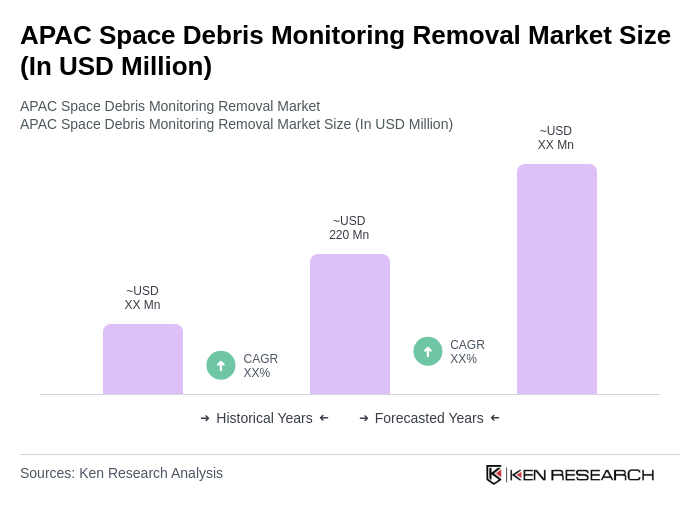
- The APAC Space Debris Monitoring Removal Market is valued at USD 220 million, based on a five-year historical analysis. This growth is primarily driven by the increasing number of satellites in orbit, rising concerns over space safety, and the need for sustainable space operations. The market is also influenced by advancements in tracking technologies, the adoption of AI-powered monitoring solutions, and international collaborations aimed at mitigating space debris. The surge in Low Earth Orbit (LEO) satellite launches and heightened regulatory pressures are accelerating investments in advanced debris mitigation and removal technologies .
- Key players in this market include China, Japan, and India, which dominate due to their robust space programs and significant investments in satellite technology. These countries have established themselves as leaders in space exploration and debris management, supported by government initiatives and partnerships with private companies to enhance their capabilities in space debris monitoring and removal. Regional collaborations and the development of indigenous tracking infrastructure are further strengthening APAC’s leadership in this sector .
- The “Guidelines for Space Object Debris Mitigation, 2023” issued by the Indian Space Research Organisation (ISRO) require all satellite operators to conduct regular debris assessments and submit compliance reports to the Department of Space. This regulation enhances space situational awareness and mandates proactive measures for debris mitigation, including end-of-life disposal planning and collision avoidance protocols .
APAC Space Debris Monitoring Removal Market Segmentation
By Type:The market is segmented into various types, including Space Debris Monitoring, Space Debris Removal, Space Situational Awareness (SSA) Services, Collision Prediction and Avoidance Maneuver Support, Consultation and Risk Assessment Services, and Research and Development Services. Among these, Space Debris Monitoring is currently the leading sub-segment due to the increasing demand for tracking and identifying debris in orbit. The rise in satellite launches and the adoption of AI-enabled tracking systems have heightened the need for effective monitoring solutions to prevent collisions and ensure the safety of space operations .

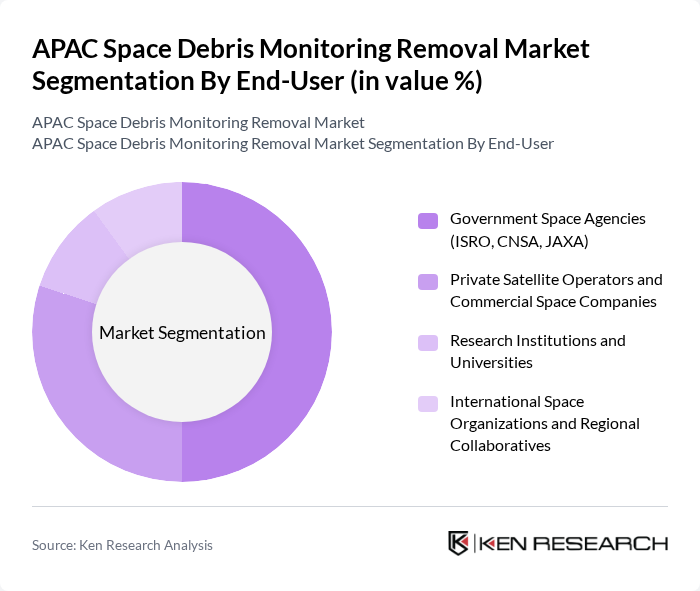
By End-User:The end-user segmentation includes Government Space Agencies, Private Satellite Operators and Commercial Space Companies, Research Institutions and Universities, and International Space Organizations and Regional Collaboratives. Government Space Agencies are the dominant segment, primarily due to their significant funding and resources allocated for space debris management initiatives. These agencies are increasingly collaborating with private entities to enhance their capabilities in monitoring and removing space debris .
APAC Space Debris Monitoring Removal Market Competitive Landscape
The APAC Space Debris Monitoring Removal Market is characterized by a dynamic mix of regional and international players. Leading participants such as Astroscale Holdings Inc., LeoLabs Inc., Northrop Grumman Corporation, Airbus Defence and Space, Lockheed Martin Corporation, Rocket Lab USA Inc., Momentus Inc., SpaceX, Japan Aerospace Exploration Agency (JAXA), Indian Space Research Organisation (ISRO), China National Space Administration (CNSA), China Academy of Space Technology (CAST), European Space Agency (ESA) contribute to innovation, geographic expansion, and service delivery in this space.
APAC Space Debris Monitoring Removal Market Industry Analysis
Growth Drivers
- Increasing Satellite Launches:The APAC region has witnessed a surge in satellite launches, with over 150 satellites launched in future alone, a significant increase from 120 in the previous period. This growth is driven by advancements in satellite technology and the demand for communication, Earth observation, and navigation services. The rise in mega-constellations, such as Starlink, which aims to deploy thousands of satellites, further exacerbates the space debris issue, necessitating effective monitoring and removal solutions to ensure orbital safety.
- Rising Awareness of Space Debris Hazards:The increasing number of near-miss incidents, with over 20 reported in future, has heightened awareness of the risks posed by space debris. Governments and organizations are now prioritizing space safety, leading to initiatives aimed at educating stakeholders about collision risks. This awareness is driving demand for debris monitoring and removal technologies, as stakeholders recognize the potential economic impact of satellite collisions, which can cost billions in damages and lost services.
- Government Initiatives for Space Sustainability:In future, several APAC countries, including Japan and India, have allocated over $200 million towards space sustainability initiatives. These initiatives focus on developing regulations for debris mitigation and funding active debris removal projects. The establishment of national space policies promoting compliance with international guidelines is fostering a supportive environment for the growth of the debris monitoring and removal market, ensuring long-term sustainability in space operations.
Market Challenges
- High Capital Costs:The development and deployment of debris removal technologies require significant investment, with estimates suggesting that initial costs can exceed $100 million per mission. This financial barrier limits participation from smaller companies and startups, which may have innovative solutions but lack the necessary funding. As a result, the market faces challenges in scaling up operations and developing cost-effective solutions to address the growing debris problem.
- Complex Regulatory Hurdles:Navigating the regulatory landscape for space debris management is challenging, with multiple jurisdictions imposing varying compliance requirements. For instance, the European Space Agency's guidelines differ from those in the United States and APAC countries. This complexity can lead to delays in project approvals and increased costs, hindering the timely implementation of debris monitoring and removal initiatives across the region.
APAC Space Debris Monitoring Removal Market Future Outlook
The APAC space debris monitoring and removal market is poised for significant evolution, driven by technological advancements and increased collaboration among stakeholders. As governments and private entities prioritize sustainable space practices, innovative solutions such as AI-powered tracking and contactless debris removal methods are expected to gain traction. Furthermore, the establishment of international partnerships will enhance resource sharing and knowledge exchange, fostering a more robust framework for addressing the challenges posed by space debris in the coming years.
Market Opportunities
- Collaboration with Private Sector:Engaging with private companies and startups can lead to innovative solutions for debris removal. With over 50 startups focusing on space technology in APAC, partnerships can leverage their agility and creativity, driving advancements in debris mitigation technologies and enhancing operational efficiency in the market.
- Development of Contactless Solutions:The exploration of contactless debris removal methods, such as laser ablation and ion-beam shepherding, presents a significant opportunity. These technologies, which can be developed with investments exceeding $150 million, promise to enhance the effectiveness of debris removal efforts while minimizing risks associated with traditional methods, thus attracting interest from both public and private sectors.
Scope of the Report
| Segment | Sub-Segments |
|---|---|
| By Type | Space Debris Monitoring (Ground-based radars, optical sensors, AI-powered tracking systems) Space Debris Removal (Robotic arms, harpoons, nets, propulsion-based deorbiting) Space Situational Awareness (SSA) Services Collision Prediction and Avoidance Maneuver Support Consultation and Risk Assessment Services Research and Development Services |
| By End-User | Government Space Agencies (ISRO, CNSA, JAXA) Private Satellite Operators and Commercial Space Companies Research Institutions and Universities International Space Organizations and Regional Collaboratives |
| By Region | North Asia (China, Japan, South Korea) Southeast Asia (ASEAN nations) South Asia (India) Oceania (Australia) |
| By Technology | Laser-based Removal and Laser Ranging Systems Net-based Capture and Deorbiting Harpoon-based Capture Mechanisms Robotic Arms and Autonomous Removal Platforms Ion-beam Shepherding and Contactless Approaches |
| By Debris Size | Micro-debris (1mm to 1cm) Small Debris (1cm to 10cm) Large Objects (Greater than 10cm) |
| By Orbit Type | Low Earth Orbit (LEO) Medium Earth Orbit (MEO) Geostationary Orbit (GEO) |
| By Application | Satellite Operations and Constellation Management Space Exploration Missions Commercial Launch and Satellite Services Earth Observation and Remote Sensing |
| By Investment Source | Government Funding and Space Agency Budgets Private Venture Capital and Corporate Investments International Grants and Collaborative Funding |
Key Target Audience
Investors and Venture Capitalist Firms
Government and Regulatory Bodies (e.g., National Aeronautics and Space Administration, European Space Agency)
Space Agencies (e.g., Indian Space Research Organisation, Japan Aerospace Exploration Agency)
Satellite Operators
Aerospace and Defense Contractors
Environmental Protection Agencies
Space Industry Associations
Insurance Companies Specializing in Space Assets
Players Mentioned in the Report:
Astroscale Holdings Inc.
LeoLabs Inc.
Northrop Grumman Corporation
Airbus Defence and Space
Lockheed Martin Corporation
Rocket Lab USA Inc.
Momentus Inc.
SpaceX
Japan Aerospace Exploration Agency (JAXA)
Indian Space Research Organisation (ISRO)
China National Space Administration (CNSA)
China Academy of Space Technology (CAST)
European Space Agency (ESA)
Table of Contents
Market Assessment Phase
1. Executive Summary and Approach
2. APAC Space Debris Monitoring Removal Market Overview
2.1 Key Insights and Strategic Recommendations
2.2 APAC Space Debris Monitoring Removal Market Overview
2.3 Definition and Scope
2.4 Evolution of Market Ecosystem
2.5 Timeline of Key Regulatory Milestones
2.6 Value Chain & Stakeholder Mapping
2.7 Business Cycle Analysis
2.8 Policy & Incentive Landscape
3. APAC Space Debris Monitoring Removal Market Analysis
3.1 Growth Drivers
3.1.1 Increasing satellite launches and mega-constellation deployments
3.1.2 Rising awareness of space debris hazards and collision risks
3.1.3 Government initiatives for space sustainability and debris mitigation
3.1.4 Technological advancements in active debris removal and AI-powered tracking
3.2 Market Challenges
3.2.1 High capital costs of debris removal and monitoring technologies
3.2.2 Complex regulatory hurdles and compliance requirements across regions
3.2.3 Limited funding for space debris projects relative to demand
3.2.4 Technical complexities in real-time debris tracking and prediction
3.3 Market Opportunities
3.3.1 Collaboration with private sector companies and startups
3.3.2 Development of contactless debris removal solutions (laser ablation, ion-beam shepherding)
3.3.3 Expansion of international partnerships and regional collaborations
3.3.4 Increased investment in space technology and orbital sustainability
3.4 Market Trends
3.4.1 Growth of public-private partnerships in debris mitigation
3.4.2 Emergence of new regulatory frameworks and mandatory post-mission disposal
3.4.3 Adoption of AI and machine learning in monitoring and collision prediction
3.4.4 Focus on sustainable space practices and orbital lifecycle management
3.5 Government Regulation
3.5.1 International treaties on space debris and orbital safety standards
3.5.2 National space policies promoting active debris removal compliance
3.5.3 Guidelines for satellite end-of-life management and deorbiting requirements
3.5.4 Funding programs for debris mitigation technologies and SSA networks
4. SWOT Analysis
5. Stakeholder Analysis
6. Porter's Five Forces Analysis
7. APAC Space Debris Monitoring Removal Market Market Size, 2019-2024
7.1 By Value
7.2 By Volume
7.3 By Average Selling Price
8. APAC Space Debris Monitoring Removal Market Segmentation
8.1 By Type
8.1.1 Space Debris Monitoring (Ground-based radars, optical sensors, AI-powered tracking systems)
8.1.2 Space Debris Removal (Robotic arms, harpoons, nets, propulsion-based deorbiting)
8.1.3 Space Situational Awareness (SSA) Services
8.1.4 Collision Prediction and Avoidance Maneuver Support
8.1.5 Consultation and Risk Assessment Services
8.1.6 Research and Development Services
8.2 By End-User
8.2.1 Government Space Agencies (ISRO, CNSA, JAXA)
8.2.2 Private Satellite Operators and Commercial Space Companies
8.2.3 Research Institutions and Universities
8.2.4 International Space Organizations and Regional Collaboratives
8.3 By Region
8.3.1 North Asia (China, Japan, South Korea)
8.3.2 Southeast Asia (ASEAN nations)
8.3.3 South Asia (India)
8.3.4 Oceania (Australia)
8.4 By Technology
8.4.1 Laser-based Removal and Laser Ranging Systems
8.4.2 Net-based Capture and Deorbiting
8.4.3 Harpoon-based Capture Mechanisms
8.4.4 Robotic Arms and Autonomous Removal Platforms
8.4.5 Ion-beam Shepherding and Contactless Approaches
8.5 By Debris Size
8.5.1 Micro-debris (1mm to 1cm)
8.5.2 Small Debris (1cm to 10cm)
8.5.3 Large Objects (Greater than 10cm)
8.6 By Orbit Type
8.6.1 Low Earth Orbit (LEO)
8.6.2 Medium Earth Orbit (MEO)
8.6.3 Geostationary Orbit (GEO)
8.7 By Application
8.7.1 Satellite Operations and Constellation Management
8.7.2 Space Exploration Missions
8.7.3 Commercial Launch and Satellite Services
8.7.4 Earth Observation and Remote Sensing
8.8 By Investment Source
8.8.1 Government Funding and Space Agency Budgets
8.8.2 Private Venture Capital and Corporate Investments
8.8.3 International Grants and Collaborative Funding
9. APAC Space Debris Monitoring Removal Market Competitive Analysis
9.1 Market Share of Key Players
9.2 Cross Comparison of Key Players
9.2.1 Company Name
9.2.2 Organization Size (Large, Medium, or Small per industry classification)
9.2.3 Revenue Growth Rate (YoY %)
9.2.4 Market Penetration Rate (% of target APAC market)
9.2.5 Active Debris Removal (ADR) Mission Capability Status
9.2.6 Technology Portfolio Breadth (monitoring, removal, SSA)
9.2.7 R&D Investment as % of Revenue
9.2.8 Government and Institutional Client Base (number and tier)
9.2.9 Patent Portfolio in Space Debris Technologies
9.2.10 Strategic Partnerships with APAC Space Agencies
9.3 SWOT Analysis of Top Players
9.4 Pricing Analysis
9.5 Detailed Profile of Major Companies
9.5.1 Astroscale Holdings Inc.
9.5.2 LeoLabs Inc.
9.5.3 Northrop Grumman Corporation
9.5.4 Airbus Defence and Space
9.5.5 Lockheed Martin Corporation
9.5.6 Rocket Lab USA Inc.
9.5.7 Momentus Inc.
9.5.8 SpaceX
9.5.9 Japan Aerospace Exploration Agency (JAXA)
9.5.10 Indian Space Research Organisation (ISRO)
9.5.11 China National Space Administration (CNSA)
9.5.12 China Academy of Space Technology (CAST)
9.5.13 European Space Agency (ESA)
10. APAC Space Debris Monitoring Removal Market End-User Analysis
10.1 Procurement Behavior of Key Ministries and Space Agencies
10.1.1 Budget Allocation for Space Debris Programs
10.1.2 Decision-Making Processes and RFP Cycles
10.1.3 Collaboration with Private Sector Companies
10.2 Corporate Spend on Space Infrastructure & Technology
10.2.1 Investment in Space Debris Monitoring and Removal Technologies
10.2.2 Funding for Research and Operational Initiatives
10.3 Pain Point Analysis by End-User Category
10.3.1 Challenges in Real-time Debris Tracking and Prediction
10.3.2 Budget Constraints and ROI Justification
10.3.3 Need for Advanced Monitoring and Removal Technologies
10.4 User Readiness for Adoption
10.4.1 Awareness of Space Debris Risks and Regulatory Requirements
10.4.2 Willingness to Invest in Solutions and Operational Changes
10.5 Post-Deployment ROI and Use Case Expansion
10.5.1 Measurement of Effectiveness and Collision Avoidance Success Rates
10.5.2 Potential for Future Projects and Technology Upgrades
11. APAC Space Debris Monitoring Removal Market Future Size, 2025-2030
11.1 By Value
11.2 By Volume
11.3 By Average Selling Price
Go-To-Market Strategy Phase
1. Whitespace Analysis + Business Model Canvas
1.1 Market Gaps Identification
1.2 Value Proposition Development
1.3 Revenue Streams Analysis
1.4 Key Partnerships Exploration
1.5 Customer Segmentation
1.6 Cost Structure Analysis
1.7 Channels of Distribution
2. Marketing and Positioning Recommendations
2.1 Branding Strategies
2.2 Product USPs
2.3 Target Audience Identification
2.4 Communication Strategies
2.5 Digital Marketing Approaches
3. Distribution Plan
3.1 Government Procurement Channels
3.2 Direct B2B with Commercial Satellite Operators
3.3 Partnerships with Space Agencies and Research Institutions
3.4 Technology Licensing and Integration Partners
4. Channel & Pricing Gaps
4.1 Underserved APAC Market Segments
4.2 Pricing Models for Monitoring vs. Removal Services
4.3 Competitor Pricing Strategies
5. Unmet Demand & Latent Needs
5.1 Regional Gaps in Space Debris Capabilities
5.1.1 Southeast Asia's Limited SSA Infrastructure
5.1.2 Small Satellite Operator Affordability Constraints
5.2 Government and Commercial Segments Analysis
5.3 Emerging Trends in Space Sustainability Preferences
6. Customer Relationship
6.1 Government Liaison Programs
6.2 After-deployment Support and Technology Transfer
6.3 Feedback Mechanisms and Continuous Improvement
7. Value Proposition
7.1 Sustainability and Orbital Preservation Initiatives
7.2 Cost-Effective Monitoring and Removal Solutions
7.3 Competitive Advantages in APAC Market
8. Key Activities
8.1 Regulatory Compliance with International Space Treaties
8.2 Technology Development and Innovation
8.3 Market Development and Strategic Partnerships
9. Entry Strategy Evaluation
9.1 APAC Market Entry Strategy
9.1.1 Regional Prioritization (China, India, Japan)
9.1.2 Pricing Models for Government vs. Commercial Customers
Research Methodology
Phase 1: Approach1
Desk Research
- Analysis of satellite data and reports from space agencies across APAC countries
- Review of academic journals and publications on space debris and mitigation technologies
- Examination of policy documents and regulatory frameworks related to space debris management
Primary Research
- Interviews with experts in aerospace engineering and space debris removal technologies
- Surveys with government officials involved in space policy and regulation
- Focus groups with stakeholders from the satellite manufacturing and launch sectors
Validation & Triangulation
- Cross-validation of findings through multiple data sources including industry reports and expert opinions
- Triangulation of market trends with historical data on satellite launches and debris incidents
- Sanity checks through expert panel discussions and feedback sessions
Phase 2: Market Size Estimation1
Top-down Assessment
- Estimation of total market size based on government budgets allocated for space debris mitigation
- Segmentation of the market by technology type (e.g., active removal, passive measures)
- Incorporation of projected growth rates in satellite launches and space missions
Bottom-up Modeling
- Collection of data on current expenditures by key players in space debris removal initiatives
- Estimation of costs associated with various debris removal technologies and methods
- Volume and frequency analysis of satellite launches to determine potential debris generation
Forecasting & Scenario Analysis
- Multi-factor regression analysis incorporating technological advancements and regulatory changes
- Scenario modeling based on varying levels of international cooperation and funding
- Development of baseline, optimistic, and pessimistic market forecasts through 2030
Phase 3: CATI Sample Composition1
| Scope Item/Segment | Sample Size | Target Respondent Profiles |
|---|---|---|
| Government Space Agencies | 60 | Policy Makers, Space Program Directors |
| Aerospace Engineering Firms | 50 | Lead Engineers, R&D Managers |
| Satellite Manufacturers | 40 | Product Development Managers, Operations Directors |
| Environmental NGOs focused on Space | 40 | Program Coordinators, Advocacy Directors |
| Academic Institutions researching Space Debris | 45 | Research Professors, Graduate Students |
Frequently Asked Questions
What is the current value of the APAC Space Debris Monitoring Removal Market?
The APAC Space Debris Monitoring Removal Market is valued at approximately USD 220 million, reflecting a significant increase driven by the growing number of satellites, concerns over space safety, and advancements in tracking technologies.
What factors are driving the growth of the APAC Space Debris Monitoring Removal Market?
Which countries are leading in the APAC Space Debris Monitoring Removal Market?
What are the main types of services offered in the APAC Space Debris Monitoring Removal Market?
Other Regional/Country Reports
Indonesia Space Debris Monitoring Removal Market
Malaysia Space Debris Monitoring Removal Market
KSA Space Debris Monitoring Removal Market
SEA Space Debris Monitoring Removal Market
Vietnam Space Debris Monitoring Removal Market
Thailand Space Debris Monitoring Removal Market
Other Adjacent Reports
Malaysia Satellite Launch Services Market
Kuwait Space Insurance Market
Oman Aerospace Robotics Market
KSA Orbital Debris Mitigation Market
Qatar space tourism market report Size, Share, Growth Drivers, Trends, Opportunities & Forecast 2025–2030Japan Satellite Communication MarketPhilippines earth observation market report Size, Share, Growth Drivers, Trends, Opportunities & Forecast 2025–2030Mexico Space Regulatory Compliance Market
Why Buy From Us?

What makes us stand out is that our consultants follow Robust, Refine and Result (RRR) methodology. Robust for clear definitions, approaches and sanity checking, Refine for differentiating respondents' facts and opinions, and Result for presenting data with story.

We have set a benchmark in the industry by offering our clients with syndicated and customized market research reports featuring coverage of entire market as well as meticulous research and analyst insights.

While we don't replace traditional research, we flip the method upside down. Our dual approach of Top Bottom & Bottom Top ensures quality deliverable by not just verifying company fundamentals but also looking at the sector and macroeconomic factors.

With one step in the future, our research team constantly tries to show you the bigger picture. We help with some of the tough questions you may encounter along the way: How is the industry positioned? Best marketing channel? KPI's of competitors? By aligning every element, we help maximize success.

Our report gives you instant access to the answers and sources that other companies might choose to hide. We elaborate each steps of research methodology we have used and showcase you the sample size to earn your trust.

If you need any support, we are here! We pride ourselves on universe strength, data quality, and quick, friendly, and professional service.