About the Report
Base Year 2024Australia Critical Illness Insurance Market Overview
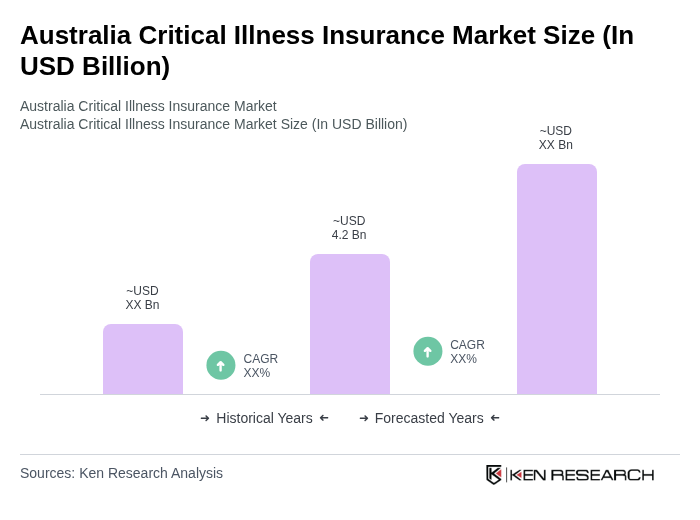
- The Australia Critical Illness Insurance Market is valued at USD 4.2 billion, based on a five-year historical analysis. This growth is primarily driven by increasing awareness of health risks, rising healthcare costs, a growing aging population that seeks financial protection against critical illnesses, and rising incidence of chronic diseases alongside expanding employer-sponsored benefits.
- Key cities such as Sydney, Melbourne, and Brisbane dominate the market due to their high population density, economic activity, and access to healthcare services. These urban centers have a higher concentration of individuals seeking insurance products, contributing to the overall market growth.
- The Life Insurance Code of Practice, 2025 issued by the Life Insurance Association of Australia (LIAA), mandates that all insurers must provide clear Product Disclosure Statements outlining terms, conditions, exclusions, and claims processes for critical illness policies, with compliance requiring annual audits and consumer complaint resolution within specified timelines.
Australia Critical Illness Insurance Market Segmentation
By Type:The segmentation by type includes Individual Plans, Family Plans, Group Plans, and Others. Individual Plans are tailored for single policyholders, while Family Plans cover multiple members under one policy. Group Plans are typically offered by employers to their employees, and Others may include specialized or niche plans.
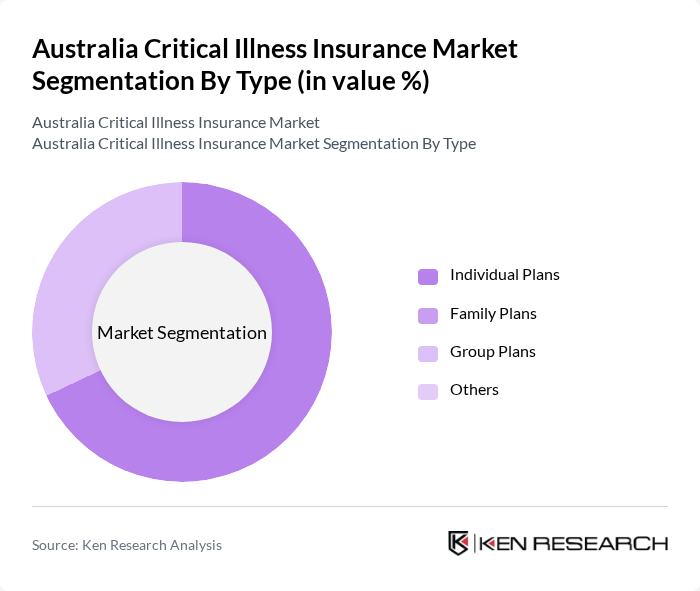
The Individual Plans segment is currently dominating the market due to the increasing trend of personalized insurance solutions. Consumers are increasingly seeking tailored coverage that meets their specific health needs, leading to a rise in demand for individual policies. Family Plans are also gaining traction as families look for comprehensive coverage that protects multiple members under a single policy. However, the flexibility and customization offered by Individual Plans make them the preferred choice for many consumers.
By Coverage Type:The coverage type segmentation includes Comprehensive Coverage, Basic Coverage, Critical Illness Add-ons, and Others. Comprehensive Coverage provides extensive protection against a wide range of critical illnesses, while Basic Coverage offers essential protection. Critical Illness Add-ons allow policyholders to enhance their coverage, and Others may include unique or specialized coverage options.
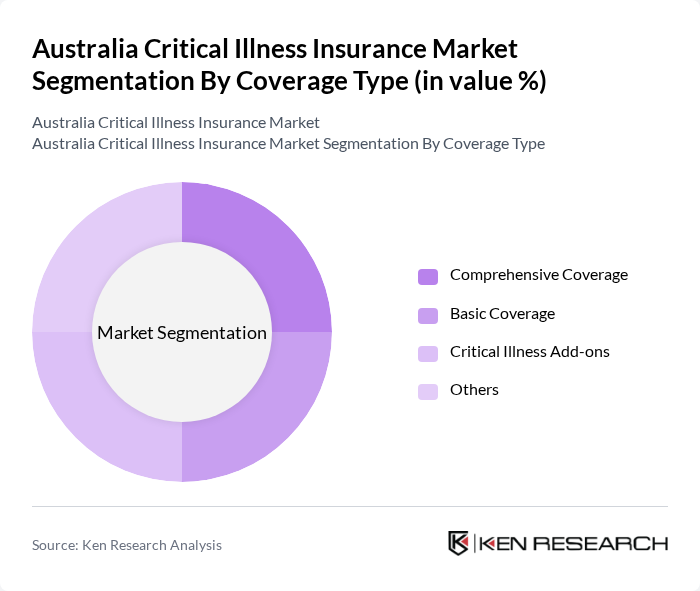
Comprehensive Coverage is leading the market as it offers extensive protection against a variety of critical illnesses, appealing to consumers who prioritize thorough health security. The Basic Coverage segment is also significant, catering to budget-conscious individuals seeking essential protection. Critical Illness Add-ons are becoming increasingly popular as policyholders look to enhance their existing coverage, reflecting a trend towards more personalized insurance solutions.
Australia Critical Illness Insurance Market Competitive Landscape
The Australia Critical Illness Insurance Market is characterized by a dynamic mix of regional and international players. Leading participants such as TAL Life Limited, AIA Australia, Zurich Australia, MLC Life Insurance, Suncorp Life, QBE Insurance, Allianz Australia, MetLife Australia, AMP Life, CBA Life, Asteron Life, OnePath Life, ClearView Wealth, InsureandGo, NobleOak Life contribute to innovation, geographic expansion, and service delivery in this space.
Australia Critical Illness Insurance Market Industry Analysis
Growth Drivers
- Increasing Awareness of Health Risks:The Australian population is becoming increasingly aware of health risks, with 75% of adults recognizing the importance of critical illness insurance. This awareness is driven by rising incidences of chronic diseases, which affected approximately 52% of Australians recently. The Australian Institute of Health and Welfare reported that 1 in 4 Australians live with a chronic condition, prompting a greater demand for financial protection against health-related uncertainties.
- Rising Healthcare Costs:Healthcare expenditure in Australia reached AUD 210 billion recently, reflecting a 6% increase from the previous year. This surge in costs is primarily due to advancements in medical technology and an increase in the aging population. As individuals face higher out-of-pocket expenses, critical illness insurance becomes a vital financial tool, leading to a projected increase in policy uptake as consumers seek to mitigate these rising costs.
- Aging Population:In future, it is estimated that 22% of Australia's population will be aged 65 and over, up from 15% previously. This demographic shift is significant, as older individuals are more susceptible to critical illnesses. The Australian Bureau of Statistics indicates that the number of people aged 85 and older is expected to double in future, driving demand for critical illness insurance products tailored to this age group, thereby enhancing market growth.
Market Challenges
- Regulatory Compliance Issues:The Australian insurance market is heavily regulated, with compliance costs estimated at AUD 1.6 billion annually for insurers. The Insurance Contracts Act and the Life Insurance Act impose stringent requirements that can hinder product innovation and increase operational costs. Insurers must navigate these regulations carefully, which can limit their ability to offer competitive products in a rapidly evolving market.
- Consumer Skepticism:Despite the growing awareness of critical illness insurance, consumer skepticism remains a significant barrier. A survey by the Australian Financial Complaints Authority revealed that 32% of policyholders felt misled about their coverage. This skepticism is exacerbated by high-profile claims disputes, leading to a lack of trust in insurance providers and potentially stalling market growth as consumers hesitate to invest in policies.
Australia Critical Illness Insurance Market Future Outlook
The future of the Australia critical illness insurance market appears promising, driven by technological advancements and changing consumer preferences. The integration of telehealth services and AI in underwriting processes is expected to enhance customer experience and streamline operations. Additionally, as the focus on preventive healthcare increases, insurers may adapt their offerings to include wellness programs, further appealing to health-conscious consumers and expanding market reach in the coming years.
Market Opportunities
- Expansion of Digital Insurance Platforms:The rise of digital insurance platforms presents a significant opportunity for growth. With over 85% of Australians using the internet, insurers can leverage online channels to enhance accessibility and streamline the purchasing process, potentially increasing policy sales and customer engagement.
- Customization of Insurance Products:There is a growing demand for personalized insurance solutions. By offering customizable policies that cater to individual health needs and preferences, insurers can attract a broader customer base. This trend is supported by data indicating that 70% of consumers prefer tailored insurance products, highlighting a clear opportunity for market differentiation.
Scope of the Report
| Segment | Sub-Segments |
|---|---|
| By Type | Individual Plans Family Plans Group Plans Others |
| By Coverage Type | Comprehensive Coverage Basic Coverage Critical Illness Add-ons Others |
| By Distribution Channel | Direct Sales Brokers Online Platforms Others |
| By Demographics | Age Group (18-30, 31-45, 46-60, 60+) Gender Income Level Others |
| By Policy Term | Short-Term Policies Long-Term Policies Others |
| By Claim Settlement Ratio | High Settlement Ratio Medium Settlement Ratio Low Settlement Ratio Others |
| By Customer Type | Individual Customers Corporate Customers Non-Profit Organizations Others |
Key Target Audience
Investors and Venture Capitalist Firms
Government and Regulatory Bodies (e.g., Australian Prudential Regulation Authority, Australian Securities and Investments Commission)
Insurance Underwriters
Healthcare Providers and Institutions
Insurance Brokers and Agents
Financial Advisors and Planners
Industry Associations (e.g., Insurance Council of Australia)
Reinsurers
Players Mentioned in the Report:
TAL Life Limited
AIA Australia
Zurich Australia
MLC Life Insurance
Suncorp Life
QBE Insurance
Allianz Australia
MetLife Australia
AMP Life
CBA Life
Asteron Life
OnePath Life
ClearView Wealth
InsureandGo
NobleOak Life
Table of Contents
Market Assessment Phase
1. Executive Summary and Approach
2. Australia Critical Illness Insurance Market Overview
2.1 Key Insights and Strategic Recommendations
2.2 Australia Critical Illness Insurance Market Overview
2.3 Definition and Scope
2.4 Evolution of Market Ecosystem
2.5 Timeline of Key Regulatory Milestones
2.6 Value Chain & Stakeholder Mapping
2.7 Business Cycle Analysis
2.8 Policy & Incentive Landscape
3. Australia Critical Illness Insurance Market Analysis
3.1 Growth Drivers
3.1.1 Increasing Awareness of Health Risks
3.1.2 Rising Healthcare Costs
3.1.3 Aging Population
3.1.4 Technological Advancements in Insurance Products
3.2 Market Challenges
3.2.1 Regulatory Compliance Issues
3.2.2 High Competition Among Insurers
3.2.3 Consumer Skepticism
3.2.4 Limited Product Awareness
3.3 Market Opportunities
3.3.1 Expansion of Digital Insurance Platforms
3.3.2 Customization of Insurance Products
3.3.3 Partnerships with Healthcare Providers
3.3.4 Increased Focus on Preventive Healthcare
3.4 Market Trends
3.4.1 Growth of Telehealth Services
3.4.2 Integration of AI in Underwriting
3.4.3 Shift Towards Comprehensive Coverage Plans
3.4.4 Rise of Wellness Programs in Insurance
3.5 Government Regulation
3.5.1 Insurance Contracts Act
3.5.2 Life Insurance Act
3.5.3 Australian Consumer Law
3.5.4 Privacy Act Compliance
4. SWOT Analysis
5. Stakeholder Analysis
6. Porter's Five Forces Analysis
7. Australia Critical Illness Insurance Market Market Size, 2019-2024
7.1 By Value
7.2 By Volume
7.3 By Average Selling Price
8. Australia Critical Illness Insurance Market Segmentation
8.1 By Type
8.1.1 Individual Plans
8.1.2 Family Plans
8.1.3 Group Plans
8.1.4 Others
8.2 By Coverage Type
8.2.1 Comprehensive Coverage
8.2.2 Basic Coverage
8.2.3 Critical Illness Add-ons
8.2.4 Others
8.3 By Distribution Channel
8.3.1 Direct Sales
8.3.2 Brokers
8.3.3 Online Platforms
8.3.4 Others
8.4 By Demographics
8.4.1 Age Group (18-30, 31-45, 46-60, 60+)
8.4.2 Gender
8.4.3 Income Level
8.4.4 Others
8.5 By Policy Term
8.5.1 Short-Term Policies
8.5.2 Long-Term Policies
8.5.3 Others
8.6 By Claim Settlement Ratio
8.6.1 High Settlement Ratio
8.6.2 Medium Settlement Ratio
8.6.3 Low Settlement Ratio
8.6.4 Others
8.7 By Customer Type
8.7.1 Individual Customers
8.7.2 Corporate Customers
8.7.3 Non-Profit Organizations
8.7.4 Others
9. Australia Critical Illness Insurance Market Competitive Analysis
9.1 Market Share of Key Players
9.2 Cross Comparison of Key Players
9.2.1 Company Name.
9.2.2 Group Size (Large, Medium, or Small as per industry convention).
9.2.3 Customer Acquisition Cost
9.2.4 Policy Retention Rate
9.2.5 Claims Processing Time
9.2.6 Customer Satisfaction Score
9.2.7 Pricing Strategy
9.2.8 Market Penetration Rate
9.2.9 Revenue Growth Rate
9.2.10 Average Policy Value
9.3 SWOT Analysis of Top Players
9.4 Pricing Analysis
9.5 Detailed Profile of Major Companies
9.5.1 TAL Life Limited
9.5.2 AIA Australia
9.5.3 Zurich Australia
9.5.4 MLC Life Insurance
9.5.5 Suncorp Life
9.5.6 QBE Insurance
9.5.7 Allianz Australia
9.5.8 MetLife Australia
9.5.9 AMP Life
9.5.10 CBA Life
9.5.11 Asteron Life
9.5.12 OnePath Life
9.5.13 ClearView Wealth
9.5.14 InsureandGo
9.5.15 NobleOak Life
10. Australia Critical Illness Insurance Market End-User Analysis
10.1 Procurement Behavior of Key Ministries
10.1.1 Budget Allocation for Health Insurance
10.1.2 Decision-Making Processes
10.1.3 Evaluation Criteria for Insurance Providers
10.1.4 Others
10.2 Corporate Spend on Infrastructure & Energy
10.2.1 Investment in Employee Health Programs
10.2.2 Budgeting for Insurance Premiums
10.2.3 Trends in Corporate Health Spending
10.2.4 Others
10.3 Pain Point Analysis by End-User Category
10.3.1 Coverage Gaps
10.3.2 Affordability Issues
10.3.3 Complexity of Policy Terms
10.3.4 Others
10.4 User Readiness for Adoption
10.4.1 Awareness of Critical Illness Insurance
10.4.2 Perceived Value of Coverage
10.4.3 Trust in Insurance Providers
10.4.4 Others
10.5 Post-Deployment ROI and Use Case Expansion
10.5.1 Evaluation of Claims Experience
10.5.2 Impact on Employee Productivity
10.5.3 Long-term Financial Benefits
10.5.4 Others
11. Australia Critical Illness Insurance Market Future Size, 2025-2030
11.1 By Value
11.2 By Volume
11.3 By Average Selling Price
Go-To-Market Strategy Phase
1. Whitespace Analysis + Business Model Canvas
1.1 Market Gaps Identification
1.2 Value Proposition Development
1.3 Revenue Streams
1.4 Cost Structure Analysis
1.5 Key Partnerships
1.6 Customer Segments
1.7 Channels
2. Marketing and Positioning Recommendations
2.1 Branding Strategies
2.2 Product USPs
3. Distribution Plan
3.1 Urban Retail vs Rural NGO Tie-ups
4. Channel & Pricing Gaps
4.1 Underserved Routes
4.2 Pricing Bands
5. Unmet Demand & Latent Needs
5.1 Category Gaps
5.2 Consumer Segments
6. Customer Relationship
6.1 Loyalty Programs
6.2 After-sales Service
7. Value Proposition
7.1 Sustainability
7.2 Integrated Supply Chains
8. Key Activities
8.1 Regulatory Compliance
8.2 Branding
8.3 Distribution Setup
9. Entry Strategy Evaluation
9.1 Domestic Market Entry Strategy
9.1.1 Product Mix
9.1.2 Pricing Band
9.1.3 Packaging
9.2 Export Entry Strategy
9.2.1 Target Countries
9.2.2 Compliance Roadmap
10. Entry Mode Assessment
10.1 JV
10.2 Greenfield
10.3 M&A
10.4 Distributor Model
11. Capital and Timeline Estimation
11.1 Capital Requirements
11.2 Timelines
12. Control vs Risk Trade-Off
12.1 Ownership vs Partnerships
13. Profitability Outlook
13.1 Breakeven Analysis
13.2 Long-term Sustainability
14. Potential Partner List
14.1 Distributors
14.2 JVs
14.3 Acquisition Targets
15. Execution Roadmap
15.1 Phased Plan for Market Entry
15.1.1 Market Setup
15.1.2 Market Entry
15.1.3 Growth Acceleration
15.1.4 Scale & Stabilize
15.2 Key Activities and Milestones
15.2.1 Milestone Planning
15.2.2 Activity Tracking
Research Methodology
Phase 1: Approach1
Desk Research
- Analysis of industry reports from Australian insurance regulatory bodies
- Review of market trends and forecasts from financial institutions and consultancy firms
- Examination of published articles and white papers on critical illness insurance
Primary Research
- Interviews with underwriters and product managers from leading insurance companies
- Surveys targeting financial advisors and insurance brokers specializing in critical illness products
- Focus groups with policyholders to gather insights on customer experiences and expectations
Validation & Triangulation
- Cross-validation of findings through multiple data sources, including government statistics
- Triangulation of qualitative insights from interviews with quantitative data from surveys
- Sanity checks conducted through expert panel reviews comprising industry veterans
Phase 2: Market Size Estimation1
Top-down Assessment
- Estimation of total market size based on national health expenditure and insurance penetration rates
- Segmentation of the market by demographic factors such as age, gender, and income levels
- Incorporation of trends in health awareness and critical illness prevalence rates
Bottom-up Modeling
- Collection of premium data from major insurance providers to establish average policy values
- Analysis of claims data to determine payout ratios and loss ratios in the critical illness segment
- Estimation of market growth based on new policy issuance rates and renewal trends
Forecasting & Scenario Analysis
- Multi-variable regression analysis incorporating economic indicators and health trends
- Scenario modeling based on potential regulatory changes and market entry of new players
- Development of baseline, optimistic, and pessimistic forecasts through 2030
Phase 3: CATI Sample Composition1
| Scope Item/Segment | Sample Size | Target Respondent Profiles |
|---|---|---|
| Insurance Brokers | 120 | Licensed Insurance Brokers, Financial Advisors |
| Policyholders | 100 | Individuals with Critical Illness Insurance Policies |
| Insurance Underwriters | 80 | Underwriters from Major Insurance Firms |
| Healthcare Professionals | 70 | Doctors, Specialists, and Health Consultants |
| Financial Planners | 60 | Certified Financial Planners, Wealth Managers |
Frequently Asked Questions
What is the current value of the Australia Critical Illness Insurance Market?
The Australia Critical Illness Insurance Market is valued at approximately USD 4.2 billion, reflecting a significant growth driven by increasing health awareness, rising healthcare costs, and a growing aging population seeking financial protection against critical illnesses.
What factors are driving the growth of critical illness insurance in Australia?
Which cities in Australia dominate the critical illness insurance market?
What are the main types of critical illness insurance plans available in Australia?
Other Regional/Country Reports
Other Adjacent Reports
Indonesia Long-Term Care Insurance Market
Japan Medical Underwriting Market
Saudi Arabia Telehealth Services Market Size, Share & Forecast, By Service Type, Delivery Model & Care Setting, 2026-2031UAE insurtech market size, share, growth drivers, trends, opportunities & forecast 2025–2030Middle East Chronic Disease Management Market Size, Share, Growth Drivers, Trends, Opportunities & Forecast 2025–2030Thailand Employee Benefits Market
Saudi Arabia Personal Finance Market Size, Share & Forecast, By Loan Purpose, Institution Type & Distribution Channel, 2026-2031Why Buy From Us?

What makes us stand out is that our consultants follow Robust, Refine and Result (RRR) methodology. Robust for clear definitions, approaches and sanity checking, Refine for differentiating respondents' facts and opinions, and Result for presenting data with story.

We have set a benchmark in the industry by offering our clients with syndicated and customized market research reports featuring coverage of entire market as well as meticulous research and analyst insights.

While we don't replace traditional research, we flip the method upside down. Our dual approach of Top Bottom & Bottom Top ensures quality deliverable by not just verifying company fundamentals but also looking at the sector and macroeconomic factors.

With one step in the future, our research team constantly tries to show you the bigger picture. We help with some of the tough questions you may encounter along the way: How is the industry positioned? Best marketing channel? KPI's of competitors? By aligning every element, we help maximize success.

Our report gives you instant access to the answers and sources that other companies might choose to hide. We elaborate each steps of research methodology we have used and showcase you the sample size to earn your trust.

If you need any support, we are here! We pride ourselves on universe strength, data quality, and quick, friendly, and professional service.