About the Report
Base Year 2024New Zealand Critical Illness Insurance Market Overview
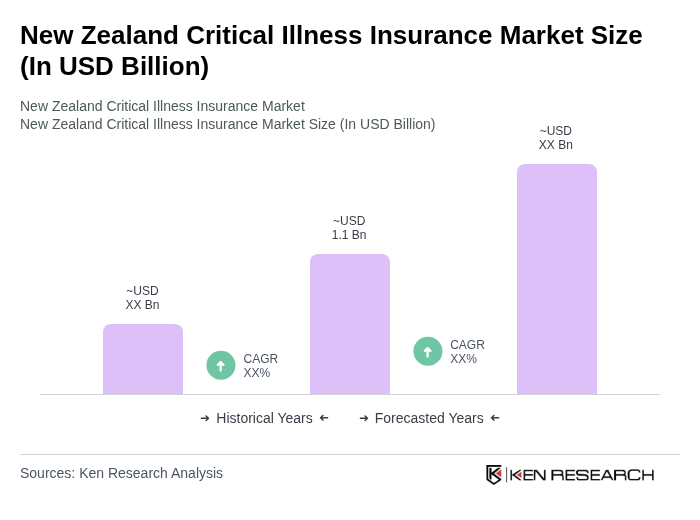
- The New Zealand Critical Illness Insurance Market is valued at USD 1.1 billion, based on a five-year historical analysis. This growth is primarily driven by increasing awareness of health risks, rising healthcare costs, a growing aging population that demands more comprehensive health coverage, and rising demand for income protection amid chronic disease prevalence. The market has seen a significant uptick in policy purchases as individuals seek financial security against critical illnesses.
- Auckland, Wellington, and Christchurch are the dominant cities in the New Zealand Critical Illness Insurance Market. Auckland leads due to its large population and economic activity, while Wellington benefits from being the political center, influencing insurance regulations and policies. Christchurch, recovering from past natural disasters, has seen a rise in demand for health-related insurance products as residents prioritize financial protection.
- The Health and Disability System Act 2023, issued by the New Zealand Parliament, establishes the national Public Health Agency and Te Whatu Ora | Health New Zealand to oversee health service delivery. This binding legislation requires integrated commissioning of services across primary, community, and hospital care with defined performance standards for accessibility and equity, mandating insurers to align policies with public system enhancements for critical care coverage thresholds above public entitlements.
New Zealand Critical Illness Insurance Market Segmentation
By Type:This segmentation includes various types of insurance products tailored to meet the needs of consumers. The subsegments are Disease Insurance, Medical Insurance, Income Protection Insurance, and Others. Each type serves a unique purpose, catering to different consumer preferences and financial requirements.
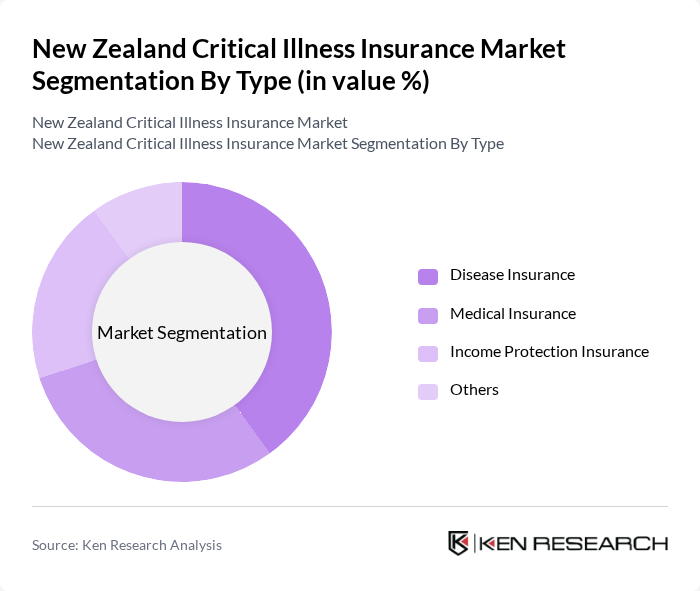
The Disease Insurance subsegment is currently dominating the market due to the increasing prevalence of chronic illnesses and the rising awareness among consumers about the financial implications of such diseases. This type of insurance provides coverage for specific critical illnesses, which is appealing to individuals seeking targeted protection. The growing trend of preventive healthcare and early diagnosis has also contributed to the popularity of disease-specific policies, making them a preferred choice among consumers.
By End-User:This segmentation categorizes the market based on the type of consumers purchasing insurance. The subsegments include Individuals, Corporates, SMEs, and Others. Each end-user group has distinct needs and preferences, influencing their choice of insurance products.
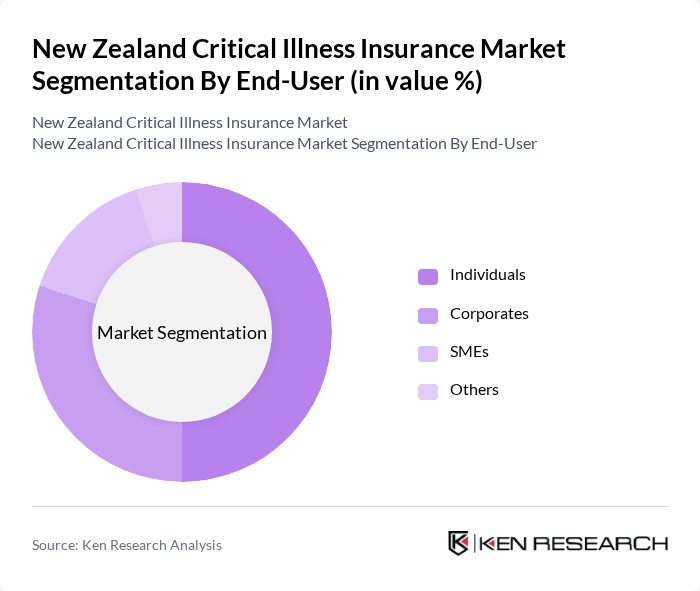
Individuals represent the largest segment in the market, driven by a growing awareness of health risks and the need for financial security against critical illnesses. The increasing number of self-employed individuals and freelancers has also contributed to this trend, as they seek personal insurance solutions. Corporates are increasingly offering critical illness insurance as part of employee benefits, but the individual market remains the most significant due to the personal nature of health insurance decisions.
New Zealand Critical Illness Insurance Market Competitive Landscape
The New Zealand Critical Illness Insurance Market is characterized by a dynamic mix of regional and international players. Leading participants such as Southern Cross Health Society, AIA New Zealand, Partners Life, Fidelity Life, Tower Insurance, nib New Zealand, ASB Insurance, Cigna Life Insurance New Zealand, AMP Life, Vero Insurance, Sovereign Assurance Company, QBE Insurance, Zurich New Zealand, Asteron Life, Medical Insurance Group contribute to innovation, geographic expansion, and service delivery in this space.
New Zealand Critical Illness Insurance Market Industry Analysis
Growth Drivers
- Increasing Awareness of Health Risks:The New Zealand population is becoming increasingly aware of health risks, with 75% of adults acknowledging the importance of critical illness insurance. This awareness is driven by rising incidences of chronic diseases, which have increased by 18% over the past decade. As a result, more individuals are seeking financial protection against potential health crises, leading to a surge in policy purchases. This trend is supported by health campaigns and educational initiatives by the government and insurance companies.
- Rising Healthcare Costs:Healthcare expenditure in New Zealand is projected to reach NZD 22 billion, reflecting a 6% annual increase. This rise in costs is prompting consumers to seek critical illness insurance as a financial safety net. With out-of-pocket expenses for medical treatments increasing, individuals are more inclined to invest in insurance products that cover significant health events. This trend is further fueled by the government's focus on improving healthcare access and affordability, making insurance a vital consideration for many.
- Aging Population:New Zealand's population aged 65 and over is expected to grow to 1.3 million, representing a 25% increase from 2020. This demographic shift is driving demand for critical illness insurance, as older individuals are more susceptible to severe health conditions. Insurers are responding by tailoring products to meet the needs of this age group, enhancing coverage options and benefits. Consequently, the aging population is a significant growth driver for the critical illness insurance market in New Zealand.
Market Challenges
- Regulatory Compliance Issues:The New Zealand insurance market faces stringent regulatory requirements, with compliance costs estimated at NZD 600 million annually. Insurers must navigate complex regulations, including consumer protection laws and prudential standards, which can hinder operational efficiency. These compliance challenges can lead to increased premiums for consumers, potentially limiting market growth. Additionally, the evolving regulatory landscape requires continuous adaptation, placing further strain on insurance providers.
- Consumer Trust Deficit:A significant trust deficit exists in the insurance sector, with only 50% of consumers expressing confidence in insurance providers. This lack of trust is often attributed to negative experiences with claims processing and perceived lack of transparency. As a result, many potential customers hesitate to purchase critical illness insurance, fearing inadequate support during health crises. Building consumer trust is essential for market growth, necessitating improved communication and service delivery from insurers.
New Zealand Critical Illness Insurance Market Future Outlook
The future of the New Zealand critical illness insurance market appears promising, driven by technological advancements and a growing emphasis on preventive healthcare. Insurers are increasingly adopting digital platforms to streamline operations and enhance customer engagement. Additionally, the focus on preventive measures is likely to encourage more individuals to invest in insurance products that offer comprehensive coverage. As the market evolves, insurers must adapt to changing consumer preferences and leverage technology to improve service delivery and customer satisfaction.
Market Opportunities
- Customizable Insurance Plans:There is a growing demand for customizable insurance plans that cater to individual health needs. With 65% of consumers expressing interest in tailored coverage options, insurers can capitalize on this trend by offering flexible policies. This approach not only enhances customer satisfaction but also increases market penetration, as more individuals find plans that align with their specific health concerns and financial situations.
- Partnerships with Healthcare Providers:Collaborating with healthcare providers presents a significant opportunity for insurers. By forming partnerships, insurers can offer integrated services that enhance customer value. For instance, joint initiatives can provide policyholders with access to preventive health screenings and wellness programs, fostering a holistic approach to health management. This strategy can improve customer retention and attract new clients seeking comprehensive health solutions.
Scope of the Report
| Segment | Sub-Segments |
|---|---|
| By Type | Disease Insurance Medical Insurance Income Protection Insurance Others |
| By End-User | Individuals Corporates SMEs Others |
| By Disease Coverage | Cancer Heart Attack Stroke Others |
| By Coverage Amount | Low Coverage Medium Coverage High Coverage Others |
| By Payment Frequency | Monthly Quarterly Annually Others |
| By Distribution Channel | Direct Sales Brokers Online Platforms Others |
| By Policy Duration | Short-Term Policies Long-Term Policies Others |
Key Target Audience
Investors and Venture Capitalist Firms
Government and Regulatory Bodies (e.g., Reserve Bank of New Zealand, Financial Markets Authority)
Insurance Underwriters
Healthcare Providers and Institutions
Insurance Brokers and Agents
Financial Advisors and Planners
Industry Associations (e.g., Insurance Council of New Zealand)
Reinsurers
Players Mentioned in the Report:
Southern Cross Health Society
AIA New Zealand
Partners Life
Fidelity Life
Tower Insurance
nib New Zealand
ASB Insurance
Cigna Life Insurance New Zealand
AMP Life
Vero Insurance
Sovereign Assurance Company
QBE Insurance
Zurich New Zealand
Asteron Life
Medical Insurance Group
Table of Contents
Market Assessment Phase
1. Executive Summary and Approach
2. New Zealand Critical Illness Insurance Market Overview
2.1 Key Insights and Strategic Recommendations
2.2 New Zealand Critical Illness Insurance Market Overview
2.3 Definition and Scope
2.4 Evolution of Market Ecosystem
2.5 Timeline of Key Regulatory Milestones
2.6 Value Chain & Stakeholder Mapping
2.7 Business Cycle Analysis
2.8 Policy & Incentive Landscape
3. New Zealand Critical Illness Insurance Market Analysis
3.1 Growth Drivers
3.1.1 Increasing Awareness of Health Risks
3.1.2 Rising Healthcare Costs
3.1.3 Aging Population
3.1.4 Enhanced Product Offerings
3.2 Market Challenges
3.2.1 Regulatory Compliance Issues
3.2.2 Market Saturation
3.2.3 Consumer Trust Deficit
3.2.4 Economic Uncertainty
3.3 Market Opportunities
3.3.1 Technological Advancements
3.3.2 Customizable Insurance Plans
3.3.3 Partnerships with Healthcare Providers
3.3.4 Expansion into Emerging Markets
3.4 Market Trends
3.4.1 Digital Transformation in Insurance
3.4.2 Increased Focus on Preventive Healthcare
3.4.3 Integration of AI in Claims Processing
3.4.4 Shift Towards Flexible Payment Options
3.5 Government Regulation
3.5.1 Consumer Protection Laws
3.5.2 Insurance Prudential Standards
3.5.3 Tax Incentives for Policyholders
3.5.4 Health and Safety Regulations
4. SWOT Analysis
5. Stakeholder Analysis
6. Porter's Five Forces Analysis
7. New Zealand Critical Illness Insurance Market Size, 2019-2024
7.1 By Value
7.2 By Volume
7.3 By Average Selling Price
8. New Zealand Critical Illness Insurance Market Segmentation
8.1 By Type
8.1.1 Disease Insurance
8.1.2 Medical Insurance
8.1.3 Income Protection Insurance
8.1.4 Others
8.2 By End-User
8.2.1 Individuals
8.2.2 Corporates
8.2.3 SMEs
8.2.4 Others
8.3 By Disease Coverage
8.3.1 Cancer
8.3.2 Heart Attack
8.3.3 Stroke
8.3.4 Others
8.4 By Coverage Amount
8.4.1 Low Coverage
8.4.2 Medium Coverage
8.4.3 High Coverage
8.4.4 Others
8.5 By Payment Frequency
8.5.1 Monthly
8.5.2 Quarterly
8.5.3 Annually
8.5.4 Others
8.6 By Distribution Channel
8.6.1 Direct Sales
8.6.2 Brokers
8.6.3 Online Platforms
8.6.4 Others
8.7 By Policy Duration
8.7.1 Short-Term Policies
8.7.2 Long-Term Policies
8.7.3 Others
9. New Zealand Critical Illness Insurance Market Competitive Analysis
9.1 Market Share of Key Players
9.2 Cross Comparison of Key Players
9.2.1 Company Name
9.2.2 Market Share (%)
9.2.3 Customer Acquisition Cost (CAC)
9.2.4 Policy Retention Rate (%)
9.2.5 Claims Settlement Ratio (%)
9.2.6 Average Policy Size (NZD)
9.2.7 Pricing Strategy
9.2.8 Customer Satisfaction Score (NPS)
9.2.9 Market Penetration Rate (%)
9.2.10 Revenue Growth Rate (CAGR %)
9.3 SWOT Analysis of Top Players
9.4 Pricing Analysis
9.5 Detailed Profile of Major Companies
9.5.1 Southern Cross Health Society
9.5.2 AIA New Zealand
9.5.3 Partners Life
9.5.4 Fidelity Life
9.5.5 Tower Insurance
9.5.6 nib New Zealand
9.5.7 ASB Insurance
9.5.8 Cigna Life Insurance New Zealand
9.5.9 AMP Life
9.5.10 Vero Insurance
9.5.11 Sovereign Assurance Company
9.5.12 QBE Insurance
9.5.13 Zurich New Zealand
9.5.14 Asteron Life
9.5.15 Medical Insurance Group
10. New Zealand Critical Illness Insurance Market End-User Analysis
10.1 Procurement Behavior of Key Ministries
10.1.1 Budget Allocation Trends
10.1.2 Decision-Making Processes
10.1.3 Preferred Insurance Providers
10.1.4 Others
10.2 Corporate Spend on Infrastructure & Energy
10.2.1 Investment Trends
10.2.2 Budget Prioritization
10.2.3 Key Spending Areas
10.2.4 Others
10.3 Pain Point Analysis by End-User Category
10.3.1 Coverage Gaps
10.3.2 Affordability Issues
10.3.3 Complexity of Policies
10.3.4 Others
10.4 User Readiness for Adoption
10.4.1 Awareness Levels
10.4.2 Attitude Towards Insurance
10.4.3 Barriers to Adoption
10.4.4 Others
10.5 Post-Deployment ROI and Use Case Expansion
10.5.1 Performance Metrics
10.5.2 Customer Feedback
10.5.3 Future Investment Plans
10.5.4 Others
11. New Zealand Critical Illness Insurance Market Future Size, 2025-2030
11.1 By Value
11.2 By Volume
11.3 By Average Selling Price
Go-To-Market Strategy Phase
1. Whitespace Analysis + Business Model Canvas
1.1 Market Gaps Identification
1.2 Value Proposition Development
1.3 Revenue Model Structuring
1.4 Customer Segmentation
1.5 Competitive Landscape Analysis
1.6 Key Partnerships
1.7 Risk Assessment
2. Marketing and Positioning Recommendations
2.1 Branding Strategies
2.2 Product USPs
2.3 Target Audience Identification
2.4 Communication Strategy
2.5 Digital Marketing Tactics
2.6 Customer Engagement Plans
2.7 Performance Metrics
3. Distribution Plan
3.1 Urban Retail Strategies
3.2 Rural NGO Tie-Ups
3.3 Online Distribution Channels
3.4 Direct Sales Approaches
3.5 Partnership Opportunities
3.6 Logistics and Supply Chain
3.7 Performance Evaluation
4. Channel & Pricing Gaps
4.1 Underserved Routes
4.2 Pricing Bands
4.3 Competitive Pricing Analysis
4.4 Customer Sensitivity Analysis
4.5 Pricing Strategy Recommendations
4.6 Channel Optimization
4.7 Performance Metrics
5. Unmet Demand & Latent Needs
5.1 Category Gaps
5.2 Consumer Segments
5.3 Product Development Opportunities
5.4 Market Entry Strategies
5.5 Customer Feedback Mechanisms
5.6 Performance Metrics
6. Customer Relationship
6.1 Loyalty Programs
6.2 After-Sales Service
6.3 Customer Support Strategies
6.4 Feedback and Improvement Processes
6.5 Performance Metrics
7. Value Proposition
7.1 Sustainability Initiatives
7.2 Integrated Supply Chains
7.3 Customer-Centric Approaches
7.4 Competitive Differentiation
7.5 Performance Metrics
8. Key Activities
8.1 Regulatory Compliance
8.2 Branding Initiatives
8.3 Distribution Setup
8.4 Training and Development
8.5 Performance Metrics
9. Entry Strategy Evaluation
9.1 Domestic Market Entry Strategy
9.1.1 Product Mix
9.1.2 Pricing Band
9.1.3 Packaging
9.2 Export Entry Strategy
9.2.1 Target Countries
9.2.2 Compliance Roadmap
10. Entry Mode Assessment
10.1 Joint Ventures
10.2 Greenfield Investments
10.3 Mergers & Acquisitions
10.4 Distributor Model
10.5 Performance Metrics
11. Capital and Timeline Estimation
11.1 Capital Requirements
11.2 Timelines
12. Control vs Risk Trade-Off
12.1 Ownership vs Partnerships
12.2 Risk Management Strategies
13. Profitability Outlook
13.1 Breakeven Analysis
13.2 Long-Term Sustainability
14. Potential Partner List
14.1 Distributors
14.2 Joint Ventures
14.3 Acquisition Targets
15. Execution Roadmap
15.1 Phased Plan for Market Entry
15.1.1 Market Setup
15.1.2 Market Entry
15.1.3 Growth Acceleration
15.1.4 Scale & Stabilize
15.2 Key Activities and Milestones
15.2.1 Milestone Planning
15.2.2 Performance Tracking
Research Methodology
Phase 1: Approach1
Desk Research
- Analysis of industry reports from New Zealand's insurance regulatory bodies
- Review of market trends and consumer behavior studies published by local research firms
- Examination of financial statements and annual reports from major critical illness insurance providers
Primary Research
- Interviews with underwriters and product managers from leading insurance companies
- Surveys targeting financial advisors and insurance brokers to gather insights on market dynamics
- Focus groups with policyholders to understand customer satisfaction and product awareness
Validation & Triangulation
- Cross-validation of findings through comparison with international critical illness insurance markets
- Triangulation of data from consumer surveys, expert interviews, and industry reports
- Sanity checks conducted through expert panel reviews comprising industry veterans
Phase 2: Market Size Estimation1
Top-down Assessment
- Estimation of total market size based on national health expenditure and insurance penetration rates
- Segmentation of the market by demographic factors such as age, gender, and income levels
- Incorporation of government health initiatives and their impact on insurance uptake
Bottom-up Modeling
- Collection of premium data from major insurance providers to establish a baseline
- Analysis of policy issuance trends and claims data to gauge market growth
- Estimation of average policy values and frequency of claims to project revenue potential
Forecasting & Scenario Analysis
- Multi-variable regression analysis incorporating economic indicators and health trends
- Scenario modeling based on potential regulatory changes and market disruptions
- Development of baseline, optimistic, and pessimistic forecasts through 2030
Phase 3: CATI Sample Composition1
| Scope Item/Segment | Sample Size | Target Respondent Profiles |
|---|---|---|
| Individual Policyholders | 150 | Current policyholders, potential buyers |
| Insurance Brokers | 100 | Independent brokers, financial advisors |
| Healthcare Professionals | 80 | Doctors, hospital administrators |
| Insurance Company Executives | 60 | CEOs, product development heads |
| Regulatory Bodies | 40 | Policy makers, compliance officers |
Frequently Asked Questions
What is the current value of the New Zealand Critical Illness Insurance Market?
The New Zealand Critical Illness Insurance Market is valued at approximately USD 1.1 billion, reflecting significant growth driven by increased awareness of health risks, rising healthcare costs, and a growing aging population seeking comprehensive health coverage.
What factors are driving the growth of critical illness insurance in New Zealand?
Which cities dominate the New Zealand Critical Illness Insurance Market?
What types of insurance products are available in the New Zealand Critical Illness Insurance Market?
Other Regional/Country Reports
Other Adjacent Reports
Vietnam Income Protection Insurance Market
South Korea Medical Insurance Market
UAE pharmaceutical market report size, share, growth drivers, trends, opportunities & forecast 2025–2030Oman Healthcare Services Market
UAE Wellness and Preventive Care Market
Singapore Aging Population Care Market
UAE insurtech market size, share, growth drivers, trends, opportunities & forecast 2025–2030Why Buy From Us?

What makes us stand out is that our consultants follow Robust, Refine and Result (RRR) methodology. Robust for clear definitions, approaches and sanity checking, Refine for differentiating respondents' facts and opinions, and Result for presenting data with story.

We have set a benchmark in the industry by offering our clients with syndicated and customized market research reports featuring coverage of entire market as well as meticulous research and analyst insights.

While we don't replace traditional research, we flip the method upside down. Our dual approach of Top Bottom & Bottom Top ensures quality deliverable by not just verifying company fundamentals but also looking at the sector and macroeconomic factors.

With one step in the future, our research team constantly tries to show you the bigger picture. We help with some of the tough questions you may encounter along the way: How is the industry positioned? Best marketing channel? KPI's of competitors? By aligning every element, we help maximize success.

Our report gives you instant access to the answers and sources that other companies might choose to hide. We elaborate each steps of research methodology we have used and showcase you the sample size to earn your trust.

If you need any support, we are here! We pride ourselves on universe strength, data quality, and quick, friendly, and professional service.