About the Report
Base Year 2024Australia Cross Border Import E Commerce Market Overview
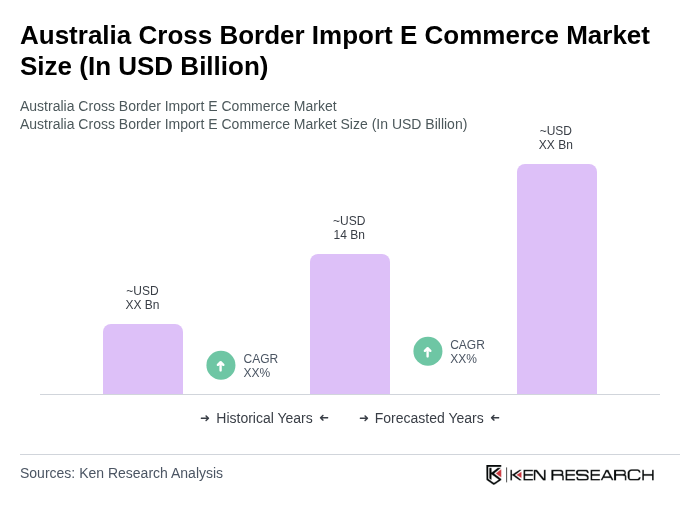
- The Australia Cross Border Import E Commerce Market is valued at approximately USD 14 billion, based on a five-year historical analysis. This growth is primarily driven by the increasing adoption of online shopping, enhanced logistics capabilities, a growing preference for international brands among Australian consumers, rising mobile commerce penetration, and AI-driven personalized shopping experiences. The market has seen a significant rise in cross-border transactions, fueled by the convenience of e-commerce platforms, the availability of diverse product offerings, and strong demand from sources like China and the US.
- Key players in this market include major cities such as Sydney, Melbourne, and Brisbane, which dominate due to their large populations, high internet penetration rates, and robust infrastructure. These urban centers serve as hubs for logistics and distribution, facilitating efficient cross-border trade and attracting international retailers looking to tap into the Australian consumer market.
- The Treasury Laws Amendment (GST Low Value Imported Goods) Act 2017, issued by the Australian Parliament, requires overseas sellers of low-value goods (valued at AUD 1,000 or less) to register for and charge 10% Goods and Services Tax (GST) if their annual sales to Australia exceed AUD 75,000, with quarterly remittance obligations to the Australian Taxation Office for compliance.
Australia Cross Border Import E Commerce Market Segmentation
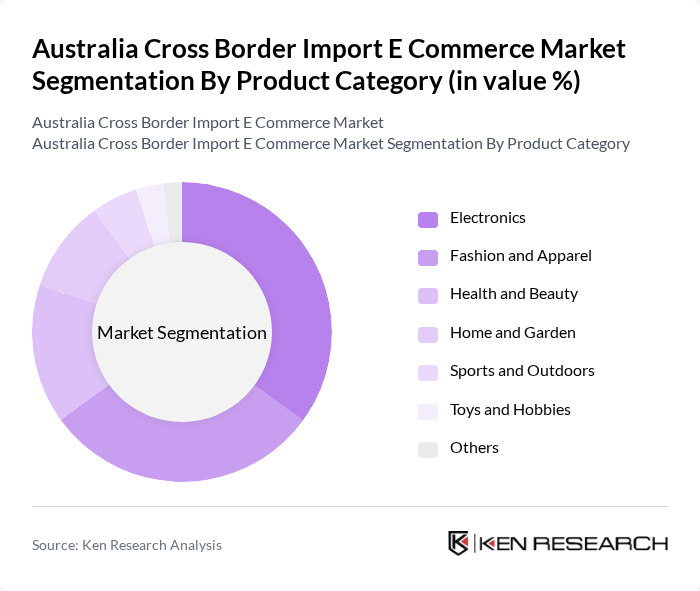
By Product Category:The product category segmentation includes various subsegments such as Electronics, Fashion and Apparel, Health and Beauty, Home and Garden, Sports and Outdoors, Toys and Hobbies, and Others. Among these, Electronics is the leading subsegment, driven by the increasing demand for gadgets and smart devices. Consumers are increasingly purchasing electronics online due to competitive pricing and the convenience of home delivery. Fashion and Apparel also show significant growth, as consumers seek international brands and unique styles not available locally.
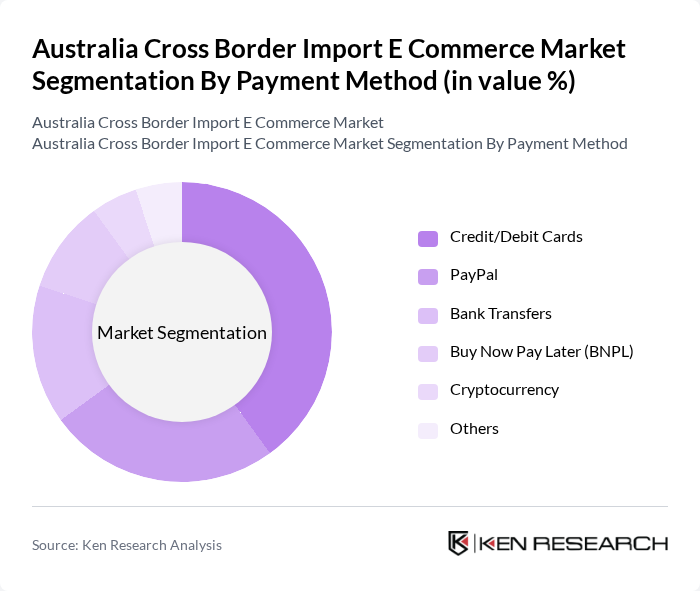
By Payment Method:The payment method segmentation includes Credit/Debit Cards, PayPal, Bank Transfers, Buy Now Pay Later (BNPL), Cryptocurrency, and Others. Credit/Debit Cards dominate this segment due to their widespread acceptance and consumer familiarity. PayPal follows closely, offering a secure and convenient option for online transactions. The rise of BNPL services has also gained traction, particularly among younger consumers who prefer flexible payment options.
Australia Cross Border Import E Commerce Market Competitive Landscape
The Australia Cross Border Import E Commerce Market is characterized by a dynamic mix of regional and international players. Leading participants such as eBay Australia, Amazon Australia, Catch.com.au, Kogan.com, AliExpress, MyDeal.com.au, OzSale, The Iconic, Booktopia, Adore Beauty, JB Hi-Fi, Bunnings Warehouse, Officeworks, Chemist Warehouse, Pet Circle contribute to innovation, geographic expansion, and service delivery in this space.
Australia Cross Border Import E Commerce Market Industry Analysis
Growth Drivers
- Increasing Consumer Demand for International Products:In future, Australian consumers are projected to spend approximately AUD 32 billion on cross-border e-commerce, driven by a growing preference for unique international products. This demand is fueled by the increasing availability of global brands and the desire for quality goods not found locally. The Australian Bureau of Statistics reported that 62% of online shoppers have purchased from overseas retailers, highlighting a significant trend towards international shopping.
- Expansion of Logistics and Shipping Capabilities:The logistics sector in Australia is expected to grow by AUD 6 billion in future, enhancing cross-border e-commerce efficiency. Major shipping companies are investing in advanced technologies and infrastructure, reducing delivery times to an average of 4-6 days for international shipments. This improvement in logistics is crucial as it addresses consumer concerns about shipping delays, thereby encouraging more purchases from overseas retailers.
- Rise of Mobile Commerce:Mobile commerce in Australia is anticipated to reach AUD 22 billion in future, accounting for 32% of total e-commerce sales. The increasing penetration of smartphones, with over 92% of Australians owning one, facilitates easy access to international e-commerce platforms. This trend is further supported by mobile-friendly payment solutions, which enhance the shopping experience and drive higher conversion rates for cross-border purchases.
Market Challenges
- Complex Customs Regulations:Navigating Australia's customs regulations can be challenging for cross-border e-commerce businesses. In future, the Australian Border Force reported that over 42% of international shipments face delays due to compliance issues. These complexities can deter consumers from purchasing internationally, as they may encounter unexpected fees or lengthy customs processes, impacting overall market growth.
- High Shipping Costs:Shipping costs for international deliveries to Australia can average AUD 32-52 per package, significantly impacting consumer purchasing decisions. In future, the Australian Competition and Consumer Commission noted that high shipping fees are a primary reason 27% of consumers abandon their carts when shopping online. This challenge necessitates innovative solutions to reduce costs and improve the attractiveness of cross-border purchases.
Australia Cross Border Import E Commerce Market Future Outlook
The future of the Australia cross-border import e-commerce market appears promising, driven by technological advancements and evolving consumer preferences. As logistics capabilities improve and mobile commerce continues to rise, more Australians are likely to engage in international shopping. Additionally, the increasing focus on sustainability and personalized shopping experiences will shape the market landscape, encouraging businesses to adapt and innovate. Companies that leverage these trends will be well-positioned to capture a larger share of the growing market.
Market Opportunities
- Growth in Niche Markets:There is a significant opportunity for businesses to tap into niche markets, such as eco-friendly products and artisanal goods. In future, the demand for sustainable products is expected to increase by AUD 2.5 billion, as consumers become more environmentally conscious. This trend presents a lucrative avenue for cross-border e-commerce retailers focusing on unique, sustainable offerings.
- Partnerships with Local Influencers:Collaborating with local influencers can enhance brand visibility and credibility in the Australian market. In future, influencer marketing is projected to generate AUD 1.2 billion in sales for e-commerce businesses. By leveraging influencers, cross-border retailers can effectively reach targeted demographics, driving engagement and increasing conversion rates for international products.
Scope of the Report
| Segment | Sub-Segments |
|---|---|
| By Product Category | Electronics Fashion and Apparel Health and Beauty Home and Garden Sports and Outdoors Toys and Hobbies Others |
| By Payment Method | Credit/Debit Cards PayPal Bank Transfers Buy Now Pay Later (BNPL) Cryptocurrency Others |
| By Shipping Method | Standard Shipping Express Shipping Click and Collect Freight Forwarding Others |
| By Customer Demographics | Age Group (18-24, 25-34, 35-44, 45+) Gender Income Level Geographic Location Others |
| By Device Used | Mobile Devices Desktop Computers Tablets Smart TVs Others |
| By Delivery Speed | Same-Day Delivery Next-Day Delivery Standard Delivery Scheduled Delivery Others |
| By Customer Loyalty Programs | Points-Based Systems Tiered Memberships Subscription Services Referral Programs Others |
Key Target Audience
Investors and Venture Capitalist Firms
Government and Regulatory Bodies (e.g., Australian Competition and Consumer Commission, Department of Home Affairs)
Logistics and Shipping Companies
Customs Brokers and Freight Forwarders
Payment Gateway Providers
Digital Marketing Agencies
Importers and Exporters
Retail Trade Associations
Players Mentioned in the Report:
eBay Australia
Amazon Australia
Catch.com.au
Kogan.com
AliExpress
MyDeal.com.au
OzSale
The Iconic
Booktopia
Adore Beauty
JB Hi-Fi
Bunnings Warehouse
Officeworks
Chemist Warehouse
Pet Circle
Table of Contents
Market Assessment Phase
1. Executive Summary and Approach
2. Australia Cross Border Import E Commerce Market Overview
2.1 Key Insights and Strategic Recommendations
2.2 Australia Cross Border Import E Commerce Market Overview
2.3 Definition and Scope
2.4 Evolution of Market Ecosystem
2.5 Timeline of Key Regulatory Milestones
2.6 Value Chain & Stakeholder Mapping
2.7 Business Cycle Analysis
2.8 Policy & Incentive Landscape
3. Australia Cross Border Import E Commerce Market Analysis
3.1 Growth Drivers
3.1.1 Increasing consumer demand for international products
3.1.2 Expansion of logistics and shipping capabilities
3.1.3 Rise of mobile commerce
3.1.4 Favorable exchange rates
3.2 Market Challenges
3.2.1 Complex customs regulations
3.2.2 High shipping costs
3.2.3 Competition from local retailers
3.2.4 Currency fluctuations
3.3 Market Opportunities
3.3.1 Growth in niche markets
3.3.2 Partnerships with local influencers
3.3.3 Development of localized e-commerce platforms
3.3.4 Utilization of social media for marketing
3.4 Market Trends
3.4.1 Increased focus on sustainability
3.4.2 Personalization of shopping experiences
3.4.3 Integration of AI in customer service
3.4.4 Growth of subscription-based models
3.5 Government Regulation
3.5.1 Import tariffs and duties
3.5.2 Consumer protection laws
3.5.3 Data privacy regulations
3.5.4 E-commerce taxation policies
4. SWOT Analysis
5. Stakeholder Analysis
6. Porter's Five Forces Analysis
7. Australia Cross Border Import E Commerce Market Market Size, 2019-2024
7.1 By Value
7.2 By Volume
7.3 By Average Selling Price
8. Australia Cross Border Import E Commerce Market Segmentation
8.1 By Product Category
8.1.1 Electronics
8.1.2 Fashion and Apparel
8.1.3 Health and Beauty
8.1.4 Home and Garden
8.1.5 Sports and Outdoors
8.1.6 Toys and Hobbies
8.1.7 Others
8.2 By Payment Method
8.2.1 Credit/Debit Cards
8.2.2 PayPal
8.2.3 Bank Transfers
8.2.4 Buy Now Pay Later (BNPL)
8.2.5 Cryptocurrency
8.2.6 Others
8.3 By Shipping Method
8.3.1 Standard Shipping
8.3.2 Express Shipping
8.3.3 Click and Collect
8.3.4 Freight Forwarding
8.3.5 Others
8.4 By Customer Demographics
8.4.1 Age Group (18-24, 25-34, 35-44, 45+)
8.4.2 Gender
8.4.3 Income Level
8.4.4 Geographic Location
8.4.5 Others
8.5 By Device Used
8.5.1 Mobile Devices
8.5.2 Desktop Computers
8.5.3 Tablets
8.5.4 Smart TVs
8.5.5 Others
8.6 By Delivery Speed
8.6.1 Same-Day Delivery
8.6.2 Next-Day Delivery
8.6.3 Standard Delivery
8.6.4 Scheduled Delivery
8.6.5 Others
8.7 By Customer Loyalty Programs
8.7.1 Points-Based Systems
8.7.2 Tiered Memberships
8.7.3 Subscription Services
8.7.4 Referral Programs
8.7.5 Others
9. Australia Cross Border Import E Commerce Market Competitive Analysis
9.1 Market Share of Key Players
9.2 Cross Comparison of Key Players
9.2.1 Company Name
9.2.2 Group Size (Large, Medium, or Small as per industry convention)
9.2.3 Customer Acquisition Cost
9.2.4 Average Order Value
9.2.5 Customer Retention Rate
9.2.6 Conversion Rate
9.2.7 Pricing Strategy
9.2.8 Return on Advertising Spend (ROAS)
9.2.9 Net Promoter Score (NPS)
9.2.10 Market Penetration Rate
9.3 SWOT Analysis of Top Players
9.4 Pricing Analysis
9.5 Detailed Profile of Major Companies
9.5.1 eBay Australia
9.5.2 Amazon Australia
9.5.3 Catch.com.au
9.5.4 Kogan.com
9.5.5 AliExpress
9.5.6 MyDeal.com.au
9.5.7 OzSale
9.5.8 The Iconic
9.5.9 Booktopia
9.5.10 Adore Beauty
9.5.11 JB Hi-Fi
9.5.12 Bunnings Warehouse
9.5.13 Officeworks
9.5.14 Chemist Warehouse
9.5.15 Pet Circle
10. Australia Cross Border Import E Commerce Market End-User Analysis
10.1 Procurement Behavior of Key Ministries
10.1.1 Key Procurement Trends
10.1.2 Budget Allocations
10.1.3 Supplier Selection Criteria
10.1.4 Contract Management Practices
10.2 Corporate Spend on Infrastructure & Energy
10.2.1 Investment Priorities
10.2.2 Spending Patterns
10.2.3 Key Infrastructure Projects
10.2.4 Energy Efficiency Initiatives
10.3 Pain Point Analysis by End-User Category
10.3.1 Common Challenges Faced
10.3.2 Solutions Sought
10.3.3 Impact of Pain Points on Procurement
10.3.4 Feedback Mechanisms
10.4 User Readiness for Adoption
10.4.1 Awareness Levels
10.4.2 Training Needs
10.4.3 Technology Adoption Rates
10.4.4 Support Requirements
10.5 Post-Deployment ROI and Use Case Expansion
10.5.1 Measurement of ROI
10.5.2 Use Case Success Stories
10.5.3 Future Expansion Plans
10.5.4 Lessons Learned
11. Australia Cross Border Import E Commerce Market Future Size, 2025-2030
11.1 By Value
11.2 By Volume
11.3 By Average Selling Price
Go-To-Market Strategy Phase
1. Whitespace Analysis + Business Model Canvas
1.1 Market Gaps Identification
1.2 Business Model Framework
2. Marketing and Positioning Recommendations
2.1 Branding Strategies
2.2 Product USPs
3. Distribution Plan
3.1 Urban Retail vs Rural NGO Tie-ups
4. Channel & Pricing Gaps
4.1 Underserved Routes
4.2 Pricing Bands
5. Unmet Demand & Latent Needs
5.1 Category Gaps
5.2 Consumer Segments
6. Customer Relationship
6.1 Loyalty Programs
6.2 After-sales Service
7. Value Proposition
7.1 Sustainability
7.2 Integrated Supply Chains
8. Key Activities
8.1 Regulatory Compliance
8.2 Branding
8.3 Distribution Setup
9. Entry Strategy Evaluation
9.1 Domestic Market Entry Strategy
9.1.1 Product Mix
9.1.2 Pricing Band
9.1.3 Packaging
9.2 Export Entry Strategy
9.2.1 Target Countries
9.2.2 Compliance Roadmap
10. Entry Mode Assessment
10.1 JV
10.2 Greenfield
10.3 M&A
10.4 Distributor Model
11. Capital and Timeline Estimation
11.1 Capital Requirements
11.2 Timelines
12. Control vs Risk Trade-Off
12.1 Ownership vs Partnerships
13. Profitability Outlook
13.1 Breakeven Analysis
13.2 Long-term Sustainability
14. Potential Partner List
14.1 Distributors
14.2 JVs
14.3 Acquisition Targets
15. Execution Roadmap
15.1 Phased Plan for Market Entry
15.1.1 Market Setup
15.1.2 Market Entry
15.1.3 Growth Acceleration
15.1.4 Scale & Stabilize
15.2 Key Activities and Milestones
15.2.1 Milestone Planning
15.2.2 Activity Tracking
Research Methodology
Phase 1: Approach1
Desk Research
- Analysis of Australian Bureau of Statistics (ABS) trade data specific to cross-border e-commerce
- Review of industry reports from the Australian Trade and Investment Commission (Austrade)
- Examination of consumer behavior studies published by e-commerce research firms
Primary Research
- Interviews with logistics providers specializing in cross-border e-commerce
- Surveys targeting Australian consumers who have engaged in cross-border online shopping
- Focus groups with e-commerce platform managers to understand operational challenges
Validation & Triangulation
- Cross-validation of findings with data from Australian Customs and Border Protection
- Triangulation of consumer insights with sales data from major e-commerce platforms
- Sanity checks through expert panel discussions with industry veterans
Phase 2: Market Size Estimation1
Top-down Assessment
- Estimation of total e-commerce market size and segmentation by cross-border transactions
- Analysis of growth trends in international shipping and logistics costs
- Incorporation of government policies promoting digital trade and e-commerce
Bottom-up Modeling
- Collection of data on average order values and return rates from leading e-commerce platforms
- Estimation of shipping volumes based on consumer purchasing patterns
- Cost analysis of logistics and fulfillment services for cross-border transactions
Forecasting & Scenario Analysis
- Multi-variable forecasting models incorporating economic indicators and consumer trends
- Scenario analysis based on potential regulatory changes affecting cross-border trade
- Development of baseline, optimistic, and pessimistic market growth projections through 2030
Phase 3: CATI Sample Composition1
| Scope Item/Segment | Sample Size | Target Respondent Profiles |
|---|---|---|
| Consumer Cross-Border Purchases | 150 | Online Shoppers, Frequent International Buyers |
| Logistics and Shipping Providers | 90 | Operations Managers, Logistics Coordinators |
| E-commerce Platform Insights | 70 | Product Managers, Marketing Directors |
| Regulatory Impact Assessment | 40 | Policy Analysts, Compliance Officers |
| Consumer Experience and Satisfaction | 120 | Customer Service Representatives, User Experience Researchers |
Frequently Asked Questions
What is the current value of the Australia Cross Border Import E Commerce Market?
The Australia Cross Border Import E Commerce Market is valued at approximately USD 14 billion, driven by the increasing adoption of online shopping and a growing preference for international brands among Australian consumers.
What are the main drivers of growth in the Australia Cross Border Import E Commerce Market?
Which cities are the primary hubs for cross-border e-commerce in Australia?
What are the key product categories in the Australia Cross Border Import E Commerce Market?
Other Regional/Country Reports
Other Adjacent Reports
Qatar Digital Payment Market
Global Mobile Commerce Market Outlook to 2030Philippines Consumer Electronics Market Size, Share & Forecast, By Product Type, Price Tier & Distribution Channel, 2025–2032Bahrain Fashion and Apparel Market
Qatar Health and Beauty Market
Singapore International Shipping Market
India Supply Chain Management Market Size, Share & Forecast, By Solution Type, Deployment Model & End-Use Industry, 2026-2031UK Online Retail Market Outlook to 2025South Africa Import Export Market
Why Buy From Us?

What makes us stand out is that our consultants follow Robust, Refine and Result (RRR) methodology. Robust for clear definitions, approaches and sanity checking, Refine for differentiating respondents' facts and opinions, and Result for presenting data with story.

We have set a benchmark in the industry by offering our clients with syndicated and customized market research reports featuring coverage of entire market as well as meticulous research and analyst insights.

While we don't replace traditional research, we flip the method upside down. Our dual approach of Top Bottom & Bottom Top ensures quality deliverable by not just verifying company fundamentals but also looking at the sector and macroeconomic factors.

With one step in the future, our research team constantly tries to show you the bigger picture. We help with some of the tough questions you may encounter along the way: How is the industry positioned? Best marketing channel? KPI's of competitors? By aligning every element, we help maximize success.

Our report gives you instant access to the answers and sources that other companies might choose to hide. We elaborate each steps of research methodology we have used and showcase you the sample size to earn your trust.

If you need any support, we are here! We pride ourselves on universe strength, data quality, and quick, friendly, and professional service.