About the Report
Base Year 2024Australia Intermediate Bulk Container Liner Market Overview
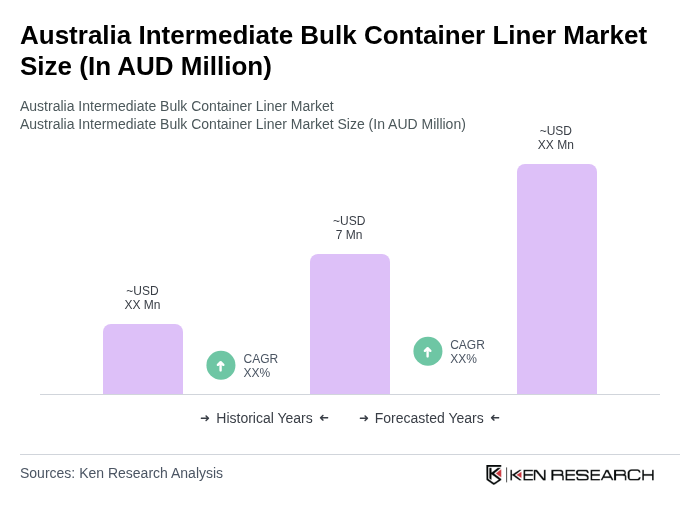
- The Australia Intermediate Bulk Container Liner Market is valued at approximately AUD 7 million, based on a five-year historical analysis of the country-level intermediate bulk container liner industry revenue. This growth is primarily driven by the increasing demand for efficient and safe transportation of bulk liquids and powders across industries such as chemicals, food, beverages, and pharmaceuticals, where IBC liners support hygienic handling, product integrity, and reduced cleaning and turnaround times. The rising focus on sustainability, including reduced water use for container washing, lower contamination risk, and the adoption of reusable outer containers with replaceable liners, further contributes to the market’s expansion as end users seek eco-friendly and cost-effective bulk packaging solutions.
- Key demand centres for intermediate bulk containers and liners in Australia include industrialised states such as New South Wales and Victoria, which dominate due to their robust manufacturing base in chemicals, food processing, and pharmaceuticals, along with strong warehousing and logistics activity. The presence of major ports, freight corridors, and a well-developed transportation infrastructure in these regions facilitates efficient distribution of intermediate bulk containers and liners, making them critical to the market’s growth.
- In 2023, the regulatory environment for the transport of dangerous goods in Australia continued to be governed by the Australian Dangerous Goods Code (ADG Code), formally adopted in most jurisdictions through instruments such as the Dangerous Goods (Road and Rail Transport) Regulation 2022 issued by the New South Wales Environment Protection Authority. These rules require that intermediate bulk containers and any associated inner packagings or liners used for hazardous materials comply with UN performance standards for packaging, including suitability of materials, containment integrity, and barrier properties appropriate to the class of dangerous goods being transported, thereby promoting the use of high?performance and high?barrier liner technologies to enhance safety and reduce environmental risks from potential leaks during transit.
Australia Intermediate Bulk Container Liner Market Segmentation
By Material Type:
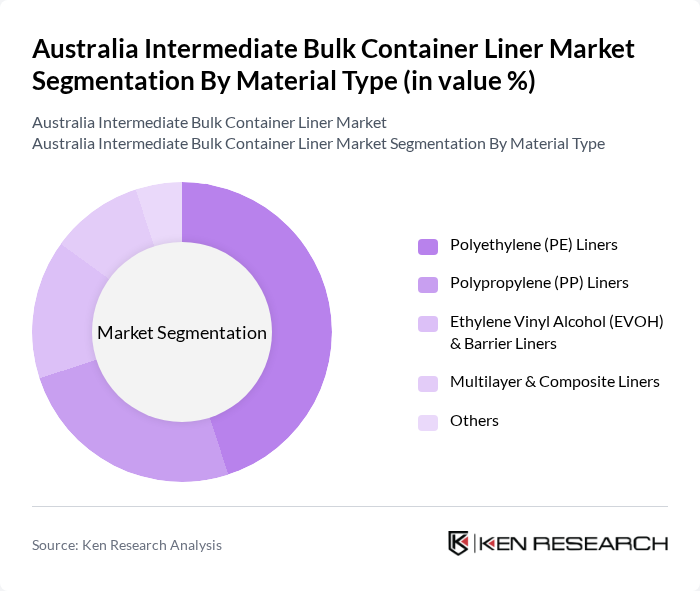
The material type segmentation includes Polyethylene (PE) Liners, Polypropylene (PP) Liners, Ethylene Vinyl Alcohol (EVOH) & Barrier Liners, Multilayer & Composite Liners, and Others. Polyethylene (PE) liners are widely used in intermediate bulk container liner applications globally due to their cost-effectiveness, processability, flexibility, and good chemical resistance, making them suitable for a broad range of liquid and dry bulk products in food, beverage, chemical, and pharmaceutical supply chains. The increasing demand for lightweight and durable flexible packaging, along with the ability of PE liners to support hygienic single-use contact surfaces while enabling reuse of the rigid outer IBC, further drives their preference among end users. Additionally, ongoing innovations such as incorporating recycled content, improved barrier layers, and compatibility with recycling streams are strengthening the position of PE-based liner solutions in sustainable packaging strategies.
By Capacity:
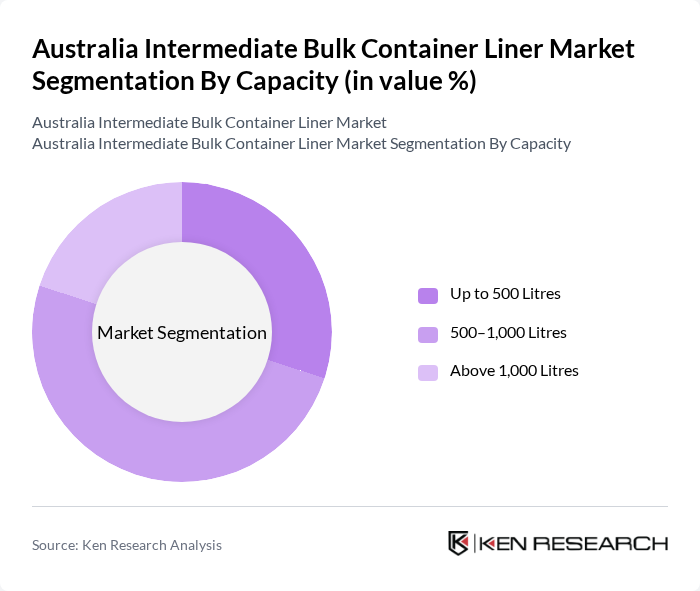
The capacity segmentation includes Up to 500 Litres, 500–1,000 Litres, and Above 1,000 Litres. The segment of 500–1,000 Litres broadly aligns with standard IBC sizes used in Australia and worldwide and is increasingly adopted for transporting food ingredients, specialty chemicals, pharmaceutical intermediates, and industrial liquids due to its balance of payload, footprint, and handling efficiency. This capacity range is particularly favored by manufacturers and distributors for optimizing palletisation, warehouse space utilisation, and transport costs in road, rail, and intermodal logistics, while enabling rapid filling, discharge, and changeover when combined with form-fit liners. As users look to replace drums and smaller containers with larger but still manageable IBC formats, demand in this mid-capacity band has strengthened in applications requiring both operational flexibility and compliance with dangerous goods and food-contact standards.
Australia Intermediate Bulk Container Liner Market Competitive Landscape
The Australia Intermediate Bulk Container Liner Market is characterized by a dynamic mix of regional and international players. Leading participants such as Amcor plc, Visy Industries, CDF Corporation, Berry Global, Inc., Greif, Inc., Schoeller Allibert, Nittel GmbH, Büscherhoff Packaging Solutions GmbH & Co. KG, LC Packaging International BV, Trans Ocean Bulk Logistics Limited, Qingdao LAF Packaging Co., Ltd., Shandong Fully Packing Materials Co., Ltd., Composite Containers LLC, International Paper Company, Mondi Group contribute to innovation, geographic expansion, and service delivery in this space.
Australia Intermediate Bulk Container Liner Market Industry Analysis
Growth Drivers
- Increasing Demand for Bulk Transportation:The Australian logistics sector is projected to grow significantly, with the freight transport industry expected to reach AUD 90 billion in future. This growth is driven by the rising need for efficient bulk transportation solutions across various sectors, including agriculture and manufacturing. The increasing volume of goods transported, estimated at 1.1 billion tonnes annually, necessitates the use of intermediate bulk containers (IBCs) for cost-effective and safe transport, thereby boosting market demand.
- Rising Focus on Sustainable Packaging Solutions:With Australia aiming to reduce plastic waste by 50% in future, there is a growing emphasis on sustainable packaging solutions. The Australian Packaging Covenant has led to a 25% increase in the adoption of eco-friendly materials in packaging. This shift is encouraging manufacturers to invest in biodegradable and recyclable intermediate bulk container liners, aligning with consumer preferences for environmentally responsible products and enhancing market growth.
- Growth in the Food and Beverage Industry:The Australian food and beverage sector is projected to reach AUD 220 billion in future, driven by increasing consumer demand for packaged goods. This growth is fostering a higher requirement for intermediate bulk containers, particularly for transporting liquids and bulk solids. The sector's expansion is expected to increase the demand for IBC liners, which are essential for maintaining product integrity and safety during transportation, thus propelling market growth.
Market Challenges
- Fluctuating Raw Material Prices:The volatility in raw material prices, particularly for plastics and biodegradable materials, poses a significant challenge to the intermediate bulk container liner market. In future, the price of polyethylene, a key material, surged by 20%, impacting production costs. This fluctuation can lead to increased prices for end consumers and may hinder the growth of the market as manufacturers struggle to maintain profitability while offering competitive pricing.
- Stringent Environmental Regulations:Compliance with stringent environmental regulations in Australia, such as the National Waste Policy, presents challenges for manufacturers of intermediate bulk container liners. These regulations require adherence to recycling and waste management standards, which can increase operational costs. In future, companies may face fines exceeding AUD 1.5 million for non-compliance, compelling them to invest in sustainable practices that could strain financial resources and impact market dynamics.
Australia Intermediate Bulk Container Liner Market Future Outlook
The future of the Australia intermediate bulk container liner market appears promising, driven by technological advancements and a shift towards sustainability. As manufacturers increasingly adopt automation and smart technologies, production efficiency is expected to improve significantly. Additionally, the growing emphasis on circular economy practices will likely lead to innovative packaging solutions that minimize waste. These trends, combined with the expansion of e-commerce, will create a robust environment for market growth, fostering new opportunities for businesses in the sector.
Market Opportunities
- Adoption of Advanced Manufacturing Technologies:The integration of advanced manufacturing technologies, such as 3D printing and automation, presents a significant opportunity for the intermediate bulk container liner market. These technologies can enhance production efficiency and reduce costs, allowing manufacturers to meet the growing demand for customized solutions while maintaining high-quality standards, thus driving market growth.
- Expansion into Emerging Markets:The potential for expansion into emerging markets, particularly in the Asia-Pacific region, offers lucrative opportunities for Australian manufacturers. With the region's increasing demand for bulk transportation solutions, companies can leverage their expertise in intermediate bulk container liners to capture new market share, driving revenue growth and enhancing their competitive position in the global market.
Scope of the Report
| Segment | Sub-Segments |
|---|---|
| By Material Type | Polyethylene (PE) Liners Polypropylene (PP) Liners Ethylene Vinyl Alcohol (EVOH) & Barrier Liners Multilayer & Composite Liners Others |
| By Capacity | Up to 500 Litres –1,000 Litres Above 1,000 Litres |
| By Content Type | Liquid Products Semi-liquid & Paste Products Dry Bulk & Granular Products |
| By Application | Chemicals & Hazardous Materials Food & Beverages Pharmaceuticals & Biologics Lubricants, Oils & Petrochemicals Agriculture & Allied Products Others |
| By End-Use Industry | Chemical Manufacturing Food Processing Pharmaceutical Production Agriculture & Agribusiness Mining & Industrial Processing Others |
| By Liner Configuration | Single-Use Liners Reusable / Multi-trip Liners Aseptic & Sterile Liners High-Barrier & Oxygen-Barrier Liners |
| By Region | New South Wales Victoria Queensland Western Australia South Australia Others |
Key Target Audience
Investors and Venture Capitalist Firms
Government and Regulatory Bodies (e.g., Australian Competition and Consumer Commission, Department of Agriculture, Water and the Environment)
Manufacturers and Producers
Logistics and Supply Chain Companies
Packaging Material Suppliers
Transport and Freight Companies
Industry Associations (e.g., Australian Packaging Covenant Organisation)
Financial Institutions
Players Mentioned in the Report:
Amcor plc
Visy Industries
CDF Corporation
Berry Global, Inc.
Greif, Inc.
Schoeller Allibert
Nittel GmbH
Buscherhoff Packaging Solutions GmbH & Co. KG
LC Packaging International BV
Trans Ocean Bulk Logistics Limited
Qingdao LAF Packaging Co., Ltd.
Shandong Fully Packing Materials Co., Ltd.
Composite Containers LLC
International Paper Company
Mondi Group
Table of Contents
Market Assessment Phase
1. Executive Summary and Approach
2. Australia Intermediate Bulk Container Liner Market Overview
2.1 Key Insights and Strategic Recommendations
2.2 Australia Intermediate Bulk Container Liner Market Overview
2.3 Definition and Scope
2.4 Evolution of Market Ecosystem
2.5 Timeline of Key Regulatory Milestones
2.6 Value Chain & Stakeholder Mapping
2.7 Business Cycle Analysis
2.8 Policy & Incentive Landscape
3. Australia Intermediate Bulk Container Liner Market Analysis
3.1 Growth Drivers
3.1.1 Increasing demand for bulk transportation
3.1.2 Rising focus on sustainable packaging solutions
3.1.3 Growth in the food and beverage industry
3.1.4 Expansion of e-commerce and logistics sectors
3.2 Market Challenges
3.2.1 Fluctuating raw material prices
3.2.2 Stringent environmental regulations
3.2.3 Competition from alternative packaging solutions
3.2.4 Supply chain disruptions
3.3 Market Opportunities
3.3.1 Adoption of advanced manufacturing technologies
3.3.2 Expansion into emerging markets
3.3.3 Development of customized liner solutions
3.3.4 Strategic partnerships and collaborations
3.4 Market Trends
3.4.1 Increasing use of biodegradable materials
3.4.2 Growth of reusable packaging systems
3.4.3 Digitalization in supply chain management
3.4.4 Focus on circular economy practices
3.5 Government Regulation
3.5.1 Compliance with Australian Packaging Covenant
3.5.2 Regulations on plastic waste management
3.5.3 Standards for food safety and hygiene
3.5.4 Import/export regulations for packaging materials
4. SWOT Analysis
5. Stakeholder Analysis
6. Porter's Five Forces Analysis
7. Australia Intermediate Bulk Container Liner Market Market Size, 2019-2024
7.1 By Value
7.2 By Volume
7.3 By Average Selling Price
8. Australia Intermediate Bulk Container Liner Market Segmentation
8.1 By Material Type
8.1.1 Polyethylene (PE) Liners
8.1.2 Polypropylene (PP) Liners
8.1.3 Ethylene Vinyl Alcohol (EVOH) & Barrier Liners
8.1.4 Multilayer & Composite Liners
8.1.5 Others
8.2 By Capacity
8.2.1 Up to 500 Litres
8.2.2 500–1,000 Litres
8.2.3 Above 1,000 Litres
8.3 By Content Type
8.3.1 Liquid Products
8.3.2 Semi-liquid & Paste Products
8.3.3 Dry Bulk & Granular Products
8.4 By Application
8.4.1 Chemicals & Hazardous Materials
8.4.2 Food & Beverages
8.4.3 Pharmaceuticals & Biologics
8.4.4 Lubricants, Oils & Petrochemicals
8.4.5 Agriculture & Allied Products
8.4.6 Others
8.5 By End-Use Industry
8.5.1 Chemical Manufacturing
8.5.2 Food Processing
8.5.3 Pharmaceutical Production
8.5.4 Agriculture & Agribusiness
8.5.5 Mining & Industrial Processing
8.5.6 Others
8.6 By Liner Configuration
8.6.1 Single-Use Liners
8.6.2 Reusable / Multi-trip Liners
8.6.3 Aseptic & Sterile Liners
8.6.4 High-Barrier & Oxygen-Barrier Liners
8.7 By Region
8.7.1 New South Wales
8.7.2 Victoria
8.7.3 Queensland
8.7.4 Western Australia
8.7.5 South Australia
8.7.6 Others
9. Australia Intermediate Bulk Container Liner Market Competitive Analysis
9.1 Market Share of Key Players
9.2 Cross Comparison of Key Players
9.2.1 Company Name
9.2.2 Company Size (Revenue & Employee Band)
9.2.3 Australia IBC Liner Revenue (AUD Mn)
9.2.4 3-Year Revenue CAGR in IBC Liners (%)
9.2.5 EBITDA Margin from IBC Liner Business (%)
9.2.6 Market Share in Australia IBC Liner Market (%)
9.2.7 Average Realized Price per Liner (AUD/Unit)
9.2.8 Capacity Utilization Rate (%)
9.2.9 On-time Delivery Rate (%)
9.2.10 Customer Retention Rate (%)
9.2.11 R&D Intensity (% of Revenue)
9.2.12 Revenue Share from Sustainable/High-Barrier Liners (%)
9.2.13 Geographic Revenue Mix (Domestic vs Export %)
9.3 SWOT Analysis of Top Players
9.4 Pricing Analysis
9.5 Detailed Profile of Major Companies
9.5.1 Amcor plc
9.5.2 Visy Industries
9.5.3 CDF Corporation
9.5.4 Berry Global, Inc.
9.5.5 Greif, Inc.
9.5.6 Schoeller Allibert
9.5.7 Nittel GmbH
9.5.8 Büscherhoff Packaging Solutions GmbH & Co. KG
9.5.9 LC Packaging International BV
9.5.10 Trans Ocean Bulk Logistics Limited
9.5.11 Qingdao LAF Packaging Co., Ltd.
9.5.12 Shandong Fully Packing Materials Co., Ltd.
9.5.13 Composite Containers LLC
9.5.14 International Paper Company
9.5.15 Mondi Group
10. Australia Intermediate Bulk Container Liner Market End-User Analysis
10.1 Procurement Behavior of Key Ministries
10.1.1 Key Procurement Policies
10.1.2 Budget Allocation Trends
10.1.3 Supplier Selection Criteria
10.1.4 Contract Management Practices
10.2 Corporate Spend on Infrastructure & Energy
10.2.1 Investment Trends in Infrastructure
10.2.2 Energy Consumption Patterns
10.2.3 Budgeting for Sustainability Initiatives
10.3 Pain Point Analysis by End-User Category
10.3.1 Challenges in Supply Chain Management
10.3.2 Quality Assurance Issues
10.3.3 Cost Management Concerns
10.4 User Readiness for Adoption
10.4.1 Awareness of New Technologies
10.4.2 Training and Support Needs
10.5 Post-Deployment ROI and Use Case Expansion
10.5.1 Measurement of ROI Metrics
10.5.2 Case Studies of Successful Implementations
11. Australia Intermediate Bulk Container Liner Market Future Size, 2025-2030
11.1 By Value
11.2 By Volume
11.3 By Average Selling Price
Go-To-Market Strategy Phase
1. Whitespace Analysis + Business Model Canvas
1.1 Market Gaps Identification
1.2 Value Proposition Development
1.3 Revenue Streams Analysis
1.4 Cost Structure Evaluation
1.5 Key Partnerships Exploration
1.6 Customer Segmentation
1.7 Channels of Distribution
2. Marketing and Positioning Recommendations
2.1 Branding Strategies
2.2 Product USPs
3. Distribution Plan
3.1 Urban Retail vs Rural NGO Tie-ups
4. Channel & Pricing Gaps
4.1 Underserved Routes
4.2 Pricing Bands
5. Unmet Demand & Latent Needs
5.1 Category Gaps
5.2 Consumer Segments
6. Customer Relationship
6.1 Loyalty Programs
6.2 After-sales Service
7. Value Proposition
7.1 Sustainability
7.2 Integrated Supply Chains
8. Key Activities
8.1 Regulatory Compliance
8.2 Branding
8.3 Distribution Setup
9. Entry Strategy Evaluation
9.1 Domestic Market Entry Strategy
9.1.1 Product Mix
9.1.2 Pricing Band
9.1.3 Packaging
9.2 Export Entry Strategy
9.2.1 Target Countries
9.2.2 Compliance Roadmap
10. Entry Mode Assessment
10.1 JV
10.2 Greenfield
10.3 M&A
10.4 Distributor Model
11. Capital and Timeline Estimation
11.1 Capital Requirements
11.2 Timelines
12. Control vs Risk Trade-Off
12.1 Ownership vs Partnerships
13. Profitability Outlook
13.1 Breakeven Analysis
13.2 Long-term Sustainability
14. Potential Partner List
14.1 Distributors
14.2 JVs
14.3 Acquisition Targets
15. Execution Roadmap
15.1 Phased Plan for Market Entry
15.1.1 Market Setup
15.1.2 Market Entry
15.1.3 Growth Acceleration
15.1.4 Scale & Stabilize
15.2 Key Activities and Milestones
15.2.1 Milestone Planning
15.2.2 Activity Tracking
Research Methodology
Phase 1: Approach1
Desk Research
- Industry reports from Australian logistics and packaging associations
- Market analysis from government publications and trade statistics
- Academic journals focusing on supply chain management and bulk container usage
Primary Research
- Interviews with logistics managers at major Australian import/export firms
- Surveys targeting manufacturers utilizing intermediate bulk containers
- Field visits to distribution centers and warehouses employing bulk liners
Validation & Triangulation
- Cross-validation of data through multiple industry sources and reports
- Triangulation of findings from primary interviews and secondary data
- Expert panel reviews to ensure data accuracy and relevance
Phase 2: Market Size Estimation1
Top-down Assessment
- Analysis of total logistics expenditure in Australia to estimate market potential
- Segmentation of market by end-user industries such as food, chemicals, and pharmaceuticals
- Incorporation of trends in sustainability and environmental regulations affecting bulk container usage
Bottom-up Modeling
- Volume estimates based on production data from key sectors using intermediate bulk containers
- Cost analysis derived from pricing models of leading container manufacturers
- Estimation of market share based on firm-level sales data and distribution networks
Forecasting & Scenario Analysis
- Multi-variable forecasting considering economic growth, trade policies, and environmental factors
- Scenario planning based on potential shifts in consumer behavior and regulatory changes
- Development of baseline, optimistic, and pessimistic market growth projections through 2030
Phase 3: CATI Sample Composition1
| Scope Item/Segment | Sample Size | Target Respondent Profiles |
|---|---|---|
| Food and Beverage Sector | 120 | Supply Chain Managers, Quality Assurance Officers |
| Chemicals and Petrochemicals | 90 | Procurement Managers, Operations Directors |
| Pharmaceuticals and Healthcare | 80 | Logistics Coordinators, Compliance Managers |
| Construction and Building Materials | 60 | Warehouse Managers, Project Managers |
| Retail and E-commerce | 100 | Inventory Managers, Distribution Center Supervisors |
Frequently Asked Questions
What is the current value of the Australia Intermediate Bulk Container Liner Market?
The Australia Intermediate Bulk Container Liner Market is valued at approximately AUD 7 million, driven by the increasing demand for efficient transportation of bulk liquids and powders across various industries, including chemicals, food, beverages, and pharmaceuticals.
What factors are driving the growth of the Australia Intermediate Bulk Container Liner Market?
Which regions in Australia are the primary demand centers for intermediate bulk containers?
What are the main material types used for intermediate bulk container liners in Australia?
Other Regional/Country Reports
Other Adjacent Reports
South Africa Bulk Packaging Market
Malaysia Chemical Packaging Market
KSA food packaging market size, share, growth drivers, trends, opportunities & forecast 2025–2030Indonesia Beverage Packaging Market Size, Share, Growth Drivers, Trends, Opportunities & Forecast 2025–2030Middle East pharmaceutical packaging market size, share, growth drivers, trends, opportunities & forecast 2025–2030KSA sustainable packaging market report Size, Share, Growth Drivers, Trends, Opportunities & Forecast 2025–2030UAE Industrial Packaging Market Report Size Share Growth Drivers Trends Opportunities & Forecast 2025–2030South Korea Hazardous Materials Packaging Market
Why Buy From Us?

What makes us stand out is that our consultants follow Robust, Refine and Result (RRR) methodology. Robust for clear definitions, approaches and sanity checking, Refine for differentiating respondents' facts and opinions, and Result for presenting data with story.

We have set a benchmark in the industry by offering our clients with syndicated and customized market research reports featuring coverage of entire market as well as meticulous research and analyst insights.

While we don't replace traditional research, we flip the method upside down. Our dual approach of Top Bottom & Bottom Top ensures quality deliverable by not just verifying company fundamentals but also looking at the sector and macroeconomic factors.

With one step in the future, our research team constantly tries to show you the bigger picture. We help with some of the tough questions you may encounter along the way: How is the industry positioned? Best marketing channel? KPI's of competitors? By aligning every element, we help maximize success.

Our report gives you instant access to the answers and sources that other companies might choose to hide. We elaborate each steps of research methodology we have used and showcase you the sample size to earn your trust.

If you need any support, we are here! We pride ourselves on universe strength, data quality, and quick, friendly, and professional service.