About the Report
Base Year 2024New Zealand Intermediate Bulk Container Liner Market Overview
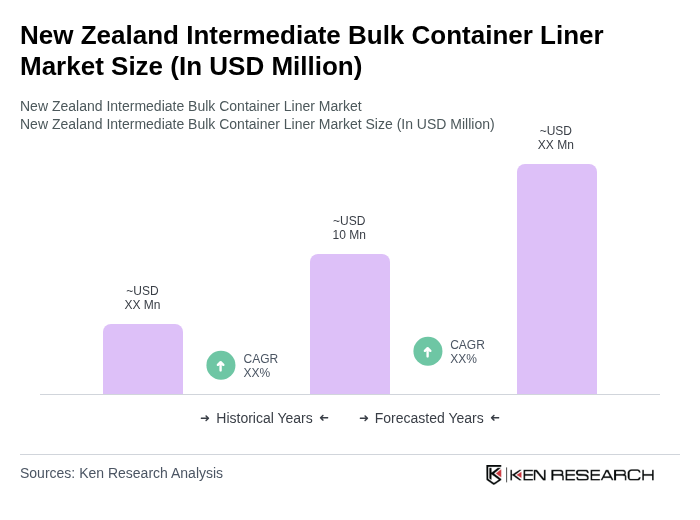
- The New Zealand Intermediate Bulk Container Liner Market is valued at approximately USD 10 million, based on a five-year historical analysis and the proportion of New Zealand’s chemicals, food and beverage, and pharmaceutical output relative to the global intermediate bulk container liner market, which was valued at about USD 950–1,000 million at the global level. This growth is primarily driven by the increasing demand for efficient and safe transportation of bulk liquids and powders across various industries, including chemicals, food and beverages, and pharmaceuticals, all of which are key export-oriented sectors in New Zealand. The rising focus on sustainability, driven by tighter packaging waste requirements and corporate environmental targets, and the need for cost-effective, reusable bulk packaging solutions further propel market expansion.
- Key cities such as Auckland, Wellington, and Christchurch dominate the market due to their strategic locations, robust port and transport infrastructure, and concentration of manufacturing and logistics companies. Auckland and Tauranga are New Zealand’s primary container ports, handling the majority of the country’s containerised trade, while Christchurch (via Lyttelton Port) and Wellington play important roles in South and North Island distribution. These urban centers serve as critical hubs for trade and distribution, facilitating the efficient movement of goods and enhancing the demand for intermediate bulk container liners used in export and domestic supply chains.
- In 2023, the New Zealand government strengthened its policy framework to reduce plastic waste, including tighter product stewardship and packaging requirements that affect industrial and transport packaging. The Waste Minimisation (Plastic and Related Products) Regulations 2022, issued by the New Zealand Ministry for the Environment, phase out a range of hard-to-recycle and single-use plastic products and support a shift toward reusable and recyclable packaging materials for goods placed on the market. Complementary initiatives under the New Zealand Emissions Reduction Plan and the move toward regulated, mandatory product stewardship for packaging are encouraging industries to adopt eco?friendly, recyclable, and lightweight bulk packaging solutions, thereby influencing the demand for innovative intermediate bulk container liners that comply with environmental and resource-efficiency standards.
New Zealand Intermediate Bulk Container Liner Market Segmentation
By Capacity:
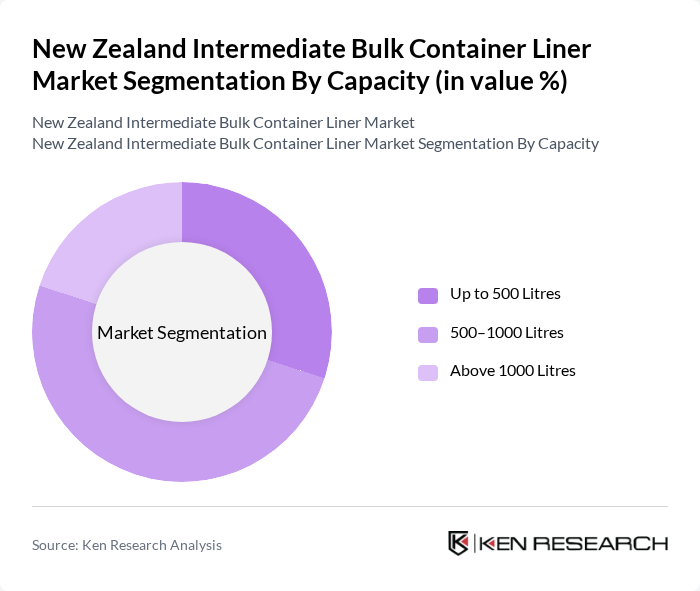
The capacity segmentation of the market includes three subsegments: Up to 500 Litres, 500–1000 Litres, and Above 1000 Litres. The subsegment of 500–1000 Litres is described as dominating the market due to its versatility and suitability for a wide range of applications, particularly in the chemical and food industries. However, global evidence for intermediate bulk container liners shows that containers above 1000 litres account for the larger share of demand, supported by their cost-efficiency for bulk transport and export of liquids and semi-liquids. In New Zealand, 500–1000 Litres formats remain widely used for domestic distribution and medium-volume shipments where handling flexibility and compatibility with standard pallets and warehouse systems are critical, while the demand for larger containers, particularly those above 1000 Litres, is growing in export-oriented sectors seeking to optimize logistics, reduce per-unit transport costs, and minimise packaging waste.
By Material Type:
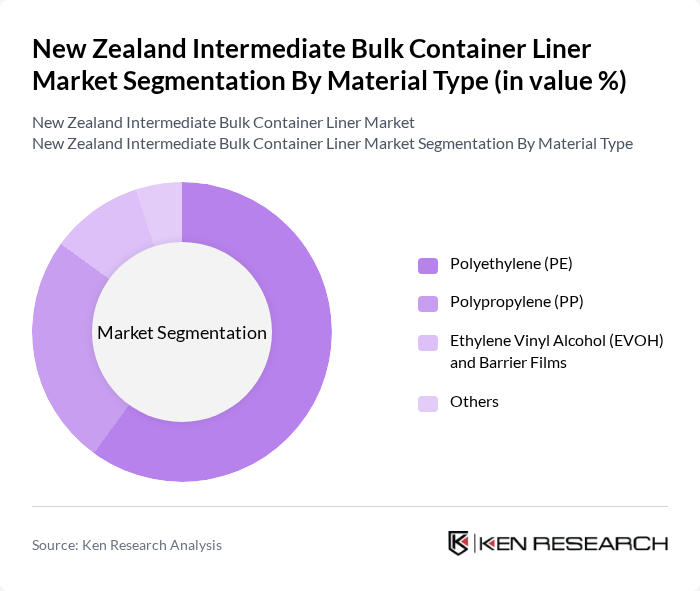
The material type segmentation includes Polyethylene (PE), Polypropylene (PP), Ethylene Vinyl Alcohol (EVOH) and Barrier Films, and Others. Polyethylene (PE) is the leading material type in the market, primarily due to its excellent chemical resistance, flexibility, sealability, and cost-effectiveness, which aligns with global usage patterns for intermediate bulk container liners and other industrial films. This material is widely used in the production of intermediate bulk container liners, making it a preferred choice among manufacturers for food, beverage, and many chemical applications. Polypropylene (PP) is also gaining traction due to its higher temperature resistance, stiffness, and strength, which support applications requiring better heat resistance and mechanical performance in the food, chemical, and pharmaceutical sectors, while multilayer EVOH and other barrier films are increasingly used where enhanced oxygen and moisture barrier properties are needed to protect sensitive liquid food and nutraceutical products.
New Zealand Intermediate Bulk Container Liner Market Competitive Landscape
The New Zealand Intermediate Bulk Container Liner Market is characterized by a dynamic mix of regional and international players. Leading participants such as Greif, Inc., Schütz GmbH & Co. KGaA, Mondi Group, Smurfit Kappa Group, Berry Global, Inc., Visy Industries, Amcor plc, International Paper Company, Novolex, ProAmpac, Sonoco Products Company, BulkPak, AEP Industries Inc., Sealed Air Corporation, Dunlop Protective Footwear contribute to innovation, geographic expansion, and service delivery in this space.
New Zealand Intermediate Bulk Container Liner Market Industry Analysis
Growth Drivers
- Increasing Demand for Bulk Transportation Solutions:The New Zealand logistics sector is projected to grow significantly, with the freight transport industry expected to reach NZD 12 billion in future. This growth is driven by the need for efficient bulk transportation solutions, particularly in agriculture and manufacturing. The rise in demand for cost-effective shipping methods is pushing companies to adopt intermediate bulk containers, which can handle large volumes while minimizing waste and transportation costs.
- Growth in the Food and Beverage Industry:The food and beverage sector in New Zealand is anticipated to generate NZD 45 billion in revenue in future, reflecting a robust demand for bulk packaging solutions. This growth is fueled by increasing exports, particularly in dairy and meat products, which require reliable and safe transportation methods. Intermediate bulk containers are essential for maintaining product integrity during transit, thus driving their adoption in this expanding market.
- Rising Environmental Concerns and Sustainability Initiatives:New Zealand's commitment to sustainability is evident, with the government aiming for a 50% reduction in greenhouse gas emissions in future. This has led to increased demand for eco-friendly packaging solutions, including biodegradable and recyclable intermediate bulk container liners. Companies are investing in sustainable practices, which is expected to boost the market for environmentally friendly liners, aligning with consumer preferences for sustainable products.
Market Challenges
- Fluctuating Raw Material Prices:The volatility in raw material prices, particularly plastics and polymers, poses a significant challenge for the intermediate bulk container liner market. In recent periods, the price of polyethylene increased by 18% due to supply chain disruptions and increased demand. This fluctuation can lead to unpredictable production costs, affecting profit margins and pricing strategies for manufacturers in New Zealand.
- Stringent Regulatory Requirements:Compliance with stringent regulations regarding packaging waste and environmental standards is a major challenge for the industry. New Zealand's Waste Minimisation Act mandates that companies reduce packaging waste, which can complicate the production and disposal of intermediate bulk container liners. Adhering to these regulations requires significant investment in compliance measures, impacting operational efficiency and costs for manufacturers.
New Zealand Intermediate Bulk Container Liner Market Future Outlook
The New Zealand intermediate bulk container liner market is poised for significant transformation driven by technological advancements and sustainability initiatives. As companies increasingly adopt smart packaging technologies, the integration of digital solutions in supply chain management will enhance efficiency and traceability. Furthermore, the shift towards reusable and recyclable liners will align with global sustainability trends, positioning New Zealand as a leader in eco-friendly packaging solutions. This evolving landscape presents opportunities for innovation and growth in the sector.
Market Opportunities
- Technological Advancements in Liner Materials:Innovations in liner materials, such as the development of lightweight and durable composites, present significant opportunities for manufacturers. These advancements can enhance product performance and reduce shipping costs, making them attractive to businesses looking to optimize their logistics operations.
- Development of Eco-Friendly Liner Options:The increasing consumer demand for sustainable products opens avenues for the development of biodegradable and recyclable liners. Companies that invest in eco-friendly options can differentiate themselves in the market, appealing to environmentally conscious consumers and aligning with government sustainability goals.
Scope of the Report
| Segment | Sub-Segments |
|---|---|
| By Capacity | Up to 500 Litres –1000 Litres Above 1000 Litres |
| By Material Type | Polyethylene (PE) Polypropylene (PP) Ethylene Vinyl Alcohol (EVOH) and Barrier Films Others |
| By Application | Chemicals Food & Beverages Pharmaceuticals Lubricants & Oils Others |
| By End-Use Industry | Chemical Manufacturing Food Processing Pharmaceutical Production Agriculture Others |
| By Thickness | Standard (100–200 Microns) Heavy-Duty (200–300 Microns) Extra Heavy-Duty (Above 300 Microns) |
| By Region | North Island South Island Others |
| By Customer Type | Large Enterprises SMEs Government Others |
Key Target Audience
Investors and Venture Capitalist Firms
Government and Regulatory Bodies (e.g., Ministry of Business, Innovation and Employment)
Manufacturers and Producers
Logistics and Supply Chain Companies
Importers and Exporters
Packaging Material Suppliers
Environmental Agencies (e.g., Environmental Protection Authority)
Trade Associations and Industry Groups
Players Mentioned in the Report:
Greif, Inc.
Schutz GmbH & Co. KGaA
Mondi Group
Smurfit Kappa Group
Berry Global, Inc.
Visy Industries
Amcor plc
International Paper Company
Novolex
ProAmpac
Sonoco Products Company
BulkPak
AEP Industries Inc.
Sealed Air Corporation
Dunlop Protective Footwear
Table of Contents
Market Assessment Phase
1. Executive Summary and Approach
2. New Zealand Intermediate Bulk Container Liner Market Overview
2.1 Key Insights and Strategic Recommendations
2.2 New Zealand Intermediate Bulk Container Liner Market Overview
2.3 Definition and Scope
2.4 Evolution of Market Ecosystem
2.5 Timeline of Key Regulatory Milestones
2.6 Value Chain & Stakeholder Mapping
2.7 Business Cycle Analysis
2.8 Policy & Incentive Landscape
3. New Zealand Intermediate Bulk Container Liner Market Analysis
3.1 Growth Drivers
3.1.1 Increasing demand for bulk transportation solutions
3.1.2 Growth in the food and beverage industry
3.1.3 Rising environmental concerns and sustainability initiatives
3.1.4 Expansion of e-commerce and logistics sectors
3.2 Market Challenges
3.2.1 Fluctuating raw material prices
3.2.2 Stringent regulatory requirements
3.2.3 Competition from alternative packaging solutions
3.2.4 Supply chain disruptions
3.3 Market Opportunities
3.3.1 Technological advancements in liner materials
3.3.2 Growing export markets for New Zealand products
3.3.3 Increased investment in infrastructure
3.3.4 Development of eco-friendly liner options
3.4 Market Trends
3.4.1 Shift towards reusable and recyclable liners
3.4.2 Adoption of smart packaging technologies
3.4.3 Customization of liners for specific industries
3.4.4 Integration of digital solutions in supply chain management
3.5 Government Regulation
3.5.1 Compliance with environmental standards
3.5.2 Regulations on packaging waste management
3.5.3 Safety standards for transportation of goods
3.5.4 Import/export regulations affecting liner materials
4. SWOT Analysis
5. Stakeholder Analysis
6. Porter's Five Forces Analysis
7. New Zealand Intermediate Bulk Container Liner Market Size, 2019-2024
7.1 By Value
7.2 By Volume
7.3 By Average Selling Price
8. New Zealand Intermediate Bulk Container Liner Market Segmentation
8.1 By Capacity
8.1.1 Up to 500 Litres
8.1.2 500–1000 Litres
8.1.3 Above 1000 Litres
8.2 By Material Type
8.2.1 Polyethylene (PE)
8.2.2 Polypropylene (PP)
8.2.3 Ethylene Vinyl Alcohol (EVOH) and Barrier Films
8.2.4 Others
8.3 By Application
8.3.1 Chemicals
8.3.2 Food & Beverages
8.3.3 Pharmaceuticals
8.3.4 Lubricants & Oils
8.3.5 Others
8.4 By End-Use Industry
8.4.1 Chemical Manufacturing
8.4.2 Food Processing
8.4.3 Pharmaceutical Production
8.4.4 Agriculture
8.4.5 Others
8.5 By Thickness
8.5.1 Standard (100–200 Microns)
8.5.2 Heavy-Duty (200–300 Microns)
8.5.3 Extra Heavy-Duty (Above 300 Microns)
8.6 By Region
8.6.1 North Island
8.6.2 South Island
8.6.3 Others
8.7 By Customer Type
8.7.1 Large Enterprises
8.7.2 SMEs
8.7.3 Government
8.7.4 Others
9. New Zealand Intermediate Bulk Container Liner Market Competitive Analysis
9.1 Market Share of Key Players
9.2 Cross Comparison of Key Players
9.2.1 Company Name
9.2.2 Group Size (Large, Medium, or Small as per industry convention)
9.2.3 New Zealand Revenue (NZD, Latest Year)
9.2.4 3-Year Revenue CAGR (%)
9.2.5 EBITDA Margin (%)
9.2.6 Market Share in New Zealand IBC Liner Segment (%)
9.2.7 Volume Sold in New Zealand (Units / Tonnes)
9.2.8 Average Realised Price per Liner (NZD)
9.2.9 Customer Retention Rate (%)
9.2.10 On-Time Delivery Performance (%)
9.2.11 New Product / SKU Introduction Rate (Annual)
9.2.12 Capex Intensity (% of Revenue)
9.3 SWOT Analysis of Top Players
9.4 Pricing Analysis
9.5 Detailed Profile of Major Companies
9.5.1 Greif, Inc.
9.5.2 Schütz GmbH & Co. KGaA
9.5.3 Mondi Group
9.5.4 Smurfit Kappa Group
9.5.5 Berry Global, Inc.
9.5.6 Visy Industries
9.5.7 Amcor plc
9.5.8 International Paper Company
9.5.9 Novolex
9.5.10 ProAmpac
9.5.11 Sonoco Products Company
9.5.12 BulkPak
9.5.13 AEP Industries Inc.
9.5.14 Sealed Air Corporation
9.5.15 Dunlop Protective Footwear
10. New Zealand Intermediate Bulk Container Liner Market End-User Analysis
10.1 Procurement Behavior of Key Ministries
10.1.1 Government procurement policies
10.1.2 Budget allocation for packaging solutions
10.1.3 Supplier selection criteria
10.1.4 Contract management practices
10.2 Corporate Spend on Infrastructure & Energy
10.2.1 Investment trends in packaging infrastructure
10.2.2 Energy efficiency initiatives
10.2.3 Budgeting for sustainable packaging
10.2.4 Corporate social responsibility spending
10.3 Pain Point Analysis by End-User Category
10.3.1 Quality assurance issues
10.3.2 Cost management challenges
10.3.3 Supply chain reliability concerns
10.3.4 Regulatory compliance difficulties
10.4 User Readiness for Adoption
10.4.1 Awareness of new liner technologies
10.4.2 Training and support needs
10.4.3 Financial readiness for investment
10.4.4 Adoption barriers
10.5 Post-Deployment ROI and Use Case Expansion
10.5.1 Measurement of ROI metrics
10.5.2 Case studies of successful implementations
10.5.3 Opportunities for scaling solutions
10.5.4 Feedback mechanisms for continuous improvement
11. New Zealand Intermediate Bulk Container Liner Market Future Size, 2025-2030
11.1 By Value
11.2 By Volume
11.3 By Average Selling Price
Go-To-Market Strategy Phase
1. Whitespace Analysis + Business Model Canvas
1.1 Market gaps identification
1.2 Value proposition development
1.3 Revenue model exploration
1.4 Customer segmentation analysis
1.5 Competitive landscape overview
1.6 Key partnerships identification
1.7 Risk assessment
2. Marketing and Positioning Recommendations
2.1 Branding strategies
2.2 Product USPs
2.3 Target market identification
2.4 Communication strategies
2.5 Digital marketing initiatives
2.6 Customer engagement tactics
2.7 Performance metrics
3. Distribution Plan
3.1 Urban retail strategies
3.2 Rural NGO tie-ups
3.3 Logistics optimization
3.4 Channel partner selection
3.5 Inventory management
3.6 Distribution cost analysis
3.7 Performance tracking
4. Channel & Pricing Gaps
4.1 Underserved routes analysis
4.2 Pricing bands evaluation
4.3 Competitor pricing comparison
4.4 Customer willingness to pay
4.5 Pricing strategy recommendations
4.6 Discounting strategies
4.7 Price elasticity assessment
5. Unmet Demand & Latent Needs
5.1 Category gaps identification
5.2 Consumer segments analysis
5.3 Product development opportunities
5.4 Market entry strategies
5.5 Customer feedback integration
5.6 Future trends forecasting
5.7 Competitive advantage development
6. Customer Relationship
6.1 Loyalty programs design
6.2 After-sales service strategies
6.3 Customer feedback mechanisms
6.4 Relationship management tools
6.5 Customer satisfaction metrics
6.6 Retention strategies
6.7 Community engagement initiatives
7. Value Proposition
7.1 Sustainability initiatives
7.2 Integrated supply chains
7.3 Cost-saving measures
7.4 Quality assurance practices
7.5 Innovation in product offerings
7.6 Customer-centric approaches
7.7 Competitive differentiation
8. Key Activities
8.1 Regulatory compliance measures
8.2 Branding initiatives
8.3 Distribution setup processes
8.4 Training and development programs
8.5 Performance monitoring systems
8.6 Stakeholder engagement activities
8.7 Risk management strategies
9. Entry Strategy Evaluation
9.1 Domestic Market Entry Strategy
9.1.1 Product mix considerations
9.1.2 Pricing band analysis
9.1.3 Packaging strategies
9.2 Export Entry Strategy
9.2.1 Target countries identification
9.2.2 Compliance roadmap development
10. Entry Mode Assessment
10.1 Joint Ventures
10.2 Greenfield Investments
10.3 Mergers & Acquisitions
10.4 Distributor Model
11. Capital and Timeline Estimation
11.1 Capital requirements analysis
11.2 Timelines for market entry
12. Control vs Risk Trade-Off
12.1 Ownership considerations
12.2 Partnerships evaluation
13. Profitability Outlook
13.1 Breakeven analysis
13.2 Long-term sustainability strategies
14. Potential Partner List
14.1 Distributors identification
14.2 Joint Ventures opportunities
14.3 Acquisition targets
15. Execution Roadmap
15.1 Phased Plan for Market Entry
15.1.1 Market Setup
15.1.2 Market Entry
15.1.3 Growth Acceleration
15.1.4 Scale & Stabilize
15.2 Key Activities and Milestones
15.2.1 Activity timelines
15.2.2 Milestone tracking
Research Methodology
Phase 1: Approach1
Desk Research
- Industry reports from New Zealand's Ministry of Transport and Trade
- Market analysis from logistics and supply chain publications
- Statistical data from New Zealand Customs and Statistics Department
Primary Research
- Interviews with key stakeholders in the IBC liner manufacturing sector
- Surveys targeting logistics managers in major import/export companies
- Field interviews with end-users in the food and beverage industry
Validation & Triangulation
- Cross-validation of findings with industry expert panels
- Triangulation of data from trade associations and government reports
- Sanity checks through comparative analysis with similar markets
Phase 2: Market Size Estimation1
Top-down Assessment
- Analysis of total logistics expenditure in New Zealand
- Segmentation of market size by end-user industries such as agriculture and chemicals
- Incorporation of trends in sustainable packaging and environmental regulations
Bottom-up Modeling
- Volume estimates based on production capacities of leading IBC liner manufacturers
- Cost analysis derived from pricing models of various liner types
- Calculation of market size based on projected growth rates and demand forecasts
Forecasting & Scenario Analysis
- Multi-variable regression analysis incorporating economic indicators and trade volumes
- Scenario modeling based on potential shifts in consumer behavior and regulatory changes
- Development of baseline, optimistic, and pessimistic market forecasts through 2030
Phase 3: CATI Sample Composition1
| Scope Item/Segment | Sample Size | Target Respondent Profiles |
|---|---|---|
| Food and Beverage Industry | 120 | Supply Chain Managers, Quality Assurance Officers |
| Chemicals and Hazardous Materials | 90 | Logistics Coordinators, Safety Compliance Managers |
| Agricultural Products | 80 | Procurement Managers, Operations Directors |
| Pharmaceuticals and Healthcare | 70 | Distribution Managers, Regulatory Affairs Specialists |
| Retail and E-commerce | 100 | Warehouse Managers, eCommerce Operations Heads |
Frequently Asked Questions
What is the current value of the New Zealand Intermediate Bulk Container Liner Market?
The New Zealand Intermediate Bulk Container Liner Market is valued at approximately USD 10 million, reflecting its significance in the transportation of bulk liquids and powders across key sectors such as chemicals, food and beverages, and pharmaceuticals.
What factors are driving the growth of the Intermediate Bulk Container Liner Market in New Zealand?
Which cities are key players in the New Zealand Intermediate Bulk Container Liner Market?
What are the main applications of Intermediate Bulk Container Liners in New Zealand?
Other Regional/Country Reports
Other Adjacent Reports
Thailand Chemical Packaging Market
KSA food packaging market size, share, growth drivers, trends, opportunities & forecast 2025–2030Middle East pharmaceutical packaging market size, share, growth drivers, trends, opportunities & forecast 2025–2030Gcc Liquid Packaging Market Report Size, Share, Growth Drivers, Trends, Opportunities & Forecast 2025–2030Egypt Bulk Transportation Market
Germany Plastic Film Market
Why Buy From Us?

What makes us stand out is that our consultants follow Robust, Refine and Result (RRR) methodology. Robust for clear definitions, approaches and sanity checking, Refine for differentiating respondents' facts and opinions, and Result for presenting data with story.

We have set a benchmark in the industry by offering our clients with syndicated and customized market research reports featuring coverage of entire market as well as meticulous research and analyst insights.

While we don't replace traditional research, we flip the method upside down. Our dual approach of Top Bottom & Bottom Top ensures quality deliverable by not just verifying company fundamentals but also looking at the sector and macroeconomic factors.

With one step in the future, our research team constantly tries to show you the bigger picture. We help with some of the tough questions you may encounter along the way: How is the industry positioned? Best marketing channel? KPI's of competitors? By aligning every element, we help maximize success.

Our report gives you instant access to the answers and sources that other companies might choose to hide. We elaborate each steps of research methodology we have used and showcase you the sample size to earn your trust.

If you need any support, we are here! We pride ourselves on universe strength, data quality, and quick, friendly, and professional service.