








Ken Research Logo

Bahrain Hydrolyzed Vegetable Proteins Market Report Size, Share, Growth Drivers, Trends, Opportunities & Forecast 2025–2030

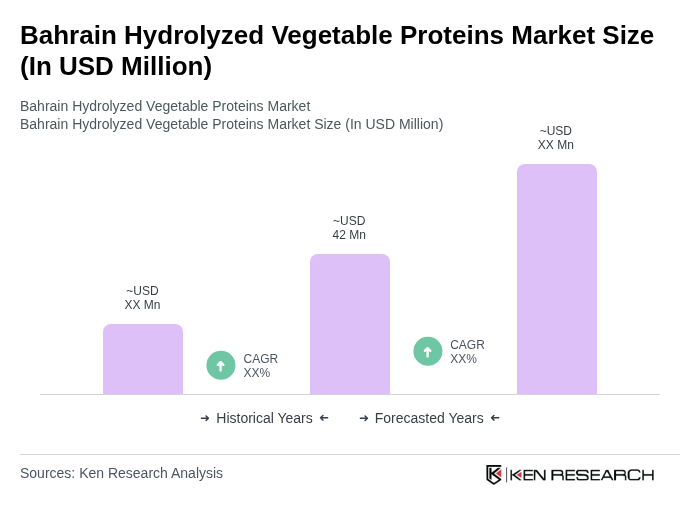
The Bahrain hydrolyzed vegetable proteins market, valued at USD 42 million, is driven by rising demand for plant-based sources and health trends, with opportunities in vegan diets and exports.

Region:Middle East

Author(s):Shubham

Product Code:KRAD5360

Pages:80

Published On:December 2025
About the Report

Base Year 2024

Bahrain Hydrolyzed Vegetable Proteins Market Overview

  • The Bahrain Hydrolyzed Vegetable Proteins Market is valued at USD 42 million, based on a five-year historical analysis. This growth is primarily driven by the increasing demand for plant-based protein sources, rising health consciousness among consumers, and the expanding food and beverage industry. The trend towards vegetarianism and veganism has further accelerated the adoption of hydrolyzed vegetable proteins in various applications.
  • Key players in this market include companies operating in Bahrain, Saudi Arabia, and the United Arab Emirates. These countries dominate the market due to their robust food processing industries, high consumer awareness regarding health and nutrition, and significant investments in food technology. The presence of established food manufacturers and a growing trend towards clean label products also contribute to their market leadership.
  • The Food Safety Regulations, 2017 issued by the Ministry of Health of Bahrain require food additives including hydrolyzed vegetable proteins to meet specified purity standards and mandates clear labeling of all ingredients and protein sources on packaged food products. This initiative aims to enhance food safety standards and encourage the development of plant-based alternatives, aligning with the country's vision for a sustainable food system. The regulation mandates clear labeling of protein sources, ensuring transparency for consumers.
Bahrain Hydrolyzed Vegetable Proteins Market Size

Bahrain Hydrolyzed Vegetable Proteins Market Segmentation

By Type (Hydrolysate Source):The market is segmented into various types based on the source of hydrolysate. The primary types include Hydrolyzed Soy Protein, Hydrolyzed Pea Protein, Hydrolyzed Wheat Protein (including gluten), Hydrolyzed Rice Protein, and Hydrolyzed Corn and Other Cereal Proteins. Each type caters to different consumer preferences and applications in the food industry.
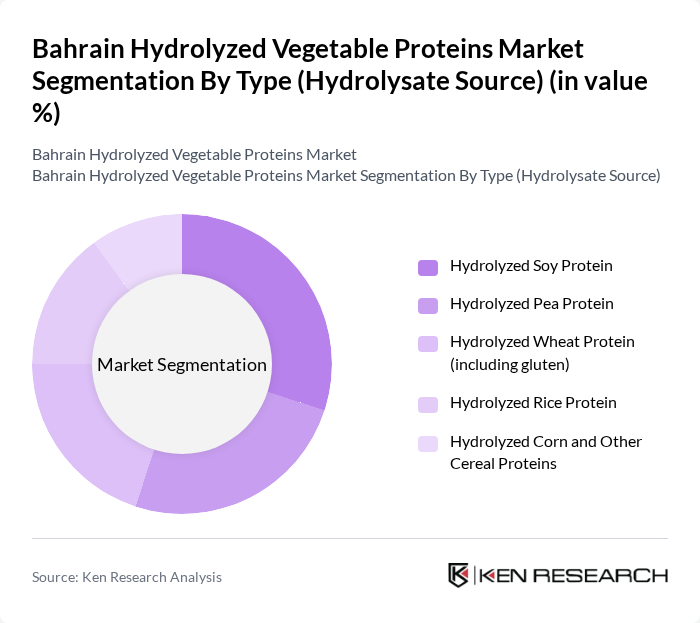
Bahrain Hydrolyzed Vegetable Proteins Market segmentation by Type (Hydrolysate Source).

By End-User Industry:The hydrolyzed vegetable proteins market is further segmented by end-user industries, which include Food Manufacturers, Beverage Manufacturers, Nutraceuticals and Sports Nutrition Brands, Foodservice & HORECA, and Animal Nutrition & Pet Food Producers. Each segment has unique requirements and applications for hydrolyzed proteins.
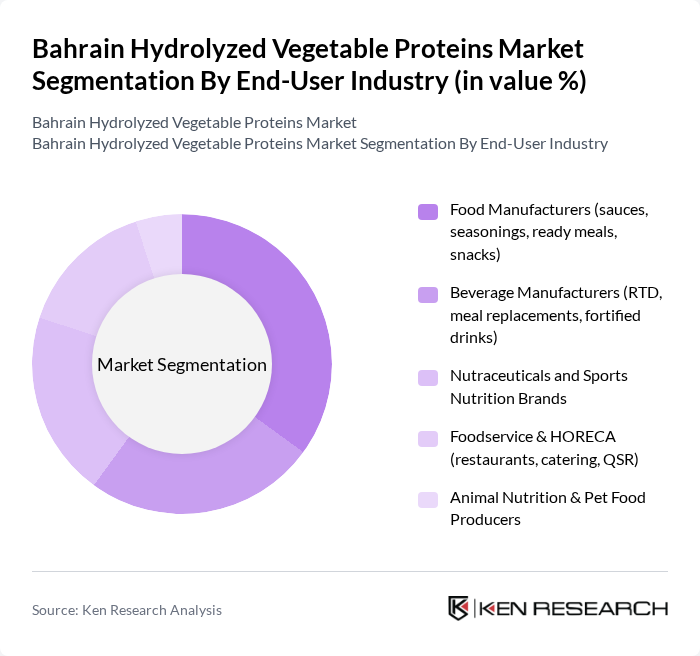
Bahrain Hydrolyzed Vegetable Proteins Market segmentation by End-User Industry.

Bahrain Hydrolyzed Vegetable Proteins Market Competitive Landscape

The Bahrain Hydrolyzed Vegetable Proteins Market is characterized by a dynamic mix of regional and international players. Leading participants such as Kerry Group plc, Tate & Lyle PLC, Roquette Frères, Givaudan SA, Ajinomoto Co., Inc., Griffith Foods International Inc., Sensient Technologies Corporation, Symrise AG, Mane Group, Archer Daniels Midland Company, Cargill, Incorporated, Ingredion Incorporated, CHS Inc., Emsland Group, AGT Food and Ingredients Inc. contribute to innovation, geographic expansion, and service delivery in this space.

Kerry Group plc

1972

Tralee, Ireland

Tate & Lyle PLC

1921

London, UK

Roquette Frères

1933

Lestrem, France

Givaudan SA

1895

Geneva, Switzerland

Ajinomoto Co., Inc.

1909

Tokyo, Japan

Company

Establishment Year

Headquarters

Group Size (Global, Regional, or Local Player)

Bahrain-Specific HVP Revenue (USD Million)

Bahrain HVP Volume Sold (Tonnes per Year)

3-Year CAGR in Bahrain HVP Revenue

Share of HVP in Total MENA Protein Ingredient Sales (%)

Number of HVP SKUs Sold in Bahrain

Bahrain Hydrolyzed Vegetable Proteins Market Industry Analysis

Growth Drivers

  • Increasing Demand for Plant-Based Protein Sources:The global shift towards plant-based diets is reflected in Bahrain, where the demand for hydrolyzed vegetable proteins is surging. In future, the plant-based protein market in the Middle East was valued at approximately $1.5 billion, with projections indicating a growth rate of 10% annually. This trend is driven by a growing population of health-conscious consumers seeking sustainable protein alternatives, aligning with Bahrain's Vision 2030 goals for a diversified economy.
  • Rising Health Consciousness Among Consumers:Health awareness in Bahrain is on the rise, with 78% of consumers actively seeking healthier food options. The World Health Organization reported that non-communicable diseases account for 78% of deaths in Bahrain, prompting a shift towards nutritious diets. This has led to increased interest in hydrolyzed vegetable proteins, which are perceived as healthier alternatives to animal proteins, thus driving market growth and product innovation in the food sector.
  • Expansion of the Food and Beverage Industry:Bahrain's food and beverage industry is projected to reach $1.8 billion by future, fueled by a growing population and tourism sector. The increasing number of restaurants and cafes, alongside a rise in food exports, is creating a robust demand for hydrolyzed vegetable proteins. This expansion is supported by government initiatives aimed at enhancing food security and promoting local production, further solidifying the market's growth potential.

Market Challenges

  • High Production Costs:The production of hydrolyzed vegetable proteins in Bahrain faces significant challenges due to high operational costs. The cost of raw materials, such as soybeans and peas, has increased by 15% over the past year, driven by global supply chain disruptions. This has resulted in a tighter profit margin for manufacturers, making it difficult to compete with cheaper alternative protein sources, thereby hindering market growth.
  • Limited Consumer Awareness:Despite the growing interest in plant-based diets, consumer awareness regarding hydrolyzed vegetable proteins remains low in Bahrain. A recent survey indicated that only 30% of consumers are familiar with these products and their benefits. This lack of knowledge poses a significant barrier to market penetration, as consumers often prefer traditional protein sources, necessitating targeted educational campaigns to increase awareness and acceptance.

Bahrain Hydrolyzed Vegetable Proteins Market Future Outlook

The future of the hydrolyzed vegetable proteins market in Bahrain appears promising, driven by increasing health consciousness and a shift towards plant-based diets. As consumers become more aware of the benefits of these proteins, demand is expected to rise. Additionally, technological advancements in protein extraction and formulation will likely enhance product quality and variety, making hydrolyzed vegetable proteins more appealing to a broader audience, including athletes and health enthusiasts.

Market Opportunities

  • Growth in Vegan and Vegetarian Diets:The rising trend of veganism and vegetarianism in Bahrain presents a significant opportunity for hydrolyzed vegetable proteins. With approximately 10% of the population identifying as vegetarian, there is a growing market for plant-based protein products that cater to this demographic, potentially increasing sales and market share for manufacturers.
  • Potential for Export Markets:Bahrain's strategic location offers access to regional markets, providing opportunities for exporting hydrolyzed vegetable proteins. With the Middle East's demand for plant-based proteins expected to grow by 12% annually, local producers can capitalize on this trend by expanding their export capabilities, thus enhancing revenue streams and market presence.

Scope of the Report

SegmentSub-Segments
By Type (Hydrolysate Source)

Hydrolyzed Soy Protein

Hydrolyzed Pea Protein

Hydrolyzed Wheat Protein (including gluten)

Hydrolyzed Rice Protein

Hydrolyzed Corn and Other Cereal Proteins

By End-User Industry

Food Manufacturers (sauces, seasonings, ready meals, snacks)

Beverage Manufacturers (RTD, meal replacements, fortified drinks)

Nutraceuticals and Sports Nutrition Brands

Foodservice & HORECA (restaurants, catering, QSR)

Animal Nutrition & Pet Food Producers

By Application in Food & Beverages

Flavor Enhancers and Bouillons

Meat Analogues and Extenders

Dairy Alternatives and Vegan Desserts

Bakery, Snacks, and Savory Products

Clinical, Infant, and Medical Nutrition

By Distribution Channel

B2B Ingredient Supply (direct to manufacturers)

Foodservice Distributors

Specialized Ingredient Importers & Traders

Online B2B Platforms

Retail & E-commerce (finished products)

By Form

Dry Powder

Liquid

Paste

Granules and Other Formats

By Processing Method

Acid-Hydrolyzed Vegetable Protein (HVP)

Enzymatically Hydrolyzed Vegetable Protein

Mixed/Other Hydrolysis Processes

By Claim & Certification

Clean Label and Natural

Non-GMO

Halal-Certified

Organic

Conventional

By Governorate in Bahrain

Capital Governorate

Northern Governorate

Southern Governorate

Muharraq Governorate

Key Target Audience

Investors and Venture Capitalist Firms

Government and Regulatory Bodies (e.g., Ministry of Industry, Commerce and Tourism)

Manufacturers and Producers of Hydrolyzed Vegetable Proteins

Food and Beverage Companies

Health and Nutrition Product Developers

Importers and Exporters of Food Ingredients

Industry Associations (e.g., Bahrain Chamber of Commerce and Industry)

Financial Institutions and Banks

Players Mentioned in the Report:

Kerry Group plc

Tate & Lyle PLC

Roquette Freres

Givaudan SA

Ajinomoto Co., Inc.

Griffith Foods International Inc.

Sensient Technologies Corporation

Symrise AG

Mane Group

Archer Daniels Midland Company

Cargill, Incorporated

Ingredion Incorporated

CHS Inc.

Emsland Group

AGT Food and Ingredients Inc.

Table of Contents

Market Assessment Phase

1. Executive Summary and Approach


2. Bahrain Hydrolyzed Vegetable Proteins Market Overview

2.1 Key Insights and Strategic Recommendations

2.2 Bahrain Hydrolyzed Vegetable Proteins Market Overview

2.3 Definition and Scope

2.4 Evolution of Market Ecosystem

2.5 Timeline of Key Regulatory Milestones

2.6 Value Chain & Stakeholder Mapping

2.7 Business Cycle Analysis

2.8 Policy & Incentive Landscape


3. Bahrain Hydrolyzed Vegetable Proteins Market Analysis

3.1 Growth Drivers

3.1.1 Increasing demand for plant-based protein sources
3.1.2 Rising health consciousness among consumers
3.1.3 Expansion of the food and beverage industry
3.1.4 Technological advancements in protein extraction

3.2 Market Challenges

3.2.1 High production costs
3.2.2 Limited consumer awareness
3.2.3 Regulatory hurdles
3.2.4 Competition from alternative protein sources

3.3 Market Opportunities

3.3.1 Growth in vegan and vegetarian diets
3.3.2 Potential for export markets
3.3.3 Innovations in product formulations
3.3.4 Collaborations with food manufacturers

3.4 Market Trends

3.4.1 Increasing use of hydrolyzed vegetable proteins in sports nutrition
3.4.2 Shift towards clean label products
3.4.3 Rising popularity of functional foods
3.4.4 Growth in online retail channels

3.5 Government Regulation

3.5.1 Food safety standards
3.5.2 Labeling requirements
3.5.3 Import/export regulations
3.5.4 Subsidies for local production

4. SWOT Analysis


5. Stakeholder Analysis


6. Porter's Five Forces Analysis


7. Bahrain Hydrolyzed Vegetable Proteins Market Market Size, 2019-2024

7.1 By Value

7.2 By Volume

7.3 By Average Selling Price


8. Bahrain Hydrolyzed Vegetable Proteins Market Segmentation

8.1 By Type (Hydrolysate Source)

8.1.1 Hydrolyzed Soy Protein
8.1.2 Hydrolyzed Pea Protein
8.1.3 Hydrolyzed Wheat Protein (including gluten)
8.1.4 Hydrolyzed Rice Protein
8.1.5 Hydrolyzed Corn and Other Cereal Proteins

8.2 By End-User Industry

8.2.1 Food Manufacturers (sauces, seasonings, ready meals, snacks)
8.2.2 Beverage Manufacturers (RTD, meal replacements, fortified drinks)
8.2.3 Nutraceuticals and Sports Nutrition Brands
8.2.4 Foodservice & HORECA (restaurants, catering, QSR)
8.2.5 Animal Nutrition & Pet Food Producers

8.3 By Application in Food & Beverages

8.3.1 Flavor Enhancers and Bouillons
8.3.2 Meat Analogues and Extenders
8.3.3 Dairy Alternatives and Vegan Desserts
8.3.4 Bakery, Snacks, and Savory Products
8.3.5 Clinical, Infant, and Medical Nutrition

8.4 By Distribution Channel

8.4.1 B2B Ingredient Supply (direct to manufacturers)
8.4.2 Foodservice Distributors
8.4.3 Specialized Ingredient Importers & Traders
8.4.4 Online B2B Platforms
8.4.5 Retail & E-commerce (finished products)

8.5 By Form

8.5.1 Dry Powder
8.5.2 Liquid
8.5.3 Paste
8.5.4 Granules and Other Formats

8.6 By Processing Method

8.6.1 Acid-Hydrolyzed Vegetable Protein (HVP)
8.6.2 Enzymatically Hydrolyzed Vegetable Protein
8.6.3 Mixed/Other Hydrolysis Processes

8.7 By Claim & Certification

8.7.1 Clean Label and Natural
8.7.2 Non-GMO
8.7.3 Halal-Certified
8.7.4 Organic
8.7.5 Conventional

8.8 By Governorate in Bahrain

8.8.1 Capital Governorate
8.8.2 Northern Governorate
8.8.3 Southern Governorate
8.8.4 Muharraq Governorate

9. Bahrain Hydrolyzed Vegetable Proteins Market Competitive Analysis

9.1 Market Share of Key Players

9.2 Cross Comparison of Key Players

9.2.1 Company Name
9.2.2 Group Size (Global, Regional, or Local Player)
9.2.3 Bahrain-Specific HVP Revenue (USD Million)
9.2.4 Bahrain HVP Volume Sold (Tonnes per Year)
9.2.5 3-Year CAGR in Bahrain HVP Revenue
9.2.6 Share of HVP in Total MENA Protein Ingredient Sales (%)
9.2.7 Number of HVP SKUs Sold in Bahrain
9.2.8 Application Breadth Index (Number of End-Use Segments Served)
9.2.9 Average Realized Price per kg in Bahrain (USD/kg)
9.2.10 Local Stockholding Capability (Days of Inventory in Bahrain/GCC)
9.2.11 Distribution Reach in Bahrain (Number of Active B2B Accounts)
9.2.12 Halal & Other Certifications Coverage (Count of Relevant Certifications)
9.2.13 New HVP Products/Variants Launched in MENA in Last 3 Years
9.2.14 Strategic Partnerships in GCC (Distributors, Co-packers, JV)

9.3 SWOT Analysis of Top Players

9.4 Pricing Analysis

9.5 Detailed Profile of Major Companies

9.5.1 Kerry Group plc
9.5.2 Tate & Lyle PLC
9.5.3 Roquette Frères
9.5.4 Givaudan SA
9.5.5 Ajinomoto Co., Inc.
9.5.6 Griffith Foods International Inc.
9.5.7 Sensient Technologies Corporation
9.5.8 Symrise AG
9.5.9 Mane Group
9.5.10 Archer Daniels Midland Company
9.5.11 Cargill, Incorporated
9.5.12 Ingredion Incorporated
9.5.13 CHS Inc.
9.5.14 Emsland Group
9.5.15 AGT Food and Ingredients Inc.

10. Bahrain Hydrolyzed Vegetable Proteins Market End-User Analysis

10.1 Procurement Behavior of Key Ministries

10.1.1 Ministry of Health
10.1.2 Ministry of Industry and Commerce
10.1.3 Ministry of Agriculture and Marine Resources
10.1.4 Ministry of Education

10.2 Corporate Spend on Infrastructure & Energy

10.2.1 Investment in Food Processing Facilities
10.2.2 Budget Allocation for R&D
10.2.3 Expenditure on Marketing and Branding
10.2.4 Funding for Sustainability Initiatives

10.3 Pain Point Analysis by End-User Category

10.3.1 Food Manufacturers
10.3.2 Beverage Producers
10.3.3 Nutraceutical Companies
10.3.4 Animal Feed Suppliers

10.4 User Readiness for Adoption

10.4.1 Awareness of Hydrolyzed Proteins
10.4.2 Willingness to Switch from Traditional Proteins
10.4.3 Availability of Alternative Products
10.4.4 Training and Support Needs

10.5 Post-Deployment ROI and Use Case Expansion

10.5.1 Measurement of Performance Metrics
10.5.2 Customer Feedback and Adaptation
10.5.3 Opportunities for Product Line Expansion
10.5.4 Long-term Partnerships and Collaborations

11. Bahrain Hydrolyzed Vegetable Proteins Market Future Size, 2025-2030

11.1 By Value

11.2 By Volume

11.3 By Average Selling Price


Go-To-Market Strategy Phase

1. Whitespace Analysis + Business Model Canvas

1.1 Market Gaps Identification

1.2 Business Model Framework


2. Marketing and Positioning Recommendations

2.1 Branding Strategies

2.2 Product USPs


3. Distribution Plan

3.1 Urban Retail Strategies

3.2 Rural NGO Tie-ups


4. Channel & Pricing Gaps

4.1 Underserved Routes

4.2 Pricing Bands


5. Unmet Demand & Latent Needs

5.1 Category Gaps

5.2 Consumer Segments


6. Customer Relationship

6.1 Loyalty Programs

6.2 After-sales Service


7. Value Proposition

7.1 Sustainability Initiatives

7.2 Integrated Supply Chains


8. Key Activities

8.1 Regulatory Compliance

8.2 Branding Efforts

8.3 Distribution Setup


9. Entry Strategy Evaluation

9.1 Domestic Market Entry Strategy

9.1.1 Product Mix
9.1.2 Pricing Band
9.1.3 Packaging Considerations

9.2 Export Entry Strategy

9.2.1 Target Countries
9.2.2 Compliance Roadmap

10. Entry Mode Assessment

10.1 Joint Ventures

10.2 Greenfield Investments

10.3 Mergers & Acquisitions

10.4 Distributor Model


11. Capital and Timeline Estimation

11.1 Capital Requirements

11.2 Timelines for Implementation


12. Control vs Risk Trade-Off

12.1 Ownership vs Partnerships


13. Profitability Outlook

13.1 Breakeven Analysis

13.2 Long-term Sustainability


14. Potential Partner List

14.1 Distributors

14.2 Joint Ventures

14.3 Acquisition Targets


15. Execution Roadmap

15.1 Phased Plan for Market Entry

15.1.1 Market Setup
15.1.2 Market Entry
15.1.3 Growth Acceleration
15.1.4 Scale & Stabilize

15.2 Key Activities and Milestones

15.2.1 Milestone Planning
15.2.2 Activity Tracking

Research Methodology

ApproachModellingSample

Phase 1: Approach1

Desk Research

  • Analysis of industry reports from local agricultural and food processing associations
  • Review of government publications on food safety and protein consumption trends in Bahrain
  • Examination of academic journals and market studies focusing on hydrolyzed vegetable proteins

Primary Research

  • Interviews with key stakeholders in the food and beverage industry, including manufacturers and distributors
  • Surveys conducted with nutritionists and dietitians to understand consumer preferences
  • Field interviews with retail managers to gauge market demand and product availability

Validation & Triangulation

  • Cross-validation of data from multiple sources, including trade publications and market surveys
  • Triangulation of findings from primary interviews with secondary data insights
  • Sanity checks through expert panel discussions with industry veterans

Phase 2: Market Size Estimation1

Top-down Assessment

  • Estimation of market size based on national consumption statistics for plant-based proteins
  • Segmentation of the market by application areas such as food, beverages, and dietary supplements
  • Incorporation of growth rates from related sectors, such as vegan and vegetarian food trends

Bottom-up Modeling

  • Collection of sales data from leading manufacturers of hydrolyzed vegetable proteins in Bahrain
  • Estimation of production capacities and output levels from local processing plants
  • Analysis of pricing strategies and cost structures of hydrolyzed protein products

Forecasting & Scenario Analysis

  • Utilization of time-series analysis to project future market trends based on historical data
  • Scenario modeling based on potential regulatory changes and shifts in consumer behavior
  • Development of best-case, worst-case, and most-likely market scenarios through 2030

Phase 3: CATI Sample Composition1

Scope Item/SegmentSample SizeTarget Respondent Profiles
Food and Beverage Manufacturers60Production Managers, Quality Assurance Managers
Retail Outlets and Supermarkets50Store Managers, Category Buyers
Health and Nutrition Experts40Dietitians, Nutrition Consultants
Food Processing Equipment Suppliers40Sales Representatives, Technical Support Staff
Importers and Distributors of Plant-Based Products50Logistics Managers, Procurement Specialists

Frequently Asked Questions

What is the current value of the Bahrain Hydrolyzed Vegetable Proteins Market?

The Bahrain Hydrolyzed Vegetable Proteins Market is valued at approximately USD 42 million, reflecting a growing demand for plant-based protein sources and the expansion of the food and beverage industry in the region.

What are the main drivers of growth in the Bahrain Hydrolyzed Vegetable Proteins Market?

What types of hydrolyzed vegetable proteins are available in Bahrain?

Who are the key players in the Bahrain Hydrolyzed Vegetable Proteins Market?

Other Regional/Country Reports

Indonesia Hydrolyzed Vegetable Proteins Market

Malaysia Hydrolyzed Vegetable Proteins Market

KSA Hydrolyzed Vegetable Proteins Market

APAC Hydrolyzed Vegetable Proteins Market

SEA Hydrolyzed Vegetable Proteins Market

Vietnam Hydrolyzed Vegetable Proteins Market

Why Buy From Us?

Refine Robust Result (RRR) Framework

What makes us stand out is that our consultants follow Robust, Refine and Result (RRR) methodology. Robust for clear definitions, approaches and sanity checking, Refine for differentiating respondents' facts and opinions, and Result for presenting data with story.

Our Reach Is Unmatched

We have set a benchmark in the industry by offering our clients with syndicated and customized market research reports featuring coverage of entire market as well as meticulous research and analyst insights.

Shifting the Research Paradigm

While we don't replace traditional research, we flip the method upside down. Our dual approach of Top Bottom & Bottom Top ensures quality deliverable by not just verifying company fundamentals but also looking at the sector and macroeconomic factors.

More Insights-Better Decisions

With one step in the future, our research team constantly tries to show you the bigger picture. We help with some of the tough questions you may encounter along the way: How is the industry positioned? Best marketing channel? KPI's of competitors? By aligning every element, we help maximize success.

Transparency and Trust

Our report gives you instant access to the answers and sources that other companies might choose to hide. We elaborate each steps of research methodology we have used and showcase you the sample size to earn your trust.

Round the Clock Support

If you need any support, we are here! We pride ourselves on universe strength, data quality, and quick, friendly, and professional service.

Why Clients Choose Us?

400000+
Reports in repository
150+
Consulting projects a year
100+
Analysts
8000+
Client Queries in 2022