About the Report
Base Year 2024Brazil Executive Education and Leadership Market Overview
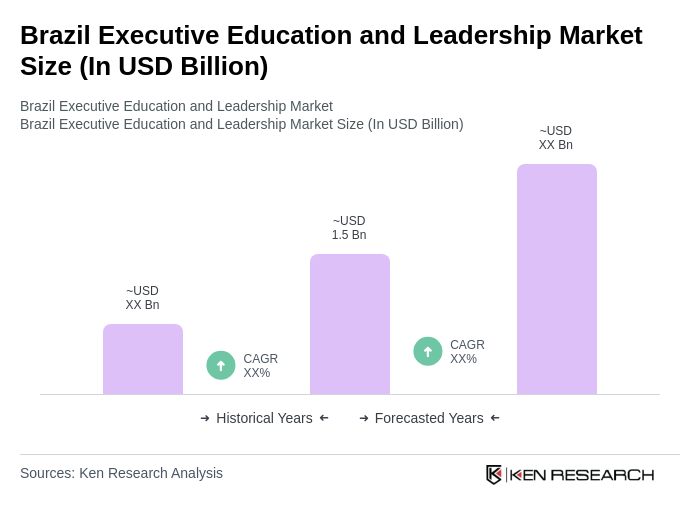
- The Brazil Executive Education and Leadership Market is valued at USD 1.5 billion, based on a five-year historical analysis. This growth is primarily driven by the increasing demand for skilled leadership in a rapidly evolving business environment, coupled with the rise of digital learning platforms that enhance accessibility and flexibility for professionals seeking to advance their careers.
- Key cities such as São Paulo, Rio de Janeiro, and Brasília dominate the market due to their concentration of corporate headquarters, educational institutions, and a vibrant business ecosystem. These urban centers are hubs for innovation and networking, attracting both local and international participants to executive education programs.
- In 2023, the Brazilian government implemented a new regulation aimed at enhancing the quality of executive education programs. This regulation mandates that all accredited institutions must adhere to specific standards of curriculum development and faculty qualifications, ensuring that programs meet the evolving needs of the workforce.
Brazil Executive Education and Leadership Market Segmentation
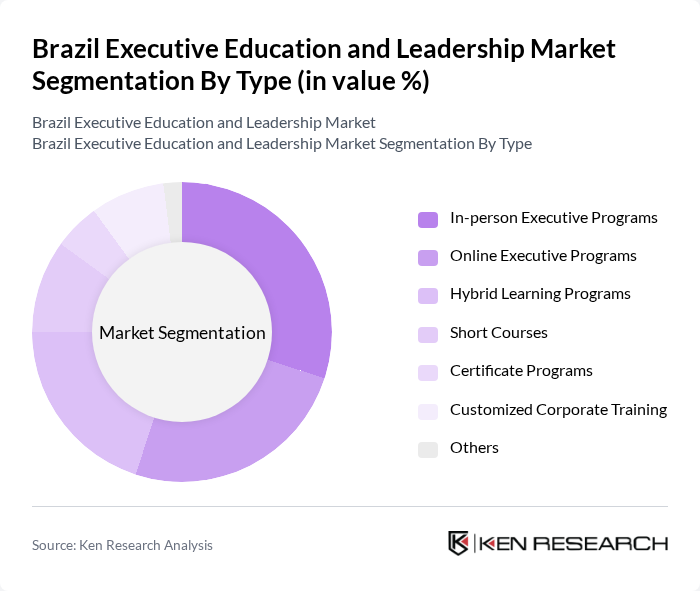
By Type:The market is segmented into various types of educational offerings, including In-person Executive Programs, Online Executive Programs, Hybrid Learning Programs, Short Courses, Certificate Programs, Customized Corporate Training, and Others. Each of these subsegments caters to different learning preferences and organizational needs, reflecting the diverse landscape of executive education.
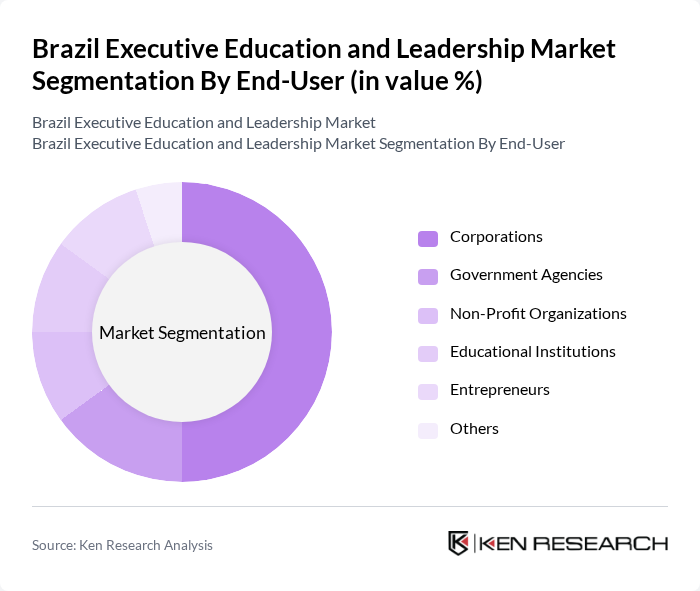
By End-User:The end-user segmentation includes Corporations, Government Agencies, Non-Profit Organizations, Educational Institutions, Entrepreneurs, and Others. This segmentation highlights the diverse clientele that seeks executive education, each with unique requirements and objectives for professional development.
Brazil Executive Education and Leadership Market Competitive Landscape
The Brazil Executive Education and Leadership Market is characterized by a dynamic mix of regional and international players. Leading participants such as Fundação Getulio Vargas (FGV), INSPER, Escola Superior de Propaganda e Marketing (ESPM), HSM Educação, Dom Cabral Foundation, PUC-Rio, FIA Business School, Universidade de São Paulo (USP), FGV Online, Harvard Business School Brazil, Stanford Graduate School of Business Brazil, Wharton School of the University of Pennsylvania Brazil, London Business School Brazil, IE Business School Brazil, MIT Sloan School of Management Brazil contribute to innovation, geographic expansion, and service delivery in this space.
Brazil Executive Education and Leadership Market Industry Analysis
Growth Drivers
- Increasing Demand for Leadership Skills:The Brazilian economy is projected to grow by 2.1% in future, leading to a heightened demand for skilled leaders. Companies are increasingly recognizing the importance of effective leadership in navigating economic challenges. According to the World Economic Forum, 60% of employers in Brazil report a skills gap in leadership, driving investments in executive education programs. This trend is expected to continue as organizations seek to enhance their competitive edge through improved leadership capabilities.
- Rise of Digital Learning Platforms:The digital learning market in Brazil is anticipated to reach $3.5 billion in future, reflecting a significant shift towards online education. This growth is fueled by increased internet penetration, which reached 82% in 2023, and the proliferation of mobile devices. As organizations adapt to remote work, digital platforms offer flexible, accessible training solutions. This trend is particularly relevant for executive education, allowing professionals to enhance their skills without geographical constraints.
- Corporate Investment in Employee Development:In future, Brazilian companies are expected to allocate approximately $10 billion towards employee training and development. This investment is driven by the need to upskill employees in response to rapid technological advancements and market changes. A study by the Brazilian Institute of Geography and Statistics indicates that 70% of firms prioritize leadership training as a key component of their development strategy, highlighting the growing recognition of its importance in fostering organizational success.
Market Challenges
- Economic Instability:Brazil's economic landscape remains volatile, with inflation rates projected to hover around 5.5% in future. This instability poses a challenge for organizations investing in executive education, as budget constraints may limit training expenditures. Additionally, fluctuating currency values can impact the affordability of international programs, making it difficult for companies to commit to long-term training initiatives. Such economic uncertainties can hinder the growth of the executive education market.
- Competition from Informal Education Providers:The rise of informal education providers, including online courses and free resources, presents a significant challenge to traditional executive education institutions. In future, it is estimated that 40% of Brazilian professionals will opt for informal learning options due to their cost-effectiveness and flexibility. This trend threatens the market share of established providers, compelling them to innovate and adapt their offerings to remain competitive in a rapidly evolving educational landscape.
Brazil Executive Education and Leadership Market Future Outlook
The future of the Brazilian executive education market appears promising, driven by technological advancements and evolving corporate needs. As organizations increasingly prioritize leadership development, the demand for tailored programs is expected to rise. Furthermore, the integration of artificial intelligence in learning processes will enhance personalization and effectiveness. With a focus on sustainability and ethical leadership, educational institutions will likely adapt their curricula to meet the changing expectations of both businesses and society, fostering a new generation of responsible leaders.
Market Opportunities
- Expansion of Online Executive Programs:The growing acceptance of online learning presents a significant opportunity for executive education providers. By developing comprehensive online programs, institutions can reach a broader audience, including professionals in remote areas. This shift not only enhances accessibility but also allows for the incorporation of innovative teaching methods, catering to diverse learning preferences and increasing overall engagement.
- Partnerships with International Institutions:Collaborating with international educational institutions can enhance the credibility and appeal of Brazilian executive programs. Such partnerships can facilitate knowledge exchange, access to global best practices, and the introduction of internationally recognized certifications. This strategy can attract a wider range of participants, including those seeking global perspectives on leadership and management, thereby enriching the local educational landscape.
Scope of the Report
| Segment | Sub-Segments |
|---|---|
| By Type | In-person Executive Programs Online Executive Programs Hybrid Learning Programs Short Courses Certificate Programs Customized Corporate Training Others |
| By End-User | Corporations Government Agencies Non-Profit Organizations Educational Institutions Entrepreneurs Others |
| By Industry | Finance Technology Healthcare Manufacturing Retail Others |
| By Program Duration | Short-term (Less than 3 months) Medium-term (3 to 6 months) Long-term (More than 6 months) |
| By Delivery Mode | Online In-person Blended |
| By Certification Type | Accredited Programs Non-accredited Programs Professional Development Certifications |
| By Pricing Tier | Premium Mid-range Budget |
Key Target Audience
Investors and Venture Capitalist Firms
Government and Regulatory Bodies (e.g., Ministério da Educação, Agência Nacional de Educação Profissional e Tecnológica)
Corporate Training and Development Managers
Human Resources Executives
Professional Associations and Networks
Non-Governmental Organizations (NGOs) focused on education and leadership
Industry Leaders and Executives
International Development Agencies
Players Mentioned in the Report:
Fundacao Getulio Vargas (FGV)
INSPER
Escola Superior de Propaganda e Marketing (ESPM)
HSM Educacao
Dom Cabral Foundation
PUC-Rio
FIA Business School
Universidade de Sao Paulo (USP)
FGV Online
Harvard Business School Brazil
Stanford Graduate School of Business Brazil
Wharton School of the University of Pennsylvania Brazil
London Business School Brazil
IE Business School Brazil
MIT Sloan School of Management Brazil
Table of Contents
Market Assessment Phase
1. Executive Summary and Approach
2. Brazil Executive Education and Leadership Market Overview
2.1 Key Insights and Strategic Recommendations
2.2 Brazil Executive Education and Leadership Market Overview
2.3 Definition and Scope
2.4 Evolution of Market Ecosystem
2.5 Timeline of Key Regulatory Milestones
2.6 Value Chain & Stakeholder Mapping
2.7 Business Cycle Analysis
2.8 Policy & Incentive Landscape
3. Brazil Executive Education and Leadership Market Analysis
3.1 Growth Drivers
3.1.1 Increasing demand for leadership skills
3.1.2 Rise of digital learning platforms
3.1.3 Corporate investment in employee development
3.1.4 Globalization of business practices
3.2 Market Challenges
3.2.1 Economic instability
3.2.2 Competition from informal education providers
3.2.3 Limited access to high-quality resources
3.2.4 Resistance to change in traditional corporate cultures
3.3 Market Opportunities
3.3.1 Expansion of online executive programs
3.3.2 Partnerships with international institutions
3.3.3 Customization of programs for local industries
3.3.4 Focus on sustainability and ethical leadership
3.4 Market Trends
3.4.1 Increased use of AI in learning
3.4.2 Emphasis on soft skills development
3.4.3 Growth of micro-credentialing
3.4.4 Shift towards experiential learning
3.5 Government Regulation
3.5.1 Accreditation requirements for educational institutions
3.5.2 Funding programs for executive education
3.5.3 Tax incentives for corporate training
3.5.4 Regulations on online education platforms
4. SWOT Analysis
5. Stakeholder Analysis
6. Porter's Five Forces Analysis
7. Brazil Executive Education and Leadership Market Market Size, 2019-2024
7.1 By Value
7.2 By Volume
7.3 By Average Selling Price
8. Brazil Executive Education and Leadership Market Segmentation
8.1 By Type
8.1.1 In-person Executive Programs
8.1.2 Online Executive Programs
8.1.3 Hybrid Learning Programs
8.1.4 Short Courses
8.1.5 Certificate Programs
8.1.6 Customized Corporate Training
8.1.7 Others
8.2 By End-User
8.2.1 Corporations
8.2.2 Government Agencies
8.2.3 Non-Profit Organizations
8.2.4 Educational Institutions
8.2.5 Entrepreneurs
8.2.6 Others
8.3 By Industry
8.3.1 Finance
8.3.2 Technology
8.3.3 Healthcare
8.3.4 Manufacturing
8.3.5 Retail
8.3.6 Others
8.4 By Program Duration
8.4.1 Short-term (Less than 3 months)
8.4.2 Medium-term (3 to 6 months)
8.4.3 Long-term (More than 6 months)
8.5 By Delivery Mode
8.5.1 Online
8.5.2 In-person
8.5.3 Blended
8.6 By Certification Type
8.6.1 Accredited Programs
8.6.2 Non-accredited Programs
8.6.3 Professional Development Certifications
8.7 By Pricing Tier
8.7.1 Premium
8.7.2 Mid-range
8.7.3 Budget
9. Brazil Executive Education and Leadership Market Competitive Analysis
9.1 Market Share of Key Players
9.2 Cross Comparison of Key Players
9.2.1 Company Name
9.2.2 Group Size (Large, Medium, or Small as per industry convention)
9.2.3 Revenue Growth Rate
9.2.4 Customer Retention Rate
9.2.5 Market Penetration Rate
9.2.6 Average Course Completion Rate
9.2.7 Pricing Strategy
9.2.8 Customer Satisfaction Score
9.2.9 Brand Recognition Index
9.2.10 Course Offerings Diversity
9.3 SWOT Analysis of Top Players
9.4 Pricing Analysis
9.5 Detailed Profile of Major Companies
9.5.1 Fundação Getulio Vargas (FGV)
9.5.2 INSPER
9.5.3 Escola Superior de Propaganda e Marketing (ESPM)
9.5.4 HSM Educação
9.5.5 Dom Cabral Foundation
9.5.6 PUC-Rio
9.5.7 FIA Business School
9.5.8 Universidade de São Paulo (USP)
9.5.9 FGV Online
9.5.10 Harvard Business School Brazil
9.5.11 Stanford Graduate School of Business Brazil
9.5.12 Wharton School of the University of Pennsylvania Brazil
9.5.13 London Business School Brazil
9.5.14 IE Business School Brazil
9.5.15 MIT Sloan School of Management Brazil
10. Brazil Executive Education and Leadership Market End-User Analysis
10.1 Procurement Behavior of Key Ministries
10.1.1 Budget Allocation Trends
10.1.2 Preferred Training Providers
10.1.3 Evaluation Criteria for Programs
10.2 Corporate Spend on Infrastructure & Energy
10.2.1 Investment in Leadership Development
10.2.2 Trends in Corporate Training Budgets
10.2.3 Impact of Economic Factors on Spending
10.3 Pain Point Analysis by End-User Category
10.3.1 Skill Gaps in Leadership
10.3.2 Access to Quality Training
10.3.3 Time Constraints for Executives
10.4 User Readiness for Adoption
10.4.1 Attitudes Towards Online Learning
10.4.2 Willingness to Invest in Training
10.4.3 Perceived Value of Executive Education
10.5 Post-Deployment ROI and Use Case Expansion
10.5.1 Measurement of Training Effectiveness
10.5.2 Long-term Benefits of Executive Education
10.5.3 Opportunities for Program Expansion
11. Brazil Executive Education and Leadership Market Future Size, 2025-2030
11.1 By Value
11.2 By Volume
11.3 By Average Selling Price
Go-To-Market Strategy Phase
1. Whitespace Analysis + Business Model Canvas
1.1 Market Gaps Identification
1.2 Value Proposition Development
1.3 Revenue Streams Analysis
1.4 Cost Structure Evaluation
1.5 Key Partnerships Exploration
1.6 Customer Segmentation
1.7 Channels of Distribution
2. Marketing and Positioning Recommendations
2.1 Branding Strategies
2.2 Product USPs
2.3 Target Audience Identification
2.4 Communication Strategy
2.5 Digital Marketing Tactics
2.6 Event Marketing Opportunities
3. Distribution Plan
3.1 Urban Retail Strategies
3.2 Rural NGO Tie-ups
3.3 Online Distribution Channels
3.4 Partnerships with Corporates
3.5 Direct Sales Approaches
4. Channel & Pricing Gaps
4.1 Underserved Routes
4.2 Pricing Bands Analysis
4.3 Competitor Pricing Comparison
4.4 Customer Willingness to Pay
4.5 Discount Strategies
5. Unmet Demand & Latent Needs
5.1 Category Gaps Identification
5.2 Consumer Segments Analysis
5.3 Emerging Trends Exploration
5.4 Feedback Mechanisms
6. Customer Relationship
6.1 Loyalty Programs
6.2 After-sales Service
6.3 Customer Engagement Strategies
6.4 Feedback and Improvement Processes
7. Value Proposition
7.1 Sustainability Initiatives
7.2 Integrated Supply Chains
7.3 Unique Selling Points
7.4 Customer-Centric Approaches
8. Key Activities
8.1 Regulatory Compliance
8.2 Branding Efforts
8.3 Distribution Setup
8.4 Training and Development
9. Entry Strategy Evaluation
9.1 Domestic Market Entry Strategy
9.1.1 Product Mix Considerations
9.1.2 Pricing Band Strategy
9.1.3 Packaging Options
9.2 Export Entry Strategy
9.2.1 Target Countries Analysis
9.2.2 Compliance Roadmap Development
10. Entry Mode Assessment
10.1 Joint Ventures
10.2 Greenfield Investments
10.3 Mergers & Acquisitions
10.4 Distributor Model Evaluation
11. Capital and Timeline Estimation
11.1 Capital Requirements
11.2 Timelines for Implementation
12. Control vs Risk Trade-Off
12.1 Ownership Considerations
12.2 Partnerships Evaluation
13. Profitability Outlook
13.1 Breakeven Analysis
13.2 Long-term Sustainability Strategies
14. Potential Partner List
14.1 Distributors
14.2 Joint Ventures
14.3 Acquisition Targets
15. Execution Roadmap
15.1 Phased Plan for Market Entry
15.1.1 Market Setup
15.1.2 Market Entry
15.1.3 Growth Acceleration
15.1.4 Scale & Stabilize
15.2 Key Activities and Milestones
15.2.1 Milestone Planning
15.2.2 Activity Tracking
Research Methodology
Phase 1: Approach1
Desk Research
- Analysis of industry reports from Brazilian educational institutions and leadership training organizations
- Review of government publications and statistics on executive education trends in Brazil
- Examination of academic journals and articles focusing on leadership development methodologies
Primary Research
- Interviews with program directors of leading executive education programs in Brazil
- Surveys with participants of recent leadership training courses to gather feedback on effectiveness
- Focus groups with HR professionals to understand corporate training needs and preferences
Validation & Triangulation
- Cross-validation of findings through comparison with international executive education benchmarks
- Triangulation of data from interviews, surveys, and secondary research sources
- Sanity checks conducted through expert panel reviews comprising industry veterans and academic leaders
Phase 2: Market Size Estimation1
Top-down Assessment
- Estimation of market size based on national education expenditure and corporate training budgets
- Segmentation of the market by industry verticals and types of leadership programs offered
- Incorporation of trends in digital learning and remote executive education formats
Bottom-up Modeling
- Collection of enrollment data from major executive education providers in Brazil
- Analysis of pricing structures for various leadership programs and courses
- Calculation of total revenue based on participant numbers and average course fees
Forecasting & Scenario Analysis
- Multi-factor regression analysis considering economic growth, corporate investment in training, and workforce trends
- Scenario modeling based on potential shifts in corporate training preferences and regulatory changes
- Development of baseline, optimistic, and pessimistic forecasts through 2030
Phase 3: CATI Sample Composition1
| Scope Item/Segment | Sample Size | Target Respondent Profiles |
|---|---|---|
| Corporate Leadership Programs | 150 | HR Managers, Training Coordinators |
| Executive MBA Participants | 100 | Current Students, Alumni |
| Online Leadership Courses | 80 | Course Participants, Instructional Designers |
| Industry-Specific Leadership Training | 70 | Industry Executives, Program Facilitators |
| Corporate Training Needs Assessment | 90 | Business Leaders, Learning and Development Specialists |
Frequently Asked Questions
What is the current value of the Brazil Executive Education and Leadership Market?
The Brazil Executive Education and Leadership Market is valued at approximately USD 1.5 billion, reflecting a significant growth driven by the demand for skilled leadership and the rise of digital learning platforms that enhance accessibility for professionals.
Which cities are the main hubs for executive education in Brazil?
What recent regulations have impacted executive education in Brazil?
What are the main types of executive education programs available in Brazil?
Other Regional/Country Reports
Other Adjacent Reports
Brazil Online Learning Platforms Market
Egypt Professional Development Services Market
Vietnam Business Coaching Market
Qatar Management Consulting Market
Egypt Leadership Development Programs Market
Vietnam Human Resources Training Market
Malaysia Vocational Education Market
South Korea Continuing Professional Education Market
Brazil Executive Coaching Market
Why Buy From Us?

What makes us stand out is that our consultants follow Robust, Refine and Result (RRR) methodology. Robust for clear definitions, approaches and sanity checking, Refine for differentiating respondents' facts and opinions, and Result for presenting data with story.

We have set a benchmark in the industry by offering our clients with syndicated and customized market research reports featuring coverage of entire market as well as meticulous research and analyst insights.

While we don't replace traditional research, we flip the method upside down. Our dual approach of Top Bottom & Bottom Top ensures quality deliverable by not just verifying company fundamentals but also looking at the sector and macroeconomic factors.

With one step in the future, our research team constantly tries to show you the bigger picture. We help with some of the tough questions you may encounter along the way: How is the industry positioned? Best marketing channel? KPI's of competitors? By aligning every element, we help maximize success.

Our report gives you instant access to the answers and sources that other companies might choose to hide. We elaborate each steps of research methodology we have used and showcase you the sample size to earn your trust.

If you need any support, we are here! We pride ourselves on universe strength, data quality, and quick, friendly, and professional service.