About the Report
Base Year 2024Colombia Power Market Overview
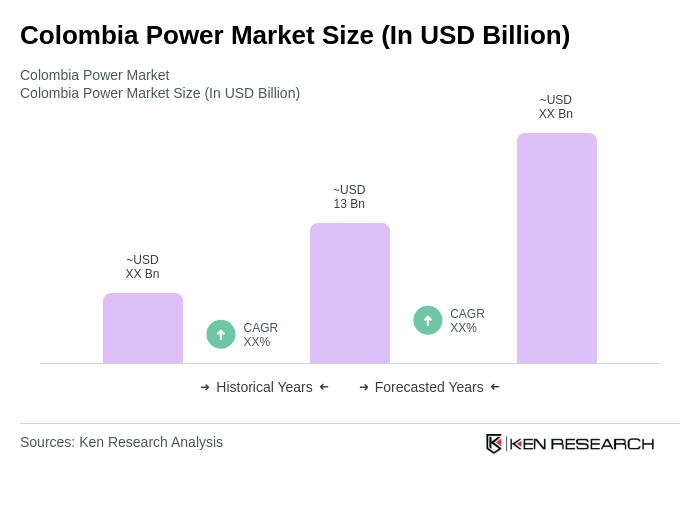
- The Colombia Power Market is valued at USD 13 billion, based on a five-year historical analysis. This growth is primarily driven by rising energy demand from industrial and commercial sectors, expanding urbanization, and significant investments in renewable energy sources, particularly solar and wind. Government initiatives focused on energy diversification, grid modernization, and sustainability are accelerating the transition to a more resilient and cleaner energy mix. The market has seen a notable shift towards non-hydro renewable energy, with solar and wind capacity expanding rapidly in recent years, reflecting global trends towards cleaner energy solutions .
- Key players in this market include Bogotá, Medellín, and Cali, which dominate due to their large populations, industrial activities, and status as economic hubs. These cities are central to Colombia's economic activities, leading to higher energy consumption and ongoing investments in grid and generation infrastructure. Urbanization and industrialization in these regions further amplify their influence in the power market, with Bogotá and Medellín also serving as headquarters for several major utility companies .
- In 2023, the Colombian government advanced the Energy Transition Law, aiming to increase the share of non-conventional renewable energy in the national grid to 12% by 2025. This regulation has accelerated investments in solar and wind energy projects, supporting a sustainable energy future and reducing reliance on fossil fuels .
Colombia Power Market Segmentation
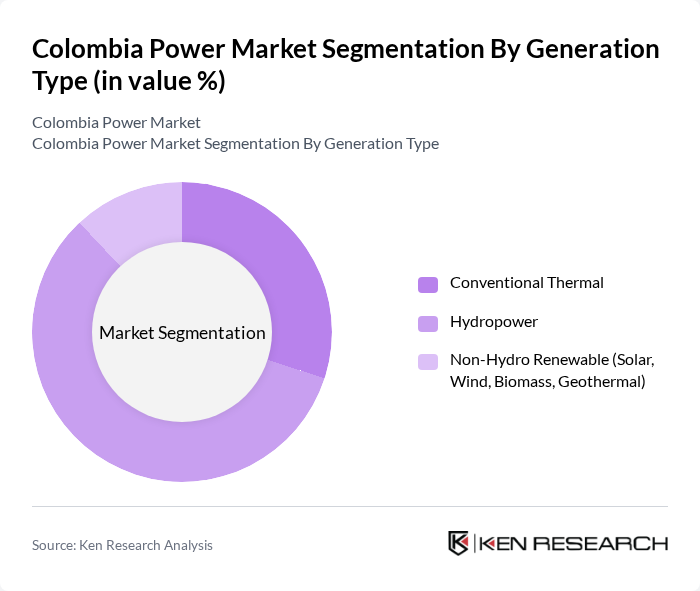
By Generation Type:The generation type segmentation includes Conventional Thermal, Hydropower, and Non-Hydro Renewable sources such as Solar, Wind, Biomass, and Geothermal. Hydropower remains the dominant contributor, leveraging Colombia's extensive river systems and favorable geography. However, Non-Hydro Renewables—especially solar and wind—are rapidly gaining traction as the government and private sector accelerate deployment of cleaner energy projects. The share of non-hydro renewables is expected to continue rising as new capacity comes online .
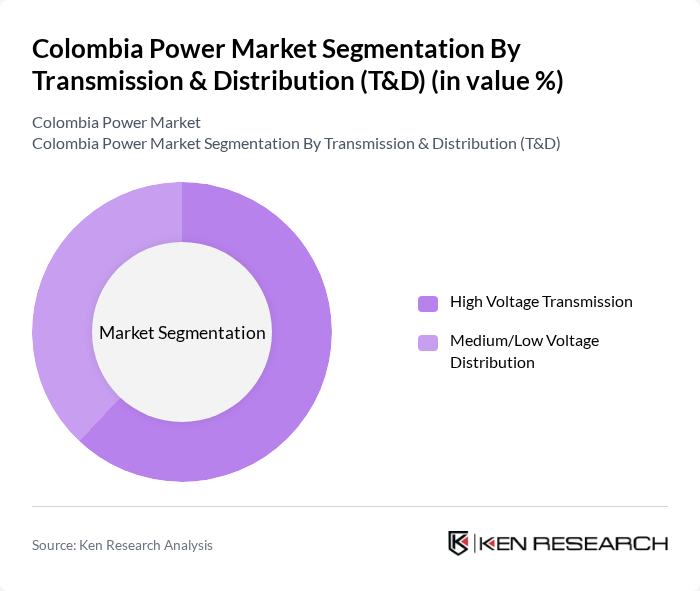
By Transmission & Distribution (T&D):This segmentation includes High Voltage Transmission and Medium/Low Voltage Distribution. High Voltage Transmission is essential for transporting electricity over long distances from generation sites to demand centers, while Medium/Low Voltage Distribution ensures delivery to end-users, especially in urban and industrial areas. Recent investments are focused on expanding and modernizing the high-voltage grid to accommodate new renewable energy projects and improve reliability .
Colombia Power Market Competitive Landscape
The Colombia Power Market is characterized by a dynamic mix of regional and international players. Leading participants such as Empresas Públicas de Medellín (EPM), Isagen S.A. E.S.P., Celsia S.A. E.S.P., Enel Colombia S.A. E.S.P. (formerly Enel-Codensa and Emgesa), Grupo Energía Bogotá (GEB), Electrificadora del Caribe S.A. E.S.P. (Aire & Afinia), AES Colombia, Enel Green Power Colombia, Interconexión Eléctrica S.A. E.S.P. (ISA), Vatia S.A. E.S.P., TermoCandelaria Power Limited, Ventus Ingeniería S.A., DNV GL Colombia, Prime Energía Colombia, and EPM Solar contribute to innovation, geographic expansion, and service delivery in this space .
Colombia Power Market Industry Analysis
Growth Drivers
- Increasing Demand for Renewable Energy:Colombia's renewable energy capacity reached 2,000 MW, driven by a national goal to generate 15% of its energy from renewables in future. The World Bank projects that the demand for clean energy will increase by 25% annually, reflecting a shift in consumer preferences and corporate sustainability commitments. This growing demand is supported by a robust regulatory framework that encourages investment in solar and wind energy projects, positioning Colombia as a regional leader in renewable energy.
- Government Incentives for Clean Energy:The Colombian government allocated $1.5 billion to support renewable energy projects, including tax incentives and subsidies for solar and wind installations. This financial backing is crucial as it aims to attract both local and foreign investments, with the expectation of adding 1,500 MW of renewable capacity in future. Such initiatives are designed to reduce reliance on fossil fuels and promote sustainable energy practices, aligning with global climate goals.
- Infrastructure Development Initiatives:Colombia's investment in energy infrastructure reached $3 billion, focusing on modernizing the grid and expanding transmission lines. The government plans to enhance grid connectivity to remote areas, aiming to increase access to electricity from 95% to 99% in future. This infrastructure development is essential for integrating renewable energy sources and ensuring a reliable power supply, thereby fostering economic growth and improving quality of life for citizens.
Market Challenges
- Regulatory Uncertainty:The Colombian power market faces significant regulatory challenges, with over 40 changes in energy laws since 2010. This instability has led to hesitance among investors, with foreign direct investment in the energy sector dropping to $600 million, down from $900 million. The lack of a consistent regulatory framework complicates long-term planning for energy projects, hindering the growth of the renewable sector.
- Aging Infrastructure:Approximately 45% of Colombia's energy infrastructure is over 30 years old, leading to inefficiencies and increased maintenance costs. The average outage duration for consumers was reported at 12 hours per year, significantly impacting productivity and economic output. Upgrading this aging infrastructure requires an estimated $4 billion investment, which poses a challenge for the government and private sector to secure necessary funding and resources.
Colombia Power Market Future Outlook
The Colombia power market is poised for transformative growth, driven by a strong commitment to renewable energy and infrastructure modernization. With the government’s ambitious targets for renewable energy generation and ongoing investments in grid enhancements, the market is expected to attract significant foreign investment. Additionally, the increasing adoption of electric vehicles and smart grid technologies will further reshape the energy landscape, promoting efficiency and sustainability. These trends indicate a robust future for Colombia's energy sector, aligning with global energy transition goals.
Market Opportunities
- Expansion of Smart Grid Technologies:The Colombian government plans to invest $700 million in smart grid technologies in future, enhancing energy management and efficiency. This investment will facilitate real-time monitoring and control of energy distribution, reducing losses and improving service reliability. The integration of smart technologies is expected to attract tech firms and create job opportunities in the energy sector.
- Investment in Energy Storage Solutions:With the rise of intermittent renewable energy sources, the demand for energy storage solutions is increasing. Colombia is projected to invest $500 million in battery storage systems in future, which will help stabilize the grid and ensure a reliable power supply. This investment presents opportunities for companies specializing in energy storage technologies to enter the Colombian market and contribute to its energy transition.
Scope of the Report
| Segment | Sub-Segments |
|---|---|
| By Generation Type | Conventional Thermal Hydropower Non-Hydro Renewable (Solar, Wind, Biomass, Geothermal) |
| By Transmission & Distribution (T&D) | High Voltage Transmission Medium/Low Voltage Distribution |
| By End-User | Residential Commercial Industrial Government & Utilities |
| By Application | Grid-Connected Off-Grid Rooftop Installations Utility-Scale Projects |
| By Investment Source | Domestic Foreign Direct Investment (FDI) Public-Private Partnerships (PPP) Government Schemes |
| By Region | Andean Region Caribbean Coast (Atlántico, La Guajira) Pacific Region Orinoquía and Amazonía |
Key Target Audience
Investors and Venture Capitalist Firms
Government and Regulatory Bodies (e.g., Ministry of Mines and Energy, Energy and Gas Regulatory Commission)
Power Generation Companies
Transmission and Distribution Network Operators
Renewable Energy Project Developers
Energy Service Companies (ESCOs)
Environmental NGOs and Advocacy Groups
International Development Agencies
Players Mentioned in the Report:
Empresas Publicas de Medellin (EPM)
Isagen S.A. E.S.P.
Celsia S.A. E.S.P.
Enel Colombia S.A. E.S.P. (formerly Enel-Codensa and Emgesa)
Grupo Energia Bogota (GEB)
Electrificadora del Caribe S.A. E.S.P. (Aire & Afinia)
AES Colombia
Enel Green Power Colombia
Interconexion Electrica S.A. E.S.P. (ISA)
Vatia S.A. E.S.P.
TermoCandelaria Power Limited
Ventus Ingenieria S.A.
DNV GL Colombia
Prime Energia Colombia
EPM Solar
Table of Contents
Market Assessment Phase
1. Executive Summary and Approach
2. Colombia Power Market Overview
2.1 Key Insights and Strategic Recommendations
2.2 Colombia Power Market Overview
2.3 Definition and Scope
2.4 Evolution of Market Ecosystem
2.5 Timeline of Key Regulatory Milestones
2.6 Value Chain & Stakeholder Mapping
2.7 Business Cycle Analysis
2.8 Policy & Incentive Landscape
3. Colombia Power Market Analysis
3.1 Growth Drivers
3.1.1 Increasing Demand for Renewable Energy
3.1.2 Government Incentives for Clean Energy
3.1.3 Infrastructure Development Initiatives
3.1.4 Foreign Investment in Energy Projects
3.2 Market Challenges
3.2.1 Regulatory Uncertainty
3.2.2 Aging Infrastructure
3.2.3 High Operational Costs
3.2.4 Environmental Concerns
3.3 Market Opportunities
3.3.1 Expansion of Smart Grid Technologies
3.3.2 Investment in Energy Storage Solutions
3.3.3 Development of Off-Grid Solutions
3.3.4 Partnerships with International Firms
3.4 Market Trends
3.4.1 Shift Towards Decentralized Energy Systems
3.4.2 Increasing Adoption of Electric Vehicles
3.4.3 Growth of Distributed Energy Resources
3.4.4 Focus on Energy Efficiency Programs
3.5 Government Regulation
3.5.1 Renewable Energy Law
3.5.2 Environmental Protection Regulations
3.5.3 Tariff Structures for Renewable Energy
3.5.4 Grid Access Regulations
4. SWOT Analysis
5. Stakeholder Analysis
6. Porter's Five Forces Analysis
7. Colombia Power Market Market Size, 2019-2024
7.1 By Value
7.2 By Volume
7.3 By Average Selling Price
8. Colombia Power Market Segmentation
8.1 By Generation Type
8.1.1 Conventional Thermal
8.1.2 Hydropower
8.1.3 Non-Hydro Renewable (Solar, Wind, Biomass, Geothermal)
8.2 By Transmission & Distribution (T&D)
8.2.1 High Voltage Transmission
8.2.2 Medium/Low Voltage Distribution
8.3 By End-User
8.3.1 Residential
8.3.2 Commercial
8.3.3 Industrial
8.3.4 Government & Utilities
8.4 By Application
8.4.1 Grid-Connected
8.4.2 Off-Grid
8.4.3 Rooftop Installations
8.4.4 Utility-Scale Projects
8.5 By Investment Source
8.5.1 Domestic
8.5.2 Foreign Direct Investment (FDI)
8.5.3 Public-Private Partnerships (PPP)
8.5.4 Government Schemes
8.6 By Region
8.6.1 Andean Region
8.6.2 Caribbean Coast (Atlántico, La Guajira)
8.6.3 Pacific Region
8.6.4 Orinoquía and Amazonía
9. Colombia Power Market Competitive Analysis
9.1 Market Share of Key Players
9.2 Cross Comparison of Key Players
9.2.1 Installed Generation Capacity (MW)
9.2.2 Market Share (%)
9.2.3 Revenue (USD Million)
9.2.4 EBITDA Margin (%)
9.2.5 Return on Assets (ROA) (%)
9.2.6 Capital Expenditure (CAPEX, USD Million)
9.2.7 Renewable Energy Share (%)
9.2.8 Grid Reliability Index (SAIDI/SAIFI)
9.2.9 Customer Base (Number of Users)
9.2.10 Investment in New Projects (USD Million)
9.3 SWOT Analysis of Top Players
9.4 Pricing Analysis
9.5 Detailed Profile of Major Companies
9.5.1 Empresas Públicas de Medellín (EPM)
9.5.2 Isagen S.A. E.S.P.
9.5.3 Celsia S.A. E.S.P.
9.5.4 Enel Colombia S.A. E.S.P. (formerly Enel-Codensa and Emgesa)
9.5.5 Grupo Energía Bogotá (GEB)
9.5.6 Electrificadora del Caribe S.A. E.S.P. (Aire & Afinia)
9.5.7 AES Colombia
9.5.8 Enel Green Power Colombia
9.5.9 Interconexión Eléctrica S.A. E.S.P. (ISA)
9.5.10 Vatia S.A. E.S.P.
9.5.11 TermoCandelaria Power Limited
9.5.12 Ventus Ingeniería S.A.
9.5.13 DNV GL Colombia
9.5.14 Prime Energía Colombia
9.5.15 EPM Solar
10. Colombia Power Market End-User Analysis
10.1 Procurement Behavior of Key Ministries
10.1.1 Ministry of Mines and Energy
10.1.2 Ministry of Environment and Sustainable Development
10.1.3 Ministry of Finance and Public Credit
10.2 Corporate Spend on Infrastructure & Energy
10.2.1 Investment in Renewable Projects
10.2.2 Budget Allocation for Energy Efficiency
10.2.3 Expenditure on Grid Modernization
10.3 Pain Point Analysis by End-User Category
10.3.1 Residential Users
10.3.2 Commercial Users
10.3.3 Industrial Users
10.4 User Readiness for Adoption
10.4.1 Awareness of Renewable Options
10.4.2 Financial Readiness
10.4.3 Technical Capability
10.5 Post-Deployment ROI and Use Case Expansion
10.5.1 Measurement of Energy Savings
10.5.2 Expansion into New Applications
10.5.3 Long-term Sustainability Assessment
11. Colombia Power Market Future Size, 2025-2030
11.1 By Value
11.2 By Volume
11.3 By Average Selling Price
Go-To-Market Strategy Phase
1. Whitespace Analysis + Business Model Canvas
1.1 Market Gaps Identification
1.2 Business Model Development
2. Marketing and Positioning Recommendations
2.1 Branding Strategies
2.2 Product USPs
3. Distribution Plan
3.1 Urban Retail vs Rural NGO Tie-ups
4. Channel & Pricing Gaps
4.1 Underserved Routes
4.2 Pricing Bands
5. Unmet Demand & Latent Needs
5.1 Category Gaps
5.2 Consumer Segments
6. Customer Relationship
6.1 Loyalty Programs
6.2 After-sales Service
7. Value Proposition
7.1 Sustainability
7.2 Integrated Supply Chains
8. Key Activities
8.1 Regulatory Compliance
8.2 Branding
8.3 Distribution Setup
9. Entry Strategy Evaluation
9.1 Domestic Market Entry Strategy
9.1.1 Product Mix
9.1.2 Pricing Band
9.1.3 Packaging
9.2 Export Entry Strategy
9.2.1 Target Countries
9.2.2 Compliance Roadmap
10. Entry Mode Assessment
10.1 Joint Ventures
10.2 Greenfield Investments
10.3 Mergers & Acquisitions
10.4 Distributor Model
11. Capital and Timeline Estimation
11.1 Capital Requirements
11.2 Timelines
12. Control vs Risk Trade-Off
12.1 Ownership vs Partnerships
13. Profitability Outlook
13.1 Breakeven Analysis
13.2 Long-term Sustainability
14. Potential Partner List
14.1 Distributors
14.2 Joint Ventures
14.3 Acquisition Targets
15. Execution Roadmap
15.1 Phased Plan for Market Entry
15.1.1 Market Setup
15.1.2 Market Entry
15.1.3 Growth Acceleration
15.1.4 Scale & Stabilize
15.2 Key Activities and Milestones
15.2.1 Activity Planning
15.2.2 Milestone Tracking
Research Methodology
Phase 1: Approach1
Desk Research
- Analysis of government reports and energy policy documents from the Ministry of Mines and Energy
- Review of market studies and publications from the Colombian Energy Regulatory Commission (CREG)
- Examination of historical electricity consumption data and generation statistics from UPME (Unidad de Planeación Minero Energética)
Primary Research
- Interviews with key stakeholders in the Colombian power sector, including utility executives and regulatory officials
- Surveys targeting energy analysts and consultants specializing in Latin American markets
- Field interviews with representatives from renewable energy firms and traditional power generation companies
Validation & Triangulation
- Cross-validation of findings through comparison with international energy market trends
- Triangulation of data from government sources, industry reports, and expert interviews
- Sanity checks conducted through expert panel discussions and feedback sessions
Phase 2: Market Size Estimation1
Top-down Assessment
- Estimation of total electricity demand based on national economic growth forecasts and demographic trends
- Segmentation of the market by generation type (hydro, thermal, renewable) and end-user categories (residential, commercial, industrial)
- Incorporation of government initiatives aimed at increasing renewable energy capacity and reducing carbon emissions
Bottom-up Modeling
- Collection of operational data from major power producers to establish generation capacity and output levels
- Cost analysis of electricity generation, including fixed and variable costs associated with different energy sources
- Volume and pricing analysis based on historical sales data from utility companies
Forecasting & Scenario Analysis
- Development of forecasting models using historical consumption patterns and projected economic indicators
- Scenario analysis based on potential regulatory changes and shifts in consumer behavior towards renewable energy
- Creation of baseline, optimistic, and pessimistic forecasts for electricity demand through 2030
Phase 3: CATI Sample Composition1
| Scope Item/Segment | Sample Size | Target Respondent Profiles |
|---|---|---|
| Residential Electricity Consumers | 120 | Homeowners, Renters |
| Commercial Power Users | 90 | Facility Managers, Business Owners |
| Industrial Energy Managers | 60 | Operations Directors, Energy Managers |
| Renewable Energy Stakeholders | 50 | Project Developers, Policy Makers |
| Utility Company Executives | 40 | CEOs, CFOs, Regulatory Affairs Managers |
Frequently Asked Questions
What is the current value of the Colombia Power Market?
The Colombia Power Market is valued at approximately USD 13 billion, reflecting significant growth driven by rising energy demand, urbanization, and investments in renewable energy sources, particularly solar and wind.
What are the main drivers of growth in the Colombia Power Market?
Which cities are the key players in the Colombia Power Market?
What is the Energy Transition Law in Colombia?
Why Buy From Us?

What makes us stand out is that our consultants follow Robust, Refine and Result (RRR) methodology. Robust for clear definitions, approaches and sanity checking, Refine for differentiating respondents' facts and opinions, and Result for presenting data with story.

We have set a benchmark in the industry by offering our clients with syndicated and customized market research reports featuring coverage of entire market as well as meticulous research and analyst insights.

While we don't replace traditional research, we flip the method upside down. Our dual approach of Top Bottom & Bottom Top ensures quality deliverable by not just verifying company fundamentals but also looking at the sector and macroeconomic factors.

With one step in the future, our research team constantly tries to show you the bigger picture. We help with some of the tough questions you may encounter along the way: How is the industry positioned? Best marketing channel? KPI's of competitors? By aligning every element, we help maximize success.

Our report gives you instant access to the answers and sources that other companies might choose to hide. We elaborate each steps of research methodology we have used and showcase you the sample size to earn your trust.

If you need any support, we are here! We pride ourselves on universe strength, data quality, and quick, friendly, and professional service.