About the Report
Base Year 2024Listen to the audio summary
Finland Pharmaceutical Market Overview
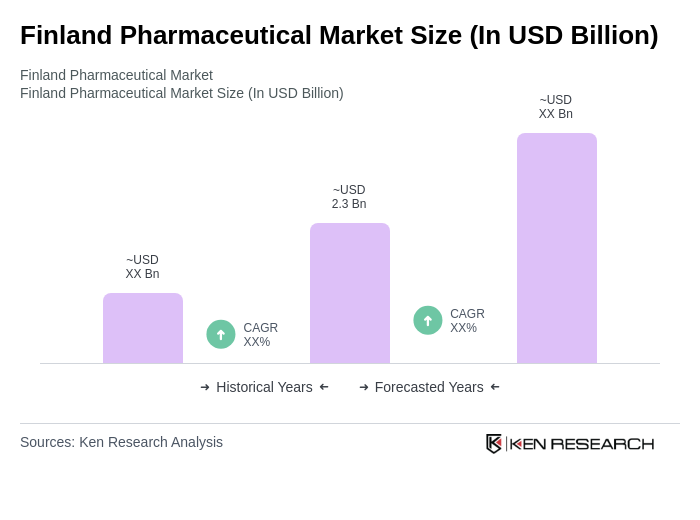
- The Finland Pharmaceutical Market is valued at USD 2.3 billion, based on a five-year historical analysis. This growth is primarily driven by an aging population, rising burden of chronic diseases, and sustained healthcare spending tied to Finland’s universal coverage and reimbursement framework. The demand for innovative therapies and personalized medicine has also contributed significantly to the market's expansion.
- Helsinki, as the capital and largest city, plays a pivotal role in the pharmaceutical market due to its concentration of university hospitals, research institutions, and company headquarters. Other significant cities include Espoo and Vantaa, which contribute through clusters of biotech firms, contract research, and logistics, supporting collaboration across Greater Helsinki’s health and life sciences hub.
- In 2023, the Finnish government advanced work on a Pharmaceutical Strategy aimed at medicine availability, cost-effectiveness, and innovation, building on measures to improve supply security, reimbursement efficiency, and market access pathways. Supporting actions include recent product introductions and hospital adoption of new therapies that broaden access to novel prescription drugs.
Finland Pharmaceutical Market Segmentation
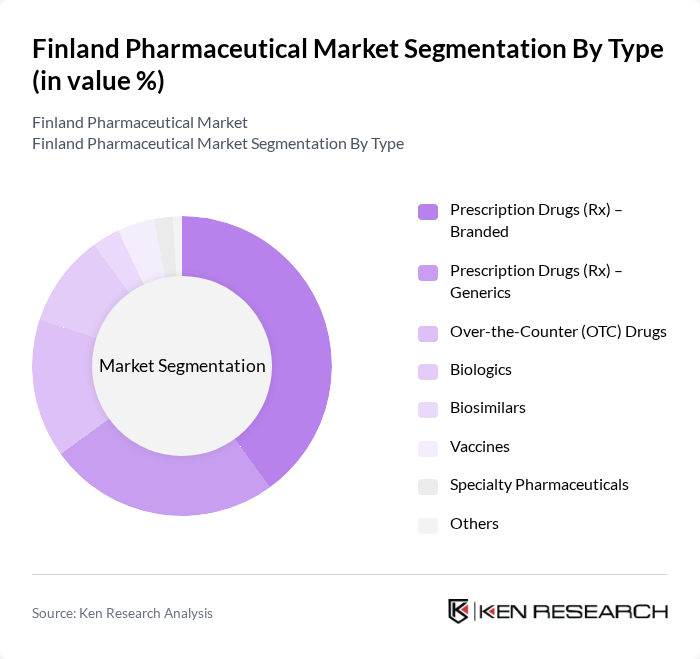
By Type:The pharmaceutical market can be segmented into various types, including Prescription Drugs (Rx) – Branded, Prescription Drugs (Rx) – Generics, Over-the-Counter (OTC) Drugs, Biologics, Biosimilars, Vaccines, Specialty Pharmaceuticals, and Others. Among these, Prescription Drugs (Rx) – Branded and Biologics are leading segments due to their high demand and significant investment in research and development. The increasing prevalence of chronic diseases and the need for advanced treatment options are driving the growth of these segments.
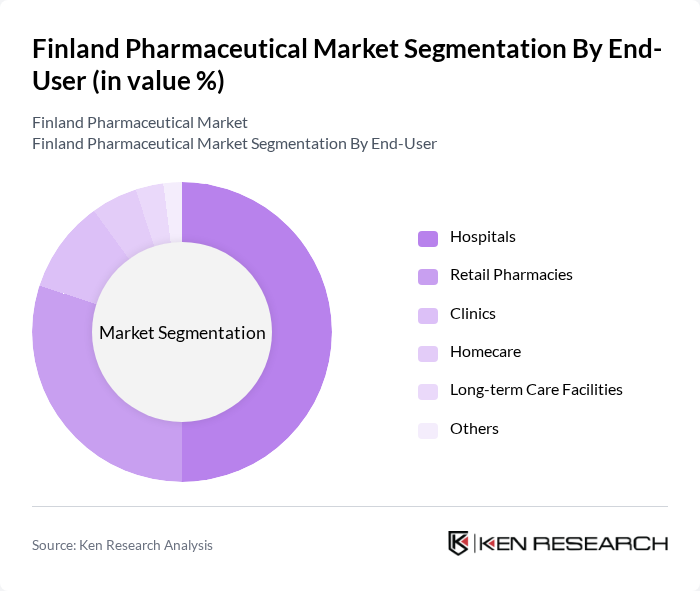
By End-User:The end-user segmentation includes Hospitals, Retail Pharmacies, Clinics, Homecare, Long-term Care Facilities, and Others. Hospitals are the dominant end-user segment, driven by higher volumes of inpatient and specialty care prescribing, oncology and biologics administration, and formulary-driven uptake of new therapies. Retail pharmacies play a significant role through reimbursed outpatient prescriptions and consumer health demand in OTC products.
Finland Pharmaceutical Market Competitive Landscape
The Finland Pharmaceutical Market is characterized by a dynamic mix of regional and international players. Leading participants such as Orion Oyj (Orion Corporation), Bayer Oy, Pfizer Oy, Novartis Finland Oy, Roche Oy, Sanofi Oy, MSD Finland Oy (Merck Sharp & Dohme), GlaxoSmithKline Oy (GSK), AbbVie Oy, Amgen AB, Finland Branch, Eli Lilly Finland Oy, Astellas Pharma Oy, Teva Finland Oy, Sandoz A/S, Finland Branch, Boehringer Ingelheim Finland Ky contribute to innovation, geographic expansion, and service delivery in this space.
Finland Pharmaceutical Market Industry Analysis
Growth Drivers
- Increasing Aging Population:Finland's population aged 65 and older is projected to reach approximately 1.3 million, representing roughly 25% of the total population. This demographic shift drives demand for pharmaceuticals, particularly for chronic disease management and age-related health issues. The aging population is expected to increase healthcare spending, which was around €22 billion, further stimulating the pharmaceutical market as older adults typically require more medications and healthcare services.
- Rising Chronic Diseases:Chronic diseases such as diabetes and cardiovascular conditions are on the rise in Finland, with diabetes cases expected to exceed 500,000. This increase necessitates a greater supply of medications and healthcare services, contributing to market growth. The Finnish Institute for Health and Welfare reported that chronic diseases account for over 80% of healthcare costs, emphasizing the need for innovative pharmaceutical solutions to manage these conditions effectively.
- Advancements in Biotechnology:The biotechnology sector in Finland is rapidly evolving, with over 200 biotech companies operating in the country. Investments in research and development reached €1.5 billion, fostering innovation in drug development and personalized medicine. These advancements are expected to enhance treatment options and improve patient outcomes, driving demand for new pharmaceuticals and positioning Finland as a leader in biopharmaceutical innovation in the Nordic region.
Market Challenges
- Stringent Regulatory Environment:The Finnish pharmaceutical market is subject to rigorous regulations enforced by the Finnish Medicines Agency (Fimea). The drug approval process can take up to 18 months, which may delay the introduction of new products. Additionally, compliance with EU regulations adds complexity, requiring companies to invest significant resources in regulatory affairs, which can hinder market entry and innovation for smaller firms.
- Pricing Pressures from Health Authorities:The Finnish government has implemented strict pricing regulations to control healthcare costs, with the average price of prescription drugs decreasing by 5% annually since 2020. This pricing pressure can limit profit margins for pharmaceutical companies, making it challenging to sustain investments in research and development. As a result, companies may face difficulties in balancing affordability with the need for innovation in drug development.
Finland Pharmaceutical Market Future Outlook
The Finnish pharmaceutical market is poised for significant transformation driven by technological advancements and demographic shifts. The integration of artificial intelligence in drug development is expected to streamline processes, reducing time-to-market for new therapies. Additionally, the growing emphasis on preventive healthcare will likely lead to increased investments in innovative treatments. As the healthcare landscape evolves, collaboration between pharmaceutical companies and research institutions will be crucial in addressing emerging health challenges and enhancing patient care.
Market Opportunities
- Growth in Personalized Medicine:The personalized medicine market in Finland is projected to grow significantly, with an estimated value of €500 million. This growth is driven by advancements in genomics and biotechnology, enabling tailored treatments that improve patient outcomes. Companies focusing on personalized therapies can capitalize on this trend, enhancing their market position and meeting the specific needs of patients.
- Expansion of Digital Health Solutions:The digital health market in Finland is expected to reach €1 billion, fueled by increased adoption of telemedicine and health apps. This expansion presents opportunities for pharmaceutical companies to integrate digital solutions into their offerings, enhancing patient engagement and adherence to treatment regimens. Embracing digital health can lead to improved health outcomes and greater market competitiveness.
Scope of the Report
| Segment | Sub-Segments |
|---|---|
| By Type | Prescription Drugs (Rx) – Branded Prescription Drugs (Rx) – Generics Over-the-Counter (OTC) Drugs Biologics Biosimilars Vaccines Specialty Pharmaceuticals Others |
| By End-User | Hospitals Retail Pharmacies Clinics Homecare Long-term Care Facilities Others |
| By Distribution Channel | Direct Sales Wholesalers/Full-line Distributors Online Pharmacies (E-pharmacies) Retail Pharmacies Hospital Pharmacies Others |
| By Therapeutic Area (ATC-aligned) | Cardiovascular System Antineoplastic & Immunomodulating Agents (Oncology, immunology) Nervous System Anti-infectives for Systemic Use Alimentary Tract & Metabolism (incl. diabetes) Respiratory System Musculo-skeletal System Genito-urinary System & Sex Hormones Dermatologicals Sensory Organs Others |
| By Formulation | Tablets & Capsules (oral solids) Injectables (parenterals) Topicals Liquids/Suspensions Inhalation & Nasal Others |
| By Pricing Strategy | Premium Pricing (innovative/specialty) Reference/Competitive Pricing Generic Penetration Pricing Value-Based Pricing/Outcomes-based Others |
| By Market Segment | Hospital Segment Retail Segment Institutional/Public Procurement Segment Others |
Key Target Audience
Investors and Venture Capitalist Firms
Government and Regulatory Bodies (e.g., Finnish Medicines Agency, Ministry of Social Affairs and Health)
Pharmaceutical Manufacturers and Producers
Wholesale Distributors
Pharmacy Chains and Retail Pharmacies
Biotechnology Firms
Health Insurance Companies
Clinical Research Organizations
Players Mentioned in the Report:
Orion Oyj (Orion Corporation)
Bayer Oy
Pfizer Oy
Novartis Finland Oy
Roche Oy
Sanofi Oy
MSD Finland Oy (Merck Sharp & Dohme)
GlaxoSmithKline Oy (GSK)
AbbVie Oy
Amgen AB, Finland Branch
Eli Lilly Finland Oy
Astellas Pharma Oy
Teva Finland Oy
Sandoz A/S, Finland Branch
Boehringer Ingelheim Finland Ky
Table of Contents
Market Assessment Phase
1. Executive Summary and Approach
2. Finland Pharmaceutical Market Overview
2.1 Key Insights and Strategic Recommendations
2.2 Finland Pharmaceutical Market Overview
2.3 Definition and Scope
2.4 Evolution of Market Ecosystem
2.5 Timeline of Key Regulatory Milestones
2.6 Value Chain & Stakeholder Mapping
2.7 Business Cycle Analysis
2.8 Policy & Incentive Landscape
3. Finland Pharmaceutical Market Analysis
3.1 Growth Drivers
3.1.1 Increasing Aging Population
3.1.2 Rising Chronic Diseases
3.1.3 Advancements in Biotechnology
3.1.4 Government Investment in Healthcare
3.2 Market Challenges
3.2.1 Stringent Regulatory Environment
3.2.2 Pricing Pressures from Health Authorities
3.2.3 Competition from Generic Drugs
3.2.4 Supply Chain Disruptions
3.3 Market Opportunities
3.3.1 Growth in Personalized Medicine
3.3.2 Expansion of Digital Health Solutions
3.3.3 Increased Focus on Preventive Healthcare
3.3.4 Collaborations with Research Institutions
3.4 Market Trends
3.4.1 Shift Towards Value-Based Care
3.4.2 Rise of Telemedicine
3.4.3 Integration of AI in Drug Development
3.4.4 Growing Demand for Over-the-Counter Medications
3.5 Government Regulation
3.5.1 Drug Approval Processes
3.5.2 Pricing Regulations
3.5.3 Reimbursement Policies
3.5.4 Pharmacovigilance Requirements
4. SWOT Analysis
5. Stakeholder Analysis
6. Porter's Five Forces Analysis
7. Finland Pharmaceutical Market Market Size, 2019-2024
7.1 By Value
7.2 By Volume
7.3 By Average Selling Price
8. Finland Pharmaceutical Market Segmentation
8.1 By Type
8.1.1 Prescription Drugs (Rx) – Branded
8.1.2 Prescription Drugs (Rx) – Generics
8.1.3 Over-the-Counter (OTC) Drugs
8.1.4 Biologics
8.1.5 Biosimilars
8.1.6 Vaccines
8.1.7 Specialty Pharmaceuticals
8.1.8 Others
8.2 By End-User
8.2.1 Hospitals
8.2.2 Retail Pharmacies
8.2.3 Clinics
8.2.4 Homecare
8.2.5 Long-term Care Facilities
8.2.6 Others
8.3 By Distribution Channel
8.3.1 Direct Sales
8.3.2 Wholesalers/Full-line Distributors
8.3.3 Online Pharmacies (E-pharmacies)
8.3.4 Retail Pharmacies
8.3.5 Hospital Pharmacies
8.3.6 Others
8.4 By Therapeutic Area (ATC-aligned)
8.4.1 Cardiovascular System
8.4.2 Antineoplastic & Immunomodulating Agents (Oncology, immunology)
8.4.3 Nervous System
8.4.4 Anti-infectives for Systemic Use
8.4.5 Alimentary Tract & Metabolism (incl. diabetes)
8.4.6 Respiratory System
8.4.7 Musculo-skeletal System
8.4.8 Genito-urinary System & Sex Hormones
8.4.9 Dermatologicals
8.4.10 Sensory Organs
8.4.11 Others
8.5 By Formulation
8.5.1 Tablets & Capsules (oral solids)
8.5.2 Injectables (parenterals)
8.5.3 Topicals
8.5.4 Liquids/Suspensions
8.5.5 Inhalation & Nasal
8.5.6 Others
8.6 By Pricing Strategy
8.6.1 Premium Pricing (innovative/specialty)
8.6.2 Reference/Competitive Pricing
8.6.3 Generic Penetration Pricing
8.6.4 Value-Based Pricing/Outcomes-based
8.6.5 Others
8.7 By Market Segment
8.7.1 Hospital Segment
8.7.2 Retail Segment
8.7.3 Institutional/Public Procurement Segment
8.7.4 Others
9. Finland Pharmaceutical Market Competitive Analysis
9.1 Market Share of Key Players
9.2 Cross Comparison of Key Players
9.2.1 Company Name (local affiliate or HQ serving Finland)
9.2.2 Group Size (Global scale: Large/Medium/Small)
9.2.3 Finland Revenue or Rx Sales Growth (YoY, %)
9.2.4 Market Share/Prescription Volume Share in Finland (%)
9.2.5 Tender Win Rate with HUS & Regional Wellbeing Services (%)
9.2.6 Average List-to-Net Price Erosion vs. Kela Reference Price (%)
9.2.7 R&D Intensity (Global R&D as % of Revenue) and Finland Clinical Trial Count
9.2.8 New Product/Biosimilar Launches in Finland (count, last 24 months)
9.2.9 Distribution Coverage (wholesaler availability, hospital/retail reach, % SKUs)
9.2.10 Pharmacovigilance/Regulatory Compliance Score (Fimea inspections, pass rate)
9.3 SWOT Analysis of Top Players
9.4 Pricing Analysis
9.5 Detailed Profile of Major Companies
9.5.1 Orion Oyj (Orion Corporation)
9.5.2 Bayer Oy
9.5.3 Pfizer Oy
9.5.4 Novartis Finland Oy
9.5.5 Roche Oy
9.5.6 Sanofi Oy
9.5.7 MSD Finland Oy (Merck Sharp & Dohme)
9.5.8 GlaxoSmithKline Oy (GSK)
9.5.9 AbbVie Oy
9.5.10 Amgen AB, Finland Branch
9.5.11 Eli Lilly Finland Oy
9.5.12 Astellas Pharma Oy
9.5.13 Teva Finland Oy
9.5.14 Sandoz A/S, Finland Branch
9.5.15 Boehringer Ingelheim Finland Ky
10. Finland Pharmaceutical Market End-User Analysis
10.1 Procurement Behavior of Key Ministries
10.1.1 Budget Allocation Trends
10.1.2 Procurement Processes
10.1.3 Key Decision-Makers
10.1.4 Contracting Strategies
10.2 Corporate Spend on Infrastructure & Energy
10.2.1 Investment in Healthcare Infrastructure
10.2.2 Energy Efficiency Initiatives
10.2.3 Corporate Social Responsibility Spending
10.3 Pain Point Analysis by End-User Category
10.3.1 Access to Medications
10.3.2 Affordability Issues
10.3.3 Quality of Care Concerns
10.4 User Readiness for Adoption
10.4.1 Training and Support Needs
10.4.2 Technology Adoption Rates
10.4.3 Feedback Mechanisms
10.5 Post-Deployment ROI and Use Case Expansion
10.5.1 Measurement of Outcomes
10.5.2 Scalability of Solutions
10.5.3 Long-term Partnerships
11. Finland Pharmaceutical Market Future Size, 2025-2030
11.1 By Value
11.2 By Volume
11.3 By Average Selling Price
Go-To-Market Strategy Phase
1. Whitespace Analysis + Business Model Canvas
1.1 Market Gaps Identification
1.2 Value Proposition Development
1.3 Revenue Streams Analysis
1.4 Key Partnerships Exploration
1.5 Cost Structure Assessment
1.6 Customer Segmentation
1.7 Channels of Distribution
2. Marketing and Positioning Recommendations
2.1 Branding Strategies
2.2 Product USPs
2.3 Target Audience Identification
2.4 Communication Strategies
2.5 Digital Marketing Approaches
3. Distribution Plan
3.1 Urban Retail Strategies
3.2 Rural NGO Tie-ups
3.3 Logistics and Supply Chain Management
3.4 Distribution Partnerships
4. Channel & Pricing Gaps
4.1 Underserved Routes
4.2 Pricing Bands Analysis
4.3 Competitive Pricing Strategies
5. Unmet Demand & Latent Needs
5.1 Category Gaps
5.2 Consumer Segments Analysis
5.3 Emerging Trends Identification
6. Customer Relationship
6.1 Loyalty Programs
6.2 After-sales Service
6.3 Customer Feedback Mechanisms
7. Value Proposition
7.1 Sustainability Initiatives
7.2 Integrated Supply Chains
7.3 Customer-Centric Approaches
8. Key Activities
8.1 Regulatory Compliance
8.2 Branding Efforts
8.3 Distribution Setup
9. Entry Strategy Evaluation
9.1 Domestic Market Entry Strategy
9.1.1 Product Mix Considerations
9.1.2 Pricing Band Strategies
9.1.3 Packaging Innovations
9.2 Export Entry Strategy
9.2.1 Target Countries Identification
9.2.2 Compliance Roadmap Development
10. Entry Mode Assessment
10.1 Joint Ventures
10.2 Greenfield Investments
10.3 Mergers & Acquisitions
10.4 Distributor Model Evaluation
11. Capital and Timeline Estimation
11.1 Capital Requirements
11.2 Timelines for Implementation
12. Control vs Risk Trade-Off
12.1 Ownership Considerations
12.2 Partnerships Evaluation
13. Profitability Outlook
13.1 Breakeven Analysis
13.2 Long-term Sustainability Strategies
14. Potential Partner List
14.1 Distributors
14.2 Joint Ventures
14.3 Acquisition Targets
15. Execution Roadmap
15.1 Phased Plan for Market Entry
15.1.1 Market Setup
15.1.2 Market Entry
15.1.3 Growth Acceleration
15.1.4 Scale & Stabilize
15.2 Key Activities and Milestones
15.2.1 Milestone Planning
15.2.2 Activity Tracking
Research Methodology
Phase 1: Approach1
Desk Research
- Analysis of pharmaceutical sales data from Finnish Medicines Agency (Fimea)
- Review of industry reports from Finnish Pharmaceutical Industry Association (PIF)
- Examination of market trends and forecasts from government publications and academic journals
Primary Research
- Interviews with key opinion leaders in the pharmaceutical sector, including pharmacists and healthcare professionals
- Surveys targeting pharmaceutical sales representatives and marketing managers
- Focus groups with patients to understand medication adherence and preferences
Validation & Triangulation
- Cross-validation of findings with data from healthcare expenditure reports and insurance claims
- Triangulation of insights from primary interviews with secondary data sources
- Sanity checks through expert panel discussions with industry veterans
Phase 2: Market Size Estimation1
Top-down Assessment
- Estimation of total pharmaceutical market size based on national healthcare spending
- Segmentation by therapeutic areas and drug types, including prescription and over-the-counter medications
- Incorporation of demographic trends and aging population impact on pharmaceutical consumption
Bottom-up Modeling
- Collection of sales data from major pharmaceutical companies operating in Finland
- Analysis of prescription volume trends and average drug prices
- Estimation of market share for emerging biotech and generic drug segments
Forecasting & Scenario Analysis
- Multi-factor regression analysis incorporating factors such as healthcare policy changes and technological advancements
- Scenario modeling based on potential shifts in regulatory frameworks and market access conditions
- Development of baseline, optimistic, and pessimistic forecasts through 2030
Phase 3: CATI Sample Composition1
| Scope Item/Segment | Sample Size | Target Respondent Profiles |
|---|---|---|
| Pharmaceutical Retail Market | 120 | Pharmacy Owners, Retail Pharmacists |
| Hospital Pharmacy Operations | 90 | Hospital Pharmacists, Pharmacy Directors |
| Biopharmaceuticals Sector | 60 | Biotech Researchers, Product Managers |
| Generic Drug Market | 60 | Generic Drug Manufacturers, Regulatory Affairs Specialists |
| Patient Adherence Programs | 70 | Healthcare Providers, Patient Advocacy Representatives |
Frequently Asked Questions
What is the current value of the Finland Pharmaceutical Market?
The Finland Pharmaceutical Market is valued at approximately USD 2.3 billion, reflecting growth driven by an aging population, chronic diseases, and increased healthcare spending linked to universal coverage and reimbursement frameworks.
What factors are driving growth in the Finland Pharmaceutical Market?
Which cities are significant in the Finland Pharmaceutical Market?
What is the Finnish government's Pharmaceutical Strategy?
Why Buy From Us?

What makes us stand out is that our consultants follow Robust, Refine and Result (RRR) methodology. Robust for clear definitions, approaches and sanity checking, Refine for differentiating respondents' facts and opinions, and Result for presenting data with story.

We have set a benchmark in the industry by offering our clients with syndicated and customized market research reports featuring coverage of entire market as well as meticulous research and analyst insights.

While we don't replace traditional research, we flip the method upside down. Our dual approach of Top Bottom & Bottom Top ensures quality deliverable by not just verifying company fundamentals but also looking at the sector and macroeconomic factors.

With one step in the future, our research team constantly tries to show you the bigger picture. We help with some of the tough questions you may encounter along the way: How is the industry positioned? Best marketing channel? KPI's of competitors? By aligning every element, we help maximize success.

Our report gives you instant access to the answers and sources that other companies might choose to hide. We elaborate each steps of research methodology we have used and showcase you the sample size to earn your trust.

If you need any support, we are here! We pride ourselves on universe strength, data quality, and quick, friendly, and professional service.