About the Report
Base Year 2024Listen to the audio summary
France Agricultural Machinery Market Overview
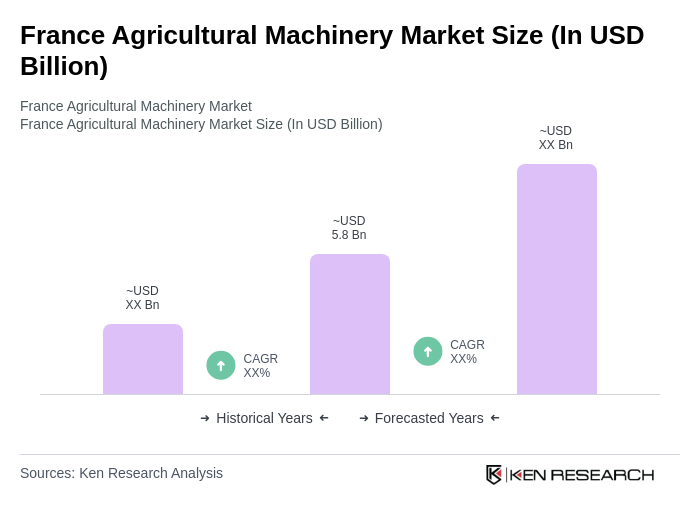
- The France Agricultural Machinery Market is valued at USD 5.8 billion, based on a five-year historical analysis. This growth is primarily driven by advancements in technology, increasing demand for food production, and the need for efficient farming practices. The market has seen a surge in the adoption of precision agriculture, automation, and digital technologies, which enhance productivity, optimize resource use, and reduce labor costs. The integration of GPS, telematics, and data-driven solutions is further accelerating the modernization of French agriculture .
- Key regions in this market include Northern France, recognized for its extensive arable land and significant cereal and oilseed production, and Southern France, where vineyards and horticultural activities are prominent. The concentration of agricultural activities in these areas, along with favorable climatic and soil conditions, contributes to their dominance in the agricultural machinery market .
- In 2023, the French government enacted the “Arrêté du 5 mai 2023 relatif à la réduction des émissions polluantes des engins mobiles non routiers” issued by the Ministry for the Ecological Transition. This regulation mandates that all new agricultural machinery placed on the French market must comply with stringent environmental standards, including reduced emissions of nitrogen oxides and particulate matter, as well as increased energy efficiency. The regulation requires manufacturers to certify compliance before sale and is part of France’s broader commitment to climate and sustainability objectives.
France Agricultural Machinery Market Segmentation
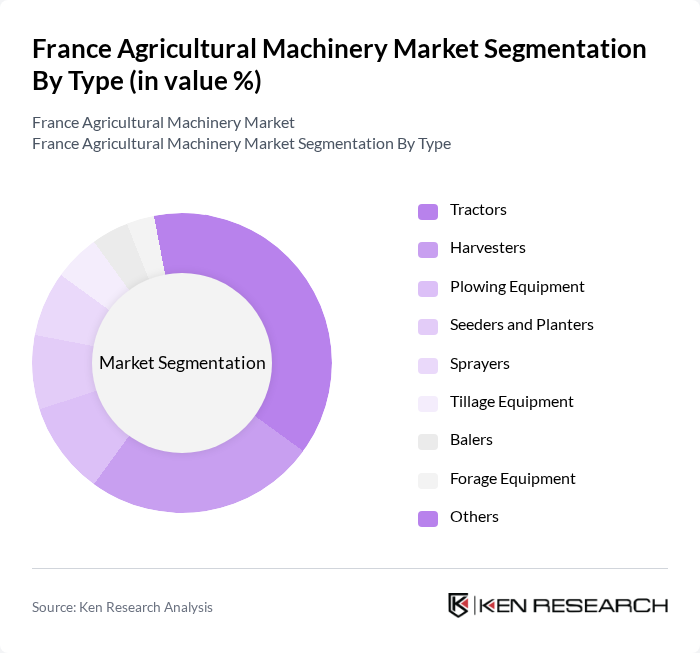
By Type:The market is segmented into various types of agricultural machinery, including tractors, harvesters, plowing equipment, seeders and planters, sprayers, tillage equipment, balers, forage equipment, and others. Each of these subsegments plays a crucial role in enhancing agricultural productivity and efficiency. Among these, tractors and harvesters are the most dominant due to their essential functions in modern farming practices and the ongoing shift toward mechanization and automation .
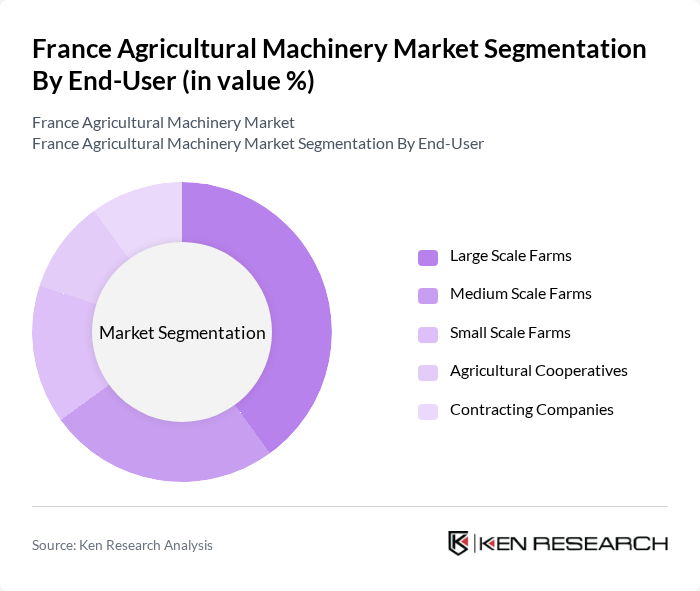
By End-User:The end-user segmentation includes large scale farms, medium scale farms, small scale farms, agricultural cooperatives, and contracting companies. Large scale farms dominate the market due to their capacity to invest in advanced machinery and technology, which enhances productivity and operational efficiency. The trend toward farm consolidation and the increasing prevalence of contract farming are also driving demand for high-capacity and technologically advanced equipment .
France Agricultural Machinery Market Competitive Landscape
The France Agricultural Machinery Market is characterized by a dynamic mix of regional and international players. Leading participants such as John Deere, CNH Industrial, AGCO Corporation, Claas KGaA mbH, Kubota Corporation, SDF Group (Same Deutz-Fahr), Massey Ferguson, Fendt, Valtra, JCB, Manitou Group, Kuhn Group, Kverneland Group, Lemken GmbH & Co. KG, Pöttinger Landtechnik GmbH, Väderstad AB, Artec Pulvérisation, Grégoire SAS, Monosem (John Deere), Sulky Burel contribute to innovation, geographic expansion, and service delivery in this space.
France Agricultural Machinery Market Industry Analysis
Growth Drivers
- Increasing Demand for Precision Farming:The French agricultural sector is witnessing a significant shift towards precision farming, driven by the need for enhanced productivity. In future, the precision agriculture market in France is projected to reach €1.3 billion, reflecting a 15% increase from the previous year. This growth is fueled by the adoption of advanced technologies such as GPS and remote sensing, which enable farmers to optimize resource use and improve crop yields, thereby addressing food security challenges.
- Technological Advancements in Machinery:The agricultural machinery sector in France is rapidly evolving, with investments in innovative technologies. In future, the market for smart agricultural machinery is expected to exceed €3 billion, driven by advancements in automation and robotics. These technologies enhance operational efficiency, reduce labor costs, and improve overall productivity, making them essential for modern farming practices in a competitive landscape.
- Government Subsidies for Agricultural Modernization:The French government has allocated approximately €550 million in subsidies for agricultural modernization in future. These financial incentives are aimed at encouraging farmers to invest in new machinery and technologies, thereby enhancing productivity and sustainability. This support is crucial for small and medium-sized enterprises, enabling them to adopt modern practices and remain competitive in the evolving agricultural landscape.
Market Challenges
- High Initial Investment Costs:One of the primary challenges facing the agricultural machinery market in France is the high initial investment required for modern equipment. In future, the average cost of advanced machinery is estimated to be around €160,000, which poses a significant barrier for small farmers. This financial strain can hinder their ability to adopt new technologies, ultimately affecting productivity and competitiveness in the market.
- Regulatory Compliance Complexities:The agricultural machinery sector in France is subject to stringent regulatory requirements, which can complicate market entry and operations. In future, compliance with EU regulations on emissions and safety standards is expected to increase operational costs by approximately €22,000 per machine. These complexities can deter investment and slow down the adoption of innovative technologies, impacting overall market growth.
France Agricultural Machinery Market Future Outlook
The future of the agricultural machinery market in France appears promising, driven by technological advancements and increasing demand for sustainable practices. As farmers increasingly adopt automation and smart farming solutions, the market is expected to evolve significantly. Additionally, the focus on eco-friendly machinery and practices will likely shape investment strategies, encouraging innovation and modernization. The integration of IoT and data analytics will further enhance operational efficiency, positioning the sector for robust growth in future.
Market Opportunities
- Expansion of Organic Farming Practices:The organic farming sector in France is projected to grow by 9% annually, creating opportunities for specialized agricultural machinery. This trend is driven by increasing consumer demand for organic products, prompting farmers to invest in equipment tailored for organic cultivation, thus enhancing market potential.
- Development of Smart Farming Solutions:The rise of smart farming solutions presents a significant opportunity for the agricultural machinery market. In future, investments in IoT-enabled machinery are expected to reach €850 million, driven by the need for data-driven decision-making. This trend will enhance productivity and sustainability, positioning companies to capitalize on emerging technologies.
Scope of the Report
| Segment | Sub-Segments |
|---|---|
| By Type | Tractors Harvesters Plowing Equipment Seeders and Planters Sprayers Tillage Equipment Balers Forage Equipment Others |
| By End-User | Large Scale Farms Medium Scale Farms Small Scale Farms Agricultural Cooperatives Contracting Companies |
| By Application | Crop Production Livestock Farming Horticulture Forestry Viticulture |
| By Distribution Channel | Direct Sales Dealers and Distributors Online Sales Rental Services |
| By Price Range | Budget Segment Mid-Range Segment Premium Segment |
| By Region | Northern France Southern France Eastern France Western France Central France |
| By Policy Support | Subsidies Tax Exemptions Grants for Innovation Training Programs |
Key Target Audience
Investors and Venture Capitalist Firms
Government and Regulatory Bodies (e.g., Ministry of Agriculture and Food, French Agricultural Agency)
Manufacturers and Producers
Distributors and Retailers
Farmers' Cooperatives
Technology Providers
Industry Associations (e.g., French Agricultural Machinery Manufacturers Association)
Financial Institutions
Players Mentioned in the Report:
John Deere
CNH Industrial
AGCO Corporation
Claas KGaA mbH
Kubota Corporation
SDF Group (Same Deutz-Fahr)
Massey Ferguson
Fendt
Valtra
JCB
Manitou Group
Kuhn Group
Kverneland Group
Lemken GmbH & Co. KG
Pottinger Landtechnik GmbH
Vaderstad AB
Artec Pulverisation
Gregoire SAS
Monosem (John Deere)
Sulky Burel
Table of Contents
Market Assessment Phase
1. Executive Summary and Approach
2. France Agricultural Machinery Market Overview
2.1 Key Insights and Strategic Recommendations
2.2 France Agricultural Machinery Market Overview
2.3 Definition and Scope
2.4 Evolution of Market Ecosystem
2.5 Timeline of Key Regulatory Milestones
2.6 Value Chain & Stakeholder Mapping
2.7 Business Cycle Analysis
2.8 Policy & Incentive Landscape
3. France Agricultural Machinery Market Analysis
3.1 Growth Drivers
3.1.1 Increasing demand for precision farming
3.1.2 Technological advancements in machinery
3.1.3 Government subsidies for agricultural modernization
3.1.4 Rising labor costs driving mechanization
3.2 Market Challenges
3.2.1 High initial investment costs
3.2.2 Regulatory compliance complexities
3.2.3 Fluctuating commodity prices
3.2.4 Limited access to financing for small farmers
3.3 Market Opportunities
3.3.1 Expansion of organic farming practices
3.3.2 Growth in export markets for machinery
3.3.3 Development of smart farming solutions
3.3.4 Increasing focus on sustainability and eco-friendly practices
3.4 Market Trends
3.4.1 Adoption of automation and robotics
3.4.2 Integration of IoT in agricultural machinery
3.4.3 Shift towards electric and hybrid machinery
3.4.4 Rise of data-driven decision-making in farming
3.5 Government Regulation
3.5.1 Environmental protection regulations
3.5.2 Safety standards for machinery operation
3.5.3 Subsidy programs for agricultural equipment
3.5.4 Regulations on emissions and fuel efficiency
4. SWOT Analysis
5. Stakeholder Analysis
6. Porter's Five Forces Analysis
7. France Agricultural Machinery Market Market Size, 2019-2024
7.1 By Value
7.2 By Volume
7.3 By Average Selling Price
8. France Agricultural Machinery Market Segmentation
8.1 By Type
8.1.1 Tractors
8.1.2 Harvesters
8.1.3 Plowing Equipment
8.1.4 Seeders and Planters
8.1.5 Sprayers
8.1.6 Tillage Equipment
8.1.7 Balers
8.1.8 Forage Equipment
8.1.9 Others
8.2 By End-User
8.2.1 Large Scale Farms
8.2.2 Medium Scale Farms
8.2.3 Small Scale Farms
8.2.4 Agricultural Cooperatives
8.2.5 Contracting Companies
8.3 By Application
8.3.1 Crop Production
8.3.2 Livestock Farming
8.3.3 Horticulture
8.3.4 Forestry
8.3.5 Viticulture
8.4 By Distribution Channel
8.4.1 Direct Sales
8.4.2 Dealers and Distributors
8.4.3 Online Sales
8.4.4 Rental Services
8.5 By Price Range
8.5.1 Budget Segment
8.5.2 Mid-Range Segment
8.5.3 Premium Segment
8.6 By Region
8.6.1 Northern France
8.6.2 Southern France
8.6.3 Eastern France
8.6.4 Western France
8.6.5 Central France
8.7 By Policy Support
8.7.1 Subsidies
8.7.2 Tax Exemptions
8.7.3 Grants for Innovation
8.7.4 Training Programs
9. France Agricultural Machinery Market Competitive Analysis
9.1 Market Share of Key Players
9.2 Cross Comparison of Key Players
9.2.1 Company Name
9.2.2 Group Size (Large, Medium, or Small as per industry convention)
9.2.3 Revenue (France, EUR million)
9.2.4 Revenue Growth Rate (CAGR, %)
9.2.5 Market Share (%)
9.2.6 Product Portfolio Breadth
9.2.7 R&D Investment (% of revenue)
9.2.8 Distribution Network Coverage (number of outlets/partners in France)
9.2.9 After-Sales Service Network (number of service points in France)
9.2.10 Customer Satisfaction Index (France, score/benchmark)
9.3 SWOT Analysis of Top Players
9.4 Pricing Analysis
9.5 Detailed Profile of Major Companies
9.5.1 John Deere
9.5.2 CNH Industrial
9.5.3 AGCO Corporation
9.5.4 Claas KGaA mbH
9.5.5 Kubota Corporation
9.5.6 SDF Group (Same Deutz-Fahr)
9.5.7 Massey Ferguson
9.5.8 Fendt
9.5.9 Valtra
9.5.10 JCB
9.5.11 Manitou Group
9.5.12 Kuhn Group
9.5.13 Kverneland Group
9.5.14 Lemken GmbH & Co. KG
9.5.15 Pöttinger Landtechnik GmbH
9.5.16 Väderstad AB
9.5.17 Artec Pulvérisation
9.5.18 Grégoire SAS
9.5.19 Monosem (John Deere)
9.5.20 Sulky Burel
10. France Agricultural Machinery Market End-User Analysis
10.1 Procurement Behavior of Key Ministries
10.1.1 Ministry of Agriculture
10.1.2 Ministry of Environment
10.1.3 Ministry of Economy
10.2 Corporate Spend on Infrastructure & Energy
10.2.1 Investment in Modernization
10.2.2 Budget Allocation for Sustainability
10.3 Pain Point Analysis by End-User Category
10.3.1 Equipment Reliability
10.3.2 Maintenance Costs
10.3.3 Access to Financing
10.4 User Readiness for Adoption
10.4.1 Training and Support Needs
10.4.2 Technology Acceptance Levels
10.5 Post-Deployment ROI and Use Case Expansion
10.5.1 Performance Metrics Tracking
10.5.2 Case Studies of Successful Implementations
11. France Agricultural Machinery Market Future Size, 2025-2030
11.1 By Value
11.2 By Volume
11.3 By Average Selling Price
Go-To-Market Strategy Phase
1. Whitespace Analysis + Business Model Canvas
1.1 Market Gaps Identification
1.2 Value Proposition Development
1.3 Revenue Streams Analysis
1.4 Cost Structure Evaluation
1.5 Key Partnerships Exploration
1.6 Customer Segmentation
1.7 Channels of Distribution
2. Marketing and Positioning Recommendations
2.1 Branding Strategies
2.2 Product USPs
3. Distribution Plan
3.1 Urban Retail vs Rural NGO Tie-ups
4. Channel & Pricing Gaps
4.1 Underserved Routes
4.2 Pricing Bands
5. Unmet Demand & Latent Needs
5.1 Category Gaps
5.2 Consumer Segments
6. Customer Relationship
6.1 Loyalty Programs
6.2 After-sales Service
7. Value Proposition
7.1 Sustainability
7.2 Integrated Supply Chains
8. Key Activities
8.1 Regulatory Compliance
8.2 Branding
8.3 Distribution Setup
9. Entry Strategy Evaluation
9.1 Domestic Market Entry Strategy
9.1.1 Product Mix
9.1.2 Pricing Band
9.1.3 Packaging
9.2 Export Entry Strategy
9.2.1 Target Countries
9.2.2 Compliance Roadmap
10. Entry Mode Assessment
10.1 JV
10.2 Greenfield
10.3 M&A
10.4 Distributor Model
11. Capital and Timeline Estimation
11.1 Capital Requirements
11.2 Timelines
12. Control vs Risk Trade-Off
12.1 Ownership vs Partnerships
13. Profitability Outlook
13.1 Breakeven Analysis
13.2 Long-term Sustainability
14. Potential Partner List
14.1 Distributors
14.2 JVs
14.3 Acquisition Targets
15. Execution Roadmap
15.1 Phased Plan for Market Entry
15.1.1 Market Setup
15.1.2 Market Entry
15.1.3 Growth Acceleration
15.1.4 Scale & Stabilize
15.2 Key Activities and Milestones
15.2.1 Milestone Planning
15.2.2 Activity Tracking
Research Methodology
Phase 1: Approach1
Desk Research
- Analysis of agricultural machinery market reports from industry associations and government publications
- Review of trade statistics and import/export data from French customs and agricultural ministries
- Examination of academic journals and white papers focusing on agricultural technology advancements in France
Primary Research
- Interviews with key stakeholders including manufacturers, distributors, and retailers of agricultural machinery
- Surveys conducted with farmers and agricultural cooperatives to understand machinery usage and preferences
- Field visits to agricultural exhibitions and trade shows to gather insights on market trends and innovations
Validation & Triangulation
- Cross-validation of findings through comparison with historical market data and growth trends
- Triangulation of insights from primary interviews with secondary data sources to ensure accuracy
- Sanity checks through expert panel discussions involving agronomists and market analysts
Phase 2: Market Size Estimation1
Top-down Assessment
- Estimation of market size based on national agricultural output and machinery penetration rates
- Segmentation of the market by machinery type, including tractors, harvesters, and tillage equipment
- Incorporation of government subsidies and incentives for agricultural modernization
Bottom-up Modeling
- Collection of sales data from leading agricultural machinery manufacturers operating in France
- Estimation of average selling prices and unit sales across different machinery categories
- Analysis of regional demand variations based on crop types and farming practices
Forecasting & Scenario Analysis
- Utilization of econometric models to project future market growth based on historical data
- Scenario analysis considering factors such as technological advancements and climate change impacts on agriculture
- Development of multiple growth scenarios (baseline, optimistic, and pessimistic) through 2030
Phase 3: CATI Sample Composition1
| Scope Item/Segment | Sample Size | Target Respondent Profiles |
|---|---|---|
| Tractor Manufacturers | 60 | Product Managers, Sales Directors |
| Harvesting Equipment Suppliers | 50 | Operations Managers, Technical Support Leads |
| Farmers and Agricultural Cooperatives | 120 | Farm Owners, Cooperative Managers |
| Distributors and Retailers of Agricultural Machinery | 40 | Sales Representatives, Inventory Managers |
| Agricultural Technology Innovators | 40 | R&D Managers, Product Development Specialists |
Frequently Asked Questions
What is the current value of the France Agricultural Machinery Market?
The France Agricultural Machinery Market is valued at approximately USD 5.8 billion, reflecting a five-year historical analysis. This growth is driven by technological advancements, increased food production demand, and the adoption of efficient farming practices.
What are the key regions contributing to the France Agricultural Machinery Market?
What recent regulations have impacted the agricultural machinery market in France?
What types of agricultural machinery are most commonly used in France?
Other Regional/Country Reports
Why Buy From Us?

What makes us stand out is that our consultants follow Robust, Refine and Result (RRR) methodology. Robust for clear definitions, approaches and sanity checking, Refine for differentiating respondents' facts and opinions, and Result for presenting data with story.

We have set a benchmark in the industry by offering our clients with syndicated and customized market research reports featuring coverage of entire market as well as meticulous research and analyst insights.

While we don't replace traditional research, we flip the method upside down. Our dual approach of Top Bottom & Bottom Top ensures quality deliverable by not just verifying company fundamentals but also looking at the sector and macroeconomic factors.

With one step in the future, our research team constantly tries to show you the bigger picture. We help with some of the tough questions you may encounter along the way: How is the industry positioned? Best marketing channel? KPI's of competitors? By aligning every element, we help maximize success.

Our report gives you instant access to the answers and sources that other companies might choose to hide. We elaborate each steps of research methodology we have used and showcase you the sample size to earn your trust.

If you need any support, we are here! We pride ourselves on universe strength, data quality, and quick, friendly, and professional service.