About the Report
Base Year 2024Listen to the audio summary
United States Agricultural Machinery Market Overview
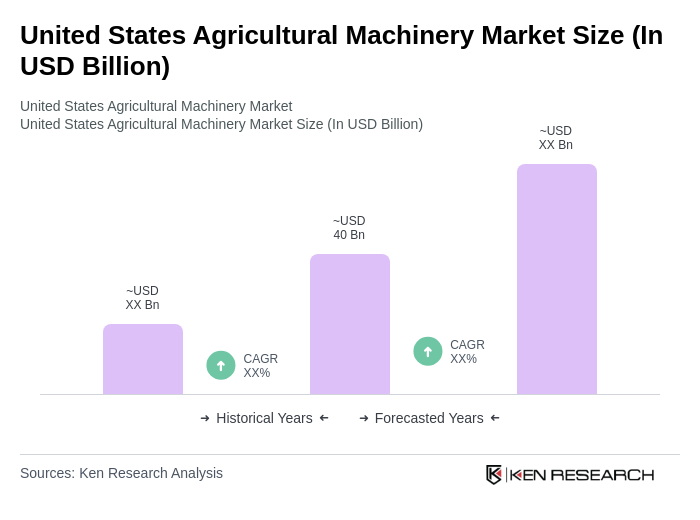
- The United States Agricultural Machinery Market is valued at approximately USD 40 billion, based on a five-year historical analysis. This growth is primarily driven by advancements in technology, increasing demand for food production, and the need for efficient farming practices. The market has seen a surge in the adoption of precision agriculture technologies, which enhance productivity and reduce operational costs for farmers.
- Key players in this market include states like Iowa, Illinois, and Nebraska, which dominate due to their extensive agricultural activities and large-scale farming operations. These regions benefit from fertile land, favorable climate conditions, and a strong infrastructure that supports agricultural machinery usage, making them critical hubs for the agricultural machinery market.
- In 2023, the U.S. did not implement a new Agricultural Improvement Act; the most recent farm bill (Agricultural Improvement Act of 2018) was extended through 2024 by Congress to maintain program funding while a new bill is negotiated. Supportive federal programs and extensions have continued to fund conservation, precision agriculture, and equipment-related initiatives during the extension period.
United States Agricultural Machinery Market Segmentation
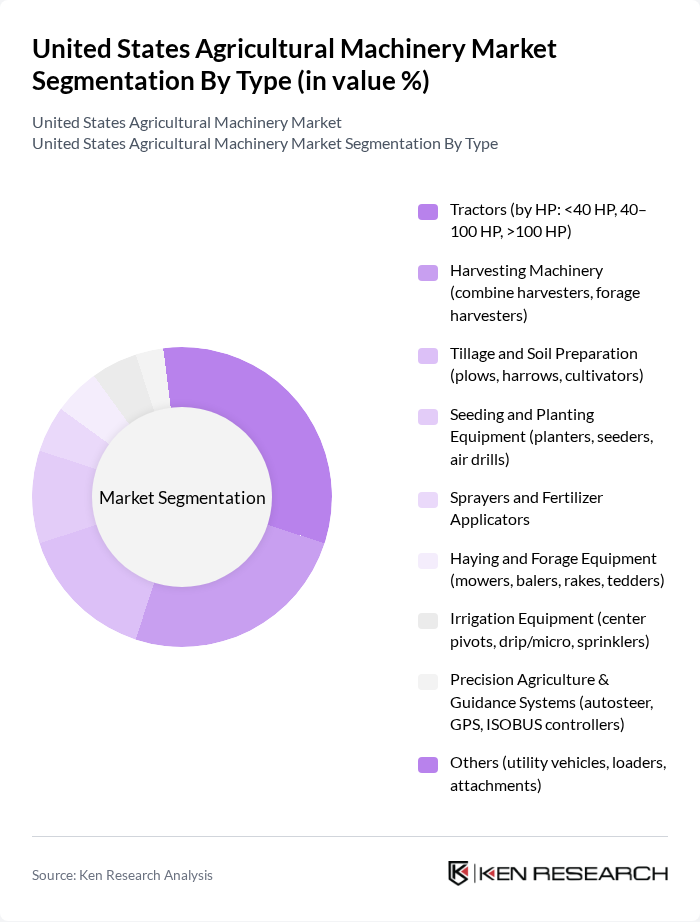
By Type:The agricultural machinery market can be segmented into various types, including tractors, harvesting machinery, tillage and soil preparation equipment, seeding and planting equipment, sprayers and fertilizer applicators, haying and forage equipment, irrigation equipment, precision agriculture and guidance systems, and others. Each of these subsegments plays a crucial role in enhancing agricultural productivity and efficiency.
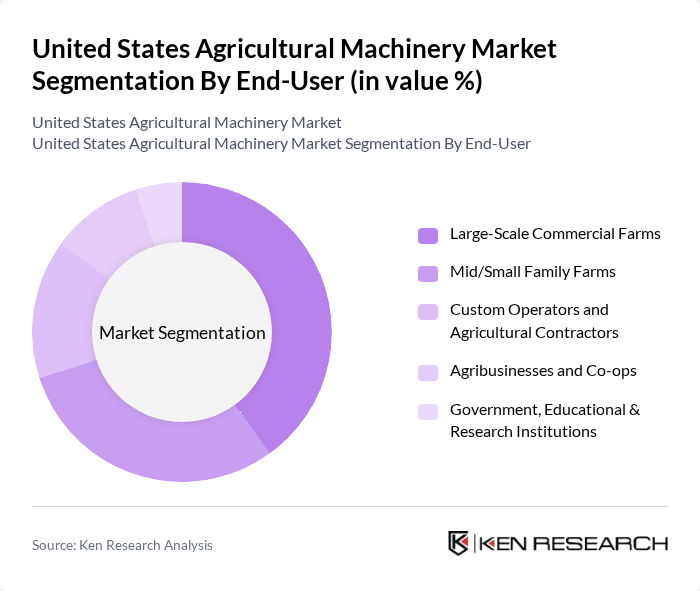
By End-User:The end-user segmentation of the agricultural machinery market includes large-scale commercial farms, mid/small family farms, custom operators and agricultural contractors, agribusinesses and co-ops, and government, educational, and research institutions. Each of these segments has distinct needs and purchasing behaviors that influence the types of machinery they invest in.
United States Agricultural Machinery Market Competitive Landscape
The United States Agricultural Machinery Market is characterized by a dynamic mix of regional and international players. Leading participants such as Deere & Company (John Deere), AGCO Corporation (Fendt, Massey Ferguson, Challenger, Precision Planting), CNH Industrial (Case IH, New Holland), Kubota Corporation, Mahindra & Mahindra Ltd. (Mahindra North America), Trimble Inc., Raven Industries, Inc. (a CNH Industrial brand), CLAAS Group, AG Leader Technology, Yanmar Co., Ltd. (Yanmar America), SDF Group (Deutz-Fahr), JCB, Bobcat Company, Vermeer Corporation, Great Plains Manufacturing (a Kubota company) contribute to innovation, geographic expansion, and service delivery in this space.
United States Agricultural Machinery Market Industry Analysis
Growth Drivers
- Increasing Demand for Food Production:The U.S. agricultural sector is projected to produce approximately 430 billion pounds of food in future, driven by a growing population expected to reach 333 million. This surge in food demand necessitates advanced agricultural machinery to enhance productivity and efficiency. The USDA reports that food production must increase by 70% by future to meet global needs, further emphasizing the critical role of modern machinery in achieving these targets.
- Technological Advancements in Machinery:The agricultural machinery sector is witnessing rapid technological innovations, with investments in R&D reaching $1.5 billion in future. These advancements include automation, precision farming tools, and smart machinery, which enhance operational efficiency. The integration of AI and machine learning in equipment is expected to reduce operational costs by up to 20%, making modern machinery more attractive to farmers seeking to optimize their production processes.
- Government Subsidies and Support:In future, the U.S. government allocated $3 billion in subsidies for agricultural technology adoption, aimed at promoting modernization in farming practices. These financial incentives encourage farmers to invest in new machinery, thereby boosting the agricultural machinery market. Additionally, programs like the Environmental Quality Incentives Program (EQIP) support sustainable practices, further driving demand for advanced machinery that meets regulatory standards.
Market Challenges
- High Initial Investment Costs:The average cost of new agricultural machinery can exceed $200,000, posing a significant barrier for many farmers, especially small-scale operators. This high upfront investment often leads to reluctance in upgrading equipment, limiting access to advanced technologies. As a result, many farmers continue to rely on outdated machinery, which can hinder productivity and efficiency in the long term.
- Supply Chain Disruptions:The agricultural machinery market faces ongoing supply chain challenges, exacerbated by global events such as the COVID-19 pandemic. In future, delays in the delivery of critical components have increased lead times by an average of 30%. These disruptions not only affect production schedules but also inflate costs, making it difficult for manufacturers to meet the rising demand for new machinery in a timely manner.
United States Agricultural Machinery Market Future Outlook
The future of the U.S. agricultural machinery market appears promising, driven by ongoing technological advancements and increasing adoption of precision agriculture. As farmers seek to enhance productivity and sustainability, the integration of IoT and automation will likely become standard practice. Additionally, the shift towards electric and hybrid machinery is expected to gain momentum, aligning with environmental regulations and consumer preferences for sustainable practices, ultimately transforming the agricultural landscape.
Market Opportunities
- Expansion into Precision Agriculture:The precision agriculture market is projected to reach $12 billion in future, offering significant opportunities for machinery manufacturers. By developing equipment that utilizes data analytics and GPS technology, companies can cater to the growing demand for efficient farming solutions, enhancing crop yields and resource management.
- Growth in Sustainable Farming Practices:With a rising focus on sustainability, the demand for eco-friendly agricultural machinery is increasing. The market for sustainable farming solutions is expected to grow by 15% annually, driven by consumer preferences and regulatory pressures. Manufacturers that innovate in this space can capture a significant share of the market, aligning with broader environmental goals.
Scope of the Report
| Segment | Sub-Segments |
|---|---|
| By Type | Tractors (by HP: <40 HP, 40–100 HP, >100 HP) Harvesting Machinery (combine harvesters, forage harvesters) Tillage and Soil Preparation (plows, harrows, cultivators) Seeding and Planting Equipment (planters, seeders, air drills) Sprayers and Fertilizer Applicators Haying and Forage Equipment (mowers, balers, rakes, tedders) Irrigation Equipment (center pivots, drip/micro, sprinklers) Precision Agriculture & Guidance Systems (autosteer, GPS, ISOBUS controllers) Others (utility vehicles, loaders, attachments) |
| By End-User | Large-Scale Commercial Farms Mid/Small Family Farms Custom Operators and Agricultural Contractors Agribusinesses and Co-ops Government, Educational & Research Institutions |
| By Application | Row Crops (corn, soybeans, cotton) Specialty Crops and Horticulture (fruits, vegetables, vineyards, orchards) Livestock & Forage Operations Pasture & Hay Management Others |
| By Sales Channel | OEM Dealer Networks Independent Distributors Direct Sales Online Sales and Marketplaces Retail and Farm Supply Outlets |
| By Distribution Mode | Wholesale Distribution Retail Distribution Direct-to-Farm Others |
| By Price Range | Entry-Level/Compact Equipment Mid-Range Equipment High-End/Premium Equipment |
| By Component | Engine and Powertrain Transmission and Driveline Hydraulics and PTO Systems Electronic Control Units, Sensors & Displays Attachments & Implements Aftermarket Parts & Services |
Key Target Audience
Investors and Venture Capitalist Firms
Government and Regulatory Bodies (e.g., U.S. Department of Agriculture, Environmental Protection Agency)
Manufacturers and Producers
Distributors and Retailers
Farm Equipment Dealers
Technology Providers
Industry Associations (e.g., Association of Equipment Manufacturers)
Financial Institutions
Players Mentioned in the Report:
Deere & Company (John Deere)
AGCO Corporation (Fendt, Massey Ferguson, Challenger, Precision Planting)
CNH Industrial (Case IH, New Holland)
Kubota Corporation
Mahindra & Mahindra Ltd. (Mahindra North America)
Trimble Inc.
Raven Industries, Inc. (a CNH Industrial brand)
CLAAS Group
AG Leader Technology
Yanmar Co., Ltd. (Yanmar America)
SDF Group (Deutz-Fahr)
JCB
Bobcat Company
Vermeer Corporation
Great Plains Manufacturing (a Kubota company)
Table of Contents
Market Assessment Phase
1. Executive Summary and Approach
2. United States Agricultural Machinery Market Overview
2.1 Key Insights and Strategic Recommendations
2.2 United States Agricultural Machinery Market Overview
2.3 Definition and Scope
2.4 Evolution of Market Ecosystem
2.5 Timeline of Key Regulatory Milestones
2.6 Value Chain & Stakeholder Mapping
2.7 Business Cycle Analysis
2.8 Policy & Incentive Landscape
3. United States Agricultural Machinery Market Analysis
3.1 Growth Drivers
3.1.1 Increasing demand for food production
3.1.2 Technological advancements in machinery
3.1.3 Government subsidies and support
3.1.4 Rising labor costs
3.2 Market Challenges
3.2.1 High initial investment costs
3.2.2 Supply chain disruptions
3.2.3 Environmental regulations
3.2.4 Competition from used machinery
3.3 Market Opportunities
3.3.1 Expansion into precision agriculture
3.3.2 Growth in sustainable farming practices
3.3.3 Development of smart machinery
3.3.4 Increasing export potential
3.4 Market Trends
3.4.1 Adoption of automation and robotics
3.4.2 Integration of IoT in agricultural machinery
3.4.3 Shift towards electric and hybrid machinery
3.4.4 Focus on data analytics for farm management
3.5 Government Regulation
3.5.1 Emission standards for agricultural machinery
3.5.2 Safety regulations for machinery operation
3.5.3 Subsidy programs for new technology adoption
3.5.4 Compliance with labor laws in machinery operation
4. SWOT Analysis
5. Stakeholder Analysis
6. Porter's Five Forces Analysis
7. United States Agricultural Machinery Market Market Size, 2019-2024
7.1 By Value
7.2 By Volume
7.3 By Average Selling Price
8. United States Agricultural Machinery Market Segmentation
8.1 By Type
8.1.1 Tractors (by HP: <40 HP, 40–100 HP, >100 HP)
8.1.2 Harvesting Machinery (combine harvesters, forage harvesters)
8.1.3 Tillage and Soil Preparation (plows, harrows, cultivators)
8.1.4 Seeding and Planting Equipment (planters, seeders, air drills)
8.1.5 Sprayers and Fertilizer Applicators
8.1.6 Haying and Forage Equipment (mowers, balers, rakes, tedders)
8.1.7 Irrigation Equipment (center pivots, drip/micro, sprinklers)
8.1.8 Precision Agriculture & Guidance Systems (autosteer, GPS, ISOBUS controllers)
8.1.9 Others (utility vehicles, loaders, attachments)
8.2 By End-User
8.2.1 Large-Scale Commercial Farms
8.2.2 Mid/Small Family Farms
8.2.3 Custom Operators and Agricultural Contractors
8.2.4 Agribusinesses and Co-ops
8.2.5 Government, Educational & Research Institutions
8.3 By Application
8.3.1 Row Crops (corn, soybeans, cotton)
8.3.2 Specialty Crops and Horticulture (fruits, vegetables, vineyards, orchards)
8.3.3 Livestock & Forage Operations
8.3.4 Pasture & Hay Management
8.3.5 Others
8.4 By Sales Channel
8.4.1 OEM Dealer Networks
8.4.2 Independent Distributors
8.4.3 Direct Sales
8.4.4 Online Sales and Marketplaces
8.4.5 Retail and Farm Supply Outlets
8.5 By Distribution Mode
8.5.1 Wholesale Distribution
8.5.2 Retail Distribution
8.5.3 Direct-to-Farm
8.5.4 Others
8.6 By Price Range
8.6.1 Entry-Level/Compact Equipment
8.6.2 Mid-Range Equipment
8.6.3 High-End/Premium Equipment
8.7 By Component
8.7.1 Engine and Powertrain
8.7.2 Transmission and Driveline
8.7.3 Hydraulics and PTO Systems
8.7.4 Electronic Control Units, Sensors & Displays
8.7.5 Attachments & Implements
8.7.6 Aftermarket Parts & Services
9. United States Agricultural Machinery Market Competitive Analysis
9.1 Market Share of Key Players
9.2 Cross Comparison of Key Players
9.2.1 Company Name
9.2.2 Group Size (Large, Medium, or Small as per industry convention)
9.2.3 U.S. Agricultural Equipment Revenue (USD) and YoY Growth
9.2.4 Tractor Market Share by HP Band (<40 HP, 40–100 HP, >100 HP)
9.2.5 Dealer Network Footprint (number of U.S. locations)
9.2.6 Installed Base and Replacement Cycle (average years)
9.2.7 Precision/Guidance Adoption (percentage of sales with guidance/autosteer)
9.2.8 R&D Intensity (R&D as % of revenue)
9.2.9 Product Breadth Index (number of major categories covered)
9.2.10 Aftermarket Mix (parts & service as % of revenue)
9.2.11 Pricing Positioning (premium, value, economy) and ASP trend
9.2.12 CAPEX and Manufacturing Footprint in the U.S.
9.2.13 Sustainability Metrics (Tier 4/Stage V compliance, electrified models count)
9.2.14 Customer Satisfaction/Net Promoter Score Proxy
9.3 SWOT Analysis of Top Players
9.4 Pricing Analysis
9.5 Detailed Profile of Major Companies
9.5.1 Deere & Company (John Deere)
9.5.2 AGCO Corporation (Fendt, Massey Ferguson, Challenger, Precision Planting)
9.5.3 CNH Industrial (Case IH, New Holland)
9.5.4 Kubota Corporation
9.5.5 Mahindra & Mahindra Ltd. (Mahindra North America)
9.5.6 Trimble Inc.
9.5.7 Raven Industries, Inc. (a CNH Industrial brand)
9.5.8 CLAAS Group
9.5.9 AG Leader Technology
9.5.10 Yanmar Co., Ltd. (Yanmar America)
9.5.11 SDF Group (Deutz-Fahr)
9.5.12 JCB
9.5.13 Bobcat Company
9.5.14 Vermeer Corporation
9.5.15 Great Plains Manufacturing (a Kubota company)
10. United States Agricultural Machinery Market End-User Analysis
10.1 Procurement Behavior of Key Ministries
10.1.1 Federal Agricultural Programs
10.1.2 State Agricultural Departments
10.1.3 Local Government Initiatives
10.2 Corporate Spend on Infrastructure & Energy
10.2.1 Investment in Modernization
10.2.2 Budget Allocation for Equipment
10.2.3 Funding for Sustainable Practices
10.3 Pain Point Analysis by End-User Category
10.3.1 Equipment Reliability Issues
10.3.2 Maintenance Costs
10.3.3 Training and Skill Gaps
10.4 User Readiness for Adoption
10.4.1 Technology Acceptance Levels
10.4.2 Financial Readiness
10.4.3 Infrastructure Support
10.5 Post-Deployment ROI and Use Case Expansion
10.5.1 Performance Metrics Tracking
10.5.2 Case Studies of Successful Implementations
10.5.3 Future Investment Plans
11. United States Agricultural Machinery Market Future Size, 2025-2030
11.1 By Value
11.2 By Volume
11.3 By Average Selling Price
Go-To-Market Strategy Phase
1. Whitespace Analysis + Business Model Canvas
1.1 Market Gaps Identification
1.2 Value Proposition Development
1.3 Revenue Streams Analysis
1.4 Cost Structure Evaluation
1.5 Key Partnerships Exploration
1.6 Customer Segmentation
1.7 Channels of Distribution
2. Marketing and Positioning Recommendations
2.1 Branding Strategies
2.2 Product USPs
2.3 Target Market Identification
2.4 Communication Strategies
2.5 Digital Marketing Approaches
3. Distribution Plan
3.1 Urban Retail Strategies
3.2 Rural NGO Tie-Ups
3.3 Direct Sales Approaches
3.4 E-commerce Integration
4. Channel & Pricing Gaps
4.1 Underserved Routes
4.2 Pricing Bands Analysis
4.3 Competitor Pricing Strategies
5. Unmet Demand & Latent Needs
5.1 Category Gaps Identification
5.2 Consumer Segments Analysis
5.3 Emerging Trends Exploration
6. Customer Relationship
6.1 Loyalty Programs Development
6.2 After-sales Service Strategies
6.3 Customer Feedback Mechanisms
7. Value Proposition
7.1 Sustainability Initiatives
7.2 Integrated Supply Chains
7.3 Competitive Advantages
8. Key Activities
8.1 Regulatory Compliance
8.2 Branding Initiatives
8.3 Distribution Setup
9. Entry Strategy Evaluation
9.1 Domestic Market Entry Strategy
9.1.1 Product Mix Considerations
9.1.2 Pricing Band Strategies
9.1.3 Packaging Innovations
9.2 Export Entry Strategy
9.2.1 Target Countries Analysis
9.2.2 Compliance Roadmap Development
10. Entry Mode Assessment
10.1 Joint Ventures
10.2 Greenfield Investments
10.3 Mergers & Acquisitions
10.4 Distributor Model Evaluation
11. Capital and Timeline Estimation
11.1 Capital Requirements Analysis
11.2 Timelines for Implementation
12. Control vs Risk Trade-Off
12.1 Ownership vs Partnerships
12.2 Risk Management Strategies
13. Profitability Outlook
13.1 Breakeven Analysis
13.2 Long-term Sustainability Strategies
14. Potential Partner List
14.1 Distributors Identification
14.2 Joint Ventures Opportunities
14.3 Acquisition Targets
15. Execution Roadmap
15.1 Phased Plan for Market Entry
15.1.1 Market Setup
15.1.2 Market Entry
15.1.3 Growth Acceleration
15.1.4 Scale & Stabilize
15.2 Key Activities and Milestones
15.2.1 Milestone Planning
15.2.2 Activity Tracking
Research Methodology
Phase 1: Approach1
Desk Research
- Analysis of industry reports from agricultural machinery associations and government publications
- Review of market trends and forecasts from agricultural machinery market research firms
- Examination of trade statistics and import/export data from the U.S. Department of Agriculture
Primary Research
- Interviews with key stakeholders including manufacturers, distributors, and retailers in the agricultural machinery sector
- Surveys targeting farmers and agricultural operators to understand machinery usage and preferences
- Field visits to agricultural expos and trade shows to gather insights on new technologies and market dynamics
Validation & Triangulation
- Cross-validation of findings through multiple data sources including sales data and expert opinions
- Triangulation of market insights from primary interviews and secondary data sources
- Sanity checks conducted through expert panel reviews to ensure data accuracy and relevance
Phase 2: Market Size Estimation1
Top-down Assessment
- Estimation of total market size based on national agricultural spending and machinery investment trends
- Segmentation of the market by machinery type, including tractors, harvesters, and tillage equipment
- Incorporation of government agricultural policies and subsidies affecting machinery purchases
Bottom-up Modeling
- Collection of sales data from leading agricultural machinery manufacturers to establish baseline figures
- Analysis of regional demand variations based on crop types and farming practices
- Volume and pricing analysis to derive revenue estimates for different machinery segments
Forecasting & Scenario Analysis
- Multi-factor regression analysis incorporating variables such as crop yield forecasts and technological advancements
- Scenario modeling based on potential shifts in agricultural practices and climate change impacts
- Development of baseline, optimistic, and pessimistic forecasts through 2030
Phase 3: CATI Sample Composition1
| Scope Item/Segment | Sample Size | Target Respondent Profiles |
|---|---|---|
| Tractor Market Insights | 140 | Farm Owners, Equipment Operators |
| Harvesting Equipment Usage | 100 | Agricultural Managers, Crop Producers |
| Tillage Equipment Preferences | 80 | Farm Equipment Dealers, Agronomists |
| Precision Agriculture Technologies | 70 | Technology Providers, Farm Consultants |
| Market Trends in Sustainable Machinery | 90 | Environmental Specialists, Policy Makers |
Frequently Asked Questions
What is the current value of the United States Agricultural Machinery Market?
The United States Agricultural Machinery Market is valued at approximately USD 40 billion, driven by technological advancements, increasing food production demands, and the adoption of precision agriculture technologies that enhance productivity and reduce operational costs for farmers.
Which states are the key players in the U.S. Agricultural Machinery Market?
What are the main types of agricultural machinery in the U.S. market?
How does government support impact the agricultural machinery market?
Why Buy From Us?

What makes us stand out is that our consultants follow Robust, Refine and Result (RRR) methodology. Robust for clear definitions, approaches and sanity checking, Refine for differentiating respondents' facts and opinions, and Result for presenting data with story.

We have set a benchmark in the industry by offering our clients with syndicated and customized market research reports featuring coverage of entire market as well as meticulous research and analyst insights.

While we don't replace traditional research, we flip the method upside down. Our dual approach of Top Bottom & Bottom Top ensures quality deliverable by not just verifying company fundamentals but also looking at the sector and macroeconomic factors.

With one step in the future, our research team constantly tries to show you the bigger picture. We help with some of the tough questions you may encounter along the way: How is the industry positioned? Best marketing channel? KPI's of competitors? By aligning every element, we help maximize success.

Our report gives you instant access to the answers and sources that other companies might choose to hide. We elaborate each steps of research methodology we have used and showcase you the sample size to earn your trust.

If you need any support, we are here! We pride ourselves on universe strength, data quality, and quick, friendly, and professional service.