Gcc Polyethylene Terephthalate Pet Market Size, Share, Growth Drivers, Trends, Opportunities & Forecast 2025–2030

The GCC PET market, valued at USD 4.2 billion, is growing due to demand for recyclable packaging in beverages and advancements in rPET recycling.

Region:Middle East

Author(s):Dev

Product Code:KRAD7845

Pages:100

Published On:December 2025

About the Report

Base Year 2024

GCC Polyethylene Terephthalate (PET) Market Overview

  • The GCC Polyethylene Terephthalate (PET) Market is valued at approximately USD 4.2 billion, based on a five-year analysis of regional PET demand and pricing levels for polyethylene terephthalate in the Gulf Cooperation Council countries. This growth is primarily driven by the increasing demand for sustainable packaging solutions, particularly in the food and beverage sector, as well as the rising consumer preference for lightweight and recyclable materials. The market is also supported by advancements in recycling technologies and government initiatives promoting the use of recycled PET, including investment in mechanical and chemical recycling lines and bottle-to-bottle rPET projects in the region.
  • Key players in this market include Saudi Arabia, the United Arab Emirates, and Qatar, with Saudi Arabia holding the largest share of GCC PET demand and supply on the back of its integrated petrochemical value chain and access to purified terephthalic acid and monoethylene glycol feedstocks. These countries dominate the market due to their robust petrochemical industries, strategic investments in PET resin and bottle-grade production facilities, and supportive policy frameworks that encourage the development of sustainable materials and recycling capacity. Additionally, the presence of major global companies and joint ventures in these regions, such as SABIC and Alpek/JBF RAK, further strengthens their market position through large-scale capacities and export-oriented operations.
  • In 2023, the GCC governments implemented regulations aimed at reducing plastic waste, including mandates for increased recycling rates and the use of recycled materials in packaging. One of the key frameworks is the Gulf Cooperation Council Standardization Organization’s “GSO 1863/2021 – Packaging – Requirements for the recovery and recycling of packaging waste”, which sets technical requirements for design for recyclability, collection, and material recovery, including plastics packaging used for food and beverages. In parallel, national measures such as the Saudi “Waste Management Law 2021” issued by the Saudi Ministry of Environment, Water and Agriculture, and the United Arab Emirates “Federal Law No. 12 of 2018 on Integrated Waste Management” introduced obligations for segregation, recycling targets, and extended producer responsibility schemes that are increasingly applied to PET bottles and other plastic packaging. These regulations are designed to promote environmental sustainability and encourage manufacturers to adopt eco-friendly practices, thereby enhancing the overall growth of the PET market through higher collection rates and demand for recycled PET content.
GCC Polyethylene Terephthalate (PET) Market Size

GCC Polyethylene Terephthalate (PET) Market Segmentation

By Type:The market is segmented into four main types: Bottle-grade PET, Film-grade PET, Fiber-grade PET, and Recycled PET (rPET). Among these, Bottle-grade PET is the most dominant segment due to its extensive use in beverage packaging, which is driven by consumer demand for bottled water, carbonated soft drinks, juices, and dairy-based beverages across the GCC. The increasing focus on sustainability has also led to a rise in the adoption of rPET, as manufacturers seek to meet regulatory requirements, corporate sustainability targets, and consumer preferences for eco-friendly products, including the use of high rPET content bottles and closed-loop bottle-to-bottle applications.
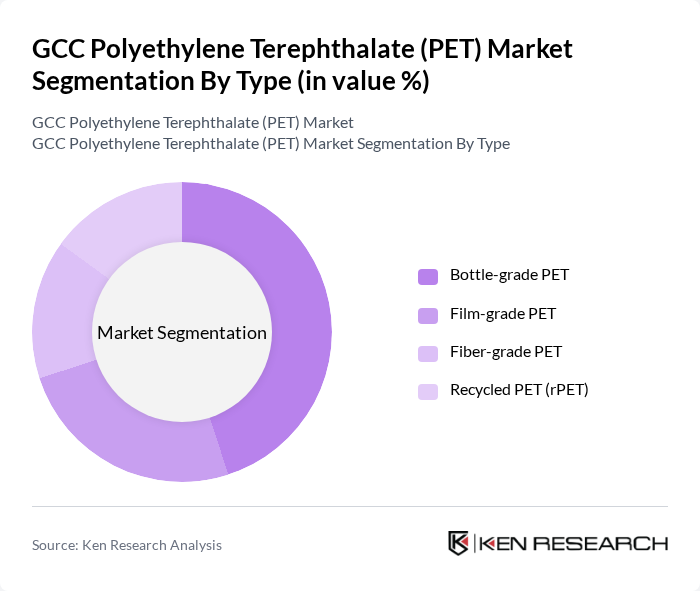
GCC Polyethylene Terephthalate (PET) Market segmentation by Type.

By End-User Industry:The end-user industries for PET include Food and Beverage, Textiles and Apparel, Automotive, Electrical and Electronics, Healthcare and Pharmaceuticals, and Consumer Goods and Household. The Food and Beverage sector is the largest consumer of PET, primarily due to the high demand for bottled beverages, on-the-go consumption, and the preference for PET bottles in hot-climate markets such as Saudi Arabia and the United Arab Emirates. The growing trend towards sustainable packaging is also influencing other sectors, leading to increased adoption of PET in textiles and apparel via polyester fibers, in automotive for lightweight components, and in consumer goods and household products where durability, clarity, and recyclability are key purchasing criteria.

GCC Polyethylene Terephthalate (PET) Market segmentation by End-User Industry.

GCC Polyethylene Terephthalate (PET) Market Competitive Landscape

The GCC Polyethylene Terephthalate (PET) Market is characterized by a dynamic mix of regional and international players. Leading participants such as SABIC (Saudi Basic Industries Corporation), Indorama Ventures Public Company Limited, EQUATE Petrochemical Company, Petrochemikal Industries Company K.S.C. (PIC), Qatar Petrochemical Company (QAPCO), Bahrain National Gas Company (BANAGAS), Alpek Polyester, Reliance Industries Limited, Eastman Chemical Company, Jiangsu Sanfangxiang Group Co., Ltd., Nan Ya Plastics Corporation, Far Eastern New Century Corporation, M&G Chemicals, DAK Americas LLC, Lotte Chemical Corporation contribute to innovation, geographic expansion, and service delivery in this space.

SABIC

1976

Riyadh, Saudi Arabia

Indorama Ventures

1994

Bangkok, Thailand

EQUATE

1995

Kuwait City, Kuwait

QAPCO

1974

Doha, Qatar

Reliance Industries

1966

Mumbai, India

Company

Establishment Year

Headquarters

Installed PET Resin Capacity in GCC (KT per year)

Share of rPET in Total PET Sales (%)

Regional Revenue from GCC PET Business (USD million)

EBITDA Margin from PET Segment (%)

Average Plant Utilization Rate (%)

Number of Production Sites and Recycling Facilities in GCC

GCC Polyethylene Terephthalate (PET) Market Industry Analysis

Growth Drivers

  • Increasing Demand for Sustainable Packaging:The GCC region is witnessing a significant shift towards sustainable packaging solutions, driven by consumer preferences and corporate responsibility. In future, the sustainable packaging market in the GCC was valued at approximately $1.3 billion, with expectations to reach $1.6 billion. This growth is fueled by a 35% increase in demand for eco-friendly materials, particularly in the food and beverage sectors, where PET is increasingly favored for its recyclability and lightweight properties.
  • Growth in the Beverage Industry:The beverage industry in the GCC is projected to grow at a rate of 6% annually, reaching a market size of $22 billion. This growth is primarily driven by rising disposable incomes and changing consumer lifestyles, leading to increased consumption of bottled beverages. As a result, the demand for PET, which accounts for over 65% of beverage packaging, is expected to rise significantly, further solidifying its position in the market.
  • Technological Advancements in Recycling:The GCC is investing heavily in recycling technologies, with over $600 million allocated to enhance recycling capabilities. Innovations such as advanced sorting and processing technologies are expected to increase the recycling rate of PET from 25% to 45%. This advancement not only supports sustainability goals but also reduces dependency on virgin materials, making recycled PET a more attractive option for manufacturers and consumers alike.

Market Challenges

  • Fluctuating Raw Material Prices:The PET market faces significant challenges due to the volatility of raw material prices, particularly crude oil and paraxylene. In future, the price of paraxylene surged by 18%, impacting production costs for PET manufacturers. This fluctuation creates uncertainty in pricing strategies and profit margins, forcing companies to adapt quickly to maintain competitiveness in a price-sensitive market.
  • Stringent Environmental Regulations:The GCC region is increasingly implementing stringent environmental regulations aimed at reducing plastic waste. In future, several countries introduced laws mandating a 30% reduction in single-use plastics. Compliance with these regulations requires significant investment in sustainable practices and technologies, posing a challenge for PET manufacturers who must balance regulatory compliance with operational costs and market demands.

GCC Polyethylene Terephthalate (PET) Market Future Outlook

The GCC PET market is poised for transformative growth, driven by a robust shift towards sustainability and innovation. As consumer awareness of environmental issues increases, companies are expected to invest in advanced recycling technologies and sustainable practices. The anticipated rise in e-commerce will further boost demand for PET packaging solutions. Additionally, the expansion into emerging markets will provide new avenues for growth, allowing manufacturers to capitalize on the increasing demand for eco-friendly products and packaging solutions.

Market Opportunities

  • Growth in E-commerce Packaging:The e-commerce sector in the GCC is projected to reach $30 billion, creating substantial demand for efficient and sustainable packaging solutions. This growth presents an opportunity for PET manufacturers to develop innovative packaging that meets the needs of online retailers while adhering to sustainability standards, thereby enhancing market penetration.
  • Innovations in Biodegradable PET:The development of biodegradable PET is gaining traction, with investments exceeding $250 million. This innovation aligns with global sustainability trends and offers a competitive edge in the market. As consumer preferences shift towards environmentally friendly products, biodegradable PET can capture a significant share of the packaging market, appealing to eco-conscious consumers.

Scope of the Report

SegmentSub-Segments
By Type

Bottle-grade PET

Film-grade PET

Fiber-grade PET

Recycled PET (rPET)

By End-User Industry

Food and Beverage

Textiles and Apparel

Automotive

Electrical and Electronics

Healthcare and Pharmaceuticals

Consumer Goods and Household

By Application

Bottles and Jars

Films and Sheets

Preforms

Industrial and Technical Applications

By Sales Channel

Direct Sales to Brand Owners and Converters

Sales via Regional Distributors/Traders

Export Sales

By Country

Saudi Arabia

United Arab Emirates

Qatar

Oman

Kuwait

Bahrain

By Product Form

Resin Chips/Pellets

Preforms

Sheets

Bottles and Containers

By Processing Technology

Injection Moulding

Injection Stretch Blow Moulding (ISBM)

Extrusion and Thermoforming

Other Conversion Processes

Key Target Audience

Investors and Venture Capitalist Firms

Government and Regulatory Bodies (e.g., Gulf Cooperation Council, Ministry of Environment and Water)

Manufacturers and Producers

Distributors and Retailers

Packaging Industry Stakeholders

Recycling and Waste Management Companies

Petrochemical Industry Players

Trade Associations and Industry Groups

Players Mentioned in the Report:

SABIC (Saudi Basic Industries Corporation)

Indorama Ventures Public Company Limited

EQUATE Petrochemical Company

Petrochemikal Industries Company K.S.C. (PIC)

Qatar Petrochemical Company (QAPCO)

Bahrain National Gas Company (BANAGAS)

Alpek Polyester

Reliance Industries Limited

Eastman Chemical Company

Jiangsu Sanfangxiang Group Co., Ltd.

Nan Ya Plastics Corporation

Far Eastern New Century Corporation

M&G Chemicals

DAK Americas LLC

Lotte Chemical Corporation

Table of Contents

Market Assessment Phase

1. Executive Summary and Approach


2. GCC Polyethylene Terephthalate (PET) Market Overview

2.1 Key Insights and Strategic Recommendations

2.2 GCC Polyethylene Terephthalate (PET) Market Overview

2.3 Definition and Scope

2.4 Evolution of Market Ecosystem

2.5 Timeline of Key Regulatory Milestones

2.6 Value Chain & Stakeholder Mapping

2.7 Business Cycle Analysis

2.8 Policy & Incentive Landscape


3. GCC Polyethylene Terephthalate (PET) Market Analysis

3.1 Growth Drivers

3.1.1 Increasing Demand for Sustainable Packaging
3.1.2 Growth in the Beverage Industry
3.1.3 Expansion of the Textile Industry
3.1.4 Technological Advancements in Recycling

3.2 Market Challenges

3.2.1 Fluctuating Raw Material Prices
3.2.2 Stringent Environmental Regulations
3.2.3 Competition from Alternative Materials
3.2.4 Supply Chain Disruptions

3.3 Market Opportunities

3.3.1 Growth in E-commerce Packaging
3.3.2 Innovations in Biodegradable PET
3.3.3 Expansion into Emerging Markets
3.3.4 Increased Investment in Recycling Technologies

3.4 Market Trends

3.4.1 Shift Towards Circular Economy
3.4.2 Rise of Eco-friendly Products
3.4.3 Increased Use of Recycled PET (rPET)
3.4.4 Digital Transformation in Supply Chain Management

3.5 Government Regulation

3.5.1 Regulations on Plastic Waste Management
3.5.2 Standards for Recycled Content in Products
3.5.3 Incentives for Sustainable Practices
3.5.4 Import Tariffs on PET Products

4. SWOT Analysis


5. Stakeholder Analysis


6. Porter's Five Forces Analysis


7. GCC Polyethylene Terephthalate (PET) Market Market Size, 2019-2024

7.1 By Value

7.2 By Volume

7.3 By Average Selling Price


8. GCC Polyethylene Terephthalate (PET) Market Segmentation

8.1 By Type

8.1.1 Bottle-grade PET
8.1.2 Film-grade PET
8.1.3 Fiber-grade PET
8.1.4 Recycled PET (rPET)

8.2 By End-User Industry

8.2.1 Food and Beverage
8.2.2 Textiles and Apparel
8.2.3 Automotive
8.2.4 Electrical and Electronics
8.2.5 Healthcare and Pharmaceuticals
8.2.6 Consumer Goods and Household

8.3 By Application

8.3.1 Bottles and Jars
8.3.2 Films and Sheets
8.3.3 Preforms
8.3.4 Industrial and Technical Applications

8.4 By Sales Channel

8.4.1 Direct Sales to Brand Owners and Converters
8.4.2 Sales via Regional Distributors/Traders
8.4.3 Export Sales

8.5 By Country

8.5.1 Saudi Arabia
8.5.2 United Arab Emirates
8.5.3 Qatar
8.5.4 Oman
8.5.5 Kuwait
8.5.6 Bahrain

8.6 By Product Form

8.6.1 Resin Chips/Pellets
8.6.2 Preforms
8.6.3 Sheets
8.6.4 Bottles and Containers

8.7 By Processing Technology

8.7.1 Injection Moulding
8.7.2 Injection Stretch Blow Moulding (ISBM)
8.7.3 Extrusion and Thermoforming
8.7.4 Other Conversion Processes

9. GCC Polyethylene Terephthalate (PET) Market Competitive Analysis

9.1 Market Share of Key Players

9.2 Cross Comparison of Key Players

9.2.1 Company Name
9.2.2 Installed PET Resin Capacity in GCC (KT per year)
9.2.3 Share of rPET in Total PET Sales (%)
9.2.4 Regional Revenue from GCC PET Business (USD million)
9.2.5 EBITDA Margin from PET Segment (%)
9.2.6 Average Plant Utilization Rate (%)
9.2.7 Number of Production Sites and Recycling Facilities in GCC
9.2.8 Long-term Offtake / Supply Agreements with Beverage and FMCG Majors (Yes/No, Count)
9.2.9 Average Contract Pricing vs GCC Benchmark (Discount/Premium %)
9.2.10 R&D and Sustainability Spending as % of PET Revenue

9.3 SWOT Analysis of Top Players

9.4 Pricing Analysis

9.5 Detailed Profile of Major Companies

9.5.1 SABIC (Saudi Basic Industries Corporation)
9.5.2 Indorama Ventures Public Company Limited
9.5.3 EQUATE Petrochemical Company
9.5.4 Petrochemikal Industries Company K.S.C. (PIC)
9.5.5 Qatar Petrochemical Company (QAPCO)
9.5.6 Bahrain National Gas Company (BANAGAS)
9.5.7 Alpek Polyester
9.5.8 Reliance Industries Limited
9.5.9 Eastman Chemical Company
9.5.10 Jiangsu Sanfangxiang Group Co., Ltd.
9.5.11 Nan Ya Plastics Corporation
9.5.12 Far Eastern New Century Corporation
9.5.13 M&G Chemicals
9.5.14 DAK Americas LLC
9.5.15 Lotte Chemical Corporation

10. GCC Polyethylene Terephthalate (PET) Market End-User Analysis

10.1 Procurement Behavior of Key Ministries

10.1.1 Government Procurement Policies
10.1.2 Budget Allocations for PET Products
10.1.3 Supplier Selection Criteria
10.1.4 Contract Management Practices

10.2 Corporate Spend on Infrastructure & Energy

10.2.1 Investment Trends in PET Infrastructure
10.2.2 Energy Consumption Patterns
10.2.3 Budgeting for Sustainability Initiatives
10.2.4 Corporate Social Responsibility Spending

10.3 Pain Point Analysis by End-User Category

10.3.1 Quality Concerns
10.3.2 Supply Chain Reliability
10.3.3 Cost Management
10.3.4 Regulatory Compliance Issues

10.4 User Readiness for Adoption

10.4.1 Awareness of PET Benefits
10.4.2 Training and Support Needs
10.4.3 Adoption Barriers
10.4.4 Feedback Mechanisms

10.5 Post-Deployment ROI and Use Case Expansion

10.5.1 Measurement of ROI
10.5.2 Case Studies of Successful Implementations
10.5.3 Expansion Opportunities
10.5.4 Long-term Sustainability Goals

11. GCC Polyethylene Terephthalate (PET) Market Future Size, 2025-2030

11.1 By Value

11.2 By Volume

11.3 By Average Selling Price


Go-To-Market Strategy Phase

1. Whitespace Analysis + Business Model Canvas

1.1 Market Gaps Identification

1.2 Value Proposition Development

1.3 Revenue Streams Analysis

1.4 Cost Structure Evaluation

1.5 Key Partnerships Exploration

1.6 Customer Segmentation

1.7 Competitive Advantage Assessment


2. Marketing and Positioning Recommendations

2.1 Branding Strategies

2.2 Product USPs

2.3 Target Market Identification

2.4 Communication Strategy

2.5 Digital Marketing Approach

2.6 Customer Engagement Tactics

2.7 Performance Metrics


3. Distribution Plan

3.1 Urban Retail Strategies

3.2 Rural NGO Tie-ups

3.3 E-commerce Integration

3.4 Logistics and Supply Chain Management

3.5 Distribution Partnerships

3.6 Inventory Management

3.7 Performance Tracking


4. Channel & Pricing Gaps

4.1 Underserved Routes

4.2 Pricing Bands Analysis

4.3 Competitor Pricing Strategies

4.4 Customer Price Sensitivity

4.5 Value-based Pricing Models

4.6 Discount Strategies

4.7 Pricing Optimization Techniques


5. Unmet Demand & Latent Needs

5.1 Category Gaps Identification

5.2 Consumer Segments Analysis

5.3 Product Development Opportunities

5.4 Market Entry Strategies

5.5 Customer Feedback Mechanisms

5.6 Innovation Opportunities

5.7 Future Trends Analysis


6. Customer Relationship

6.1 Loyalty Programs

6.2 After-sales Service

6.3 Customer Support Strategies

6.4 Feedback Collection Methods

6.5 Relationship Management Tools

6.6 Customer Retention Strategies

6.7 Performance Metrics


7. Value Proposition

7.1 Sustainability Initiatives

7.2 Integrated Supply Chains

7.3 Customer-Centric Approach

7.4 Competitive Differentiation

7.5 Value Creation Strategies

7.6 Long-term Vision

7.7 Performance Metrics


8. Key Activities

8.1 Regulatory Compliance

8.2 Branding Initiatives

8.3 Distribution Setup

8.4 Marketing Campaigns

8.5 Training and Development

8.6 Performance Monitoring

8.7 Continuous Improvement


9. Entry Strategy Evaluation

9.1 Domestic Market Entry Strategy

9.1.1 Product Mix
9.1.2 Pricing Band
9.1.3 Packaging Solutions

9.2 Export Entry Strategy

9.2.1 Target Countries
9.2.2 Compliance Roadmap

10. Entry Mode Assessment

10.1 Joint Ventures

10.2 Greenfield Investments

10.3 Mergers & Acquisitions

10.4 Distributor Model

10.5 Risk Assessment

10.6 Strategic Fit Evaluation

10.7 Performance Metrics


11. Capital and Timeline Estimation

11.1 Capital Requirements

11.2 Timelines for Implementation

11.3 Financial Projections

11.4 Funding Sources

11.5 Risk Management Strategies

11.6 Performance Metrics


12. Control vs Risk Trade-Off

12.1 Ownership vs Partnerships

12.2 Risk Mitigation Strategies

12.3 Performance Metrics


13. Profitability Outlook

13.1 Breakeven Analysis

13.2 Long-term Sustainability

13.3 Financial Health Indicators

13.4 Performance Metrics


14. Potential Partner List

14.1 Distributors

14.2 Joint Ventures

14.3 Acquisition Targets

14.4 Strategic Alliances

14.5 Performance Metrics


15. Execution Roadmap

15.1 Phased Plan for Market Entry

15.1.1 Market Setup
15.1.2 Market Entry
15.1.3 Growth Acceleration
15.1.4 Scale & Stabilize

15.2 Key Activities and Milestones

15.2.1 Activity Planning
15.2.2 Milestone Tracking
15.2.3 Performance Metrics

Research Methodology

ApproachModellingSample

Phase 1: Approach1

Desk Research

  • Analysis of industry reports from GCC petrochemical associations and trade bodies
  • Review of market studies published by government agencies and industry analysts
  • Examination of academic journals and publications focusing on PET applications and innovations

Primary Research

  • Interviews with key stakeholders in the PET supply chain, including manufacturers and distributors
  • Surveys targeting end-users in sectors such as packaging, textiles, and automotive
  • Field visits to production facilities to gather insights on operational practices and capacity

Validation & Triangulation

  • Cross-referencing data from multiple sources to ensure consistency and reliability
  • Engaging industry experts for qualitative insights and validation of quantitative findings
  • Conducting peer reviews with market analysts to confirm assumptions and projections

Phase 2: Market Size Estimation1

Top-down Assessment

  • Estimation of total market size based on regional consumption patterns and production capacities
  • Segmentation of the market by application areas, including packaging, textiles, and consumer goods
  • Incorporation of macroeconomic indicators and trends affecting PET demand in the GCC

Bottom-up Modeling

  • Collection of production data from major PET manufacturers in the GCC region
  • Analysis of sales volumes and pricing strategies across different application segments
  • Estimation of market share for emerging players and their impact on overall market dynamics

Forecasting & Scenario Analysis

  • Development of predictive models based on historical data and market trends
  • Scenario planning to assess the impact of regulatory changes and sustainability initiatives
  • Creation of multiple forecast scenarios (baseline, optimistic, and pessimistic) through 2030

Phase 3: CATI Sample Composition1

Scope Item/SegmentSample SizeTarget Respondent Profiles
Packaging Industry Stakeholders120Procurement Managers, Product Development Heads
Textile Manufacturers100Operations Managers, Quality Control Supervisors
Automotive Component Suppliers80Supply Chain Managers, Engineering Directors
Consumer Goods Producers100Marketing Managers, Sustainability Officers
Recycling and Waste Management Firms70Business Development Managers, Environmental Compliance Officers

Frequently Asked Questions

What is the current value of the GCC Polyethylene Terephthalate (PET) Market?

The GCC Polyethylene Terephthalate (PET) Market is valued at approximately USD 4.2 billion, driven by increasing demand for sustainable packaging solutions, particularly in the food and beverage sector, and advancements in recycling technologies.

Which countries are the key players in the GCC PET Market?

What are the main types of PET in the GCC Market?

How is the GCC PET Market influenced by sustainability trends?

Other Regional/Country Reports

Indonesia Polyethylene Terephthalate Pet Market

Malaysia Polyethylene Terephthalate Pet Market

KSA Polyethylene Terephthalate Pet Market

APAC Polyethylene Terephthalate Pet Market

SEA Polyethylene Terephthalate Pet Market

Vietnam Polyethylene Terephthalate Pet Market

Why Buy From Us?

Refine Robust Result (RRR) Framework

What makes us stand out is that our consultants follow Robust, Refine and Result (RRR) methodology. Robust for clear definitions, approaches and sanity checking, Refine for differentiating respondents' facts and opinions, and Result for presenting data with story.

Our Reach Is Unmatched

We have set a benchmark in the industry by offering our clients with syndicated and customized market research reports featuring coverage of entire market as well as meticulous research and analyst insights.

Shifting the Research Paradigm

While we don't replace traditional research, we flip the method upside down. Our dual approach of Top Bottom & Bottom Top ensures quality deliverable by not just verifying company fundamentals but also looking at the sector and macroeconomic factors.

More Insights-Better Decisions

With one step in the future, our research team constantly tries to show you the bigger picture. We help with some of the tough questions you may encounter along the way: How is the industry positioned? Best marketing channel? KPI's of competitors? By aligning every element, we help maximize success.

Transparency and Trust

Our report gives you instant access to the answers and sources that other companies might choose to hide. We elaborate each steps of research methodology we have used and showcase you the sample size to earn your trust.

Round the Clock Support

If you need any support, we are here! We pride ourselves on universe strength, data quality, and quick, friendly, and professional service.

Why Clients Choose Us?

400000+
Reports in repository
150+
Consulting projects a year
100+
Analysts
8000+
Client Queries in 2022








