About the Report
Base Year 2024GCC RFID Kanban Systems Market Overview
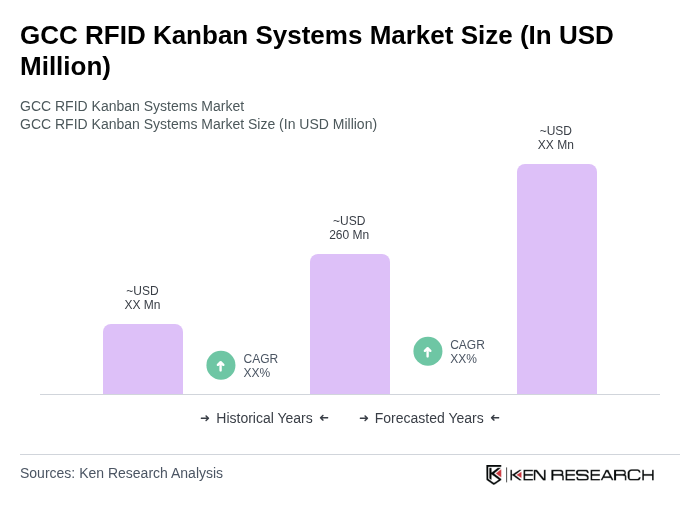
- The GCC RFID Kanban Systems Market is valued at USD 260 million, based on a five-year historical analysis. This growth is primarily driven by the increasing adoption of automation in supply chain management, enhanced inventory control, and the need for real-time tracking of goods. The integration of RFID technology with Kanban systems has significantly improved operational efficiency and reduced costs for businesses across sectors such as healthcare, manufacturing, and logistics.
- Key players in this market include the UAE and Saudi Arabia, which dominate due to their advanced logistics infrastructure, significant investments in technology, and a growing focus on digital transformation and Industry 4.0 initiatives. The UAE's strategic location as a trade hub with major ports and free zones, and Saudi Arabia's Vision 2030 initiative emphasizing smart logistics, digital supply chains, and healthcare modernization, further bolster their positions in the RFID Kanban systems market.
- In Saudi Arabia, regulatory and policy initiatives supporting supply chain digitization and product traceability, such as the Saudi Food and Drug Authority’s Medical Devices Interim Regulation and associated Unique Device Identification requirements, as well as Saudi Customs and ZATCA digital trade and e?invoicing frameworks, are encouraging the use of RFID and similar technologies in supply chain operations for specific industries to enhance transparency, reduce fraud, and improve inventory management, thereby supporting the adoption of RFID Kanban systems across the region.
GCC RFID Kanban Systems Market Segmentation
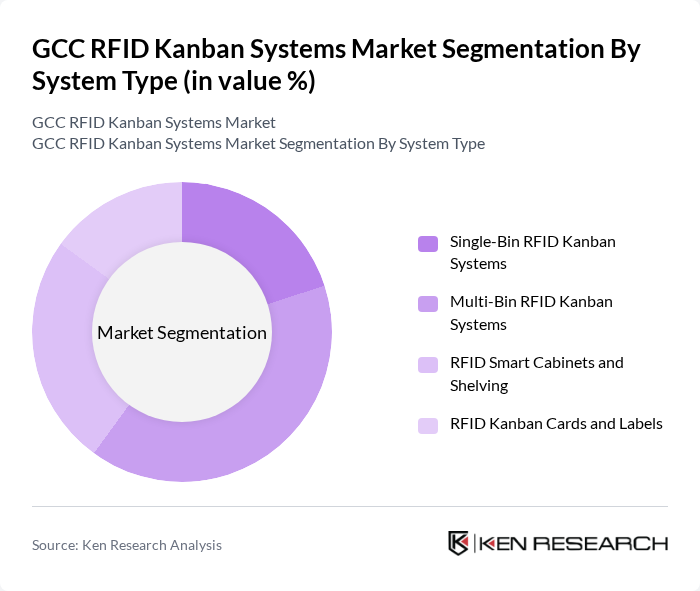
By System Type:The segmentation under System Type includes Single-Bin RFID Kanban Systems, Multi-Bin RFID Kanban Systems, RFID Smart Cabinets and Shelving, and RFID Kanban Cards and Labels. Single-bin and multi-bin RFID Kanban architectures are both widely adopted globally for inventory automation, with single-bin RFID Kanban systems currently accounting for the largest share worldwide due to their simplicity and lower implementation complexity, while multi-bin RFID Kanban systems are growing rapidly as hospitals and manufacturers seek greater redundancy and continuous replenishment capability. In the GCC, multi-bin RFID Kanban systems, RFID smart cabinets, and shelving solutions are particularly favored in healthcare and high-value manufacturing environments for improving inventory accuracy, minimizing manual counts, and reducing stockouts of critical consumables.
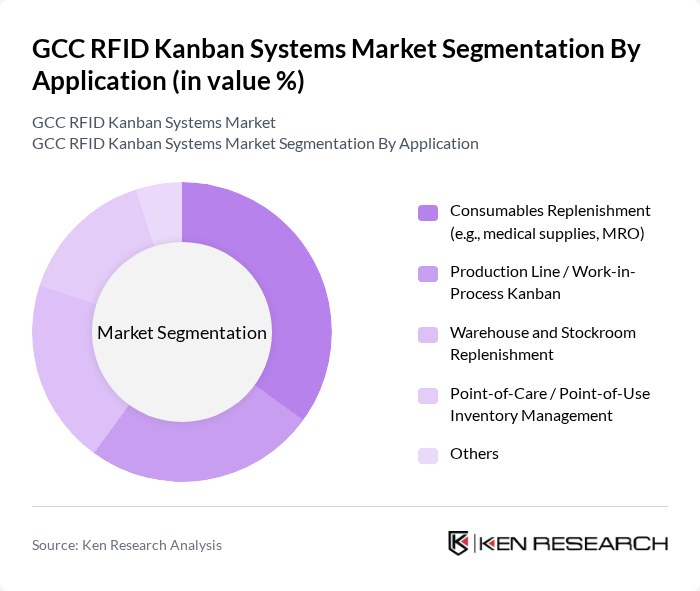
By Application:The application segmentation includes Consumables Replenishment (e.g., medical supplies, MRO), Production Line / Work-in-Process Kanban, Warehouse and Stockroom Replenishment, Point-of-Care / Point-of-Use Inventory Management, and Others. Globally, RFID Kanban systems are extensively used for real-time consumables and spare-parts replenishment in healthcare, manufacturing, and MRO environments, where they support automated reordering, reduction of manual inventory checks, and lower stockout risk. The Consumables Replenishment and Point-of-Care / Point-of-Use Inventory Management segments are particularly important in hospitals and clinics, where RFID Kanban-enabled cabinets and Kanban boxes improve visibility of medical supplies and implants, a trend further reinforced by post?pandemic emphasis on resilient healthcare supply chains.
GCC RFID Kanban Systems Market Competitive Landscape
The GCC RFID Kanban Systems Market is characterized by a dynamic mix of regional and international players. Leading participants such as Zebra Technologies Corporation, Impinj, Inc., Avery Dennison Corporation (including Smartrac brand), SATO Holdings Corporation, NXP Semiconductors N.V., HID Global Corporation (an ASSA ABLOY Group brand), Terso Solutions, Inc., Logistyx Technologies / Körber Supply Chain (RFID Kanban solutions), Wavemark, Inc. (Cardinal Health), Stanley Healthcare (Securitas Healthcare), Palex Medical, LogiTag Systems Ltd., Mobile Aspects, Inc., MediQR / RFID Global Solution, Inc., GCC System Integrators and Partners (e.g., Emitac Healthcare Solutions, TECHNOMED Group) contribute to innovation, geographic expansion, and service delivery in this space.
GCC RFID Kanban Systems Market Industry Analysis
Growth Drivers
- Increasing Demand for Inventory Management Solutions:The GCC region is witnessing a surge in demand for efficient inventory management solutions, driven by a projected increase in retail sales, expected to reach $400 billion in future. This growth is fueled by the need for businesses to optimize stock levels and reduce holding costs. Companies are increasingly adopting RFID Kanban systems to enhance accuracy and efficiency in inventory tracking, which is crucial for maintaining competitive advantage in a rapidly evolving market.
- Adoption of Automation in Supply Chain Processes:The GCC's logistics sector is projected to grow to $50 billion in future, with automation playing a pivotal role. Businesses are investing in RFID Kanban systems to streamline operations, reduce manual errors, and improve overall productivity. Automation not only enhances operational efficiency but also supports the region's vision of becoming a global logistics hub, aligning with the UAE's National Logistics Strategy aimed at boosting trade and investment.
- Rising Need for Real-Time Tracking and Visibility:As e-commerce in the GCC is expected to reach $35 billion in future, the demand for real-time tracking solutions is escalating. Companies are increasingly implementing RFID Kanban systems to gain visibility into their supply chains, enabling them to respond swiftly to market changes. This trend is critical for enhancing customer satisfaction and operational efficiency, as businesses strive to meet the growing expectations of consumers for timely deliveries and accurate order fulfillment.
Market Challenges
- High Initial Investment Costs:The implementation of RFID Kanban systems involves significant upfront costs, often exceeding $150,000 for small to medium-sized enterprises. This financial barrier can deter potential adopters, particularly in a region where many businesses are still recovering from economic fluctuations. The high costs associated with hardware, software, and training can limit the accessibility of these advanced systems, hindering market growth in the GCC.
- Integration Issues with Existing Systems:Many companies in the GCC face challenges integrating RFID Kanban systems with their legacy systems, which can lead to operational disruptions. Approximately 70% of businesses report difficulties in achieving seamless integration, resulting in increased downtime and inefficiencies. This challenge is compounded by the lack of standardized protocols across different platforms, making it essential for companies to invest in compatible solutions to ensure smooth operations.
GCC RFID Kanban Systems Market Future Outlook
The future of the GCC RFID Kanban systems market appears promising, driven by technological advancements and increasing digitalization across industries. As businesses prioritize efficiency and transparency, the integration of IoT and AI technologies is expected to enhance the capabilities of RFID systems. Furthermore, the growing emphasis on sustainability will likely push companies to adopt eco-friendly practices, aligning with regional goals for sustainable development and operational excellence in supply chain management.
Market Opportunities
- Expansion into Emerging Markets:The GCC region presents significant opportunities for RFID Kanban systems as emerging markets, such as Saudi Arabia and Oman, are investing heavily in logistics infrastructure. With government initiatives aimed at diversifying economies, companies can leverage these developments to introduce advanced inventory management solutions, enhancing their market presence and driving growth.
- Development of Advanced RFID Technologies:The ongoing innovation in RFID technology, including the introduction of low-cost tags and enhanced data analytics capabilities, presents a lucrative opportunity for market players. By investing in research and development, companies can create tailored solutions that meet the specific needs of various industries, thereby expanding their customer base and increasing market share in the GCC.
Scope of the Report
| Segment | Sub-Segments |
|---|---|
| By System Type | Single-Bin RFID Kanban Systems Multi-Bin RFID Kanban Systems RFID Smart Cabinets and Shelving RFID Kanban Cards and Labels |
| By Application | Consumables Replenishment (e.g., medical supplies, MRO) Production Line / Work-in-Process Kanban Warehouse and Stockroom Replenishment Point-of-Care / Point-of-Use Inventory Management Others |
| By End-User Industry | Healthcare Providers (Hospitals, Clinics, Pharmacies) Automotive and Discrete Manufacturing Food & Beverage and FMCG Logistics, 3PL, and Distribution Centers Retail and E-commerce Fulfilment Others |
| By Component | RFID Kanban Boxes / Bins RFID Tags and Labels RFID Readers and Gateways RFID-Enabled Cabinets / Shelves Software Platform & Integration (Middleware, Analytics, Cloud) Services (Design, Integration, Managed Services) |
| By Deployment Mode | On-Premises Cloud-Based (SaaS) Hybrid Others |
| By Geography (Within GCC) | UAE Saudi Arabia Qatar Kuwait Oman Bahrain |
| By Healthcare Use Case (GCC Hospitals & Clinics) | Operating Room and Cath Lab Inventory Central Stores and Pharmacy Kanban Ward and Point-of-Care Supplies Implantable Devices and High-Value Assets Others |
Key Target Audience
Investors and Venture Capitalist Firms
Government and Regulatory Bodies (e.g., Ministry of Commerce and Industry, Ministry of Transport)
Manufacturers and Producers
Distributors and Retailers
Logistics and Supply Chain Companies
Technology Providers
Industry Associations
Financial Institutions
Players Mentioned in the Report:
Zebra Technologies Corporation
Impinj, Inc.
Avery Dennison Corporation (including Smartrac brand)
SATO Holdings Corporation
NXP Semiconductors N.V.
HID Global Corporation (an ASSA ABLOY Group brand)
Terso Solutions, Inc.
Logistyx Technologies / Korber Supply Chain (RFID Kanban solutions)
Wavemark, Inc. (Cardinal Health)
Stanley Healthcare (Securitas Healthcare)
Palex Medical
LogiTag Systems Ltd.
Mobile Aspects, Inc.
MediQR / RFID Global Solution, Inc.
GCC System Integrators and Partners (e.g., Emitac Healthcare Solutions, TECHNOMED Group)
Table of Contents
Market Assessment Phase
1. Executive Summary and Approach
2. GCC RFID Kanban Systems Market Overview
2.1 Key Insights and Strategic Recommendations
2.2 GCC RFID Kanban Systems Market Overview
2.3 Definition and Scope
2.4 Evolution of Market Ecosystem
2.5 Timeline of Key Regulatory Milestones
2.6 Value Chain & Stakeholder Mapping
2.7 Business Cycle Analysis
2.8 Policy & Incentive Landscape
3. GCC RFID Kanban Systems Market Analysis
3.1 Growth Drivers
3.1.1 Increasing demand for inventory management solutions
3.1.2 Adoption of automation in supply chain processes
3.1.3 Rising need for real-time tracking and visibility
3.1.4 Growth in e-commerce and retail sectors
3.2 Market Challenges
3.2.1 High initial investment costs
3.2.2 Integration issues with existing systems
3.2.3 Lack of awareness among potential users
3.2.4 Data security concerns
3.3 Market Opportunities
3.3.1 Expansion into emerging markets
3.3.2 Development of advanced RFID technologies
3.3.3 Collaborations with technology providers
3.3.4 Customization of solutions for specific industries
3.4 Market Trends
3.4.1 Increasing use of IoT in supply chain management
3.4.2 Shift towards cloud-based solutions
3.4.3 Growing emphasis on sustainability in operations
3.4.4 Enhanced focus on data analytics for decision-making
3.5 Government Regulation
3.5.1 Standards for RFID technology implementation
3.5.2 Incentives for technology adoption in logistics
3.5.3 Compliance requirements for data protection
3.5.4 Regulations promoting supply chain transparency
4. SWOT Analysis
5. Stakeholder Analysis
6. Porter's Five Forces Analysis
7. GCC RFID Kanban Systems Market Market Size, 2019-2024
7.1 By Value
7.2 By Volume
7.3 By Average Selling Price
8. GCC RFID Kanban Systems Market Segmentation
8.1 By System Type
8.1.1 Single-Bin RFID Kanban Systems
8.1.2 Multi-Bin RFID Kanban Systems
8.1.3 RFID Smart Cabinets and Shelving
8.1.4 RFID Kanban Cards and Labels
8.2 By Application
8.2.1 Consumables Replenishment (e.g., medical supplies, MRO)
8.2.2 Production Line / Work-in-Process Kanban
8.2.3 Warehouse and Stockroom Replenishment
8.2.4 Point-of-Care / Point-of-Use Inventory Management
8.2.5 Others
8.3 By End-User Industry
8.3.1 Healthcare Providers (Hospitals, Clinics, Pharmacies)
8.3.2 Automotive and Discrete Manufacturing
8.3.3 Food & Beverage and FMCG
8.3.4 Logistics, 3PL, and Distribution Centers
8.3.5 Retail and E-commerce Fulfilment
8.3.6 Others
8.4 By Component
8.4.1 RFID Kanban Boxes / Bins
8.4.2 RFID Tags and Labels
8.4.3 RFID Readers and Gateways
8.4.4 RFID-Enabled Cabinets / Shelves
8.4.5 Software Platform & Integration (Middleware, Analytics, Cloud)
8.4.6 Services (Design, Integration, Managed Services)
8.5 By Deployment Mode
8.5.1 On-Premises
8.5.2 Cloud-Based (SaaS)
8.5.3 Hybrid
8.5.4 Others
8.6 By Geography (Within GCC)
8.6.1 UAE
8.6.2 Saudi Arabia
8.6.3 Qatar
8.6.4 Kuwait
8.6.5 Oman
8.6.6 Bahrain
8.7 By Healthcare Use Case (GCC Hospitals & Clinics)
8.7.1 Operating Room and Cath Lab Inventory
8.7.2 Central Stores and Pharmacy Kanban
8.7.3 Ward and Point-of-Care Supplies
8.7.4 Implantable Devices and High-Value Assets
8.7.5 Others
9. GCC RFID Kanban Systems Market Competitive Analysis
9.1 Market Share of Key Players
9.2 Cross Comparison of Key Players
9.2.1 Company Name
9.2.2 Regional Presence in GCC (Number of Countries Served)
9.2.3 GCC RFID Kanban Revenue (Latest Year, USD Million)
9.2.4 3-Year Revenue CAGR in RFID Kanban Segment
9.2.5 Installed Base in GCC (Number of Sites / Facilities)
9.2.6 Share of Healthcare vs. Industrial Deployments (%)
9.2.7 Average Deal Size per Deployment (USD)
9.2.8 Win Rate in Competitive Tenders (%)
9.2.9 Portfolio Breadth (Bins, Cabinets, Software, Services Score)
9.2.10 Integration Capability (No. of Supported ERP/HIS/WMS Platforms)
9.2.11 SLA / Uptime Performance (% Uptime Committed)
9.2.12 Customer Retention Rate in GCC (%)
9.2.13 R&D Intensity (% of Revenue Spent on Product Development)
9.3 SWOT Analysis of Top Players
9.4 Pricing Analysis
9.5 Detailed Profile of Major Companies
9.5.1 Zebra Technologies Corporation
9.5.2 Impinj, Inc.
9.5.3 Avery Dennison Corporation (including Smartrac brand)
9.5.4 SATO Holdings Corporation
9.5.5 NXP Semiconductors N.V.
9.5.6 HID Global Corporation (an ASSA ABLOY Group brand)
9.5.7 Terso Solutions, Inc.
9.5.8 Logistyx Technologies / Körber Supply Chain (RFID Kanban solutions)
9.5.9 Wavemark, Inc. (Cardinal Health)
9.5.10 Stanley Healthcare (Securitas Healthcare)
9.5.11 Palex Medical
9.5.12 LogiTag Systems Ltd.
9.5.13 Mobile Aspects, Inc.
9.5.14 MediQR / RFID Global Solution, Inc.
9.5.15 GCC System Integrators and Partners (e.g., Emitac Healthcare Solutions, TECHNOMED Group)
10. GCC RFID Kanban Systems Market End-User Analysis
10.1 Procurement Behavior of Key Ministries
10.1.1 Government procurement policies
10.1.2 Budget allocation for technology
10.1.3 Decision-making processes
10.1.4 Vendor selection criteria
10.2 Corporate Spend on Infrastructure & Energy
10.2.1 Investment trends in technology
10.2.2 Budget priorities for RFID solutions
10.2.3 Impact of economic conditions
10.2.4 Long-term planning strategies
10.3 Pain Point Analysis by End-User Category
10.3.1 Challenges faced by manufacturers
10.3.2 Issues in retail inventory management
10.3.3 Healthcare tracking difficulties
10.3.4 Logistics operational hurdles
10.4 User Readiness for Adoption
10.4.1 Awareness of RFID benefits
10.4.2 Training and support needs
10.4.3 Infrastructure readiness
10.4.4 Financial readiness for investment
10.5 Post-Deployment ROI and Use Case Expansion
10.5.1 Measurement of ROI post-implementation
10.5.2 Case studies of successful deployments
10.5.3 Expansion into new use cases
10.5.4 Long-term benefits realization
11. GCC RFID Kanban Systems Market Future Size, 2025-2030
11.1 By Value
11.2 By Volume
11.3 By Average Selling Price
Go-To-Market Strategy Phase
1. Whitespace Analysis + Business Model Canvas
1.1 Market gaps identification
1.2 Value proposition development
1.3 Revenue model exploration
1.4 Customer segmentation analysis
1.5 Competitive landscape overview
1.6 Key partnerships identification
1.7 Resource allocation strategy
2. Marketing and Positioning Recommendations
2.1 Branding strategies
2.2 Product USPs
2.3 Target audience definition
2.4 Communication strategy
2.5 Digital marketing approach
2.6 Trade show participation
2.7 Customer engagement tactics
3. Distribution Plan
3.1 Urban retail strategies
3.2 Rural NGO tie-ups
3.3 E-commerce distribution channels
3.4 Direct sales approach
3.5 Partnerships with logistics providers
3.6 Inventory management solutions
3.7 Distribution network optimization
4. Channel & Pricing Gaps
4.1 Underserved routes analysis
4.2 Pricing bands evaluation
4.3 Competitor pricing comparison
4.4 Customer willingness to pay
4.5 Discount strategies
4.6 Bundling opportunities
4.7 Channel conflict resolution
5. Unmet Demand & Latent Needs
5.1 Category gaps identification
5.2 Consumer segments analysis
5.3 Emerging trends exploration
5.4 Customer feedback incorporation
5.5 Product development alignment
5.6 Market entry barriers assessment
5.7 Future demand forecasting
6. Customer Relationship
6.1 Loyalty programs design
6.2 After-sales service strategies
6.3 Customer feedback mechanisms
6.4 Relationship management tools
6.5 Community engagement initiatives
6.6 Customer education programs
6.7 Retention strategies
7. Value Proposition
7.1 Sustainability initiatives
7.2 Integrated supply chains
7.3 Cost-saving measures
7.4 Enhanced customer experience
7.5 Innovation in product offerings
7.6 Competitive differentiation
7.7 Long-term partnerships
8. Key Activities
8.1 Regulatory compliance measures
8.2 Branding initiatives
8.3 Distribution setup processes
8.4 Training and development programs
8.5 Performance monitoring systems
8.6 Risk management strategies
8.7 Stakeholder engagement activities
9. Entry Strategy Evaluation
9.1 Domestic Market Entry Strategy
9.1.1 Product mix considerations
9.1.2 Pricing band analysis
9.1.3 Packaging strategies
9.2 Export Entry Strategy
9.2.1 Target countries identification
9.2.2 Compliance roadmap development
10. Entry Mode Assessment
10.1 Joint Ventures
10.2 Greenfield investments
10.3 Mergers and Acquisitions
10.4 Distributor Model evaluation
11. Capital and Timeline Estimation
11.1 Capital requirements analysis
11.2 Timelines for market entry
12. Control vs Risk Trade-Off
12.1 Ownership considerations
12.2 Partnerships evaluation
13. Profitability Outlook
13.1 Breakeven analysis
13.2 Long-term sustainability strategies
14. Potential Partner List
14.1 Distributors identification
14.2 Joint Ventures opportunities
14.3 Acquisition targets
15. Execution Roadmap
15.1 Phased Plan for Market Entry
15.1.1 Market Setup
15.1.2 Market Entry
15.1.3 Growth Acceleration
15.1.4 Scale & Stabilize
15.2 Key Activities and Milestones
15.2.1 Milestone tracking
15.2.2 Activity scheduling
Research Methodology
Phase 1: Approach1
Desk Research
- Industry reports from GCC logistics and supply chain associations
- Market analysis publications focusing on RFID technology adoption in the GCC region
- Government publications and white papers on smart manufacturing and inventory management
Primary Research
- Interviews with supply chain managers in manufacturing firms utilizing Kanban systems
- Surveys targeting RFID technology providers and integrators in the GCC market
- Field interviews with logistics coordinators in retail and distribution sectors
Validation & Triangulation
- Cross-validation of findings through multiple industry reports and expert opinions
- Triangulation of data from primary interviews and secondary research sources
- Sanity checks through feedback from industry panels and focus groups
Phase 2: Market Size Estimation1
Top-down Assessment
- Analysis of overall logistics market size in the GCC and its growth trajectory
- Segmentation of the market by industry verticals adopting RFID Kanban systems
- Incorporation of regional economic indicators and trade data influencing market growth
Bottom-up Modeling
- Estimation of RFID system adoption rates among key sectors such as retail and manufacturing
- Cost analysis based on average pricing of RFID solutions and Kanban systems
- Volume estimates derived from operational data of firms implementing these systems
Forecasting & Scenario Analysis
- Multi-variable forecasting models considering technological advancements and market trends
- Scenario planning based on varying levels of RFID adoption and regulatory impacts
- Projections for market growth through 2030 under different economic conditions
Phase 3: CATI Sample Composition1
| Scope Item/Segment | Sample Size | Target Respondent Profiles |
|---|---|---|
| Manufacturing Sector RFID Implementation | 120 | Operations Managers, Supply Chain Analysts |
| Retail Inventory Management | 90 | Inventory Managers, Retail Operations Directors |
| Logistics and Distribution Centers | 80 | Logistics Coordinators, Warehouse Managers |
| Healthcare Supply Chain Solutions | 70 | Healthcare Administrators, Procurement Officers |
| Food and Beverage Industry Tracking | 60 | Quality Control Managers, Supply Chain Directors |
Frequently Asked Questions
What is the current value of the GCC RFID Kanban Systems Market?
The GCC RFID Kanban Systems Market is valued at approximately USD 260 million, reflecting a significant growth driven by the increasing adoption of automation in supply chain management and the need for real-time tracking of goods across various sectors.
Which countries dominate the GCC RFID Kanban Systems Market?
What are the main drivers of growth in the GCC RFID Kanban Systems Market?
What challenges does the GCC RFID Kanban Systems Market face?
Other Regional/Country Reports
Indonesia RFID Kanban Systems Market
Malaysia RFID Kanban Systems Market
KSA RFID Kanban Systems Market
APAC RFID Kanban Systems Market
SEA RFID Kanban Systems Market
Vietnam RFID Kanban Systems Market
Other Adjacent Reports
Malaysia RFID Technology Market
Bahrain inventory management software market report Size, Share, Growth Drivers, Trends, Opportunities & Forecast 2025–2030Saudi Arabia Supply Chain Automation MarketGCC Healthcare Logistics Market Size, Share, Growth Drivers, Trends, Opportunities & Forecast 2025–2030Indonesia Manufacturing Automation Market Report Size Share Growth Drivers Trends Opportunities & Forecast 2025–2030Vietnam warehouse automation market report size, share, growth drivers, trends, opportunities & forecast 2025–2030Germany Real-Time Tracking Systems Market
Thailand IoT Solutions Market
Philippines Asset Management Systems Market
Singapore Smart Cabinet Systems Market
Why Buy From Us?

What makes us stand out is that our consultants follow Robust, Refine and Result (RRR) methodology. Robust for clear definitions, approaches and sanity checking, Refine for differentiating respondents' facts and opinions, and Result for presenting data with story.

We have set a benchmark in the industry by offering our clients with syndicated and customized market research reports featuring coverage of entire market as well as meticulous research and analyst insights.

While we don't replace traditional research, we flip the method upside down. Our dual approach of Top Bottom & Bottom Top ensures quality deliverable by not just verifying company fundamentals but also looking at the sector and macroeconomic factors.

With one step in the future, our research team constantly tries to show you the bigger picture. We help with some of the tough questions you may encounter along the way: How is the industry positioned? Best marketing channel? KPI's of competitors? By aligning every element, we help maximize success.

Our report gives you instant access to the answers and sources that other companies might choose to hide. We elaborate each steps of research methodology we have used and showcase you the sample size to earn your trust.

If you need any support, we are here! We pride ourselves on universe strength, data quality, and quick, friendly, and professional service.