About the Report
Base Year 2024Listen to the audio summary
Germany Agricultural Machinery Market Overview
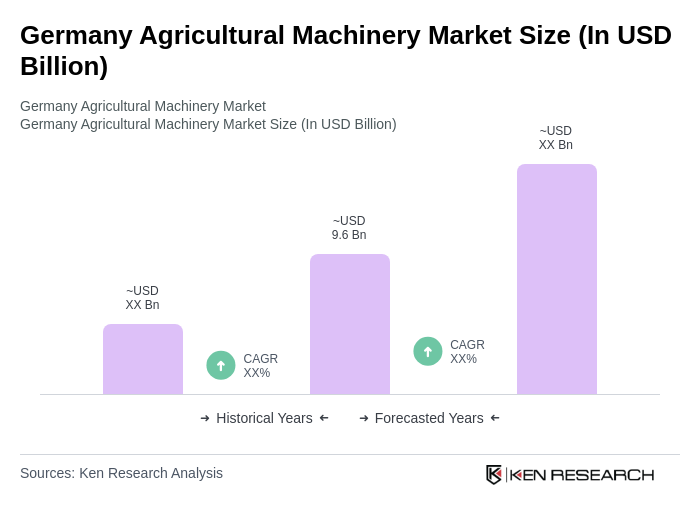
- The Germany Agricultural Machinery Market is valued at approximately USD 9.6 billion, based on a five-year historical analysis. This growth is primarily driven by advancements in technology, increasing demand for efficient farming practices, and the need for sustainable agricultural solutions. The market has seen a significant rise in the adoption of smart machinery and automation, which enhances productivity and reduces labor costs. Recent trends include the integration of precision agriculture, autonomous equipment, and energy-efficient machinery, reflecting the sector's shift toward digitalization and sustainability .
- Key players in this market include major agricultural hubs such as Bavaria, North Rhine-Westphalia, and Lower Saxony. These regions dominate due to their strong agricultural base, extensive farming activities, and a high concentration of agricultural machinery manufacturers. The presence of well-established supply chains and a skilled workforce further contribute to their market leadership .
- In 2023, the German government implemented a modernization program allocating approximately EUR 200 million to support farmers in upgrading their machinery. This initiative aims to promote the adoption of environmentally friendly technologies and improve the overall efficiency of agricultural operations across the country .
Germany Agricultural Machinery Market Segmentation
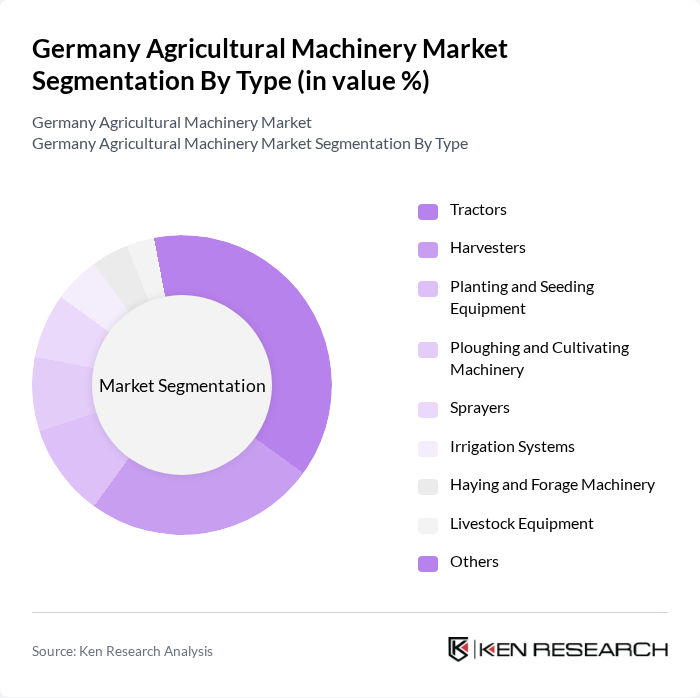
By Type:The agricultural machinery market can be segmented into various types, including tractors, harvesters, planting and seeding equipment, ploughing and cultivating machinery, sprayers, irrigation systems, haying and forage machinery, livestock equipment, and others. Among these, tractors and harvesters are the most significant segments, driven by their essential roles in modern farming practices. The increasing trend towards mechanization in agriculture has led to a higher demand for these machines, as they enhance productivity and efficiency in farming operations. Precision agriculture equipment and autonomous machinery are also gaining traction, reflecting the market's focus on digital and sustainable solutions .
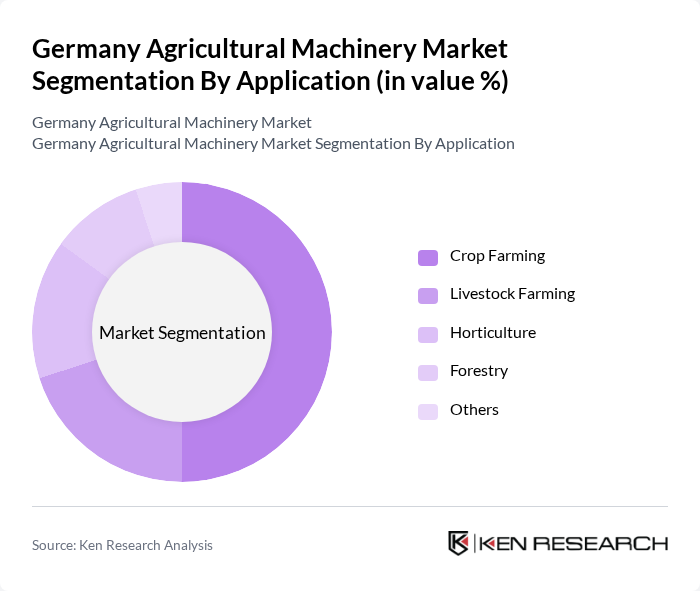
By Application:The market can also be segmented based on application, which includes crop farming, livestock farming, horticulture, forestry, and others. Crop farming is the leading application segment, driven by the increasing need for food production and the adoption of modern farming techniques. The growing population and rising food demand have led to a surge in crop farming activities, necessitating the use of advanced agricultural machinery to enhance yield and efficiency. Livestock farming and horticulture are also significant, supported by investments in animal welfare and specialty crop production .
Germany Agricultural Machinery Market Competitive Landscape
The Germany Agricultural Machinery Market is characterized by a dynamic mix of regional and international players. Leading participants such as John Deere GmbH & Co. KG, AGCO GmbH (Fendt, Massey Ferguson, Valtra), CLAAS KGaA mbH, CNH Industrial N.V. (Case IH, New Holland), Kubota (Deutschland) GmbH, SDF Group (SAME DEUTZ-FAHR), HORSCH Maschinen GmbH, Lemken GmbH & Co. KG, AMAZONE-Werke H. Dreyer GmbH & Co. KG, Grimme Landmaschinenfabrik GmbH & Co. KG, Kuhn Group (Bucher Industries AG), Pöttinger Landtechnik GmbH, Kverneland Group (Kubota Holdings Europe B.V.), Väderstad AB, Strautmann & Söhne GmbH u. Co. KG contribute to innovation, geographic expansion, and service delivery in this space.
Germany Agricultural Machinery Market Industry Analysis
Growth Drivers
- Increasing Demand for Precision Farming:The German agricultural sector is witnessing a significant shift towards precision farming, driven by the need for enhanced productivity. In future, the market for precision agriculture technologies is projected to reach €1.1 billion, reflecting a 10% increase from the previous year. This growth is fueled by the rising adoption of GPS-guided equipment and data analytics, which enable farmers to optimize resource use and improve crop yields, thereby addressing food security challenges.
- Technological Advancements in Machinery:The agricultural machinery market in Germany is benefiting from rapid technological advancements, particularly in automation and robotics. In future, investments in smart machinery are expected to exceed €1.5 billion, as farmers increasingly adopt automated solutions to reduce labor costs and enhance efficiency. Innovations such as autonomous tractors and drones are becoming commonplace, allowing for more precise farming operations and better management of agricultural resources.
- Government Subsidies for Agricultural Modernization:The German government is actively promoting agricultural modernization through various subsidy programs. In future, approximately €300 million is allocated for grants aimed at encouraging farmers to invest in modern machinery and sustainable practices. These subsidies not only alleviate the financial burden on farmers but also stimulate the adoption of advanced technologies, contributing to the overall growth of the agricultural machinery market in Germany.
Market Challenges
- High Initial Investment Costs:One of the significant challenges facing the agricultural machinery market in Germany is the high initial investment required for modern equipment. In future, the average cost of advanced machinery is estimated to be around €120,000, which poses a barrier for many small and medium-sized farms. This financial hurdle limits access to cutting-edge technology, hindering productivity improvements and the overall competitiveness of the agricultural sector.
- Regulatory Compliance Complexities:The agricultural machinery sector in Germany is subject to stringent regulatory requirements, which can complicate market entry and operations. In future, compliance with new EU regulations on emissions and safety standards is expected to increase operational costs by approximately 15%. These complexities can deter investment and innovation, particularly among smaller manufacturers who may struggle to meet the evolving regulatory landscape.
Germany Agricultural Machinery Market Future Outlook
The future of the agricultural machinery market in Germany appears promising, driven by ongoing technological innovations and a strong push towards sustainability. As farmers increasingly adopt smart farming solutions, the integration of IoT and automation will likely enhance operational efficiency. Additionally, the focus on electric and hybrid machinery is expected to grow, aligning with environmental goals. These trends indicate a transformative phase for the industry, fostering a more sustainable and productive agricultural landscape in Germany.
Market Opportunities
- Expansion of E-commerce Platforms for Machinery Sales:The rise of e-commerce platforms presents a significant opportunity for the agricultural machinery market. In future, online sales are projected to account for 20% of total machinery sales, driven by increased digital adoption among farmers. This shift allows manufacturers to reach a broader audience and streamline the purchasing process, enhancing market accessibility.
- Development of Smart Farming Solutions:The growing demand for smart farming solutions offers substantial market opportunities. In future, investments in smart technologies are expected to reach €800 million, as farmers seek to leverage data analytics and IoT for improved decision-making. This trend not only enhances productivity but also supports sustainable practices, positioning the market for long-term growth.
Scope of the Report
| Segment | Sub-Segments |
|---|---|
| By Type | Tractors Harvesters Planting and Seeding Equipment Ploughing and Cultivating Machinery Sprayers Irrigation Systems Haying and Forage Machinery Livestock Equipment Others |
| By Application | Crop Farming Livestock Farming Horticulture Forestry Others |
| By End-User | Large Farms Medium Farms Small Farms Agricultural Cooperatives Others |
| By Sales Channel | Direct Sales Distributors Online Retail Auctions Others |
| By Distribution Mode | Wholesale Retail Direct-to-Consumer Others |
| By Price Range | Budget Mid-Range Premium |
| By Technology | Conventional Machinery Smart Machinery Autonomous Machinery Others |
Key Target Audience
Investors and Venture Capitalist Firms
Government and Regulatory Bodies (e.g., Federal Ministry of Food and Agriculture, German Agricultural Society)
Manufacturers and Producers
Distributors and Retailers
Farmers' Cooperatives
Technology Providers
Industry Associations (e.g., VDMA - Mechanical Engineering Industry Association)
Financial Institutions
Players Mentioned in the Report:
John Deere GmbH & Co. KG
AGCO GmbH (Fendt, Massey Ferguson, Valtra)
CLAAS KGaA mbH
CNH Industrial N.V. (Case IH, New Holland)
Kubota (Deutschland) GmbH
SDF Group (SAME DEUTZ-FAHR)
HORSCH Maschinen GmbH
Lemken GmbH & Co. KG
AMAZONE-Werke H. Dreyer GmbH & Co. KG
Grimme Landmaschinenfabrik GmbH & Co. KG
Kuhn Group (Bucher Industries AG)
Pottinger Landtechnik GmbH
Kverneland Group (Kubota Holdings Europe B.V.)
Vaderstad AB
Strautmann & Sohne GmbH u. Co. KG
Table of Contents
Market Assessment Phase
1. Executive Summary and Approach
2. Germany Agricultural Machinery Market Overview
2.1 Key Insights and Strategic Recommendations
2.2 Germany Agricultural Machinery Market Overview
2.3 Definition and Scope
2.4 Evolution of Market Ecosystem
2.5 Timeline of Key Regulatory Milestones
2.6 Value Chain & Stakeholder Mapping
2.7 Business Cycle Analysis
2.8 Policy & Incentive Landscape
3. Germany Agricultural Machinery Market Analysis
3.1 Growth Drivers
3.1.1 Increasing demand for precision farming
3.1.2 Technological advancements in machinery
3.1.3 Government subsidies for agricultural modernization
3.1.4 Rising awareness of sustainable farming practices
3.2 Market Challenges
3.2.1 High initial investment costs
3.2.2 Regulatory compliance complexities
3.2.3 Limited access to financing for small farmers
3.2.4 Competition from used machinery market
3.3 Market Opportunities
3.3.1 Expansion of e-commerce platforms for machinery sales
3.3.2 Development of smart farming solutions
3.3.3 Collaborations with tech companies for innovation
3.3.4 Growing export potential to emerging markets
3.4 Market Trends
3.4.1 Shift towards electric and hybrid machinery
3.4.2 Increasing integration of IoT in agricultural equipment
3.4.3 Focus on automation and robotics in farming
3.4.4 Rising demand for multifunctional machinery
3.5 Government Regulation
3.5.1 Stricter emissions standards for agricultural machinery
3.5.2 Incentives for adopting sustainable practices
3.5.3 Regulations on machinery safety and operation
3.5.4 Compliance requirements for machinery imports
4. SWOT Analysis
5. Stakeholder Analysis
6. Porter's Five Forces Analysis
7. Germany Agricultural Machinery Market Market Size, 2019-2024
7.1 By Value
7.2 By Volume
7.3 By Average Selling Price
8. Germany Agricultural Machinery Market Segmentation
8.1 By Type
8.1.1 Tractors
8.1.2 Harvesters
8.1.3 Planting and Seeding Equipment
8.1.4 Ploughing and Cultivating Machinery
8.1.5 Sprayers
8.1.6 Irrigation Systems
8.1.7 Haying and Forage Machinery
8.1.8 Livestock Equipment
8.1.9 Others
8.2 By Application
8.2.1 Crop Farming
8.2.2 Livestock Farming
8.2.3 Horticulture
8.2.4 Forestry
8.2.5 Others
8.3 By End-User
8.3.1 Large Farms
8.3.2 Medium Farms
8.3.3 Small Farms
8.3.4 Agricultural Cooperatives
8.3.5 Others
8.4 By Sales Channel
8.4.1 Direct Sales
8.4.2 Distributors
8.4.3 Online Retail
8.4.4 Auctions
8.4.5 Others
8.5 By Distribution Mode
8.5.1 Wholesale
8.5.2 Retail
8.5.3 Direct-to-Consumer
8.5.4 Others
8.6 By Price Range
8.6.1 Budget
8.6.2 Mid-Range
8.6.3 Premium
8.7 By Technology
8.7.1 Conventional Machinery
8.7.2 Smart Machinery
8.7.3 Autonomous Machinery
8.7.4 Others
9. Germany Agricultural Machinery Market Competitive Analysis
9.1 Market Share of Key Players
9.2 Cross Comparison of Key Players
9.2.1 Company Name
9.2.2 Company Size (Large, Medium, Small)
9.2.3 Revenue (Germany, EUR million)
9.2.4 Market Share (%)
9.2.5 Product Portfolio Breadth
9.2.6 R&D Expenditure (% of Revenue)
9.2.7 Distribution Network Coverage (No. of Dealers/Outlets)
9.2.8 After-Sales Service Network (No. of Service Points)
9.2.9 Innovation Index (Patents, New Product Launches)
9.2.10 Sustainability Initiatives (CO? Reduction, Green Tech Adoption)
9.3 SWOT Analysis of Top Players
9.4 Pricing Analysis
9.5 Detailed Profile of Major Companies
9.5.1 John Deere GmbH & Co. KG
9.5.2 AGCO GmbH (Fendt, Massey Ferguson, Valtra)
9.5.3 CLAAS KGaA mbH
9.5.4 CNH Industrial N.V. (Case IH, New Holland)
9.5.5 Kubota (Deutschland) GmbH
9.5.6 SDF Group (SAME DEUTZ-FAHR)
9.5.7 HORSCH Maschinen GmbH
9.5.8 Lemken GmbH & Co. KG
9.5.9 AMAZONE-Werke H. Dreyer GmbH & Co. KG
9.5.10 Grimme Landmaschinenfabrik GmbH & Co. KG
9.5.11 Kuhn Group (Bucher Industries AG)
9.5.12 Pöttinger Landtechnik GmbH
9.5.13 Kverneland Group (Kubota Holdings Europe B.V.)
9.5.14 Väderstad AB
9.5.15 Strautmann & Söhne GmbH u. Co. KG
10. Germany Agricultural Machinery Market End-User Analysis
10.1 Procurement Behavior of Key Ministries
10.1.1 Budget Allocation Trends
10.1.2 Procurement Processes
10.1.3 Key Decision-Makers
10.2 Corporate Spend on Infrastructure & Energy
10.2.1 Investment Trends in Agricultural Infrastructure
10.2.2 Energy Efficiency Initiatives
10.2.3 Funding Sources
10.3 Pain Point Analysis by End-User Category
10.3.1 Equipment Reliability Issues
10.3.2 Maintenance Costs
10.3.3 Access to Technology
10.4 User Readiness for Adoption
10.4.1 Training and Support Needs
10.4.2 Technology Acceptance Levels
10.4.3 Investment Willingness
10.5 Post-Deployment ROI and Use Case Expansion
10.5.1 Performance Metrics
10.5.2 Case Studies of Successful Implementations
10.5.3 Future Expansion Plans
11. Germany Agricultural Machinery Market Future Size, 2025-2030
11.1 By Value
11.2 By Volume
11.3 By Average Selling Price
Go-To-Market Strategy Phase
1. Whitespace Analysis + Business Model Canvas
1.1 Market Gaps Identification
1.2 Business Model Framework
2. Marketing and Positioning Recommendations
2.1 Branding Strategies
2.2 Product USPs
3. Distribution Plan
3.1 Urban Retail Strategies
3.2 Rural NGO Tie-ups
4. Channel & Pricing Gaps
4.1 Underserved Routes
4.2 Pricing Bands
5. Unmet Demand & Latent Needs
5.1 Category Gaps
5.2 Consumer Segments
6. Customer Relationship
6.1 Loyalty Programs
6.2 After-sales Service
7. Value Proposition
7.1 Sustainability Initiatives
7.2 Integrated Supply Chains
8. Key Activities
8.1 Regulatory Compliance
8.2 Branding Efforts
8.3 Distribution Setup
9. Entry Strategy Evaluation
9.1 Domestic Market Entry Strategy
9.1.1 Product Mix Considerations
9.1.2 Pricing Band Strategy
9.1.3 Packaging Approaches
9.2 Export Entry Strategy
9.2.1 Target Countries
9.2.2 Compliance Roadmap
10. Entry Mode Assessment
10.1 Joint Ventures
10.2 Greenfield Investments
10.3 Mergers & Acquisitions
10.4 Distributor Model
11. Capital and Timeline Estimation
11.1 Capital Requirements
11.2 Timelines for Implementation
12. Control vs Risk Trade-Off
12.1 Ownership Considerations
12.2 Partnerships Evaluation
13. Profitability Outlook
13.1 Breakeven Analysis
13.2 Long-term Sustainability Strategies
14. Potential Partner List
14.1 Distributors
14.2 Joint Ventures
14.3 Acquisition Targets
15. Execution Roadmap
15.1 Phased Plan for Market Entry
15.1.1 Market Setup
15.1.2 Market Entry
15.1.3 Growth Acceleration
15.1.4 Scale & Stabilize
15.2 Key Activities and Milestones
15.2.1 Milestone Planning
15.2.2 Activity Tracking
Research Methodology
Phase 1: Approach1
Desk Research
- Analysis of industry reports from agricultural machinery associations in Germany
- Review of government publications and agricultural statistics from the Federal Ministry of Food and Agriculture
- Examination of market trends and forecasts from reputable agricultural machinery journals and publications
Primary Research
- Interviews with key stakeholders including manufacturers, distributors, and retailers in the agricultural machinery sector
- Surveys conducted with farmers and agricultural cooperatives to understand machinery usage and preferences
- Field visits to agricultural trade shows and exhibitions to gather insights on new technologies and market dynamics
Validation & Triangulation
- Cross-validation of data through multiple sources including trade associations and government reports
- Triangulation of findings from primary interviews with secondary data to ensure consistency
- Sanity checks through expert panels comprising industry veterans and academic professionals
Phase 2: Market Size Estimation1
Top-down Assessment
- Estimation of market size based on national agricultural output and machinery penetration rates
- Segmentation of the market by machinery type, including tractors, harvesters, and tillage equipment
- Incorporation of government subsidies and incentives for agricultural modernization
Bottom-up Modeling
- Collection of sales data from leading agricultural machinery manufacturers in Germany
- Estimation of average selling prices and volume sold across different machinery categories
- Analysis of regional demand variations based on crop types and farming practices
Forecasting & Scenario Analysis
- Utilization of time-series analysis to project future market growth based on historical data
- Scenario modeling based on potential impacts of technological advancements and environmental regulations
- Development of baseline, optimistic, and pessimistic forecasts through 2030
Phase 3: CATI Sample Composition1
| Scope Item/Segment | Sample Size | Target Respondent Profiles |
|---|---|---|
| Tractor Manufacturers | 60 | Product Managers, Sales Directors |
| Harvesting Equipment Suppliers | 50 | Operations Managers, Marketing Heads |
| Farmers and Agricultural Cooperatives | 120 | Farm Owners, Cooperative Leaders |
| Distributors and Retailers | 40 | Supply Chain Managers, Retail Operations Heads |
| Research and Development Experts | 40 | R&D Managers, Innovation Directors |
Frequently Asked Questions
What is the current value of the Germany Agricultural Machinery Market?
The Germany Agricultural Machinery Market is valued at approximately USD 9.6 billion, reflecting a significant growth driven by technological advancements, increased demand for efficient farming practices, and sustainable agricultural solutions.
What are the key drivers of growth in the Germany Agricultural Machinery Market?
Which regions in Germany dominate the Agricultural Machinery Market?
What types of agricultural machinery are most significant in Germany?
Why Buy From Us?

What makes us stand out is that our consultants follow Robust, Refine and Result (RRR) methodology. Robust for clear definitions, approaches and sanity checking, Refine for differentiating respondents' facts and opinions, and Result for presenting data with story.

We have set a benchmark in the industry by offering our clients with syndicated and customized market research reports featuring coverage of entire market as well as meticulous research and analyst insights.

While we don't replace traditional research, we flip the method upside down. Our dual approach of Top Bottom & Bottom Top ensures quality deliverable by not just verifying company fundamentals but also looking at the sector and macroeconomic factors.

With one step in the future, our research team constantly tries to show you the bigger picture. We help with some of the tough questions you may encounter along the way: How is the industry positioned? Best marketing channel? KPI's of competitors? By aligning every element, we help maximize success.

Our report gives you instant access to the answers and sources that other companies might choose to hide. We elaborate each steps of research methodology we have used and showcase you the sample size to earn your trust.

If you need any support, we are here! We pride ourselves on universe strength, data quality, and quick, friendly, and professional service.