About the Report
Base Year 2024Germany Office Furniture Market Overview
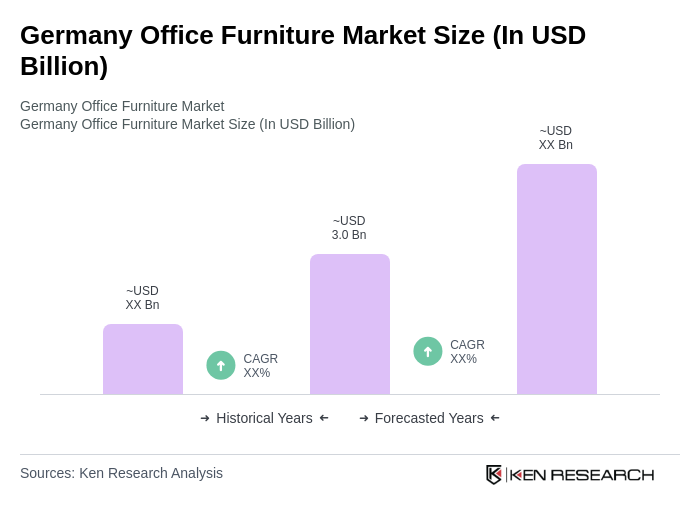
- The Germany Office Furniture Market is valued at USD 3.0 billion, based on a five-year historical analysis. This growth is primarily driven by the increasing demand for ergonomic and flexible office solutions, as well as the rise of remote and hybrid work models that necessitate home office setups. The market has seen a significant shift towards sustainable materials and designs, reflecting broader environmental concerns among consumers and businesses alike.
- Key cities such as Berlin, Munich, and Frankfurt dominate the market due to their status as economic hubs with a high concentration of corporate offices and startups. These cities are characterized by a vibrant business environment, attracting both local and international companies, which in turn drives demand for innovative office furniture solutions that enhance productivity and employee well-being.
- In 2023, the German government implemented regulations aimed at promoting sustainable office environments, including EU-wide Ecodesign and circularity initiatives and Germany’s implementation of the Supply Chain Due Diligence Act and packaging/waste directives; however, there is no mandate that “all new office furniture must” meet a specific uniform environmental standard nationwide. Current policy emphasis encourages eco-design, recyclability, and responsible sourcing rather than a categorical furniture-specific mandate.
Germany Office Furniture Market Segmentation
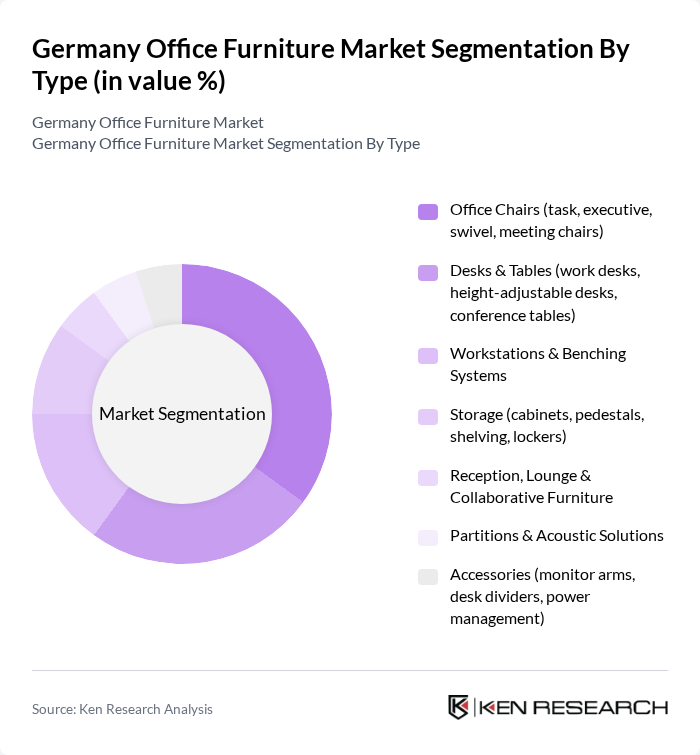
By Type:The office furniture market can be segmented into various types, including office chairs, desks and tables, workstations, storage solutions, reception and lounge furniture, partitions, and accessories. Among these, office chairs, particularly ergonomic models, are leading the market due to the growing awareness of workplace health and comfort. The demand for height-adjustable desks is also on the rise, reflecting a shift towards more flexible work environments.
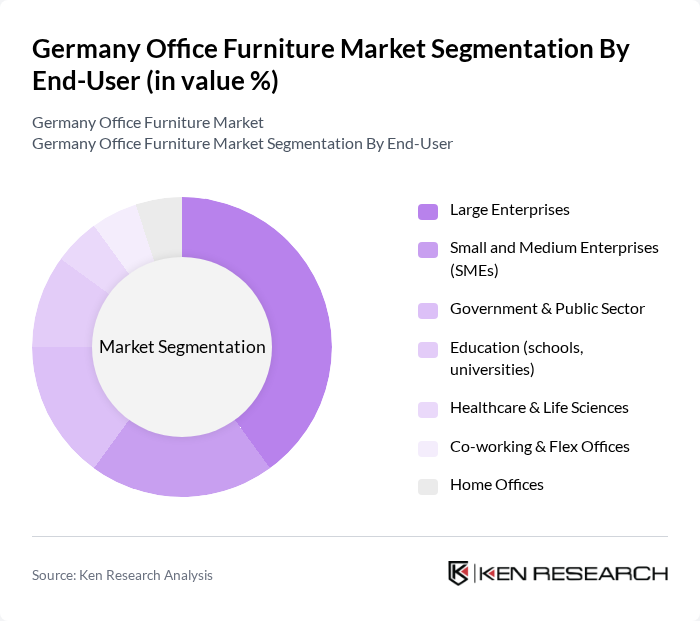
By End-User:The end-user segmentation includes large enterprises, small and medium enterprises (SMEs), government and public sector, education, healthcare, co-working spaces, and home offices. Large enterprises are the dominant segment, driven by their need for comprehensive office solutions that enhance productivity and employee satisfaction. The rise of co-working spaces has also contributed to the demand for flexible and modular furniture solutions.
Germany Office Furniture Market Competitive Landscape
The Germany Office Furniture Market is characterized by a dynamic mix of regional and international players. Leading participants such as Steelcase Inc., MillerKnoll, Inc. (Herman Miller and Knoll), Haworth Inc., Vitra AG, Kinnarps AB, Bene AG, Wilkhahn Wilkening + Hahne GmbH & Co. KG, Interstuhl Büromöbel GmbH & Co. KG, Sedus Stoll AG, König + Neurath AG, Nowy Styl Group, Assmann Büromöbel GmbH & Co. KG, Dauphin HumanDesign Group, HNI Corporation, Teknion Corporation contribute to innovation, geographic expansion, and service delivery in this space.
Germany Office Furniture Market Industry Analysis
Growth Drivers
- Increasing Demand for Ergonomic Furniture:The German office furniture market is witnessing a significant shift towards ergonomic solutions, driven by a growing awareness of workplace health. In future, the demand for ergonomic chairs and desks is projected to reach approximately 1.3 million units, reflecting a 10% increase from the previous year. This trend is supported by the German government's initiatives promoting workplace wellness, which aim to reduce work-related injuries and enhance employee productivity, ultimately benefiting businesses economically.
- Rise in Remote Working Trends:The remote working trend has surged in Germany, with around 45% of employees expected to work remotely at least part-time in future. This shift has led to increased investments in home office setups, with an estimated €1.8 billion spent on office furniture for home use. Companies are also adapting their office spaces to accommodate flexible work arrangements, driving demand for versatile and space-efficient furniture solutions that cater to both home and office environments.
- Growing Focus on Sustainable Office Solutions:Sustainability is becoming a key driver in the German office furniture market, with a reported 65% of consumers prioritizing eco-friendly products. In future, the market for sustainable office furniture is expected to grow to €900 million, fueled by increasing regulations and consumer demand for environmentally responsible practices. Companies are investing in sustainable materials and production processes, aligning with Germany's commitment to reducing carbon emissions and promoting a circular economy.
Market Challenges
- High Competition Among Local and International Players:The German office furniture market is characterized by intense competition, with over 600 manufacturers vying for market share. This competitive landscape has led to price wars, impacting profit margins. In future, the average profit margin for office furniture manufacturers is projected to decline to 7%, down from 9% in the previous year. Companies must innovate and differentiate their offerings to maintain profitability amidst this fierce competition.
- Fluctuating Raw Material Prices:The office furniture industry in Germany faces challenges due to volatile raw material prices, particularly for wood and metals. In future, the cost of plywood is expected to rise by 15%, while steel prices may increase by 12%. These fluctuations can significantly impact production costs, forcing manufacturers to either absorb the costs or pass them on to consumers, which could affect demand and overall market stability.
Germany Office Furniture Market Future Outlook
The future of the German office furniture market appears promising, driven by ongoing trends in remote work and sustainability. As companies continue to adapt to hybrid work models, the demand for flexible and multifunctional furniture solutions is expected to rise. Additionally, the integration of technology in office design will likely enhance user experience and productivity. Manufacturers that prioritize innovation and sustainability will be well-positioned to capture market share and meet evolving consumer preferences in the coming years.
Market Opportunities
- Adoption of Smart Office Solutions:The increasing integration of technology in office environments presents a significant opportunity. In future, the market for smart office furniture, including IoT-enabled desks and chairs, is projected to reach €400 million. This growth is driven by the demand for enhanced connectivity and productivity, as businesses seek to create more efficient workspaces that cater to the needs of modern employees.
- Growth in E-commerce for Office Furniture:The shift towards online shopping is transforming the office furniture market. In future, e-commerce sales are expected to account for 30% of total office furniture sales, amounting to approximately €1.2 billion. This trend offers manufacturers and retailers the chance to reach a broader audience, streamline operations, and enhance customer engagement through digital platforms, ultimately driving sales growth.
Scope of the Report
| Segment | Sub-Segments |
|---|---|
| By Type | Office Chairs (task, executive, swivel, meeting chairs) Desks & Tables (work desks, height-adjustable desks, conference tables) Workstations & Benching Systems Storage (cabinets, pedestals, shelving, lockers) Reception, Lounge & Collaborative Furniture Partitions & Acoustic Solutions Accessories (monitor arms, desk dividers, power management) |
| By End-User | Large Enterprises Small and Medium Enterprises (SMEs) Government & Public Sector Education (schools, universities) Healthcare & Life Sciences Co-working & Flex Offices Home Offices |
| By Distribution Channel | Offline (dealers, showrooms, contract furniture) Online (brand e-shops, marketplaces) Direct to Enterprise (project/contract sales) Architect & Designer Specified Facility Management & Integrators |
| By Material | Wood & Wood-based Panels Metal (steel, aluminum) Plastics & Composites Upholstery & Fabrics Sustainable/Recycled Materials |
| By Price Range | Budget Mid-Range Premium Luxury/Design Icon |
| By Design Style | Modern/Contemporary Traditional/Classic Scandinavian/Minimalist Industrial Biophilic & Sustainable Design |
| By Functionality | Ergonomic (EN 1335/DIN standards compliant) Height-adjustable & Sit-Stand Modular & Reconfigurable Fixed & Casegoods Smart/Connected (IoT, occupancy sensors) |
Key Target Audience
Investors and Venture Capitalist Firms
Government and Regulatory Bodies (e.g., Federal Ministry for Economic Affairs and Energy, German Trade and Invest)
Manufacturers and Producers
Distributors and Retailers
Interior Designers and Architects
Corporate Real Estate Managers
Facility Management Companies
Trade Associations (e.g., German Furniture Industry Association)
Players Mentioned in the Report:
Steelcase Inc.
MillerKnoll, Inc. (Herman Miller and Knoll)
Haworth Inc.
Vitra AG
Kinnarps AB
Bene AG
Wilkhahn Wilkening + Hahne GmbH & Co. KG
Interstuhl Buromobel GmbH & Co. KG
Sedus Stoll AG
Konig + Neurath AG
Nowy Styl Group
Assmann Buromobel GmbH & Co. KG
Dauphin HumanDesign Group
HNI Corporation
Teknion Corporation
Table of Contents
Market Assessment Phase
1. Executive Summary and Approach
2. Germany Office Furniture Market Overview
2.1 Key Insights and Strategic Recommendations
2.2 Germany Office Furniture Market Overview
2.3 Definition and Scope
2.4 Evolution of Market Ecosystem
2.5 Timeline of Key Regulatory Milestones
2.6 Value Chain & Stakeholder Mapping
2.7 Business Cycle Analysis
2.8 Policy & Incentive Landscape
3. Germany Office Furniture Market Analysis
3.1 Growth Drivers
3.1.1 Increasing demand for ergonomic furniture
3.1.2 Rise in remote working trends
3.1.3 Growing focus on sustainable office solutions
3.1.4 Expansion of co-working spaces
3.2 Market Challenges
3.2.1 High competition among local and international players
3.2.2 Fluctuating raw material prices
3.2.3 Changing consumer preferences
3.2.4 Regulatory compliance costs
3.3 Market Opportunities
3.3.1 Adoption of smart office solutions
3.3.2 Growth in e-commerce for office furniture
3.3.3 Increasing investments in office renovations
3.3.4 Demand for customized furniture solutions
3.4 Market Trends
3.4.1 Shift towards multifunctional office furniture
3.4.2 Emphasis on health and wellness in office design
3.4.3 Integration of technology in office furniture
3.4.4 Rise of sustainable materials in production
3.5 Government Regulation
3.5.1 Compliance with environmental standards
3.5.2 Regulations on workplace safety
3.5.3 Incentives for sustainable manufacturing
3.5.4 Tax benefits for ergonomic furniture purchases
4. SWOT Analysis
5. Stakeholder Analysis
6. Porter's Five Forces Analysis
7. Germany Office Furniture Market Market Size, 2019-2024
7.1 By Value
7.2 By Volume
7.3 By Average Selling Price
8. Germany Office Furniture Market Segmentation
8.1 By Type
8.1.1 Office Chairs (task, executive, swivel, meeting chairs)
8.1.2 Desks & Tables (work desks, height-adjustable desks, conference tables)
8.1.3 Workstations & Benching Systems
8.1.4 Storage (cabinets, pedestals, shelving, lockers)
8.1.5 Reception, Lounge & Collaborative Furniture
8.1.6 Partitions & Acoustic Solutions
8.1.7 Accessories (monitor arms, desk dividers, power management)
8.2 By End-User
8.2.1 Large Enterprises
8.2.2 Small and Medium Enterprises (SMEs)
8.2.3 Government & Public Sector
8.2.4 Education (schools, universities)
8.2.5 Healthcare & Life Sciences
8.2.6 Co-working & Flex Offices
8.2.7 Home Offices
8.3 By Distribution Channel
8.3.1 Offline (dealers, showrooms, contract furniture)
8.3.2 Online (brand e-shops, marketplaces)
8.3.3 Direct to Enterprise (project/contract sales)
8.3.4 Architect & Designer Specified
8.3.5 Facility Management & Integrators
8.4 By Material
8.4.1 Wood & Wood-based Panels
8.4.2 Metal (steel, aluminum)
8.4.3 Plastics & Composites
8.4.4 Upholstery & Fabrics
8.4.5 Sustainable/Recycled Materials
8.5 By Price Range
8.5.1 Budget
8.5.2 Mid-Range
8.5.3 Premium
8.5.4 Luxury/Design Icon
8.6 By Design Style
8.6.1 Modern/Contemporary
8.6.2 Traditional/Classic
8.6.3 Scandinavian/Minimalist
8.6.4 Industrial
8.6.5 Biophilic & Sustainable Design
8.7 By Functionality
8.7.1 Ergonomic (EN 1335/DIN standards compliant)
8.7.2 Height-adjustable & Sit-Stand
8.7.3 Modular & Reconfigurable
8.7.4 Fixed & Casegoods
8.7.5 Smart/Connected (IoT, occupancy sensors)
9. Germany Office Furniture Market Competitive Analysis
9.1 Market Share of Key Players
9.2 Cross Comparison of Key Players
9.2.1 Company Name
9.2.2 Group Size (Global, Regional, or Local footprint)
9.2.3 Germany Revenue (EUR) and Share from Office Segment
9.2.4 Revenue Growth Rate (Germany, 3-yr CAGR)
9.2.5 Market Coverage (cities served, dealer/showroom count)
9.2.6 Product Mix (chairs, desks, storage, systems; % split)
9.2.7 Average Selling Price Band (budget/mid/premium)
9.2.8 Contract Win Rate (tenders/projects closed)
9.2.9 Lead Time & Delivery Reliability (OTD %)
9.2.10 Sustainability KPIs (recycled content %, EPD/Blue Angel, FSC/PEFC)
9.2.11 Ergonomics & Certification (EN 1335, GS mark, BIFMA where applicable)
9.2.12 After-sales & Warranty Terms (years, service network)
9.2.13 Innovation Intensity (R&D spend %, patents, smart/IoT SKUs)
9.2.14 Customer Retention/Repeat Business (%)
9.3 SWOT Analysis of Top Players
9.4 Pricing Analysis
9.5 Detailed Profile of Major Companies
9.5.1 Steelcase Inc.
9.5.2 MillerKnoll, Inc. (Herman Miller and Knoll)
9.5.3 Haworth Inc.
9.5.4 Vitra AG
9.5.5 Kinnarps AB
9.5.6 Bene AG
9.5.7 Wilkhahn Wilkening + Hahne GmbH & Co. KG
9.5.8 Interstuhl Büromöbel GmbH & Co. KG
9.5.9 Sedus Stoll AG
9.5.10 König + Neurath AG
9.5.11 Nowy Styl Group
9.5.12 Assmann Büromöbel GmbH & Co. KG
9.5.13 Dauphin HumanDesign Group
9.5.14 HNI Corporation
9.5.15 Teknion Corporation
10. Germany Office Furniture Market End-User Analysis
10.1 Procurement Behavior of Key Ministries
10.1.1 Budget Allocation Trends
10.1.2 Preferred Suppliers
10.1.3 Procurement Processes
10.1.4 Sustainability Considerations
10.2 Corporate Spend on Infrastructure & Energy
10.2.1 Investment Trends
10.2.2 Budget Priorities
10.2.3 Impact of Remote Work
10.3 Pain Point Analysis by End-User Category
10.3.1 Space Utilization Issues
10.3.2 Ergonomic Challenges
10.3.3 Budget Constraints
10.4 User Readiness for Adoption
10.4.1 Awareness of Ergonomic Solutions
10.4.2 Willingness to Invest
10.4.3 Training Needs
10.5 Post-Deployment ROI and Use Case Expansion
10.5.1 Measurement of Productivity Gains
10.5.2 Feedback Mechanisms
10.5.3 Future Investment Plans
11. Germany Office Furniture Market Future Size, 2025-2030
11.1 By Value
11.2 By Volume
11.3 By Average Selling Price
Go-To-Market Strategy Phase
1. Whitespace Analysis + Business Model Canvas
1.1 Market Gaps Identification
1.2 Value Proposition Development
1.3 Revenue Streams
1.4 Cost Structure Analysis
1.5 Key Partnerships
1.6 Customer Segments
1.7 Channels
2. Marketing and Positioning Recommendations
2.1 Branding Strategies
2.2 Product USPs
3. Distribution Plan
3.1 Urban Retail Strategies
3.2 Rural NGO Tie-ups
4. Channel & Pricing Gaps
4.1 Underserved Routes
4.2 Pricing Bands
5. Unmet Demand & Latent Needs
5.1 Category Gaps
5.2 Consumer Segments
6. Customer Relationship
6.1 Loyalty Programs
6.2 After-sales Service
7. Value Proposition
7.1 Sustainability Initiatives
7.2 Integrated Supply Chains
8. Key Activities
8.1 Regulatory Compliance
8.2 Branding Efforts
8.3 Distribution Setup
9. Entry Strategy Evaluation
9.1 Domestic Market Entry Strategy
9.1.1 Product Mix
9.1.2 Pricing Band
9.1.3 Packaging
9.2 Export Entry Strategy
9.2.1 Target Countries
9.2.2 Compliance Roadmap
10. Entry Mode Assessment
10.1 JV
10.2 Greenfield
10.3 M&A
10.4 Distributor Model
11. Capital and Timeline Estimation
11.1 Capital Requirements
11.2 Timelines
12. Control vs Risk Trade-Off
12.1 Ownership vs Partnerships
13. Profitability Outlook
13.1 Breakeven Analysis
13.2 Long-term Sustainability
14. Potential Partner List
14.1 Distributors
14.2 JVs
14.3 Acquisition Targets
15. Execution Roadmap
15.1 Phased Plan for Market Entry
15.1.1 Market Setup
15.1.2 Market Entry
15.1.3 Growth Acceleration
15.1.4 Scale & Stabilize
15.2 Key Activities and Milestones
15.2.1 Milestone Planning
15.2.2 Activity Tracking
Research Methodology
Phase 1: Approach1
Desk Research
- Analysis of industry reports from market research firms focusing on the German office furniture sector
- Review of government publications and trade statistics related to furniture manufacturing and imports
- Examination of academic journals and white papers discussing trends in workspace design and ergonomics
Primary Research
- Interviews with key stakeholders including office furniture manufacturers and distributors in Germany
- Surveys targeting office managers and facility planners to understand purchasing behavior and preferences
- Focus groups with end-users to gather insights on functionality and design preferences in office furniture
Validation & Triangulation
- Cross-validation of findings through comparison with historical sales data and market trends
- Triangulation of insights from primary interviews with secondary data sources to ensure consistency
- Sanity checks conducted through expert panel reviews comprising industry veterans and market analysts
Phase 2: Market Size Estimation1
Top-down Assessment
- Estimation of total market size based on national economic indicators and office space growth rates
- Segmentation of the market by product type, including desks, chairs, and storage solutions
- Incorporation of trends in remote work and flexible office spaces impacting furniture demand
Bottom-up Modeling
- Collection of sales data from leading office furniture retailers and manufacturers in Germany
- Estimation of average selling prices for various office furniture categories
- Calculation of market size based on unit sales and revenue generation across different segments
Forecasting & Scenario Analysis
- Utilization of time-series analysis to project future market growth based on historical data
- Scenario modeling considering factors such as economic fluctuations and changes in workplace design trends
- Development of multiple growth scenarios (baseline, optimistic, and pessimistic) through 2030
Phase 3: CATI Sample Composition1
| Scope Item/Segment | Sample Size | Target Respondent Profiles |
|---|---|---|
| Corporate Office Furniture Purchases | 120 | Office Managers, Procurement Officers |
| Small Business Furniture Needs | 100 | Small Business Owners, Facility Managers |
| Ergonomic Furniture Preferences | 80 | HR Managers, Health and Safety Officers |
| Trends in Remote Work Furniture | 70 | Remote Workers, Freelancers |
| Design and Aesthetic Preferences | 90 | Interior Designers, Office Space Planners |
Frequently Asked Questions
What is the current value of the Germany Office Furniture Market?
The Germany Office Furniture Market is valued at approximately USD 3.0 billion, reflecting a significant growth trend driven by the demand for ergonomic solutions and the rise of remote and hybrid work models.
What factors are driving growth in the Germany Office Furniture Market?
Which cities are the main hubs for the Germany Office Furniture Market?
How is the demand for ergonomic furniture impacting the market?
Other Regional/Country Reports
Why Buy From Us?

What makes us stand out is that our consultants follow Robust, Refine and Result (RRR) methodology. Robust for clear definitions, approaches and sanity checking, Refine for differentiating respondents' facts and opinions, and Result for presenting data with story.

We have set a benchmark in the industry by offering our clients with syndicated and customized market research reports featuring coverage of entire market as well as meticulous research and analyst insights.

While we don't replace traditional research, we flip the method upside down. Our dual approach of Top Bottom & Bottom Top ensures quality deliverable by not just verifying company fundamentals but also looking at the sector and macroeconomic factors.

With one step in the future, our research team constantly tries to show you the bigger picture. We help with some of the tough questions you may encounter along the way: How is the industry positioned? Best marketing channel? KPI's of competitors? By aligning every element, we help maximize success.

Our report gives you instant access to the answers and sources that other companies might choose to hide. We elaborate each steps of research methodology we have used and showcase you the sample size to earn your trust.

If you need any support, we are here! We pride ourselves on universe strength, data quality, and quick, friendly, and professional service.