About the Report
Base Year 2024Global 5G Chipset Market Overview
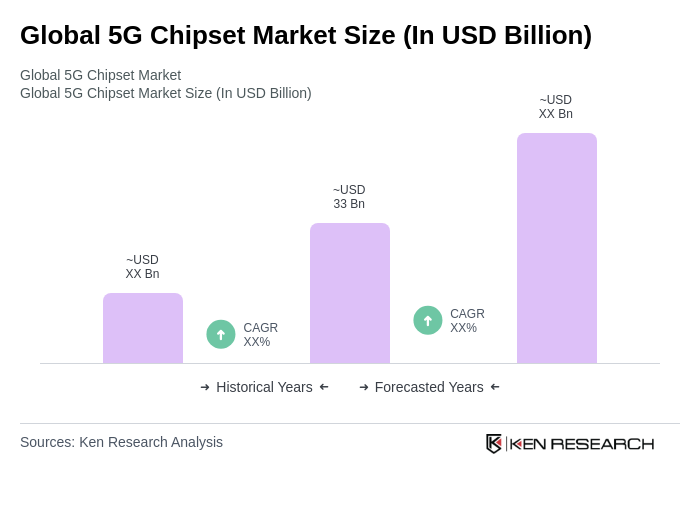
- The Global 5G Chipset Market is valued at USD 33 billion, based on a five-year historical analysis. This growth is primarily driven by the increasing demand for high-speed internet, the proliferation of IoT devices, and advancements in telecommunications infrastructure. The market has seen significant investments from both private and public sectors, aiming to enhance connectivity and support emerging technologies. Recent trends highlight the integration of AI-driven chipsets, which optimize network resource allocation and improve device efficiency, as well as the rapid expansion of smart city projects and industrial automation.
- Key players in this market include the United States, China, and South Korea, which dominate due to their robust technological ecosystems, significant investments in research and development, and early adoption of 5G technology. Asia Pacific holds the largest market share, driven by substantial investments in base stations and 5G-enabled devices from leading companies such as Huawei Technologies Co., Ltd. and Samsung Electronics Co., Ltd. These countries have established themselves as leaders in telecommunications, fostering innovation and attracting global investments.
- In 2023, the Federal Communications Commission (FCC) in the United States implemented regulations to streamline the deployment of 5G infrastructure. The “Accelerating Wireless Broadband Deployment by Removing Barriers to Infrastructure Investment” order (FCC 18-133, Federal Communications Commission, 2018, amended through 2023) mandates expedited permitting processes and promotes the use of public rights-of-way for 5G installations, aiming to accelerate the rollout of 5G networks across urban and rural areas. This regulation requires local governments to act on applications within specified timeframes and sets standards for fees and access to municipal infrastructure.
Global 5G Chipset Market Segmentation
By Type:The market is segmented into various types of chipsets, including Application-Specific Integrated Circuits (ASICs), Radio Frequency Integrated Circuits (RFICs), Millimeter Wave Technology Chips, Field-Programmable Gate Arrays (FPGAs), System on Chip (SoC), and others. Each of these types serves specific functions in the 5G ecosystem, catering to different applications and performance requirements. ASICs and SoCs are particularly prominent due to their integration in consumer electronics and base stations, while RFICs and millimeter wave chips support advanced antenna systems and high-frequency applications.
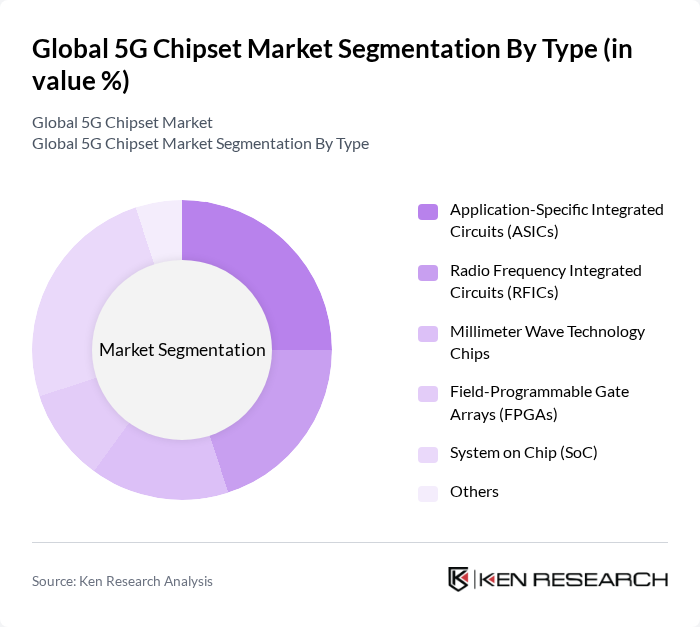
The Application-Specific Integrated Circuits (ASICs) segment is currently dominating the market due to their efficiency and performance in handling specific tasks related to 5G technology. ASICs are designed to optimize power consumption and processing speed, making them ideal for applications such as base stations and mobile devices. The increasing demand for high-speed data transmission and low latency in various sectors, including telecommunications, automotive, and industrial automation, further drives the adoption of ASICs in the 5G chipset market.
By Operational Frequency:The market is also segmented based on operational frequency, which includes Sub 6 GHz, Between 26 and 39 GHz, and Above 39 GHz. Each frequency range serves different applications and is crucial for the effective deployment of 5G networks. Sub 6 GHz is widely adopted for broad coverage and reliable connectivity, while millimeter wave bands (above 26 GHz) enable ultra-high-speed data transmission for dense urban environments and specialized industrial uses.
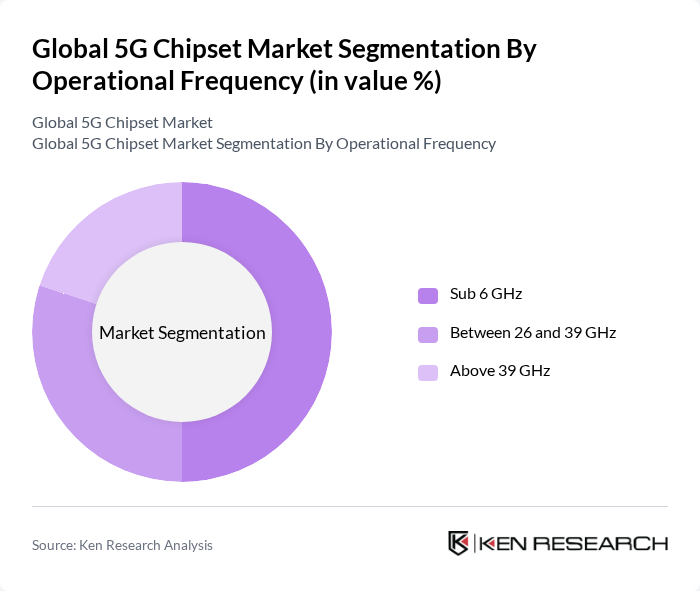
The Sub 6 GHz frequency range is leading the market due to its extensive coverage and ability to penetrate buildings effectively. This frequency is particularly suitable for urban environments where high data rates and reliable connectivity are essential. The growing demand for mobile broadband services and the need for enhanced connectivity in smart cities further contribute to the dominance of the Sub 6 GHz segment in the 5G chipset market.
Global 5G Chipset Market Competitive Landscape
The Global 5G Chipset Market is characterized by a dynamic mix of regional and international players. Leading participants such as Qualcomm Technologies, Inc., Intel Corporation, MediaTek Inc., Samsung Electronics Co., Ltd., Huawei Technologies Co., Ltd., Ericsson AB, Nokia Corporation, Texas Instruments Incorporated, Broadcom Inc., NXP Semiconductors N.V., Analog Devices, Inc., Infineon Technologies AG, STMicroelectronics N.V., Qorvo, Inc., Marvell Technology, Inc. contribute to innovation, geographic expansion, and service delivery in this space.
Global 5G Chipset Market Industry Analysis
Growth Drivers
- Increased Demand for High-Speed Connectivity:The global demand for high-speed connectivity is projected to reach 1.7 billion 5G subscriptions in future, driven by the need for faster internet services. According to the International Telecommunication Union (ITU), the average mobile broadband speed is expected to increase to 150 Mbps, significantly enhancing user experience. This surge in demand is primarily fueled by the proliferation of data-intensive applications, such as streaming services and online gaming, which require robust connectivity solutions.
- Expansion of IoT Applications:The Internet of Things (IoT) market is anticipated to grow to 35 billion connected devices in future, creating a substantial demand for 5G chipsets. The World Economic Forum estimates that IoT applications could contribute up to $15 trillion to the global economy in future. This growth is driven by sectors such as smart cities, healthcare, and industrial automation, which rely on 5G technology for real-time data processing and communication, thereby boosting chipset demand.
- Government Initiatives for 5G Deployment:Governments worldwide are investing heavily in 5G infrastructure, with the U.S. allocating $25 billion for 5G initiatives through the Infrastructure Investment and Jobs Act. Similarly, the European Union has set a target for all member states to have 5G coverage in future. These initiatives are expected to accelerate the deployment of 5G networks, thereby increasing the demand for advanced chipsets that support these technologies and enhance connectivity.
Market Challenges
- High Infrastructure Costs:The deployment of 5G networks requires significant investment, with estimates suggesting that global spending on 5G infrastructure could exceed $1.5 trillion in future. This high cost poses a challenge for telecom operators, particularly in developing regions where financial resources are limited. The need for extensive fiber optic networks and new base stations further exacerbates the financial burden, potentially slowing down the rollout of 5G technology.
- Regulatory Hurdles:Regulatory challenges remain a significant barrier to 5G deployment, with varying policies across countries impacting the speed of implementation. For instance, the Federal Communications Commission (FCC) in the U.S. has faced delays in spectrum allocation, which is crucial for 5G services. Additionally, compliance with safety and environmental regulations can complicate the installation of necessary infrastructure, hindering market growth and delaying the benefits of 5G technology.
Global 5G Chipset Market Future Outlook
The future of the 5G chipset market is poised for significant advancements, driven by technological innovations and increasing demand for connectivity. As industries adopt 5G technology, the integration of artificial intelligence and machine learning into chipsets will enhance performance and efficiency. Furthermore, the rise of private 5G networks in sectors like manufacturing and healthcare will create new opportunities for chipset manufacturers, fostering a competitive landscape that encourages continuous improvement and innovation in technology.
Market Opportunities
- Development of Advanced Applications:The growing need for advanced applications, such as augmented reality and autonomous vehicles, presents a lucrative opportunity for 5G chipset manufacturers. These applications require high-speed, low-latency connectivity, which 5G technology can provide, potentially leading to increased chipset sales and innovation in design and functionality.
- Partnerships with Telecom Providers:Collaborating with telecom providers can enhance market reach and facilitate the development of tailored solutions for specific industries. Such partnerships can leverage existing infrastructure and customer bases, driving the adoption of 5G chipsets in various applications, from smart cities to industrial automation, thereby expanding market opportunities.
Scope of the Report
| Segment | Sub-Segments |
|---|---|
| By Type | Application-Specific Integrated Circuits (ASICs) Radio Frequency Integrated Circuits (RFICs) Millimeter Wave Technology Chips Field-Programmable Gate Arrays (FPGAs) System on Chip (SoC) Others |
| By Operational Frequency | Sub 6 GHz Between 26 and 39 GHz Above 39 GHz |
| By End-User | Consumer Electronics Industrial Automation Automotive & Transportation Energy & Utilities Healthcare Retail Others |
| By Component | Antennas Processors Memory Units Power Management ICs Others |
| By Application | Mobile Broadband Fixed Wireless Access Smart Cities Remote Healthcare Autonomous Vehicles Others |
| By Sales Channel | Direct Sales Distributors Online Retail Others |
| By Distribution Mode | Offline Distribution Online Distribution Hybrid Distribution |
| By Price Range | Low-End Mid-Range High-End Others |
Key Target Audience
Investors and Venture Capitalist Firms
Government and Regulatory Bodies (e.g., Federal Communications Commission, European Telecommunications Standards Institute)
Telecommunications Equipment Manufacturers
Network Operators and Service Providers
Semiconductor Manufacturers
Technology Solution Providers
Industry Associations (e.g., GSMA, 5G Americas)
Financial Institutions and Investment Banks
Players Mentioned in the Report:
Qualcomm Technologies, Inc.
Intel Corporation
MediaTek Inc.
Samsung Electronics Co., Ltd.
Huawei Technologies Co., Ltd.
Ericsson AB
Nokia Corporation
Texas Instruments Incorporated
Broadcom Inc.
NXP Semiconductors N.V.
Analog Devices, Inc.
Infineon Technologies AG
STMicroelectronics N.V.
Qorvo, Inc.
Marvell Technology, Inc.
Table of Contents
Market Assessment Phase
1. Executive Summary and Approach
2. Global 5G Chipset Market Overview
2.1 Key Insights and Strategic Recommendations
2.2 Global 5G Chipset Market Overview
2.3 Definition and Scope
2.4 Evolution of Market Ecosystem
2.5 Timeline of Key Regulatory Milestones
2.6 Value Chain & Stakeholder Mapping
2.7 Business Cycle Analysis
2.8 Policy & Incentive Landscape
3. Global 5G Chipset Market Analysis
3.1 Growth Drivers
3.1.1 Increased Demand for High-Speed Connectivity
3.1.2 Expansion of IoT Applications
3.1.3 Government Initiatives for 5G Deployment
3.1.4 Rising Adoption of Smart Devices
3.2 Market Challenges
3.2.1 High Infrastructure Costs
3.2.2 Regulatory Hurdles
3.2.3 Security Concerns
3.2.4 Limited Availability of Spectrum
3.3 Market Opportunities
3.3.1 Development of Advanced Applications
3.3.2 Partnerships with Telecom Providers
3.3.3 Expansion into Emerging Markets
3.3.4 Innovations in Chipset Technology
3.4 Market Trends
3.4.1 Shift Towards Open RAN Architectures
3.4.2 Increased Focus on Energy Efficiency
3.4.3 Growth of Private 5G Networks
3.4.4 Integration of AI in Chipsets
3.5 Government Regulation
3.5.1 Spectrum Allocation Policies
3.5.2 Safety and Compliance Standards
3.5.3 Subsidies for 5G Infrastructure
3.5.4 International Trade Regulations
4. SWOT Analysis
5. Stakeholder Analysis
6. Porter's Five Forces Analysis
7. Global 5G Chipset Market Market Size, 2019-2024
7.1 By Value
7.2 By Volume
7.3 By Average Selling Price
8. Global 5G Chipset Market Segmentation
8.1 By Type
8.1.1 Application-Specific Integrated Circuits (ASICs)
8.1.2 Radio Frequency Integrated Circuits (RFICs)
8.1.3 Millimeter Wave Technology Chips
8.1.4 Field-Programmable Gate Arrays (FPGAs)
8.1.5 System on Chip (SoC)
8.1.6 Others
8.2 By Operational Frequency
8.2.1 Sub 6 GHz
8.2.2 Between 26 and 39 GHz
8.2.3 Above 39 GHz
8.3 By End-User
8.3.1 Consumer Electronics
8.3.2 Industrial Automation
8.3.3 Automotive & Transportation
8.3.4 Energy & Utilities
8.3.5 Healthcare
8.3.6 Retail
8.3.7 Others
8.4 By Component
8.4.1 Antennas
8.4.2 Processors
8.4.3 Memory Units
8.4.4 Power Management ICs
8.4.5 Others
8.5 By Application
8.5.1 Mobile Broadband
8.5.2 Fixed Wireless Access
8.5.3 Smart Cities
8.5.4 Remote Healthcare
8.5.5 Autonomous Vehicles
8.5.6 Others
8.6 By Sales Channel
8.6.1 Direct Sales
8.6.2 Distributors
8.6.3 Online Retail
8.6.4 Others
8.7 By Distribution Mode
8.7.1 Offline Distribution
8.7.2 Online Distribution
8.7.3 Hybrid Distribution
8.8 By Price Range
8.8.1 Low-End
8.8.2 Mid-Range
8.8.3 High-End
8.8.4 Others
9. Global 5G Chipset Market Competitive Analysis
9.1 Market Share of Key Players
9.2 KPIs for Cross Comparison of Key Players
9.2.1 Company Name
9.2.2 Group Size (Large, Medium, or Small as per industry convention)
9.2.3 Revenue Growth Rate (5G Chipset Segment)
9.2.4 Market Share in Global 5G Chipset Market
9.2.5 R&D Expenditure (as % of Revenue)
9.2.6 Product Portfolio Breadth (Number of 5G Chipset SKUs)
9.2.7 Patent Count (5G Chipset Related)
9.2.8 Geographic Presence (Number of Countries/Regions)
9.2.9 Strategic Partnerships & Alliances (Number of Major Deals)
9.2.10 Supply Chain Efficiency (Lead Time, Inventory Turnover)
9.2.11 Customer Satisfaction Score (5G Chipset Clients)
9.2.12 Brand Recognition (Global/Regional)
9.3 SWOT Analysis of Top Players
9.4 Pricing Analysis
9.5 Detailed Profile of Major Companies
9.5.1 Qualcomm Technologies, Inc.
9.5.2 Intel Corporation
9.5.3 MediaTek Inc.
9.5.4 Samsung Electronics Co., Ltd.
9.5.5 Huawei Technologies Co., Ltd.
9.5.6 Ericsson AB
9.5.7 Nokia Corporation
9.5.8 Texas Instruments Incorporated
9.5.9 Broadcom Inc.
9.5.10 NXP Semiconductors N.V.
9.5.11 Analog Devices, Inc.
9.5.12 Infineon Technologies AG
9.5.13 STMicroelectronics N.V.
9.5.14 Qorvo, Inc.
9.5.15 Marvell Technology, Inc.
10. Global 5G Chipset Market End-User Analysis
10.1 Procurement Behavior of Key Ministries
10.1.1 Government Contracts for 5G Infrastructure
10.1.2 Budget Allocations for Technology Upgrades
10.1.3 Collaboration with Private Sector
10.1.4 Regulatory Compliance Requirements
10.2 Corporate Spend on Infrastructure & Energy
10.2.1 Investment in 5G Networks
10.2.2 Funding for Research and Development
10.2.3 Expenditure on Cybersecurity Measures
10.3 Pain Point Analysis by End-User Category
10.3.1 Connectivity Issues in Rural Areas
10.3.2 High Costs of Implementation
10.3.3 Integration with Legacy Systems
10.4 User Readiness for Adoption
10.4.1 Awareness of 5G Benefits
10.4.2 Training and Support Needs
10.4.3 Infrastructure Readiness
10.5 Post-Deployment ROI and Use Case Expansion
10.5.1 Measurement of Performance Metrics
10.5.2 Case Studies of Successful Implementations
10.5.3 Future Use Case Development
11. Global 5G Chipset Market Future Size, 2025-2030
11.1 By Value
11.2 By Volume
11.3 By Average Selling Price
Go-To-Market Strategy Phase
1. Whitespace Analysis + Business Model Canvas
1.1
2. Marketing and Positioning Recommendations
2.1
3. Distribution Plan
3.1
4. Channel & Pricing Gaps
4.1
5. Unmet Demand & Latent Needs
5.1
6. Customer Relationship
7.1
7. Value Proposition
8.1
8. Key Activities
9.1
9. Entry Strategy Evaluation
9.1 Domestic Market Entry Strategy
10.1.1
9.2 Export Entry Strategy
10.2.1
10. Entry Mode Assessment
11.1
11. Capital and Timeline Estimation
12.1
12. Control vs Risk Trade-Off
13.1
13. Profitability Outlook
14.1
14. Potential Partner List
15.1
15. Execution Roadmap
15.1 Phased Plan for Market Entry
16.1.1
15.2 Key Activities and Milestones
16.2.1
Research Methodology
Phase 1: Approach1
Desk Research
- Industry reports from telecommunications associations and market research firms
- Technical specifications and white papers from leading 5G chipset manufacturers
- Government publications and regulatory frameworks related to 5G technology
Primary Research
- Interviews with R&D heads at major semiconductor companies
- Surveys with telecom operators regarding chipset requirements and deployment
- Field interviews with industry analysts and technology consultants
Validation & Triangulation
- Cross-validation of data from multiple industry sources and expert opinions
- Triangulation of market trends using sales data and technology adoption rates
- Sanity checks through expert panel discussions and feedback sessions
Phase 2: Market Size Estimation1
Top-down Assessment
- Analysis of global telecommunications spending and its impact on chipset demand
- Segmentation by application areas such as IoT, automotive, and consumer electronics
- Incorporation of regional growth trends and government initiatives promoting 5G
Bottom-up Modeling
- Volume estimates based on production data from leading chipset manufacturers
- Cost analysis derived from pricing models of various 5G chipsets
- Estimation of market share based on sales figures from key players
Forecasting & Scenario Analysis
- Multi-variable regression analysis incorporating technology adoption rates and market drivers
- Scenario modeling based on potential regulatory changes and market disruptions
- Development of baseline, optimistic, and pessimistic forecasts through 2030
Phase 3: CATI Sample Composition1
| Scope Item/Segment | Sample Size | Target Respondent Profiles |
|---|---|---|
| Telecom Operators | 100 | Network Engineers, Procurement Managers |
| Semiconductor Manufacturers | 80 | Product Development Managers, Technical Directors |
| IoT Device Manufacturers | 60 | Product Managers, R&D Specialists |
| Automotive Industry Stakeholders | 50 | Supply Chain Managers, Technology Officers |
| Consumer Electronics Firms | 70 | Market Analysts, Product Strategy Leads |
Frequently Asked Questions
What is the current value of the Global 5G Chipset Market?
The Global 5G Chipset Market is valued at approximately USD 33 billion, driven by the increasing demand for high-speed internet, IoT device proliferation, and advancements in telecommunications infrastructure.
What factors are driving the growth of the 5G Chipset Market?
Which countries are leading in the 5G Chipset Market?
What are the main types of chipsets in the 5G market?
Other Regional/Country Reports
Indonesia 5G Chipset Market
Malaysia 5G Chipset Market
Other Adjacent Reports
Thailand Semiconductor Manufacturing Market
KSA Telecommunications Infrastructure Market
Philippines Smartphone Market
KSA autonomous vehicles market Size, Share, Growth Drivers, Trends, Opportunities & Forecast 2025–2030Kuwait smart cities market Size, Share, Growth Drivers, Trends, Opportunities & Forecast 2025–2030APAC artificial intelligence chipset market Size, Share, Growth Drivers, Trends, Opportunities & Forecast 2025–2030Middle East and Africa Edge Computing Market Size, Share & Forecast, By Component, Deployment Model & End-Use Industry, 2026-2031MEA Network Security Market Size, Share & Forecast, By Component, Deployment Mode, Organization Size & Industry Vertical, 2026-2032Qatar Wireless Broadband Market
Why Buy From Us?

What makes us stand out is that our consultants follow Robust, Refine and Result (RRR) methodology. Robust for clear definitions, approaches and sanity checking, Refine for differentiating respondents' facts and opinions, and Result for presenting data with story.

We have set a benchmark in the industry by offering our clients with syndicated and customized market research reports featuring coverage of entire market as well as meticulous research and analyst insights.

While we don't replace traditional research, we flip the method upside down. Our dual approach of Top Bottom & Bottom Top ensures quality deliverable by not just verifying company fundamentals but also looking at the sector and macroeconomic factors.

With one step in the future, our research team constantly tries to show you the bigger picture. We help with some of the tough questions you may encounter along the way: How is the industry positioned? Best marketing channel? KPI's of competitors? By aligning every element, we help maximize success.

Our report gives you instant access to the answers and sources that other companies might choose to hide. We elaborate each steps of research methodology we have used and showcase you the sample size to earn your trust.

If you need any support, we are here! We pride ourselves on universe strength, data quality, and quick, friendly, and professional service.