Region:Global
Author(s):Dev
Product Code:KRAA2557
Pages:95
Published On:August 2025
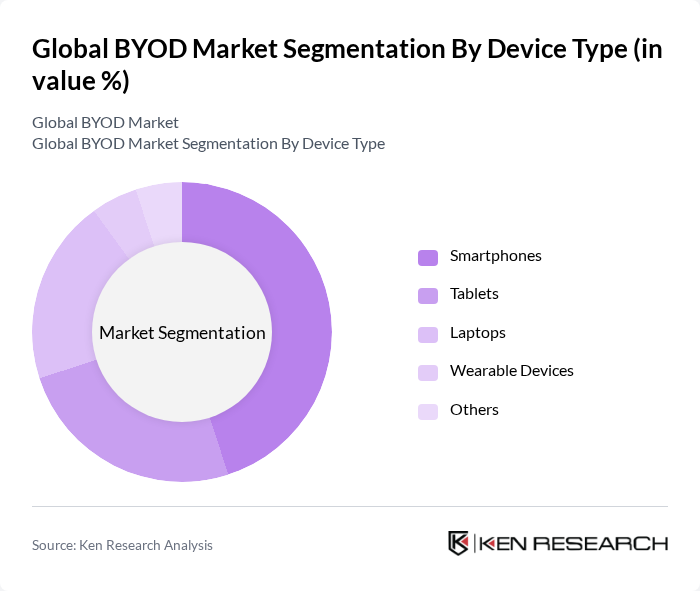
By Device Type:The device type segmentation includes smartphones, tablets, laptops, wearable devices, and others. Among these, smartphones are the leading sub-segment due to their ubiquitous presence and essential role in daily business operations. The increasing reliance on mobile applications and communication tools has made smartphones indispensable for employees, driving their adoption in BYOD policies. Tablets and laptops follow, catering to specific business needs, while wearable devices and other types are gradually gaining traction as technology evolves. The dominance of smartphones is further supported by the growing use of mobile device management and security solutions tailored for these devices .
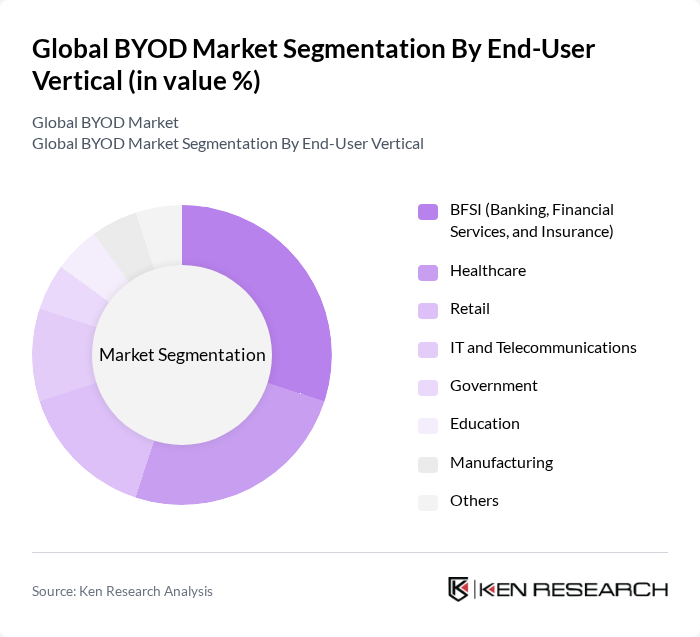
By End-User Vertical:The end-user vertical segmentation encompasses various sectors, including BFSI, healthcare, retail, IT and telecommunications, government, education, manufacturing, and others. The BFSI sector leads this market due to its stringent security requirements and the need for real-time data access. Healthcare follows closely, driven by the need for mobile access to patient data and telemedicine solutions. Other sectors are also adopting BYOD policies, but the pace varies based on industry-specific needs and regulatory compliance. The increasing adoption in IT and telecommunications is supported by the sector's focus on digital transformation and remote work enablement .
The Global BYOD Market is characterized by a dynamic mix of regional and international players. Leading participants such as Cisco Systems, Inc., IBM Corporation, Microsoft Corporation, VMware, Inc., Citrix Systems, Inc., MobileIron, Inc. (now part of Ivanti), BlackBerry Limited, Sophos Group plc, Okta, Inc., Jamf Holding Corp., SOTI Inc., ManageEngine (a division of Zoho Corporation), Trend Micro Incorporated, Check Point Software Technologies Ltd., Samsung Electronics Co., Ltd. contribute to innovation, geographic expansion, and service delivery in this space.
The future of the BYOD market is poised for significant transformation, driven by technological advancements and evolving workplace dynamics. As organizations increasingly adopt hybrid work models, the integration of BYOD with corporate policies will become essential. Furthermore, the rise of artificial intelligence in security solutions will enhance data protection measures, addressing the growing concerns around cybersecurity. Companies that effectively leverage these trends will likely see improved employee satisfaction and operational efficiency in the coming years.
| Segment | Sub-Segments |
|---|---|
| By Device Type | Smartphones Tablets Laptops Wearable Devices Others |
| By End-User Vertical | BFSI (Banking, Financial Services, and Insurance) Healthcare Retail IT and Telecommunications Government Education Manufacturing Others |
| By Deployment Mode | On-Premises Cloud-Based |
| By Component | Software Services Security Solutions |
| By Region | North America Europe Asia-Pacific Latin America Middle East and Africa |
| By Pricing Model | Subscription-Based One-Time License Freemium Others |
| Scope Item/Segment | Sample Size | Target Respondent Profiles |
|---|---|---|
| Healthcare Sector BYOD Implementation | 100 | IT Managers, Compliance Officers |
| Education Sector Device Usage | 60 | School Administrators, IT Coordinators |
| Financial Services BYOD Policies | 75 | Risk Managers, IT Security Analysts |
| Retail Sector Employee Device Management | 55 | Store Managers, Operations Directors |
| Corporate BYOD Strategy Development | 90 | HR Managers, Business Analysts |
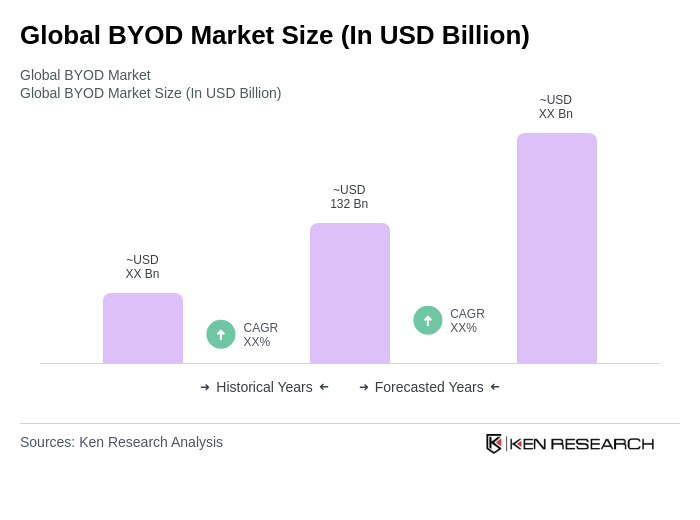
The Global BYOD Market is valued at approximately USD 132 billion, driven by the increasing adoption of mobile devices in workplaces and the rise of remote and hybrid work cultures. This growth reflects the demand for solutions that enhance employee productivity and ensure security.

What makes us stand out is that our consultants follow Robust, Refine and Result (RRR) methodology. Robust for clear definitions, approaches and sanity checking, Refine for differentiating respondents' facts and opinions, and Result for presenting data with story.

We have set a benchmark in the industry by offering our clients with syndicated and customized market research reports featuring coverage of entire market as well as meticulous research and analyst insights.

While we don't replace traditional research, we flip the method upside down. Our dual approach of Top Bottom & Bottom Top ensures quality deliverable by not just verifying company fundamentals but also looking at the sector and macroeconomic factors.

With one step in the future, our research team constantly tries to show you the bigger picture. We help with some of the tough questions you may encounter along the way: How is the industry positioned? Best marketing channel? KPI's of competitors? By aligning every element, we help maximize success.

Our report gives you instant access to the answers and sources that other companies might choose to hide. We elaborate each steps of research methodology we have used and showcase you the sample size to earn your trust.

If you need any support, we are here! We pride ourselves on universe strength, data quality, and quick, friendly, and professional service.













