About the Report
Base Year 2024Global Data Center Networking Market Overview
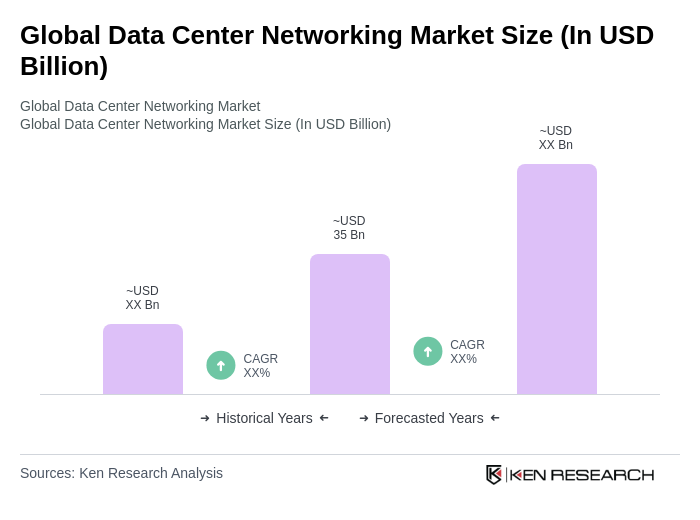
- The Global Data Center Networking Market is valued at USD 35 billion, based on a five-year historical analysis. This growth is primarily driven by the increasing demand for cloud services, the rise of big data analytics, and the need for enhanced network security. The proliferation of IoT devices and the shift towards remote work have further accelerated the need for robust data center networking solutions. Additionally, advancements in technologies like AI, edge computing, and 5G are driving market growth.
- Key players in this market include regions such as North America, Asia-Pacific, and Europe. North America, particularly the United States, dominates due to its advanced technological infrastructure and high investment in data centers. Asia-Pacific, led by China, is driven by rapid digital transformation and large-scale internet usage. Europe, with countries like Germany, benefits from strong economies and a focus on data privacy regulations.
- In 2023, the European Union implemented the Digital Services Act, which mandates stricter regulations on data privacy and security for data center operators. This regulation aims to enhance user protection and ensure that data handling practices are transparent and accountable, thereby influencing the operational strategies of companies in the data center networking market. The act requires data centers to adhere to strict data processing standards, impacting their operational strategies.
Global Data Center Networking Market Segmentation
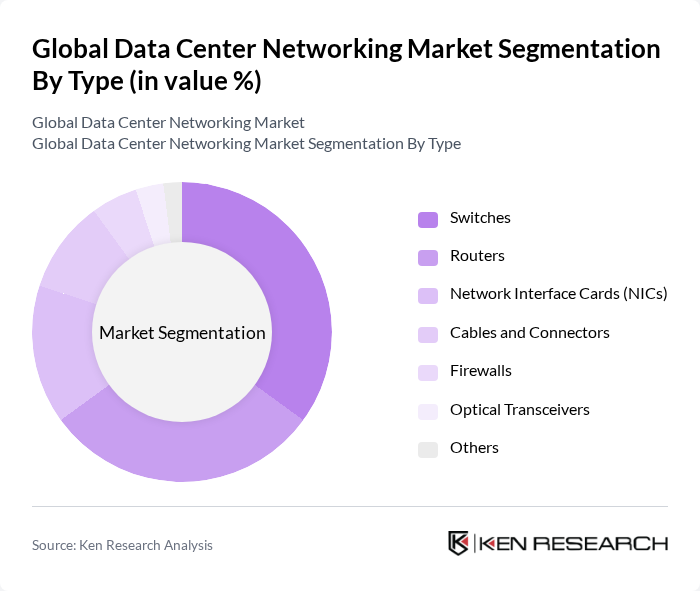
By Type:The market is segmented into various types, including Switches, Routers, Network Interface Cards (NICs), Cables and Connectors, Firewalls, Optical Transceivers, and Others. Among these, Switches and Routers are the most significant contributors, driven by the increasing need for efficient data traffic management and connectivity in data centers. The demand for high-speed data transfer and network reliability is pushing the adoption of advanced switching and routing technologies.
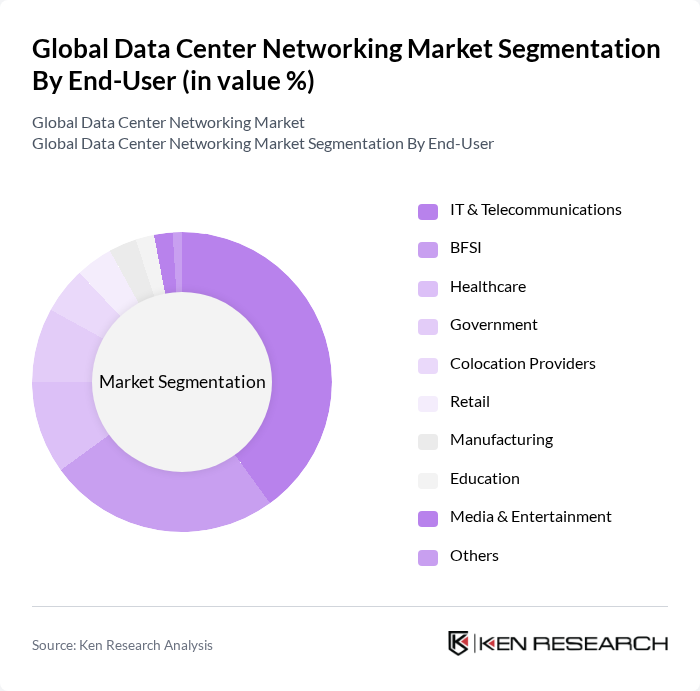
By End-User:The end-user segmentation includes IT & Telecommunications, BFSI, Healthcare, Government, Colocation Providers, Retail, Manufacturing, Education, Media & Entertainment, and Others. The IT & Telecommunications sector leads the market, driven by the increasing demand for data processing and storage solutions. The BFSI sector follows closely, as financial institutions require robust networking solutions to ensure data security and compliance.
Global Data Center Networking Market Competitive Landscape
The Global Data Center Networking Market is characterized by a dynamic mix of regional and international players. Leading participants such as Cisco Systems, Inc., Arista Networks, Inc., Juniper Networks, Inc., Hewlett Packard Enterprise (HPE), Dell Technologies Inc., Extreme Networks, Inc., NVIDIA Corporation (formerly Mellanox Technologies), Huawei Technologies Co., Ltd., Netgear, Inc., Brocade Communications Systems, Inc. (now part of Broadcom Inc.), Cumulus Networks, Inc. (now part of NVIDIA Corporation), ZTE Corporation, Nokia Corporation, International Business Machines Corporation (IBM), VMware, Inc., Broadcom Inc., Fortinet, Inc., Palo Alto Networks, Inc., Amazon Web Services, Inc., Microsoft Corporation, Google LLC contribute to innovation, geographic expansion, and service delivery in this space.
Global Data Center Networking Market Industry Analysis
Growth Drivers
- Increasing Demand for Cloud Services:The global cloud services market is projected to reach $832.1 billion in future, driven by a 20% annual growth rate. This surge is fueled by businesses migrating to cloud platforms for enhanced scalability and flexibility. In future, the demand for Infrastructure as a Service (IaaS) is expected to grow significantly, with enterprises investing approximately $50 billion in cloud infrastructure, thereby increasing the need for robust data center networking solutions.
- Rise in Data Traffic and Bandwidth Requirements:Global IP traffic is anticipated to reach 4.8 zettabytes per year in future, reflecting a 25% increase from the previous period. This exponential growth in data traffic necessitates advanced networking solutions to manage bandwidth effectively. As organizations generate and consume more data, the demand for high-capacity data center networks will intensify, compelling investments in networking infrastructure to support this trend.
- Adoption of Virtualization and Software-Defined Networking:The software-defined networking (SDN) market is expected to grow to $100 billion in future, driven by the need for more agile and efficient network management. Virtualization technologies are projected to account for 70% of data center workloads in future, enhancing resource utilization and operational efficiency. This shift towards SDN and virtualization is a key driver for the data center networking market, as organizations seek to optimize their network architectures.
Market Challenges
- High Initial Investment Costs:The initial capital expenditure for setting up advanced data center networking infrastructure can exceed $1 million for mid-sized enterprises. This significant financial barrier often deters smaller organizations from upgrading their networking capabilities. Additionally, ongoing maintenance and operational costs can further strain budgets, making it challenging for companies to justify investments in new technologies amidst tight financial constraints.
- Complexity in Network Management:As data center networks grow in size and complexity, managing these systems becomes increasingly challenging. In future, it is estimated that 60% of IT teams will struggle with network management due to the integration of multiple technologies and platforms. This complexity can lead to increased downtime and operational inefficiencies, posing a significant challenge for organizations aiming to maintain optimal network performance and reliability.
Global Data Center Networking Market Future Outlook
The future of the data center networking market is poised for transformative growth, driven by technological advancements and evolving business needs. As organizations increasingly adopt hybrid cloud solutions, the demand for integrated networking systems will rise. Furthermore, the emphasis on automation and AI-driven management tools will enhance operational efficiency, enabling data centers to adapt swiftly to changing demands. The focus on sustainability will also shape future investments, as companies seek to reduce their carbon footprint while optimizing performance.
Market Opportunities
- Growth in Edge Computing:The edge computing market is projected to reach $43.4 billion in future, driven by the need for real-time data processing. This growth presents opportunities for data center networking solutions that can support distributed architectures, enabling organizations to process data closer to the source and reduce latency, thereby enhancing overall performance.
- Increasing Focus on Energy Efficiency:With energy costs rising, organizations are prioritizing energy-efficient networking solutions. The global market for energy-efficient data centers is expected to reach $25 billion in future. This trend offers opportunities for companies that develop innovative technologies aimed at reducing energy consumption while maintaining high performance, aligning with corporate sustainability goals.
Scope of the Report
| Segment | Sub-Segments |
|---|---|
| By Type | Switches Routers Network Interface Cards (NICs) Cables and Connectors Firewalls Optical Transceivers Others |
| By End-User | IT & Telecommunications BFSI Healthcare Government Colocation Providers Retail Manufacturing Education Media & Entertainment Others |
| By Application | Data Storage Data Processing Network Security Cloud Computing Edge Computing AI/ML Workloads Others |
| By Component | Hardware Software Services |
| By Sales Channel | Direct Sales Distributors Online Sales |
| By Distribution Mode | Retail Wholesale E-commerce |
| By Pricing Strategy | Premium Pricing Competitive Pricing Value-Based Pricing |
Key Target Audience
Investors and Venture Capitalist Firms
Government and Regulatory Bodies (e.g., Federal Communications Commission, National Institute of Standards and Technology)
Telecommunications Service Providers
Data Center Operators
Cloud Service Providers
Network Equipment Manufacturers
System Integrators
Telecom Regulatory Authorities
Players Mentioned in the Report:
Cisco Systems, Inc.
Arista Networks, Inc.
Juniper Networks, Inc.
Hewlett Packard Enterprise (HPE)
Dell Technologies Inc.
Extreme Networks, Inc.
NVIDIA Corporation (formerly Mellanox Technologies)
Huawei Technologies Co., Ltd.
Netgear, Inc.
Brocade Communications Systems, Inc. (now part of Broadcom Inc.)
Cumulus Networks, Inc. (now part of NVIDIA Corporation)
ZTE Corporation
Nokia Corporation
International Business Machines Corporation (IBM)
VMware, Inc.
Broadcom Inc.
Fortinet, Inc.
Palo Alto Networks, Inc.
Amazon Web Services, Inc.
Microsoft Corporation
Google LLC
Table of Contents
Market Assessment Phase
1. Executive Summary and Approach
2. Global Data Center Networking Market Overview
2.1 Key Insights and Strategic Recommendations
2.2 Global Data Center Networking Market Overview
2.3 Definition and Scope
2.4 Evolution of Market Ecosystem
2.5 Timeline of Key Regulatory Milestones
2.6 Value Chain & Stakeholder Mapping
2.7 Business Cycle Analysis
2.8 Policy & Incentive Landscape
3. Global Data Center Networking Market Analysis
3.1 Growth Drivers
3.1.1 Increasing demand for cloud services
3.1.2 Rise in data traffic and bandwidth requirements
3.1.3 Adoption of virtualization and software-defined networking
3.1.4 Expansion of IoT and connected devices
3.2 Market Challenges
3.2.1 High initial investment costs
3.2.2 Complexity in network management
3.2.3 Security concerns and data privacy issues
3.2.4 Rapid technological changes
3.3 Market Opportunities
3.3.1 Growth in edge computing
3.3.2 Increasing focus on energy efficiency
3.3.3 Development of 5G networks
3.3.4 Strategic partnerships and collaborations
3.4 Market Trends
3.4.1 Shift towards hybrid cloud solutions
3.4.2 Increased automation in data center operations
3.4.3 Emphasis on sustainability and green technologies
3.4.4 Growth of AI and machine learning in networking
3.5 Government Regulation
3.5.1 Data protection regulations
3.5.2 Environmental compliance standards
3.5.3 Telecommunications regulations
3.5.4 Incentives for renewable energy use
4. SWOT Analysis
5. Stakeholder Analysis
6. Porter's Five Forces Analysis
7. Global Data Center Networking Market Market Size, 2019-2024
7.1 By Value
7.2 By Volume
7.3 By Average Selling Price
8. Global Data Center Networking Market Segmentation
8.1 By Type
8.1.1 Switches
8.1.2 Routers
8.1.3 Network Interface Cards (NICs)
8.1.4 Cables and Connectors
8.1.5 Firewalls
8.1.6 Optical Transceivers
8.1.7 Others
8.2 By End-User
8.2.1 IT & Telecommunications
8.2.2 BFSI
8.2.3 Healthcare
8.2.4 Government
8.2.5 Colocation Providers
8.2.6 Retail
8.2.7 Manufacturing
8.2.8 Education
8.2.9 Media & Entertainment
8.2.10 Others
8.3 By Application
8.3.1 Data Storage
8.3.2 Data Processing
8.3.3 Network Security
8.3.4 Cloud Computing
8.3.5 Edge Computing
8.3.6 AI/ML Workloads
8.3.7 Others
8.4 By Component
8.4.1 Hardware
8.4.2 Software
8.4.3 Services
8.5 By Sales Channel
8.5.1 Direct Sales
8.5.2 Distributors
8.5.3 Online Sales
8.6 By Distribution Mode
8.6.1 Retail
8.6.2 Wholesale
8.6.3 E-commerce
8.7 By Pricing Strategy
8.7.1 Premium Pricing
8.7.2 Competitive Pricing
8.7.3 Value-Based Pricing
9. Global Data Center Networking Market Competitive Analysis
9.1 Market Share of Key Players
9.2 Cross Comparison of Key Players
9.2.1 Company Name
9.2.2 Group Size (Large, Medium, or Small as per industry convention)
9.2.3 Revenue Growth Rate (YoY %)
9.2.4 Market Share (%)
9.2.5 Geographic Presence (No. of Countries/Regions)
9.2.6 Product Portfolio Breadth (No. of SKUs or Product Lines)
9.2.7 R&D Investment (% of Revenue)
9.2.8 Customer Retention Rate (%)
9.2.9 Average Deal Size (USD)
9.2.10 Pricing Strategy (Premium/Competitive/Value-Based)
9.2.11 Product Innovation Rate (No. of New Launches/Year)
9.2.12 Operational Efficiency (Gross Margin %)
9.2.13 Customer Satisfaction Score (NPS or Equivalent)
9.3 SWOT Analysis of Top Players
9.4 Pricing Analysis
9.5 Detailed Profile of Major Companies
9.5.1 Cisco Systems, Inc.
9.5.2 Arista Networks, Inc.
9.5.3 Juniper Networks, Inc.
9.5.4 Hewlett Packard Enterprise (HPE)
9.5.5 Dell Technologies Inc.
9.5.6 Extreme Networks, Inc.
9.5.7 NVIDIA Corporation (formerly Mellanox Technologies)
9.5.8 Huawei Technologies Co., Ltd.
9.5.9 Netgear, Inc.
9.5.10 Brocade Communications Systems, Inc. (now part of Broadcom Inc.)
9.5.11 Cumulus Networks, Inc. (now part of NVIDIA Corporation)
9.5.12 ZTE Corporation
9.5.13 Nokia Corporation
9.5.14 International Business Machines Corporation (IBM)
9.5.15 VMware, Inc.
9.5.16 Broadcom Inc.
9.5.17 Fortinet, Inc.
9.5.18 Palo Alto Networks, Inc.
9.5.19 Amazon Web Services, Inc.
9.5.20 Microsoft Corporation
9.5.21 Google LLC
10. Global Data Center Networking Market End-User Analysis
10.1 Procurement Behavior of Key Ministries
10.1.1 Budget Allocation Trends
10.1.2 Decision-Making Processes
10.1.3 Preferred Vendors
10.2 Corporate Spend on Infrastructure & Energy
10.2.1 Investment Trends
10.2.2 Cost Management Strategies
10.2.3 Infrastructure Upgrades
10.3 Pain Point Analysis by End-User Category
10.3.1 Network Downtime Issues
10.3.2 Scalability Challenges
10.3.3 Security Vulnerabilities
10.4 User Readiness for Adoption
10.4.1 Training and Support Needs
10.4.2 Technology Adoption Rates
10.4.3 Change Management Strategies
10.5 Post-Deployment ROI and Use Case Expansion
10.5.1 Performance Metrics
10.5.2 Use Case Diversification
10.5.3 Long-term Value Assessment
11. Global Data Center Networking Market Future Size, 2025-2030
11.1 By Value
11.2 By Volume
11.3 By Average Selling Price
Go-To-Market Strategy Phase
1. Whitespace Analysis + Business Model Canvas
1.1 Market Gaps Identification
1.2 Value Proposition Development
1.3 Revenue Streams Analysis
1.4 Customer Segmentation
1.5 Key Partnerships
1.6 Cost Structure Analysis
1.7 Competitive Advantage
2. Marketing and Positioning Recommendations
2.1 Branding Strategies
2.2 Product USPs
2.3 Target Market Identification
2.4 Communication Strategies
2.5 Digital Marketing Approaches
3. Distribution Plan
3.1 Urban Retail Strategies
3.2 Rural NGO Tie-ups
3.3 Online Distribution Channels
3.4 Direct Sales Approaches
4. Channel & Pricing Gaps
4.1 Underserved Routes
4.2 Pricing Bands Analysis
4.3 Competitive Pricing Strategies
5. Unmet Demand & Latent Needs
5.1 Category Gaps
5.2 Consumer Segments Analysis
5.3 Emerging Trends Identification
6. Customer Relationship
6.1 Loyalty Programs
6.2 After-sales Service
6.3 Customer Feedback Mechanisms
7. Value Proposition
7.1 Sustainability Initiatives
7.2 Integrated Supply Chains
7.3 Unique Selling Points
8. Key Activities
8.1 Regulatory Compliance
8.2 Branding Efforts
8.3 Distribution Setup
9. Entry Strategy Evaluation
9.1 Domestic Market Entry Strategy
9.1.1 Product Mix
9.1.2 Pricing Band
9.1.3 Packaging Strategies
9.2 Export Entry Strategy
9.2.1 Target Countries
9.2.2 Compliance Roadmap
10. Entry Mode Assessment
10.1 Joint Ventures
10.2 Greenfield Investments
10.3 Mergers & Acquisitions
10.4 Distributor Model
11. Capital and Timeline Estimation
11.1 Capital Requirements
11.2 Timelines for Implementation
12. Control vs Risk Trade-Off
12.1 Ownership vs Partnerships
13. Profitability Outlook
13.1 Breakeven Analysis
13.2 Long-term Sustainability
14. Potential Partner List
14.1 Distributors
14.2 Joint Ventures
14.3 Acquisition Targets
15. Execution Roadmap
15.1 Phased Plan for Market Entry
15.1.1 Market Setup
15.1.2 Market Entry
15.1.3 Growth Acceleration
15.1.4 Scale & Stabilize
15.2 Key Activities and Milestones
15.2.1 Milestone Planning
15.2.2 Activity Tracking
Research Methodology
Phase 1: Approach1
Desk Research
- Industry reports from global data center associations and market research firms
- Published white papers and case studies on data center networking technologies
- Government publications and regulatory frameworks impacting data center operations
Primary Research
- Interviews with IT infrastructure managers at leading data center providers
- Surveys with network architects and engineers specializing in data center solutions
- Field interviews with executives from cloud service providers and colocation facilities
Validation & Triangulation
- Cross-validation of findings through multiple industry reports and expert opinions
- Triangulation of data from primary interviews and secondary research sources
- Sanity checks conducted through expert panel discussions and feedback sessions
Phase 2: Market Size Estimation1
Top-down Assessment
- Analysis of global IT spending trends and their impact on data center networking
- Segmentation of the market by geographic regions and service types
- Incorporation of emerging technologies such as SDN and NFV in market projections
Bottom-up Modeling
- Data collection from leading data center operators regarding their networking expenditures
- Estimation of market size based on the number of data centers and average spending per facility
- Volume and cost analysis of networking equipment and services across various segments
Forecasting & Scenario Analysis
- Multi-variable regression analysis incorporating growth rates of cloud services and IoT
- Scenario modeling based on technological advancements and regulatory changes
- Development of baseline, optimistic, and pessimistic forecasts through 2030
Phase 3: CATI Sample Composition1
| Scope Item/Segment | Sample Size | Target Respondent Profiles |
|---|---|---|
| Colocation Data Centers | 40 | Data Center Managers, Operations Directors |
| Cloud Service Providers | 40 | Network Architects, IT Infrastructure Leads |
| Telecommunications Data Centers | 40 | Network Engineers, Technical Operations Managers |
| Enterprise Data Center Networking | 40 | IT Managers, Chief Technology Officers |
| Edge Computing Facilities | 40 | Product Development Managers, Systems Architects |
Frequently Asked Questions
What is the current value of the Global Data Center Networking Market?
The Global Data Center Networking Market is valued at approximately USD 35 billion, reflecting a significant growth driven by the increasing demand for cloud services, big data analytics, and enhanced network security solutions.
What are the key drivers of growth in the Data Center Networking Market?
Which regions dominate the Global Data Center Networking Market?
What impact does the Digital Services Act have on data centers in Europe?
Other Regional/Country Reports
Malaysia Data Center Networking Market
KSA Data Center Networking Market
APAC Data Center Networking Market
SEA Data Center Networking Market
Other Adjacent Reports
South Korea Big Data Analytics Market
UAE Iot Devices MarketSaudi Arabia 5G Technology Market Outlook to 2030Apac Ai Infrastructure Market Report Size, Share, Growth Drivers, Trends, Opportunities & Forecast 2025–2030Belgium Data Center Infrastructure Market
Germany Virtualization Software Market
Why Buy From Us?

What makes us stand out is that our consultants follow Robust, Refine and Result (RRR) methodology. Robust for clear definitions, approaches and sanity checking, Refine for differentiating respondents' facts and opinions, and Result for presenting data with story.

We have set a benchmark in the industry by offering our clients with syndicated and customized market research reports featuring coverage of entire market as well as meticulous research and analyst insights.

While we don't replace traditional research, we flip the method upside down. Our dual approach of Top Bottom & Bottom Top ensures quality deliverable by not just verifying company fundamentals but also looking at the sector and macroeconomic factors.

With one step in the future, our research team constantly tries to show you the bigger picture. We help with some of the tough questions you may encounter along the way: How is the industry positioned? Best marketing channel? KPI's of competitors? By aligning every element, we help maximize success.

Our report gives you instant access to the answers and sources that other companies might choose to hide. We elaborate each steps of research methodology we have used and showcase you the sample size to earn your trust.

If you need any support, we are here! We pride ourselves on universe strength, data quality, and quick, friendly, and professional service.