














Region:Global
Author(s):Geetanshi
Product Code:KRAA2804
Pages:86
Published On:August 2025
By Storage System:The storage system segment includes various types of storage solutions tailored to different applications. Direct Attached Storage (DAS) is typically favored for personal and small business use due to its simplicity and cost-effectiveness. Network Attached Storage (NAS) is widely adopted by small to medium businesses for its ease of access and centralized management. Storage Area Network (SAN) solutions are preferred by enterprises requiring high performance, scalability, and robust data management for mission-critical workloads .

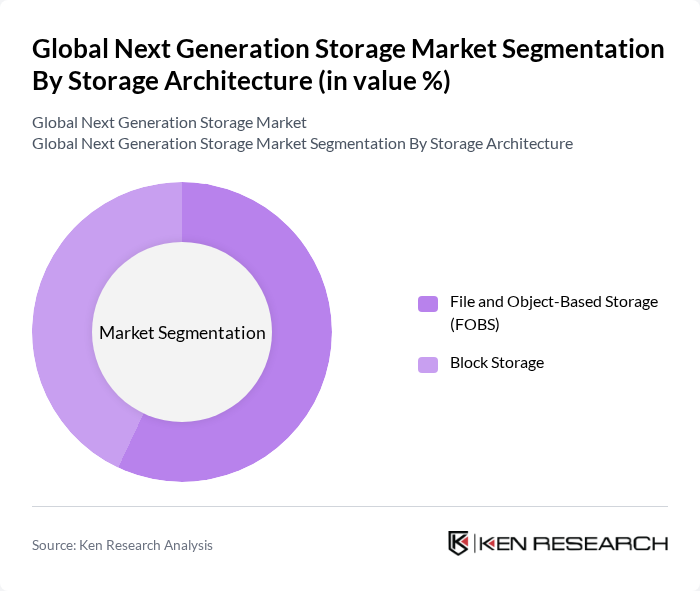
By Storage Architecture:The storage architecture segment encompasses File and Object-Based Storage (FOBS) and Block Storage. File and Object-Based Storage is increasingly popular for its flexibility, scalability, and suitability for cloud-native and unstructured data environments. Block Storage remains the preferred choice for high-performance enterprise applications, databases, and virtualized workloads where speed and reliability are critical .
The Global Next Generation Storage Market is characterized by a dynamic mix of regional and international players. Leading participants such as Dell Technologies, Hewlett Packard Enterprise, IBM Corporation, NetApp, Inc., Western Digital Corporation, Seagate Technology Holdings PLC, Pure Storage, Inc., Hitachi Vantara, Toshiba Corporation, Samsung Electronics Co., Ltd., Intel Corporation, Micron Technology, Inc., Cloudian, Inc., Acronis International GmbH, Veeam Software, Fujitsu Limited, Huawei Technologies Co., Ltd., Quantum Corporation, Inspur Group, Oracle Corporation contribute to innovation, geographic expansion, and service delivery in this space.
As the demand for data storage continues to escalate, the next-generation storage market is poised for transformative growth. Innovations in decentralized storage solutions and the rise of edge computing are expected to redefine data management strategies. Additionally, sustainability initiatives will drive the development of eco-friendly storage technologies. Companies that adapt to these trends and invest in hybrid storage solutions will likely gain a competitive edge, positioning themselves favorably in an evolving market landscape.
| Segment | Sub-Segments |
|---|---|
| By Storage System | Direct Attached Storage (DAS) Network Attached Storage (NAS) Storage Area Network (SAN) |
| By Storage Architecture | File and Object-Based Storage (FOBS) Block Storage |
| By Storage Medium | Hard Disk Drive (HDD) Solid State Drive (SSD) Tape Storage |
| By Deployment Type | On-Premises Cloud Hybrid |
| By End-User Industry | BFSI Retail IT and Telecom Healthcare Media and Entertainment Other End-user Industries |
| By Geography | North America Europe Asia Pacific Rest of the World |
| Scope Item/Segment | Sample Size | Target Respondent Profiles |
|---|---|---|
| Enterprise Storage Solutions | 120 | IT Directors, System Architects |
| Cloud Storage Adoption | 90 | Cloud Operations Managers, Data Analysts |
| Data Center Infrastructure | 70 | Data Center Managers, Network Engineers |
| Hybrid Storage Systems | 60 | Product Managers, Technology Strategists |
| Emerging Storage Technologies | 50 | R&D Managers, Innovation Leads |
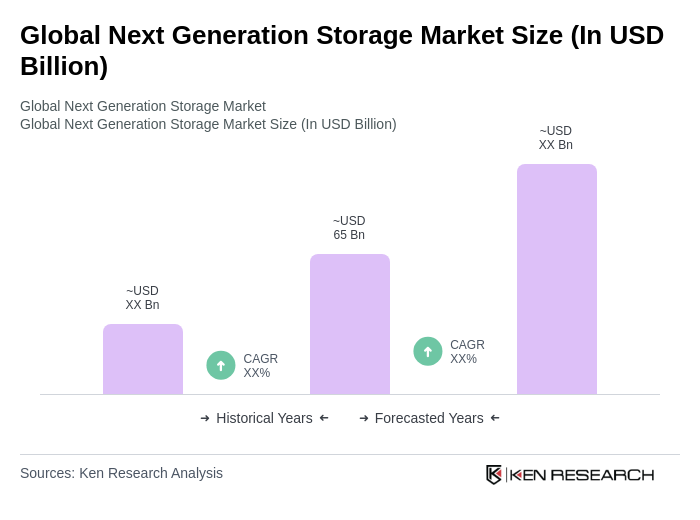
The Global Next Generation Storage Market is valued at approximately USD 65 billion, driven by the increasing volumes of digital data across various sectors, including healthcare, retail, BFSI, and manufacturing.

What makes us stand out is that our consultants follow Robust, Refine and Result (RRR) methodology. Robust for clear definitions, approaches and sanity checking, Refine for differentiating respondents' facts and opinions, and Result for presenting data with story.

We have set a benchmark in the industry by offering our clients with syndicated and customized market research reports featuring coverage of entire market as well as meticulous research and analyst insights.

While we don't replace traditional research, we flip the method upside down. Our dual approach of Top Bottom & Bottom Top ensures quality deliverable by not just verifying company fundamentals but also looking at the sector and macroeconomic factors.

With one step in the future, our research team constantly tries to show you the bigger picture. We help with some of the tough questions you may encounter along the way: How is the industry positioned? Best marketing channel? KPI's of competitors? By aligning every element, we help maximize success.

Our report gives you instant access to the answers and sources that other companies might choose to hide. We elaborate each steps of research methodology we have used and showcase you the sample size to earn your trust.

If you need any support, we are here! We pride ourselves on universe strength, data quality, and quick, friendly, and professional service.