About the Report
Base Year 2024Global Orthokeratology Lens Market Overview
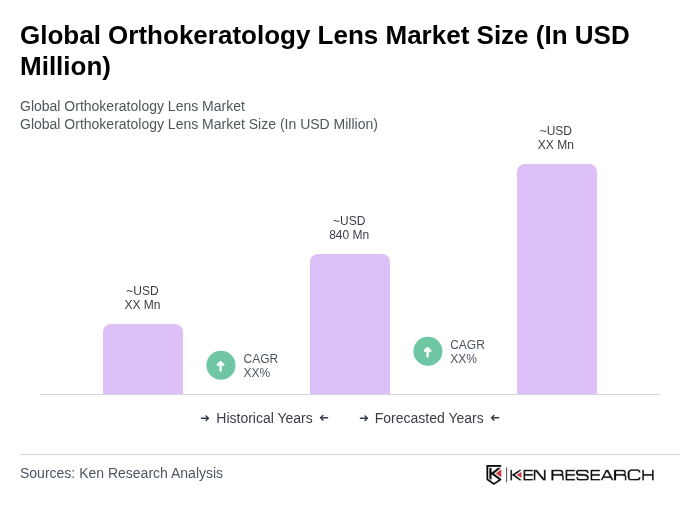
- The Global Orthokeratology Lens Market is valued at USD 840 million, based on a five-year historical analysis. This growth is primarily driven by the increasing prevalence of myopia, rising awareness about vision correction and myopia management options, and advancements in lens materials, topography-guided fitting, and customized lens designs. The market has seen a surge in demand for non-surgical alternatives to traditional vision correction methods, especially among pediatric and young adult populations seeking myopia control, leading to a significant uptick in the adoption of overnight orthokeratology lenses.
- Key players in this market are concentrated in regions such as North America, Europe, and Asia-Pacific, with North America and Asia-Pacific accounting for a substantial share of global revenues. Countries like the United States and China dominate the market due to their large myopic populations, high rates of pediatric myopia, and well-established eye care and optometry infrastructure, supported by growing specialty contact lens practices. The presence of leading manufacturers, expanding networks of ortho-k fitting eye care professionals, and a growing trend towards preventive eye care and myopia management further solidify their market position.
- The U.S. Food and Drug Administration (FDA) regulates orthokeratology lenses as medical devices under existing contact lens and medical device frameworks, including the Premarket Notification process and Premarket Approval (PMA) requirements for certain indications. Under the Federal Food, Drug, and Cosmetic Act and the Medical Device Amendments, orthokeratology lenses are generally classified as Class II or Class III devices depending on design and indication, requiring manufacturers to submit clinical performance data, biocompatibility evidence, labeling that includes risks such as infectious keratitis, and to comply with Quality System Regulation (21 CFR Part 820) and device listing obligations. These binding requirements ensure that orthokeratology lenses marketed in the United States meet defined safety and efficacy standards, and they guide clinical trial expectations and post-market surveillance for long-term lens wear.
Global Orthokeratology Lens Market Segmentation
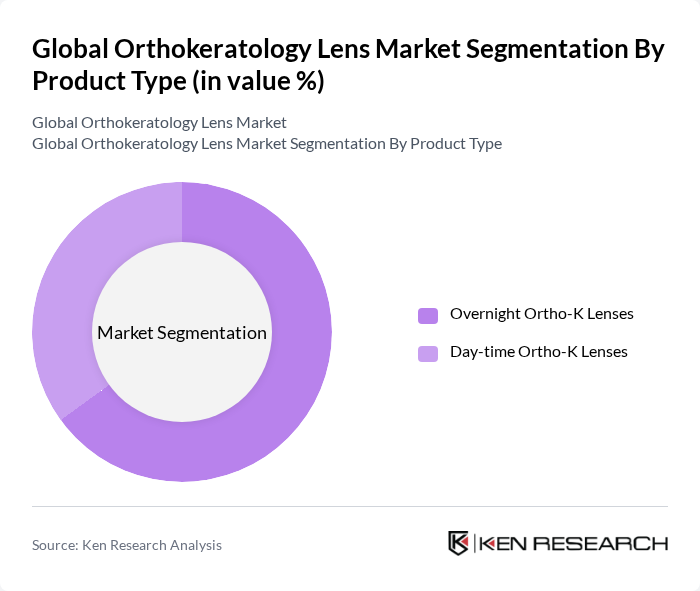
By Product Type:The product type segmentation includes Overnight Ortho-K Lenses and Day-time Ortho-K Lenses. Overnight Ortho-K Lenses are designed to be worn while sleeping, reshaping the cornea overnight so that users can experience improved unaided vision during waking hours. Day-time Ortho-K Lenses are specialty rigid lenses designed for controlled corneal reshaping during daytime wear and are used in more selected clinical scenarios. The Overnight Ortho-K Lenses segment is currently dominating the market due to their convenience, strong clinical evidence for myopia control, and effectiveness in providing clear vision throughout the day without the need for glasses or daytime contact lenses. Consumers, particularly children and active adults, prefer these lenses for their ease of use, the ability to integrate with daily activities and sports, and growing endorsement by eye care professionals as part of structured myopia management programs.
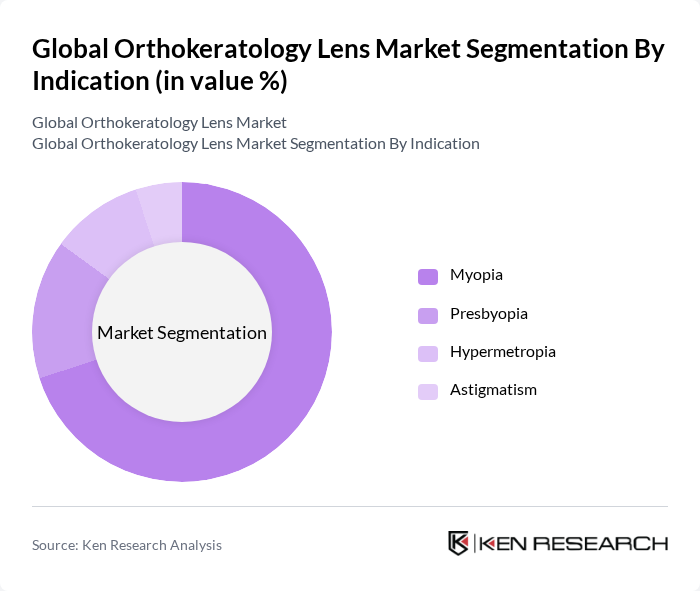
By Indication:The indication segmentation includes Myopia, Presbyopia, Hypermetropia, and Astigmatism. Myopia is the leading indication for orthokeratology lenses, supported by the high and rising global burden of nearsightedness, with billions of individuals affected worldwide and a particularly rapid increase among children and adolescents. The growing awareness of the potential for myopia control and slowing axial elongation through orthokeratology, reinforced by clinical studies and professional guidelines, has led to a significant rise in their adoption for pediatric and juvenile myopia management. As a result, the Myopia segment holds a substantial share of the market, while presbyopia, hypermetropia, and astigmatism remain important but smaller niche applications where ortho-k is used in selected patients requiring temporary refractive correction without daytime lenses.
Global Orthokeratology Lens Market Competitive Landscape
The Global Orthokeratology Lens Market is characterized by a dynamic mix of regional and international players. Leading participants such as CooperVision, Inc. (Paragon Vision Sciences / Paragon CRT), Bausch + Lomb Corporation, Johnson & Johnson Vision Care, Inc., Alcon Inc., Menicon Co., Ltd. (Menicon Z Night / Alpha Ortho-K), Euclid Systems Corporation (Euclid Emerald), Art Optical Contact Lens, Inc. (DreamLens / MOONLENS), Brighten Optix Co., Ltd. (DRL Ortho-K), Lucid Korea Co., Ltd. (Lucid Ortho-K), Procornea Nederland B.V. (a CooperVision Specialty EyeCare company), Avellino Labs / GOV® (Global OK Vision) Ortho-K Designs, Lensology Co., Ltd. (Asian Ortho-K Design Manufacturer), GP Specialists, Inc. (Custom Ortho-K Designs), Innovision Optics Pty Ltd (BE Ortho-K and Other Designs), Seewell Eyecare Holdings (Ortho-K Lens Brands in China) contribute to innovation, geographic expansion, and service delivery in this space.
Global Orthokeratology Lens Market Industry Analysis
Growth Drivers
- Increasing Prevalence of Myopia:The global prevalence of myopia is projected to reach approximately 50% of the world’s population in future, with nearly 2.8 billion individuals affected. This surge is particularly notable in urban areas, where lifestyle factors contribute to higher rates of myopia. The World Health Organization estimates that myopia-related complications could cost healthcare systems over $250 billion annually in future, driving demand for effective vision correction solutions like orthokeratology lenses.
- Rising Awareness About Vision Correction Options:Awareness campaigns and educational initiatives have significantly increased consumer knowledge regarding vision correction options. In future, it is estimated that over 65% of individuals in developed regions will be aware of orthokeratology as a viable alternative to traditional lenses and surgical procedures. This growing awareness is expected to boost market penetration, particularly among parents seeking non-invasive solutions for their children’s myopia.
- Technological Advancements in Lens Manufacturing:Innovations in lens manufacturing, such as the introduction of advanced materials and digital fitting technologies, are enhancing the performance and comfort of orthokeratology lenses. In future, the global investment in optical technology is projected to exceed $6 billion, facilitating the development of customized lenses that cater to individual eye shapes and conditions, thus expanding the market's reach and appeal.
Market Challenges
- High Cost of Orthokeratology Lenses:The average cost of orthokeratology lenses can range from $1,200 to $2,800 per pair, which poses a significant barrier for many consumers. In regions with lower average incomes, such as parts of Southeast Asia, the affordability issue is exacerbated, limiting access to these lenses. This high cost can deter potential users, impacting overall market growth and adoption rates.
- Limited Availability in Certain Regions:Access to orthokeratology lenses is uneven, with significant gaps in availability across various regions. For instance, in Africa and parts of South America, fewer than 25% of eye care professionals offer these lenses. This limited distribution hampers market penetration and restricts consumer access, particularly in underserved areas where myopia rates are rising.
Global Orthokeratology Lens Market Future Outlook
The future of the orthokeratology lens market appears promising, driven by increasing demand for personalized vision correction solutions and the integration of telehealth services in eye care. As more consumers seek non-invasive options, the market is likely to expand, particularly in emerging economies. Additionally, advancements in smart lens technology and sustainable materials will further enhance product offerings, catering to environmentally conscious consumers and improving overall market dynamics.
Market Opportunities
- Expansion into Emerging Markets:Emerging markets present significant growth opportunities, with a projected increase in myopia cases. Countries like India and Brazil are experiencing rapid urbanization, leading to higher myopia prevalence. In future, the potential market in these regions could exceed $1.2 billion, making them attractive targets for orthokeratology lens manufacturers seeking to expand their footprint.
- Development of Innovative Lens Designs:The demand for innovative lens designs that enhance comfort and efficacy is on the rise. By investing in research and development, companies can create lenses that address specific vision needs, such as multifocal designs for presbyopia. This innovation could capture a significant share of the market, with potential revenue growth estimated at $600 million in future.
Scope of the Report
| Segment | Sub-Segments |
|---|---|
| By Product Type | Overnight Ortho-K Lenses Day-time Ortho-K Lenses |
| By Indication | Myopia Presbyopia Hypermetropia Astigmatism |
| By End User | Hospitals Optometry Clinics Ophthalmology Clinics Others |
| By Material | Fluoro-silicone Acrylate Silicone Acrylate Others |
| By Region | North America Europe Asia-Pacific Latin America Middle East & Africa |
| By Age Group | 12 Years 25 Years 40 Years Years and Above |
| By Usage Pattern | Single Vision Ortho-K Lenses Multifocal Ortho-K Lenses |
Key Target Audience
Investors and Venture Capitalist Firms
Government and Regulatory Bodies (e.g., Food and Drug Administration, European Medicines Agency)
Manufacturers and Producers
Distributors and Retailers
Healthcare Providers and Clinics
Optometry Associations
Insurance Companies
Market Analysts and Industry Experts
Players Mentioned in the Report:
CooperVision, Inc. (Paragon Vision Sciences / Paragon CRT)
Bausch + Lomb Corporation
Johnson & Johnson Vision Care, Inc.
Alcon Inc.
Menicon Co., Ltd. (Menicon Z Night / Alpha Ortho-K)
Euclid Systems Corporation (Euclid Emerald)
Art Optical Contact Lens, Inc. (DreamLens / MOONLENS)
Brighten Optix Co., Ltd. (DRL Ortho-K)
Lucid Korea Co., Ltd. (Lucid Ortho-K)
Procornea Nederland B.V. (a CooperVision Specialty EyeCare company)
Avellino Labs / GOV (Global OK Vision) Ortho-K Designs
Lensology Co., Ltd. (Asian Ortho-K Design Manufacturer)
GP Specialists, Inc. (Custom Ortho-K Designs)
Innovision Optics Pty Ltd (BE Ortho-K and Other Designs)
Seewell Eyecare Holdings (Ortho-K Lens Brands in China)
Table of Contents
Market Assessment Phase
1. Executive Summary and Approach
2. Global Orthokeratology Lens Market Overview
2.1 Key Insights and Strategic Recommendations
2.2 Global Orthokeratology Lens Market Overview
2.3 Definition and Scope
2.4 Evolution of Market Ecosystem
2.5 Timeline of Key Regulatory Milestones
2.6 Value Chain & Stakeholder Mapping
2.7 Business Cycle Analysis
2.8 Policy & Incentive Landscape
3. Global Orthokeratology Lens Market Analysis
3.1 Growth Drivers
3.1.1 Increasing prevalence of myopia
3.1.2 Rising awareness about vision correction options
3.1.3 Technological advancements in lens manufacturing
3.1.4 Growing demand for non-surgical vision correction methods
3.2 Market Challenges
3.2.1 High cost of orthokeratology lenses
3.2.2 Limited availability in certain regions
3.2.3 Lack of awareness among consumers
3.2.4 Regulatory hurdles in different markets
3.3 Market Opportunities
3.3.1 Expansion into emerging markets
3.3.2 Development of innovative lens designs
3.3.3 Collaborations with eye care professionals
3.3.4 Increasing online sales channels
3.4 Market Trends
3.4.1 Growing trend towards personalized vision correction
3.4.2 Rise in telehealth services for eye care
3.4.3 Increasing focus on sustainable materials in lens production
3.4.4 Adoption of smart lenses technology
3.5 Government Regulation
3.5.1 Standards for lens safety and efficacy
3.5.2 Licensing requirements for eye care professionals
3.5.3 Guidelines for marketing and advertising of lenses
3.5.4 Regulations on import/export of medical devices
4. SWOT Analysis
5. Stakeholder Analysis
6. Porter's Five Forces Analysis
7. Global Orthokeratology Lens Market Market Size, 2019-2024
7.1 By Value
7.2 By Volume
7.3 By Average Selling Price
8. Global Orthokeratology Lens Market Segmentation
8.1 By Product Type
8.1.1 Overnight Ortho-K Lenses
8.1.2 Day-time Ortho-K Lenses
8.2 By Indication
8.2.1 Myopia
8.2.2 Presbyopia
8.2.3 Hypermetropia
8.2.4 Astigmatism
8.3 By End User
8.3.1 Hospitals
8.3.2 Optometry Clinics
8.3.3 Ophthalmology Clinics
8.3.4 Others
8.4 By Material
8.4.1 Fluoro-silicone Acrylate
8.4.2 Silicone Acrylate
8.4.3 Others
8.5 By Region
8.5.1 North America
8.5.2 Europe
8.5.3 Asia-Pacific
8.5.4 Latin America
8.5.5 Middle East & Africa
8.6 By Age Group
8.6.1 0-12 Years
8.6.2 13-25 Years
8.6.3 26-40 Years
8.6.4 41 Years and Above
8.7 By Usage Pattern
8.7.1 Single Vision Ortho-K Lenses
8.7.2 Multifocal Ortho-K Lenses
9. Global Orthokeratology Lens Market Competitive Analysis
9.1 Market Share of Key Players
9.2 Cross Comparison of Key Players
9.2.1 Company Name
9.2.2 Group Size (global revenue and orthokeratology business scale)
9.2.3 Orthokeratology Lens Revenue and Revenue Growth Rate
9.2.4 Geographic Market Coverage and Penetration (by key regions)
9.2.5 Installed Base of Ortho-K Fitting Eye Care Professionals
9.2.6 Average Selling Price (ASP) and Pricing Positioning
9.2.7 R&D Intensity and New Ortho-K Product Launch Rate
9.2.8 Distribution Channel Mix (Hospitals, Optometry, Online)
9.2.9 Regulatory Approvals and Portfolio Breadth by Indication
9.2.10 Customer Satisfaction and Brand Preference Index among ECPs
9.3 SWOT Analysis of Top Players
9.4 Pricing Analysis
9.5 Detailed Profile of Major Companies
9.5.1 CooperVision, Inc. (Paragon Vision Sciences / Paragon CRT)
9.5.2 Bausch + Lomb Corporation
9.5.3 Johnson & Johnson Vision Care, Inc.
9.5.4 Alcon Inc.
9.5.5 Menicon Co., Ltd. (Menicon Z Night / Alpha Ortho-K)
9.5.6 Euclid Systems Corporation (Euclid Emerald)
9.5.7 Art Optical Contact Lens, Inc. (DreamLens / MOONLENS)
9.5.8 Brighten Optix Co., Ltd. (DRL Ortho-K)
9.5.9 Lucid Korea Co., Ltd. (Lucid Ortho-K)
9.5.10 Procornea Nederland B.V. (a CooperVision Specialty EyeCare company)
9.5.11 Avellino Labs / GOV® (Global OK Vision) Ortho-K Designs
9.5.12 Lensology Co., Ltd. (Asian Ortho-K Design Manufacturer)
9.5.13 GP Specialists, Inc. (Custom Ortho-K Designs)
9.5.14 Innovision Optics Pty Ltd (BE Ortho-K and Other Designs)
9.5.15 Seewell Eyecare Holdings (Ortho-K Lens Brands in China)
10. Global Orthokeratology Lens Market End-User Analysis
10.1 Procurement Behavior of Key Ministries
10.1.1 Government procurement policies
10.1.2 Budget allocation for eye care
10.1.3 Collaboration with private sectors
10.1.4 Evaluation criteria for suppliers
10.2 Corporate Spend on Infrastructure & Energy
10.2.1 Investment in eye care facilities
10.2.2 Funding for research and development
10.2.3 Partnerships with healthcare providers
10.2.4 Marketing budgets for awareness campaigns
10.3 Pain Point Analysis by End-User Category
10.3.1 Accessibility issues
10.3.2 Affordability concerns
10.3.3 Quality of available products
10.3.4 Lack of professional guidance
10.4 User Readiness for Adoption
10.4.1 Awareness of orthokeratology benefits
10.4.2 Willingness to invest in vision correction
10.4.3 Availability of trained professionals
10.4.4 Support from family and peers
10.5 Post-Deployment ROI and Use Case Expansion
10.5.1 Measurement of vision improvement
10.5.2 Cost savings from reduced corrective procedures
10.5.3 Expansion into new user demographics
10.5.4 Long-term user satisfaction and loyalty
11. Global Orthokeratology Lens Market Future Size, 2025-2030
11.1 By Value
11.2 By Volume
11.3 By Average Selling Price
Go-To-Market Strategy Phase
1. Whitespace Analysis + Business Model Canvas
1.1 Market gaps identification
1.2 Value proposition development
1.3 Revenue model exploration
1.4 Customer segmentation analysis
1.5 Competitive landscape overview
1.6 Key partnerships identification
1.7 Risk assessment and mitigation
2. Marketing and Positioning Recommendations
2.1 Branding strategies
2.2 Product USPs
2.3 Target audience identification
2.4 Communication strategy
2.5 Digital marketing initiatives
2.6 Offline marketing strategies
2.7 Performance metrics
3. Distribution Plan
3.1 Urban retail strategies
3.2 Rural NGO tie-ups
3.3 E-commerce platforms
3.4 Direct-to-consumer models
3.5 Partnerships with healthcare providers
3.6 Logistics and supply chain management
3.7 Distribution channel optimization
4. Channel & Pricing Gaps
4.1 Underserved routes
4.2 Pricing bands analysis
4.3 Competitor pricing strategies
4.4 Consumer price sensitivity
4.5 Value-based pricing models
4.6 Discount and promotion strategies
4.7 Pricing strategy recommendations
5. Unmet Demand & Latent Needs
5.1 Category gaps identification
5.2 Consumer segments analysis
5.3 Product development opportunities
5.4 Market entry strategies
5.5 Customer feedback mechanisms
5.6 Future trends forecasting
5.7 Strategic partnerships for unmet needs
6. Customer Relationship
6.1 Loyalty programs
6.2 After-sales service
6.3 Customer engagement strategies
6.4 Feedback and improvement loops
6.5 Community building initiatives
6.6 Customer education programs
6.7 Relationship management tools
7. Value Proposition
7.1 Sustainability initiatives
7.2 Integrated supply chains
7.3 Unique selling propositions
7.4 Customer-centric approaches
7.5 Competitive advantages
7.6 Value delivery mechanisms
7.7 Long-term vision alignment
8. Key Activities
8.1 Regulatory compliance
8.2 Branding efforts
8.3 Distribution setup
8.4 Marketing campaigns
8.5 Training and development
8.6 Performance monitoring
8.7 Stakeholder engagement
9. Entry Strategy Evaluation
9.1 Domestic Market Entry Strategy
9.1.1 Product mix considerations
9.1.2 Pricing band analysis
9.1.3 Packaging strategies
9.2 Export Entry Strategy
9.2.1 Target countries selection
9.2.2 Compliance roadmap development
10. Entry Mode Assessment
10.1 Joint Ventures
10.2 Greenfield Investments
10.3 Mergers & Acquisitions
10.4 Distributor Model
10.5 Risk assessment
10.6 Strategic fit evaluation
10.7 Long-term sustainability considerations
11. Capital and Timeline Estimation
11.1 Capital requirements
11.2 Timelines for market entry
11.3 Financial projections
11.4 Funding sources identification
11.5 Budget allocation strategies
11.6 Cost management plans
11.7 Milestone tracking
12. Control vs Risk Trade-Off
12.1 Ownership considerations
12.2 Partnerships evaluation
12.3 Risk management strategies
12.4 Control mechanisms
12.5 Long-term implications
12.6 Flexibility in operations
12.7 Strategic alignment
13. Profitability Outlook
13.1 Breakeven analysis
13.2 Long-term sustainability
13.3 Profit margin projections
13.4 Revenue growth strategies
13.5 Cost reduction initiatives
13.6 Financial health assessment
13.7 Investment return expectations
14. Potential Partner List
14.1 Distributors
14.2 Joint Ventures
14.3 Acquisition targets
14.4 Strategic alliances
14.5 Collaborative opportunities
14.6 Partnership evaluation criteria
14.7 Long-term partnership strategies
15. Execution Roadmap
15.1 Phased Plan for Market Entry
15.1.1 Market Setup
15.1.2 Market Entry
15.1.3 Growth Acceleration
15.1.4 Scale & Stabilize
15.2 Key Activities and Milestones
15.2.1 Timeline for key activities
15.2.2 Milestone tracking
15.2.3 Performance evaluation
15.2.4 Adjustments and pivots
Research Methodology
Phase 1: Approach1
Desk Research
- Industry reports from global optometry associations and market research firms
- Published articles and white papers on orthokeratology lens technology and trends
- Statistical data from health organizations regarding myopia prevalence and treatment options
Primary Research
- Interviews with ophthalmologists and optometrists specializing in orthokeratology
- Surveys conducted with lens manufacturers and distributors
- Focus groups with patients currently using orthokeratology lenses
Validation & Triangulation
- Cross-validation of findings through multiple expert interviews
- Triangulation of data from clinical studies and market reports
- Sanity checks through feedback from industry stakeholders and advisory panels
Phase 2: Market Size Estimation1
Top-down Assessment
- Analysis of global ophthalmic market size and growth rates
- Segmentation of the orthokeratology lens market by region and demographic factors
- Incorporation of trends in myopia management and consumer awareness
Bottom-up Modeling
- Volume estimates based on sales data from leading orthokeratology lens manufacturers
- Cost analysis of lens production and pricing strategies
- Estimation of market share based on distribution channels and geographic presence
Forecasting & Scenario Analysis
- Multi-variable forecasting using historical growth rates and market drivers
- Scenario analysis based on regulatory changes and technological advancements
- Development of baseline, optimistic, and pessimistic market projections through 2030
Phase 3: CATI Sample Composition1
| Scope Item/Segment | Sample Size | Target Respondent Profiles |
|---|---|---|
| Ophthalmologists Specializing in Myopia | 90 | Eye Care Professionals, Clinic Owners |
| Optometrists Fitting Orthokeratology Lenses | 70 | Optometry Practitioners, Lens Fitters |
| Patients Using Orthokeratology Lenses | 120 | Current Users, Parents of Young Patients |
| Lens Manufacturers and Distributors | 60 | Product Managers, Sales Representatives |
| Industry Experts and Researchers | 40 | Market Analysts, Academic Researchers |
Frequently Asked Questions
What is the current value of the Global Orthokeratology Lens Market?
The Global Orthokeratology Lens Market is valued at approximately USD 840 million, driven by the rising prevalence of myopia and advancements in lens technology. This market is expected to grow as awareness of non-surgical vision correction options increases.
What factors are driving the growth of the Orthokeratology Lens Market?
Which regions dominate the Orthokeratology Lens Market?
What are the main product types in the Orthokeratology Lens Market?
Other Regional/Country Reports
Indonesia Orthokeratology Lens Market
Malaysia Orthokeratology Lens Market
APAC Orthokeratology Lens Market
SEA Orthokeratology Lens Market
Other Adjacent Reports
Thailand Myopia Management Market
India Contact Lens Market Outlook to 2030Germany Refractive Surgery Market
Global Ophthalmic Devices Market Size Share Growth Drivers Trends Opportunities & Forecast 2025–2030Singapore Vision Care Products Market
Egypt Optometric Services Market
Bahrain Eyewear MarketMexico Laser Vision Correction Market
Japan Corneal Reshaping Technology Market
Malaysia Pediatric Eye Care Market
Why Buy From Us?

What makes us stand out is that our consultants follow Robust, Refine and Result (RRR) methodology. Robust for clear definitions, approaches and sanity checking, Refine for differentiating respondents' facts and opinions, and Result for presenting data with story.

We have set a benchmark in the industry by offering our clients with syndicated and customized market research reports featuring coverage of entire market as well as meticulous research and analyst insights.

While we don't replace traditional research, we flip the method upside down. Our dual approach of Top Bottom & Bottom Top ensures quality deliverable by not just verifying company fundamentals but also looking at the sector and macroeconomic factors.

With one step in the future, our research team constantly tries to show you the bigger picture. We help with some of the tough questions you may encounter along the way: How is the industry positioned? Best marketing channel? KPI's of competitors? By aligning every element, we help maximize success.

Our report gives you instant access to the answers and sources that other companies might choose to hide. We elaborate each steps of research methodology we have used and showcase you the sample size to earn your trust.

If you need any support, we are here! We pride ourselves on universe strength, data quality, and quick, friendly, and professional service.