Ken Research Logo

Global Service Delivery Platform Market

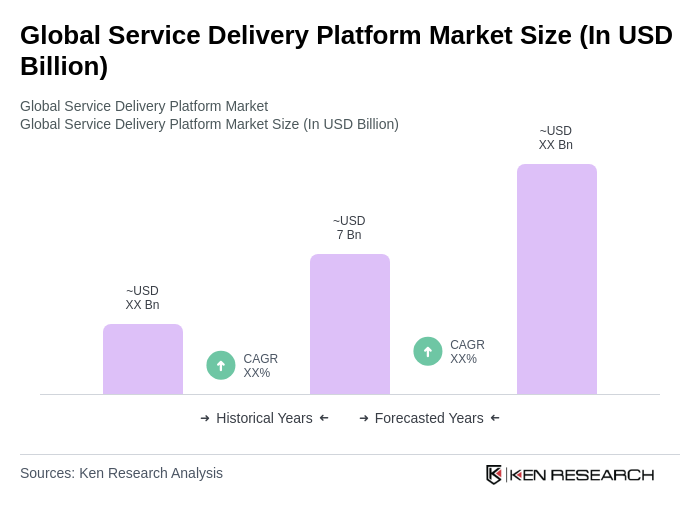
Global Service Delivery Platform Market, valued at USD 7 billion, grows with demand for cloud-native solutions, 5G integration, and AI-driven personalization across key regions like US, China, and Germany.

Region:Global

Author(s):Shubham

Product Code:KRAA3131

Pages:81

Published On:August 2025
About the Report

Base Year 2024

Global Service Delivery Platform Market Overview

  • The Global Service Delivery Platform Market is valued at USD 7 billion, based on a five-year historical analysis. This growth is primarily driven by the increasing demand for seamless service delivery across sectors such as telecommunications, IT services, and financial services. Key drivers include the rapid adoption of cloud-native architectures, the proliferation of 5G networks, and the integration of artificial intelligence and Internet of Things technologies, which collectively enhance operational efficiency and customer engagement solutions. The market is further propelled by digital transformation initiatives and the need for hyper-personalized services, as organizations seek to optimize service orchestration and management capabilities .
  • Key players in this market include the United States, China, and Germany, which dominate due to their advanced technological infrastructure and significant investments in digital services. The United States leads with a substantial market share, driven by the presence of major telecom operators and IT service providers, while China and Germany continue to expand through aggressive digitalization and regulatory compliance. These countries benefit from robust ecosystems supporting cloud migration, 5G rollouts, and data-driven customer engagement, making them leaders in the service delivery platform landscape .
  • In 2023, the European Union implemented the Digital Services Act (Regulation (EU) 2022/2065), issued by the European Parliament and Council. This binding regulation governs online platforms, mandating transparency in service delivery, accountability for content moderation, and enhanced consumer protection. The Act requires platforms to provide clear information on algorithms, content policies, and complaint mechanisms, directly impacting how service delivery platforms operate within the EU and strengthening consumer trust and safety .
Global Service Delivery Platform Market Size

Global Service Delivery Platform Market Segmentation

By Component:The components of the service delivery platform market include hardware, software, and services. Software remains the leading sub-segment, driven by the increasing need for integrated solutions that enhance operational efficiency, enable automation, and support advanced analytics. Organizations are prioritizing software platforms that facilitate cloud-native transformation, microservices adoption, and real-time orchestration, reflecting the shift towards agile and scalable service delivery models .
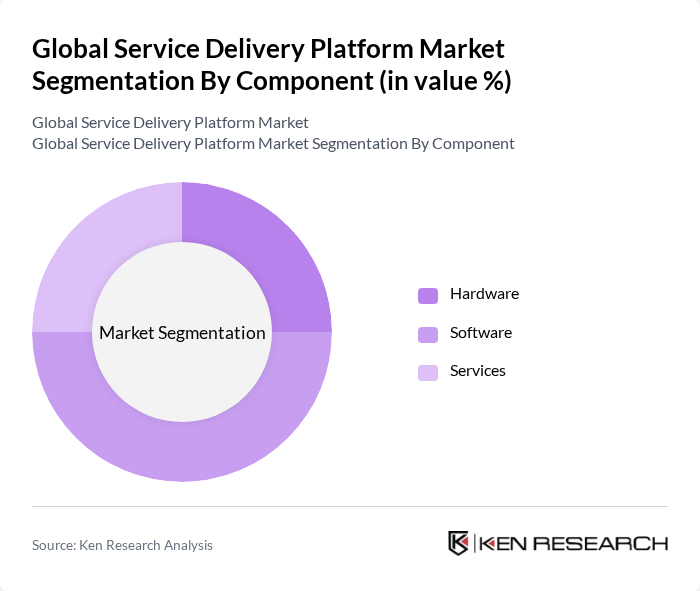
Global Service Delivery Platform Market segmentation by Component.

By Deployment Model:The deployment models for service delivery platforms include cloud-based platforms, on-premises platforms, and hybrid platforms. Cloud-based platforms are the most popular choice among organizations, favored for their scalability, cost-effectiveness, and seamless integration with existing systems. The acceleration of remote work, demand for flexible service delivery, and the rise of cloud-native architectures have further increased the adoption of cloud-based models. Hybrid platforms are gaining traction among enterprises seeking to balance regulatory compliance and operational agility .
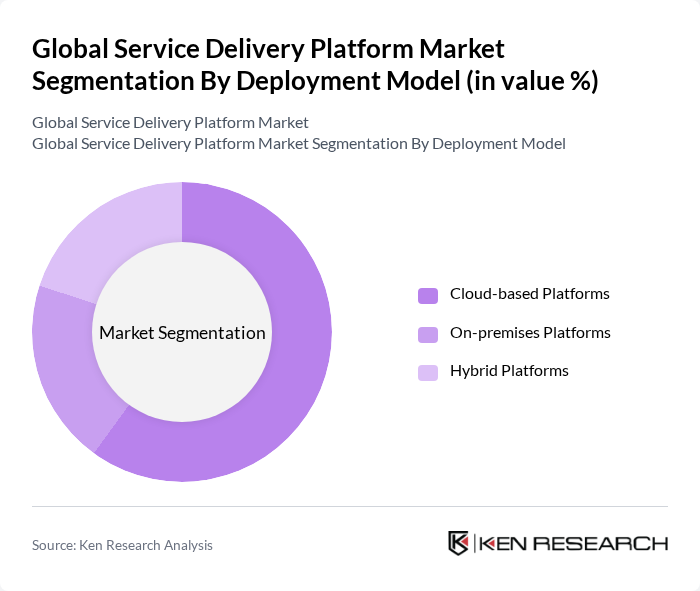
Global Service Delivery Platform Market segmentation by Deployment Model.

Global Service Delivery Platform Market Competitive Landscape

The Global Service Delivery Platform Market is characterized by a dynamic mix of regional and international players. Leading participants such as Amdocs Limited, Oracle Corporation, Ericsson AB, Nokia Corporation, Huawei Technologies Co., Ltd., IBM Corporation, Cisco Systems, Inc., ZTE Corporation, CSG International, Inc., Netcracker Technology Corporation, Hewlett Packard Enterprise Development LP, Tata Consultancy Services Limited, Accenture PLC, Infosys Limited, Capgemini SE contribute to innovation, geographic expansion, and service delivery in this space.

Amdocs Limited

1982

Chesterfield, Missouri, USA

Oracle Corporation

1977

Redwood City, California, USA

Ericsson AB

1876

Stockholm, Sweden

Nokia Corporation

1865

Espoo, Finland

Huawei Technologies Co., Ltd.

1987

Shenzhen, China

Company

Establishment Year

Headquarters

Group Size (Large, Medium, or Small as per industry convention)

Revenue Growth Rate

Market Share (%)

Customer Acquisition Cost

Customer Retention Rate

Market Penetration Rate

Global Service Delivery Platform Market Industry Analysis

Growth Drivers

  • Increasing Demand for Digital Services:The global digital services market is projected to reach $1 trillion, driven by a surge in online transactions and remote work. In the future, the number of digital service users surpassed 5 billion, indicating a robust demand for platforms that facilitate these services. This growth is further supported by the increasing internet penetration rate, which is expected to reach 67% globally, enhancing the need for efficient service delivery platforms.
  • Rise in Cloud-Based Solutions:The cloud computing market is anticipated to grow to $600 billion, with a significant portion attributed to service delivery platforms. In the future, the adoption of cloud services is expected to increase significantly, as businesses seek scalable and cost-effective solutions. This shift is driven by the need for flexibility and remote access, with a majority of enterprises planning to migrate to cloud-based systems, thereby boosting the demand for integrated service delivery platforms.
  • Expansion of IoT Applications:The Internet of Things (IoT) market is projected to reach $1 trillion, with over 15 billion connected devices expected globally. This rapid expansion necessitates robust service delivery platforms to manage and analyze the vast amounts of data generated. In the future, IoT applications in sectors like healthcare and manufacturing increased significantly, highlighting the need for platforms that can efficiently deliver services and insights in real-time.

Market Challenges

  • High Initial Investment Costs:The implementation of service delivery platforms often requires significant upfront investments, averaging around $500,000 for mid-sized enterprises. This financial barrier can deter smaller companies from adopting these technologies. In the future, it is estimated that a substantial proportion of businesses will cite high costs as a primary challenge, limiting their ability to compete in a rapidly evolving digital landscape.
  • Data Security Concerns:With the increasing reliance on digital services, data breaches have become a pressing issue, costing businesses an average of over $4 million per incident. In the future, a significant proportion of organizations are expected to prioritize data security, as regulatory pressures and consumer expectations rise. This challenge necessitates robust security measures within service delivery platforms to protect sensitive information and maintain customer trust.

Global Service Delivery Platform Market Future Outlook

The future of service delivery platforms is poised for transformative growth, driven by technological advancements and evolving consumer expectations. As businesses increasingly prioritize customer experience, platforms that integrate AI and machine learning will become essential for personalized service delivery. Additionally, the ongoing development of 5G technology will enhance connectivity and enable real-time data processing, further driving innovation in service delivery solutions across various sectors.

Market Opportunities

  • Growth in Emerging Markets:Emerging markets are expected to see a significant increase in digital service adoption, driven by rising internet access and mobile penetration. This presents a significant opportunity for service delivery platforms to expand their reach and cater to new customer bases, particularly in regions like Southeast Asia and Africa, where digital transformation is accelerating.
  • Development of 5G Technology:The rollout of 5G networks is projected to create a multi-trillion USD economic impact in future. In the future, the adoption of 5G is expected to enhance service delivery platforms by enabling faster data transfer and improved connectivity. This technological advancement will facilitate the development of innovative applications, particularly in sectors such as healthcare and smart cities, creating new revenue streams.

Scope of the Report

SegmentSub-Segments
By Component

Hardware

Software

Services

By Deployment Model

Cloud-based Platforms

On-premises Platforms

Hybrid Platforms

By Organization Size

Small and Medium-sized Enterprises (SMEs)

Large Enterprises

By End-User

Telecom Operators

Enterprises

Content Providers

By Application

Customer Engagement

Service Management

Network Management

Billing and Revenue Management

By Industry Vertical

Telecommunications

Banking and Finance (BFSI)

Healthcare

Retail

Manufacturing

Government

By Region

North America

Europe

Asia-Pacific

Middle East & Africa

Latin America

Key Target Audience

Investors and Venture Capitalist Firms

Government and Regulatory Bodies (e.g., Federal Communications Commission, European Commission)

Telecommunications Service Providers

Cloud Service Providers

Software Development Companies

System Integrators

Industry Associations (e.g., GSMA, ITU)

Financial Institutions

Players Mentioned in the Report:

Amdocs Limited

Oracle Corporation

Ericsson AB

Nokia Corporation

Huawei Technologies Co., Ltd.

IBM Corporation

Cisco Systems, Inc.

ZTE Corporation

CSG International, Inc.

Netcracker Technology Corporation

Hewlett Packard Enterprise Development LP

Tata Consultancy Services Limited

Accenture PLC

Infosys Limited

Capgemini SE

Table of Contents

Market Assessment Phase

1. Executive Summary and Approach


2. Global Service Delivery Platform Market Overview

2.1 Key Insights and Strategic Recommendations

2.2 Global Service Delivery Platform Market Overview

2.3 Definition and Scope

2.4 Evolution of Market Ecosystem

2.5 Timeline of Key Regulatory Milestones

2.6 Value Chain & Stakeholder Mapping

2.7 Business Cycle Analysis

2.8 Policy & Incentive Landscape


3. Global Service Delivery Platform Market Analysis

3.1 Growth Drivers

3.1.1 Increasing demand for digital services
3.1.2 Rise in cloud-based solutions
3.1.3 Expansion of IoT applications
3.1.4 Need for operational efficiency

3.2 Market Challenges

3.2.1 High initial investment costs
3.2.2 Data security concerns
3.2.3 Rapid technological changes
3.2.4 Integration with legacy systems

3.3 Market Opportunities

3.3.1 Growth in emerging markets
3.3.2 Development of 5G technology
3.3.3 Increasing partnerships and collaborations
3.3.4 Customization of services

3.4 Market Trends

3.4.1 Shift towards subscription-based models
3.4.2 Focus on customer experience
3.4.3 Adoption of AI and machine learning
3.4.4 Emphasis on sustainability

3.5 Government Regulation

3.5.1 Data protection regulations
3.5.2 Compliance with international standards
3.5.3 Incentives for technology adoption
3.5.4 Regulations on service quality

4. SWOT Analysis


5. Stakeholder Analysis


6. Porter's Five Forces Analysis


7. Global Service Delivery Platform Market Market Size, 2019-2024

7.1 By Value

7.2 By Volume

7.3 By Average Selling Price


8. Global Service Delivery Platform Market Segmentation

8.1 By Component

8.1.1 Hardware
8.1.2 Software
8.1.3 Services

8.2 By Deployment Model

8.2.1 Cloud-based Platforms
8.2.2 On-premises Platforms
8.2.3 Hybrid Platforms

8.3 By Organization Size

8.3.1 Small and Medium-sized Enterprises (SMEs)
8.3.2 Large Enterprises

8.4 By End-User

8.4.1 Telecom Operators
8.4.2 Enterprises
8.4.3 Content Providers

8.5 By Application

8.5.1 Customer Engagement
8.5.2 Service Management
8.5.3 Network Management
8.5.4 Billing and Revenue Management

8.6 By Industry Vertical

8.6.1 Telecommunications
8.6.2 Banking and Finance (BFSI)
8.6.3 Healthcare
8.6.4 Retail
8.6.5 Manufacturing
8.6.6 Government

8.7 By Region

8.7.1 North America
8.7.2 Europe
8.7.3 Asia-Pacific
8.7.4 Middle East & Africa
8.7.5 Latin America

9. Global Service Delivery Platform Market Competitive Analysis

9.1 Market Share of Key Players

9.2 KPIs for Cross Comparison of Key Players

9.2.1 Company Name
9.2.2 Group Size (Large, Medium, or Small as per industry convention)
9.2.3 Revenue Growth Rate
9.2.4 Market Share (%)
9.2.5 Customer Acquisition Cost
9.2.6 Customer Retention Rate
9.2.7 Market Penetration Rate
9.2.8 Pricing Strategy
9.2.9 Average Deal Size
9.2.10 Service Delivery Efficiency (e.g., average time to provision new service)
9.2.11 Customer Satisfaction Score (e.g., Net Promoter Score)
9.2.12 R&D Investment (% of revenue)
9.2.13 Number of Active Deployments

9.3 SWOT Analysis of Top Players

9.4 Pricing Analysis

9.5 Detailed Profile of Major Companies

9.5.1 Amdocs Limited
9.5.2 Oracle Corporation
9.5.3 Ericsson AB
9.5.4 Nokia Corporation
9.5.5 Huawei Technologies Co., Ltd.
9.5.6 IBM Corporation
9.5.7 Cisco Systems, Inc.
9.5.8 ZTE Corporation
9.5.9 CSG International, Inc.
9.5.10 Netcracker Technology Corporation
9.5.11 Hewlett Packard Enterprise Development LP
9.5.12 Tata Consultancy Services Limited
9.5.13 Accenture PLC
9.5.14 Infosys Limited
9.5.15 Capgemini SE

10. Global Service Delivery Platform Market End-User Analysis

10.1 Procurement Behavior of Key Ministries

10.1.1 Budget Allocation Trends
10.1.2 Decision-Making Processes
10.1.3 Preferred Service Providers

10.2 Corporate Spend on Infrastructure & Energy

10.2.1 Investment Priorities
10.2.2 Spending Patterns
10.2.3 Impact of Economic Conditions

10.3 Pain Point Analysis by End-User Category

10.3.1 Service Delivery Delays
10.3.2 Cost Management Issues
10.3.3 Technology Integration Challenges

10.4 User Readiness for Adoption

10.4.1 Training and Support Needs
10.4.2 Technology Familiarity
10.4.3 Change Management Strategies

10.5 Post-Deployment ROI and Use Case Expansion

10.5.1 Performance Metrics
10.5.2 Use Case Diversification
10.5.3 Long-term Value Realization

11. Global Service Delivery Platform Market Future Size, 2025-2030

11.1 By Value

11.2 By Volume

11.3 By Average Selling Price


Go-To-Market Strategy Phase

1. Whitespace Analysis + Business Model Canvas

1.1 Market Gaps Identification

1.2 Value Proposition Development

1.3 Revenue Streams Analysis

1.4 Cost Structure Evaluation

1.5 Key Partnerships Exploration

1.6 Customer Segmentation

1.7 Channels and Customer Relationships


2. Marketing and Positioning Recommendations

2.1 Branding Strategies

2.2 Product USPs

2.3 Target Market Identification

2.4 Communication Strategies

2.5 Digital Marketing Approaches


3. Distribution Plan

3.1 Urban Retail Strategies

3.2 Rural NGO Tie-ups

3.3 Online Distribution Channels

3.4 Direct Sales Approaches


4. Channel & Pricing Gaps

4.1 Underserved Routes

4.2 Pricing Bands Analysis

4.3 Competitor Pricing Comparison


5. Unmet Demand & Latent Needs

5.1 Category Gaps

5.2 Consumer Segments Analysis

5.3 Emerging Trends Identification


6. Customer Relationship

6.1 Loyalty Programs

6.2 After-sales Service

6.3 Customer Feedback Mechanisms


7. Value Proposition

7.1 Sustainability Initiatives

7.2 Integrated Supply Chains

7.3 Competitive Advantages


8. Key Activities

8.1 Regulatory Compliance

8.2 Branding Efforts

8.3 Distribution Setup


9. Entry Strategy Evaluation

9.1 Domestic Market Entry Strategy

9.1.1 Product Mix Considerations
9.1.2 Pricing Band Strategy
9.1.3 Packaging Approaches

9.2 Export Entry Strategy

9.2.1 Target Countries Identification
9.2.2 Compliance Roadmap Development

10. Entry Mode Assessment

10.1 Joint Ventures

10.2 Greenfield Investments

10.3 Mergers & Acquisitions

10.4 Distributor Model Evaluation


11. Capital and Timeline Estimation

11.1 Capital Requirements

11.2 Timelines for Implementation


12. Control vs Risk Trade-Off

12.1 Ownership vs Partnerships


13. Profitability Outlook

13.1 Breakeven Analysis

13.2 Long-term Sustainability


14. Potential Partner List

14.1 Distributors

14.2 Joint Ventures

14.3 Acquisition Targets


15. Execution Roadmap

15.1 Phased Plan for Market Entry

15.1.1 Market Setup
15.1.2 Market Entry
15.1.3 Growth Acceleration
15.1.4 Scale & Stabilize

15.2 Key Activities and Milestones

15.2.1 Milestone Planning
15.2.2 Activity Tracking

Research Methodology

ApproachModellingSample

Phase 1: Approach1

Desk Research

  • Industry reports from global telecommunications and IT service organizations
  • Market analysis publications from leading consulting firms focusing on service delivery platforms
  • Government publications and white papers on digital transformation initiatives

Primary Research

  • Interviews with CTOs and CIOs of major enterprises utilizing service delivery platforms
  • Surveys with IT managers and service delivery specialists across various sectors
  • Focus groups with end-users to gather insights on platform usability and features

Validation & Triangulation

  • Cross-validation of findings through multiple industry reports and expert opinions
  • Triangulation of data from primary interviews and secondary research sources
  • Sanity checks through feedback from a panel of industry experts and analysts

Phase 2: Market Size Estimation1

Top-down Assessment

  • Analysis of global IT spending trends and their impact on service delivery platforms
  • Segmentation of the market by geographic regions and industry verticals
  • Incorporation of emerging technologies such as AI and cloud computing in market forecasts

Bottom-up Modeling

  • Estimation of revenue contributions from key service delivery platform providers
  • Operational metrics derived from user adoption rates and service usage statistics
  • Cost analysis based on subscription models and service tier pricing

Forecasting & Scenario Analysis

  • Multi-variable forecasting using growth drivers such as digital transformation and remote work trends
  • Scenario planning based on potential regulatory changes and market disruptions
  • Development of baseline, optimistic, and pessimistic market growth projections through 2030

Phase 3: CATI Sample Composition1

Scope Item/SegmentSample SizeTarget Respondent Profiles
Enterprise Service Delivery Platforms120CTOs, IT Directors
Cloud-Based Service Solutions90Cloud Architects, Service Managers
Telecom Service Delivery Models60Network Engineers, Operations Managers
AI-Driven Service Platforms50Data Scientists, Product Managers
Customer Experience Management Tools70Customer Experience Officers, Marketing Managers

Frequently Asked Questions

What is the current value of the Global Service Delivery Platform Market?

The Global Service Delivery Platform Market is valued at approximately USD 7 billion, driven by the increasing demand for seamless service delivery across various sectors, including telecommunications, IT services, and financial services.

What are the key drivers of growth in the Global Service Delivery Platform Market?

Which countries dominate the Global Service Delivery Platform Market?

What is the impact of the Digital Services Act on service delivery platforms in the EU?

Why Buy From Us?

Refine Robust Result (RRR) Framework

What makes us stand out is that our consultants follow Robust, Refine and Result (RRR) methodology. Robust for clear definitions, approaches and sanity checking, Refine for differentiating respondents' facts and opinions, and Result for presenting data with story.

Our Reach Is Unmatched

We have set a benchmark in the industry by offering our clients with syndicated and customized market research reports featuring coverage of entire market as well as meticulous research and analyst insights.

Shifting the Research Paradigm

While we don't replace traditional research, we flip the method upside down. Our dual approach of Top Bottom & Bottom Top ensures quality deliverable by not just verifying company fundamentals but also looking at the sector and macroeconomic factors.

More Insights-Better Decisions

With one step in the future, our research team constantly tries to show you the bigger picture. We help with some of the tough questions you may encounter along the way: How is the industry positioned? Best marketing channel? KPI's of competitors? By aligning every element, we help maximize success.

Transparency and Trust

Our report gives you instant access to the answers and sources that other companies might choose to hide. We elaborate each steps of research methodology we have used and showcase you the sample size to earn your trust.

Round the Clock Support

If you need any support, we are here! We pride ourselves on universe strength, data quality, and quick, friendly, and professional service.

Why Clients Choose Us?

400000+
Reports in repository
150+
Consulting projects a year
100+
Analysts
8000+
Client Queries in 2022








