Indonesia Breakfast Restaurants Market Size Share Growth Drivers Trends Opportunities & Forecast 2025–2030

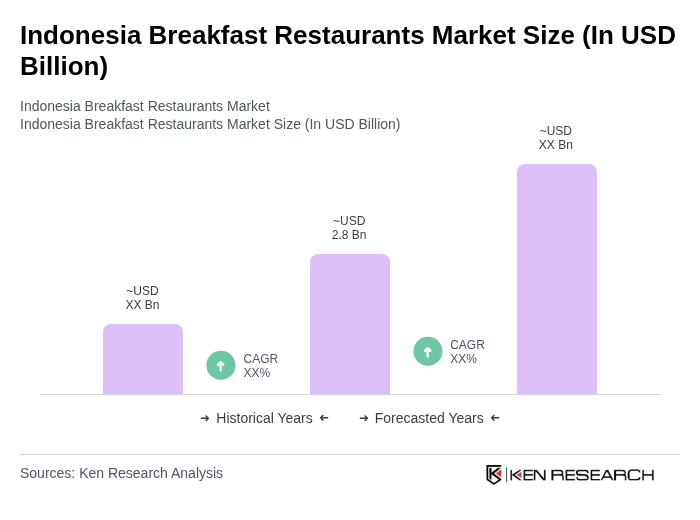
Indonesia Breakfast Restaurants Market, worth USD 2.8 billion, grows with urban demand for diverse options like traditional Indonesian and Western breakfasts in cities like Jakarta.

Region:Asia

Author(s):Shubham

Product Code:KRAD2631

Pages:84

Published On:January 2026
About the Report

Base Year 2024

Indonesia Breakfast Restaurants Market Overview

  • The Indonesia Breakfast Restaurants Market is valued at USD 2.8 billion, based on a five-year historical analysis and by relating breakfast-focused sales to the wider hotel, restaurant, and institutional (HRI) sector, which is reported at about USD 26–29 billion for Indonesia. This growth is primarily driven by increasing urbanization, rising disposable incomes, and a growing trend towards dining out and ordering in, particularly for morning and breakfast occasions. The market has seen a surge in demand for diverse breakfast options, spanning localized menus at quick?service chains, specialty coffee and bakery formats, and modernized street-food style offerings that cater to both local and international tastes.
  • Key cities such as Jakarta, Surabaya, and Bandung dominate the market due to their large populations, high economic activity, and vibrant tourism and business travel, which drive strong morning footfall in foodservice outlets. These urban centers are characterized by a high density of breakfast-related establishments, ranging from street food stalls and traditional warung to international quick-service and coffee chains and upscale hotel venues, making them hotspots for breakfast consumption and delivery-focused formats.
  • To strengthen food safety and hygiene in restaurants, breakfast outlets are required to comply with provisions such as the Food Safety Law (Law Number 18 of 2012 on Food) issued by the Government of Indonesia and operationalized through implementing regulations under the National Agency of Drug and Food Control (BPOM) and the Ministry of Health. These instruments set binding requirements on safe food handling, hygiene, labeling, and periodic inspection for foodservice businesses, and breakfast establishments increasingly align with these standards to enhance consumer confidence and maintain license eligibility.
Indonesia Breakfast Restaurants Market Size

Indonesia Breakfast Restaurants Market Segmentation

By Restaurant Format:The restaurant format segmentation includes various types of establishments catering to breakfast consumers. The subsegments are Quick-Service / Fast Food Breakfast Outlets, Full-Service / Casual Dining Restaurants, Cafés & Coffee Shops, Hotel & Boutique Breakfast Venues, and Street Food Stalls & Hawkers. Quick-Service / Fast Food Breakfast Outlets, including chain QSRs and convenience-led formats, hold a leading share of the organized breakfast occasion due to their convenience, standardized menus, and value pricing, which fit the fast-paced lifestyle of urban consumers and commuters. The growing trend of on-the-go breakfast options and app-based ordering through super-apps and delivery platforms has further reinforced the leadership of these formats in Indonesia’s major cities.
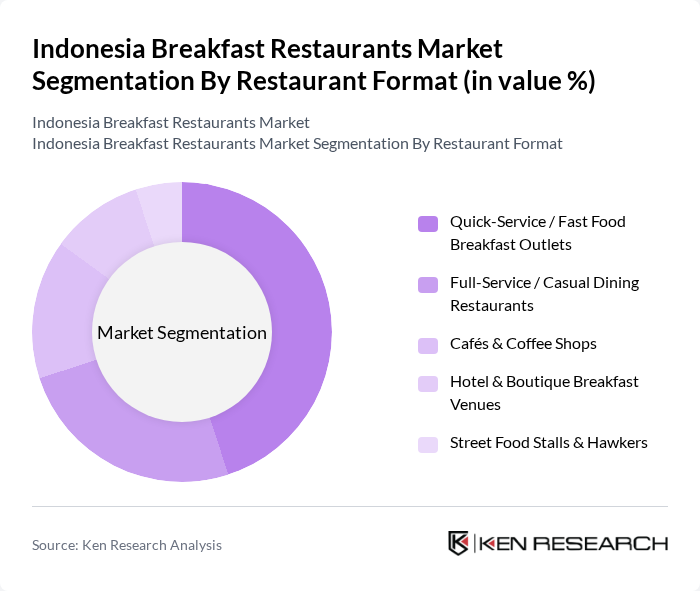
Indonesia Breakfast Restaurants Market segmentation by Restaurant Format.

By Cuisine / Menu Type:This segmentation focuses on the types of cuisines offered in breakfast restaurants. The subsegments include Traditional Indonesian Breakfast (Nasi uduk, bubur, lontong, etc.), Western & International Breakfast, Asian Fusion & Regional Concepts, Health-Focused & Functional Breakfast (low-calorie, high-protein, plant-based), and Bakery & Grab-and-Go Items (roti, pastries, sandwiches). Traditional Indonesian Breakfast is the leading subsegment in terms of total occasions, as dishes such as nasi uduk, bubur ayam, lontong, and mie-based breakfasts are deeply embedded in daily eating habits and are widely available across both organized and informal channels. At the same time, Western and international breakfast, specialty coffee, bakery, and health-oriented options are expanding fastest in urban centers, supported by the rapid growth of café culture, premium bakery chains, and younger consumers’ interest in global and wellness-focused concepts.
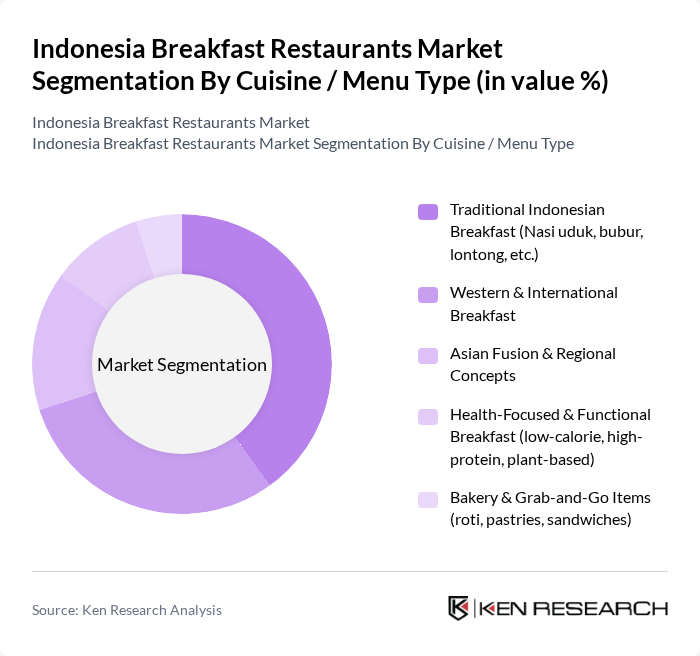
Indonesia Breakfast Restaurants Market segmentation by Cuisine / Menu Type.

Indonesia Breakfast Restaurants Market Competitive Landscape

The Indonesia Breakfast Restaurants Market is characterized by a dynamic mix of regional and international players. Leading participants such as McDonald's Indonesia (PT Rekso Nasional Food), KFC Indonesia (PT Fast Food Indonesia Tbk), A&W Restaurants Indonesia, Starbucks Coffee Indonesia (PT Sari Coffee Indonesia), Kopi Kenangan, Roti'O, Roti Bakar Eddy, The Breakfast Club Jakarta, Bubur Ayam Barito, Nasi Uduk Kebon Kacang, Sari Roti (PT Nippon Indosari Corpindo Tbk), Bakerzin Indonesia, Excelso Coffee, Warung Upnormal, Selected Emerging Local Breakfast Chains & Cloud Kitchens contribute to innovation, geographic expansion, and service delivery in this space, with chained players particularly leveraging franchising, digital ordering, and delivery integration to expand their breakfast daypart.

McDonald's Indonesia

1991

Jakarta

KFC Indonesia

1979

Jakarta

A&W Restaurants Indonesia

1985

Jakarta

Starbucks Coffee Indonesia

2002

Jakarta

Kopi Kenangan

2017

Jakarta

Company

Establishment Year

Headquarters

Ownership Type (Independent vs Chain / Franchise)

Group Size (Outlet Count – Large, Medium, Small)

Annual Revenue from Breakfast Segment

Same-Store Sales Growth (SSSG) – Breakfast

Average Daily Transactions per Outlet (Breakfast Daypart)

Average Ticket Size / Order Value (IDR)

Indonesia Breakfast Restaurants Market Industry Analysis

Growth Drivers

  • Increasing Urbanization:Indonesia's urban population is projected to reach 56% in future, up from 54% in 2020, according to the World Bank. This urbanization trend drives demand for breakfast restaurants as more people seek convenient dining options. Urban areas typically have higher foot traffic and a greater concentration of working professionals, leading to increased patronage of breakfast establishments. The growth of urban centers also fosters a diverse culinary landscape, encouraging innovation in breakfast offerings.
  • Rising Disposable Income:The World Bank estimates that Indonesia's GDP per capita will rise to approximately $4,800 in future, reflecting a growing middle class with increased disposable income. This economic growth enables consumers to spend more on dining out, particularly in breakfast restaurants. As disposable income rises, consumers are more likely to indulge in premium breakfast options, driving revenue growth for restaurants that cater to this demographic shift.
  • Expansion of Food Delivery Services:The food delivery market in Indonesia is expected to grow significantly, with revenues projected to reach $4 billion in future, according to Statista. This growth is driven by the increasing adoption of mobile technology and changing consumer habits. Breakfast restaurants that partner with delivery platforms can tap into a broader customer base, catering to those who prefer dining at home or in the office, thus enhancing their market reach and sales potential.

Market Challenges

  • Intense Competition:The breakfast restaurant sector in Indonesia is characterized by fierce competition, with over 35,000 establishments operating nationwide as of future. This saturation makes it challenging for new entrants to establish a foothold and for existing businesses to maintain market share. Restaurants must differentiate themselves through unique offerings, exceptional service, and effective marketing strategies to attract and retain customers in this crowded marketplace.
  • Fluctuating Ingredient Prices:The volatility of ingredient prices poses a significant challenge for breakfast restaurants in Indonesia. For instance, the price of eggs, a staple breakfast item, has seen fluctuations of up to 25% in recent periods due to supply chain disruptions and seasonal variations. Such price instability can erode profit margins and force restaurants to adjust their pricing strategies, potentially alienating price-sensitive customers.

Indonesia Breakfast Restaurants Market Future Outlook

The future of the breakfast restaurant market in Indonesia appears promising, driven by evolving consumer preferences and technological advancements. As urbanization continues, restaurants are likely to innovate their menus to include healthier and more diverse options. Additionally, the integration of technology in customer engagement, such as mobile ordering and loyalty programs, will enhance customer experiences. These trends indicate a dynamic market landscape that will adapt to meet the changing needs of consumers while fostering growth opportunities for established and new players alike.

Market Opportunities

  • Expansion into Tier 2 and Tier 3 Cities:With urbanization spreading beyond major cities, tier 2 and tier 3 cities present significant growth opportunities for breakfast restaurants. These areas are experiencing rising disposable incomes and changing lifestyles, making them ideal markets for new establishments. Targeting these regions can lead to increased market penetration and brand loyalty among emerging consumer bases.
  • Introduction of Health-Oriented Menus:As health consciousness rises, breakfast restaurants can capitalize on this trend by offering health-oriented menus. Incorporating organic ingredients and plant-based options can attract health-conscious consumers. The global health food market is projected to reach $1.2 trillion in future, indicating a substantial opportunity for restaurants to align their offerings with consumer preferences for healthier dining choices.

Scope of the Report

SegmentSub-Segments
By Restaurant Format

Quick-Service / Fast Food Breakfast Outlets

Full-Service / Casual Dining Restaurants

Cafés & Coffee Shops

Hotel & Boutique Breakfast Venues

Street Food Stalls & Hawkers

By Cuisine / Menu Type

Traditional Indonesian Breakfast (Nasi uduk, bubur, lontong, etc.)

Western & International Breakfast

Asian Fusion & Regional Concepts

Health-Focused & Functional Breakfast (low-calorie, high-protein, plant-based)

Bakery & Grab-and-Go Items (roti, pastries, sandwiches)

By Service Model

On-Premise Dine-In

Takeaway / Pickup

Delivery via Own Channels

Delivery via Aggregator Platforms (GoFood, GrabFood, ShopeeFood, etc.)

Drive-Thru & Kiosk Models

By Consumer Segment

Office Workers & Young Professionals

Students

Families

Tourists & Business Travelers

Blue-Collar & Informal Workforce

By Price Band (Per Person Spend)

Mass / Value (Budget)

Mid-Market

Premium

Luxury / Upscale

Promotional / Combo-Driven Offers

By Location & Trade Area

Central Business Districts (CBDs)

Residential Neighborhoods

Transport Hubs (stations, airports, terminals)

Malls & Retail Clusters

Tourist Hotspots & Coastal Areas

By Time & Occasion

Everyday / Workday Breakfast

Weekend & Holiday Brunch

Business Breakfast Meetings

Special Themed Events & Promotions

Late Breakfast / All-Day Breakfast Concepts

Key Target Audience

Investors and Venture Capitalist Firms

Government and Regulatory Bodies (e.g., Ministry of Tourism and Creative Economy, Ministry of Trade)

Food and Beverage Suppliers

Restaurant Franchise Owners

Local Farmers and Food Producers

Real Estate Developers

Marketing and Advertising Agencies

Food Safety and Health Organizations

Players Mentioned in the Report:

McDonald's Indonesia (PT Rekso Nasional Food)

KFC Indonesia (PT Fast Food Indonesia Tbk)

A&W Restaurants Indonesia

Starbucks Coffee Indonesia (PT Sari Coffee Indonesia)

Kopi Kenangan

Roti'O

Roti Bakar Eddy

The Breakfast Club Jakarta

Bubur Ayam Barito

Nasi Uduk Kebon Kacang

Sari Roti (PT Nippon Indosari Corpindo Tbk)

Bakerzin Indonesia

Excelso Coffee

Warung Upnormal

Selected Emerging Local Breakfast Chains & Cloud Kitchens

Table of Contents

Market Assessment Phase

1. Executive Summary and Approach


2. Indonesia Breakfast Restaurants Market Overview

2.1 Key Insights and Strategic Recommendations

2.2 Indonesia Breakfast Restaurants Market Overview

2.3 Definition and Scope

2.4 Evolution of Market Ecosystem

2.5 Timeline of Key Regulatory Milestones

2.6 Value Chain & Stakeholder Mapping

2.7 Business Cycle Analysis

2.8 Policy & Incentive Landscape


3. Indonesia Breakfast Restaurants Market Analysis

3.1 Growth Drivers

3.1.1 Increasing Urbanization
3.1.2 Rising Disposable Income
3.1.3 Growing Health Consciousness
3.1.4 Expansion of Food Delivery Services

3.2 Market Challenges

3.2.1 Intense Competition
3.2.2 Fluctuating Ingredient Prices
3.2.3 Regulatory Compliance Issues
3.2.4 Changing Consumer Preferences

3.3 Market Opportunities

3.3.1 Expansion into Tier 2 and Tier 3 Cities
3.3.2 Introduction of Health-Oriented Menus
3.3.3 Collaborations with Local Farmers
3.3.4 Leveraging Technology for Customer Engagement

3.4 Market Trends

3.4.1 Rise of Plant-Based Breakfast Options
3.4.2 Increasing Popularity of Brunch Culture
3.4.3 Focus on Sustainable Practices
3.4.4 Growth of Online Food Ordering Platforms

3.5 Government Regulation

3.5.1 Food Safety Standards
3.5.2 Labor Regulations
3.5.3 Tax Incentives for Local Sourcing
3.5.4 Health and Hygiene Regulations

4. SWOT Analysis


5. Stakeholder Analysis


6. Porter's Five Forces Analysis


7. Indonesia Breakfast Restaurants Market Market Size, 2019-2024

7.1 By Value

7.2 By Volume

7.3 By Average Selling Price


8. Indonesia Breakfast Restaurants Market Segmentation

8.1 By Restaurant Format

8.1.1 Quick-Service / Fast Food Breakfast Outlets
8.1.2 Full-Service / Casual Dining Restaurants
8.1.3 Cafés & Coffee Shops
8.1.4 Hotel & Boutique Breakfast Venues
8.1.5 Street Food Stalls & Hawkers

8.2 By Cuisine / Menu Type

8.2.1 Traditional Indonesian Breakfast (Nasi uduk, bubur, lontong, etc.)
8.2.2 Western & International Breakfast
8.2.3 Asian Fusion & Regional Concepts
8.2.4 Health-Focused & Functional Breakfast (low-calorie, high-protein, plant-based)
8.2.5 Bakery & Grab-and-Go Items (roti, pastries, sandwiches)

8.3 By Service Model

8.3.1 On-Premise Dine-In
8.3.2 Takeaway / Pickup
8.3.3 Delivery via Own Channels
8.3.4 Delivery via Aggregator Platforms (GoFood, GrabFood, ShopeeFood, etc.)
8.3.5 Drive-Thru & Kiosk Models

8.4 By Consumer Segment

8.4.1 Office Workers & Young Professionals
8.4.2 Students
8.4.3 Families
8.4.4 Tourists & Business Travelers
8.4.5 Blue-Collar & Informal Workforce

8.5 By Price Band (Per Person Spend)

8.5.1 Mass / Value (Budget)
8.5.2 Mid-Market
8.5.3 Premium
8.5.4 Luxury / Upscale
8.5.5 Promotional / Combo-Driven Offers

8.6 By Location & Trade Area

8.6.1 Central Business Districts (CBDs)
8.6.2 Residential Neighborhoods
8.6.3 Transport Hubs (stations, airports, terminals)
8.6.4 Malls & Retail Clusters
8.6.5 Tourist Hotspots & Coastal Areas

8.7 By Time & Occasion

8.7.1 Everyday / Workday Breakfast
8.7.2 Weekend & Holiday Brunch
8.7.3 Business Breakfast Meetings
8.7.4 Special Themed Events & Promotions
8.7.5 Late Breakfast / All-Day Breakfast Concepts

9. Indonesia Breakfast Restaurants Market Competitive Analysis

9.1 Market Share of Key Players

9.2 Cross Comparison of Key Players

9.2.1 Company Name
9.2.2 Ownership Type (Independent vs Chain / Franchise)
9.2.3 Group Size (Outlet Count – Large, Medium, Small)
9.2.4 Annual Revenue from Breakfast Segment
9.2.5 Same-Store Sales Growth (SSSG) – Breakfast
9.2.6 Average Daily Transactions per Outlet (Breakfast Daypart)
9.2.7 Average Ticket Size / Order Value (IDR)
9.2.8 Breakfast Daypart Contribution to Total Sales (%)
9.2.9 Delivery vs Dine-In Mix (%) for Breakfast
9.2.10 Number of Cities Covered / Geographic Spread
9.2.11 Digital Adoption Index (App downloads, loyalty users, online orders share)
9.2.12 Customer Retention / Repeat Visit Rate
9.2.13 EBITDA Margin for Breakfast Operations
9.2.14 Table Turnover Rate / Seating Utilization (Breakfast Hours)
9.2.15 Menu Innovation Intensity (new items launched per year)

9.3 SWOT Analysis of Top Players

9.4 Pricing Analysis

9.5 Detailed Profile of Major Companies

9.5.1 McDonald's Indonesia (PT Rekso Nasional Food)
9.5.2 KFC Indonesia (PT Fast Food Indonesia Tbk)
9.5.3 A&W Restaurants Indonesia
9.5.4 Starbucks Coffee Indonesia (PT Sari Coffee Indonesia)
9.5.5 Kopi Kenangan
9.5.6 Roti'O
9.5.7 Roti Bakar Eddy
9.5.8 The Breakfast Club Jakarta
9.5.9 Bubur Ayam Barito
9.5.10 Nasi Uduk Kebon Kacang
9.5.11 Sari Roti (PT Nippon Indosari Corpindo Tbk)
9.5.12 Bakerzin Indonesia
9.5.13 Excelso Coffee
9.5.14 Warung Upnormal
9.5.15 Selected Emerging Local Breakfast Chains & Cloud Kitchens

10. Indonesia Breakfast Restaurants Market End-User Analysis

10.1 Procurement Behavior of Key Ministries

10.1.1 Government Contracts
10.1.2 Budget Allocations
10.1.3 Supplier Selection Criteria
10.1.4 Compliance Requirements
10.1.5 Others

10.2 Corporate Spend on Infrastructure & Energy

10.2.1 Investment in Kitchen Equipment
10.2.2 Renovation Costs
10.2.3 Energy Efficiency Initiatives
10.2.4 Technology Upgrades
10.2.5 Others

10.3 Pain Point Analysis by End-User Category

10.3.1 Quality of Ingredients
10.3.2 Service Speed
10.3.3 Menu Variety
10.3.4 Pricing Affordability
10.3.5 Others

10.4 User Readiness for Adoption

10.4.1 Awareness of Breakfast Options
10.4.2 Willingness to Try New Menus
10.4.3 Technology Adoption for Ordering
10.4.4 Feedback Mechanisms
10.4.5 Others

10.5 Post-Deployment ROI and Use Case Expansion

10.5.1 Customer Retention Rates
10.5.2 Revenue Growth Post-Implementation
10.5.3 Menu Performance Analysis
10.5.4 Brand Loyalty Metrics
10.5.5 Others

11. Indonesia Breakfast Restaurants Market Future Size, 2025-2030

11.1 By Value

11.2 By Volume

11.3 By Average Selling Price


Go-To-Market Strategy Phase

1. Whitespace Analysis + Business Model Canvas

1.1 Market Gaps Identification

1.2 Business Model Framework


2. Marketing and Positioning Recommendations

2.1 Branding Strategies

2.2 Product USPs


3. Distribution Plan

3.1 Urban Retail vs Rural NGO Tie-Ups


4. Channel & Pricing Gaps

4.1 Underserved Routes

4.2 Pricing Bands


5. Unmet Demand & Latent Needs

5.1 Category Gaps

5.2 Consumer Segments


6. Customer Relationship

6.1 Loyalty Programs

6.2 After-Sales Service


7. Value Proposition

7.1 Sustainability

7.2 Integrated Supply Chains


8. Key Activities

8.1 Regulatory Compliance

8.2 Branding

8.3 Distribution Setup


9. Entry Strategy Evaluation

9.1 Domestic Market Entry Strategy

9.1.1 Product Mix
9.1.2 Pricing Band
9.1.3 Packaging

9.2 Export Entry Strategy

9.2.1 Target Countries
9.2.2 Compliance Roadmap

10. Entry Mode Assessment

10.1 JV

10.2 Greenfield

10.3 M&A

10.4 Distributor Model


11. Capital and Timeline Estimation

11.1 Capital Requirements

11.2 Timelines


12. Control vs Risk Trade-Off

12.1 Ownership vs Partnerships


13. Profitability Outlook

13.1 Breakeven Analysis

13.2 Long-Term Sustainability


14. Potential Partner List

14.1 Distributors

14.2 JVs

14.3 Acquisition Targets


15. Execution Roadmap

15.1 Phased Plan for Market Entry

15.1.1 Market Setup
15.1.2 Market Entry
15.1.3 Growth Acceleration
15.1.4 Scale & Stabilize

15.2 Key Activities and Milestones

15.2.1 Milestone Tracking
15.2.2 Activity Scheduling

Research Methodology

ApproachModellingSample

Phase 1: Approach1

Desk Research

  • Analysis of industry reports from local food and beverage associations
  • Review of government publications on food service regulations and trends
  • Examination of market studies and consumer behavior reports specific to breakfast dining

Primary Research

  • Interviews with owners and managers of popular breakfast restaurants across major cities
  • Surveys targeting customers to understand preferences and dining habits
  • Focus groups with food industry experts to gather insights on market dynamics

Validation & Triangulation

  • Cross-validation of findings with data from food service market analysts
  • Triangulation of consumer insights with sales data from restaurant point-of-sale systems
  • Sanity checks through expert panel reviews comprising chefs and culinary consultants

Phase 2: Market Size Estimation1

Top-down Assessment

  • Estimation of total food service market size and segmentation by meal type
  • Analysis of breakfast consumption trends and growth rates in urban areas
  • Incorporation of demographic data to assess potential market reach

Bottom-up Modeling

  • Collection of sales data from a sample of breakfast restaurants to establish average revenue
  • Estimation of customer footfall and average spend per visit
  • Calculation of market size based on the number of breakfast establishments and their performance metrics

Forecasting & Scenario Analysis

  • Multi-factor regression analysis incorporating economic indicators and consumer spending patterns
  • Scenario modeling based on potential impacts of health trends and dietary preferences
  • Baseline, optimistic, and pessimistic forecasts for the next five years

Phase 3: CATI Sample Composition1

Scope Item/SegmentSample SizeTarget Respondent Profiles
Urban Breakfast Restaurant Owners80Restaurant Owners, Franchise Operators
Breakfast Menu Development Experts60Culinary Chefs, Menu Planners
Breakfast Consumers in Major Cities150Regular Diners, Food Enthusiasts
Food Service Industry Analysts50Market Analysts, Research Consultants
Health and Nutrition Experts40Nutritionists, Dieticians

Frequently Asked Questions

What is the current value of the Indonesia Breakfast Restaurants Market?

The Indonesia Breakfast Restaurants Market is valued at approximately USD 2.8 billion, reflecting a significant segment of the broader hotel, restaurant, and institutional sector, which is estimated to be between USD 2629 billion.

What factors are driving the growth of breakfast restaurants in Indonesia?

Which cities are the main hubs for breakfast restaurants in Indonesia?

What types of restaurant formats are prevalent in the Indonesia Breakfast Restaurants Market?

Other Adjacent Reports

Why Buy From Us?

Refine Robust Result (RRR) Framework

What makes us stand out is that our consultants follow Robust, Refine and Result (RRR) methodology. Robust for clear definitions, approaches and sanity checking, Refine for differentiating respondents' facts and opinions, and Result for presenting data with story.

Our Reach Is Unmatched

We have set a benchmark in the industry by offering our clients with syndicated and customized market research reports featuring coverage of entire market as well as meticulous research and analyst insights.

Shifting the Research Paradigm

While we don't replace traditional research, we flip the method upside down. Our dual approach of Top Bottom & Bottom Top ensures quality deliverable by not just verifying company fundamentals but also looking at the sector and macroeconomic factors.

More Insights-Better Decisions

With one step in the future, our research team constantly tries to show you the bigger picture. We help with some of the tough questions you may encounter along the way: How is the industry positioned? Best marketing channel? KPI's of competitors? By aligning every element, we help maximize success.

Transparency and Trust

Our report gives you instant access to the answers and sources that other companies might choose to hide. We elaborate each steps of research methodology we have used and showcase you the sample size to earn your trust.

Round the Clock Support

If you need any support, we are here! We pride ourselves on universe strength, data quality, and quick, friendly, and professional service.

Why Clients Choose Us?

400000+
Reports in repository
150+
Consulting projects a year
100+
Analysts
8000+
Client Queries in 2022








