About the Report
Base Year 2024Indonesia Mobile Clinics Market Overview
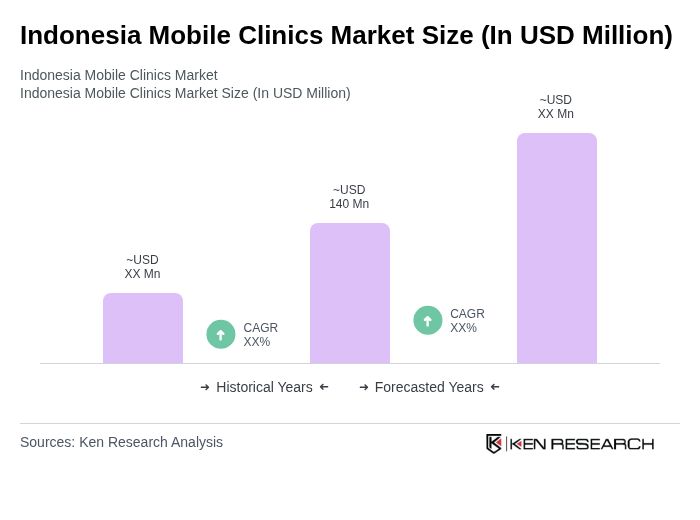
- The Indonesia Mobile Clinics Market is valued at USD 140 million, based on a five-year historical analysis. This growth is primarily driven by the increasing demand for accessible healthcare services, particularly in remote and underserved areas. The rise in chronic diseases and the need for preventive care have further propelled the market, as mobile clinics provide essential services directly to communities.
- Key cities such as Jakarta, Surabaya, and Bandung dominate the market due to their high population density and significant healthcare needs. These urban centers have a greater concentration of healthcare facilities and a higher demand for mobile health services, making them critical hubs for mobile clinic operations.
- The Minister of Health Regulation No. 20 of 2019 issued by the Ministry of Health requires Puskesmas to deploy mobile health services (Puskesmas Keliling) in rural and remote areas, mandating at least one mobile unit per Puskesmas serving populations over 10,000 with compliance verified through quarterly health reports and operational standards for basic services including vaccinations, maternal care, and chronic disease screening. This initiative aims to enhance healthcare delivery and ensure that essential medical services reach populations that are often neglected, thereby addressing health disparities across the nation.
Indonesia Mobile Clinics Market Segmentation
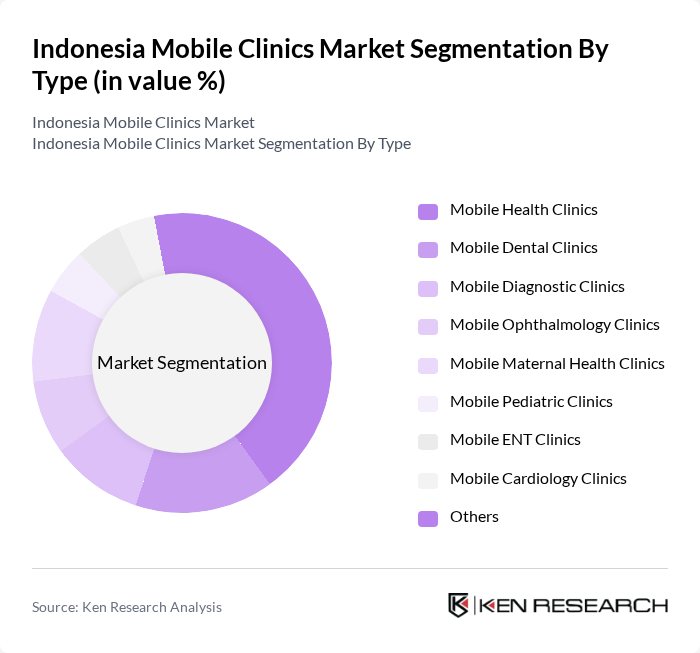
By Type:The mobile clinics market can be segmented into various types, including Mobile Health Clinics, Mobile Dental Clinics, Mobile Diagnostic Clinics, Mobile Ophthalmology Clinics, Mobile Maternal Health Clinics, Mobile Pediatric Clinics, Mobile ENT Clinics, Mobile Cardiology Clinics, and Others. Among these, Mobile Health Clinics are the most prominent, as they provide a wide range of essential health services, including vaccinations, maternal care, and chronic disease management. The increasing focus on preventive healthcare and the convenience of on-site services have made this segment particularly appealing to both healthcare providers and patients.
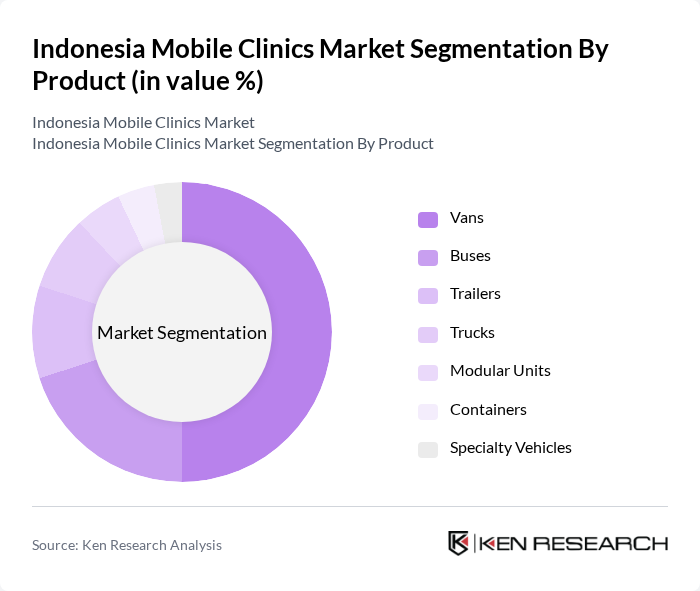
By Product:The mobile clinics market can also be categorized by product types, including Vans, Buses, Trailers, Trucks, Modular Units, Containers, and Specialty Vehicles. Vans are the most widely used product type due to their versatility and ease of maneuverability in urban and rural settings. They are often equipped with essential medical equipment and can be easily customized to meet specific healthcare needs, making them a preferred choice for many mobile health service providers.
Indonesia Mobile Clinics Market Competitive Landscape
The Indonesia Mobile Clinics Market is characterized by a dynamic mix of regional and international players. Leading participants such as RSUD Dr. Soetomo, Klinik Kesehatan Ibu dan Anak (KKIA), Puskesmas, Rumah Sakit Cipto Mangunkusumo, Klinik Sehat, Medan Mobile Clinic, Jakarta Mobile Clinic, Yayasan Kesehatan Perempuan, Mobile Health Indonesia, Klinik Peduli Sehat, Klinik Keluarga Sehat, RSU Bunda, Klinik Medika, Klinik Harapan Bunda, Klinik Sehat Bersama contribute to innovation, geographic expansion, and service delivery in this space.
Indonesia Mobile Clinics Market Industry Analysis
Growth Drivers
- Increasing Demand for Accessible Healthcare Services:The Indonesian population, exceeding 270 million, faces significant healthcare access challenges, particularly in rural areas. In future, approximately 60% of the population will reside in these regions, driving the need for mobile clinics. The World Bank reports that only 40% of rural residents have access to basic healthcare services, highlighting the urgent demand for mobile solutions to bridge this gap and improve health outcomes.
- Government Initiatives to Improve Rural Health:The Indonesian government allocated IDR 50 trillion (approximately USD 3.5 billion) in future to enhance healthcare infrastructure, particularly in underserved areas. This funding supports mobile clinics, aiming to reduce the healthcare access disparity. The Ministry of Health's initiatives, including the "One Health" program, emphasize mobile health solutions, which are expected to increase healthcare delivery efficiency and reach in rural communities significantly.
- Rising Prevalence of Chronic Diseases:Chronic diseases, such as diabetes and hypertension, are on the rise in Indonesia, with over 10 million new cases reported annually. The World Health Organization estimates that by future, chronic diseases will account for 73% of total deaths in the country. This alarming trend necessitates proactive healthcare measures, including mobile clinics, to provide regular screenings and management services, thereby improving patient outcomes and reducing healthcare costs.
Market Challenges
- Limited Infrastructure in Remote Areas:Many remote regions in Indonesia lack essential infrastructure, such as roads and communication networks, which hampers the effective deployment of mobile clinics. According to the Indonesian Ministry of Transportation, over 30% of rural roads are in poor condition, making access to healthcare services challenging. This infrastructure deficit poses a significant barrier to the successful operation and sustainability of mobile health initiatives.
- Regulatory Hurdles and Compliance Issues:The mobile clinics sector faces complex regulatory frameworks that vary across regions. In future, compliance with local health regulations and licensing requirements is expected to increase operational complexities. The Indonesian Health Ministry's stringent guidelines necessitate extensive documentation and adherence to health standards, which can deter new entrants and limit the growth potential of existing mobile clinic providers.
Indonesia Mobile Clinics Market Future Outlook
The future of the Indonesia mobile clinics market appears promising, driven by increasing health awareness and technological advancements. By future, the integration of telemedicine and mobile health applications is expected to enhance service delivery, making healthcare more accessible. Additionally, public-private partnerships are likely to play a crucial role in expanding mobile clinic services, fostering innovation, and improving healthcare outcomes in underserved areas, ultimately transforming the healthcare landscape in Indonesia.
Market Opportunities
- Expansion of Telemedicine Services:The growing acceptance of telemedicine presents a significant opportunity for mobile clinics. With over 70% of Indonesians owning smartphones, integrating telehealth services can enhance patient engagement and follow-up care, particularly in remote areas. This trend is expected to improve healthcare accessibility and efficiency, ultimately leading to better health outcomes.
- Partnerships with NGOs and Government Bodies:Collaborating with non-governmental organizations and government agencies can provide mobile clinics with essential resources and funding. In future, partnerships are projected to increase, enabling mobile clinics to expand their reach and service offerings. Such collaborations can enhance community health initiatives and ensure sustainable healthcare delivery in underserved regions.
Scope of the Report
| Segment | Sub-Segments |
|---|---|
| By Type | Mobile Health Clinics Mobile Dental Clinics Mobile Diagnostic Clinics Mobile Ophthalmology Clinics Mobile Maternal Health Clinics Mobile Pediatric Clinics Mobile ENT Clinics Mobile Cardiology Clinics Others |
| By Product | Vans Buses Trailers Trucks Modular Units Containers Specialty Vehicles |
| By Services Offered | Primary Care Services Preventive Care Services Diagnostic Services Emergency Services Rehabilitation Services Dental Services Others |
| By Technology Used | Telemedicine Remote Monitoring Electronic Health Records Mobile Diagnostic Equipment Wearable Technology |
| By End-User | Government Health Departments Non-Governmental Organizations (NGOs) Private Healthcare Providers Disaster Relief Organizations Community Health Organizations Others |
| By Geographic Coverage | Urban Areas Rural Areas Remote Islands Others |
Key Target Audience
Investors and Venture Capitalist Firms
Government and Regulatory Bodies (e.g., Ministry of Health, National Health Insurance Agency)
Healthcare Providers and Organizations
Mobile Clinic Service Operators
Pharmaceutical Companies
Non-Governmental Organizations (NGOs) focused on health
Insurance Companies
Technology Providers for Mobile Health Solutions
Players Mentioned in the Report:
RSUD Dr. Soetomo
Klinik Kesehatan Ibu dan Anak (KKIA)
Puskesmas
Rumah Sakit Cipto Mangunkusumo
Klinik Sehat
Medan Mobile Clinic
Jakarta Mobile Clinic
Yayasan Kesehatan Perempuan
Mobile Health Indonesia
Klinik Peduli Sehat
Klinik Keluarga Sehat
RSU Bunda
Klinik Medika
Klinik Harapan Bunda
Klinik Sehat Bersama
Table of Contents
Market Assessment Phase
1. Executive Summary and Approach
2. Indonesia Mobile Clinics Market Overview
2.1 Key Insights and Strategic Recommendations
2.2 Indonesia Mobile Clinics Market Overview
2.3 Definition and Scope
2.4 Evolution of Market Ecosystem
2.5 Timeline of Key Regulatory Milestones
2.6 Value Chain & Stakeholder Mapping
2.7 Business Cycle Analysis
2.8 Policy & Incentive Landscape
3. Indonesia Mobile Clinics Market Analysis
3.1 Growth Drivers
3.1.1 Increasing demand for accessible healthcare services
3.1.2 Government initiatives to improve rural health
3.1.3 Rising prevalence of chronic diseases
3.1.4 Technological advancements in mobile health solutions
3.2 Market Challenges
3.2.1 Limited infrastructure in remote areas
3.2.2 Regulatory hurdles and compliance issues
3.2.3 High operational costs
3.2.4 Competition from traditional healthcare providers
3.3 Market Opportunities
3.3.1 Expansion of telemedicine services
3.3.2 Partnerships with NGOs and government bodies
3.3.3 Increasing health awareness among the population
3.3.4 Development of specialized mobile clinics
3.4 Market Trends
3.4.1 Growth of mobile health applications
3.4.2 Integration of AI in healthcare delivery
3.4.3 Focus on preventive healthcare
3.4.4 Rise in public-private partnerships
3.5 Government Regulation
3.5.1 Licensing requirements for mobile clinics
3.5.2 Health and safety standards
3.5.3 Funding and subsidies for mobile health initiatives
3.5.4 Regulations on telehealth services
4. SWOT Analysis
5. Stakeholder Analysis
6. Porter's Five Forces Analysis
7. Indonesia Mobile Clinics Market Market Size, 2019-2024
7.1 By Value
7.2 By Volume
7.3 By Average Selling Price
8. Indonesia Mobile Clinics Market Segmentation
8.1 By Type
8.1.1 Mobile Health Clinics
8.1.2 Mobile Dental Clinics
8.1.3 Mobile Diagnostic Clinics
8.1.4 Mobile Ophthalmology Clinics
8.1.5 Mobile Maternal Health Clinics
8.1.6 Mobile Pediatric Clinics
8.1.7 Mobile ENT Clinics
8.1.8 Mobile Cardiology Clinics
8.1.9 Others
8.2 By Product
8.2.1 Vans
8.2.2 Buses
8.2.3 Trailers
8.2.4 Trucks
8.2.5 Modular Units
8.2.6 Containers
8.2.7 Specialty Vehicles
8.3 By Services Offered
8.3.1 Primary Care Services
8.3.2 Preventive Care Services
8.3.3 Diagnostic Services
8.3.4 Emergency Services
8.3.5 Rehabilitation Services
8.3.6 Dental Services
8.3.7 Others
8.4 By Technology Used
8.4.1 Telemedicine
8.4.2 Remote Monitoring
8.4.3 Electronic Health Records
8.4.4 Mobile Diagnostic Equipment
8.4.5 Wearable Technology
8.5 By End-User
8.5.1 Government Health Departments
8.5.2 Non-Governmental Organizations (NGOs)
8.5.3 Private Healthcare Providers
8.5.4 Disaster Relief Organizations
8.5.5 Community Health Organizations
8.5.6 Others
8.6 By Geographic Coverage
8.6.1 Urban Areas
8.6.2 Rural Areas
8.6.3 Remote Islands
8.6.4 Others
9. Indonesia Mobile Clinics Market Competitive Analysis
9.1 Market Share of Key Players
9.2 Cross Comparison of Key Players
9.2.1 Company Name
9.2.2 Group Size (Large, Medium, or Small as per industry convention)
9.2.3 Revenue Growth Rate (%)
9.2.4 Market Penetration Rate (%)
9.2.5 Service Delivery Efficiency (Units Deployed)
9.2.6 Customer Satisfaction Score (1-10)
9.2.7 Geographic Coverage (Number of Regions)
9.2.8 Annual Patient Reach (Volume)
9.2.9 Return on Investment (ROI %)
9.2.10 Brand Recognition Score (1-10)
9.3 SWOT Analysis of Top Players
9.4 Pricing Analysis
9.5 Detailed Profile of Major Companies
9.5.1 RSUD Dr. Soetomo
9.5.2 Klinik Kesehatan Ibu dan Anak (KKIA)
9.5.3 Puskesmas
9.5.4 Rumah Sakit Cipto Mangunkusumo
9.5.5 Klinik Sehat
9.5.6 Medan Mobile Clinic
9.5.7 Jakarta Mobile Clinic
9.5.8 Yayasan Kesehatan Perempuan
9.5.9 Mobile Health Indonesia
9.5.10 Klinik Peduli Sehat
9.5.11 Klinik Keluarga Sehat
9.5.12 RSU Bunda
9.5.13 Klinik Medika
9.5.14 Klinik Harapan Bunda
9.5.15 Klinik Sehat Bersama
10. Indonesia Mobile Clinics Market End-User Analysis
10.1 Procurement Behavior of Key Ministries
10.1.1 Ministry of Health
10.1.2 Ministry of Social Affairs
10.1.3 Ministry of Education
10.1.4 Others
10.2 Corporate Spend on Infrastructure & Energy
10.2.1 Investment in Mobile Health Infrastructure
10.2.2 Budget Allocation for Health Initiatives
10.2.3 Partnerships with Private Sector
10.2.4 Others
10.3 Pain Point Analysis by End-User Category
10.3.1 Accessibility Issues
10.3.2 Affordability Concerns
10.3.3 Quality of Care
10.3.4 Others
10.4 User Readiness for Adoption
10.4.1 Awareness of Mobile Health Services
10.4.2 Technological Literacy
10.4.3 Trust in Mobile Health Solutions
10.4.4 Others
10.5 Post-Deployment ROI and Use Case Expansion
10.5.1 Measurement of Health Outcomes
10.5.2 User Feedback and Satisfaction
10.5.3 Expansion of Services Offered
10.5.4 Others
11. Indonesia Mobile Clinics Market Future Size, 2025-2030
11.1 By Value
11.2 By Volume
11.3 By Average Selling Price
Go-To-Market Strategy Phase
1. Whitespace Analysis + Business Model Canvas
1.1 Market Gaps Identification
1.2 Business Model Development
2. Marketing and Positioning Recommendations
2.1 Branding Strategies
2.2 Product USPs
3. Distribution Plan
3.1 Urban Retail vs Rural NGO Tie-ups
4. Channel & Pricing Gaps
4.1 Underserved Routes
4.2 Pricing Bands
5. Unmet Demand & Latent Needs
5.1 Category Gaps
5.2 Consumer Segments
6. Customer Relationship
6.1 Loyalty Programs
6.2 After-sales Service
7. Value Proposition
7.1 Sustainability
7.2 Integrated Supply Chains
8. Key Activities
8.1 Regulatory Compliance
8.2 Branding
8.3 Distribution Setup
9. Entry Strategy Evaluation
9.1 Domestic Market Entry Strategy
9.1.1 Product Mix
9.1.2 Pricing Band
9.1.3 Packaging
9.2 Export Entry Strategy
9.2.1 Target Countries
9.2.2 Compliance Roadmap
10. Entry Mode Assessment
10.1 JV
10.2 Greenfield
10.3 M&A
10.4 Distributor Model
11. Capital and Timeline Estimation
11.1 Capital Requirements
11.2 Timelines
12. Control vs Risk Trade-Off
12.1 Ownership vs Partnerships
13. Profitability Outlook
13.1 Breakeven Analysis
13.2 Long-term Sustainability
14. Potential Partner List
14.1 Distributors
14.2 JVs
14.3 Acquisition Targets
15. Execution Roadmap
15.1 Phased Plan for Market Entry
15.1.1 Market Setup
15.1.2 Market Entry
15.1.3 Growth Acceleration
15.1.4 Scale & Stabilize
15.2 Key Activities and Milestones
15.2.1 Activity Planning
15.2.2 Milestone Tracking
Research Methodology
Phase 1: Approach1
Desk Research
- Analysis of government health reports and statistics on mobile healthcare services in Indonesia
- Review of industry publications and market reports focusing on mobile clinics and telemedicine
- Examination of demographic data and health indicators from the Indonesian Bureau of Statistics
Primary Research
- Interviews with healthcare providers operating mobile clinics across various regions
- Surveys with patients who have utilized mobile clinic services to gather insights on satisfaction and accessibility
- Discussions with local government health officials regarding policies and funding for mobile health initiatives
Validation & Triangulation
- Cross-validation of findings through multiple data sources, including health ministry reports and NGO publications
- Triangulation of qualitative insights from interviews with quantitative data from surveys
- Sanity checks conducted through expert panel reviews involving healthcare analysts and practitioners
Phase 2: Market Size Estimation1
Top-down Assessment
- Estimation of the total healthcare expenditure in Indonesia and its allocation to mobile health services
- Analysis of the growth trends in telemedicine and mobile health initiatives supported by government policies
- Segmentation of the market by urban and rural healthcare access and service utilization rates
Bottom-up Modeling
- Collection of operational data from existing mobile clinics regarding service frequency and patient volume
- Cost analysis based on service delivery models, including staffing, equipment, and transportation
- Estimation of revenue generation based on service pricing and patient demographics
Forecasting & Scenario Analysis
- Multi-factor regression analysis incorporating population growth, urbanization rates, and healthcare access
- Scenario modeling based on potential changes in government healthcare policies and funding
- Development of baseline, optimistic, and pessimistic forecasts for market growth through 2030
Phase 3: CATI Sample Composition1
| Scope Item/Segment | Sample Size | Target Respondent Profiles |
|---|---|---|
| Urban Mobile Clinic Utilization | 120 | Patients, Healthcare Providers |
| Rural Health Outreach Programs | 100 | Community Health Workers, Local Government Officials |
| Telemedicine Adoption Rates | 80 | Patients, Telehealth Coordinators |
| Mobile Clinic Operational Challenges | 70 | Clinic Managers, Logistics Coordinators |
| Patient Satisfaction and Feedback | 100 | Mobile Clinic Users, Health Advocates |
Frequently Asked Questions
What is the current value of the Indonesia Mobile Clinics Market?
The Indonesia Mobile Clinics Market is valued at approximately USD 140 million, reflecting a significant growth trend driven by the increasing demand for accessible healthcare services, particularly in remote and underserved areas.
What factors are driving the growth of mobile clinics in Indonesia?
Which cities are the primary hubs for mobile clinics in Indonesia?
What services do mobile clinics in Indonesia typically offer?
Other Regional/Country Reports
Other Adjacent Reports
Japan Diagnostic Services Market
UAE Dental Care Market Size, Share, Growth Drivers, Trends, Opportunities & Forecast 2025–2030Singapore Maternal Health Market
Mexico Pediatric Healthcare Market
Middle East Chronic Disease Management Market Size, Share, Growth Drivers, Trends, Opportunities & Forecast 2025–2030South Africa Specialty Vehicles Market
Why Buy From Us?

What makes us stand out is that our consultants follow Robust, Refine and Result (RRR) methodology. Robust for clear definitions, approaches and sanity checking, Refine for differentiating respondents' facts and opinions, and Result for presenting data with story.

We have set a benchmark in the industry by offering our clients with syndicated and customized market research reports featuring coverage of entire market as well as meticulous research and analyst insights.

While we don't replace traditional research, we flip the method upside down. Our dual approach of Top Bottom & Bottom Top ensures quality deliverable by not just verifying company fundamentals but also looking at the sector and macroeconomic factors.

With one step in the future, our research team constantly tries to show you the bigger picture. We help with some of the tough questions you may encounter along the way: How is the industry positioned? Best marketing channel? KPI's of competitors? By aligning every element, we help maximize success.

Our report gives you instant access to the answers and sources that other companies might choose to hide. We elaborate each steps of research methodology we have used and showcase you the sample size to earn your trust.

If you need any support, we are here! We pride ourselves on universe strength, data quality, and quick, friendly, and professional service.