About the Report
Base Year 2024Listen to the audio summary
Indonesia Veterinary Telehealth Market Overview
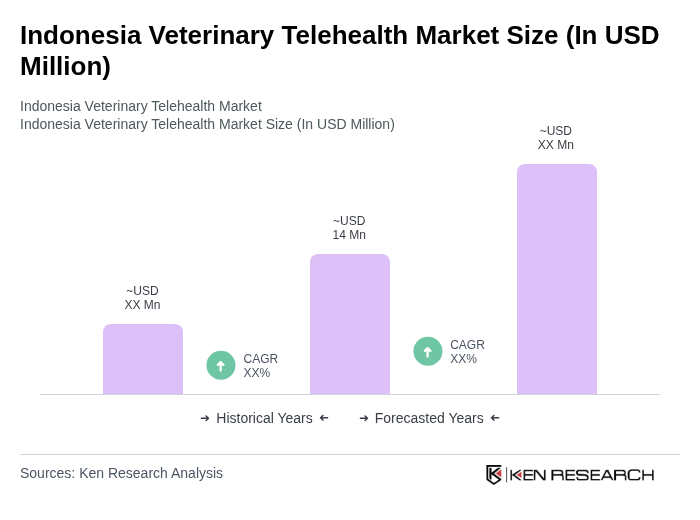
- The Indonesia Veterinary Telehealth Market is valued at USD 14 million, based on a five-year historical analysis and its share within the broader Indonesia animal health and telehealth ecosystems. This growth is primarily driven by the increasing adoption of digital health solutions, rising pet ownership, and the need for accessible veterinary care, especially in remote areas. The market has seen a surge in demand for telehealth services as pet owners seek convenient and timely consultations for their animals, supported by improving internet penetration and widespread use of smartphones in Indonesia.
- Key cities such as Jakarta, Surabaya, and Bandung dominate the market due to their high population density and urbanization, which facilitate the adoption of telehealth services. Additionally, these cities have a higher concentration of pet owners, veterinary clinics, and referral hospitals, making them ideal hubs for veterinary telehealth solutions and hybrid models that combine in?clinic visits with remote follow?up.
- In 2023, regulatory efforts around digital health in Indonesia, including telemedicine frameworks, started to be applied by professional bodies and universities to veterinary contexts, encouraging the responsible use of teleconsultation in animal health. For veterinary practice specifically, the Indonesian Veterinary Medical Association (Perhimpunan Dokter Hewan Indonesia/PDHI) has issued telemedicine and online consultation guidance that aligns with professional conduct rules set under the Veterinary Practice Act (Undang?Undang No. 18 Tahun 2009 jo. Undang?Undang No. 41 Tahun 2014 tentang Peternakan dan Kesehatan Hewan), including requirements that veterinarians be licensed, maintain medical records, protect client data, and ensure that teleconsultations do not compromise standards of care.
Indonesia Veterinary Telehealth Market Segmentation
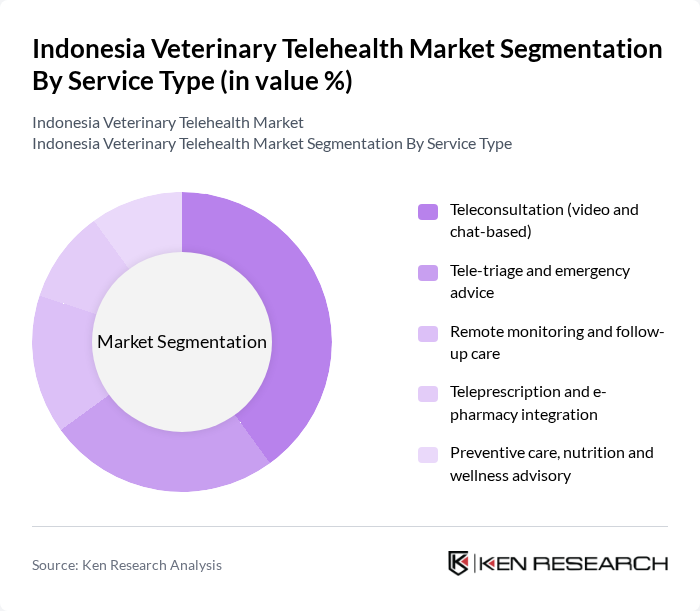
By Service Type:The service type segmentation includes various offerings that cater to the needs of pet owners and veterinary professionals. The dominant sub-segment is teleconsultation (video and chat-based), which has gained popularity due to its convenience and accessibility, mirroring global patterns where teleconsulting and teleadvice account for the largest share of veterinary telehealth use. Pet owners prefer this service for quick consultations without the need to travel, especially for minor ailments, follow?ups, and behavioural or nutrition queries. Other services like tele-triage and emergency advice, remote monitoring, and teleprescription are also gaining traction as they enhance the overall veterinary care experience and integrate with e?pharmacy and home?delivery models that are rapidly expanding in Indonesia’s broader telehealth market.
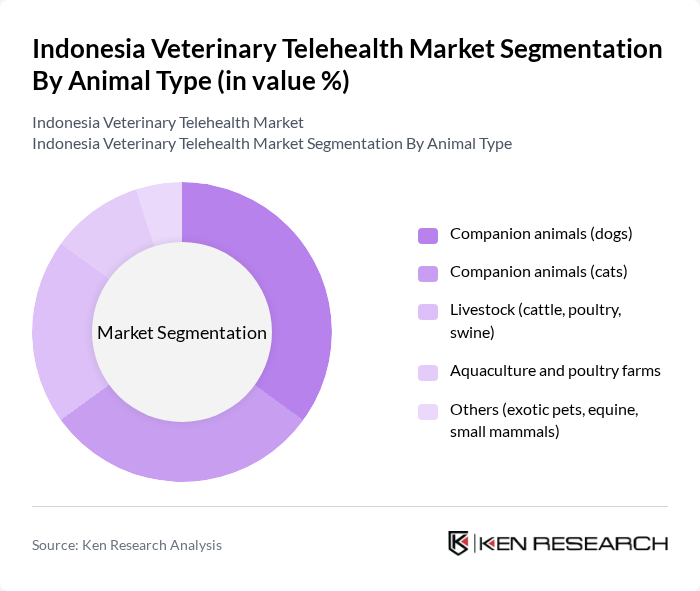
By Animal Type:The animal type segmentation encompasses various categories of animals that benefit from telehealth services. Companion animals, particularly dogs and cats, dominate this market due to the increasing trend of pet ownership in urban areas and the higher willingness of owners to spend on digital veterinary services. Pet owners are more inclined to seek telehealth services for their pets, leading to a higher demand for consultations and care for dermatology, gastrointestinal, and preventive health issues. Livestock and aquaculture also represent significant segments in Indonesia’s wider animal health market, and early use cases of tele-advisory and remote farm support are emerging to improve herd health, biosecurity, and production efficiency.
Indonesia Veterinary Telehealth Market Competitive Landscape
The Indonesia Veterinary Telehealth Market is characterized by a dynamic mix of regional and international players. Leading participants such as Halodoc (pet & animal health services via super?app), VETOPIA Indonesia, Pet+ Klinik Hewan & Petshop (hybrid clinic + teleconsult), MyVets Indonesia, Kemenkes Indonesia Digital Health Platform (pilot animal/vet use), Gadjah Mada University Veterinary Telemedicine Program, IPB University (Bogor) Veterinary Teleconsultation Services, Jolly Pet Klinik & Online Consultation, Provet Animal Hospital & Online Consultation, Go-Vet Indonesia (on?demand home & online vet services), TaniHub Group (livestock & farm health advisory), Rebananda Pet Care & Teleconsultation, KlikDokter (pet health content & emerging vet teleconsult), Hewania Vet (online vet consultation platform), PetKlinik Indonesia (multi?location clinic with remote follow?up) contribute to innovation, geographic expansion, and service delivery in this space.
Indonesia Veterinary Telehealth Market Industry Analysis
Growth Drivers
- Increasing Pet Ownership:The pet ownership rate in Indonesia has surged, with approximately 75 million pets reported in future, reflecting a 20% increase from 2020. This rise in pet ownership correlates with a growing demand for veterinary services, including telehealth. As more households adopt pets, the need for accessible veterinary care becomes critical, driving the expansion of telehealth services to cater to this burgeoning market. The trend is expected to continue, bolstering the telehealth sector significantly.
- Rising Demand for Remote Veterinary Services:The COVID-19 pandemic has accelerated the adoption of remote veterinary services, with a reported 45% increase in teleconsultations in future compared to pre-pandemic levels. Pet owners are increasingly seeking convenient and safe options for veterinary care, particularly in urban areas where traffic congestion can hinder access to clinics. This shift towards remote services is expected to persist, creating a robust demand for veterinary telehealth solutions across Indonesia.
- Technological Advancements in Telehealth:Indonesia's telehealth infrastructure has seen significant improvements, with internet penetration reaching 80% in future, up from 64% in 2020. This growth facilitates the delivery of veterinary telehealth services, enabling real-time consultations and diagnostics. Additionally, advancements in mobile technology and applications have made it easier for pet owners to access veterinary care remotely, further driving the adoption of telehealth solutions in the veterinary sector.
Market Challenges
- Limited Internet Access in Rural Areas:Despite the overall increase in internet penetration, rural areas in Indonesia still face significant connectivity challenges, with only 55% of rural households having reliable internet access as of future. This limitation restricts the reach of veterinary telehealth services, leaving a substantial portion of the pet-owning population without access to remote veterinary care. Addressing this digital divide is crucial for the growth of the telehealth market in these regions.
- Regulatory Hurdles:The veterinary telehealth sector in Indonesia faces regulatory challenges, including the lack of clear guidelines for telehealth service delivery. As of future, only 35% of veterinary practitioners are familiar with existing regulations, which can hinder the implementation of telehealth services. This uncertainty can deter investment and slow the growth of telehealth solutions, as providers navigate complex legal landscapes without adequate support or clarity.
Indonesia Veterinary Telehealth Market Future Outlook
The future of the veterinary telehealth market in Indonesia appears promising, driven by increasing pet ownership and technological advancements. As more pet owners seek convenient care options, telehealth services are likely to expand, particularly in urban areas. Additionally, the integration of artificial intelligence in diagnostics and preventive care will enhance service delivery. However, addressing regulatory challenges and improving internet access in rural regions will be essential to fully realize the market's potential and ensure equitable access to veterinary care.
Market Opportunities
- Expansion of Telehealth Services to Rural Regions:There is a significant opportunity to expand telehealth services into rural areas, where access to veterinary care is limited. By leveraging mobile technology and partnerships with local clinics, providers can reach underserved populations, enhancing pet care and improving health outcomes for animals in these regions.
- Development of Mobile Applications for Pet Care:The creation of user-friendly mobile applications tailored for pet care can facilitate better engagement between pet owners and veterinarians. These apps can offer features such as appointment scheduling, health tracking, and teleconsultation services, thereby increasing the accessibility and efficiency of veterinary care in Indonesia.
Scope of the Report
| Segment | Sub-Segments |
|---|---|
| By Service Type | Teleconsultation (video and chat-based) Tele-triage and emergency advice Remote monitoring and follow-up care Teleprescription and e-pharmacy integration Preventive care, nutrition and wellness advisory |
| By Animal Type | Companion animals (dogs) Companion animals (cats) Livestock (cattle, poultry, swine) Aquaculture and poultry farms Others (exotic pets, equine, small mammals) |
| By Revenue Model | One?time / pay?per?consultation Subscription plans for pet owners B2B contracts with clinics and hospitals Corporate / insurance and partnership-led models |
| By Technology / Delivery Mode | Mobile applications and super?apps Web?based portals Messaging and chat platforms (incl. WhatsApp) Integrated practice management & EMR platforms Others (IoT devices, wearables, remote sensors) |
| By Provider Type | Standalone veterinary telehealth platforms Brick?and?mortar clinics offering hybrid care Animal hospitals and university teaching hospitals Agri-tech and livestock health platforms NGOs and government/association programs |
| By End?User | Individual pet owners Commercial farms and livestock cooperatives Veterinary clinics and hospitals Animal shelters and welfare organizations Pet service and pet insurance providers |
| By Geography (Indonesia) | Java (incl. Jakarta, West Java, Central Java, East Java) Sumatra Kalimantan Sulawesi Bali & Nusa Tenggara, Papua and other regions |
Key Target Audience
Investors and Venture Capitalist Firms
Government and Regulatory Bodies (e.g., Ministry of Agriculture, Indonesian Veterinary Medical Association)
Veterinary Clinics and Hospitals
Telehealth Technology Providers
Animal Health Product Manufacturers
Pet Care Service Providers
Insurance Companies Offering Pet Health Coverage
Animal Welfare Organizations
Players Mentioned in the Report:
Halodoc (pet & animal health services via superapp)
VETOPIA Indonesia
Pet+ Klinik Hewan & Petshop (hybrid clinic + teleconsult)
MyVets Indonesia
Kemenkes Indonesia Digital Health Platform (pilot animal/vet use)
Gadjah Mada University Veterinary Telemedicine Program
IPB University (Bogor) Veterinary Teleconsultation Services
Jolly Pet Klinik & Online Consultation
Provet Animal Hospital & Online Consultation
Go-Vet Indonesia (ondemand home & online vet services)
TaniHub Group (livestock & farm health advisory)
Rebananda Pet Care & Teleconsultation
KlikDokter (pet health content & emerging vet teleconsult)
Hewania Vet (online vet consultation platform)
PetKlinik Indonesia (multilocation clinic with remote followup)
Table of Contents
Market Assessment Phase
1. Executive Summary and Approach
2. Indonesia Veterinary Telehealth Market Overview
2.1 Key Insights and Strategic Recommendations
2.2 Indonesia Veterinary Telehealth Market Overview
2.3 Definition and Scope
2.4 Evolution of Market Ecosystem
2.5 Timeline of Key Regulatory Milestones
2.6 Value Chain & Stakeholder Mapping
2.7 Business Cycle Analysis
2.8 Policy & Incentive Landscape
3. Indonesia Veterinary Telehealth Market Analysis
3.1 Growth Drivers
3.1.1 Increasing pet ownership
3.1.2 Rising demand for remote veterinary services
3.1.3 Technological advancements in telehealth
3.1.4 Government support for digital health initiatives
3.2 Market Challenges
3.2.1 Limited internet access in rural areas
3.2.2 Regulatory hurdles
3.2.3 Lack of awareness among pet owners
3.2.4 Competition from traditional veterinary services
3.3 Market Opportunities
3.3.1 Expansion of telehealth services to rural regions
3.3.2 Partnerships with local veterinary clinics
3.3.3 Development of mobile applications for pet care
3.3.4 Increasing investment in veterinary telehealth startups
3.4 Market Trends
3.4.1 Growth of subscription-based telehealth services
3.4.2 Integration of AI in veterinary diagnostics
3.4.3 Rise of teleconsultations during the pandemic
3.4.4 Focus on preventive care through telehealth
3.5 Government Regulation
3.5.1 Licensing requirements for telehealth providers
3.5.2 Data privacy regulations for patient information
3.5.3 Standards for telehealth service delivery
3.5.4 Incentives for digital health adoption
4. SWOT Analysis
5. Stakeholder Analysis
6. Porter's Five Forces Analysis
7. Indonesia Veterinary Telehealth Market Market Size, 2019-2024
7.1 By Value
7.2 By Volume
7.3 By Average Selling Price
8. Indonesia Veterinary Telehealth Market Segmentation
8.1 By Service Type
8.1.1 Teleconsultation (video and chat-based)
8.1.2 Tele-triage and emergency advice
8.1.3 Remote monitoring and follow-up care
8.1.4 Teleprescription and e-pharmacy integration
8.1.5 Preventive care, nutrition and wellness advisory
8.2 By Animal Type
8.2.1 Companion animals (dogs)
8.2.2 Companion animals (cats)
8.2.3 Livestock (cattle, poultry, swine)
8.2.4 Aquaculture and poultry farms
8.2.5 Others (exotic pets, equine, small mammals)
8.3 By Revenue Model
8.3.1 One?time / pay?per?consultation
8.3.2 Subscription plans for pet owners
8.3.3 B2B contracts with clinics and hospitals
8.3.4 Corporate / insurance and partnership-led models
8.4 By Technology / Delivery Mode
8.4.1 Mobile applications and super?apps
8.4.2 Web?based portals
8.4.3 Messaging and chat platforms (incl. WhatsApp)
8.4.4 Integrated practice management & EMR platforms
8.4.5 Others (IoT devices, wearables, remote sensors)
8.5 By Provider Type
8.5.1 Standalone veterinary telehealth platforms
8.5.2 Brick?and?mortar clinics offering hybrid care
8.5.3 Animal hospitals and university teaching hospitals
8.5.4 Agri-tech and livestock health platforms
8.5.5 NGOs and government/association programs
8.6 By End?User
8.6.1 Individual pet owners
8.6.2 Commercial farms and livestock cooperatives
8.6.3 Veterinary clinics and hospitals
8.6.4 Animal shelters and welfare organizations
8.6.5 Pet service and pet insurance providers
8.7 By Geography (Indonesia)
8.7.1 Java (incl. Jakarta, West Java, Central Java, East Java)
8.7.2 Sumatra
8.7.3 Kalimantan
8.7.4 Sulawesi
8.7.5 Bali & Nusa Tenggara, Papua and other regions
9. Indonesia Veterinary Telehealth Market Competitive Analysis
9.1 Market Share of Key Players
9.2 Cross Comparison of Key Players
9.2.1 Company name and platform type (pure?play / hybrid / agri?vet)
9.2.2 Scale of operations (no. of cities/regions covered in Indonesia)
9.2.3 Active veterinary professionals on platform
9.2.4 Monthly active users (MAUs) / consultations
9.2.5 Average Revenue Per User (ARPU)
9.2.6 Customer Acquisition Cost (CAC)
9.2.7 Customer Retention / 6?month repeat?usage rate
9.2.8 Average consultation response time / wait time
9.2.9 User satisfaction / app rating score
9.2.10 Year?on?year revenue and user growth rate
9.3 SWOT Analysis of Top Players
9.4 Pricing Analysis
9.5 Detailed Profile of Major Companies
9.5.1 Halodoc (pet & animal health services via super?app)
9.5.2 VETOPIA Indonesia
9.5.3 Pet+ Klinik Hewan & Petshop (hybrid clinic + teleconsult)
9.5.4 MyVets Indonesia
9.5.5 Kemenkes Indonesia Digital Health Platform (pilot animal/vet use)
9.5.6 Gadjah Mada University Veterinary Telemedicine Program
9.5.7 IPB University (Bogor) Veterinary Teleconsultation Services
9.5.8 Jolly Pet Klinik & Online Consultation
9.5.9 Provet Animal Hospital & Online Consultation
9.5.10 Go-Vet Indonesia (on?demand home & online vet services)
9.5.11 TaniHub Group (livestock & farm health advisory)
9.5.12 Rebananda Pet Care & Teleconsultation
9.5.13 KlikDokter (pet health content & emerging vet teleconsult)
9.5.14 Hewania Vet (online vet consultation platform)
9.5.15 PetKlinik Indonesia (multi?location clinic with remote follow?up)
10. Indonesia Veterinary Telehealth Market End-User Analysis
10.1 Procurement Behavior of Key Ministries
10.1.1 Budget allocation for veterinary services
10.1.2 Decision-making processes
10.1.3 Preferred service providers
10.1.4 Evaluation criteria for telehealth services
10.2 Corporate Spend on Infrastructure & Energy
10.2.1 Investment in telehealth infrastructure
10.2.2 Spending on technology upgrades
10.2.3 Budget for training and development
10.2.4 Others
10.3 Pain Point Analysis by End-User Category
10.3.1 Accessibility issues
10.3.2 Quality of service concerns
10.3.3 Cost-related challenges
10.3.4 Others
10.4 User Readiness for Adoption
10.4.1 Awareness of telehealth benefits
10.4.2 Technological literacy
10.4.3 Willingness to pay for services
10.4.4 Others
10.5 Post-Deployment ROI and Use Case Expansion
10.5.1 Measurement of service effectiveness
10.5.2 User feedback and improvement
10.5.3 Expansion into new service areas
10.5.4 Others
11. Indonesia Veterinary Telehealth Market Future Size, 2025-2030
11.1 By Value
11.2 By Volume
11.3 By Average Selling Price
Go-To-Market Strategy Phase
1. Whitespace Analysis + Business Model Canvas
1.1 Market gaps identification
1.2 Value proposition development
1.3 Revenue model exploration
1.4 Customer segment targeting
1.5 Competitive landscape analysis
2. Marketing and Positioning Recommendations
2.1 Branding strategies
2.2 Product USPs
3. Distribution Plan
3.1 Urban retail vs rural NGO tie-ups
4. Channel & Pricing Gaps
4.1 Underserved routes
4.2 Pricing bands
5. Unmet Demand & Latent Needs
5.1 Category gaps
5.2 Consumer segments
6. Customer Relationship
6.1 Loyalty programs
6.2 After-sales service
7. Value Proposition
7.1 Sustainability
7.2 Integrated supply chains
8. Key Activities
8.1 Regulatory compliance
8.2 Branding
8.3 Distribution setup
9. Entry Strategy Evaluation
9.1 Domestic Market Entry Strategy
9.1.1 Product mix
9.1.2 Pricing band
9.1.3 Packaging
9.2 Export Entry Strategy
9.2.1 Target countries
9.2.2 Compliance roadmap
10. Entry Mode Assessment
10.1 JV, Greenfield, M&A, Distributor Model
11. Capital and Timeline Estimation
11.1 Capital requirements
11.2 Timelines
12. Control vs Risk Trade-Off
12.1 Ownership vs Partnerships
13. Profitability Outlook
13.1 Breakeven analysis
13.2 Long-term sustainability
14. Potential Partner List
14.1 Distributors
14.2 JVs
14.3 Acquisition targets
15. Execution Roadmap
15.1 Phased Plan for Market Entry
15.1.1 Market Setup
15.1.2 Market Entry
15.1.3 Growth Acceleration
15.1.4 Scale & Stabilize
15.2 Key Activities and Milestones
15.2.1 Milestone tracking
15.2.2 Activity scheduling
Research Methodology
Phase 1: Approach1
Desk Research
- Analysis of existing veterinary telehealth reports and market studies
- Review of government publications and regulations related to telehealth in Indonesia
- Examination of industry white papers and academic journals on veterinary practices
Primary Research
- Interviews with veterinarians utilizing telehealth services in urban and rural areas
- Surveys targeting pet owners to assess awareness and usage of telehealth services
- Focus groups with veterinary clinic managers to understand operational challenges
Validation & Triangulation
- Cross-validation of findings through multiple data sources including government and industry reports
- Triangulation of qualitative insights from interviews with quantitative survey data
- Sanity checks conducted through expert panel reviews comprising veterinary professionals
Phase 2: Market Size Estimation1
Top-down Assessment
- Estimation of the overall veterinary market size in Indonesia as a baseline
- Segmentation of the telehealth market by service type (consultation, diagnostics, etc.)
- Incorporation of demographic data to assess potential user base growth
Bottom-up Modeling
- Collection of data on the number of telehealth consultations conducted by leading providers
- Estimation of average revenue per consultation based on service pricing
- Analysis of growth rates in telehealth adoption among pet owners
Forecasting & Scenario Analysis
- Multi-factor regression analysis incorporating technology adoption rates and pet ownership trends
- Scenario modeling based on regulatory changes and market entry of new telehealth providers
- Development of baseline, optimistic, and pessimistic forecasts through 2030
Phase 3: CATI Sample Composition1
| Scope Item/Segment | Sample Size | Target Respondent Profiles |
|---|---|---|
| Urban Pet Owners | 150 | Pet Owners, Veterinary Clients |
| Rural Pet Owners | 120 | Pet Owners, Community Leaders |
| Veterinary Clinics | 90 | Veterinarians, Clinic Managers |
| Telehealth Service Providers | 60 | Business Development Managers, Technology Officers |
| Pet Care Product Retailers | 70 | Retail Managers, Product Buyers |
Frequently Asked Questions
What is the current value of the Indonesia Veterinary Telehealth Market?
The Indonesia Veterinary Telehealth Market is valued at approximately USD 14 million, reflecting significant growth driven by increased pet ownership and the adoption of digital health solutions, particularly in urban areas with better internet access.
What factors are driving the growth of veterinary telehealth in Indonesia?
Which cities in Indonesia are leading in veterinary telehealth adoption?
What types of services are offered in the Indonesia Veterinary Telehealth Market?
Other Regional/Country Reports
Malaysia Veterinary Telehealth Market
APAC Veterinary Telehealth Market
Other Adjacent Reports
UAE Animal Nutrition Market
Malaysia Veterinary Pharmaceuticals Market Size, Share & Forecast, By Product Type, Animal Type & Distribution Channel, 2025-2032KSA Pet Care Products Market
South Korea Digital Health Platforms Market
Belgium Telemedicine Software Market
Brazil Animal Diagnostics Market
Vietnam Livestock Management Market
Belgium Pet Wellness Market
Why Buy From Us?

What makes us stand out is that our consultants follow Robust, Refine and Result (RRR) methodology. Robust for clear definitions, approaches and sanity checking, Refine for differentiating respondents' facts and opinions, and Result for presenting data with story.

We have set a benchmark in the industry by offering our clients with syndicated and customized market research reports featuring coverage of entire market as well as meticulous research and analyst insights.

While we don't replace traditional research, we flip the method upside down. Our dual approach of Top Bottom & Bottom Top ensures quality deliverable by not just verifying company fundamentals but also looking at the sector and macroeconomic factors.

With one step in the future, our research team constantly tries to show you the bigger picture. We help with some of the tough questions you may encounter along the way: How is the industry positioned? Best marketing channel? KPI's of competitors? By aligning every element, we help maximize success.

Our report gives you instant access to the answers and sources that other companies might choose to hide. We elaborate each steps of research methodology we have used and showcase you the sample size to earn your trust.

If you need any support, we are here! We pride ourselves on universe strength, data quality, and quick, friendly, and professional service.